


































Death – medicolegal aspects


                   Dr Rakhin.K.B
Death is a process
 rather than an event
Exceptions
Def – The cessation of life

3 vital system –
  nervous, circulatory, respiratory
Atria mortis – death portal of entry
4 -6 minutes - serious permanent
  impairment to brain
6-10 minutes – total loss of function
Irreversible damage to brain stem
           (somatic death)

                     Organ transplantation


 Loss of spontaneous breathing
ability, cardiac arrest (cellular death
              progresses)
IEA 108 presumption of survivorship.


    Burden of proving that person is alive who
has not been heard of for seven years. -
 Provided that when the question is whether a
man is alive or dead, and it is proved that he
has not been heard of for seven years by
those who would naturally have heard of him
if he had been alive, the burden of proving
that he is alive is shifted to the person who
affirms it.
IEA 107 presumption of death.


   Burden of proving death of person
known to have been alive within thirty
years. - When the question is whether a
man is alive or dead, and it is shown that he
was alive within thirty years, the burden of
proving that he is dead is on the person
who affirms it.
Historical Perspective


Prior to the advent of
mechanical respiration, death
was defined as the cessation of
circulation and breathing
Historical Perspective

1959 Coma de’passe’ Mollaret and Goulon
1968 Irreversible Coma/Brain Death Harvard
      Medical School Ad Hoc Committee
1981 Uniform Determination of Death Act -
      President’s Commission for the Study of
      Ethical Problems in Medicine (US)
1994 American Academy of Neurology Guidelines
      for the determination of Brain Death
1994 Transplantation of Human Organs Act (India)
Brain Death Current Consensus

Absent Cerebral Function


Absent Brainstem Function


Apnea
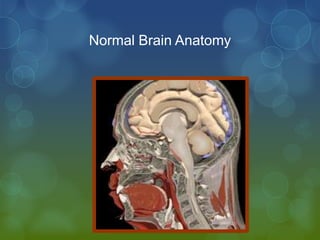
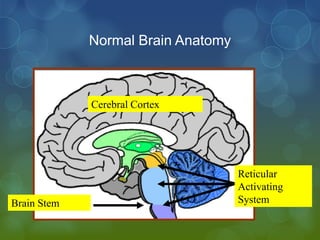
Normal Brain Anatomy


             Cerebral Cortex


                                    Reticular
                                    Activating
Brain Stem                          System
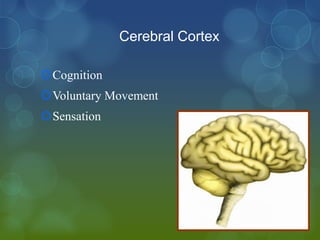
Cerebral Cortex

Cognition
Voluntary Movement
Sensation
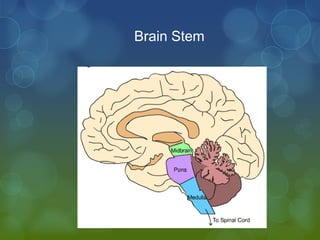
Brain Stem
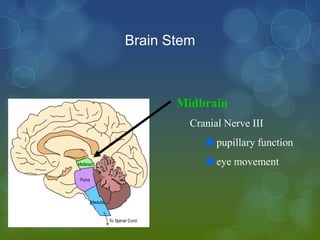
Brain Stem


       Midbrain
         Cranial Nerve III
              pupillary function
              eye movement
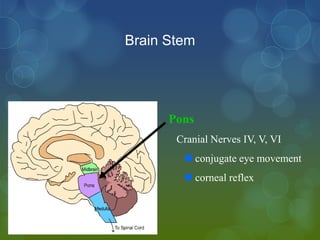
Brain Stem


      Pons
       Cranial Nerves IV, V, VI
         conjugate eye movement
         corneal reflex
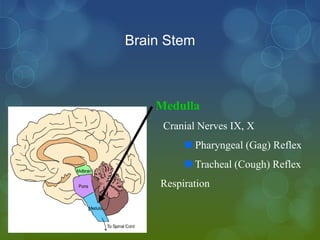
Brain Stem


    Medulla
     Cranial Nerves IX, X
           Pharyngeal (Gag) Reflex
           Tracheal (Cough) Reflex
     Respiration
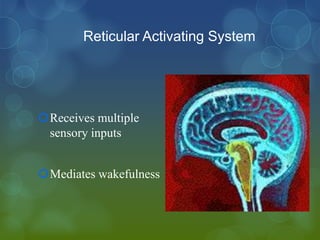
Reticular Activating System


Receives multiple
 sensory inputs


Mediates wakefulness
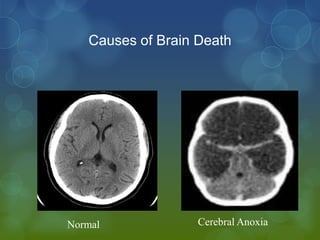
Causes of Brain Death


Normal             Cerebral Anoxia
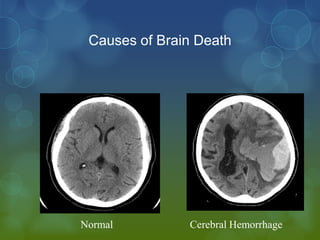
Causes of Brain Death


Normal         Cerebral Hemorrhage
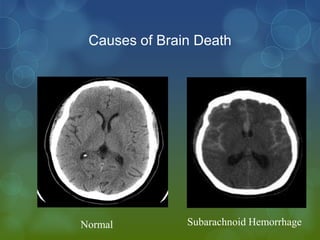
Causes of Brain Death


Normal         Subarachnoid Hemorrhage
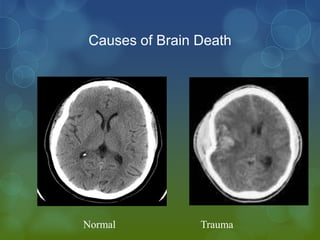
Causes of Brain Death


Normal          Trauma
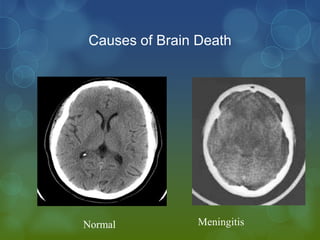
Causes of Brain Death


Normal          Meningitis
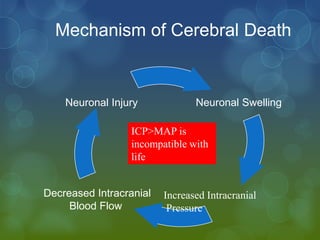
Mechanism of Cerebral Death


    Neuronal Injury             Neuronal Swelling

                 ICP>MAP is
                 incompatible with
                 life


Decreased Intracranial   Increased Intracranial
     Blood Flow           Pressure
Conditions Distinct From Brain Death


Persistent Vegetative State


Locked-in Syndrome


Minimally Responsive State
Persistent Vegetative State


Normal Sleep-Wake Cycles


No Response to Environmental Stimuli


Diffuse Brain Injury with Preservation of Brain
 Stem Function
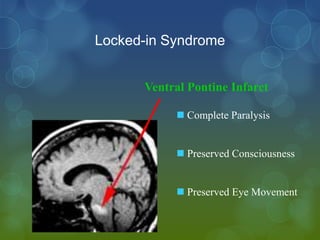
Locked-in Syndrome


      Ventral Pontine Infarct

            Complete Paralysis


            Preserved Consciousness


            Preserved Eye Movement
Minimally Responsive State
        Static Encephalopathy


Diffuse or Multi-Focal Brain Injury


Preserved Brain Stem Function


Variable Interaction with Environmental Stimuli
Brain Death Neurological Examination

Clinical Prerequisites:
    Known Irreversible Cause
    Exclusion of Potentially Reversible Conditions
      Drug Intoxication or Poisoning
      Electrolyte or Acid-Base Imbalance
      Endocrine Disturbances
    Core Body temperature > 32° C
    Team of doctors at least twice, with a reasonable gap of
     time in between ( 6 hours or so)
Brain Death Neurological Examination


 Coma


 Absent Brain Stem Reflexes


 Apnea
Coma

No Response to Noxious Stimuli


         Nail Bed Pressure


         Sternal Rub


         Supra-Orbital Ridge Pressure
Absence of Brain Stem Reflexes


 Pupillary Reflex


 Eye Movements


 Facial Sensation and Motor Response


 Pharyngeal (Gag) Reflex


 Tracheal (Cough) Reflex
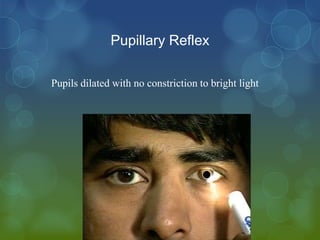
Pupillary Reflex

Pupils dilated with no constriction to bright light
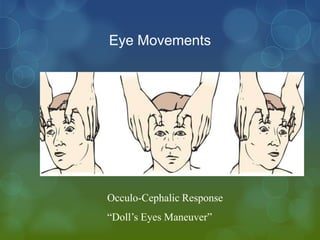
Eye Movements


Occulo-Cephalic Response
“Doll’s Eyes Maneuver”
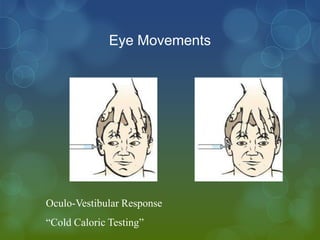
Eye Movements


Oculo-Vestibular Response
“Cold Caloric Testing”
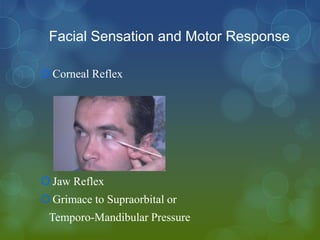
Facial Sensation and Motor Response

 Corneal Reflex


 Jaw Reflex
 Grimace to Supraorbital or
 Temporo-Mandibular Pressure
Apnea Testing

Prerequisites


          Core Body Temperature > 32° C


          Systolic Blood Pressure ≥ 90 mm Hg


          Normal Electrolytes


          Normal PCO2
Apnea Testing


1. Pre-Oxygenation
       100% Oxygen via Tracheal Cannula
       PO2 = 200 mm Hg


2. Monitor PCO2 and PO2 with pulse oximetry
3. Disconnect Ventilator
4. Observe for Respiratory Movement until PCO2 = 60
   mm Hg
5. Discontinue Testing if BP < 90, PO2 saturation
   decreases, or cardiac dysrhythmia observed
Confounding Clinical Conditions


 Facial Trauma


 Pupillary Abnormalities


 CNS Sedatives or Neuromuscular Blockers


 Hepatic Failure


 Pulmonary Disease
Observations Compatible with Brain
                     Death


 Sweating, Blushing


 Deep Tendon Reflexes


 Spontaneous Spinal Reflexes- Triple Flexion


 Babinski Sign
Confirmatory Testing


Recommended when the proximate cause of coma is not known or when
 confounding clinical conditions limit the clinical examination
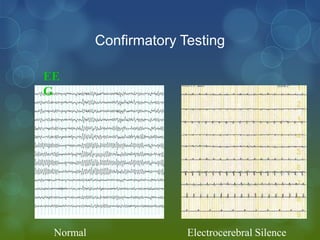
Confirmatory Testing

EE
G


 Normal                 Electrocerebral Silence
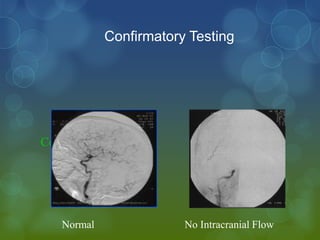
Confirmatory Testing


Cerebral Angiography


   Normal               No Intracranial Flow
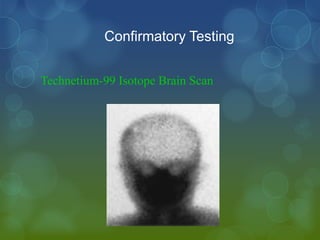
Confirmatory Testing


Technetium-99 Isotope Brain Scan
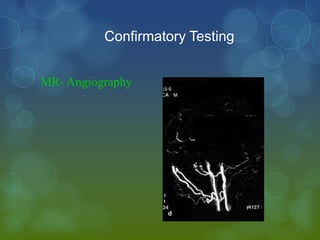
Confirmatory Testing


MR- Angiography
Confirmatory Testing


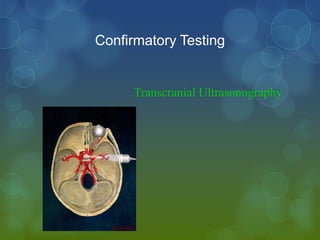
     Transcranial Ultrasonography
Confirmatory Testing


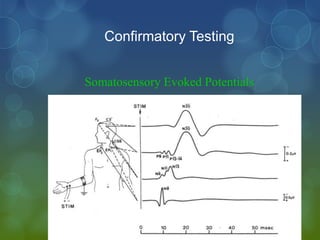
Somatosensory Evoked Potentials
Transplantation of Human Organs Act
THOA 1994


  8 July 1994
  7 Chapters, 25 Sections and variable
   no. of subsections
Transplantation of Human Organs Act
    THOA 1994
Some definitions
  “Deceased person” – A person in whom permanent
   disappearance of all evidence of life occurs, by reason
   of brain stem death or in a cardiopulmonary sense, at
   any time after live birth has taken place
  “Brain stem death” – Stage at which all functions of
   the brain stem have permanently and irreversibly
   ceased
Transplantation of Human Organs Act
  THOA 1994

“Donor” – Any person not less than 18 years of
 age, who voluntarily authorizes the removal of any
 of his human organs for therapeutic purposes under
 subsection(1) or (2) of section(3)
“Human Organ” – Any part of a human body
 consisting of a structured arrangement of tissues
 which if wholly removed, cannot be replicated by
 the body.
Transplantation of Human Organs Act
     THOA 1994
The brain stem death need to be certified by a team of
 doctors consisting of the following
   1) The RMP in charge of the hospital in which the brain stem death
      has occurred.
   2) An independent RMP, being a specialist to be nominated by
      RMP in clause(1), from the panel of names approved by the
      appropriate authority.
   3) A neurologist or a neurosurgeon to be nominated by the RMP
      specified in clause(1) from the panel of names approved by the
      appropriate authority.
   4) The RMP treating the person whose brain stem death has
      occurred.
Transplantation of Human Organs
(Amendment) Act, 2009
 Human organs and tissues
 Expansion of the term “near relative’
 Tissue
 Transplant coordinator
 Technician for enucleation of cornea
 Non availability of neurosurgeon
 Donor/recipient - near relative - foreign national
 Minors
 Swap donations
 Fine/ imprisonment
Concern for man and his fate must always form the chief
interest of all technical endeavors. Never forget this in the
          midst of your diagrams and equations.

                    Albert Einstein
Death thoa
Death thoa
Death thoa
Death thoa
Death thoa
Death thoa
Death thoa
Death thoa
Death thoa
Death thoa
Death thoa
Death thoa
Death thoa
Death thoa
Death thoa
Death thoa
Death thoa
Death thoa
Death thoa
Death thoa
Death thoa
Death thoa
Death thoa
Death thoa
Death thoa
Death thoa
Death thoa
Death thoa
Death thoa
Death thoa
Death thoa
Death thoa
Death thoa
Death thoa
Death thoa
Death thoa

Death thoa

  • 1.
    Death – medicolegalaspects Dr Rakhin.K.B
  • 2.
    Death is aprocess rather than an event Exceptions
  • 3.
    Def – Thecessation of life 3 vital system – nervous, circulatory, respiratory Atria mortis – death portal of entry 4 -6 minutes - serious permanent impairment to brain 6-10 minutes – total loss of function
  • 4.
    Irreversible damage tobrain stem (somatic death) Organ transplantation Loss of spontaneous breathing ability, cardiac arrest (cellular death progresses)
  • 5.
    IEA 108 presumptionof survivorship. Burden of proving that person is alive who has not been heard of for seven years. - Provided that when the question is whether a man is alive or dead, and it is proved that he has not been heard of for seven years by those who would naturally have heard of him if he had been alive, the burden of proving that he is alive is shifted to the person who affirms it.
  • 6.
    IEA 107 presumptionof death. Burden of proving death of person known to have been alive within thirty years. - When the question is whether a man is alive or dead, and it is shown that he was alive within thirty years, the burden of proving that he is dead is on the person who affirms it.
  • 7.
    Historical Perspective Prior tothe advent of mechanical respiration, death was defined as the cessation of circulation and breathing
  • 8.
    Historical Perspective 1959 Comade’passe’ Mollaret and Goulon 1968 Irreversible Coma/Brain Death Harvard Medical School Ad Hoc Committee 1981 Uniform Determination of Death Act - President’s Commission for the Study of Ethical Problems in Medicine (US) 1994 American Academy of Neurology Guidelines for the determination of Brain Death 1994 Transplantation of Human Organs Act (India)
  • 9.
    Brain Death CurrentConsensus Absent Cerebral Function Absent Brainstem Function Apnea
  • 10.
  • 11.
    Normal Brain Anatomy Cerebral Cortex Reticular Activating Brain Stem System
  • 12.
  • 13.
  • 14.
    Brain Stem Midbrain Cranial Nerve III  pupillary function  eye movement
  • 15.
    Brain Stem Pons Cranial Nerves IV, V, VI  conjugate eye movement  corneal reflex
  • 16.
    Brain Stem Medulla Cranial Nerves IX, X  Pharyngeal (Gag) Reflex  Tracheal (Cough) Reflex Respiration
  • 17.
    Reticular Activating System Receivesmultiple sensory inputs Mediates wakefulness
  • 18.
    Causes of BrainDeath Normal Cerebral Anoxia
  • 19.
    Causes of BrainDeath Normal Cerebral Hemorrhage
  • 20.
    Causes of BrainDeath Normal Subarachnoid Hemorrhage
  • 21.
    Causes of BrainDeath Normal Trauma
  • 22.
    Causes of BrainDeath Normal Meningitis
  • 23.
    Mechanism of CerebralDeath Neuronal Injury Neuronal Swelling ICP>MAP is incompatible with life Decreased Intracranial Increased Intracranial Blood Flow Pressure
  • 24.
    Conditions Distinct FromBrain Death Persistent Vegetative State Locked-in Syndrome Minimally Responsive State
  • 25.
    Persistent Vegetative State NormalSleep-Wake Cycles No Response to Environmental Stimuli Diffuse Brain Injury with Preservation of Brain Stem Function
  • 26.
    Locked-in Syndrome Ventral Pontine Infarct  Complete Paralysis  Preserved Consciousness  Preserved Eye Movement
  • 27.
    Minimally Responsive State Static Encephalopathy Diffuse or Multi-Focal Brain Injury Preserved Brain Stem Function Variable Interaction with Environmental Stimuli
  • 28.
    Brain Death NeurologicalExamination Clinical Prerequisites:  Known Irreversible Cause  Exclusion of Potentially Reversible Conditions Drug Intoxication or Poisoning Electrolyte or Acid-Base Imbalance Endocrine Disturbances  Core Body temperature > 32° C  Team of doctors at least twice, with a reasonable gap of time in between ( 6 hours or so)
  • 29.
    Brain Death NeurologicalExamination  Coma  Absent Brain Stem Reflexes  Apnea
  • 30.
    Coma No Response toNoxious Stimuli Nail Bed Pressure Sternal Rub Supra-Orbital Ridge Pressure
  • 31.
    Absence of BrainStem Reflexes  Pupillary Reflex  Eye Movements  Facial Sensation and Motor Response  Pharyngeal (Gag) Reflex  Tracheal (Cough) Reflex
  • 32.
    Pupillary Reflex Pupils dilatedwith no constriction to bright light
  • 33.
  • 34.
  • 35.
    Facial Sensation andMotor Response  Corneal Reflex  Jaw Reflex  Grimace to Supraorbital or Temporo-Mandibular Pressure
  • 36.
    Apnea Testing Prerequisites Core Body Temperature > 32° C Systolic Blood Pressure ≥ 90 mm Hg Normal Electrolytes Normal PCO2
  • 37.
    Apnea Testing 1. Pre-Oxygenation  100% Oxygen via Tracheal Cannula  PO2 = 200 mm Hg 2. Monitor PCO2 and PO2 with pulse oximetry 3. Disconnect Ventilator 4. Observe for Respiratory Movement until PCO2 = 60 mm Hg 5. Discontinue Testing if BP < 90, PO2 saturation decreases, or cardiac dysrhythmia observed
  • 38.
    Confounding Clinical Conditions Facial Trauma  Pupillary Abnormalities  CNS Sedatives or Neuromuscular Blockers  Hepatic Failure  Pulmonary Disease
  • 39.
    Observations Compatible withBrain Death  Sweating, Blushing  Deep Tendon Reflexes  Spontaneous Spinal Reflexes- Triple Flexion  Babinski Sign
  • 40.
    Confirmatory Testing Recommended whenthe proximate cause of coma is not known or when confounding clinical conditions limit the clinical examination
  • 41.
    Confirmatory Testing EE G Normal Electrocerebral Silence
  • 42.
    Confirmatory Testing Cerebral Angiography Normal No Intracranial Flow
  • 43.
  • 44.
  • 45.
    Confirmatory Testing Transcranial Ultrasonography
  • 46.
  • 47.
    Transplantation of HumanOrgans Act THOA 1994 8 July 1994 7 Chapters, 25 Sections and variable no. of subsections
  • 48.
    Transplantation of HumanOrgans Act THOA 1994 Some definitions “Deceased person” – A person in whom permanent disappearance of all evidence of life occurs, by reason of brain stem death or in a cardiopulmonary sense, at any time after live birth has taken place “Brain stem death” – Stage at which all functions of the brain stem have permanently and irreversibly ceased
  • 49.
    Transplantation of HumanOrgans Act THOA 1994 “Donor” – Any person not less than 18 years of age, who voluntarily authorizes the removal of any of his human organs for therapeutic purposes under subsection(1) or (2) of section(3) “Human Organ” – Any part of a human body consisting of a structured arrangement of tissues which if wholly removed, cannot be replicated by the body.
  • 50.
    Transplantation of HumanOrgans Act THOA 1994 The brain stem death need to be certified by a team of doctors consisting of the following 1) The RMP in charge of the hospital in which the brain stem death has occurred. 2) An independent RMP, being a specialist to be nominated by RMP in clause(1), from the panel of names approved by the appropriate authority. 3) A neurologist or a neurosurgeon to be nominated by the RMP specified in clause(1) from the panel of names approved by the appropriate authority. 4) The RMP treating the person whose brain stem death has occurred.
  • 51.
    Transplantation of HumanOrgans (Amendment) Act, 2009  Human organs and tissues  Expansion of the term “near relative’  Tissue  Transplant coordinator  Technician for enucleation of cornea  Non availability of neurosurgeon  Donor/recipient - near relative - foreign national  Minors  Swap donations  Fine/ imprisonment
  • 52.
    Concern for manand his fate must always form the chief interest of all technical endeavors. Never forget this in the midst of your diagrams and equations. Albert Einstein