Brain Lateralization & Critical Period Hypothesis
Created and Presented
By
Dwi Ilmiani
Introduction
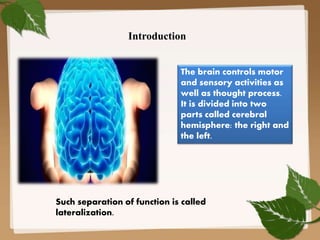
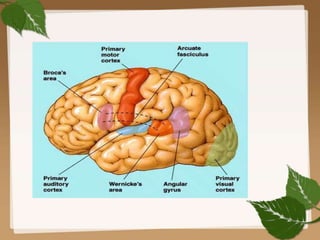
The brain controls motor
and sensory activities as
well as thought process.
It is divided into two
parts called cerebral
hemisphere: the right and
the left.
Such separation of function is called
lateralization.
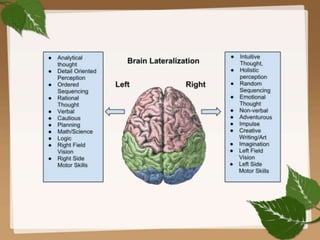
The brain undergoes a gradual
process of lateralization during
which the left brain hemisphere
and the right hemisphere
develops their specialized
function. (Lenneberg:1967,
158).
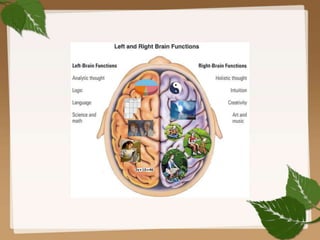
Brain lateralization
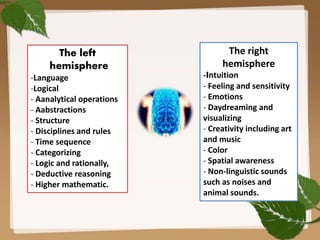
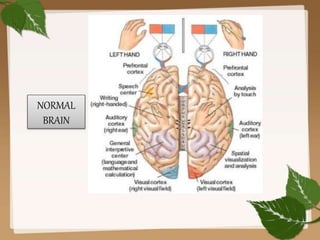
The left
hemisphere
-Language
-Logical
- Aanalytical operations
- Aabstractions
- Structure
- Disciplines and rules
- Time sequence
- Categorizing
- Logic and rationally,
- Deductive reasoning
- Higher mathematic.
The right
hemisphere
-Intuition
- Feeling and sensitivity
- Emotions
- Daydreaming and
visualizing
- Creativity including art
and music
- Color
- Spatial awareness
- Non-linguistic sounds
such as noises and
animal sounds.
NORMAL
BRAIN
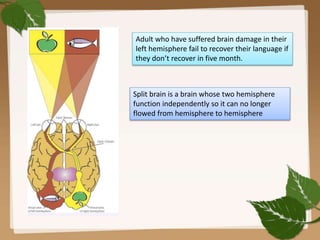
Adult who have suffered brain damage in their
left hemisphere fail to recover their language if
they don’t recover in five month.
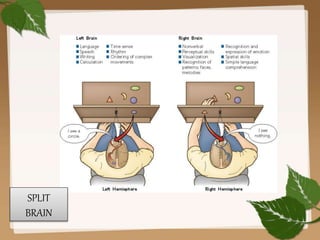
Split brain is a brain whose two hemisphere
function independently so it can no longer
flowed from hemisphere to hemisphere
SPLIT
BRAIN
The critical age hypothesis
The term critical age
hypothesis refers to “a
biologically determine
period of life when
language can be
acquired more easily and
beyond which time
language is increasingly
difficult to acquire
(Brown, 2000:53).
Within this period,
children learn
language easily,
swiftly, and without
external
intervention or
teaching.
The critical age hypothesis
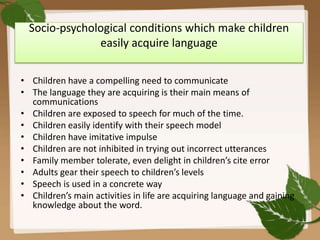
Socio-psychological conditions which make children
easily acquire language
• Children have a compelling need to communicate
• The language they are acquiring is their main means of
communications
• Children are exposed to speech for much of the time.
• Children easily identify with their speech model
• Children have imitative impulse
• Children are not inhibited in trying out incorrect utterances
• Family member tolerate, even delight in children’s cite error
• Adults gear their speech to children’s levels
• Speech is used in a concrete way
• Children’s main activities in life are acquiring language and gaining
knowledge about the word.
_Thanks abunch_

Brain lateralization

  • 1.
    Brain Lateralization &Critical Period Hypothesis Created and Presented By Dwi Ilmiani
  • 2.
    Introduction The brain controlsmotor and sensory activities as well as thought process. It is divided into two parts called cerebral hemisphere: the right and the left. Such separation of function is called lateralization.
  • 3.
    The brain undergoesa gradual process of lateralization during which the left brain hemisphere and the right hemisphere develops their specialized function. (Lenneberg:1967, 158). Brain lateralization
  • 5.
    The left hemisphere -Language -Logical - Aanalyticaloperations - Aabstractions - Structure - Disciplines and rules - Time sequence - Categorizing - Logic and rationally, - Deductive reasoning - Higher mathematic. The right hemisphere -Intuition - Feeling and sensitivity - Emotions - Daydreaming and visualizing - Creativity including art and music - Color - Spatial awareness - Non-linguistic sounds such as noises and animal sounds.
  • 9.
  • 10.
    Adult who havesuffered brain damage in their left hemisphere fail to recover their language if they don’t recover in five month. Split brain is a brain whose two hemisphere function independently so it can no longer flowed from hemisphere to hemisphere
  • 11.
  • 12.
    The critical agehypothesis The term critical age hypothesis refers to “a biologically determine period of life when language can be acquired more easily and beyond which time language is increasingly difficult to acquire (Brown, 2000:53). Within this period, children learn language easily, swiftly, and without external intervention or teaching.
  • 13.
    The critical agehypothesis
  • 14.
    Socio-psychological conditions whichmake children easily acquire language • Children have a compelling need to communicate • The language they are acquiring is their main means of communications • Children are exposed to speech for much of the time. • Children easily identify with their speech model • Children have imitative impulse • Children are not inhibited in trying out incorrect utterances • Family member tolerate, even delight in children’s cite error • Adults gear their speech to children’s levels • Speech is used in a concrete way • Children’s main activities in life are acquiring language and gaining knowledge about the word.
  • 15.