THE BRAIN
The brain is divided into two
celebral hemispheres:
*Left hemisphere
*Right hemisphere
Each hemisphere appears to be
specialized for some behaviors. The
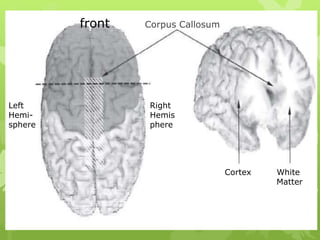
hemispheres communicate with each
other through a thick band of 200-250
million nerve fibers called the
corpus callosum.
front Corpus Callosum
Left
Hemi-
sphere
Right
Hemis
phere
Cortex White
Matter
How do we know that the left hemisphere
controls language in most adults?
A. Tests have demonstrated increased neural activity in
parts of the left hemisphere when subjects are using
language. (PET scans--Positron Emission Tomography,
where patient injects mildly radioactive substance,
which is absorbed more quickly by the more active
areas of the brain).
B. In 1949 it was discovered that if sodium amytal
is injected into the left carotid artery, which
services blood to the left hemisphere, language
skills are temporarily disrupted. If the entire left
hemisphere is put to sleep, a person can think but
cannot talk.
LANGUAGE AND BRAIN
DEVELOPMENT
Numerous neurolinguistic studies have
found that the way the brain is organized
for language and grammar in the adult is
already reflected in the brains of newborns
and young infants—even before they have
entered the period during which language
actively develops. Lateralization of
language to the left hemisphere is a
process that begins very early in life. For
example, Wernicke’s area is visibly
distinctive in the left hemisphere of the
fetus by the twenty-sixth gestational week.
Moreover, infants show evidence of many
of the neural correlates of linguistic
categories that we observe in adults.
BRAIN PLASTICITY
While the left hemisphere is innately predisposed to
specialize for language, there is also evidence of
considerable plasticity (i.e., flexibility) in the system
during the early stages of language development. This
means that under certain circumstances, the right
hemisphere can take over many of the language
functions that would normally reside in the left
hemisphere.
Hemispherectomy, in which one
hemisphere of the brain is surgically removed. This
procedure is used to treat otherwise intractable cases
of epilepsy.
CRITICAL PERIOD
Children do not require explicit language
instruction, but they do need exposure to
language to develop normally.
The critical-age hypothesis asserts that language is
biologically based and that the ability to learn a
native language develops within a fixed period,
from birth to middle childhood. During this critical
period, language acquisition proceeds easily,
swiftly, and without external intervention. After this
period, the acquisition of grammar is difficult and,
for most individuals, never fully achieved. Children
deprived of language during this critical period
show atypical patterns of brain lateralization.