“Gaming Using Brain Computer
Interface”
By
and
Ninad Bhate
CONTENTS
Project Group
Project Motivation
Introduction
Literature Survey
Actual Seminar related topics
Applications/advantages
Conclusions
References 1
Gaming Using BCI
MOTIVATION
 BCI is a technology that allows many folks to
connect with technology which are unable to make
use of other technologies like animals, small
children, old people and disable people.
 This technology has its applications in many fields.
Like health,engineering,automobile, psychological,
education etc
 This technology is the future of mankind. 3
Gaming Using BCI
PROBLEM STATEMENT
To Design A Device using Brain Computer
Interface
A Device can be any Hardware or Software.
 From Operating a Wheel Chair Using BCI to
Handling a GUI game Using BCI. 4
To Design a Device Using Brain
Computer Interface
AIM AND OBJECTIVES OF THE PROJECT
Aim:
 To design a device using Brain Computer
Interface to do work effortlessly.
Objectives:
 To detect Brain Signals using EEG recorder.
 To design GUI to interact with BCI device.
 To move a device using gestures.
5
To Design a Device Using Brain
Computer Interface
INTRODUCTION
 One of the application of brain-computer interface
(BCI) is for entertainment.
 BCI games have potential extensibility in
combination with virtual reality environment.
 BCI game system is combined with a wearable
gesture interface, which detects electromyography.
 Wearable Gesture Interface increase user‘s feeling
of presence and fun. 7
Gaming Using BCI
LITERATURE SURVEY
 Neurosky company has created a game “Judecca”
a first person shooter game that uses a player’s
concentration as a key part of the gameplay .
 It uses a player’s concentration to make enemies
visible enabling the player’s “Devils Eye”, in
which they then must eliminate the newly visible
threats.
8
Gaming Using BCI
9
:To Design a Device Using Brain
Computer Interface
 Another BCI game prototype that uses concentration as
its main game mechanic is the fNIR based LazyBrains.
 Functional near infrared spectroscopy, or fNIR, is a non-
invasive optical technique that measures neural activity
related hemodynamic response within the cortex.
 When the user approaches a closed sewer grate, they
must lift, it requires tremendous concentration levels.
10
To Design a Device Using Brain
Computer Interface
11
To Design a Device Using Brain
Computer Interface
LITERATURE SURVEY/RELATED WORK
 Minimum FIVE references should be there from literature.
8/28/2019
12
SCOE,InformationTechnology(2014-15)
Sr.
No.
Reference Name
(Write Paper Title)
Seed Idea/ Work
description
Problems found Any other
criteria
1 Ryota Horie
“A Hands-on
Game by Using
a Brain-
Computer
Interface,
Game which uses
beta/alpha ratios to
play a game
NA NA
2 “BCI gaming:
development of
concentration
based game.”
Game that use
concentration levels
and fNIR techniques
NA NA
BCI GAME SYSTEM
REQUIREMENTS
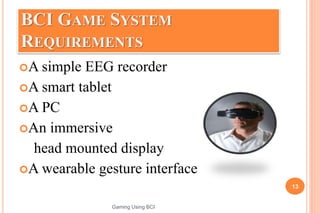
A simple EEG recorder
A smart tablet
A PC
An immersive
head mounted display
A wearable gesture interface
13
Gaming Using BCI
14
To Design a Device Using Brain
Computer Interface
How BCI Game System Works
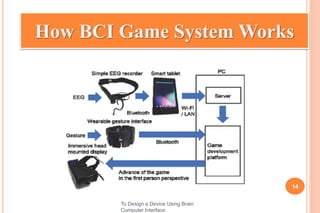
Android application which receives row signals
from the simple EEG recorder via Bluetooth.
The application detects beta/alpha ratios from the
row signals.
Depending on the beta/alpha ratio, the application
generates one-byte commands.
The application sends the one-byte commands to a
server running on a PC via TCP/IP over Wi-Fi and
LAN. 15
To Design a Device Using Brain
Computer Interface
The server converts the one-byte commands to
keyboard commands to operate the game
application.
The beta/alpha ratio is degree of concentration.
When a user concentrates, the beta/alpha ratio
increases.
The wearable gesture interface worn on a user's
arm, communicates with the PC via Bluetooth.
16
To Design a Device Using Brain
Computer Interface
The sensor detects two types of gestures of a hand,
a gesture of waving or shaking a hand or a
gesture of opening the hand.
The operating commands generated by the
beta/alpha ratio and the types of hand gestures,
controls avatar’s action in the game.
An immersive head mounted display displays the
advance of the game in the first person perspective
of the avatar.
17
To Design a Device Using Brain
Computer Interface
The head mounted display detects head motion of
a user and the first person perspective changes
according to the head motion.
18
To Design a Device Using Brain
Computer Interface
BCI Game
19
To Design a Device Using Brain
Computer Interface
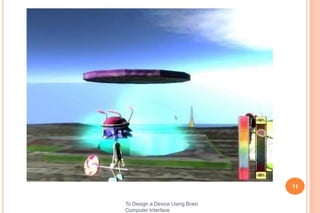
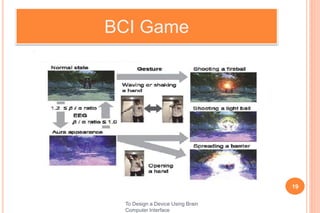
 In the game application, the avatar stands facing away
from a monster and fights with the monster. The
monster has hit points.
 The avatar shoots a fireball or a light ball. The hit
points reduces when the avatar is exposed to the flame
several times.

 The avatar protects oneself from the flame by
spreading a barrier.
 When the beta/alpha ratio becomes greater than or
equal to 1.2, an aura appears around the avatar.
20
To Design a Device Using Brain
Computer Interface
When the beta/alpha ratio becomes equal to or less
than 1.0, the aura disappears after 3 seconds.
The avatar shoots a fireball forward when the
gesture of waving or shaking the hand is detected.
And spreads a barrier with a shape of magic circle
on the front when the gesture of opening the hand is
detected.
21
To Design a Device Using Brain
Computer Interface
APPLICATIONS
Gaming become enjoyable using Brain
Computer Interface.
Its gives experience of Virtual Reality to the
users.
It checks or challenges the concentration
levels of users mind. 22
Gaming Using BCI
CONCLUSIONS
 In this study, we proposed a hands-on game
by combining the BCI game system, which
were composed of a simple EEG recorder, a
smart tablet, a PC, and an immersive head
mounted display, additionally with a wearable
gesture interface, which detects
electromyography.
23
Gaming Using BCI
REFERENCES
 Ryota Horie Department of Communications Engineering
Shibaura Institute of Technology “A Hands-on Game by
Using a Brain-Computer Interface, an Immersive Head
Mounted Display, and a Wearable Gesture Interface”.
 Kenneth Oum, Drexel University “Brain computer
interface gaming: development of concentration based
game design for research environments”.
24
Gaming Using BCI
25
Gaming Using BCI
For more info visit
https://www.digitalninad.com/

Brain Computer Interface

  • 1.
    “Gaming Using BrainComputer Interface” By and Ninad Bhate
  • 2.
    CONTENTS Project Group Project Motivation Introduction LiteratureSurvey Actual Seminar related topics Applications/advantages Conclusions References 1 Gaming Using BCI
  • 3.
    MOTIVATION  BCI isa technology that allows many folks to connect with technology which are unable to make use of other technologies like animals, small children, old people and disable people.  This technology has its applications in many fields. Like health,engineering,automobile, psychological, education etc  This technology is the future of mankind. 3 Gaming Using BCI
  • 4.
    PROBLEM STATEMENT To DesignA Device using Brain Computer Interface A Device can be any Hardware or Software.  From Operating a Wheel Chair Using BCI to Handling a GUI game Using BCI. 4 To Design a Device Using Brain Computer Interface
  • 5.
    AIM AND OBJECTIVESOF THE PROJECT Aim:  To design a device using Brain Computer Interface to do work effortlessly. Objectives:  To detect Brain Signals using EEG recorder.  To design GUI to interact with BCI device.  To move a device using gestures. 5 To Design a Device Using Brain Computer Interface
  • 6.
    INTRODUCTION  One ofthe application of brain-computer interface (BCI) is for entertainment.  BCI games have potential extensibility in combination with virtual reality environment.  BCI game system is combined with a wearable gesture interface, which detects electromyography.  Wearable Gesture Interface increase user‘s feeling of presence and fun. 7 Gaming Using BCI
  • 7.
    LITERATURE SURVEY  Neuroskycompany has created a game “Judecca” a first person shooter game that uses a player’s concentration as a key part of the gameplay .  It uses a player’s concentration to make enemies visible enabling the player’s “Devils Eye”, in which they then must eliminate the newly visible threats. 8 Gaming Using BCI
  • 8.
    9 :To Design aDevice Using Brain Computer Interface
  • 9.
     Another BCIgame prototype that uses concentration as its main game mechanic is the fNIR based LazyBrains.  Functional near infrared spectroscopy, or fNIR, is a non- invasive optical technique that measures neural activity related hemodynamic response within the cortex.  When the user approaches a closed sewer grate, they must lift, it requires tremendous concentration levels. 10 To Design a Device Using Brain Computer Interface
  • 10.
    11 To Design aDevice Using Brain Computer Interface
  • 11.
    LITERATURE SURVEY/RELATED WORK Minimum FIVE references should be there from literature. 8/28/2019 12 SCOE,InformationTechnology(2014-15) Sr. No. Reference Name (Write Paper Title) Seed Idea/ Work description Problems found Any other criteria 1 Ryota Horie “A Hands-on Game by Using a Brain- Computer Interface, Game which uses beta/alpha ratios to play a game NA NA 2 “BCI gaming: development of concentration based game.” Game that use concentration levels and fNIR techniques NA NA
  • 12.
    BCI GAME SYSTEM REQUIREMENTS Asimple EEG recorder A smart tablet A PC An immersive head mounted display A wearable gesture interface 13 Gaming Using BCI
  • 13.
    14 To Design aDevice Using Brain Computer Interface How BCI Game System Works
  • 14.
    Android application whichreceives row signals from the simple EEG recorder via Bluetooth. The application detects beta/alpha ratios from the row signals. Depending on the beta/alpha ratio, the application generates one-byte commands. The application sends the one-byte commands to a server running on a PC via TCP/IP over Wi-Fi and LAN. 15 To Design a Device Using Brain Computer Interface
  • 15.
    The server convertsthe one-byte commands to keyboard commands to operate the game application. The beta/alpha ratio is degree of concentration. When a user concentrates, the beta/alpha ratio increases. The wearable gesture interface worn on a user's arm, communicates with the PC via Bluetooth. 16 To Design a Device Using Brain Computer Interface
  • 16.
    The sensor detectstwo types of gestures of a hand, a gesture of waving or shaking a hand or a gesture of opening the hand. The operating commands generated by the beta/alpha ratio and the types of hand gestures, controls avatar’s action in the game. An immersive head mounted display displays the advance of the game in the first person perspective of the avatar. 17 To Design a Device Using Brain Computer Interface
  • 17.
    The head mounteddisplay detects head motion of a user and the first person perspective changes according to the head motion. 18 To Design a Device Using Brain Computer Interface
  • 18.
    BCI Game 19 To Designa Device Using Brain Computer Interface
  • 19.
     In thegame application, the avatar stands facing away from a monster and fights with the monster. The monster has hit points.  The avatar shoots a fireball or a light ball. The hit points reduces when the avatar is exposed to the flame several times.   The avatar protects oneself from the flame by spreading a barrier.  When the beta/alpha ratio becomes greater than or equal to 1.2, an aura appears around the avatar. 20 To Design a Device Using Brain Computer Interface
  • 20.
    When the beta/alpharatio becomes equal to or less than 1.0, the aura disappears after 3 seconds. The avatar shoots a fireball forward when the gesture of waving or shaking the hand is detected. And spreads a barrier with a shape of magic circle on the front when the gesture of opening the hand is detected. 21 To Design a Device Using Brain Computer Interface
  • 21.
    APPLICATIONS Gaming become enjoyableusing Brain Computer Interface. Its gives experience of Virtual Reality to the users. It checks or challenges the concentration levels of users mind. 22 Gaming Using BCI
  • 22.
    CONCLUSIONS  In thisstudy, we proposed a hands-on game by combining the BCI game system, which were composed of a simple EEG recorder, a smart tablet, a PC, and an immersive head mounted display, additionally with a wearable gesture interface, which detects electromyography. 23 Gaming Using BCI
  • 23.
    REFERENCES  Ryota HorieDepartment of Communications Engineering Shibaura Institute of Technology “A Hands-on Game by Using a Brain-Computer Interface, an Immersive Head Mounted Display, and a Wearable Gesture Interface”.  Kenneth Oum, Drexel University “Brain computer interface gaming: development of concentration based game design for research environments”. 24 Gaming Using BCI
  • 24.
    25 Gaming Using BCI Formore info visit https://www.digitalninad.com/