The Economics of Utility
Computing


Alan McSweeney
Objectives

•   To discuss how the transition to utility computing can be
    cost-justified by an organisation


    June 10, 2010                                               2
Utility Computing

•   Utility computing can be:
      − Within an organisation
             • Where users of computing services are charged based on usage
      − With a public cloud model
             • Where the organisation is charged for its use of computing services

•   Utility computing can replace capital costs and charges
•   Utility provider is responsible for providing computing
    resources
      − Users just draw them down and pay for what they use
•   Nothing new here – think of computer bureau services of
    old
    June 10, 2010                                                                    3
Utility Computing

•   Utility Computing is a better term than Cloud Computing
      − Describes the payment, operation and usage approach
      − Cloud computing implies technology and approaches to
        implementation
      − Not just computing but needs to include other aspects of
        information technology resources
             • Storage
             • Data transmission
             • Service management


    June 10, 2010                                                  4
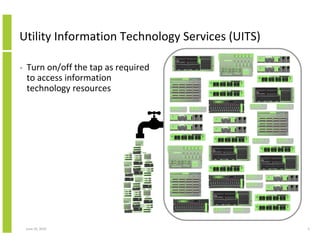
Utility Information Technology Services (UITS)

•   Turn on/off the tap as required
    to access information
    technology resources


    June 10, 2010                                5
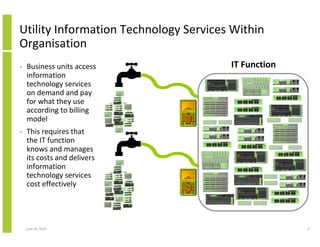
Utility Information Technology Services Within
Organisation
•   Business units access              IT Function
    information
    technology services
    on demand and pay
    for what they use
    according to billing
    model
•   This requires that
    the IT function
    knows and manages
    its costs and delivers
    information
    technology services
    cost effectively


    June 10, 2010                                    6
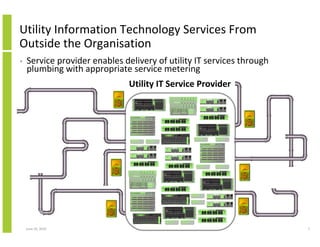
Utility Information Technology Services From
Outside the Organisation
•   Service provider enables delivery of utility IT services through
    plumbing with appropriate service metering
                               Utility IT Service Provider


    June 10, 2010                                                      7
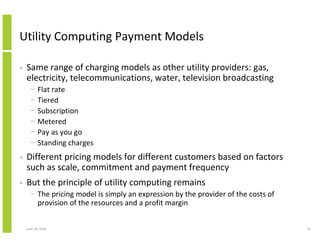
Utility Computing Payment Models

•   Same range of charging models as other utility providers: gas,
    electricity, telecommunications, water, television broadcasting
      −    Flat rate
      −    Tiered
      −    Subscription
      −    Metered
      −    Pay as you go
      −    Standing charges
•   Different pricing models for different customers based on factors
    such as scale, commitment and payment frequency
•   But the principle of utility computing remains
      − The pricing model is simply an expression by the provider of the costs of
        provision of the resources and a profit margin


    June 10, 2010                                                                   8
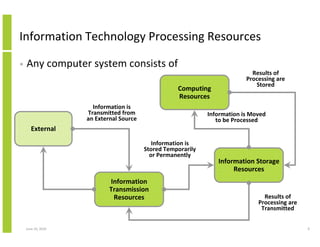
Information Technology Processing Resources

•   Any computer system consists of
                                                                             Results of
                                                                           Processing are
                                                                              Stored
                                                    Computing
                                                    Resources
                      Information is
                    Transmitted from                          Information is Moved
                    an External Source                           to be Processed
       External
                                            Information is
                                         Stored Temporarily
                                           or Permanently
                                                                 Information Storage
                                                                      Resources
                            Information
                            Transmission
                             Resources                                           Results of
                                                                               Processing are
                                                                                Transmitted


    June 10, 2010                                                                               9
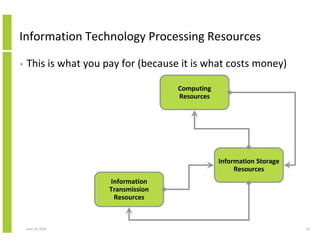
Information Technology Processing Resources

•   This is what you pay for (because it is what costs money)

                                     Computing
                                     Resources


                                                 Information Storage
                                                      Resources
                      Information
                      Transmission
                       Resources


    June 10, 2010                                                      10
Utility Computing

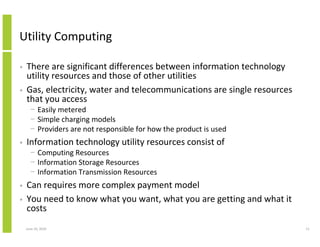
•   There are significant differences between information technology
    utility resources and those of other utilities
•   Gas, electricity, water and telecommunications are single resources
    that you access
      − Easily metered
      − Simple charging models
      − Providers are not responsible for how the product is used
•   Information technology utility resources consist of
      − Computing Resources
      − Information Storage Resources
      − Information Transmission Resources
•   Can requires more complex payment model
•   You need to know what you want, what you are getting and what it
    costs
    June 10, 2010                                                         11
Utility Computing Pricing

•   Any pricing model has to reflect the cost of recovery of
    provision of service
      − Capital cost
      − Operational costs including service management costs
      − Profit margin


    June 10, 2010                                              12
Paying for Utility Computing

•   Within an organisation
      − Do you know how much IT is costing so you can implement a utility supply and
        payment model?
      − Do you know what your costs are so you can charge for their recovery?
      − How mature is your costing model?
      − Could you implement a cost-recovery/chargeback model tomorrow?
•   Outside the organisation
      − Any costs paid to an external utility provider are still part of the IT budget
      − Do you know if their costs will be cheaper or more expensive than internal
        costs?
      − Are there hidden costs?
      − Can you disengage easily, quickly and at low cost?


    June 10, 2010                                                                        13
Coase’s Law on the Nature of the Firm

•   A firm will tend to expand until the cost of organising an extra transaction within the firm
    become equal to the costs of carrying out the same transaction on the open market
•   This means when it is cheaper to buy the service externally it will generally be bought
    externally
•   However there is an assumption of perfect knowledge and perfectly rational use of this
    knowledge to achieve the most logical solution
•   In reality this perfection is rarely if ever achieved
      − Other less rational factors affect the decision
             •      Everybody Else Is Doing It
             •      I Want To Do It So It Appears On My Resume
             •      I Like New Technology
             •      Vendors Keep Talking About It
             •      I Need One Good Idea To Stamp My Mark On The Organisation
             •      It Will Solve All My Problems
             •      I Hate Dealing With IT
             •      I Do Not Want to Setup a Large IT Function
•   Cost estimates are rarely accurate
      − What we know about most projects is that they either or both overrun on costs and deliver less
        than expected
      − Cost overruns are generally caused by a mix of errors in the initial cost estimates and deliberate
        distortions in order to cause the decision to be made


    June 10, 2010                                                                                            14
Transaction Costs

•   Along with production costs, there are costs for preparing, entering into and monitoring the
    execution of all kinds of contracts as well as costs for implementing allocation and tracking
    measures for the contracted services
•   When internal transaction costs become greater than the costs of externally sourcing the
    service, the service will be obtained externally
•   There are hidden costs associated with sourcing a service externally
      −    Selecting the wrong supplier
      −    Costs of writing contract
      −    Costs of enforcing contract
      −    Having a poor service contract that results in hidden cost and/or reduced service
      −    Overlooking personnel issues
      −    Loosing control over the outsourced activity
      −    Management, quality assurance and supervision overhead
      −    Implementation and termination costs
      −    Loss of flexibility
      −    Loss of integration between applications and data
      −    Data extraction costs
      −    Security framework implementation
•   Transition to utility computing model requires full knowledge of costs – current and future
•   Note that anything can be outsourced except the management of what is
    outsourced
    June 10, 2010                                                                                   15
Characteristics of Credible Cost Estimates

•   Clear identification of requirements of the ultimate deliverable
•   Broad participation in preparing estimates
•   Availability of valid data for performing estimates – historical,
    experience, benchmarks
•   Standardised and comprehensive estimate structure that includes all
    possible sources of cost
•   Provision for uncertainties – include known costs explicitly and allow
    for unknown costs
•   Recognition of inflation
•   Recognition of excluded costs
•   Independent review of estimates for completeness and realism
•   Revision of estimates for significant changes in requirements

    June 10, 2010                                                            16
Challenges of Developing Good Cost Estimates

•   Requires detailed, stable, agreed requirements
•   Agreed assumptions
•   Access to detailed documentation and historical data for
    comparison
•   Trained and experienced analysts
•   Risk and uncertainty analysis
•   Identification of a range of confidence levels
•   Adequate contingency and management reserves


    June 10, 2010                                              17
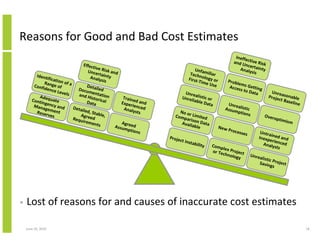
Reasons for Good and Bad Cost Estimates
                                                                                                              Ineffe
                                                                                                             and U ctive Risk
                                    Effect                                                                         ncer
                                           i ve
                                      Unce Risk and                                   Unfa                      Analy tainty
                                              r ta                                 Techn miliar                       s is
         Ident
               ificat                   Analy inty                                First- ology or
                                                 s is
              Rang ion of a                                                             Time
                                                                                             Use
                                                                                                         Probl
                                                                                                               em
        Confi      e of               De                                                                  Acces s Getting
              dence
                      Level     Docu tailed                                                                     s to D
                                       m                                                                              ata           Unre
                            s    and H entation                                Unre
                                                                                                                                  Proje asonable
           Adeq
                 ua                     istor             Train               Unre alistic or                                          ct Bas
       Conti
             ngen te                  Data ical                 e
                                                         Exper d and
                                                                                  liable
                                                                                         Data            Unre                                 elin e
        Mana      cy an                                        ien
              geme d          Detai
                                    led, S                Analy ced                                     Assumalistic
         Reser      nt                                           sts        No o                             ption
                ves               Agree table,                            Comp r Limited                           s            Overo
                              Requ       d                                     ariso                                                 ptimi
                                   ireme                 Agr                 Avail n Data                                                     sm
                                           n ts
                                                      Assum eed                   able              New
                                                            ption                                       Pr   ocess
                                                                   s                                              e   s        Untra
                                                                       Proje                                                  Inexp ined and
                                                                             ct Ins                                                er ie
                                                                                   t   abilit
                                                                                              y   Comp                          Analy nced
                                                                                                       le                              sts
                                                                                                  or Te x Project
                                                                                                       chnol              Unre
                                                                                                             ogy               alistic
                                                                                                                              Savin Project
                                                                                                                                     gs


•   Lost of reasons for and causes of inaccurate cost estimates

    June 10, 2010                                                                                                                                      18
Sources of Risk and Uncertainty in Estimating Costs

•   Lack of understanding of the project requirements
•   Shortcomings of human language and differing
    interpretations of meaning of project
•   Behaviour of parties involved in the cost estimation
    process
•   Haste
•   Deception
•   Poor cost estimating and pricing practices


    June 10, 2010                                          19
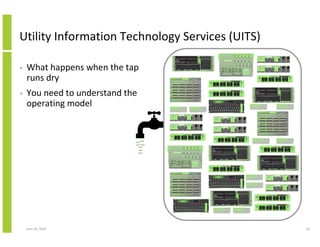
Utility Information Technology Services (UITS)

•   What happens when the tap
    runs dry
•   You need to understand the
    operating model


    June 10, 2010                                20
Availing of Utility Information Technology Services
(UITS) Model
•   Need to understand existing and future IT costs completely
•   Need to understand the service model, its limitations and
    roles and responsibilities of parties
•   Need to monitor and manage service provision
•   Works best for those information technology services that
    can be commoditised
•   Does not do away with the need for an IT budget, IT
    function and IT management
• Remember:   Anything can be outsourced except
    the management of what is outsourced
    June 10, 2010                                                21
More Information

          Alan McSweeney
          alan@alanmcsweeney.com


 June 10, 2010                     22

Economics of Utility Computing

  • 1.
    The Economics ofUtility Computing Alan McSweeney
  • 2.
    Objectives • To discuss how the transition to utility computing can be cost-justified by an organisation June 10, 2010 2
  • 3.
    Utility Computing • Utility computing can be: − Within an organisation • Where users of computing services are charged based on usage − With a public cloud model • Where the organisation is charged for its use of computing services • Utility computing can replace capital costs and charges • Utility provider is responsible for providing computing resources − Users just draw them down and pay for what they use • Nothing new here – think of computer bureau services of old June 10, 2010 3
  • 4.
    Utility Computing • Utility Computing is a better term than Cloud Computing − Describes the payment, operation and usage approach − Cloud computing implies technology and approaches to implementation − Not just computing but needs to include other aspects of information technology resources • Storage • Data transmission • Service management June 10, 2010 4
  • 5.
    Utility Information TechnologyServices (UITS) • Turn on/off the tap as required to access information technology resources June 10, 2010 5
  • 6.
    Utility Information TechnologyServices Within Organisation • Business units access IT Function information technology services on demand and pay for what they use according to billing model • This requires that the IT function knows and manages its costs and delivers information technology services cost effectively June 10, 2010 6
  • 7.
    Utility Information TechnologyServices From Outside the Organisation • Service provider enables delivery of utility IT services through plumbing with appropriate service metering Utility IT Service Provider June 10, 2010 7
  • 8.
    Utility Computing PaymentModels • Same range of charging models as other utility providers: gas, electricity, telecommunications, water, television broadcasting − Flat rate − Tiered − Subscription − Metered − Pay as you go − Standing charges • Different pricing models for different customers based on factors such as scale, commitment and payment frequency • But the principle of utility computing remains − The pricing model is simply an expression by the provider of the costs of provision of the resources and a profit margin June 10, 2010 8
  • 9.
    Information Technology ProcessingResources • Any computer system consists of Results of Processing are Stored Computing Resources Information is Transmitted from Information is Moved an External Source to be Processed External Information is Stored Temporarily or Permanently Information Storage Resources Information Transmission Resources Results of Processing are Transmitted June 10, 2010 9
  • 10.
    Information Technology ProcessingResources • This is what you pay for (because it is what costs money) Computing Resources Information Storage Resources Information Transmission Resources June 10, 2010 10
  • 11.
    Utility Computing • There are significant differences between information technology utility resources and those of other utilities • Gas, electricity, water and telecommunications are single resources that you access − Easily metered − Simple charging models − Providers are not responsible for how the product is used • Information technology utility resources consist of − Computing Resources − Information Storage Resources − Information Transmission Resources • Can requires more complex payment model • You need to know what you want, what you are getting and what it costs June 10, 2010 11
  • 12.
    Utility Computing Pricing • Any pricing model has to reflect the cost of recovery of provision of service − Capital cost − Operational costs including service management costs − Profit margin June 10, 2010 12
  • 13.
    Paying for UtilityComputing • Within an organisation − Do you know how much IT is costing so you can implement a utility supply and payment model? − Do you know what your costs are so you can charge for their recovery? − How mature is your costing model? − Could you implement a cost-recovery/chargeback model tomorrow? • Outside the organisation − Any costs paid to an external utility provider are still part of the IT budget − Do you know if their costs will be cheaper or more expensive than internal costs? − Are there hidden costs? − Can you disengage easily, quickly and at low cost? June 10, 2010 13
  • 14.
    Coase’s Law onthe Nature of the Firm • A firm will tend to expand until the cost of organising an extra transaction within the firm become equal to the costs of carrying out the same transaction on the open market • This means when it is cheaper to buy the service externally it will generally be bought externally • However there is an assumption of perfect knowledge and perfectly rational use of this knowledge to achieve the most logical solution • In reality this perfection is rarely if ever achieved − Other less rational factors affect the decision • Everybody Else Is Doing It • I Want To Do It So It Appears On My Resume • I Like New Technology • Vendors Keep Talking About It • I Need One Good Idea To Stamp My Mark On The Organisation • It Will Solve All My Problems • I Hate Dealing With IT • I Do Not Want to Setup a Large IT Function • Cost estimates are rarely accurate − What we know about most projects is that they either or both overrun on costs and deliver less than expected − Cost overruns are generally caused by a mix of errors in the initial cost estimates and deliberate distortions in order to cause the decision to be made June 10, 2010 14
  • 15.
    Transaction Costs • Along with production costs, there are costs for preparing, entering into and monitoring the execution of all kinds of contracts as well as costs for implementing allocation and tracking measures for the contracted services • When internal transaction costs become greater than the costs of externally sourcing the service, the service will be obtained externally • There are hidden costs associated with sourcing a service externally − Selecting the wrong supplier − Costs of writing contract − Costs of enforcing contract − Having a poor service contract that results in hidden cost and/or reduced service − Overlooking personnel issues − Loosing control over the outsourced activity − Management, quality assurance and supervision overhead − Implementation and termination costs − Loss of flexibility − Loss of integration between applications and data − Data extraction costs − Security framework implementation • Transition to utility computing model requires full knowledge of costs – current and future • Note that anything can be outsourced except the management of what is outsourced June 10, 2010 15
  • 16.
    Characteristics of CredibleCost Estimates • Clear identification of requirements of the ultimate deliverable • Broad participation in preparing estimates • Availability of valid data for performing estimates – historical, experience, benchmarks • Standardised and comprehensive estimate structure that includes all possible sources of cost • Provision for uncertainties – include known costs explicitly and allow for unknown costs • Recognition of inflation • Recognition of excluded costs • Independent review of estimates for completeness and realism • Revision of estimates for significant changes in requirements June 10, 2010 16
  • 17.
    Challenges of DevelopingGood Cost Estimates • Requires detailed, stable, agreed requirements • Agreed assumptions • Access to detailed documentation and historical data for comparison • Trained and experienced analysts • Risk and uncertainty analysis • Identification of a range of confidence levels • Adequate contingency and management reserves June 10, 2010 17
  • 18.
    Reasons for Goodand Bad Cost Estimates Ineffe and U ctive Risk Effect ncer i ve Unce Risk and Unfa Analy tainty r ta Techn miliar s is Ident ificat Analy inty First- ology or s is Rang ion of a Time Use Probl em Confi e of De Acces s Getting dence Level Docu tailed s to D m ata Unre s and H entation Unre Proje asonable Adeq ua istor Train Unre alistic or ct Bas Conti ngen te Data ical e Exper d and liable Data Unre elin e Mana cy an ien geme d Detai led, S Analy ced Assumalistic Reser nt sts No o ption ves Agree table, Comp r Limited s Overo Requ d ariso ptimi ireme Agr Avail n Data sm n ts Assum eed able New ption Pr ocess s e s Untra Proje Inexp ined and ct Ins er ie t abilit y Comp Analy nced le sts or Te x Project chnol Unre ogy alistic Savin Project gs • Lost of reasons for and causes of inaccurate cost estimates June 10, 2010 18
  • 19.
    Sources of Riskand Uncertainty in Estimating Costs • Lack of understanding of the project requirements • Shortcomings of human language and differing interpretations of meaning of project • Behaviour of parties involved in the cost estimation process • Haste • Deception • Poor cost estimating and pricing practices June 10, 2010 19
  • 20.
    Utility Information TechnologyServices (UITS) • What happens when the tap runs dry • You need to understand the operating model June 10, 2010 20
  • 21.
    Availing of UtilityInformation Technology Services (UITS) Model • Need to understand existing and future IT costs completely • Need to understand the service model, its limitations and roles and responsibilities of parties • Need to monitor and manage service provision • Works best for those information technology services that can be commoditised • Does not do away with the need for an IT budget, IT function and IT management • Remember: Anything can be outsourced except the management of what is outsourced June 10, 2010 21
  • 22.
    More Information Alan McSweeney alan@alanmcsweeney.com June 10, 2010 22