Project Management and Solution Delivery Process  Alan McSweeney
Agenda Process Introduction Solution Delivery and Project Management Processes Solution Delivery Project Management Using the Process Using the Template Documents Feedback and Process Development
Objective To provide you with an introduction to the proposed process and its operation and use in order to get feedback prior to its full implementation
Process Introduction
Project and Solution Delivery Process Benefits Consistency Speed Drives Delivery Ensures Acceptance Productivity Reuse Professionalism Customer Confidence Speed Accuracy Audit Trail Cost Saving Risk Management and Reduction Change Management and Additional Work Formal Project Closure Potential Disadvantages Time to Adopt Suitability Too Comprehensive Cost of Use Not Currently In Use Risk
Project Deliver defined objective/solution Must have a defined start and end Project management is concerned about delivering what has been committed
Why Use Processes Increase credibility Increase visibility of the customer engagement Improving customer confidence and facilitating smoother engagements Improve profitability by customising pre-defined proven processes rather than developing new ones Reduce risk through improve planning competitors have them Eliminate surprises
Why Use Processes Structure and mechanism for knowledge capture and reuse A means for the retention and application of company knowledge  Reuse encouraged and will become the normal practice, with significant reduction in the development of non-reusable collateral Adaptive and creative  Allowing personnel to follow a structure and focus on adding value New and developing resources are brought up to speed more quickly  Resource Management  Better understanding and definition of required skills Training based around methodologies, standard techniques, and tools
Why Use Processes Initially painful Can seem to be longwinded They really do help Add value
Methodology and Processes Methodology without process is meaningless Process without usage is pointless Methodology (General Framework) Process (Actualises the  Methodology) Use the Process (Achieve the Benefits)
Solution Delivery and Project Management Processes
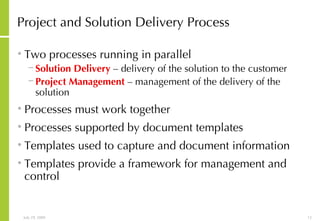
Project and Solution Delivery Process Two processes running in parallel Solution Delivery  – delivery of the solution to the customer Project Management  – management of the delivery of the solution Processes must work together Processes supported by document templates Templates used to capture and document information Templates provide a framework for management and control
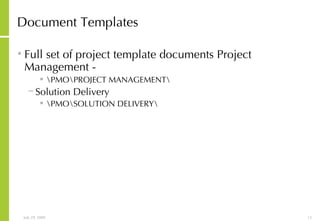
Document Templates Full set of project template documents Project Management -  \PMO\PROJECT MANAGEMENT\ Solution Delivery \PMO\SOLUTION DELIVERY\
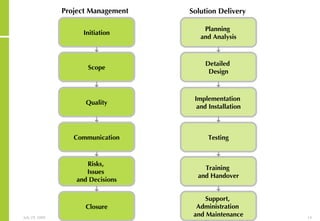
Planning  and Analysis Detailed  Design Implementation  and Installation Testing Training  and Handover Support,  Administration  and Maintenance Initiation Scope Quality Communication Risks,  Issues  and Decisions Closure Project Management Solution Delivery
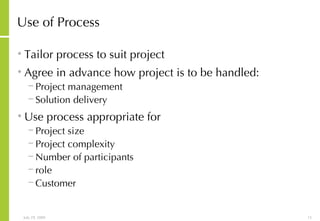
Use of Process Tailor process to suit project Agree in advance how project is to be handled: Project management Solution delivery Use process appropriate for Project size Project complexity Number of participants role Customer
V Lifecycle Approach V Project  Initiation Project  Closure System Requirements System Testing High-Level Design Integration Testing Low-Level Design Component Testing Install and  Implement Define Requirements and Solution Deliver Solution and Fulfil  Requirements
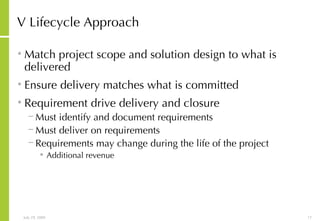
V Lifecycle Approach Match project scope and solution design to what is delivered Ensure delivery matches what is committed Requirement drive delivery and closure Must identify and document requirements Must deliver on requirements Requirements may change during the life of the project Additional revenue
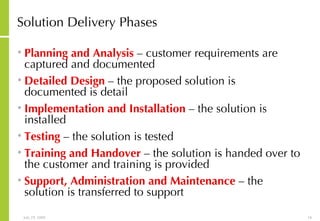
Solution Delivery Phases Planning and Analysis  – customer requirements are captured and documented Detailed Design  – the proposed solution is documented is detail Implementation and Installation  – the solution is installed Testing  – the solution is tested Training and Handover  – the solution is handed over to the customer and training is provided Support, Administration and Maintenance  – the solution is transferred to support
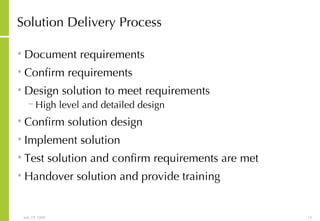
Solution Delivery Process Document requirements Confirm requirements Design solution to meet requirements High level and detailed design Confirm solution design Implement solution Test solution and confirm requirements are met Handover solution and provide training
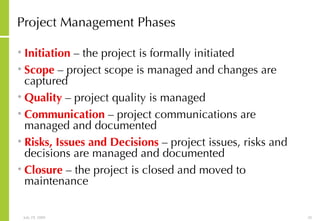
Project Management Phases Initiation  – the project is formally initiated Scope  – project scope is managed and changes are captured Quality  – project quality is managed Communication  – project communications are managed and documented Risks, Issues and Decisions  – project issues, risks and decisions are managed and documented Closure  – the project is closed and moved to maintenance
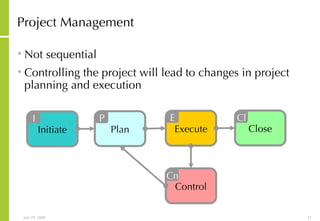
Project Management Not sequential Controlling the project will lead to changes in project planning and execution Initiate Plan Execute Control Close P I E Cn Cl
Solution Delivery
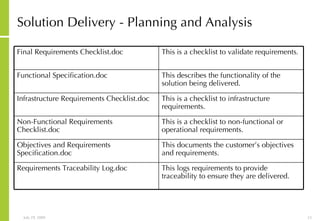
Solution Delivery -  Planning and Analysis This logs requirements to provide traceability to ensure they are delivered. Requirements Traceability Log.doc This documents the customer’s objectives and requirements. Objectives and Requirements Specification.doc This is a checklist to non-functional or operational requirements. Non-Functional Requirements Checklist.doc This is a checklist to infrastructure requirements. Infrastructure Requirements Checklist.doc This describes the functionality of the solution being delivered. Functional Specification.doc This is a checklist to validate requirements. Final Requirements Checklist.doc
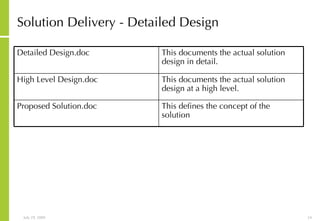
Solution Delivery -  Detailed Design This defines the concept of the solution Proposed Solution.doc This documents the actual solution design at a high level. High Level Design.doc This documents the actual solution design in detail. Detailed Design.doc
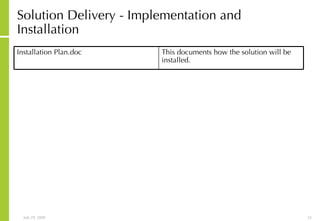
Solution Delivery -  Implementation and Installation This documents how the solution will be installed. Installation Plan.doc
Solution Delivery -  Testing  This logs the testing performed. Test Execution Log.doc This defines the plan for performing testing. System Test Plan.doc This documents a fault discovered during testing. Fault Report.doc This is a log of any faults discovered during testing. Fault Report Log.doc This details the set of tests to be performed to validate the solution. Acceptance Test Specification.doc This defines the approach to testing of the solution. Acceptance Test Package.doc
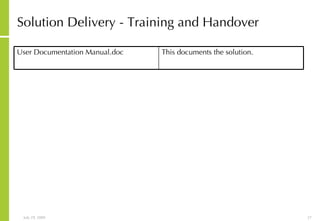
Solution Delivery -  Training and Handover This documents the solution. User Documentation Manual.doc
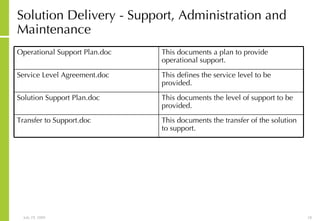
Solution Delivery -  Support, Administration and Maintenance This documents the transfer of the solution to support.  Transfer to Support.doc This documents the level of support to be provided. Solution Support Plan.doc This defines the service level to be provided. Service Level Agreement.doc This documents a plan to provide operational support. Operational Support Plan.doc
Project Management
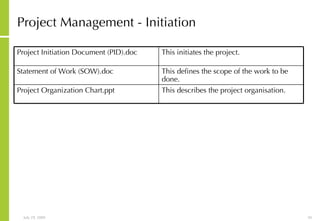
Project Management - Initiation This describes the project organisation. Project Organization Chart.ppt This defines the scope of the work to be done. Statement of Work (SOW).doc This initiates the project. Project Initiation Document (PID).doc
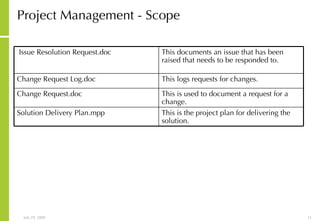
Project Management - Scope This is the project plan for delivering the solution. Solution Delivery Plan.mpp This is used to document a request for a change. Change Request.doc This logs requests for changes. Change Request Log.doc This documents an issue that has been raised that needs to be responded to. Issue Resolution Request.doc
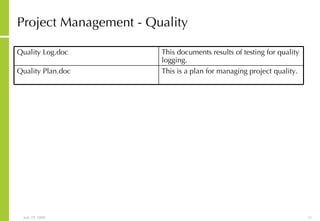
Project Management - Quality This is a plan for managing project quality. Quality Plan.doc This documents results of testing for quality logging. Quality Log.doc
Project Management - Communication This is a document for use with a project steering committee. Steering Committee Meeting Agenda.doc This is a sample weekly report. Project Weekly Status Report.doc This is an internal project report. Project Monthly Report.doc This is used to record meeting minutes. Meeting Agenda and Minutes.doc This is a request for information Information Request.doc This is a log of requests for information. Information Request Log.doc This is a formal notification of a project delay. Delay Notification.doc This is a log of delays that have occurred in the project. Delay Notification Log.doc This is a sample status report presentation Customer Status Report Presentation.ppt This is a sample monthly report. Customer Monthly Status Report.doc This logs communications. Communication Log.doc This documents project communication. Communication Distribution Plan.doc
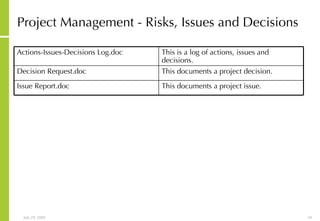
Project Management - Risks, Issues and Decisions This documents a project issue. Issue Report.doc This documents a project decision. Decision Request.doc This is a log of actions, issues and decisions. Actions-Issues-Decisions Log.doc
Project Management - Closure This is used to record formal project signoff by the customer. Project Sign-off.doc This documents project closure. Project Closeout Report.doc
Using the Process
Using the Process Effective project and solution delivery steps 1 – Initiation 2 – Requirements 3 – Project Planning 4 – Solution Design 5 – Delivery and Testing 6 – Training and Handover 7 – Closure and Move to Maintenance
Project and Solution Process – 1 - Initiation Copy folder structure into project location such as  PROJECTS\<CUSTOMER>\<PROJECT>  on shared folder Take project scope from previously submitted sales proposals Complete \Project Management\10 Initiation\Statement of Work (SOW).doc and send to customer for review and signoff Complete \Project Management\10 Initiation\Project Initiation Document (PID).doc if project justifies it (greater than 20 days effort)  Rename the documents to include customer and project name <Customer> <Project> Project Initiation Document (PID).doc
Document Storage Store template documents to shared location \PROJECTS\<CUSTOMER>\<PROJECT> Create separate folder in PROJECTS for each customer Create separate folder in PROJECTS \<CUSTOMER>\ for each project for the customer
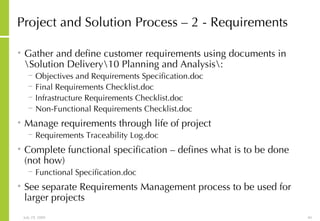
Project and Solution Process – 2 - Requirements Gather and define customer requirements using documents in \Solution Delivery\10 Planning and Analysis\: Objectives and Requirements Specification.doc Final Requirements Checklist.doc Infrastructure Requirements Checklist.doc Non-Functional Requirements Checklist.doc Manage requirements through life of project Requirements Traceability Log.doc Complete functional specification – defines what is to be done (not how) Functional Specification.doc See separate Requirements Management process to be used for larger projects
Requirements Definition and Documentation Requirements Definition Requirements Management Gather Analyse Review Assess Capture Change
Requirements Definition Gather  – Tasks relating to the initial gathering of requirements  Analyse  – Analysing and categorising requirements and specifying them Review  – Agreeing (with the customer) exactly what the requirements are. Modify if necessary to reach agreement.
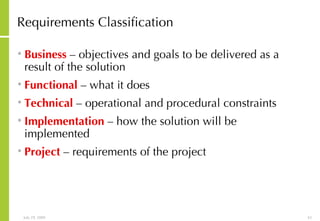
Requirements Classification Business  – objectives and goals to be delivered as a result of the solution Functional   – what it does Technical  – operational and procedural constraints  Implementation  – how the solution will be implemented Project  – requirements of the project
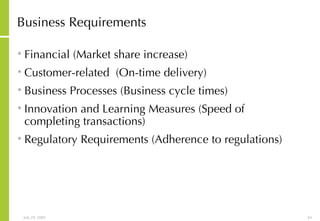
Business Requirements Financial (Market share increase) Customer-related  (On-time delivery) Business Processes (Business cycle times) Innovation and Learning Measures (Speed of completing transactions) Regulatory Requirements (Adherence to regulations)
Functional Requirements Inputs Outputs Actions Responses Outcomes Usage
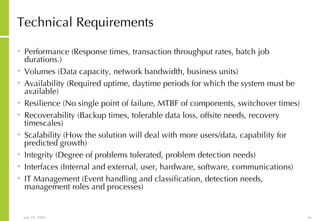
Technical Requirements Performance (Response times, transaction throughput rates, batch job durations.) Volumes (Data capacity, network bandwidth, business units) Availability (Required uptime, daytime periods for which the system must be available) Resilience (No single point of failure, MTBF of components, switchover times) Recoverability (Backup times, tolerable data loss, offsite needs, recovery timescales) Scalability (How the solution will deal with more users/data, capability for predicted growth) Integrity (Degree of problems tolerated, problem detection needs) Interfaces (Internal and external, user, hardware, software, communications) IT Management (Event handling and classification, detection needs, management roles and processes)
Implementation Requirements Timescales (What are the desired target dates) Disruption and Impact (What levels of disruption can be tolerated) Data Conversion (What data needs to be migrated, how, and with what constraints) Supportability (What levels of support will be needed) Training (What staff require what new skills) Handover (Process of transfer of control, parallel run) Support Warranty (Coverage during warranty) Post-Warranty Operation
Project Requirements Implementation Testing Facilities
Requirements Management Capture  – Ensure that the new requirements or change requests are captured Assess  – Consider whether the changes will be actioned. Approve or reject Change  – Undertake the changes
Project and Solution Process – 3 – Project Planning and Management Complete first draft of project plan
Project Planning and Management Standard project plan structure Initiation Planning Executing Project Management Closing  Customise detail for individual project
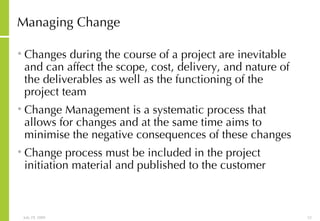
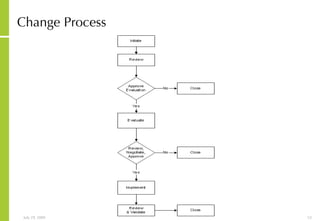
Managing Change Changes during the course of a project are inevitable and can affect the scope, cost, delivery, and nature of the deliverables as well as the functioning of the project team Change Management is a systematic process that allows for changes and at the same time aims to minimise the negative consequences of these changes Change process must be included in the project initiation material and published to the customer
Change Process
Change Control Templates \Project Management\20 Scope\ Issue Resolution Request.doc – document issues Change Request Log.doc – maintain log of change requests Change Request.doc – document change request and document outcome
Risk Management Risk  All projects have risks Need to identify and manage  Action can be taken to mitigate/circumvent risks Minimise the negative risk impacts  Risk management steps Risk Management Planning – determine the approach to risk management Risk identification - identify all known project risks Risk Analysis - perform an assessment of the probability of occurrence and potential impact Risk Response Planning - create action plans to manage the identified risks Risk Monitoring and Control – monitor, review and update risk status and plans Risk Closeout – document lessons learned  Take appropriate approach to managing risk
Issue Management Issue management  Identifying, tracking, resolving, and communicating to project stakeholders the issues that arise out of day-to-day project execution ongoing process, from start to closure of any project and it is a critical component of project monitoring and control activities Steps Identify Project Issues Establish Issue Tracking Evaluate the Issue Determine Issue Resolution Implement Issue Resolution Close the Issue Take appropriate approach to managing risk
Risk and Issue Management Templates \Project Management\50 Risks, Issues and Decisions\ Actions-Issues-Decisions Log.doc Decision Request.doc Issue Report.doc
Project and Solution Process – 4 – Solution Design Complete solution design using documents contained in  \Solution Delivery\20 Detailed Design\ High Level Design.doc Detailed Design.doc Proposed Solution.doc Not always necessary to use all documents Depends on project size and approach Could have single design document
Project Reporting Define communication structure during initiation Status reports  Frequency - weekly, fortnightly, monthly Content/agenda Meetings Frequency - weekly, fortnightly, monthly Content/agenda Levels – project team, project steering group
Project Reporting Use documents in \Project Management\40 Communication\ Document how communication is handled - Communication Distribution Plan.doc   Log communications -  Communication Log.doc Meetings Meeting Agenda and Minutes.doc Steering Committee Meeting Agenda.doc Reports Customer Monthly Status Report.doc Customer Status Report Presentation.ppt Project Monthly Report.doc Project Weekly Status Report.doc Other communications Delay Notification Log.doc Delay Notification.doc Information Request Log.doc Information Request.doc
Project and Solution Process – 5 – Delivery and Testing Deliver solution \Solution Delivery\30 Implementation and Installation\ Testing \Solution Delivery\40 Testing\ Acceptance Test Package.doc Acceptance Test Specification.doc Fault Report Log.doc Fault Report.doc System Test Plan.doc Test Execution Log.doc Test against requirements Log results of tests to establish audit trail
Project Quality \Project Management\30 Quality\ Quality Log.doc Quality Plan.doc Ensures that quality is built into project from the start Delivers real benefits Reduced testing Reduced rework Increased customer satisfaction Increased project profitability
Project and Solution Process – 6 – Training and Handover Handover \50 Training and Handover\
Project and Solution Process – 7 – Closure and Move to Maintenance Closure and Move to Maintenance \Project Management\60 Closure\ Project Closeout Report.doc Project Sign-off.doc \Solution Delivery\60 Support, Administration and Maintenance\ Operational Support Plan.doc Service Level Agreement.doc Solution Support Plan.doc Transfer to Support.doc
More Information Alan McSweeney [email_address]

Integrated Project Management And Solution Delivery Process

  • 1.
    Project Management andSolution Delivery Process Alan McSweeney
  • 2.
    Agenda Process IntroductionSolution Delivery and Project Management Processes Solution Delivery Project Management Using the Process Using the Template Documents Feedback and Process Development
  • 3.
    Objective To provideyou with an introduction to the proposed process and its operation and use in order to get feedback prior to its full implementation
  • 4.
  • 5.
    Project and SolutionDelivery Process Benefits Consistency Speed Drives Delivery Ensures Acceptance Productivity Reuse Professionalism Customer Confidence Speed Accuracy Audit Trail Cost Saving Risk Management and Reduction Change Management and Additional Work Formal Project Closure Potential Disadvantages Time to Adopt Suitability Too Comprehensive Cost of Use Not Currently In Use Risk
  • 6.
    Project Deliver definedobjective/solution Must have a defined start and end Project management is concerned about delivering what has been committed
  • 7.
    Why Use ProcessesIncrease credibility Increase visibility of the customer engagement Improving customer confidence and facilitating smoother engagements Improve profitability by customising pre-defined proven processes rather than developing new ones Reduce risk through improve planning competitors have them Eliminate surprises
  • 8.
    Why Use ProcessesStructure and mechanism for knowledge capture and reuse A means for the retention and application of company knowledge Reuse encouraged and will become the normal practice, with significant reduction in the development of non-reusable collateral Adaptive and creative Allowing personnel to follow a structure and focus on adding value New and developing resources are brought up to speed more quickly Resource Management Better understanding and definition of required skills Training based around methodologies, standard techniques, and tools
  • 9.
    Why Use ProcessesInitially painful Can seem to be longwinded They really do help Add value
  • 10.
    Methodology and ProcessesMethodology without process is meaningless Process without usage is pointless Methodology (General Framework) Process (Actualises the Methodology) Use the Process (Achieve the Benefits)
  • 11.
    Solution Delivery andProject Management Processes
  • 12.
    Project and SolutionDelivery Process Two processes running in parallel Solution Delivery – delivery of the solution to the customer Project Management – management of the delivery of the solution Processes must work together Processes supported by document templates Templates used to capture and document information Templates provide a framework for management and control
  • 13.
    Document Templates Fullset of project template documents Project Management - \PMO\PROJECT MANAGEMENT\ Solution Delivery \PMO\SOLUTION DELIVERY\
  • 14.
    Planning andAnalysis Detailed Design Implementation and Installation Testing Training and Handover Support, Administration and Maintenance Initiation Scope Quality Communication Risks, Issues and Decisions Closure Project Management Solution Delivery
  • 15.
    Use of ProcessTailor process to suit project Agree in advance how project is to be handled: Project management Solution delivery Use process appropriate for Project size Project complexity Number of participants role Customer
  • 16.
    V Lifecycle ApproachV Project Initiation Project Closure System Requirements System Testing High-Level Design Integration Testing Low-Level Design Component Testing Install and Implement Define Requirements and Solution Deliver Solution and Fulfil Requirements
  • 17.
    V Lifecycle ApproachMatch project scope and solution design to what is delivered Ensure delivery matches what is committed Requirement drive delivery and closure Must identify and document requirements Must deliver on requirements Requirements may change during the life of the project Additional revenue
  • 18.
    Solution Delivery PhasesPlanning and Analysis – customer requirements are captured and documented Detailed Design – the proposed solution is documented is detail Implementation and Installation – the solution is installed Testing – the solution is tested Training and Handover – the solution is handed over to the customer and training is provided Support, Administration and Maintenance – the solution is transferred to support
  • 19.
    Solution Delivery ProcessDocument requirements Confirm requirements Design solution to meet requirements High level and detailed design Confirm solution design Implement solution Test solution and confirm requirements are met Handover solution and provide training
  • 20.
    Project Management PhasesInitiation – the project is formally initiated Scope – project scope is managed and changes are captured Quality – project quality is managed Communication – project communications are managed and documented Risks, Issues and Decisions – project issues, risks and decisions are managed and documented Closure – the project is closed and moved to maintenance
  • 21.
    Project Management Notsequential Controlling the project will lead to changes in project planning and execution Initiate Plan Execute Control Close P I E Cn Cl
  • 22.
  • 23.
    Solution Delivery - Planning and Analysis This logs requirements to provide traceability to ensure they are delivered. Requirements Traceability Log.doc This documents the customer’s objectives and requirements. Objectives and Requirements Specification.doc This is a checklist to non-functional or operational requirements. Non-Functional Requirements Checklist.doc This is a checklist to infrastructure requirements. Infrastructure Requirements Checklist.doc This describes the functionality of the solution being delivered. Functional Specification.doc This is a checklist to validate requirements. Final Requirements Checklist.doc
  • 24.
    Solution Delivery - Detailed Design This defines the concept of the solution Proposed Solution.doc This documents the actual solution design at a high level. High Level Design.doc This documents the actual solution design in detail. Detailed Design.doc
  • 25.
    Solution Delivery - Implementation and Installation This documents how the solution will be installed. Installation Plan.doc
  • 26.
    Solution Delivery - Testing This logs the testing performed. Test Execution Log.doc This defines the plan for performing testing. System Test Plan.doc This documents a fault discovered during testing. Fault Report.doc This is a log of any faults discovered during testing. Fault Report Log.doc This details the set of tests to be performed to validate the solution. Acceptance Test Specification.doc This defines the approach to testing of the solution. Acceptance Test Package.doc
  • 27.
    Solution Delivery - Training and Handover This documents the solution. User Documentation Manual.doc
  • 28.
    Solution Delivery - Support, Administration and Maintenance This documents the transfer of the solution to support. Transfer to Support.doc This documents the level of support to be provided. Solution Support Plan.doc This defines the service level to be provided. Service Level Agreement.doc This documents a plan to provide operational support. Operational Support Plan.doc
  • 29.
  • 30.
    Project Management -Initiation This describes the project organisation. Project Organization Chart.ppt This defines the scope of the work to be done. Statement of Work (SOW).doc This initiates the project. Project Initiation Document (PID).doc
  • 31.
    Project Management -Scope This is the project plan for delivering the solution. Solution Delivery Plan.mpp This is used to document a request for a change. Change Request.doc This logs requests for changes. Change Request Log.doc This documents an issue that has been raised that needs to be responded to. Issue Resolution Request.doc
  • 32.
    Project Management -Quality This is a plan for managing project quality. Quality Plan.doc This documents results of testing for quality logging. Quality Log.doc
  • 33.
    Project Management -Communication This is a document for use with a project steering committee. Steering Committee Meeting Agenda.doc This is a sample weekly report. Project Weekly Status Report.doc This is an internal project report. Project Monthly Report.doc This is used to record meeting minutes. Meeting Agenda and Minutes.doc This is a request for information Information Request.doc This is a log of requests for information. Information Request Log.doc This is a formal notification of a project delay. Delay Notification.doc This is a log of delays that have occurred in the project. Delay Notification Log.doc This is a sample status report presentation Customer Status Report Presentation.ppt This is a sample monthly report. Customer Monthly Status Report.doc This logs communications. Communication Log.doc This documents project communication. Communication Distribution Plan.doc
  • 34.
    Project Management -Risks, Issues and Decisions This documents a project issue. Issue Report.doc This documents a project decision. Decision Request.doc This is a log of actions, issues and decisions. Actions-Issues-Decisions Log.doc
  • 35.
    Project Management -Closure This is used to record formal project signoff by the customer. Project Sign-off.doc This documents project closure. Project Closeout Report.doc
  • 36.
  • 37.
    Using the ProcessEffective project and solution delivery steps 1 – Initiation 2 – Requirements 3 – Project Planning 4 – Solution Design 5 – Delivery and Testing 6 – Training and Handover 7 – Closure and Move to Maintenance
  • 38.
    Project and SolutionProcess – 1 - Initiation Copy folder structure into project location such as PROJECTS\<CUSTOMER>\<PROJECT> on shared folder Take project scope from previously submitted sales proposals Complete \Project Management\10 Initiation\Statement of Work (SOW).doc and send to customer for review and signoff Complete \Project Management\10 Initiation\Project Initiation Document (PID).doc if project justifies it (greater than 20 days effort) Rename the documents to include customer and project name <Customer> <Project> Project Initiation Document (PID).doc
  • 39.
    Document Storage Storetemplate documents to shared location \PROJECTS\<CUSTOMER>\<PROJECT> Create separate folder in PROJECTS for each customer Create separate folder in PROJECTS \<CUSTOMER>\ for each project for the customer
  • 40.
    Project and SolutionProcess – 2 - Requirements Gather and define customer requirements using documents in \Solution Delivery\10 Planning and Analysis\: Objectives and Requirements Specification.doc Final Requirements Checklist.doc Infrastructure Requirements Checklist.doc Non-Functional Requirements Checklist.doc Manage requirements through life of project Requirements Traceability Log.doc Complete functional specification – defines what is to be done (not how) Functional Specification.doc See separate Requirements Management process to be used for larger projects
  • 41.
    Requirements Definition andDocumentation Requirements Definition Requirements Management Gather Analyse Review Assess Capture Change
  • 42.
    Requirements Definition Gather – Tasks relating to the initial gathering of requirements Analyse – Analysing and categorising requirements and specifying them Review – Agreeing (with the customer) exactly what the requirements are. Modify if necessary to reach agreement.
  • 43.
    Requirements Classification Business – objectives and goals to be delivered as a result of the solution Functional – what it does Technical – operational and procedural constraints Implementation – how the solution will be implemented Project – requirements of the project
  • 44.
    Business Requirements Financial(Market share increase) Customer-related (On-time delivery) Business Processes (Business cycle times) Innovation and Learning Measures (Speed of completing transactions) Regulatory Requirements (Adherence to regulations)
  • 45.
    Functional Requirements InputsOutputs Actions Responses Outcomes Usage
  • 46.
    Technical Requirements Performance(Response times, transaction throughput rates, batch job durations.) Volumes (Data capacity, network bandwidth, business units) Availability (Required uptime, daytime periods for which the system must be available) Resilience (No single point of failure, MTBF of components, switchover times) Recoverability (Backup times, tolerable data loss, offsite needs, recovery timescales) Scalability (How the solution will deal with more users/data, capability for predicted growth) Integrity (Degree of problems tolerated, problem detection needs) Interfaces (Internal and external, user, hardware, software, communications) IT Management (Event handling and classification, detection needs, management roles and processes)
  • 47.
    Implementation Requirements Timescales(What are the desired target dates) Disruption and Impact (What levels of disruption can be tolerated) Data Conversion (What data needs to be migrated, how, and with what constraints) Supportability (What levels of support will be needed) Training (What staff require what new skills) Handover (Process of transfer of control, parallel run) Support Warranty (Coverage during warranty) Post-Warranty Operation
  • 48.
  • 49.
    Requirements Management Capture – Ensure that the new requirements or change requests are captured Assess – Consider whether the changes will be actioned. Approve or reject Change – Undertake the changes
  • 50.
    Project and SolutionProcess – 3 – Project Planning and Management Complete first draft of project plan
  • 51.
    Project Planning andManagement Standard project plan structure Initiation Planning Executing Project Management Closing Customise detail for individual project
  • 52.
    Managing Change Changesduring the course of a project are inevitable and can affect the scope, cost, delivery, and nature of the deliverables as well as the functioning of the project team Change Management is a systematic process that allows for changes and at the same time aims to minimise the negative consequences of these changes Change process must be included in the project initiation material and published to the customer
  • 53.
  • 54.
    Change Control Templates\Project Management\20 Scope\ Issue Resolution Request.doc – document issues Change Request Log.doc – maintain log of change requests Change Request.doc – document change request and document outcome
  • 55.
    Risk Management Risk All projects have risks Need to identify and manage Action can be taken to mitigate/circumvent risks Minimise the negative risk impacts Risk management steps Risk Management Planning – determine the approach to risk management Risk identification - identify all known project risks Risk Analysis - perform an assessment of the probability of occurrence and potential impact Risk Response Planning - create action plans to manage the identified risks Risk Monitoring and Control – monitor, review and update risk status and plans Risk Closeout – document lessons learned Take appropriate approach to managing risk
  • 56.
    Issue Management Issuemanagement Identifying, tracking, resolving, and communicating to project stakeholders the issues that arise out of day-to-day project execution ongoing process, from start to closure of any project and it is a critical component of project monitoring and control activities Steps Identify Project Issues Establish Issue Tracking Evaluate the Issue Determine Issue Resolution Implement Issue Resolution Close the Issue Take appropriate approach to managing risk
  • 57.
    Risk and IssueManagement Templates \Project Management\50 Risks, Issues and Decisions\ Actions-Issues-Decisions Log.doc Decision Request.doc Issue Report.doc
  • 58.
    Project and SolutionProcess – 4 – Solution Design Complete solution design using documents contained in \Solution Delivery\20 Detailed Design\ High Level Design.doc Detailed Design.doc Proposed Solution.doc Not always necessary to use all documents Depends on project size and approach Could have single design document
  • 59.
    Project Reporting Definecommunication structure during initiation Status reports Frequency - weekly, fortnightly, monthly Content/agenda Meetings Frequency - weekly, fortnightly, monthly Content/agenda Levels – project team, project steering group
  • 60.
    Project Reporting Usedocuments in \Project Management\40 Communication\ Document how communication is handled - Communication Distribution Plan.doc Log communications - Communication Log.doc Meetings Meeting Agenda and Minutes.doc Steering Committee Meeting Agenda.doc Reports Customer Monthly Status Report.doc Customer Status Report Presentation.ppt Project Monthly Report.doc Project Weekly Status Report.doc Other communications Delay Notification Log.doc Delay Notification.doc Information Request Log.doc Information Request.doc
  • 61.
    Project and SolutionProcess – 5 – Delivery and Testing Deliver solution \Solution Delivery\30 Implementation and Installation\ Testing \Solution Delivery\40 Testing\ Acceptance Test Package.doc Acceptance Test Specification.doc Fault Report Log.doc Fault Report.doc System Test Plan.doc Test Execution Log.doc Test against requirements Log results of tests to establish audit trail
  • 62.
    Project Quality \ProjectManagement\30 Quality\ Quality Log.doc Quality Plan.doc Ensures that quality is built into project from the start Delivers real benefits Reduced testing Reduced rework Increased customer satisfaction Increased project profitability
  • 63.
    Project and SolutionProcess – 6 – Training and Handover Handover \50 Training and Handover\
  • 64.
    Project and SolutionProcess – 7 – Closure and Move to Maintenance Closure and Move to Maintenance \Project Management\60 Closure\ Project Closeout Report.doc Project Sign-off.doc \Solution Delivery\60 Support, Administration and Maintenance\ Operational Support Plan.doc Service Level Agreement.doc Solution Support Plan.doc Transfer to Support.doc
  • 65.
    More Information AlanMcSweeney [email_address]