+
CBAP® V3 Sample Questions 2017
© Adaptive Processes Think BA. Think Adaptive. Page 2 of 31
Copyright notice
All rights reserved.
IIBA®, BABOK®, CBAP®, CCBA®, ECBA® are registered Trademarks of
International Institute of Business Analysis, Canada.
All trademarks of copyrights mentioned herein are the possession
of their respective owners. We make no claim of ownership by the
mention of products that contain these marks.
Contents of this document should not be disclosed to any
unauthorized person. This document may not, in whole or in part,
be reduced, reproduced, stored in a retrieval system,
translated, or transmitted in any form or by any means,
electronic or mechanical.
This publication may be used in assisting aspirants for CBAP®
examination. It does not warrant that use of this publication
will ensure passing the CBAP® examination.
CBAP® V3 Sample Questions 2017
© Adaptive Processes Think BA. Think Adaptive. Page 3 of 31
Introduction
As the book title suggests, this book is a sample question bank
for the aspirants of the CBAP® examination from IIBA®, Canada.
We have created multiple question banks to assist CBAP
aspirants.
A full set of questions can be purchased on our site @
http://adaptiveus.com/shop/question-bank/
This book is authored by qualified CBAP® trainers who have
helped many other participants clear the CBAP® examination in
the very first attempt. They are also regular trainers for CBAP®
preparations in both corporate and open-hose workshops and have
trained participants across the world – USA, Australia, Middle
East, South East Asia, Europe and Africa.
Now CBAP® examination is based on BABOK® v3.0 and so is this
question bank. This book is also supported by a study guide and
elearning.
The CBAP® study guide and eLearnings can be purchased
http://adaptiveus.com/shop/
CBAP® V3 Sample Questions 2017
© Adaptive Processes Think BA. Think Adaptive. Page 4 of 31
Feedbacks and suggestions on the book
We will be glad and thankful if you can share your feedbacks and
suggestions on the book. Please send your feedbacks and
suggestions to Info@AdaptiveProcesses.com
© Adaptive Processes Think BA. Think Adaptive. Page 5 of 31
CBAP® V3 Sample Questions 2017
CBAP® V3
Case Study
Based Questions
Strategy
Analysis
Time allotted: 3.5 Hours (210 Minutes)
Best of luck for the examination!
© Adaptive Processes Think BA. Think Adaptive. Page 6 of 31
CBAP® V3 Sample Questions 2017
Case 1
ABCT top management is planning to develop an automated project
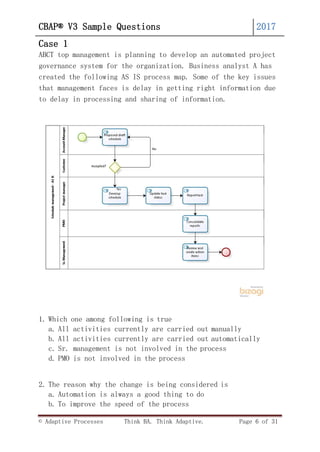
governance system for the organization. Business analyst A has
created the following AS IS process map. Some of the key issues
that management faces is delay in getting right information due
to delay in processing and sharing of information.
1. Which one among following is true
a. All activities currently are carried out manually
b. All activities currently are carried out automatically
c. Sr. management is not involved in the process
d. PMO is not involved in the process
2. The reason why the change is being considered is
a. Automation is always a good thing to do
b. To improve the speed of the process
© Adaptive Processes Think BA. Think Adaptive. Page 7 of 31
CBAP® V3 Sample Questions 2017
c. To engage developers available on bench
d. To improve quality of project deliverables
3. ABCT should
a. Automate all manual processes in the current system
b. Do cost benefit analysis of automating each activity
c. Should automate data capture aspects first
d. Should not automate customer facing processes
4. System to be developed should include
a. Needs of all stakeholders
b. Needs of internal stakeholders only
c. Needs of top management only
d. Needs of project managers only
5. Which among following statements is True
a. Business analyst has not missed any activity
b. Business analyst has not missed any stakeholder
c. This will be considered as a risky project
d. Can’t make any such assessment using the given information
© Adaptive Processes Think BA. Think Adaptive. Page 8 of 31
CBAP® V3 Sample Questions 2017
Case 2
ABCT top management is planning to develop a project
governance system which will cost USD 500K in the first year
and USD 75K per year to maintain.
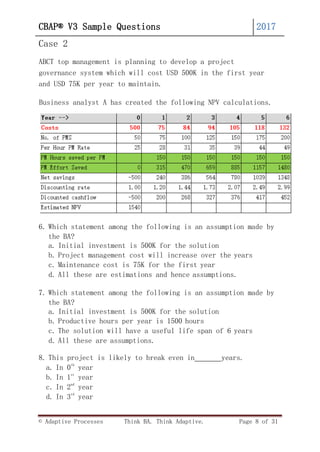
Business analyst A has created the following NPV calculations.
6. Which statement among the following is an assumption made by
the BA?
a. Initial investment is 500K for the solution
b. Project management cost will increase over the years
c. Maintenance cost is 75K for the first year
d. All these are estimations and hence assumptions.
7. Which statement among the following is an assumption made by
the BA?
a. Initial investment is 500K for the solution
b. Productive hours per year is 1500 hours
c. The solution will have a useful life span of 6 years
d. All these are assumptions.
8. This project is likely to break even in years.
a. In 0th
year
b. In 1st
year
c. In 2nd
year
d. In 3rd
year
© Adaptive Processes Think BA. Think Adaptive. Page 9 of 31
CBAP® V3 Sample Questions 2017
9. Actual Net present value for the project is going to .
a. 1540 K USD
b. +/- 20% from 1540 K USD
c. +/- 30% from 1540 K USD
d. Can’t say
10. For any project, NPV should be calculated for
a. 3 years only
b. 6 years only
c. 5 years only
d. Can’t say
Scroll down to find answers and
explanations!
© Adaptive Processes Think BA. Think Adaptive. Page 10 of 31
Complimentary
Bonus Chapter on
CBAP® V3
Certification
Tips and Tricks!
CBAP® V3 Sample Questions 2017
© Adaptive Processes Think BA. Think Adaptive. Page 11 of 31
CBAP® V3 Sample Questions 2017
1. Preface and Introduction
What is business analysis?
BABOK® Definition: Business analysis is the
practice of enabling change in an enterprise
by defining needs and recommending solutions
that deliver value to stakeholders.
Business analysis enables an enterprise to
articulate its needs, rationale for change,
and to design and describe solutions that can
deliver value.
Business analysis can be performed within a
project or across the enterprise. It can be
used to understand the current state, define
future state and determine activities required
for transition.
Business analysis can be performed from
various perspectives like agile, business
intelligence, information technology, business
architecture, business process management etc.
Your notes:
© Adaptive Processes Think BA. Think Adaptive. Page 12 of 31
CBAP® V3 Sample Questions 2017
Who is a Business Analyst
A person who performs BA tasks mentioned in
BABOK® is considered a business analyst
irrespective of his job title or organization
role.
Business analysts elicit actual needs of
stakeholders, not simply capture expressed
desires. They are also responsible for
discovering and analysing information from
various sources.
Common job titles for BAs are business
architect, system analyst, requirements
engineer, process analyst, management
consultant, product manager etc.
Business analysts help organizations define
the optimal solutions for their needs, given
the set of constraints (including time,
budget, regulations and others).
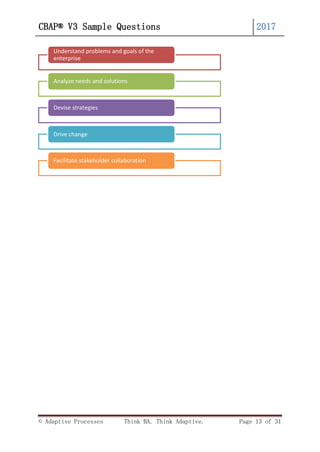
The main activities BAs perform are:
© Adaptive Processes Think BA. Think Adaptive. Page 13 of 31
CBAP® V3 Sample Questions 2017
Facilitate stakeholder collaboration
Drive change
Devise strategies
Analyze needs and solutions
Understand problems and goals of the
enterprise
© Adaptive Processes Think BA. Think Adaptive. Page 14 of 31
CBAP® V3 Sample Questions 2017
What is IIBA® ?
International Institute of Business Analysis
(IIBA® ) was founded in Toronto, Canada in
October of 2003 to support the business
analysis community by:
 Creating and developing awareness and
recognition of the value and contribution
of the business analyst.
 Defining the Business analysis body of
knowledge (BABOK® ).
 Providing a forum for knowledge sharing
and contribution to the business analysis
profession.
 Publicly recognizing and certifying
qualified practitioners through an
internationally acknowledged certification
program.
What is BABOK® ?
BABOK® contains a description of generally
accepted practices in the field of business
analysis. It gives a guidance on the skills
and knowledge that a business analyst must
© Adaptive Processes Think BA. Think Adaptive. Page 15 of 31
CBAP® V3 Sample Questions 2017
possess. Contents of BABOK® have been verified
thoroughly by practitioners.
BABOK® does not mandate that practices
described should be followed under all
circumstances.
Any set of practices MUST be tailored to the
specific business analysis conditions.
The goal of revising BABOK® v2.0 and coming up
the new version v3.0 are as follows:
 Incorporate new concepts and practices
 Address the evolving scope of the
profession
 Incorporate lessons learnt form
practitioners
 Enhance readability and usability of the
guide and consistency and quality of
texts and illustrations
 Improve consistency with other generally
accepted BA standards
What and Why of CBAP®
CBAP® stands for Certified Business Analysis
© Adaptive Processes Think BA. Think Adaptive. Page 16 of 31
CBAP® V3 Sample Questions 2017
Professional, 3rd level certification provided
by International Institute of Business
Analysis (IIBA®), Canada (www.IIBA® .org).
Following are some of the benefits of becoming
a CBAP® :
 Be recognized for your competency in
business analysis.
 Business analysis is the fastest growing
career opportunity for IT professionals.
 People with domain experience can move into
IT sector by becoming a business analyst.
 Better job prospects.
 Better salary.
Eligibility for CBAP®
 High school (In India, this will be higher
secondary school) and above.
 7500 hours of Business analysis-related
work in last 10 years.
 Professional development: 35 hours of
© Adaptive Processes Think BA. Think Adaptive. Page 17 of 31
CBAP® V3 Sample Questions 2017
verifiable BABOK® coursework. Adaptive
Processes is an authorized EEP of IIBA®,
its trainings provide desired PDUs for the
CBAP® certification examination.
 References: Two references from a career
manager, client (internal or external) or
CBAP®.
 900 hours in 4 knowledge areas.
You can down a BA experience calculator at no
cost from our eStore.
Certification process
 Become an IIBA® member at www.IIBA® .org.
 Benefits include free, unlimited access to
the BABOK® and 500+ online books, local,
national and international networking
opportunities and ability to influence the
growth and direction of the BA profession.
 Take required training from an IIBA® EEP,
such as Adaptive Processes
(www.AdaptiveProcesses.com).
© Adaptive Processes Think BA. Think Adaptive. Page 18 of 31
CBAP® V3 Sample Questions 2017
 Download BABOK® and start reading.
 Join a study group, or start one.
 Begin preparing for the application.
Preparing the application
 Begin the application at least 2 weeks
before you plan to apply.
 It can take anywhere from 6-10 hours to
complete.
 Download and use Adaptive BA experience
calculator.
 Apply within 6 months of when you plan to
write.
 You can download the CBAP® handbook for a
detailed application process at IIBA® web-
site.
Tips for the certification examination
 Please keep it in your mind that CBAP® is a
test on your knowledge of BABOK®, not your
knowledge on business analysis practice as
you may be following in your workplace.
© Adaptive Processes Think BA. Think Adaptive. Page 19 of 31
CBAP® V3 Sample Questions 2017
 Answers need to be as per BABOK® , not
what you may think appropriate.
 Questions are pretty much straight forward.
 No long descriptive questions. However,
there are questions with diagrams.
 No long answers. All questions had single
statement answers.
 Avoid answers which are prescriptive.
BABOK® does not provide any specific level
of rigor to be adopted in any activity.
 Be careful with answers which say something
should be 100% or 0% - It’s very hard
to find such digital options in life.
 Avoid terms which are not mentioned in
BABOK® . Such a term can be technically
correct, for example a specific company may
have a Wok Breakdown System – however
BABOK® does not have any such term. BABOK®
term is Work breakdown structure.
 Multiple options can be technically
correct; choose the BEST option.
 Do not trust long lists.
© Adaptive Processes Think BA. Think Adaptive. Page 20 of 31
CBAP® V3 Sample Questions 2017
Knowledge areas
Knowledge areas represent areas of specific BA
expertise.
There are 6 knowledge area in BABoK:
1. BA planning and monitoring
2. Elicitation and collaboration
3. Requirements life cycle management
4. Strategy analysis
5. Requirements analysis and design definition
6. Solution evaluation
© Adaptive Processes Think BA. Think Adaptive. Page 21 of 31
CBAP® V3 Sample Questions 2017
Knowledge areas
Knowledge Areas Description
BA planning and
monitoring
Tasks BAs perform to organize and coordinate
efforts of BAs and stakeholders
Elicitation and
Collaboration
Tasks BAs carry out to prepare for
elicitation, conduct elicitation activities,
confirm results, communicate and collaborate
with stakeholders
Requirements LCM Tasks BAs perform to manage and maintain
requirements and design information from start
till end
Strategy
Analysis
Tasks BAs perform to identify a need of
strategic or tactical importance, how to
collaborate and enable stakeholders to address
that need etc.
Requirements
Analysis and
Design
Definition
Tasks BAs carry out to organize elicited
requirements, model them, validate and verify
them and identify and estimate potential value
of solution options
Solution
Evaluation
Tasks BAs perform to assess the performance
and value delivered by a solution
© Adaptive Processes Think BA. Think Adaptive. Page 22 of 31
CBAP® V3 Sample Questions 2017
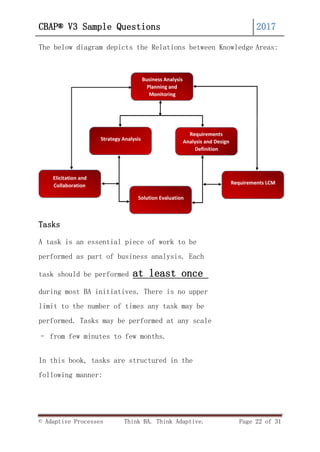
The below diagram depicts the Relations between Knowledge Areas:
Tasks
A task is an essential piece of work to be
performed as part of business analysis. Each
task should be performed at least once
during most BA initiatives. There is no upper
limit to the number of times any task may be
performed. Tasks may be performed at any scale
– from few minutes to few months.
In this book, tasks are structured in the
following manner:
© Adaptive Processes Think BA. Think Adaptive. Page 23 of 31
CBAP® V3 Sample Questions 2017
Purpose: Short description as to why a BA performs a task and
the value derived from it
Inputs Stakeholders Outputs
This section lists
the inputs for a
task which will
lead to outputs
This section lists
stakeholders who are
likely to participate
in a task
This section lists
the results
produced by
performing a task
Guidelines and Tools: This section lists resources which are
required to transform input into output.
Techniques: This section lists the techniques that can be used
to perform the BA task
Underlying competencies
Underlying competencies are skills, knowledge
and personal characteristics that support
effective performance of business analysis.
This is discussed in detail in Chapter 8.
© Adaptive Processes Think BA. Think Adaptive. Page 24 of 31
CBAP® V3 Sample Questions 2017
CBAP® V3 Study Guide
Table of contents
Copyright notice
Introduction 2
Feedbacks and suggestions on the book 2
Unique benefits of working with us 7
Our key clients 7
Adaptive workshops catalogue 8
1. Preface and Introduction 10
1.1 What is business analysis? 10
1.2 What is IIBA®? 13
What and Why of CBAP® 15
Underlying competencies 24
2. BA key concepts 25
Key terms 25
Requirement Classification 26
2.3 Stakeholders 27
3. BA planning and monitoring 29
3.1 Plan BA approach 32
3.2 Plan stakeholder engagement 39
3.3 Plan BA governance 45
Plan BA information management 49
Identify BA performance improvements 56
4. Elicitation and collaboration 60
© Adaptive Processes Think BA. Think Adaptive. Page 25 of 31
CBAP® V3 Sample Questions 2017
4.1 Prepare for elicitation 63
4.2 Conduct elicitation 67
4.3 Confirm elicitation result 70
4.4 Communicate BA information 72
4.5 Manage stakeholder collaboration 76
5. Requirements life cycle management 79
5.1 Trace Requirements 84
Maintain Requirements 87
Prioritize Requirements 89
Assess Requirements Changes 93
5.5 Approve Requirements 96
6. Strategy analysis 98
6.1 Analyze current state 103
6.2 Define future state 108
6.3 Assess risks 113
6.4 Define change strategy 117
7. Requirements analysis and design definition 121
7.1 Specify and model requirements 124
7.2 Verify requirements 128
7.3 Validate requirements 130
7.4 Define Requirements architecture 133
7.5 Define Design options 136
7.6 Analyze Potential value and Recommend Solution 139
8. Solution evaluation 142
Measure Solution Performance 144
© Adaptive Processes Think BA. Think Adaptive. Page 26 of 31
CBAP® V3 Sample Questions 2017
Analyze Performance Measures 147
8.3 Assess Solution limitations 149
8.4 Assess enterprise limitations 152
8.5 Recommend actions to increase solution value 156
9. Underlying Competencies 159
9.1 Analytical Thinking and Problem Solving 159
9.2 Behavioral Characteristics 161
9.3 Business Knowledge 163
9.4 Communication Skills 164
9.5 Interaction Skills 166
9.6 Tools and Technology 167
About Adaptive Processes Consulting
You can buy CBAP® V3 Study Guide at
http://adaptiveus.com/shop/book/
© Adaptive Processes Think BA. Think Adaptive. Page 27 of 31
CBAP® V3 Sample Questions 2017
About Adaptive Processes Consulting
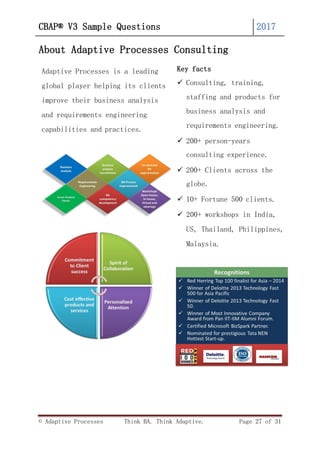
Adaptive Processes is a leading
global player helping its clients
improve their business analysis
and requirements engineering
capabilities and practices.
Key facts
 Consulting, training,
staffing and products for
business analysis and
requirements engineering.
 200+ person-years
consulting experience.
 200+ Clients across the
globe.
 10+ Fortune 500 clients.
 200+ workshops in India,
US, Thailand, Philippines,
Malaysia.
© Adaptive Processes Think BA. Think Adaptive. Page 28 of 31
CBAP® V3 Sample Questions 2017
Govern
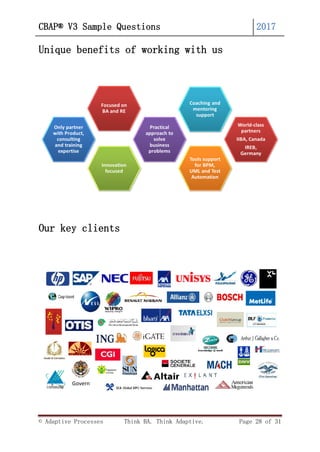
Unique benefits of working with us
Our key clients
© Adaptive Processes Think BA. Think Adaptive. Page 29 of 31
CBAP® V3 Sample Questions 2017
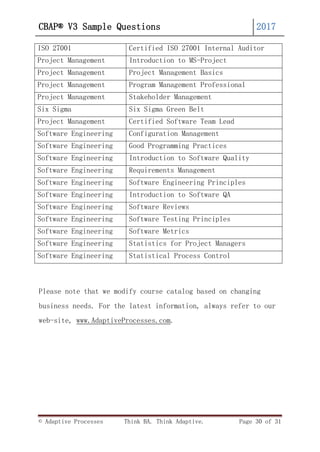
Adaptive workshops catalogue
Category Course Name
Business analysis Certified Business Analyst Professional
(CBAP® ) (Endorsed by IIBA® , Canada)
Business analysis Certification of Competency in Business
Analysis (CCBA®) (Endorsed by IIBA® ,
Canada)
Business analysis Entry Certificate in Business Analysis
(ECBA®) (Endorsed by IIBA® , Canada)
Business analysis Certified Professional in Requirements
Engineering(CPRE®) (Endorsed by IREB,
Germany)
Business analysis Elicitation techniques
Business analysis Requirements modeling using UML
Business analysis Behaviorial skills for Bas
Business analysis The ACE BA program
Agile Certified Agile Practitioner
Agile Introduction to Agile and Scrum
BSC Balance Score Card
CMMI CMMI for Services
CMMI Introduction to CMMI for Development
CMMI CMM Implementation Workshop
CoBIT Introduction to COBIT
Excel Excel for Executive Managers
ISO 27001 Certified ISO 27001 Implementer
© Adaptive Processes Think BA. Think Adaptive. Page 30 of 31
CBAP® V3 Sample Questions 2017
ISO 27001 Certified ISO 27001 Internal Auditor
Project Management Introduction to MS-Project
Project Management Project Management Basics
Project Management Program Management Professional
Project Management Stakeholder Management
Six Sigma Six Sigma Green Belt
Project Management Certified Software Team Lead
Software Engineering Configuration Management
Software Engineering Good Programming Practices
Software Engineering Introduction to Software Quality
Software Engineering Requirements Management
Software Engineering Software Engineering Principles
Software Engineering Introduction to Software QA
Software Engineering Software Reviews
Software Engineering Software Testing Principles
Software Engineering Software Metrics
Software Engineering Statistics for Project Managers
Software Engineering Statistical Process Control
Please note that we modify course catalog based on changing
business needs. For the latest information, always refer to our
web-site, www.AdaptiveProcesses.com.
© Adaptive Processes Think BA. Think Adaptive. Page 31 of 31
CBAP® V3 Sample Questions 2017
© Adaptive Processes Think BA. Think Adaptive. Page 32 of 31
CBAP® V3 Sample Questions 2017
Answers to the test
Question
Number
Correct
option
Explanation
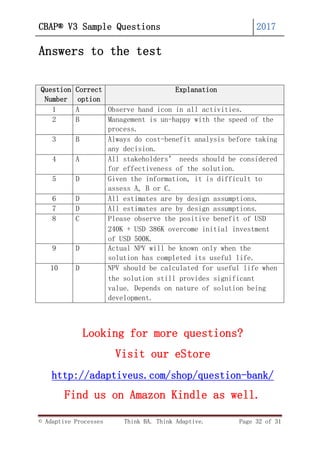
1 A Observe hand icon in all activities.
2 B Management is un-happy with the speed of the
process.
3 B Always do cost-benefit analysis before taking
any decision.
4 A All stakeholders’ needs should be considered
for effectiveness of the solution.
5 D Given the information, it is difficult to
assess A, B or C.
6 D All estimates are by design assumptions.
7 D All estimates are by design assumptions.
8 C Please observe the positive benefit of USD
240K + USD 386K overcome initial investment
of USD 500K.
9 D Actual NPV will be known only when the
solution has completed its useful life.
10 D NPV should be calculated for useful life when
the solution still provides significant
value. Depends on nature of solution being
development.
Looking for more questions?
Visit our eStore
http://adaptiveus.com/shop/question-bank/
Find us on Amazon Kindle as well.

Free CBAP V3 questions

  • 1.
  • 2.
    CBAP® V3 SampleQuestions 2017 © Adaptive Processes Think BA. Think Adaptive. Page 2 of 31 Copyright notice All rights reserved. IIBA®, BABOK®, CBAP®, CCBA®, ECBA® are registered Trademarks of International Institute of Business Analysis, Canada. All trademarks of copyrights mentioned herein are the possession of their respective owners. We make no claim of ownership by the mention of products that contain these marks. Contents of this document should not be disclosed to any unauthorized person. This document may not, in whole or in part, be reduced, reproduced, stored in a retrieval system, translated, or transmitted in any form or by any means, electronic or mechanical. This publication may be used in assisting aspirants for CBAP® examination. It does not warrant that use of this publication will ensure passing the CBAP® examination.
  • 3.
    CBAP® V3 SampleQuestions 2017 © Adaptive Processes Think BA. Think Adaptive. Page 3 of 31 Introduction As the book title suggests, this book is a sample question bank for the aspirants of the CBAP® examination from IIBA®, Canada. We have created multiple question banks to assist CBAP aspirants. A full set of questions can be purchased on our site @ http://adaptiveus.com/shop/question-bank/ This book is authored by qualified CBAP® trainers who have helped many other participants clear the CBAP® examination in the very first attempt. They are also regular trainers for CBAP® preparations in both corporate and open-hose workshops and have trained participants across the world – USA, Australia, Middle East, South East Asia, Europe and Africa. Now CBAP® examination is based on BABOK® v3.0 and so is this question bank. This book is also supported by a study guide and elearning. The CBAP® study guide and eLearnings can be purchased http://adaptiveus.com/shop/
  • 4.
    CBAP® V3 SampleQuestions 2017 © Adaptive Processes Think BA. Think Adaptive. Page 4 of 31 Feedbacks and suggestions on the book We will be glad and thankful if you can share your feedbacks and suggestions on the book. Please send your feedbacks and suggestions to Info@AdaptiveProcesses.com
  • 5.
    © Adaptive ProcessesThink BA. Think Adaptive. Page 5 of 31 CBAP® V3 Sample Questions 2017 CBAP® V3 Case Study Based Questions Strategy Analysis Time allotted: 3.5 Hours (210 Minutes) Best of luck for the examination!
  • 6.
    © Adaptive ProcessesThink BA. Think Adaptive. Page 6 of 31 CBAP® V3 Sample Questions 2017 Case 1 ABCT top management is planning to develop an automated project governance system for the organization. Business analyst A has created the following AS IS process map. Some of the key issues that management faces is delay in getting right information due to delay in processing and sharing of information. 1. Which one among following is true a. All activities currently are carried out manually b. All activities currently are carried out automatically c. Sr. management is not involved in the process d. PMO is not involved in the process 2. The reason why the change is being considered is a. Automation is always a good thing to do b. To improve the speed of the process
  • 7.
    © Adaptive ProcessesThink BA. Think Adaptive. Page 7 of 31 CBAP® V3 Sample Questions 2017 c. To engage developers available on bench d. To improve quality of project deliverables 3. ABCT should a. Automate all manual processes in the current system b. Do cost benefit analysis of automating each activity c. Should automate data capture aspects first d. Should not automate customer facing processes 4. System to be developed should include a. Needs of all stakeholders b. Needs of internal stakeholders only c. Needs of top management only d. Needs of project managers only 5. Which among following statements is True a. Business analyst has not missed any activity b. Business analyst has not missed any stakeholder c. This will be considered as a risky project d. Can’t make any such assessment using the given information
  • 8.
    © Adaptive ProcessesThink BA. Think Adaptive. Page 8 of 31 CBAP® V3 Sample Questions 2017 Case 2 ABCT top management is planning to develop a project governance system which will cost USD 500K in the first year and USD 75K per year to maintain. Business analyst A has created the following NPV calculations. 6. Which statement among the following is an assumption made by the BA? a. Initial investment is 500K for the solution b. Project management cost will increase over the years c. Maintenance cost is 75K for the first year d. All these are estimations and hence assumptions. 7. Which statement among the following is an assumption made by the BA? a. Initial investment is 500K for the solution b. Productive hours per year is 1500 hours c. The solution will have a useful life span of 6 years d. All these are assumptions. 8. This project is likely to break even in years. a. In 0th year b. In 1st year c. In 2nd year d. In 3rd year
  • 9.
    © Adaptive ProcessesThink BA. Think Adaptive. Page 9 of 31 CBAP® V3 Sample Questions 2017 9. Actual Net present value for the project is going to . a. 1540 K USD b. +/- 20% from 1540 K USD c. +/- 30% from 1540 K USD d. Can’t say 10. For any project, NPV should be calculated for a. 3 years only b. 6 years only c. 5 years only d. Can’t say Scroll down to find answers and explanations!
  • 10.
    © Adaptive ProcessesThink BA. Think Adaptive. Page 10 of 31 Complimentary Bonus Chapter on CBAP® V3 Certification Tips and Tricks! CBAP® V3 Sample Questions 2017
  • 11.
    © Adaptive ProcessesThink BA. Think Adaptive. Page 11 of 31 CBAP® V3 Sample Questions 2017 1. Preface and Introduction What is business analysis? BABOK® Definition: Business analysis is the practice of enabling change in an enterprise by defining needs and recommending solutions that deliver value to stakeholders. Business analysis enables an enterprise to articulate its needs, rationale for change, and to design and describe solutions that can deliver value. Business analysis can be performed within a project or across the enterprise. It can be used to understand the current state, define future state and determine activities required for transition. Business analysis can be performed from various perspectives like agile, business intelligence, information technology, business architecture, business process management etc. Your notes:
  • 12.
    © Adaptive ProcessesThink BA. Think Adaptive. Page 12 of 31 CBAP® V3 Sample Questions 2017 Who is a Business Analyst A person who performs BA tasks mentioned in BABOK® is considered a business analyst irrespective of his job title or organization role. Business analysts elicit actual needs of stakeholders, not simply capture expressed desires. They are also responsible for discovering and analysing information from various sources. Common job titles for BAs are business architect, system analyst, requirements engineer, process analyst, management consultant, product manager etc. Business analysts help organizations define the optimal solutions for their needs, given the set of constraints (including time, budget, regulations and others). The main activities BAs perform are:
  • 13.
    © Adaptive ProcessesThink BA. Think Adaptive. Page 13 of 31 CBAP® V3 Sample Questions 2017 Facilitate stakeholder collaboration Drive change Devise strategies Analyze needs and solutions Understand problems and goals of the enterprise
  • 14.
    © Adaptive ProcessesThink BA. Think Adaptive. Page 14 of 31 CBAP® V3 Sample Questions 2017 What is IIBA® ? International Institute of Business Analysis (IIBA® ) was founded in Toronto, Canada in October of 2003 to support the business analysis community by:  Creating and developing awareness and recognition of the value and contribution of the business analyst.  Defining the Business analysis body of knowledge (BABOK® ).  Providing a forum for knowledge sharing and contribution to the business analysis profession.  Publicly recognizing and certifying qualified practitioners through an internationally acknowledged certification program. What is BABOK® ? BABOK® contains a description of generally accepted practices in the field of business analysis. It gives a guidance on the skills and knowledge that a business analyst must
  • 15.
    © Adaptive ProcessesThink BA. Think Adaptive. Page 15 of 31 CBAP® V3 Sample Questions 2017 possess. Contents of BABOK® have been verified thoroughly by practitioners. BABOK® does not mandate that practices described should be followed under all circumstances. Any set of practices MUST be tailored to the specific business analysis conditions. The goal of revising BABOK® v2.0 and coming up the new version v3.0 are as follows:  Incorporate new concepts and practices  Address the evolving scope of the profession  Incorporate lessons learnt form practitioners  Enhance readability and usability of the guide and consistency and quality of texts and illustrations  Improve consistency with other generally accepted BA standards What and Why of CBAP® CBAP® stands for Certified Business Analysis
  • 16.
    © Adaptive ProcessesThink BA. Think Adaptive. Page 16 of 31 CBAP® V3 Sample Questions 2017 Professional, 3rd level certification provided by International Institute of Business Analysis (IIBA®), Canada (www.IIBA® .org). Following are some of the benefits of becoming a CBAP® :  Be recognized for your competency in business analysis.  Business analysis is the fastest growing career opportunity for IT professionals.  People with domain experience can move into IT sector by becoming a business analyst.  Better job prospects.  Better salary. Eligibility for CBAP®  High school (In India, this will be higher secondary school) and above.  7500 hours of Business analysis-related work in last 10 years.  Professional development: 35 hours of
  • 17.
    © Adaptive ProcessesThink BA. Think Adaptive. Page 17 of 31 CBAP® V3 Sample Questions 2017 verifiable BABOK® coursework. Adaptive Processes is an authorized EEP of IIBA®, its trainings provide desired PDUs for the CBAP® certification examination.  References: Two references from a career manager, client (internal or external) or CBAP®.  900 hours in 4 knowledge areas. You can down a BA experience calculator at no cost from our eStore. Certification process  Become an IIBA® member at www.IIBA® .org.  Benefits include free, unlimited access to the BABOK® and 500+ online books, local, national and international networking opportunities and ability to influence the growth and direction of the BA profession.  Take required training from an IIBA® EEP, such as Adaptive Processes (www.AdaptiveProcesses.com).
  • 18.
    © Adaptive ProcessesThink BA. Think Adaptive. Page 18 of 31 CBAP® V3 Sample Questions 2017  Download BABOK® and start reading.  Join a study group, or start one.  Begin preparing for the application. Preparing the application  Begin the application at least 2 weeks before you plan to apply.  It can take anywhere from 6-10 hours to complete.  Download and use Adaptive BA experience calculator.  Apply within 6 months of when you plan to write.  You can download the CBAP® handbook for a detailed application process at IIBA® web- site. Tips for the certification examination  Please keep it in your mind that CBAP® is a test on your knowledge of BABOK®, not your knowledge on business analysis practice as you may be following in your workplace.
  • 19.
    © Adaptive ProcessesThink BA. Think Adaptive. Page 19 of 31 CBAP® V3 Sample Questions 2017  Answers need to be as per BABOK® , not what you may think appropriate.  Questions are pretty much straight forward.  No long descriptive questions. However, there are questions with diagrams.  No long answers. All questions had single statement answers.  Avoid answers which are prescriptive. BABOK® does not provide any specific level of rigor to be adopted in any activity.  Be careful with answers which say something should be 100% or 0% - It’s very hard to find such digital options in life.  Avoid terms which are not mentioned in BABOK® . Such a term can be technically correct, for example a specific company may have a Wok Breakdown System – however BABOK® does not have any such term. BABOK® term is Work breakdown structure.  Multiple options can be technically correct; choose the BEST option.  Do not trust long lists.
  • 20.
    © Adaptive ProcessesThink BA. Think Adaptive. Page 20 of 31 CBAP® V3 Sample Questions 2017 Knowledge areas Knowledge areas represent areas of specific BA expertise. There are 6 knowledge area in BABoK: 1. BA planning and monitoring 2. Elicitation and collaboration 3. Requirements life cycle management 4. Strategy analysis 5. Requirements analysis and design definition 6. Solution evaluation
  • 21.
    © Adaptive ProcessesThink BA. Think Adaptive. Page 21 of 31 CBAP® V3 Sample Questions 2017 Knowledge areas Knowledge Areas Description BA planning and monitoring Tasks BAs perform to organize and coordinate efforts of BAs and stakeholders Elicitation and Collaboration Tasks BAs carry out to prepare for elicitation, conduct elicitation activities, confirm results, communicate and collaborate with stakeholders Requirements LCM Tasks BAs perform to manage and maintain requirements and design information from start till end Strategy Analysis Tasks BAs perform to identify a need of strategic or tactical importance, how to collaborate and enable stakeholders to address that need etc. Requirements Analysis and Design Definition Tasks BAs carry out to organize elicited requirements, model them, validate and verify them and identify and estimate potential value of solution options Solution Evaluation Tasks BAs perform to assess the performance and value delivered by a solution
  • 22.
    © Adaptive ProcessesThink BA. Think Adaptive. Page 22 of 31 CBAP® V3 Sample Questions 2017 The below diagram depicts the Relations between Knowledge Areas: Tasks A task is an essential piece of work to be performed as part of business analysis. Each task should be performed at least once during most BA initiatives. There is no upper limit to the number of times any task may be performed. Tasks may be performed at any scale – from few minutes to few months. In this book, tasks are structured in the following manner:
  • 23.
    © Adaptive ProcessesThink BA. Think Adaptive. Page 23 of 31 CBAP® V3 Sample Questions 2017 Purpose: Short description as to why a BA performs a task and the value derived from it Inputs Stakeholders Outputs This section lists the inputs for a task which will lead to outputs This section lists stakeholders who are likely to participate in a task This section lists the results produced by performing a task Guidelines and Tools: This section lists resources which are required to transform input into output. Techniques: This section lists the techniques that can be used to perform the BA task Underlying competencies Underlying competencies are skills, knowledge and personal characteristics that support effective performance of business analysis. This is discussed in detail in Chapter 8.
  • 24.
    © Adaptive ProcessesThink BA. Think Adaptive. Page 24 of 31 CBAP® V3 Sample Questions 2017 CBAP® V3 Study Guide Table of contents Copyright notice Introduction 2 Feedbacks and suggestions on the book 2 Unique benefits of working with us 7 Our key clients 7 Adaptive workshops catalogue 8 1. Preface and Introduction 10 1.1 What is business analysis? 10 1.2 What is IIBA®? 13 What and Why of CBAP® 15 Underlying competencies 24 2. BA key concepts 25 Key terms 25 Requirement Classification 26 2.3 Stakeholders 27 3. BA planning and monitoring 29 3.1 Plan BA approach 32 3.2 Plan stakeholder engagement 39 3.3 Plan BA governance 45 Plan BA information management 49 Identify BA performance improvements 56 4. Elicitation and collaboration 60
  • 25.
    © Adaptive ProcessesThink BA. Think Adaptive. Page 25 of 31 CBAP® V3 Sample Questions 2017 4.1 Prepare for elicitation 63 4.2 Conduct elicitation 67 4.3 Confirm elicitation result 70 4.4 Communicate BA information 72 4.5 Manage stakeholder collaboration 76 5. Requirements life cycle management 79 5.1 Trace Requirements 84 Maintain Requirements 87 Prioritize Requirements 89 Assess Requirements Changes 93 5.5 Approve Requirements 96 6. Strategy analysis 98 6.1 Analyze current state 103 6.2 Define future state 108 6.3 Assess risks 113 6.4 Define change strategy 117 7. Requirements analysis and design definition 121 7.1 Specify and model requirements 124 7.2 Verify requirements 128 7.3 Validate requirements 130 7.4 Define Requirements architecture 133 7.5 Define Design options 136 7.6 Analyze Potential value and Recommend Solution 139 8. Solution evaluation 142 Measure Solution Performance 144
  • 26.
    © Adaptive ProcessesThink BA. Think Adaptive. Page 26 of 31 CBAP® V3 Sample Questions 2017 Analyze Performance Measures 147 8.3 Assess Solution limitations 149 8.4 Assess enterprise limitations 152 8.5 Recommend actions to increase solution value 156 9. Underlying Competencies 159 9.1 Analytical Thinking and Problem Solving 159 9.2 Behavioral Characteristics 161 9.3 Business Knowledge 163 9.4 Communication Skills 164 9.5 Interaction Skills 166 9.6 Tools and Technology 167 About Adaptive Processes Consulting You can buy CBAP® V3 Study Guide at http://adaptiveus.com/shop/book/
  • 27.
    © Adaptive ProcessesThink BA. Think Adaptive. Page 27 of 31 CBAP® V3 Sample Questions 2017 About Adaptive Processes Consulting Adaptive Processes is a leading global player helping its clients improve their business analysis and requirements engineering capabilities and practices. Key facts  Consulting, training, staffing and products for business analysis and requirements engineering.  200+ person-years consulting experience.  200+ Clients across the globe.  10+ Fortune 500 clients.  200+ workshops in India, US, Thailand, Philippines, Malaysia.
  • 28.
    © Adaptive ProcessesThink BA. Think Adaptive. Page 28 of 31 CBAP® V3 Sample Questions 2017 Govern Unique benefits of working with us Our key clients
  • 29.
    © Adaptive ProcessesThink BA. Think Adaptive. Page 29 of 31 CBAP® V3 Sample Questions 2017 Adaptive workshops catalogue Category Course Name Business analysis Certified Business Analyst Professional (CBAP® ) (Endorsed by IIBA® , Canada) Business analysis Certification of Competency in Business Analysis (CCBA®) (Endorsed by IIBA® , Canada) Business analysis Entry Certificate in Business Analysis (ECBA®) (Endorsed by IIBA® , Canada) Business analysis Certified Professional in Requirements Engineering(CPRE®) (Endorsed by IREB, Germany) Business analysis Elicitation techniques Business analysis Requirements modeling using UML Business analysis Behaviorial skills for Bas Business analysis The ACE BA program Agile Certified Agile Practitioner Agile Introduction to Agile and Scrum BSC Balance Score Card CMMI CMMI for Services CMMI Introduction to CMMI for Development CMMI CMM Implementation Workshop CoBIT Introduction to COBIT Excel Excel for Executive Managers ISO 27001 Certified ISO 27001 Implementer
  • 30.
    © Adaptive ProcessesThink BA. Think Adaptive. Page 30 of 31 CBAP® V3 Sample Questions 2017 ISO 27001 Certified ISO 27001 Internal Auditor Project Management Introduction to MS-Project Project Management Project Management Basics Project Management Program Management Professional Project Management Stakeholder Management Six Sigma Six Sigma Green Belt Project Management Certified Software Team Lead Software Engineering Configuration Management Software Engineering Good Programming Practices Software Engineering Introduction to Software Quality Software Engineering Requirements Management Software Engineering Software Engineering Principles Software Engineering Introduction to Software QA Software Engineering Software Reviews Software Engineering Software Testing Principles Software Engineering Software Metrics Software Engineering Statistics for Project Managers Software Engineering Statistical Process Control Please note that we modify course catalog based on changing business needs. For the latest information, always refer to our web-site, www.AdaptiveProcesses.com.
  • 31.
    © Adaptive ProcessesThink BA. Think Adaptive. Page 31 of 31 CBAP® V3 Sample Questions 2017
  • 32.
    © Adaptive ProcessesThink BA. Think Adaptive. Page 32 of 31 CBAP® V3 Sample Questions 2017 Answers to the test Question Number Correct option Explanation 1 A Observe hand icon in all activities. 2 B Management is un-happy with the speed of the process. 3 B Always do cost-benefit analysis before taking any decision. 4 A All stakeholders’ needs should be considered for effectiveness of the solution. 5 D Given the information, it is difficult to assess A, B or C. 6 D All estimates are by design assumptions. 7 D All estimates are by design assumptions. 8 C Please observe the positive benefit of USD 240K + USD 386K overcome initial investment of USD 500K. 9 D Actual NPV will be known only when the solution has completed its useful life. 10 D NPV should be calculated for useful life when the solution still provides significant value. Depends on nature of solution being development. Looking for more questions? Visit our eStore http://adaptiveus.com/shop/question-bank/ Find us on Amazon Kindle as well.