SABSA Implementation
Generic Approach
PART VI
TIME & PERFORMANCE
MANAGEMENT CONCEPTS
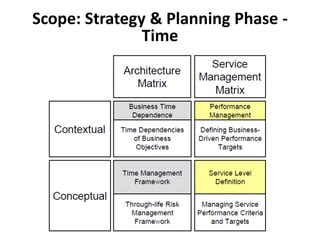
Scope: Strategy & Planning Phase -
Time
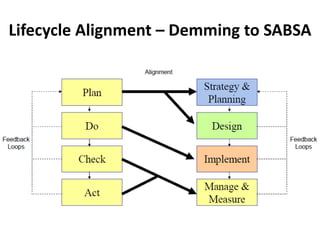
Lifecycle Alignment – Demming to SABSA
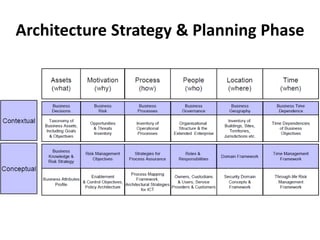
Architecture Strategy & Planning Phase
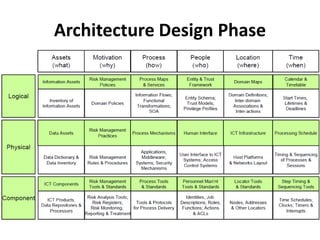
Architecture Design Phase
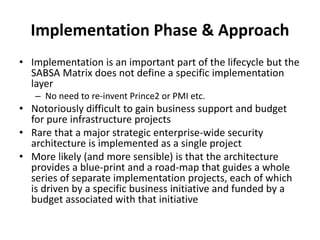
Implementation Phase & Approach
• Implementation is an important part of the lifecycle but the
SABSA Matrix does not define a specific implementation
layer
– No need to re-invent Prince2 or PMI etc.
• Notoriously difficult to gain business support and budget
for pure infrastructure projects
• Rare that a major strategic enterprise-wide security
architecture is implemented as a single project
• More likely (and more sensible) is that the architecture
provides a blue-print and a road-map that guides a whole
series of separate implementation projects, each of which
is driven by a specific business initiative and funded by a
budget associated with that initiative
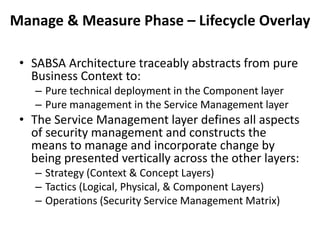
Manage & Measure Phase – Lifecycle Overlay
• SABSA Architecture traceably abstracts from pure
Business Context to:
– Pure technical deployment in the Component layer
– Pure management in the Service Management layer
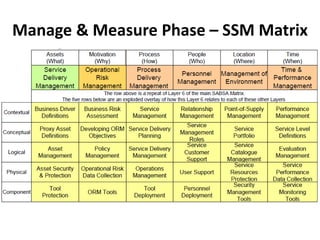
• The Service Management layer defines all aspects
of security management and constructs the
means to manage and incorporate change by
being presented vertically across the other layers:
– Strategy (Context & Concept Layers)
– Tactics (Logical, Physical, & Component Layers)
– Operations (Security Service Management Matrix)
Manage & Measure Phase – SSM Matrix
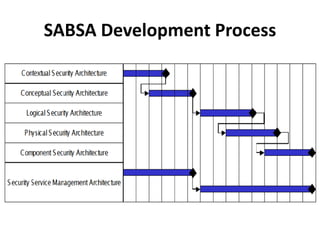
SABSA Development Process
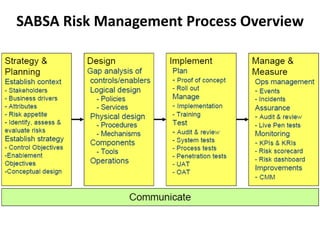
SABSA Risk Management Process Overview
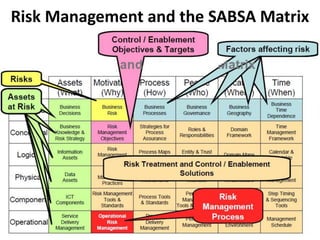
Risk Management and the SABSA Matrix
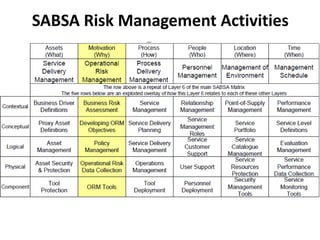
SABSA Risk Management Activities
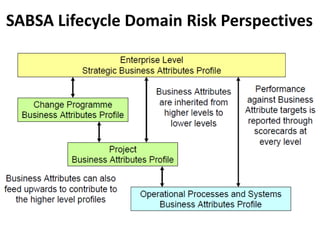
SABSA Lifecycle Domain Risk Perspectives
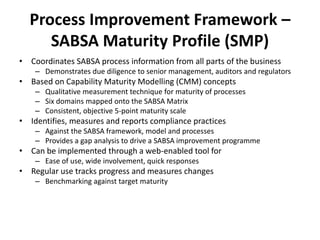
Process Improvement Framework –
SABSA Maturity Profile (SMP)
• Coordinates SABSA process information from all parts of the business
– Demonstrates due diligence to senior management, auditors and regulators
• Based on Capability Maturity Modelling (CMM) concepts
– Qualitative measurement technique for maturity of processes
– Six domains mapped onto the SABSA Matrix
– Consistent, objective 5-point maturity scale
• Identifies, measures and reports compliance practices
– Against the SABSA framework, model and processes
– Provides a gap analysis to drive a SABSA improvement programme
• Can be implemented through a web-enabled tool for
– Ease of use, wide involvement, quick responses
• Regular use tracks progress and measures changes
– Benchmarking against target maturity
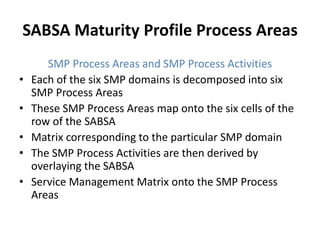
SABSA Maturity Profile Process Areas
SMP Process Areas and SMP Process Activities
• Each of the six SMP domains is decomposed into six
SMP Process Areas
• These SMP Process Areas map onto the six cells of the
row of the SABSA
• Matrix corresponding to the particular SMP domain
• The SMP Process Activities are then derived by
overlaying the SABSA
• Service Management Matrix onto the SMP Process
Areas
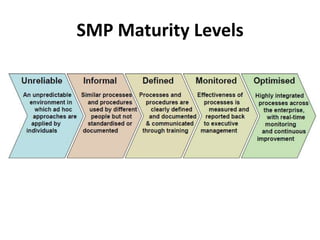
SMP Maturity Levels
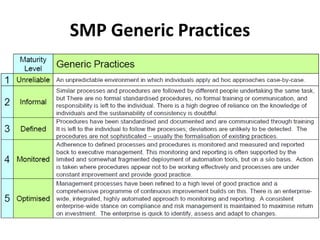
SMP Generic Practices
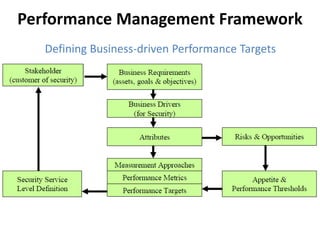
Performance Management Framework
Defining Business-driven Performance Targets
Architecture Measurement Categories
• Completeness
– Do we have all of the
components?
– Do they form an integrated
system?
• Assurance
– Does the system run
smoothly?
– Are we assured that it is
properly assembled?
– Is the system fit-for-purpose?
• Compliance
– Do we maintain the system?
– Do we follow the architecture
roadmap
– Do we comply with the rules?
• Performance
– Is the system properly tuned?
– Do the components work
together?
– Do we operate the system
correctly?
• Justification & significance
– Does the system have
business value?
Measurement Approaches
• High level statements of the approach to
obtaining a measurement
• Appropriate to the business need
• In the language of the intended audience
• Culturally specific
Measurement Guidelines
• Measurement should be a repeatable process
(for comparison & prediction)
• Measurement should have a clear
communications role
• Tracking performance
• Assigning resources
• Measurement should yield quantifiable metrics
(percentage, average, numbers, values, etc.)
Metrics Guidelines
• Data used to calculate metrics should be readily
obtainable
• Metrics may (should) be calculated
independently of parties with vested interest
• The type of metric used may change in line with
the maturity of the security process e.g. when
you are highly compliant, consider changing from
conformance measure to significance measure
• Performance metric / trend should be tested
prior to going ‘live’
• Expectations management is key
Types of Metric
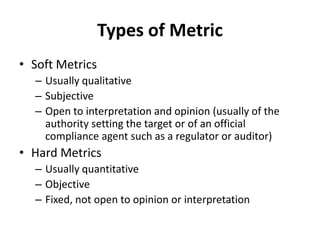
• Soft Metrics
– Usually qualitative
– Subjective
– Open to interpretation and opinion (usually of the
authority setting the target or of an official
compliance agent such as a regulator or auditor)
• Hard Metrics
– Usually quantitative
– Objective
– Fixed, not open to opinion or interpretation
Types of Metric
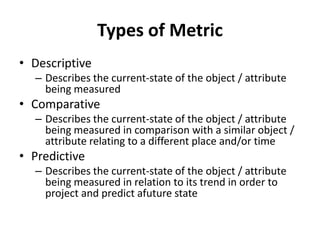
• Descriptive
– Describes the current-state of the object / attribute
being measured
• Comparative
– Describes the current-state of the object / attribute
being measured in comparison with a similar object /
attribute relating to a different place and/or time
• Predictive
– Describes the current-state of the object / attribute
being measured in relation to its trend in order to
project and predict afuture state
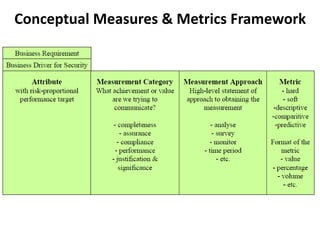
Conceptual Measures & Metrics Framework
SABSA Vitality Framework
END OF PART VI

SABSA Implementation(Part VI)_ver1-0

  • 1.
  • 2.
  • 3.
    Scope: Strategy &Planning Phase - Time
  • 4.
    Lifecycle Alignment –Demming to SABSA
  • 5.
  • 6.
  • 7.
    Implementation Phase &Approach • Implementation is an important part of the lifecycle but the SABSA Matrix does not define a specific implementation layer – No need to re-invent Prince2 or PMI etc. • Notoriously difficult to gain business support and budget for pure infrastructure projects • Rare that a major strategic enterprise-wide security architecture is implemented as a single project • More likely (and more sensible) is that the architecture provides a blue-print and a road-map that guides a whole series of separate implementation projects, each of which is driven by a specific business initiative and funded by a budget associated with that initiative
  • 8.
    Manage & MeasurePhase – Lifecycle Overlay • SABSA Architecture traceably abstracts from pure Business Context to: – Pure technical deployment in the Component layer – Pure management in the Service Management layer • The Service Management layer defines all aspects of security management and constructs the means to manage and incorporate change by being presented vertically across the other layers: – Strategy (Context & Concept Layers) – Tactics (Logical, Physical, & Component Layers) – Operations (Security Service Management Matrix)
  • 9.
    Manage & MeasurePhase – SSM Matrix
  • 10.
  • 11.
    SABSA Risk ManagementProcess Overview
  • 12.
    Risk Management andthe SABSA Matrix
  • 13.
  • 14.
    SABSA Lifecycle DomainRisk Perspectives
  • 15.
    Process Improvement Framework– SABSA Maturity Profile (SMP) • Coordinates SABSA process information from all parts of the business – Demonstrates due diligence to senior management, auditors and regulators • Based on Capability Maturity Modelling (CMM) concepts – Qualitative measurement technique for maturity of processes – Six domains mapped onto the SABSA Matrix – Consistent, objective 5-point maturity scale • Identifies, measures and reports compliance practices – Against the SABSA framework, model and processes – Provides a gap analysis to drive a SABSA improvement programme • Can be implemented through a web-enabled tool for – Ease of use, wide involvement, quick responses • Regular use tracks progress and measures changes – Benchmarking against target maturity
  • 16.
    SABSA Maturity ProfileProcess Areas SMP Process Areas and SMP Process Activities • Each of the six SMP domains is decomposed into six SMP Process Areas • These SMP Process Areas map onto the six cells of the row of the SABSA • Matrix corresponding to the particular SMP domain • The SMP Process Activities are then derived by overlaying the SABSA • Service Management Matrix onto the SMP Process Areas
  • 17.
  • 18.
  • 19.
    Performance Management Framework DefiningBusiness-driven Performance Targets
  • 20.
    Architecture Measurement Categories •Completeness – Do we have all of the components? – Do they form an integrated system? • Assurance – Does the system run smoothly? – Are we assured that it is properly assembled? – Is the system fit-for-purpose? • Compliance – Do we maintain the system? – Do we follow the architecture roadmap – Do we comply with the rules? • Performance – Is the system properly tuned? – Do the components work together? – Do we operate the system correctly? • Justification & significance – Does the system have business value?
  • 21.
    Measurement Approaches • Highlevel statements of the approach to obtaining a measurement • Appropriate to the business need • In the language of the intended audience • Culturally specific
  • 22.
    Measurement Guidelines • Measurementshould be a repeatable process (for comparison & prediction) • Measurement should have a clear communications role • Tracking performance • Assigning resources • Measurement should yield quantifiable metrics (percentage, average, numbers, values, etc.)
  • 23.
    Metrics Guidelines • Dataused to calculate metrics should be readily obtainable • Metrics may (should) be calculated independently of parties with vested interest • The type of metric used may change in line with the maturity of the security process e.g. when you are highly compliant, consider changing from conformance measure to significance measure • Performance metric / trend should be tested prior to going ‘live’ • Expectations management is key
  • 24.
    Types of Metric •Soft Metrics – Usually qualitative – Subjective – Open to interpretation and opinion (usually of the authority setting the target or of an official compliance agent such as a regulator or auditor) • Hard Metrics – Usually quantitative – Objective – Fixed, not open to opinion or interpretation
  • 25.
    Types of Metric •Descriptive – Describes the current-state of the object / attribute being measured • Comparative – Describes the current-state of the object / attribute being measured in comparison with a similar object / attribute relating to a different place and/or time • Predictive – Describes the current-state of the object / attribute being measured in relation to its trend in order to project and predict afuture state
  • 26.
    Conceptual Measures &Metrics Framework
  • 27.
  • 28.