1
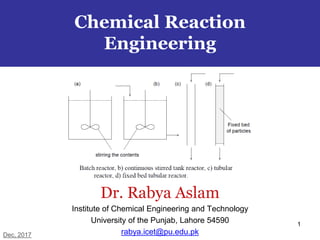
Chemical Reaction
Engineering
Dr. Rabya Aslam
Institute of Chemical Engineering and Technology
University of the Punjab, Lahore 54590
rabya.icet@pu.edu.pkDec, 2017
2
Course contents
 Introduction to chemical reaction engineering
 Kinetics of homogeneous reactions
 Interpretation of reactor data for single and multiple reactions.
Integral method and differential method of analysis for constant
volume and variable volume batch reactors.
 Design of homogeneous reactors: Batch, Mixed flow, Plug flow
reactors, Comparison of single reactor, multiple reactor systems in
parallel/series.
 Temperature and pressure effects.
 Adiabatic and non-adiabatic operations.
 Design of heterogeneous reactors: Rate equations for
heterogeneous reactions. Catalyst deactivation and regeneration.
Design of fixed bed and fluidized bed catalytic reactors.
3
 Levenspiel, O. 1999. Chemical reaction engineering. 3rd ed.
Wiley & Sons, Inc., Singapore.
 Fogler, H.S. 2006. Elements of chemical reaction engineering.
4th ed. Prentice-Hall.
 Froment, G.F.; Bischoff, K.B.; De Wilde, J. 2011. Chemical
reactor analysis and design. 3rd ed. John Wiley & Sons, Inc.
 Missen, R.W.; Mims, C.A.; Saville, B.A. 1999. Introduction to
chemical reaction engineering and kinetics. John Wiley &
Sons, Inc., New York.
 Smith, J.M. 1981. Chemical engineering kinetics. 3rd ed.
McGraw-Hill Int. Book Co., Singapore.
Recommended books
4
Course objectives
The objective of this course is to give the understanding
of designing of commonly used chemical reactors. This
course will provide in-depth knowledge of the
application of laws of thermodynamics and reaction
kinetics for the economical design of chemical reactors.
Students will learn how can a chemical engineer
develop a rate expression and design an
industrial reactor.
5
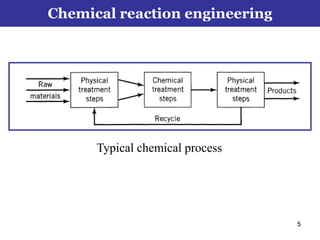
Chemical reaction engineering
Typical chemical process
5
6
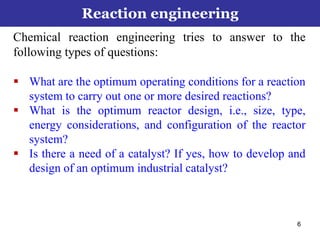
Chemical reaction engineering tries to answer to the
following types of questions:
 What are the optimum operating conditions for a reaction
system to carry out one or more desired reactions?
 What is the optimum reactor design, i.e., size, type,
energy considerations, and configuration of the reactor
system?
 Is there a need of a catalyst? If yes, how to develop and
design of an optimum industrial catalyst?
Reaction engineering
6
7
Catalysis and reaction engineering
Principle of
Chemical
reaction
engineering
7
8
What is Chemical Reaction
8
chemical reaction is said to be taken place when a detectable
number of molecules of one or more species have lost their
identity and assumed a new form by a change in the kind or
number of atoms in the compound and/or by a change in structure
or configuration of these atoms.
Thus a chemical reaction is responsible for a chemical change that
may be happened by any of the following processes
 Decomposition
 Combination
 or isomerization
In this classical approach to chemical change, it is
assumed that the total mass is neither created nor
destroyed when a chemical reaction occurs.
9
The rate of consumption of a reactant species is defined as
the change in number of moles of the reactant species per
unit volume of the reaction mixture per unit time.
The volume of a gas also changes due to changes in operating
conditions (temperature and pressure) in addition to changes in
number of moles
dt
dn
V
r A
A 
1
)(
Rate of a chemical reaction
dt
dC
r A
A  )(
 Not general
 Applicable when volume of the reaction mixture
is constant during the course of reaction
 It may be true for liquid phase reactions or for
constant density gas phase reactions
Volume of
reaction mixture
Perfectly
general
Negative sign
indicates that rate is
decreasing with time
and required as dnA is
negative for a reactant
10
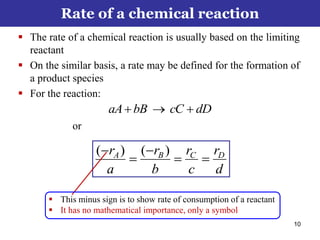
 The rate of a chemical reaction is usually based on the limiting
reactant
 On the similar basis, a rate may be defined for the formation of
a product species
 For the reaction:
dDcCbBaA 
or
d
r
c
r
b
r
a
r DCBA



 )()(
Rate of a chemical reaction
 This minus sign is to show rate of consumption of a reactant
 It has no mathematical importance, only a symbol
11
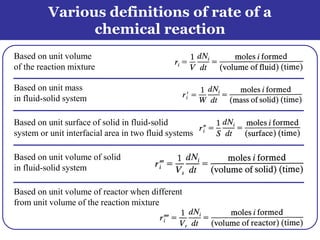
Based on unit volume
of the reaction mixture
Based on unit mass
in fluid-solid system
Based on unit surface of solid in fluid-solid
system or unit interfacial area in two fluid systems
Based on unit volume of solid
in fluid-solid system
Based on unit volume of reactor when different
from unit volume of the reaction mixture
Various definitions of rate of a
chemical reaction
12
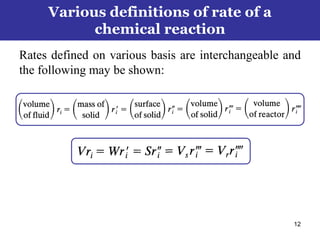
Rates defined on various basis are interchangeable and
the following may be shown:
Various definitions of rate of a
chemical reaction
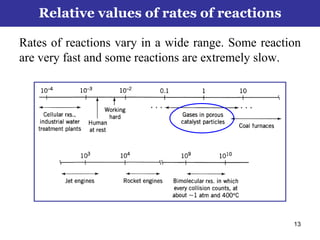
13
Rates of reactions vary in a wide range. Some reaction
are very fast and some reactions are extremely slow.
Relative values of rates of reactions
14
 A higher rate of reaction means less processing time in a
batch reactor and smaller size of reactor vessel in a
continuous flow reactor (CSTR and PFR)
 As the residence time is dependent upon the rate, the
knowledge of rate is required for the design of a reactor
 We need an expression (rate equation) that describes the
rate of a given reaction
Rate equation cannot be found reliably from the reaction
stoichiometry or by any other theoretical means and therefore
rate expressions are always to be empirical, i.e., to be
discovered through experiments.
Why are we interested in rate?
15
Classifications of reactions
15
Chemical reactions may be classified in several ways
1: Based on Mechanism
 Reversible
 Irreversible
 Consecutive
 Parallel
2: Based on number of molecules involved
 Uni-molecular
 Bi-molecular
 Termolecular
16
Classifications of reactions
16
3: Based on Operating Conditions
 Isothermal
 Adiabatic
 Non-adiabatic
4: Based on Order of Reaction
 Zero order
 First order
 Second order
 Third order
 Fractional order
17
Classifications of reactions
17
5: Based on Phases Involved
 Homogeneous
 Heterogeneous
 Catalytic
 Non catalytic/ autocatalytic
6: Based on Heat of Reaction
 Exothermic
 Endothermic
Nearly 90% of all industrial reactions involve
heterogeneous catalysis, i.e., they are heterogeneous
as well as catalytic
18
Stoichiometric coefficient (ν) is the number appearing
before the symbol for each compound in the balanced
equation for a chemical reaction.
For the reaction
a, b, c and d are the stoichiometric coefficients.
By convention:
 A stoichiometric coefficient for a reactant is negative
 A stoichiometric coefficient for a product is positive
 A stoichiometric coefficient for an inert, solvent, or
catalyst is zero.
dDcCbBaA 
Stoichiometric coefficient
ν
18
19
  iii nn 0
tcoefficientricstoichiome
speciesaofmolesinchangenn
i
ii




 0
tcoefficientricstoichiome
speciesaofflowratemolarinchangeFF
i
ii




 0
  iii FF 0
ξ extent of a reaction in terms of change in moles
ξ′ extent of a reaction in terms of change in molar flowrate
νi stoichiometric coefficient of an ith species
Extent of a reaction
ξ
19
20
Ratio of change in moles of a reactant (usually
limiting reactant) to the moles of the reactant fed.
For a reactant A:
nA0 = initial moles of the reactant “A”, mol; nA = moles of “A”
at any time t (s), mol; FA0 = initial molar flowrate, mol·s−1, FA
= molar flowrate of A at any time t (s), mol·s−1, CA =
Concentration at time t, mol.L-1, and CA0 is initial
concentration.
For an irreversible and single (no side reaction) reaction, an
increase in the outlet conversion is an indication of higher rate
of the reaction
00
0
0
0
1
AA
AA
A
AA
A
C
C
F
FF
n
nn
X
A





Conversion or fractional conversion
XA
21
Relationship between extent of a
reaction and fractional conversion
For reactant A:
A
AA nn

 0

0
00
A
A
A
AA
n
nnn




 








A
A
A
AA n
n
nn

 0
0
0
0
0
A
AA
A
n
nn
X


A
AA
A
A
A
nXn
X

 00







21
It is the fractional change in volume of the system between no
conversion and complete conversion of reactant A
For constant density system
For variable density system,
22
Expansion factor
22
0
01

 

A
AA
x
xx
V
VV

0εA 
23
Expansion factor
23
0
0
V
VV
X
εA


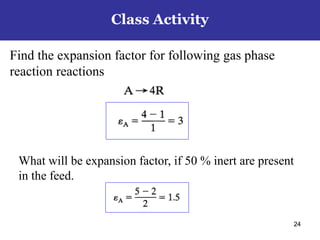
Find the expansion factor for following gas phase
reaction reactions
24
Class Activity
24
What will be expansion factor, if 50 % inert are present
in the feed.
Find the expansion factor for following liquid phase
reaction reactions
25
Class Activity
25
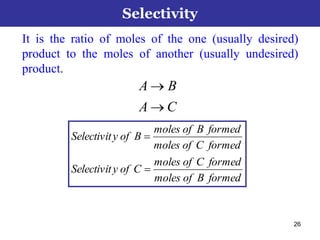
26
It is the ratio of moles of the one (usually desired)
product to the moles of another (usually undesired)
product.
CA
BA


formedBofmoles
formedCofmoles
CofySelectivit
formedCofmoles
formedBofmoles
BofySelectivit


Selectivity
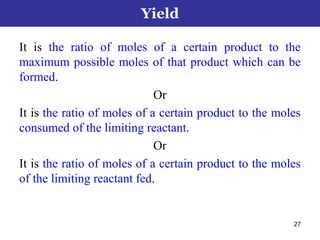
27
It is the ratio of moles of a certain product to the
maximum possible moles of that product which can be
formed.
Or
It is the ratio of moles of a certain product to the moles
consumed of the limiting reactant.
Or
It is the ratio of moles of a certain product to the moles
of the limiting reactant fed.
Yield
28
 In a chemical reaction the reactant present in excess to that
required stoichiometrically is the excess reactant the other is
limiting reactant
 If the reactants are added in stoichiometric amounts, there is
no point using the concept of limiting or excess reactant
The choice of the limiting reactant is arbitrary and depends
on the cost (profit) considerations
Limiting and excess reactant
29
Can you mention any example of an industrial
process and indicate the limiting reactant?
What are the reasons for the choice of a particular
limiting reactant in your example?
Limiting and excess reactant
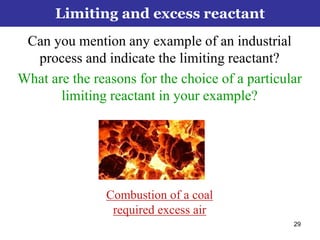
Combustion of a coal
required excess air
30
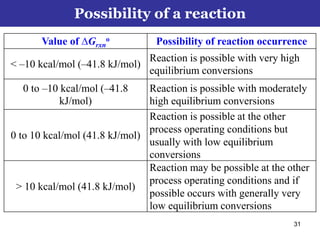
 For a thermodynamically possible reaction means that
Gibbs free energy of reaction ∆Grxn is less than zero,
i.e., the reactants have higher free energy than the
products.
A useful criterion for knowing the possibility of
reaction occurrence is to know the standard state Gibbs
free energy of reaction, ∆Grxn
o. A reaction, however,
may not be feasible at the standard conditions but may
occur at the other conditions.
Possibility of a reaction
31
Value of ∆Grxn
o Possibility of reaction occurrence
< ‒10 kcal/mol (‒41.8 kJ/mol)
Reaction is possible with very high
equilibrium conversions
0 to ‒10 kcal/mol (‒41.8
kJ/mol)
Reaction is possible with moderately
high equilibrium conversions
0 to 10 kcal/mol (41.8 kJ/mol)
Reaction is possible at the other
process operating conditions but
usually with low equilibrium
conversions
> 10 kcal/mol (41.8 kJ/mol)
Reaction may be possible at the other
process operating conditions and if
possible occurs with generally very
low equilibrium conversions
Possibility of a reaction
32
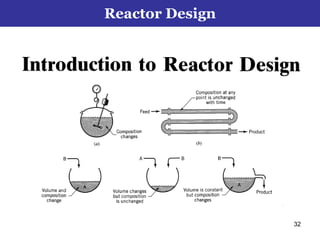
Reactor Design
33
Types of reactors
Chemical reactors may have wide variety of size, shape, flow pattern.
And operating conditions. Mainly these are classified on the basis of
1. Based on mode of operation
 Batch reactors
 Semi batch reactors
 Continuous reactors
2. Based on no. of phases involved
 Homogeneous reactors
 Heterogeneous reactors
3. Based on shape of reactor
 Tank reactors
 Tubular reactors
34
Types of reactors: Based on mode of operation
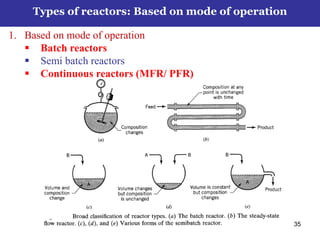
1. Based on mode of operation
 Batch reactors
 Semi batch reactors
 Continuous reactors (MFR/ PFR)
35
Types of reactors: Based on mode of operation
1. Based on mode of operation
 Batch reactors
 Semi batch reactors
 Continuous reactors (MFR/ PFR)
36
Types of reactors: Based on phases involved
2. Based on number of phases involved
 Reactors for Liquid Phase
 Reactors for Gas phase
 Reactors for Gas/Liquid Phase
 Reactors for Gas/solid phase or liquid/solid phase
 Reactors for Gas/ Liquid/ Solid Phase
37
Types of reactors: Based on shape
3. Based on shape
 Tank reactors
 Tubular reactors
38
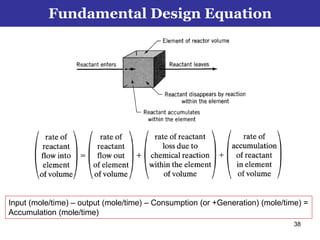
Fundamental Design Equation
Input (mole/time) – output (mole/time) – Consumption (or +Generation) (mole/time) =
Accumulation (mole/time)
39
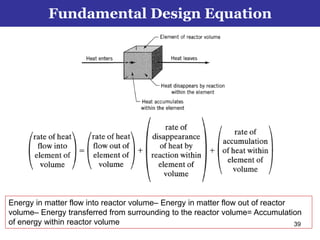
Fundamental Design Equation
Energy in matter flow into reactor volume– Energy in matter flow out of reactor
volume– Energy transferred from surrounding to the reactor volume= Accumulation
of energy within reactor volume
40
Batch reactor
Batch reactor
Semi-batch reactor
41
Batch reactor
 In the batch reactor, or BR, the reactants are initially charged into a
vessel, are well mixed, and are left to react for a certain period. The
resultant mixture is then discharged.
 This is an unsteady-state operation where composition changes with
time; however, at any instant the composition throughout the
reactor is uniform.
42
Batch reactor
This is the general equation showing the time required to achieve
a conversion XA for either isothermal or non-isothermal operation.
43
Batch reactor
Case 1: density of fluid remains constant
Case 2: density of fluid is not constant (For all reactions in
which the volume of reacting mixture changes proportionately
with conversion, such as in single gas-phase reactions with
significant density changes)
44
Batch reactor
Space time and space velocity:
45
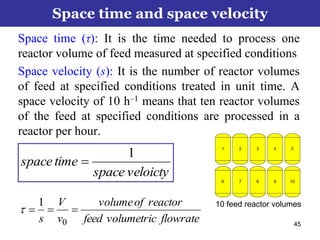
Space time (τ): It is the time needed to process one
reactor volume of feed measured at specified conditions
Space velocity (s): It is the number of reactor volumes
of feed at specified conditions treated in unit time. A
space velocity of 10 h‒1 means that ten reactor volumes
of the feed at specified conditions are processed in a
reactor per hour.
veloictyspace
timespace
1

Space time and space velocity
flowratevolumetricfeed
reactorofvolume
v
V
s

0
1

10 feed reactor volumes
46
Steady-state mixed flow reactor (CSTR)
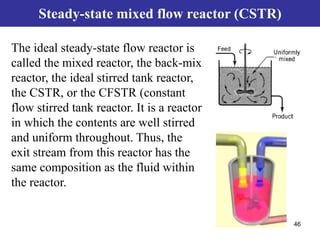
The ideal steady-state flow reactor is
called the mixed reactor, the back-mix
reactor, the ideal stirred tank reactor,
the CSTR, or the CFSTR (constant
flow stirred tank reactor. It is a reactor
in which the contents are well stirred
and uniform throughout. Thus, the
exit stream from this reactor has the
same composition as the fluid within
the reactor.
47
CSTR
Introducing these three terms into general equation, we have
48
CSTR
where XA and rA are measured at exit stream conditions, which are the same as the
conditions within the reactor. More generally, if the feed on which conversion is
based, subscript 0, enters the reactor partially converted, subscript i, and leaves at
conditions given by subscript f, we have
49
CSTR ( Class Activity)
A feed solution containing a reactant A (CA0 =1 kmol/m3) is fed to a
CSTR at a volumetric flow rate of 0.6m3 /min, and converted to
product (P) in the reactor. The reaction rate is 1.2 kmol/(min.m3).
Determine the reactor volumes of the CSTR required to attain a
fractional conversion (XA) of 0.95.
𝑉 = 𝐹𝐴0
𝑋𝐴
(−𝑟𝐴)
𝑽 = 𝟎. 𝟒𝟕𝟓 𝒎 𝟑
50
Plug Flow reactor
Plug flow is an ideal flow reactor in which no back mixing occurs. The
concentrations of both reactants and products in the plug flow reactor
varies continuously along the flow direction, but are uniform in the
direction perpendicular to flow.
This ideal steady-state flow reactors is variously known as the plug
flow, slug flow, piston flow, ideal tubular, and unmixed flow
reactor. Mostly it is referred as the plug flow reactor, or PFR. It is
characterized by the fact that the flow of fluid through the reactor is
orderly with no element of fluid overtaking or mixing with any
other element ahead or behind. Actually, there may be lateral
mixing of fluid in a plug flow reactor; however, there must be no
mixing or diffusion along flow path.
51
Plug Flow reactor
In a plug flow reactor the composition of the fluid varies from point to point
along a flow path; consequently, the material balance for a reaction component
must be made for a differential element of volume dV.
52
Plug Flow reactor
Introducing these three terms in general equation
Also
Putting value of dFA in eq. 1.
(1)
For the reactor as a whole the expression must be integrated. Now FA0, the feed rate, is
constant, but –rA, is certainly dependent on the concentration or conversion of materials
53
Plug Flow reactor
These equations allows the determination of reactor
size for a given feed rate and required conversion
54
Assignment 1 (03 Marks)
For zero, first and second order liquid phase reactions,
write down the design equations for
1. Batch reactors
2. Plug flow reactors
3. Mixed flow reactors
Submit till 22nd December 2017
55
Kinetics of homogeneous reactions
Introduction to
the rate equation
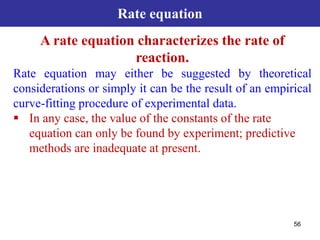
56
Rate equation
A rate equation characterizes the rate of
reaction.
Rate equation may either be suggested by theoretical
considerations or simply it can be the result of an empirical
curve-fitting procedure of experimental data.
 In any case, the value of the constants of the rate
equation can only be found by experiment; predictive
methods are inadequate at present.
57
Rate equation
Rate of reaction mainly depend on two parameters
1. Concentration of reactant/reactants
2. Temperature
The determination of the rate equation is usually a two-
step procedure; first the concentration dependency is
found at fixed temperature and then the temperature
dependence of the rate constants is found, yielding the
complete rate equation.
58
Rate equation
Equipment by which empirical information is obtained can
be divided into two types, the batch and flow reactors.
Extent of reaction is determined by considering variation
in following parameters such as
 By following the concentration of a given component.
 By following the change in some physical property of the fluid,
such as the density, electrical conductivity or refractive index.
 By following the change in total pressure of a constant-volume
system.
 By following the change in volume of a constant-pressure
system.
59
Finding the kinetic data
 To find out the kinetic data , batch reactor is usually
operated isothermally and at constant volume because
it is easy to interpret the results of such runs.
 This reactor is a relatively simple device adaptable to
small-scale laboratory set-ups, and it needs little
auxiliary equipment or instrumentation.
 Thus, it is used whenever possible for obtaining
homogeneous kinetic data.
 The flow reactor is used primarily in the study of the
kinetics of heterogeneous reactions.
60
Analysis of kinetic data
Various methods are employed for data analyses such as:
1. Integration method
2. Differential method
3. Initial-rate method
4. Excess method
5. Half-life Method
Most common
61
Analysis of kinetic data
 There are advantages and disadvantages to each method. The
integral method is easy to use and is recommended when testing
specific mechanisms, or relatively simple rate expressions, or
when the data are so scattered that we cannot reliably find the
derivatives needed in the differential method.
 The differential method is useful in more complicated situations
but requires more accurate or larger amounts of data.
 The integral method can only test this or that particular
mechanism or rate form; the differential method can be used to
develop or build up a rate equation to fit the data.
In general, it is suggested that integral analysis
should be attempted first, and, if not successful,
the differential method can be tried.
62
Integration method of kinetic data analysis
 The integral method of analysis always puts a particular
rate equation to the test by integrating and comparing
the predicted C versus t curve with the experimental C
versus t data.
 If the fit is unsatisfactory, another rate equation is
guessed and tested.
 It should be noted that the integral method is especially
useful for fitting simple reaction types corresponding to
elementary reactions.
63
Integration method of kinetic data analysis
Suppose it’s a first-order rate equation of the following type,
Separating and integrating between CA0 at time = 0 and CA at time
t, we obtain
Case 1: Irreversible Unimolecular-Type 1st Order Reactions
64
Integration method of kinetic data analysis
Case 1: Irreversible Unimolecular-Type 1st Order Reactions
Suppose that NAo is the initial amount of A in the reactor at time t = 0, and that
NA is the amount present at time t. Then the conversion of A in the constant
volume system is given by
Differentiating above equation, we obtain
Thus in term of conversion, rate expression for 1st order unimolecular irreversible
reactions can be written as
65
Integration method of kinetic data analysis
Case 1: Irreversible Unimolecular-Type 1st Order Reactions
A plot of In (1 - XA) or In (CA/CAo) vs. t gives a straight line through
the origin for this form of rate of equation. If the experimental data
seems to be better fitted by a curve than by a straight line, try another
rate form because the first-order reaction does not satisfactorily fit the
data.
66
Integration method of kinetic data analysis
Test for the first-order rate equation
t
67
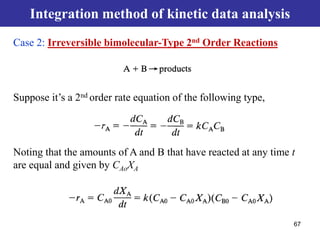
Integration method of kinetic data analysis
Suppose it’s a 2nd order rate equation of the following type,
Noting that the amounts of A and B that have reacted at any time t
are equal and given by CAoXA
Case 2: Irreversible bimolecular-Type 2nd Order Reactions
68
Integration method of kinetic data analysis
Case 2: Irreversible bimolecular-Type 2nd Order Reactions
on separation and applying integration above eq. becomes
69
Integration method of kinetic data analysis
Test for the 2nd-order rate equation
70
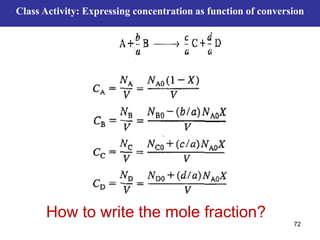
Class Activity: Expressing concentration as function of conversion
71
Class Activity: Expressing concentration as function of conversion
72
Class Activity: Expressing concentration as function of conversion
How to write the mole fraction?
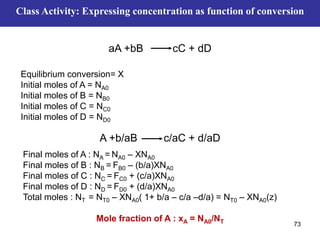
73
Class Activity: Expressing concentration as function of conversion
aA +bB cC + dD
A +b/aB c/aC + d/aD
Equilibrium conversion= X
Initial moles of A = NA0
Initial moles of B = NB0
Initial moles of C = NC0
Initial moles of D = ND0
Final moles of A : NA = NA0 – XNA0
Final moles of B : NB = FB0 – (b/a)XNA0
Final moles of C : NC = FC0 + (c/a)XNA0
Final moles of D : ND = FD0 + (d/a)XNA0
Total moles : NT = NT0 – XNA0( 1+ b/a – c/a –d/a) = NT0 – XNA0(z)
Mole fraction of A : xA = NA0/NT
74
Class Activity: Expressing concentration as function of conversion
For solution, pls attend the lecture.
75
Integration method of kinetic data analysis
Based on stoichiometric equation, rate equation can be written as
On integration, we get
Case 2a: Irreversible bimolecular-Type 2nd Order Reactions
or
76
Integration method of kinetic data analysis
Test for the 2nd-order rate equation
or
77
Integration method of kinetic data analysis
Case 3: Zero Order Reactions
A reaction is of zero order when the rate of reaction is independent
of the concentration of materials; thus
Integrating and noting that CA can never become negative
Which means that the conversion is proportional to time.
78
Integration method of kinetic data analysis
Case 3: Zero Order Reactions
As a rule, reactions are of zero order only in certain concentration ranges-
the higher concentrations. If the concentration is lowered far enough, we
usually find that the reaction becomes concentration-dependent, in which
case the order rises from zero.
Test for the zero-order rate equation

chemical reaction engineering

  • 1.
    1 Chemical Reaction Engineering Dr. RabyaAslam Institute of Chemical Engineering and Technology University of the Punjab, Lahore 54590 rabya.icet@pu.edu.pkDec, 2017
  • 2.
    2 Course contents  Introductionto chemical reaction engineering  Kinetics of homogeneous reactions  Interpretation of reactor data for single and multiple reactions. Integral method and differential method of analysis for constant volume and variable volume batch reactors.  Design of homogeneous reactors: Batch, Mixed flow, Plug flow reactors, Comparison of single reactor, multiple reactor systems in parallel/series.  Temperature and pressure effects.  Adiabatic and non-adiabatic operations.  Design of heterogeneous reactors: Rate equations for heterogeneous reactions. Catalyst deactivation and regeneration. Design of fixed bed and fluidized bed catalytic reactors.
  • 3.
    3  Levenspiel, O.1999. Chemical reaction engineering. 3rd ed. Wiley & Sons, Inc., Singapore.  Fogler, H.S. 2006. Elements of chemical reaction engineering. 4th ed. Prentice-Hall.  Froment, G.F.; Bischoff, K.B.; De Wilde, J. 2011. Chemical reactor analysis and design. 3rd ed. John Wiley & Sons, Inc.  Missen, R.W.; Mims, C.A.; Saville, B.A. 1999. Introduction to chemical reaction engineering and kinetics. John Wiley & Sons, Inc., New York.  Smith, J.M. 1981. Chemical engineering kinetics. 3rd ed. McGraw-Hill Int. Book Co., Singapore. Recommended books
  • 4.
    4 Course objectives The objectiveof this course is to give the understanding of designing of commonly used chemical reactors. This course will provide in-depth knowledge of the application of laws of thermodynamics and reaction kinetics for the economical design of chemical reactors. Students will learn how can a chemical engineer develop a rate expression and design an industrial reactor.
  • 5.
  • 6.
    6 Chemical reaction engineeringtries to answer to the following types of questions:  What are the optimum operating conditions for a reaction system to carry out one or more desired reactions?  What is the optimum reactor design, i.e., size, type, energy considerations, and configuration of the reactor system?  Is there a need of a catalyst? If yes, how to develop and design of an optimum industrial catalyst? Reaction engineering 6
  • 7.
    7 Catalysis and reactionengineering Principle of Chemical reaction engineering 7
  • 8.
    8 What is ChemicalReaction 8 chemical reaction is said to be taken place when a detectable number of molecules of one or more species have lost their identity and assumed a new form by a change in the kind or number of atoms in the compound and/or by a change in structure or configuration of these atoms. Thus a chemical reaction is responsible for a chemical change that may be happened by any of the following processes  Decomposition  Combination  or isomerization In this classical approach to chemical change, it is assumed that the total mass is neither created nor destroyed when a chemical reaction occurs.
  • 9.
    9 The rate ofconsumption of a reactant species is defined as the change in number of moles of the reactant species per unit volume of the reaction mixture per unit time. The volume of a gas also changes due to changes in operating conditions (temperature and pressure) in addition to changes in number of moles dt dn V r A A  1 )( Rate of a chemical reaction dt dC r A A  )(  Not general  Applicable when volume of the reaction mixture is constant during the course of reaction  It may be true for liquid phase reactions or for constant density gas phase reactions Volume of reaction mixture Perfectly general Negative sign indicates that rate is decreasing with time and required as dnA is negative for a reactant
  • 10.
    10  The rateof a chemical reaction is usually based on the limiting reactant  On the similar basis, a rate may be defined for the formation of a product species  For the reaction: dDcCbBaA  or d r c r b r a r DCBA     )()( Rate of a chemical reaction  This minus sign is to show rate of consumption of a reactant  It has no mathematical importance, only a symbol
  • 11.
    11 Based on unitvolume of the reaction mixture Based on unit mass in fluid-solid system Based on unit surface of solid in fluid-solid system or unit interfacial area in two fluid systems Based on unit volume of solid in fluid-solid system Based on unit volume of reactor when different from unit volume of the reaction mixture Various definitions of rate of a chemical reaction
  • 12.
    12 Rates defined onvarious basis are interchangeable and the following may be shown: Various definitions of rate of a chemical reaction
  • 13.
    13 Rates of reactionsvary in a wide range. Some reaction are very fast and some reactions are extremely slow. Relative values of rates of reactions
  • 14.
    14  A higherrate of reaction means less processing time in a batch reactor and smaller size of reactor vessel in a continuous flow reactor (CSTR and PFR)  As the residence time is dependent upon the rate, the knowledge of rate is required for the design of a reactor  We need an expression (rate equation) that describes the rate of a given reaction Rate equation cannot be found reliably from the reaction stoichiometry or by any other theoretical means and therefore rate expressions are always to be empirical, i.e., to be discovered through experiments. Why are we interested in rate?
  • 15.
    15 Classifications of reactions 15 Chemicalreactions may be classified in several ways 1: Based on Mechanism  Reversible  Irreversible  Consecutive  Parallel 2: Based on number of molecules involved  Uni-molecular  Bi-molecular  Termolecular
  • 16.
    16 Classifications of reactions 16 3:Based on Operating Conditions  Isothermal  Adiabatic  Non-adiabatic 4: Based on Order of Reaction  Zero order  First order  Second order  Third order  Fractional order
  • 17.
    17 Classifications of reactions 17 5:Based on Phases Involved  Homogeneous  Heterogeneous  Catalytic  Non catalytic/ autocatalytic 6: Based on Heat of Reaction  Exothermic  Endothermic Nearly 90% of all industrial reactions involve heterogeneous catalysis, i.e., they are heterogeneous as well as catalytic
  • 18.
    18 Stoichiometric coefficient (ν)is the number appearing before the symbol for each compound in the balanced equation for a chemical reaction. For the reaction a, b, c and d are the stoichiometric coefficients. By convention:  A stoichiometric coefficient for a reactant is negative  A stoichiometric coefficient for a product is positive  A stoichiometric coefficient for an inert, solvent, or catalyst is zero. dDcCbBaA  Stoichiometric coefficient ν 18
  • 19.
    19   iiinn 0 tcoefficientricstoichiome speciesaofmolesinchangenn i ii      0 tcoefficientricstoichiome speciesaofflowratemolarinchangeFF i ii      0   iii FF 0 ξ extent of a reaction in terms of change in moles ξ′ extent of a reaction in terms of change in molar flowrate νi stoichiometric coefficient of an ith species Extent of a reaction ξ 19
  • 20.
    20 Ratio of changein moles of a reactant (usually limiting reactant) to the moles of the reactant fed. For a reactant A: nA0 = initial moles of the reactant “A”, mol; nA = moles of “A” at any time t (s), mol; FA0 = initial molar flowrate, mol·s−1, FA = molar flowrate of A at any time t (s), mol·s−1, CA = Concentration at time t, mol.L-1, and CA0 is initial concentration. For an irreversible and single (no side reaction) reaction, an increase in the outlet conversion is an indication of higher rate of the reaction 00 0 0 0 1 AA AA A AA A C C F FF n nn X A      Conversion or fractional conversion XA
  • 21.
    21 Relationship between extentof a reaction and fractional conversion For reactant A: A AA nn   0  0 00 A A A AA n nnn               A A A AA n n nn   0 0 0 0 0 A AA A n nn X   A AA A A A nXn X   00        21
  • 22.
    It is thefractional change in volume of the system between no conversion and complete conversion of reactant A For constant density system For variable density system, 22 Expansion factor 22 0 01     A AA x xx V VV  0εA 
  • 23.
  • 24.
    Find the expansionfactor for following gas phase reaction reactions 24 Class Activity 24 What will be expansion factor, if 50 % inert are present in the feed.
  • 25.
    Find the expansionfactor for following liquid phase reaction reactions 25 Class Activity 25
  • 26.
    26 It is theratio of moles of the one (usually desired) product to the moles of another (usually undesired) product. CA BA   formedBofmoles formedCofmoles CofySelectivit formedCofmoles formedBofmoles BofySelectivit   Selectivity
  • 27.
    27 It is theratio of moles of a certain product to the maximum possible moles of that product which can be formed. Or It is the ratio of moles of a certain product to the moles consumed of the limiting reactant. Or It is the ratio of moles of a certain product to the moles of the limiting reactant fed. Yield
  • 28.
    28  In achemical reaction the reactant present in excess to that required stoichiometrically is the excess reactant the other is limiting reactant  If the reactants are added in stoichiometric amounts, there is no point using the concept of limiting or excess reactant The choice of the limiting reactant is arbitrary and depends on the cost (profit) considerations Limiting and excess reactant
  • 29.
    29 Can you mentionany example of an industrial process and indicate the limiting reactant? What are the reasons for the choice of a particular limiting reactant in your example? Limiting and excess reactant Combustion of a coal required excess air
  • 30.
    30  For athermodynamically possible reaction means that Gibbs free energy of reaction ∆Grxn is less than zero, i.e., the reactants have higher free energy than the products. A useful criterion for knowing the possibility of reaction occurrence is to know the standard state Gibbs free energy of reaction, ∆Grxn o. A reaction, however, may not be feasible at the standard conditions but may occur at the other conditions. Possibility of a reaction
  • 31.
    31 Value of ∆Grxn oPossibility of reaction occurrence < ‒10 kcal/mol (‒41.8 kJ/mol) Reaction is possible with very high equilibrium conversions 0 to ‒10 kcal/mol (‒41.8 kJ/mol) Reaction is possible with moderately high equilibrium conversions 0 to 10 kcal/mol (41.8 kJ/mol) Reaction is possible at the other process operating conditions but usually with low equilibrium conversions > 10 kcal/mol (41.8 kJ/mol) Reaction may be possible at the other process operating conditions and if possible occurs with generally very low equilibrium conversions Possibility of a reaction
  • 32.
  • 33.
    33 Types of reactors Chemicalreactors may have wide variety of size, shape, flow pattern. And operating conditions. Mainly these are classified on the basis of 1. Based on mode of operation  Batch reactors  Semi batch reactors  Continuous reactors 2. Based on no. of phases involved  Homogeneous reactors  Heterogeneous reactors 3. Based on shape of reactor  Tank reactors  Tubular reactors
  • 34.
    34 Types of reactors:Based on mode of operation 1. Based on mode of operation  Batch reactors  Semi batch reactors  Continuous reactors (MFR/ PFR)
  • 35.
    35 Types of reactors:Based on mode of operation 1. Based on mode of operation  Batch reactors  Semi batch reactors  Continuous reactors (MFR/ PFR)
  • 36.
    36 Types of reactors:Based on phases involved 2. Based on number of phases involved  Reactors for Liquid Phase  Reactors for Gas phase  Reactors for Gas/Liquid Phase  Reactors for Gas/solid phase or liquid/solid phase  Reactors for Gas/ Liquid/ Solid Phase
  • 37.
    37 Types of reactors:Based on shape 3. Based on shape  Tank reactors  Tubular reactors
  • 38.
    38 Fundamental Design Equation Input(mole/time) – output (mole/time) – Consumption (or +Generation) (mole/time) = Accumulation (mole/time)
  • 39.
    39 Fundamental Design Equation Energyin matter flow into reactor volume– Energy in matter flow out of reactor volume– Energy transferred from surrounding to the reactor volume= Accumulation of energy within reactor volume
  • 40.
  • 41.
    41 Batch reactor  Inthe batch reactor, or BR, the reactants are initially charged into a vessel, are well mixed, and are left to react for a certain period. The resultant mixture is then discharged.  This is an unsteady-state operation where composition changes with time; however, at any instant the composition throughout the reactor is uniform.
  • 42.
    42 Batch reactor This isthe general equation showing the time required to achieve a conversion XA for either isothermal or non-isothermal operation.
  • 43.
    43 Batch reactor Case 1:density of fluid remains constant Case 2: density of fluid is not constant (For all reactions in which the volume of reacting mixture changes proportionately with conversion, such as in single gas-phase reactions with significant density changes)
  • 44.
    44 Batch reactor Space timeand space velocity:
  • 45.
    45 Space time (τ):It is the time needed to process one reactor volume of feed measured at specified conditions Space velocity (s): It is the number of reactor volumes of feed at specified conditions treated in unit time. A space velocity of 10 h‒1 means that ten reactor volumes of the feed at specified conditions are processed in a reactor per hour. veloictyspace timespace 1  Space time and space velocity flowratevolumetricfeed reactorofvolume v V s  0 1  10 feed reactor volumes
  • 46.
    46 Steady-state mixed flowreactor (CSTR) The ideal steady-state flow reactor is called the mixed reactor, the back-mix reactor, the ideal stirred tank reactor, the CSTR, or the CFSTR (constant flow stirred tank reactor. It is a reactor in which the contents are well stirred and uniform throughout. Thus, the exit stream from this reactor has the same composition as the fluid within the reactor.
  • 47.
    47 CSTR Introducing these threeterms into general equation, we have
  • 48.
    48 CSTR where XA andrA are measured at exit stream conditions, which are the same as the conditions within the reactor. More generally, if the feed on which conversion is based, subscript 0, enters the reactor partially converted, subscript i, and leaves at conditions given by subscript f, we have
  • 49.
    49 CSTR ( ClassActivity) A feed solution containing a reactant A (CA0 =1 kmol/m3) is fed to a CSTR at a volumetric flow rate of 0.6m3 /min, and converted to product (P) in the reactor. The reaction rate is 1.2 kmol/(min.m3). Determine the reactor volumes of the CSTR required to attain a fractional conversion (XA) of 0.95. 𝑉 = 𝐹𝐴0 𝑋𝐴 (−𝑟𝐴) 𝑽 = 𝟎. 𝟒𝟕𝟓 𝒎 𝟑
  • 50.
    50 Plug Flow reactor Plugflow is an ideal flow reactor in which no back mixing occurs. The concentrations of both reactants and products in the plug flow reactor varies continuously along the flow direction, but are uniform in the direction perpendicular to flow. This ideal steady-state flow reactors is variously known as the plug flow, slug flow, piston flow, ideal tubular, and unmixed flow reactor. Mostly it is referred as the plug flow reactor, or PFR. It is characterized by the fact that the flow of fluid through the reactor is orderly with no element of fluid overtaking or mixing with any other element ahead or behind. Actually, there may be lateral mixing of fluid in a plug flow reactor; however, there must be no mixing or diffusion along flow path.
  • 51.
    51 Plug Flow reactor Ina plug flow reactor the composition of the fluid varies from point to point along a flow path; consequently, the material balance for a reaction component must be made for a differential element of volume dV.
  • 52.
    52 Plug Flow reactor Introducingthese three terms in general equation Also Putting value of dFA in eq. 1. (1) For the reactor as a whole the expression must be integrated. Now FA0, the feed rate, is constant, but –rA, is certainly dependent on the concentration or conversion of materials
  • 53.
    53 Plug Flow reactor Theseequations allows the determination of reactor size for a given feed rate and required conversion
  • 54.
    54 Assignment 1 (03Marks) For zero, first and second order liquid phase reactions, write down the design equations for 1. Batch reactors 2. Plug flow reactors 3. Mixed flow reactors Submit till 22nd December 2017
  • 55.
    55 Kinetics of homogeneousreactions Introduction to the rate equation
  • 56.
    56 Rate equation A rateequation characterizes the rate of reaction. Rate equation may either be suggested by theoretical considerations or simply it can be the result of an empirical curve-fitting procedure of experimental data.  In any case, the value of the constants of the rate equation can only be found by experiment; predictive methods are inadequate at present.
  • 57.
    57 Rate equation Rate ofreaction mainly depend on two parameters 1. Concentration of reactant/reactants 2. Temperature The determination of the rate equation is usually a two- step procedure; first the concentration dependency is found at fixed temperature and then the temperature dependence of the rate constants is found, yielding the complete rate equation.
  • 58.
    58 Rate equation Equipment bywhich empirical information is obtained can be divided into two types, the batch and flow reactors. Extent of reaction is determined by considering variation in following parameters such as  By following the concentration of a given component.  By following the change in some physical property of the fluid, such as the density, electrical conductivity or refractive index.  By following the change in total pressure of a constant-volume system.  By following the change in volume of a constant-pressure system.
  • 59.
    59 Finding the kineticdata  To find out the kinetic data , batch reactor is usually operated isothermally and at constant volume because it is easy to interpret the results of such runs.  This reactor is a relatively simple device adaptable to small-scale laboratory set-ups, and it needs little auxiliary equipment or instrumentation.  Thus, it is used whenever possible for obtaining homogeneous kinetic data.  The flow reactor is used primarily in the study of the kinetics of heterogeneous reactions.
  • 60.
    60 Analysis of kineticdata Various methods are employed for data analyses such as: 1. Integration method 2. Differential method 3. Initial-rate method 4. Excess method 5. Half-life Method Most common
  • 61.
    61 Analysis of kineticdata  There are advantages and disadvantages to each method. The integral method is easy to use and is recommended when testing specific mechanisms, or relatively simple rate expressions, or when the data are so scattered that we cannot reliably find the derivatives needed in the differential method.  The differential method is useful in more complicated situations but requires more accurate or larger amounts of data.  The integral method can only test this or that particular mechanism or rate form; the differential method can be used to develop or build up a rate equation to fit the data. In general, it is suggested that integral analysis should be attempted first, and, if not successful, the differential method can be tried.
  • 62.
    62 Integration method ofkinetic data analysis  The integral method of analysis always puts a particular rate equation to the test by integrating and comparing the predicted C versus t curve with the experimental C versus t data.  If the fit is unsatisfactory, another rate equation is guessed and tested.  It should be noted that the integral method is especially useful for fitting simple reaction types corresponding to elementary reactions.
  • 63.
    63 Integration method ofkinetic data analysis Suppose it’s a first-order rate equation of the following type, Separating and integrating between CA0 at time = 0 and CA at time t, we obtain Case 1: Irreversible Unimolecular-Type 1st Order Reactions
  • 64.
    64 Integration method ofkinetic data analysis Case 1: Irreversible Unimolecular-Type 1st Order Reactions Suppose that NAo is the initial amount of A in the reactor at time t = 0, and that NA is the amount present at time t. Then the conversion of A in the constant volume system is given by Differentiating above equation, we obtain Thus in term of conversion, rate expression for 1st order unimolecular irreversible reactions can be written as
  • 65.
    65 Integration method ofkinetic data analysis Case 1: Irreversible Unimolecular-Type 1st Order Reactions A plot of In (1 - XA) or In (CA/CAo) vs. t gives a straight line through the origin for this form of rate of equation. If the experimental data seems to be better fitted by a curve than by a straight line, try another rate form because the first-order reaction does not satisfactorily fit the data.
  • 66.
    66 Integration method ofkinetic data analysis Test for the first-order rate equation t
  • 67.
    67 Integration method ofkinetic data analysis Suppose it’s a 2nd order rate equation of the following type, Noting that the amounts of A and B that have reacted at any time t are equal and given by CAoXA Case 2: Irreversible bimolecular-Type 2nd Order Reactions
  • 68.
    68 Integration method ofkinetic data analysis Case 2: Irreversible bimolecular-Type 2nd Order Reactions on separation and applying integration above eq. becomes
  • 69.
    69 Integration method ofkinetic data analysis Test for the 2nd-order rate equation
  • 70.
    70 Class Activity: Expressingconcentration as function of conversion
  • 71.
    71 Class Activity: Expressingconcentration as function of conversion
  • 72.
    72 Class Activity: Expressingconcentration as function of conversion How to write the mole fraction?
  • 73.
    73 Class Activity: Expressingconcentration as function of conversion aA +bB cC + dD A +b/aB c/aC + d/aD Equilibrium conversion= X Initial moles of A = NA0 Initial moles of B = NB0 Initial moles of C = NC0 Initial moles of D = ND0 Final moles of A : NA = NA0 – XNA0 Final moles of B : NB = FB0 – (b/a)XNA0 Final moles of C : NC = FC0 + (c/a)XNA0 Final moles of D : ND = FD0 + (d/a)XNA0 Total moles : NT = NT0 – XNA0( 1+ b/a – c/a –d/a) = NT0 – XNA0(z) Mole fraction of A : xA = NA0/NT
  • 74.
    74 Class Activity: Expressingconcentration as function of conversion For solution, pls attend the lecture.
  • 75.
    75 Integration method ofkinetic data analysis Based on stoichiometric equation, rate equation can be written as On integration, we get Case 2a: Irreversible bimolecular-Type 2nd Order Reactions or
  • 76.
    76 Integration method ofkinetic data analysis Test for the 2nd-order rate equation or
  • 77.
    77 Integration method ofkinetic data analysis Case 3: Zero Order Reactions A reaction is of zero order when the rate of reaction is independent of the concentration of materials; thus Integrating and noting that CA can never become negative Which means that the conversion is proportional to time.
  • 78.
    78 Integration method ofkinetic data analysis Case 3: Zero Order Reactions As a rule, reactions are of zero order only in certain concentration ranges- the higher concentrations. If the concentration is lowered far enough, we usually find that the reaction becomes concentration-dependent, in which case the order rises from zero. Test for the zero-order rate equation