BTP-03
Well test analysis in
 horizontal well


                        1
Aim of the project

• To analyze the well test data in horizontal
  wells
• Mainly by the means of using different
  software used in industries
• Predicting reservoir parameters like
  permeability, wellbore storage, skin factor
  and also about anisotropy


                                            2
Problems in Horizontal Well
           Testing
• Three dimensional flow geometry -
  Interpretation
• Zonal variation of vertical permeability
• The general flow patterns that are
  encountered in horizontal well testing:
  – Early linear and radial
  – Late linear and radial


                                             3
Problem Statement
•


                        4
•


    5
Production schedule
     First Shut-in    5.47 hours    Stimulating well
     period
     First pumping    5minutes      Using
     period                         submersible
                                    pump
     Second shut-in   9.25 hours    Take out plug at
     period                         1963(MD) and
                                    BHP gauge to
                                    2182(MD)
     Second pumping   8.08 hours    Using
     period                         submersible
                                    pump
     Final shut-in    12.08 hours   Build up test
     period


                                                       6
•


    7
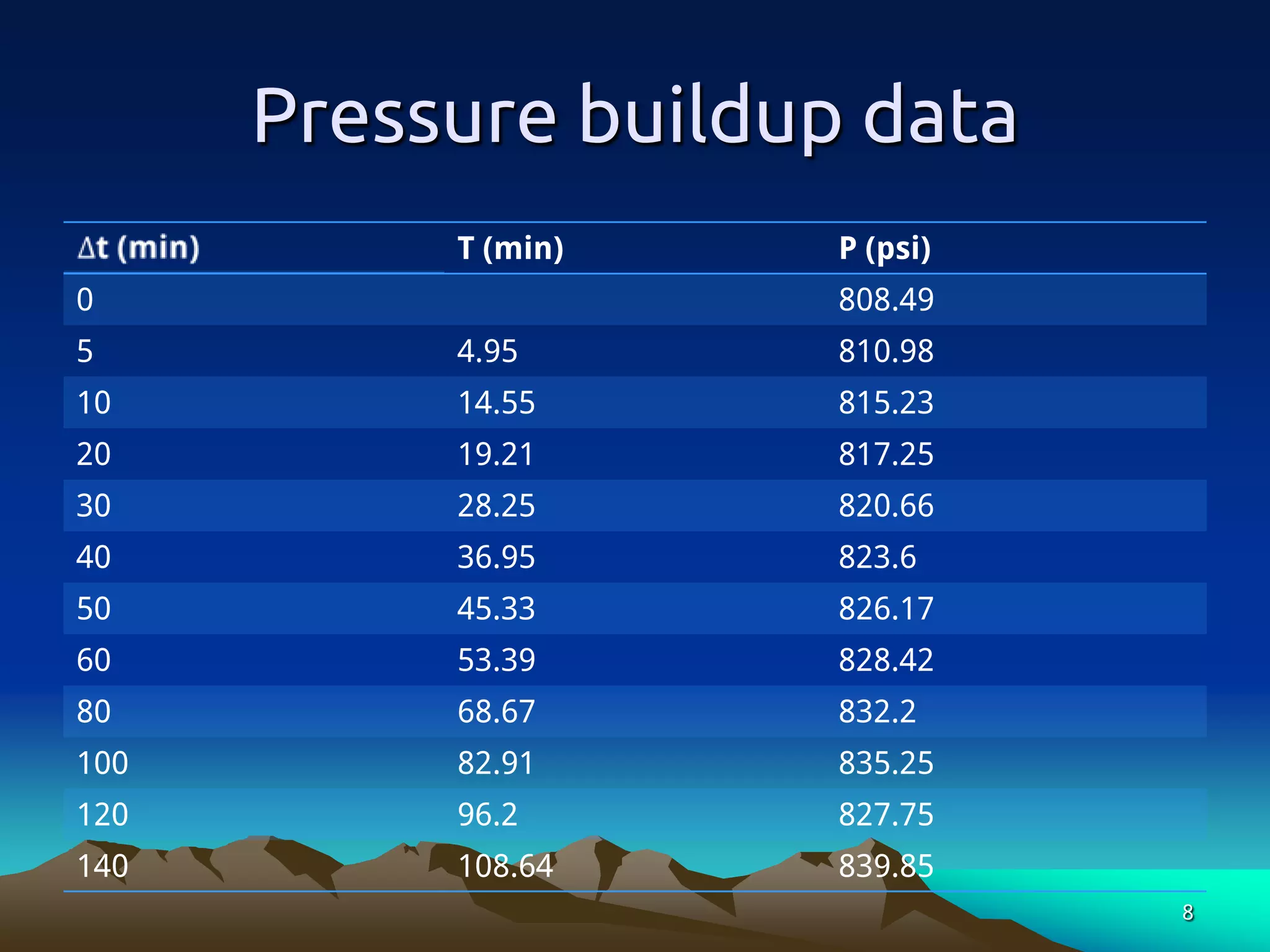
Pressure buildup data
           T (min)    P (psi)
0                     808.49
5          4.95       810.98
10         14.55      815.23
20         19.21      817.25
30         28.25      820.66
40         36.95      823.6
50         45.33      826.17
60         53.39      828.42
80         68.67      832.2
100        82.91      835.25
120        96.2       827.75
140        108.64     839.85
                                8
T (min)   P (psi)
160   120.31    841.63
180   131.28    843.16
200   141.61    844.49
240   160.55    846.69
280   177.52    848.43
320   192.8     849.85
360   206.63    851.02
420   222.76    852.58
480   241.24    853.58
540   255.21    854.5
600   269.2     855.26
660   279.56    855.91
725   290.6     856.5


                          9
The problem was solved using
        two software:
       • Kappa Saphir
        • Pansystem
   Solution by Kappa Saphir


                               10
History Curve


• The pressure dots suggests data was here
• This led• tocontinous line shut-in points given
  While theThe before the highlighted not
               initial pressure of 868.156 psia
  which was calculated result generateditself
  shows the calculated by the software by
  based on the improvement parameters
  software
  selected                                     11
Derivative Plot


                  12
Derivative Plot - 2


The main characteristics:
• Slant straight red line showing wellbore effects
• Zero slope dotted line showing either early radial or
  late radial flow                                   13
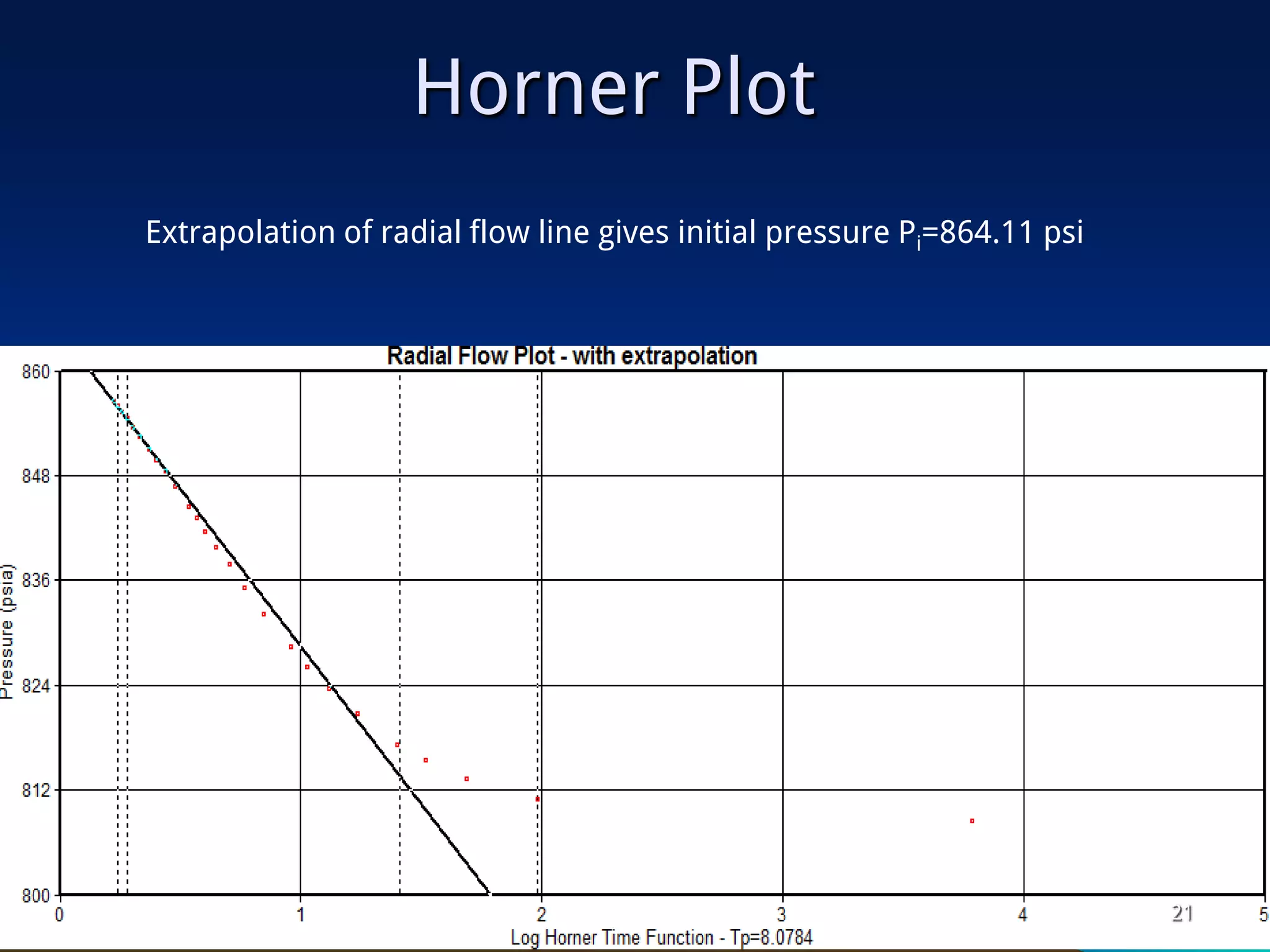
Horner Plot


• This plot was essential to determine the end of
  wellbore effect.

                                              14
Early Radial or Late Radial
• Help of Horner plot (both in Kappa and
  PanSystem) and following correlation:
• To end the early time radial flow,

      1800d z2 ct 1800  22.52  0.33  31 105
 te               
          kv                    232.1
     0.40 hours
• But the Horner plot shows that by the time
  zero slope line starts, this early radial is
  already eliminated
                                                     15
Result of Kappa Saphir
We calculated the skin and permeability
from Kappa Saphir and estimations are as
follows :
Skin= -6.04
Permeability= 7780 mD
Cs = 6.76 bbl/psi


                                           16
Solution by Pan System


                         17
History Curve


    Assumed Model:
    Two No Flow Boundary – Homogenous
    Infinite Acting Reservoir


                                        18
Derivative Plot
Line With One Slope:            Line With Zero Slope:
• Wellbore Stroge Flow period   • Pseudo Radial Flow
• This gives Wellbore Storage   • This gives value of permeability k and
   Coefficient                     Pseudo radial Skin factor


                                                                 19
Derivative Plot with
               Extrapolation


Simulated Derivative Plot:
Parameter:
Cs=     4.0287 bbl/psi
k=      8069.11 mD
Kz=     8069.11 mD
Cd=     345372.7551
kh=     363110.1493 mD-ft
Zwd=    0.5
Lw=     1531 ft
                                    20
Horner Plot
Extrapolation of radial flow line gives initial pressure Pi=864.11 psi


                                                                         21
Result of PanSystem
The estimated value of skin and
permeability of the same problem
statement are as follows :
• Skin = -5.965
• Permeability = 8026.6 mD
• Cs = 4.0287 bbl/psi


                                   22
Anisotropy
• It means different properties in different
  directions.
• Anisotropy can be indicated by the ratio
  of horizontal to vertical well’s productivity
  index.
• Hence, it is indicated by Jh/Jv.
Where Jh is horizontal productivity index.
        Jv is vertical productivity index.
                                              23
Giger, Reiss and Jourdan
Jh                      ln( rev / rw )
   
Jv        1  1  ( L / 2r )2   h   h 
       ln                 eh
                                      ln     
          
          
                L / 2reh            L   2 rw 
                                  

 reh  1667.4 ft and             rev  1179.03 ft

 Jh
  6.3769
 Jv

                                                      24
Giger
        qh                 0.007078kh L
 Jh       
        P               1  1  L / 2 r 2     
                                         eh 
               o Bo  ln                         C
                       L
                     h        L / 2reh         
                     
                                               
                                                  
Where,
        h 
C  ln        
        2 rw 

       qv   0.007078kh
Jv       
       P           rev 
             B ln  
                    rw 
 J h 26.9867
            5.926
 J v 5.04802
                                                          25
Borisov Method
     qh         0.007078kh /  B
Jh     
     P         4reh  h  h 
            ln 
                L     L ln  2 r 
                                w
Hence,
J h 26.9867
   
J v 5.04802

   5.346

                                          26
Comparison of the anisotropy

                  Giger et all       Giger             Borisov
Jh/Jv             6.3769             5.926             5.346


 • Thus, the results from all the three methods are almost same with
 an average of 5.88 which clearly indicates that the productivity in
 case of horizontal wells is higher and also the well is possibly having
 more vertical permeability.


                                                                       27
Problem-2


            28
Problem-2


            29
Derivative Plot (simulated)


                              30
1) Wellbore Storage Line:
       • Slope 1
       • Gives Wellbore Storage Coefficient

2) Early Radial Flow Line:
        • Slope Zero
        • Gives Skin, kbar(kbar=(k*kz)^(1/2), Skin

3) Linear Flow Through Layer:
        • Slope Half
        • Gives Effective Producing Length of Well

4) Late Radial Flow:
        • Slope Zero
        • Gives Vertical Permeability(k), Horizontal Permeability(kz), Pseudo Radial
          Skin factor


                                                                                   31
Simulated Radial Plot


                        32
Comparison between
Kappa and PanSystem
        and
     Conlusion


                      33
Kappa           PanSystem   Abs. %age    Abs. %age
                                        error with   error with
                                        base Kappa   base
                                                     Pansystem
kh total    3.5*105 md.ft   3.61*105    3.142%       3.047%
                            md.ft

k average   7780 md         8026.61     3.169%       3.072%


Skin        -6.04           -5.965      1.241%       1.257%


                                                                  34
Conclusion
• The difference in result of both Kappa
  and PanSystem is never more than 3.5%.
  Hence both results can be considered
  reliable.
• However for industrial purpose Kappa is
  more popular due to its faster processing
  speed.


                                          35
Conclusion
• When the results are compared we find
  that both software provide almost similar
  output. The difference in the result occurs
  due to use of different numerical
  methods by both Kappa and PanSystem.
• The numerical method used by both
  Kappa and PanSystem is not disclosed
  hence which software is more accurate
  cannot be predicted.

                                            36
References
1. A.M.Al-Otaibi, SPE, Technological College of Studies, E.ozkan, SPE, Colorado school of
    mines, “Interpretation of Skin Effect from Pressure Transient Tests in Horizontal Wells”,
    paper SPE 93296, presented at 14th SPE Middle East Oil & Gas Show and Conference held
    in Bahrain International Exhibition, Bahrain, 12-15 March 2005.
2. Amanat U. Chaudhary: Gas Well Testing Handbook, Advanced TWPSOM Petroleum
    Systems, Inc., Houston, Texas, USA, 2003.
3. Amanat U. Chaudhary: Oil well testing Handbook, Advanced TWPSOM Petroleum Systems,
    Inc., Houston, Texas, USA, 2004.
4. Aziz S. Odeh and D. K. Basu: “Transient Flow behaviors of horizontal wells: Pressure
    drawdown and Buildup analysis”, Mobil R&D Corp. SPE formation evaluation, March 1990
    presented at.
5. Commercial Well-Testing Software “Saphir”, http://www.kappaeng.com/, KAPPA
    Engineering, France 1987-2003
6. Dominique Bourdet, Well Test Analysis: The use of advanced interpretation models,
    Handbook of Petroleum Exploration and Production,3
7. L. Mattar, M. Santo: “A practical and systematic approach to horizontal well test analysis”,
    The Journal of Canadian Petroleum Technology,34(9), November 1995.
8. S.D.Joshi: Horizontal Well Technology, Joshi Technologies International, Inc., Tulsa, OK,
    USA, 1991.
9. Wang H.: “Analysis of Horizontal Oil Well Performance,” MS.Thesis, U. of Oklahoma,
    Norman,OK,1996.
10. Well test interpretation, Schlumberger, 2002.                                             37
Thank you


            38

Well Test Analysis in Horizontal Wells

  • 1.
    BTP-03 Well test analysisin horizontal well 1
  • 2.
    Aim of theproject • To analyze the well test data in horizontal wells • Mainly by the means of using different software used in industries • Predicting reservoir parameters like permeability, wellbore storage, skin factor and also about anisotropy 2
  • 3.
    Problems in HorizontalWell Testing • Three dimensional flow geometry - Interpretation • Zonal variation of vertical permeability • The general flow patterns that are encountered in horizontal well testing: – Early linear and radial – Late linear and radial 3
  • 4.
  • 5.
  • 6.
    Production schedule First Shut-in 5.47 hours Stimulating well period First pumping 5minutes Using period submersible pump Second shut-in 9.25 hours Take out plug at period 1963(MD) and BHP gauge to 2182(MD) Second pumping 8.08 hours Using period submersible pump Final shut-in 12.08 hours Build up test period 6
  • 7.
  • 8.
    Pressure buildup data T (min) P (psi) 0 808.49 5 4.95 810.98 10 14.55 815.23 20 19.21 817.25 30 28.25 820.66 40 36.95 823.6 50 45.33 826.17 60 53.39 828.42 80 68.67 832.2 100 82.91 835.25 120 96.2 827.75 140 108.64 839.85 8
  • 9.
    T (min) P (psi) 160 120.31 841.63 180 131.28 843.16 200 141.61 844.49 240 160.55 846.69 280 177.52 848.43 320 192.8 849.85 360 206.63 851.02 420 222.76 852.58 480 241.24 853.58 540 255.21 854.5 600 269.2 855.26 660 279.56 855.91 725 290.6 856.5 9
  • 10.
    The problem wassolved using two software: • Kappa Saphir • Pansystem Solution by Kappa Saphir 10
  • 11.
    History Curve • Thepressure dots suggests data was here • This led• tocontinous line shut-in points given While theThe before the highlighted not initial pressure of 868.156 psia which was calculated result generateditself shows the calculated by the software by based on the improvement parameters software selected 11
  • 12.
  • 13.
    Derivative Plot -2 The main characteristics: • Slant straight red line showing wellbore effects • Zero slope dotted line showing either early radial or late radial flow 13
  • 14.
    Horner Plot • Thisplot was essential to determine the end of wellbore effect. 14
  • 15.
    Early Radial orLate Radial • Help of Horner plot (both in Kappa and PanSystem) and following correlation: • To end the early time radial flow, 1800d z2 ct 1800  22.52  0.33  31 105 te   kv 232.1  0.40 hours • But the Horner plot shows that by the time zero slope line starts, this early radial is already eliminated 15
  • 16.
    Result of KappaSaphir We calculated the skin and permeability from Kappa Saphir and estimations are as follows : Skin= -6.04 Permeability= 7780 mD Cs = 6.76 bbl/psi 16
  • 17.
    Solution by PanSystem 17
  • 18.
    History Curve Assumed Model: Two No Flow Boundary – Homogenous Infinite Acting Reservoir 18
  • 19.
    Derivative Plot Line WithOne Slope: Line With Zero Slope: • Wellbore Stroge Flow period • Pseudo Radial Flow • This gives Wellbore Storage • This gives value of permeability k and Coefficient Pseudo radial Skin factor 19
  • 20.
    Derivative Plot with Extrapolation Simulated Derivative Plot: Parameter: Cs= 4.0287 bbl/psi k= 8069.11 mD Kz= 8069.11 mD Cd= 345372.7551 kh= 363110.1493 mD-ft Zwd= 0.5 Lw= 1531 ft 20
  • 21.
    Horner Plot Extrapolation ofradial flow line gives initial pressure Pi=864.11 psi 21
  • 22.
    Result of PanSystem Theestimated value of skin and permeability of the same problem statement are as follows : • Skin = -5.965 • Permeability = 8026.6 mD • Cs = 4.0287 bbl/psi 22
  • 23.
    Anisotropy • It meansdifferent properties in different directions. • Anisotropy can be indicated by the ratio of horizontal to vertical well’s productivity index. • Hence, it is indicated by Jh/Jv. Where Jh is horizontal productivity index. Jv is vertical productivity index. 23
  • 24.
    Giger, Reiss andJourdan Jh ln( rev / rw )  Jv 1  1  ( L / 2r )2   h   h  ln  eh     ln     L / 2reh   L   2 rw   reh  1667.4 ft and rev  1179.03 ft Jh   6.3769 Jv 24
  • 25.
    Giger qh 0.007078kh L Jh   P  1  1  L / 2 r 2   eh  o Bo  ln    C L h  L / 2reh       Where,  h  C  ln    2 rw  qv 0.007078kh Jv   P  rev   B ln    rw  J h 26.9867    5.926 J v 5.04802 25
  • 26.
    Borisov Method qh 0.007078kh /  B Jh   P  4reh  h  h  ln   L    L ln  2 r   w Hence, J h 26.9867  J v 5.04802  5.346 26
  • 27.
    Comparison of theanisotropy Giger et all Giger Borisov Jh/Jv 6.3769 5.926 5.346 • Thus, the results from all the three methods are almost same with an average of 5.88 which clearly indicates that the productivity in case of horizontal wells is higher and also the well is possibly having more vertical permeability. 27
  • 28.
  • 29.
  • 30.
  • 31.
    1) Wellbore StorageLine: • Slope 1 • Gives Wellbore Storage Coefficient 2) Early Radial Flow Line: • Slope Zero • Gives Skin, kbar(kbar=(k*kz)^(1/2), Skin 3) Linear Flow Through Layer: • Slope Half • Gives Effective Producing Length of Well 4) Late Radial Flow: • Slope Zero • Gives Vertical Permeability(k), Horizontal Permeability(kz), Pseudo Radial Skin factor 31
  • 32.
  • 33.
    Comparison between Kappa andPanSystem and Conlusion 33
  • 34.
    Kappa PanSystem Abs. %age Abs. %age error with error with base Kappa base Pansystem kh total 3.5*105 md.ft 3.61*105 3.142% 3.047% md.ft k average 7780 md 8026.61 3.169% 3.072% Skin -6.04 -5.965 1.241% 1.257% 34
  • 35.
    Conclusion • The differencein result of both Kappa and PanSystem is never more than 3.5%. Hence both results can be considered reliable. • However for industrial purpose Kappa is more popular due to its faster processing speed. 35
  • 36.
    Conclusion • When theresults are compared we find that both software provide almost similar output. The difference in the result occurs due to use of different numerical methods by both Kappa and PanSystem. • The numerical method used by both Kappa and PanSystem is not disclosed hence which software is more accurate cannot be predicted. 36
  • 37.
    References 1. A.M.Al-Otaibi, SPE,Technological College of Studies, E.ozkan, SPE, Colorado school of mines, “Interpretation of Skin Effect from Pressure Transient Tests in Horizontal Wells”, paper SPE 93296, presented at 14th SPE Middle East Oil & Gas Show and Conference held in Bahrain International Exhibition, Bahrain, 12-15 March 2005. 2. Amanat U. Chaudhary: Gas Well Testing Handbook, Advanced TWPSOM Petroleum Systems, Inc., Houston, Texas, USA, 2003. 3. Amanat U. Chaudhary: Oil well testing Handbook, Advanced TWPSOM Petroleum Systems, Inc., Houston, Texas, USA, 2004. 4. Aziz S. Odeh and D. K. Basu: “Transient Flow behaviors of horizontal wells: Pressure drawdown and Buildup analysis”, Mobil R&D Corp. SPE formation evaluation, March 1990 presented at. 5. Commercial Well-Testing Software “Saphir”, http://www.kappaeng.com/, KAPPA Engineering, France 1987-2003 6. Dominique Bourdet, Well Test Analysis: The use of advanced interpretation models, Handbook of Petroleum Exploration and Production,3 7. L. Mattar, M. Santo: “A practical and systematic approach to horizontal well test analysis”, The Journal of Canadian Petroleum Technology,34(9), November 1995. 8. S.D.Joshi: Horizontal Well Technology, Joshi Technologies International, Inc., Tulsa, OK, USA, 1991. 9. Wang H.: “Analysis of Horizontal Oil Well Performance,” MS.Thesis, U. of Oklahoma, Norman,OK,1996. 10. Well test interpretation, Schlumberger, 2002. 37
  • 38.