Bordetella
Dr. Kanwal Deep Singh Lyall
M.D. Microbiology
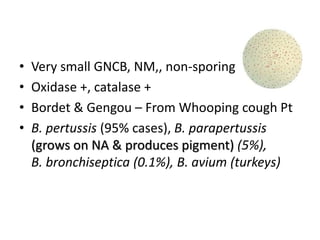
• Very small GNCB, NM,, non-sporing
• Oxidase +, catalase +
• Bordet & Gengou – From Whooping cough Pt
• B. pertussis (95% cases), B. parapertussis
(grows on NA & produces pigment) (5%),
B. bronchiseptica (0.1%), B. avium (turkeys)
Bordetella pertussis
• Bipolar metachromatic granules with toluidine
blue, confluent growth – aluminum paint
• Culture: strict aerobes, Bordet – Gengou
medium (Glycerol potato BA) x 48 – 72 hrs –
bisected pearls or mercury drops with hazy H’sis
• Charcoal BA may be used
• Blood – neutralizes inhibitory substance formed
during bacterial growth
• Loose clumps of bacilli appear as thumb
print with clear space b/w organism
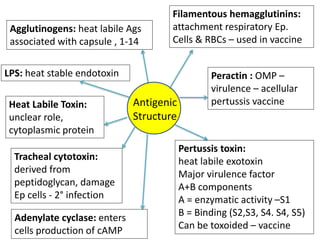
Antigenic
Structure
Agglutinogens: heat labile Ags
associated with capsule , 1-14
LPS: heat stable endotoxin
Heat Labile Toxin:
unclear role,
cytoplasmic protein
Adenylate cyclase: enters
cells production of cAMP
Filamentous hemagglutinins:
attachment respiratory Ep.
Cells & RBCs – used in vaccine
Peractin : OMP –
virulence – acellular
pertussis vaccine
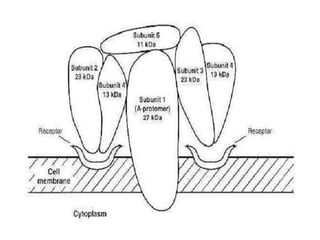
Pertussis toxin:
heat labile exotoxin
Major virulence factor
A+B components
A = enzymatic activity –S1
B = Binding (S2,S3, S4. S4, S5)
Can be toxoided – vaccine
Tracheal cytotoxin:
derived from
peptidoglycan, damage
Ep cells - 2° infection
Variations
• Capsular antigen
• May alter from smooth to rough
• Phase I To Phase iv (Rough & avirulent)
• On B.G. medium – X (xanthine – Yellow), C
(cyanic = blue), I (intermediate)
Pathogenesis
• One of the most infectious bacterial disease
• Childhood disease – whooping cough
• Source = patient in early stage, IP – 1-2 wks
• Droplets
• Catarrhal stage: max. infectivity, diff. Dx
• Paroxysmal – violent cough spasms of cont.
cough – lungs empty – air rushes in – whoop
• Convalescence
Complications
• Subconjuntival H’age
• Bronchopneumonia
• Lung collapse
• Convulsions
• Coma
• Reinfection in adults – sever disease
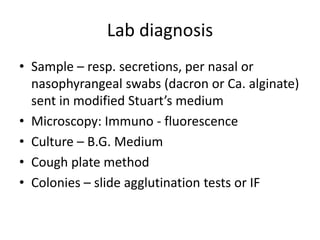
Lab diagnosis
• Sample – resp. secretions, per nasal or
nasophyrangeal swabs (dacron or Ca. alginate)
sent in modified Stuart’s medium
• Microscopy: Immuno - fluorescence
• Culture – B.G. Medium
• Cough plate method
• Colonies – slide agglutination tests or IF
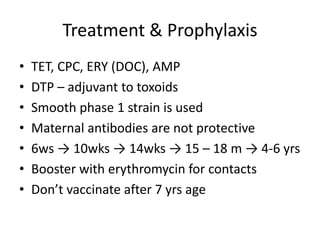
Treatment & Prophylaxis
• TET, CPC, ERY (DOC), AMP
• DTP – adjuvant to toxoids
• Smooth phase 1 strain is used
• Maternal antibodies are not protective
• 6ws → 10wks → 14wks → 15 – 18 m → 4-6 yrs
• Booster with erythromycin for contacts
• Don’t vaccinate after 7 yrs age
X

Bordetella

  • 1.
    Bordetella Dr. Kanwal DeepSingh Lyall M.D. Microbiology
  • 2.
    • Very smallGNCB, NM,, non-sporing • Oxidase +, catalase + • Bordet & Gengou – From Whooping cough Pt • B. pertussis (95% cases), B. parapertussis (grows on NA & produces pigment) (5%), B. bronchiseptica (0.1%), B. avium (turkeys)
  • 3.
    Bordetella pertussis • Bipolarmetachromatic granules with toluidine blue, confluent growth – aluminum paint • Culture: strict aerobes, Bordet – Gengou medium (Glycerol potato BA) x 48 – 72 hrs – bisected pearls or mercury drops with hazy H’sis • Charcoal BA may be used • Blood – neutralizes inhibitory substance formed during bacterial growth • Loose clumps of bacilli appear as thumb print with clear space b/w organism
  • 4.
    Antigenic Structure Agglutinogens: heat labileAgs associated with capsule , 1-14 LPS: heat stable endotoxin Heat Labile Toxin: unclear role, cytoplasmic protein Adenylate cyclase: enters cells production of cAMP Filamentous hemagglutinins: attachment respiratory Ep. Cells & RBCs – used in vaccine Peractin : OMP – virulence – acellular pertussis vaccine Pertussis toxin: heat labile exotoxin Major virulence factor A+B components A = enzymatic activity –S1 B = Binding (S2,S3, S4. S4, S5) Can be toxoided – vaccine Tracheal cytotoxin: derived from peptidoglycan, damage Ep cells - 2° infection
  • 6.
    Variations • Capsular antigen •May alter from smooth to rough • Phase I To Phase iv (Rough & avirulent) • On B.G. medium – X (xanthine – Yellow), C (cyanic = blue), I (intermediate)
  • 7.
    Pathogenesis • One ofthe most infectious bacterial disease • Childhood disease – whooping cough • Source = patient in early stage, IP – 1-2 wks • Droplets • Catarrhal stage: max. infectivity, diff. Dx • Paroxysmal – violent cough spasms of cont. cough – lungs empty – air rushes in – whoop • Convalescence
  • 8.
    Complications • Subconjuntival H’age •Bronchopneumonia • Lung collapse • Convulsions • Coma • Reinfection in adults – sever disease
  • 9.
    Lab diagnosis • Sample– resp. secretions, per nasal or nasophyrangeal swabs (dacron or Ca. alginate) sent in modified Stuart’s medium • Microscopy: Immuno - fluorescence • Culture – B.G. Medium • Cough plate method • Colonies – slide agglutination tests or IF
  • 10.
    Treatment & Prophylaxis •TET, CPC, ERY (DOC), AMP • DTP – adjuvant to toxoids • Smooth phase 1 strain is used • Maternal antibodies are not protective • 6ws → 10wks → 14wks → 15 – 18 m → 4-6 yrs • Booster with erythromycin for contacts • Don’t vaccinate after 7 yrs age
  • 11.