BRUCELLOSIS
ABHIJITH SP
CVAS POOKODE
Introduction
• Brucellosis is a worldwide zoonosis caused by the bacterial genus Brucella.
• These organisms localize in the reproductive organs of host animals, causing abortions and
sterility.
• Brucellosis was first diagnosed by Wright and Smith in 1897.
• B.melitensis was identified by Bruce in Malta in 1887.
• B.abortus was first recognized by Bang in 1897.
• B. suis was discovered by Traum in 1914.
• Alice Evans (1918) identified the first Brucella of human origin in the USA.
• Buck (1930) developed live attenuated strain 19 vaccine
24-09-2020ABHIJITH SP CVAS POOKODE 2
Aetiology
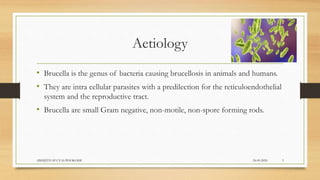
• Brucella is the genus of bacteria causing brucellosis in animals and humans.
• They are intra cellular parasites with a predilection for the reticuloendothelial
system and the reproductive tract.
• Brucella are small Gram negative, non-motile, non-spore forming rods.
24-09-2020ABHIJITH SP CVAS POOKODE 3
24-09-2020ABHIJITH SP CVAS POOKODE 4
Morphology
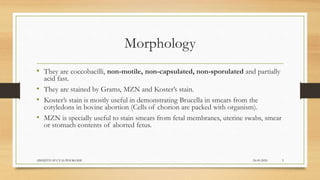
• They are coccobacilli, non-motile, non-capsulated, non-sporulated and partially
acid fast.
• They are stained by Grams, MZN and Koster’s stain.
• Koster’s stain is mostly useful in demonstrating Brucella in smears from the
cotyledons in bovine abortion (Cells of chorion are packed with organism).
• MZN is specially useful to stain smears from fetal membranes, uterine swabs, smear
or stomach contents of aborted fetus.
24-09-2020ABHIJITH SP CVAS POOKODE 5
Cultural Characters
• They are strict aerobes.
• Brucella abortus and Brucella ovis is carboxyphilic, requiring 5-10% CO2.
• Selective media for Brucella are Albimi medium and Columbia agar.
• Brucella is non hemolytic on blood agar.
• After 3-5 days incubation on selective serum agar, pinpoint smooth, glistening, bluish, translucent
colonies will appear (SBT-PGC).
• A nonselective, biphasic medium, known as Castañeda’s medium, is used for the isolation of
Brucella from blood and other body fluids or milk.
• Little or no growth is produced by most Brucella strains (exception- B. melitensis- non lactose
fermenting) on MacConkey agar.
24-09-2020ABHIJITH SP CVAS POOKODE 6
Transmission
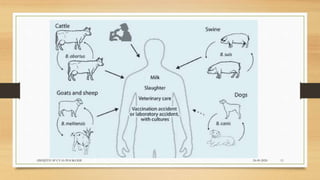
• The common routes of infection in animals and humans are via the mucous
membrane of the digestive tract, genital tract and skin.
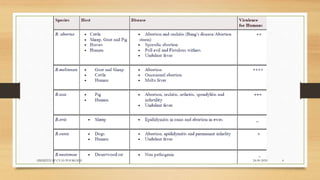
• Venereal transmission is main route for B.ovis.
• Organisms may penetrate the mucosa of nasal or oral cavities.
24-09-2020ABHIJITH SP CVAS POOKODE 7
Pathogenesis
• Brucella species are facultative intracellular bacteria that have the ability to avoid the killing
mechanism and proliferate within the macrophages, similar to other intracellular pathogens.
• After infecting the host, the pathogen becomes sequestered within the cells of the
reticuloendothelial system.
• Mainly settle in reproductive system in both male and female.
• After multiplication, the organism pass to the thoracic duct and then via blood stream to
parenchymatous organs and other tissues such as joints, granulomatous foci develop in
lymphatic tissues, liver, spleen, bone marrow and other locations. On occasion it will
become abscess.
• The incubation period is usually 2–4 weeks (range, 5 days to 6 months).
24-09-2020ABHIJITH SP CVAS POOKODE 8
Pathogenesis
• The Brucellosis is essentially disease of the sexually mature animal, the predilection sites being the
reproductive tracts of males and females especially the pregnant uterus.
• Allantoic factors such as erythritol (Polyhydric OH), steroid hormones and other substances favor
the growth of most brucellae.
• Erythritol is present in the placenta and male genital tract of cattle, sheep, goats and pigs but not
humans.
• Erythritol does not stimulate the growth of B.ovis and inhibits B.abortus strain 19, the attenuated
vaccine strain.
• A pyogranulomatous reaction occurs in affected placentae and abortion occurs from 6 month
onwards.
• Permanent infertility may occur in male dogs infected with Brucella canis.
24-09-2020ABHIJITH SP CVAS POOKODE 9
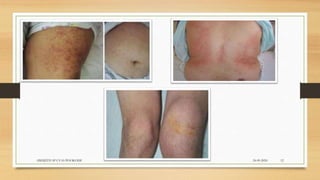
Symptoms in Human Brucellosis
• Symptoms of brucellosis may show up anytime from a few days to a few
months after you've been infected. Signs and symptoms are similar to those
of the flu and include:
• Fever, Chills
• Loss of appetite, Sweats
• Weakness, Fatigue
• Joint, muscle and back pain, Headache
24-09-2020ABHIJITH SP CVAS POOKODE 10
24-09-2020ABHIJITH SP CVAS POOKODE 11
24-09-2020ABHIJITH SP CVAS POOKODE 12
24-09-2020ABHIJITH SP CVAS POOKODE 13
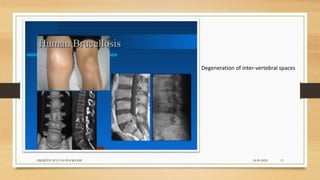
Degeneration of inter-vertebral spaces
Clinical Signs
• In small and large ruminants:
• 1.After bacteremia the infection localizes in the placentae, if the animal is not
pregnant, the infection localizes in udder (interstitial mastitis).
• 2.Orchitis and epididymitis in males.
• 3.Abortion at 6th month in cattle and 4th month in sheep and goats.
• Swine brucellosis is caused by Brucella suis characterized by abortion, sterility, and
birth of stillborn or weak pigs, focal abscesses in various organs, spondylitis and
lameness.
24-09-2020ABHIJITH SP CVAS POOKODE 14
Clinical Signs
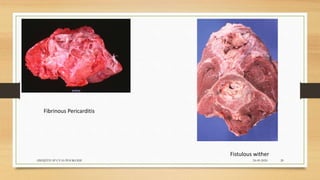
• In horse, the organisms produce chronic inflammatory conditions referred as fistulous
withers/ poll evil and joint infections.
• Fistulous wither and poll evil are clinically same conditions occurring in supraspinous and
supra-atlantal bursae respectively.
• The causative agent is B.abortus.
• In dogs, infected bitches usually aborted in the last trimester.
• Following abortion there is yellow brown to dark brown discharges that persist for 1 to 6
weeks.
• Epididymitis, orchitis and testicular atrophy with decreased spermatogenesis are common in
the male and may result in irreversible sterility.
24-09-2020ABHIJITH SP CVAS POOKODE 15
Macroscopic Lesions
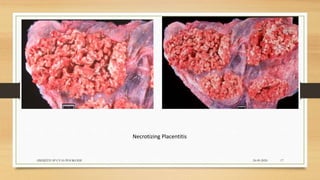
• The gravid bovine uterus infected with B.abortus develops a necrotic placentitis.
• The cotyledons become swollen, hyperemic and surrounded by brownish exudates.
• The inter cotyledonary spaces are thickened and have a characteristic leathery
appearance.
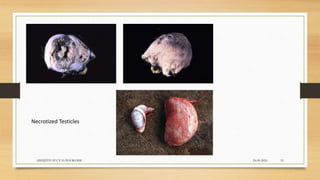
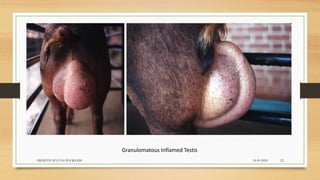
• Orchitis in bull result in abscess formation or areas of necrosis in the testicles,
surrounded by fibrous tissues.
• Brucella suis causes placentitis, metritis in ewes and epididymitis and orchitis in boars.
• In horses, B.abortus infection associated with fistulous withers (a chronic
inflammatory condition of the supraspinous bursa) and poll evil.
24-09-2020ABHIJITH SP CVAS POOKODE 16
Necrotizing Placentitis
24-09-2020ABHIJITH SP CVAS POOKODE 17
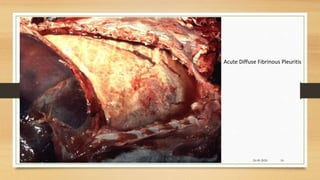
Acute Diffuse Fibrinous Pleuritis
24-09-2020ABHIJITH SP CVAS POOKODE 18
Necrotized Testicles
24-09-2020ABHIJITH SP CVAS POOKODE 19
Fibrinous Pericarditis
Fistulous wither
24-09-2020ABHIJITH SP CVAS POOKODE 20
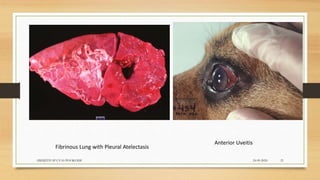
Fibrinous Lung with Pleural Atelectasis
Anterior Uveitis
24-09-2020ABHIJITH SP CVAS POOKODE 21
Granulomatous Inflamed Testis
24-09-2020ABHIJITH SP CVAS POOKODE 22
Diagnosis
• 1.Based on symptoms and lesion and history of abortion in a herd.
• 2.Microscopical examination: Smears prepared from chorionic tissues, foetal
stomach contents and uterine discharges stained by modification of Macchiavello’s
method or Koster’s method will reveal brucella organisms.
• 3.Bacteriological examination: SBT-PGC colonies in Albimi Agar.
• 4.Strauss Inoculation Test-Animal Inoculation Test.
• 5.Brucellin Skin Test:It is used for screening unvaccinated herds. A purified (free of
sLPS) and standardized antigen preparation (e.g. brucellin) is used.
24-09-2020ABHIJITH SP CVAS POOKODE 23
Diagnosis
• 6.Serological Test/Immunological Tests:
• A)Serum agglutination test/ Tube agglutination test- (STAT) (GST)
• B)Abortus Bang’s ring test (ABRT)/Milk ring test
• C)Rose Bengal plate test (RBPT)
• D)Coombs test
• E)Card test
• F)Whey agglutination test
• CFT, AGID and ELISA
• Rivanol precipitation and Mercaptoethanol agglutination
24-09-2020ABHIJITH SP CVAS POOKODE 24
Prevention and Control
• The immunity acquired from natural infection is not always sufficient to prevent reinfection.
• The general basis for elimination of brucellosis is testing and removal of reactors from the herd.
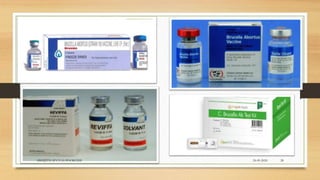
• The attenuated live vaccine (Strain 19 B.abortus biotype 1) eg: Bruvax from IIL is used in
female calves 4 to 12 months of age. One dose gives immunity up to fifth pregnancy.
• Because strain 19 cause infertility/orchitis in some male calves, its use is restricted to females.
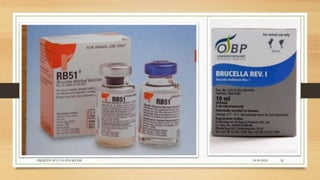
• RB51 (which is live attenuated Rough strain) strain is used instead of strain 19 vaccine.
• B.melitensis Rev.1 live attenuated vaccine has been used with success to immunize rams against
B.ovis infection also.
• A killed product B.melitensis H38 is also available.
24-09-2020ABHIJITH SP CVAS POOKODE 25
24-09-2020ABHIJITH SP CVAS POOKODE 26
24-09-2020ABHIJITH SP CVAS POOKODE 27
24-09-2020ABHIJITH SP CVAS POOKODE 28
Facts and Tips
• The B.abortus biotype 3 is commonly present in India.
• The B. abortus-Cultures in the smooth or smooth-intermediate phase are lysed by
brucella-phages of the Tbilisi (Tb), Weybridge (Wb), Firenze (Fz), Berkeley
(Bk) and D groups. Non-smooth cultures are lysed by brucella-phage R.
• The Brucellae are catalase positive, oxidase positive (except B.ovis and B.neotomae),
and urease +ve (except B.ovis and B.melitensis), reduce nitrate
• IMViC, -,-,-,-
• H2S production is positive for B. abortus biotype 1-4 and 9 and B.suis biotype 1
24-09-2020ABHIJITH SP CVAS POOKODE 29
Facts and Tips.
• The OIE listing: Notifiable (List B disease).
• The Brucella abortus contains more A antigen than M (20:1).
• B.melitensis has more M than A (20:1).
• B.suis has an intermediate pattern.
• In addition to endotoxin, the surface cell wall carbohydrate is responsible
for binding to B-lymphocytes and plays a major role in pathogenesis.
• Sensitive to thionin, basic fuchsin dyes.
24-09-2020ABHIJITH SP CVAS POOKODE 30
THANK YOU

Brucella and brucellosis

  • 1.
  • 2.
    Introduction • Brucellosis isa worldwide zoonosis caused by the bacterial genus Brucella. • These organisms localize in the reproductive organs of host animals, causing abortions and sterility. • Brucellosis was first diagnosed by Wright and Smith in 1897. • B.melitensis was identified by Bruce in Malta in 1887. • B.abortus was first recognized by Bang in 1897. • B. suis was discovered by Traum in 1914. • Alice Evans (1918) identified the first Brucella of human origin in the USA. • Buck (1930) developed live attenuated strain 19 vaccine 24-09-2020ABHIJITH SP CVAS POOKODE 2
  • 3.
    Aetiology • Brucella isthe genus of bacteria causing brucellosis in animals and humans. • They are intra cellular parasites with a predilection for the reticuloendothelial system and the reproductive tract. • Brucella are small Gram negative, non-motile, non-spore forming rods. 24-09-2020ABHIJITH SP CVAS POOKODE 3
  • 4.
  • 5.
    Morphology • They arecoccobacilli, non-motile, non-capsulated, non-sporulated and partially acid fast. • They are stained by Grams, MZN and Koster’s stain. • Koster’s stain is mostly useful in demonstrating Brucella in smears from the cotyledons in bovine abortion (Cells of chorion are packed with organism). • MZN is specially useful to stain smears from fetal membranes, uterine swabs, smear or stomach contents of aborted fetus. 24-09-2020ABHIJITH SP CVAS POOKODE 5
  • 6.
    Cultural Characters • Theyare strict aerobes. • Brucella abortus and Brucella ovis is carboxyphilic, requiring 5-10% CO2. • Selective media for Brucella are Albimi medium and Columbia agar. • Brucella is non hemolytic on blood agar. • After 3-5 days incubation on selective serum agar, pinpoint smooth, glistening, bluish, translucent colonies will appear (SBT-PGC). • A nonselective, biphasic medium, known as Castañeda’s medium, is used for the isolation of Brucella from blood and other body fluids or milk. • Little or no growth is produced by most Brucella strains (exception- B. melitensis- non lactose fermenting) on MacConkey agar. 24-09-2020ABHIJITH SP CVAS POOKODE 6
  • 7.
    Transmission • The commonroutes of infection in animals and humans are via the mucous membrane of the digestive tract, genital tract and skin. • Venereal transmission is main route for B.ovis. • Organisms may penetrate the mucosa of nasal or oral cavities. 24-09-2020ABHIJITH SP CVAS POOKODE 7
  • 8.
    Pathogenesis • Brucella speciesare facultative intracellular bacteria that have the ability to avoid the killing mechanism and proliferate within the macrophages, similar to other intracellular pathogens. • After infecting the host, the pathogen becomes sequestered within the cells of the reticuloendothelial system. • Mainly settle in reproductive system in both male and female. • After multiplication, the organism pass to the thoracic duct and then via blood stream to parenchymatous organs and other tissues such as joints, granulomatous foci develop in lymphatic tissues, liver, spleen, bone marrow and other locations. On occasion it will become abscess. • The incubation period is usually 2–4 weeks (range, 5 days to 6 months). 24-09-2020ABHIJITH SP CVAS POOKODE 8
  • 9.
    Pathogenesis • The Brucellosisis essentially disease of the sexually mature animal, the predilection sites being the reproductive tracts of males and females especially the pregnant uterus. • Allantoic factors such as erythritol (Polyhydric OH), steroid hormones and other substances favor the growth of most brucellae. • Erythritol is present in the placenta and male genital tract of cattle, sheep, goats and pigs but not humans. • Erythritol does not stimulate the growth of B.ovis and inhibits B.abortus strain 19, the attenuated vaccine strain. • A pyogranulomatous reaction occurs in affected placentae and abortion occurs from 6 month onwards. • Permanent infertility may occur in male dogs infected with Brucella canis. 24-09-2020ABHIJITH SP CVAS POOKODE 9
  • 10.
    Symptoms in HumanBrucellosis • Symptoms of brucellosis may show up anytime from a few days to a few months after you've been infected. Signs and symptoms are similar to those of the flu and include: • Fever, Chills • Loss of appetite, Sweats • Weakness, Fatigue • Joint, muscle and back pain, Headache 24-09-2020ABHIJITH SP CVAS POOKODE 10
  • 11.
  • 12.
  • 13.
    24-09-2020ABHIJITH SP CVASPOOKODE 13 Degeneration of inter-vertebral spaces
  • 14.
    Clinical Signs • Insmall and large ruminants: • 1.After bacteremia the infection localizes in the placentae, if the animal is not pregnant, the infection localizes in udder (interstitial mastitis). • 2.Orchitis and epididymitis in males. • 3.Abortion at 6th month in cattle and 4th month in sheep and goats. • Swine brucellosis is caused by Brucella suis characterized by abortion, sterility, and birth of stillborn or weak pigs, focal abscesses in various organs, spondylitis and lameness. 24-09-2020ABHIJITH SP CVAS POOKODE 14
  • 15.
    Clinical Signs • Inhorse, the organisms produce chronic inflammatory conditions referred as fistulous withers/ poll evil and joint infections. • Fistulous wither and poll evil are clinically same conditions occurring in supraspinous and supra-atlantal bursae respectively. • The causative agent is B.abortus. • In dogs, infected bitches usually aborted in the last trimester. • Following abortion there is yellow brown to dark brown discharges that persist for 1 to 6 weeks. • Epididymitis, orchitis and testicular atrophy with decreased spermatogenesis are common in the male and may result in irreversible sterility. 24-09-2020ABHIJITH SP CVAS POOKODE 15
  • 16.
    Macroscopic Lesions • Thegravid bovine uterus infected with B.abortus develops a necrotic placentitis. • The cotyledons become swollen, hyperemic and surrounded by brownish exudates. • The inter cotyledonary spaces are thickened and have a characteristic leathery appearance. • Orchitis in bull result in abscess formation or areas of necrosis in the testicles, surrounded by fibrous tissues. • Brucella suis causes placentitis, metritis in ewes and epididymitis and orchitis in boars. • In horses, B.abortus infection associated with fistulous withers (a chronic inflammatory condition of the supraspinous bursa) and poll evil. 24-09-2020ABHIJITH SP CVAS POOKODE 16
  • 17.
  • 18.
    Acute Diffuse FibrinousPleuritis 24-09-2020ABHIJITH SP CVAS POOKODE 18
  • 19.
  • 20.
  • 21.
    Fibrinous Lung withPleural Atelectasis Anterior Uveitis 24-09-2020ABHIJITH SP CVAS POOKODE 21
  • 22.
  • 23.
    Diagnosis • 1.Based onsymptoms and lesion and history of abortion in a herd. • 2.Microscopical examination: Smears prepared from chorionic tissues, foetal stomach contents and uterine discharges stained by modification of Macchiavello’s method or Koster’s method will reveal brucella organisms. • 3.Bacteriological examination: SBT-PGC colonies in Albimi Agar. • 4.Strauss Inoculation Test-Animal Inoculation Test. • 5.Brucellin Skin Test:It is used for screening unvaccinated herds. A purified (free of sLPS) and standardized antigen preparation (e.g. brucellin) is used. 24-09-2020ABHIJITH SP CVAS POOKODE 23
  • 24.
    Diagnosis • 6.Serological Test/ImmunologicalTests: • A)Serum agglutination test/ Tube agglutination test- (STAT) (GST) • B)Abortus Bang’s ring test (ABRT)/Milk ring test • C)Rose Bengal plate test (RBPT) • D)Coombs test • E)Card test • F)Whey agglutination test • CFT, AGID and ELISA • Rivanol precipitation and Mercaptoethanol agglutination 24-09-2020ABHIJITH SP CVAS POOKODE 24
  • 25.
    Prevention and Control •The immunity acquired from natural infection is not always sufficient to prevent reinfection. • The general basis for elimination of brucellosis is testing and removal of reactors from the herd. • The attenuated live vaccine (Strain 19 B.abortus biotype 1) eg: Bruvax from IIL is used in female calves 4 to 12 months of age. One dose gives immunity up to fifth pregnancy. • Because strain 19 cause infertility/orchitis in some male calves, its use is restricted to females. • RB51 (which is live attenuated Rough strain) strain is used instead of strain 19 vaccine. • B.melitensis Rev.1 live attenuated vaccine has been used with success to immunize rams against B.ovis infection also. • A killed product B.melitensis H38 is also available. 24-09-2020ABHIJITH SP CVAS POOKODE 25
  • 26.
  • 27.
  • 28.
  • 29.
    Facts and Tips •The B.abortus biotype 3 is commonly present in India. • The B. abortus-Cultures in the smooth or smooth-intermediate phase are lysed by brucella-phages of the Tbilisi (Tb), Weybridge (Wb), Firenze (Fz), Berkeley (Bk) and D groups. Non-smooth cultures are lysed by brucella-phage R. • The Brucellae are catalase positive, oxidase positive (except B.ovis and B.neotomae), and urease +ve (except B.ovis and B.melitensis), reduce nitrate • IMViC, -,-,-,- • H2S production is positive for B. abortus biotype 1-4 and 9 and B.suis biotype 1 24-09-2020ABHIJITH SP CVAS POOKODE 29
  • 30.
    Facts and Tips. •The OIE listing: Notifiable (List B disease). • The Brucella abortus contains more A antigen than M (20:1). • B.melitensis has more M than A (20:1). • B.suis has an intermediate pattern. • In addition to endotoxin, the surface cell wall carbohydrate is responsible for binding to B-lymphocytes and plays a major role in pathogenesis. • Sensitive to thionin, basic fuchsin dyes. 24-09-2020ABHIJITH SP CVAS POOKODE 30
  • 31.