1
A Survey on
Boosting Algorithms for
Supervised Learning
Artur Ferreira
supervisor Prof. Mário Figueiredo
26 November 2007
2
Summary
1. Ensembles of classifiers and boosting
2. Boosting: origins and features
3. The AdaBoost algorithm and its variants
 Supervised Learning (SL)
 Semi-Supervised Learning (SSL)
4. Experimental results (binary classification)
 Comparison with other techniques
5. Concluding remarks (and ongoing work)
3
1. Ensembles of classifiers
 Motivation for ensembles of classifiers
 Instead of learning a single complex classifier, learn
several simple classifiers
 Combine the output of the simple classifiers to
produce the classification decision
 For instance, instead of training a large neural
network (NN), train several smaller NN and combine
their individual output in order to produce the final
output
4
1. Ensembles of classifiers
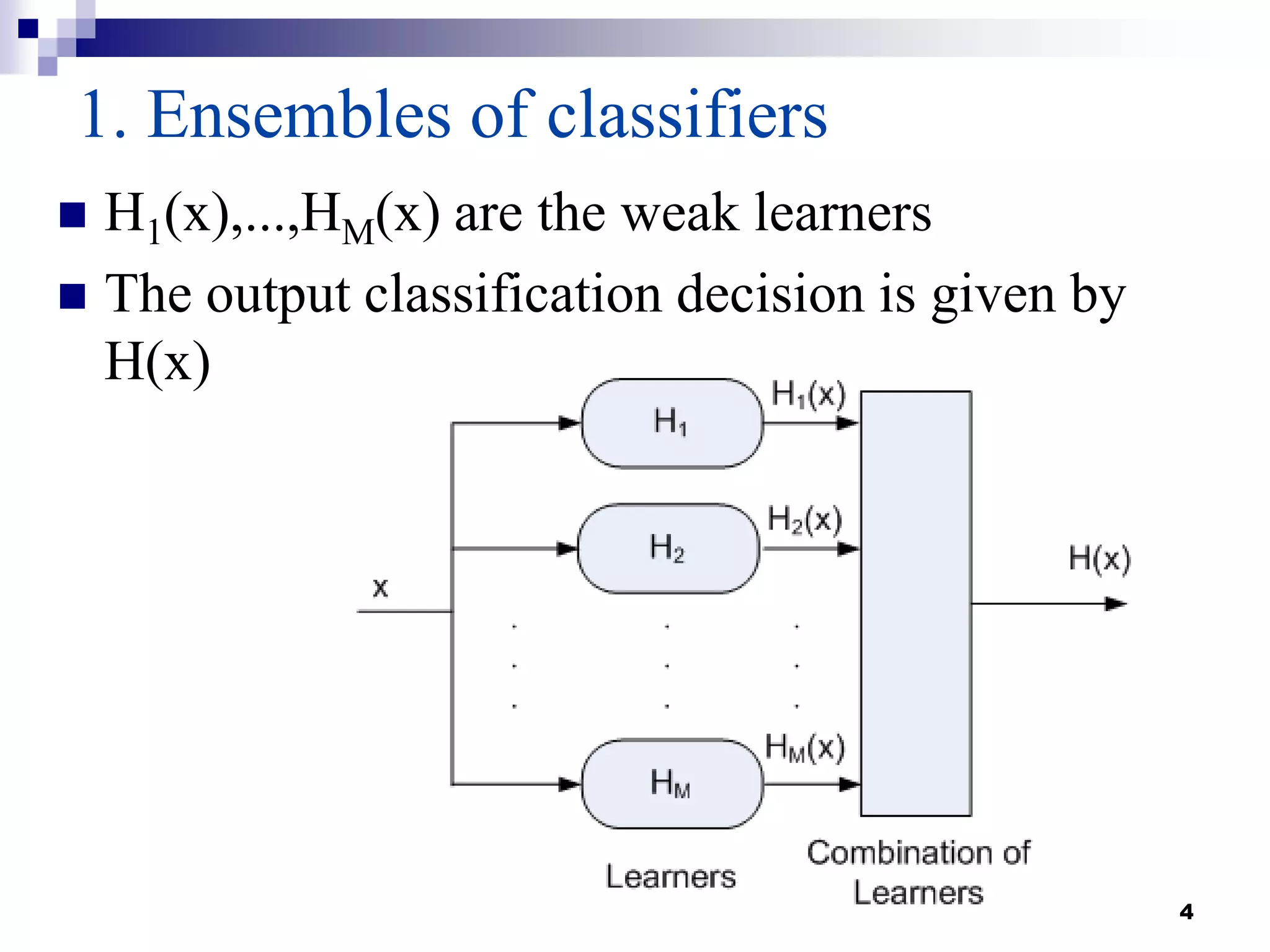
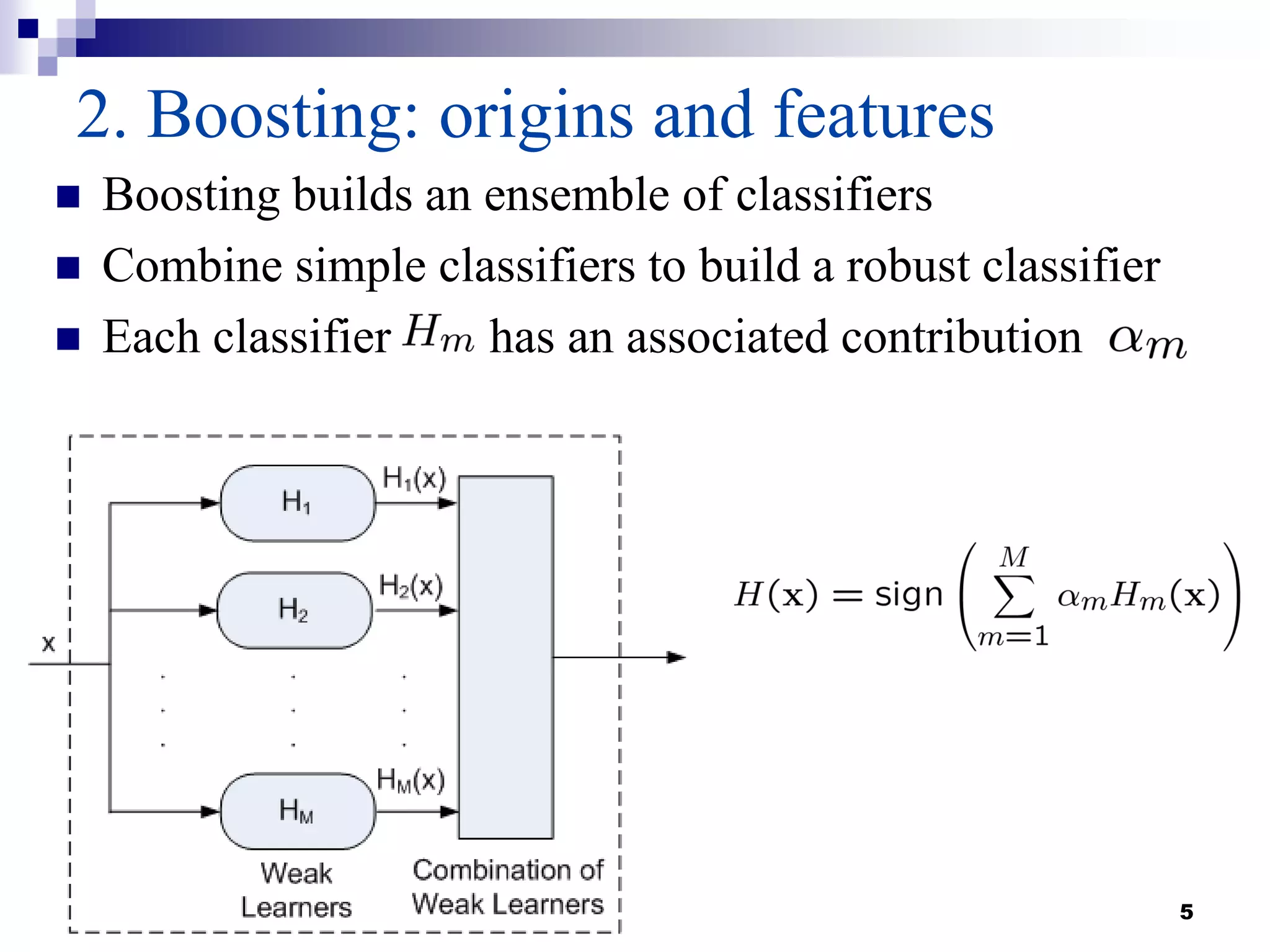
 H1(x),...,HM(x) are the weak learners
 The output classification decision is given by
H(x)
5
2. Boosting: origins and features
 Boosting builds an ensemble of classifiers
 Combine simple classifiers to build a robust classifier
 Each classifier has an associated contribution
6
2. The origins of Boosting
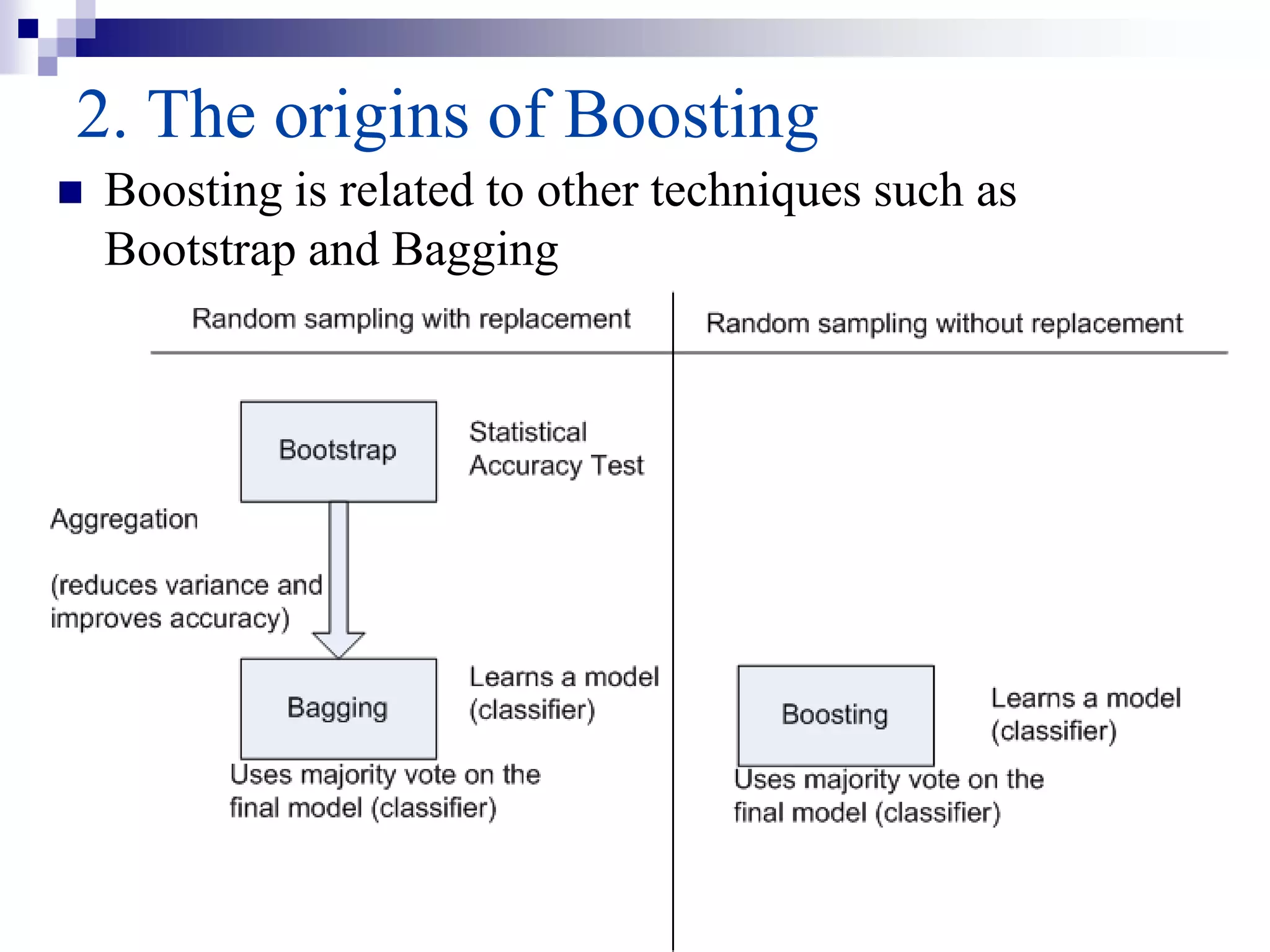
 Boosting is related to other techniques such as
Bootstrap and Bagging
7
2. Bootstrap: features
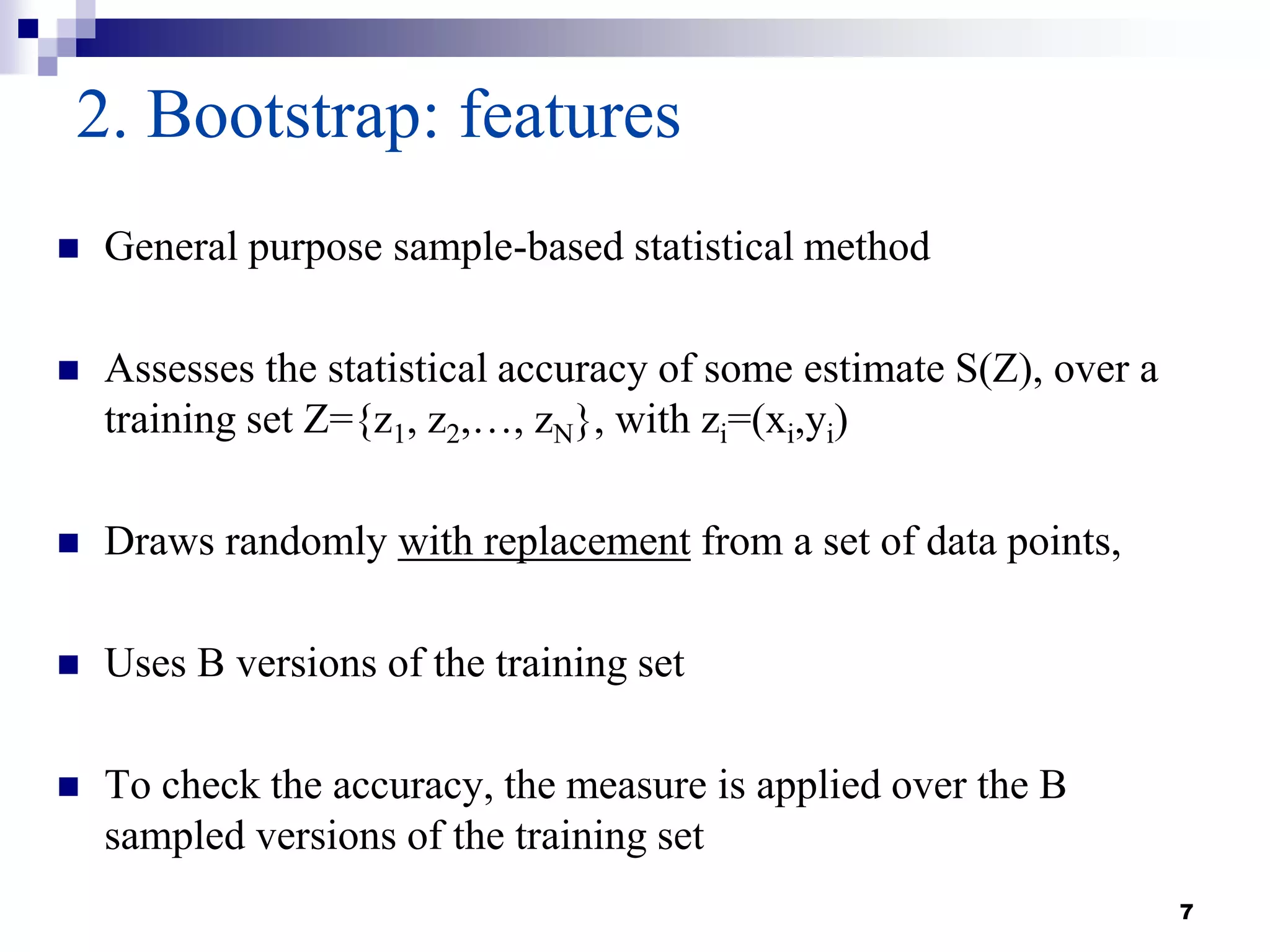
 General purpose sample-based statistical method
 Assesses the statistical accuracy of some estimate S(Z), over a
training set Z={z1, z2,…, zN}, with zi=(xi,yi)
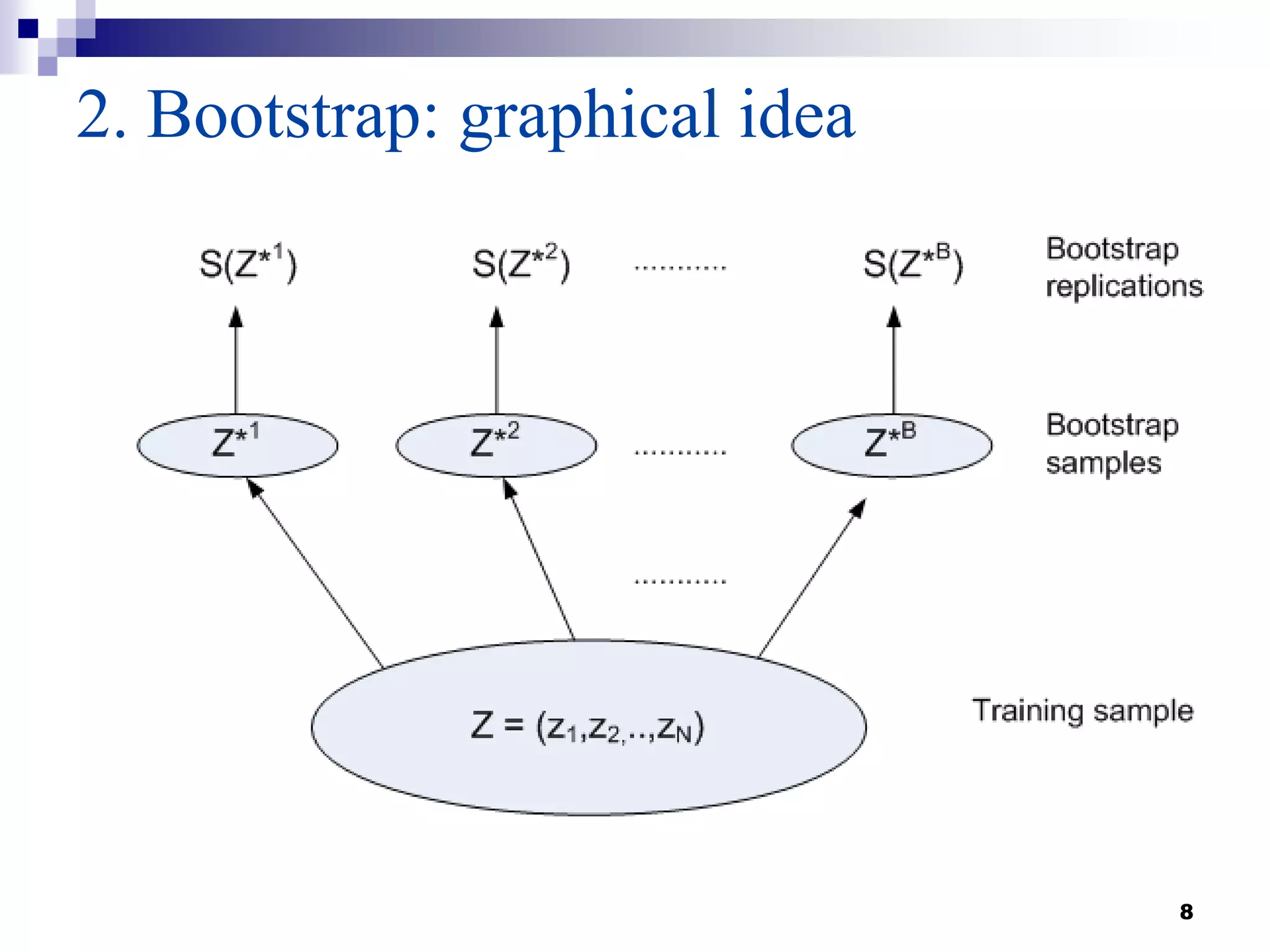
 Draws randomly with replacement from a set of data points,
 Uses B versions of the training set
 To check the accuracy, the measure is applied over the B
sampled versions of the training set
8
2. Bootstrap: graphical idea
9
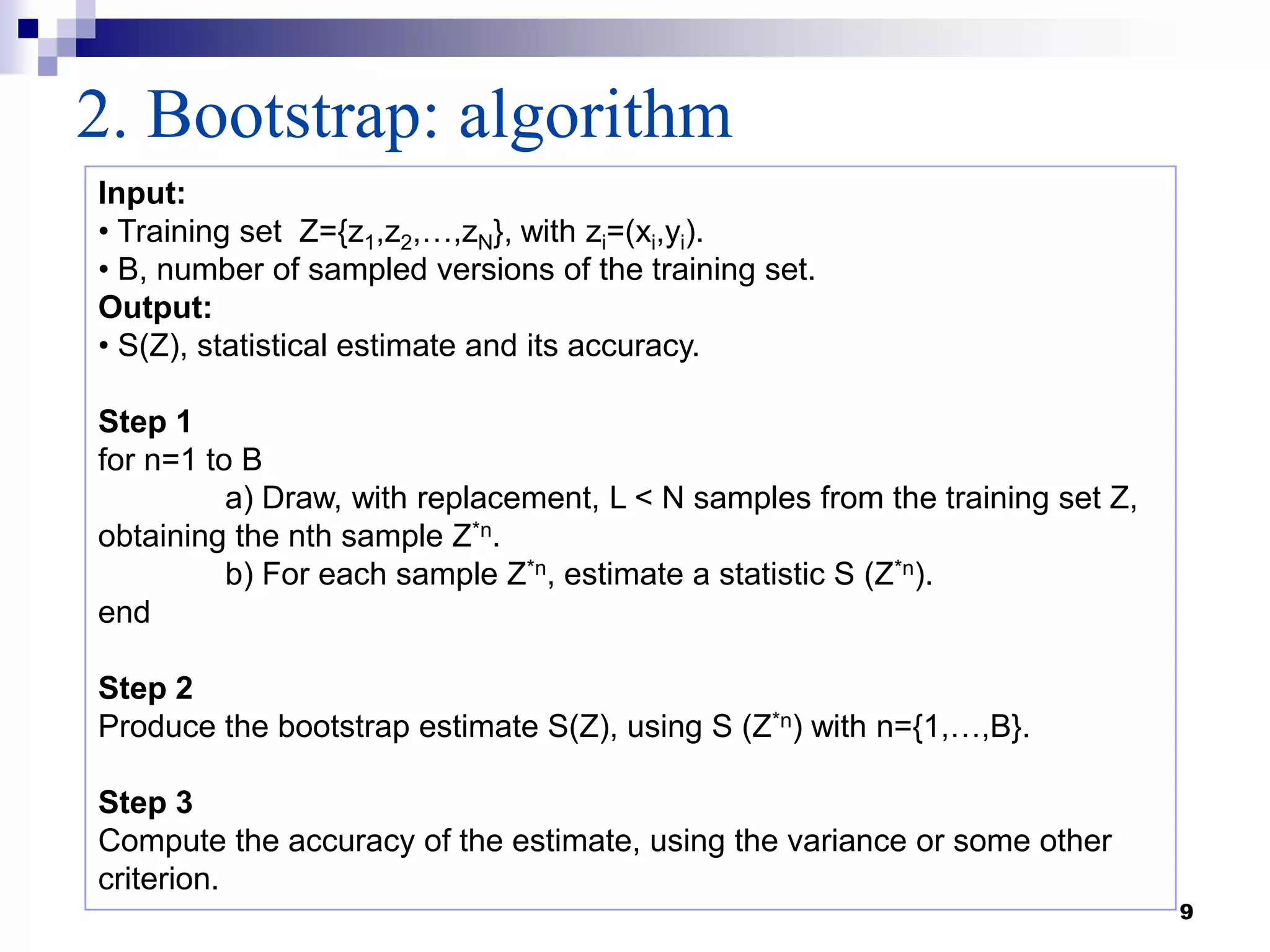
2. Bootstrap: algorithm
Input:
• Training set Z={z1,z2,…,zN}, with zi=(xi,yi).
• B, number of sampled versions of the training set.
Output:
• S(Z), statistical estimate and its accuracy.
Step 1
for n=1 to B
a) Draw, with replacement, L < N samples from the training set Z,
obtaining the nth sample Z*n.
b) For each sample Z*n, estimate a statistic S (Z*n).
end
Step 2
Produce the bootstrap estimate S(Z), using S (Z*n) with n={1,…,B}.
Step 3
Compute the accuracy of the estimate, using the variance or some other
criterion.
10
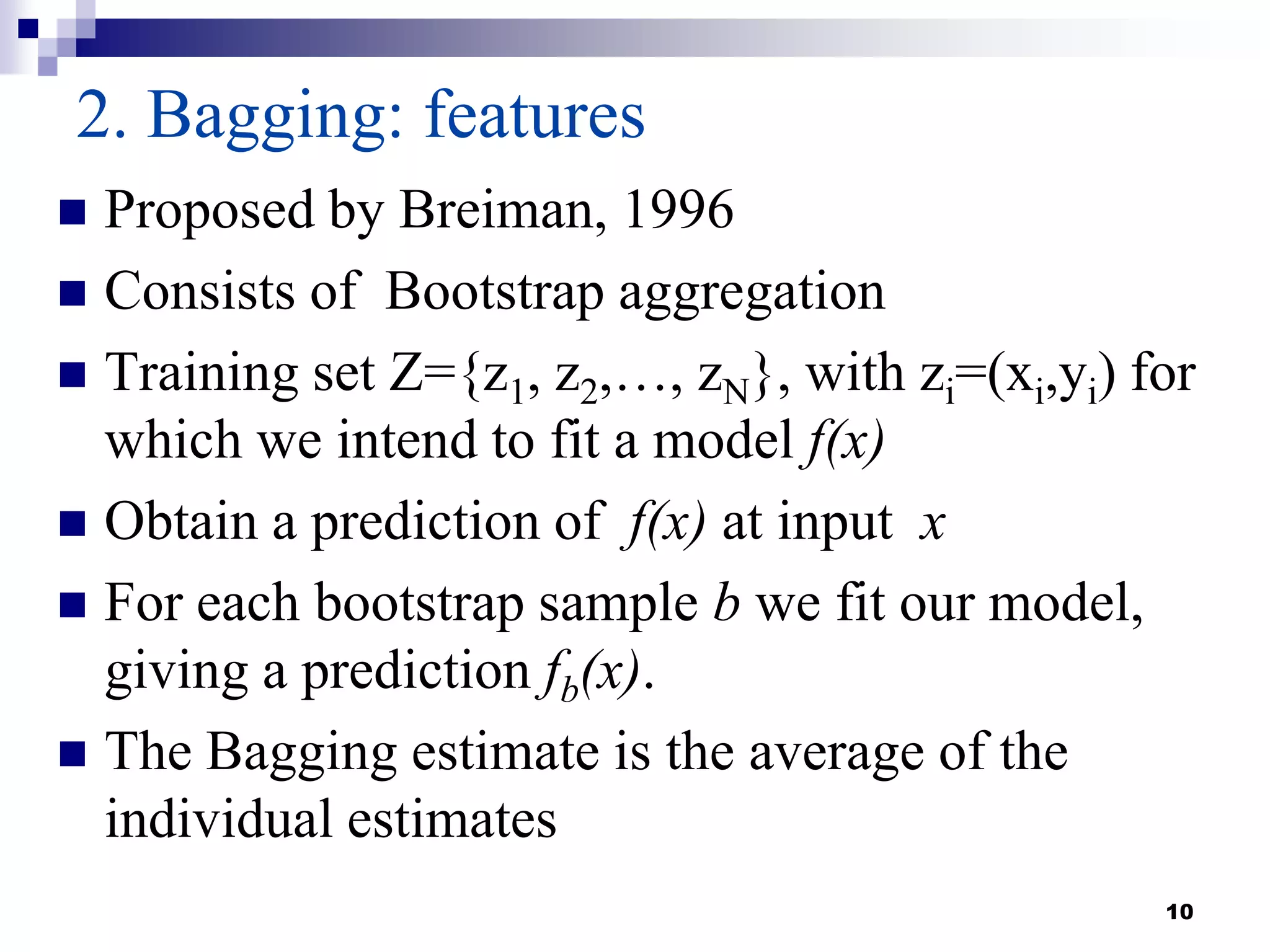
2. Bagging: features
 Proposed by Breiman, 1996
 Consists of Bootstrap aggregation
 Training set Z={z1, z2,…, zN}, with zi=(xi,yi) for
which we intend to fit a model f(x)
 Obtain a prediction of f(x) at input x
 For each bootstrap sample b we fit our model,
giving a prediction fb(x).
 The Bagging estimate is the average of the
individual estimates
11
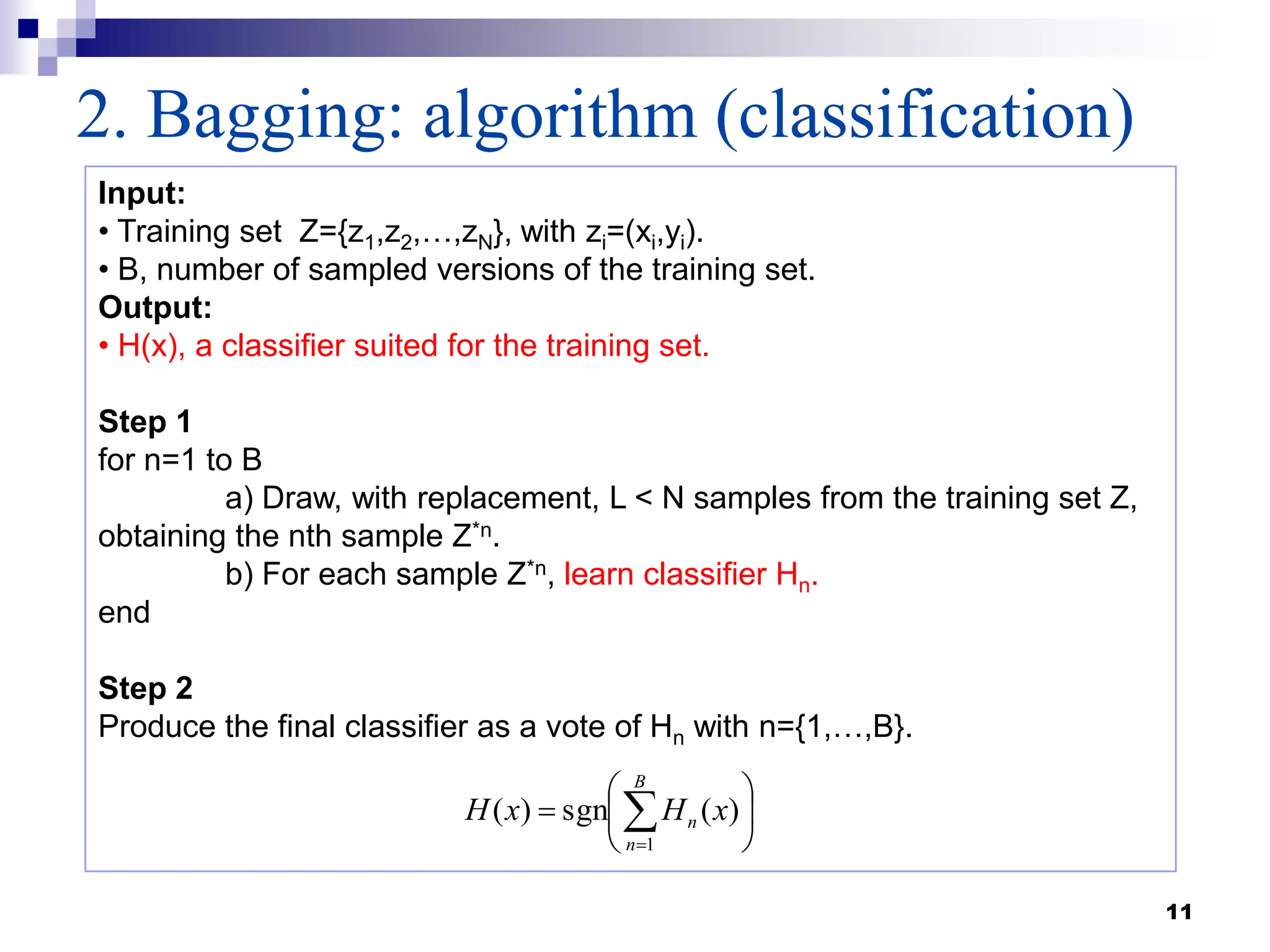
2. Bagging: algorithm (classification)
Input:
• Training set Z={z1,z2,…,zN}, with zi=(xi,yi).
• B, number of sampled versions of the training set.
Output:
• H(x), a classifier suited for the training set.
Step 1
for n=1 to B
a) Draw, with replacement, L < N samples from the training set Z,
obtaining the nth sample Z*n.
b) For each sample Z*n, learn classifier Hn.
end
Step 2
Produce the final classifier as a vote of Hn with n={1,…,B}.
B
n
n xHxH
1
)(sgn)(
12
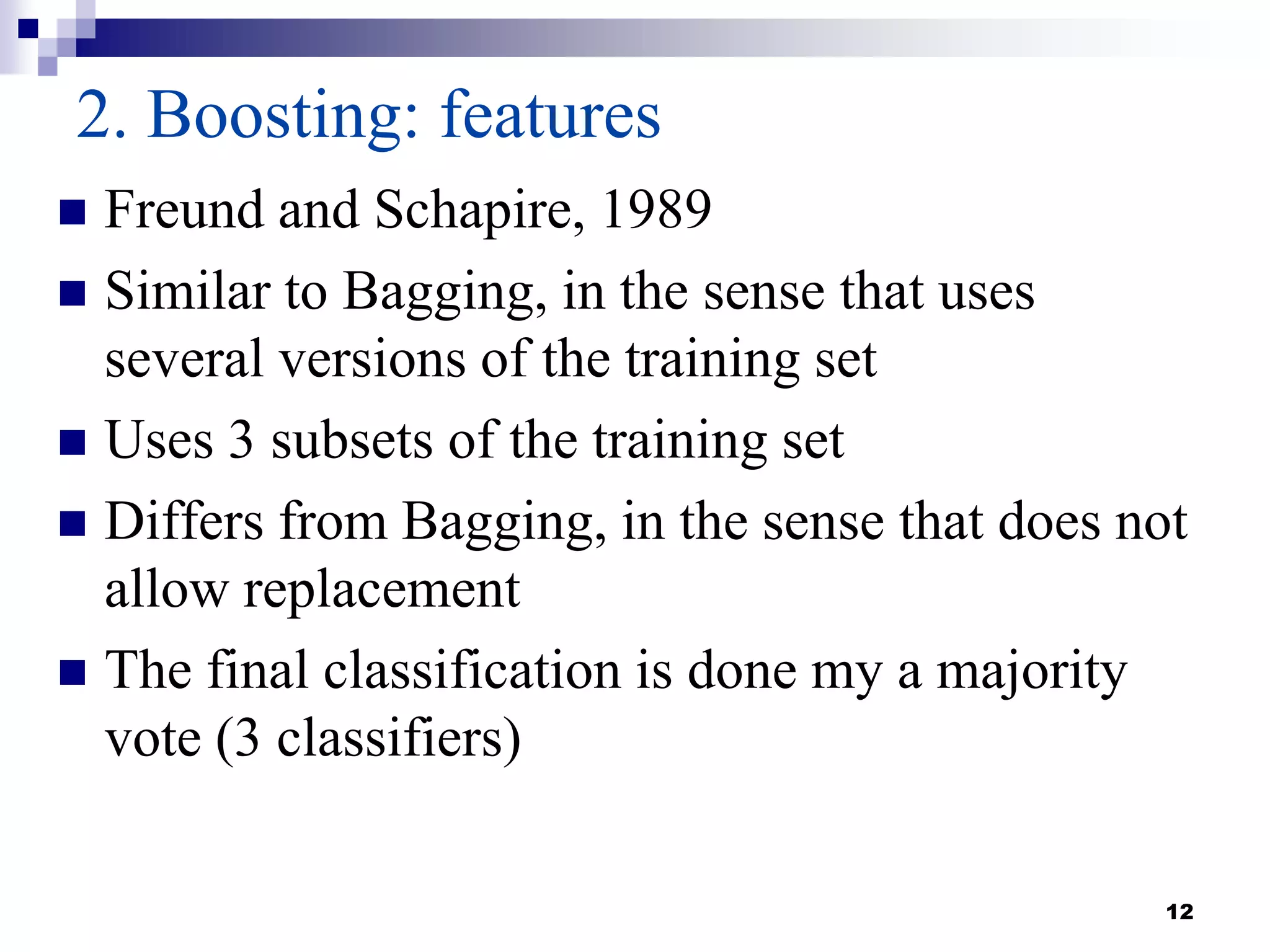
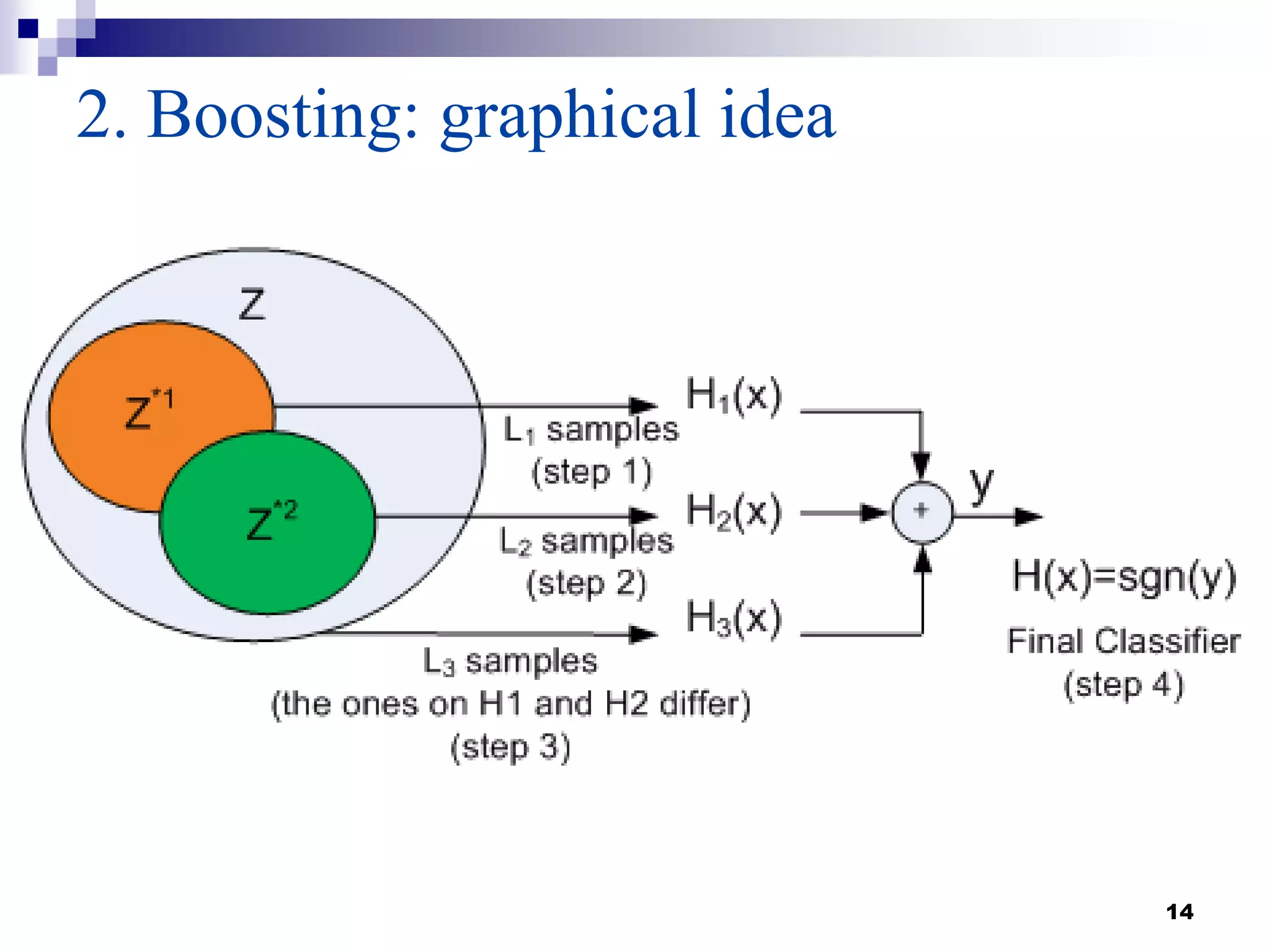
2. Boosting: features
 Freund and Schapire, 1989
 Similar to Bagging, in the sense that uses
several versions of the training set
 Uses 3 subsets of the training set
 Differs from Bagging, in the sense that does not
allow replacement
 The final classification is done my a majority
vote (3 classifiers)
13
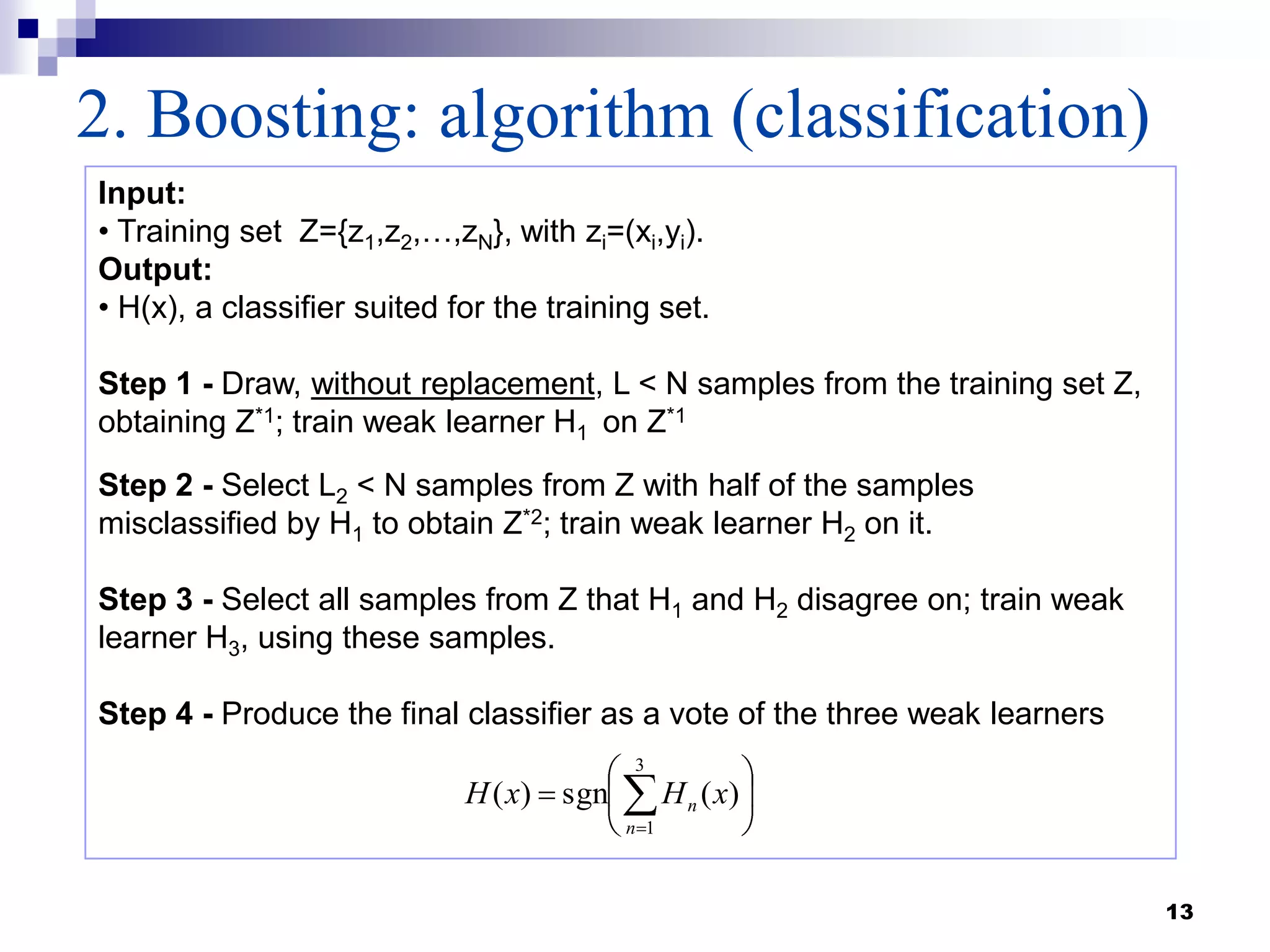
2. Boosting: algorithm (classification)
Input:
• Training set Z={z1,z2,…,zN}, with zi=(xi,yi).
Output:
• H(x), a classifier suited for the training set.
Step 1 - Draw, without replacement, L < N samples from the training set Z,
obtaining Z*1; train weak learner H1 on Z*1
Step 2 - Select L2 < N samples from Z with half of the samples
misclassified by H1 to obtain Z*2; train weak learner H2 on it.
Step 3 - Select all samples from Z that H1 and H2 disagree on; train weak
learner H3, using these samples.
Step 4 - Produce the final classifier as a vote of the three weak learners
3
1
)(sgn)(
n
n xHxH
14
2. Boosting: graphical idea
15
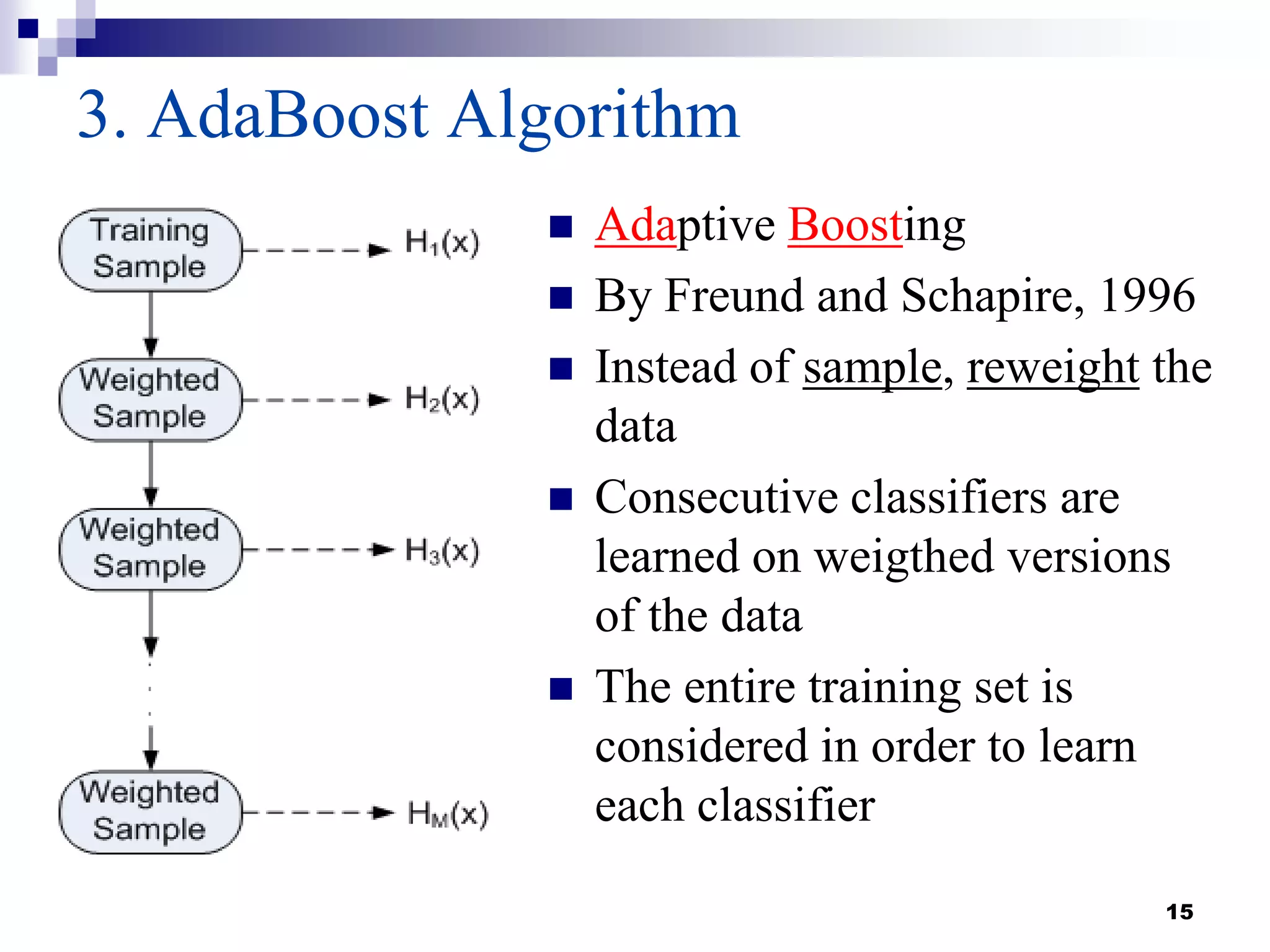
3. AdaBoost Algorithm
 Adaptive Boosting
 By Freund and Schapire, 1996
 Instead of sample, reweight the
data
 Consecutive classifiers are
learned on weigthed versions
of the data
 The entire training set is
considered in order to learn
each classifier
16
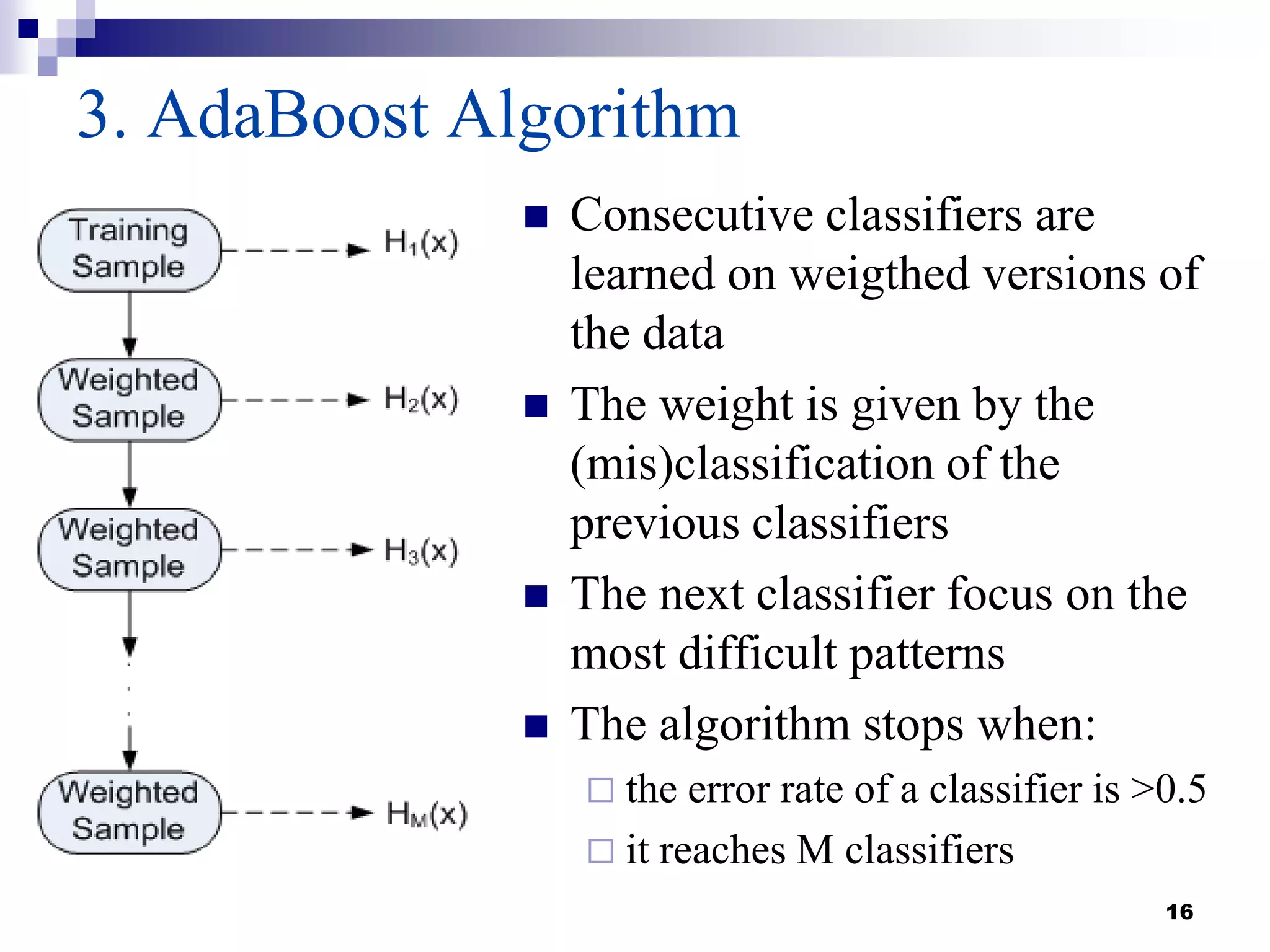
3. AdaBoost Algorithm
 Consecutive classifiers are
learned on weigthed versions of
the data
 The weight is given by the
(mis)classification of the
previous classifiers
 The next classifier focus on the
most difficult patterns
 The algorithm stops when:
 the error rate of a classifier is >0.5
 it reaches M classifiers
17
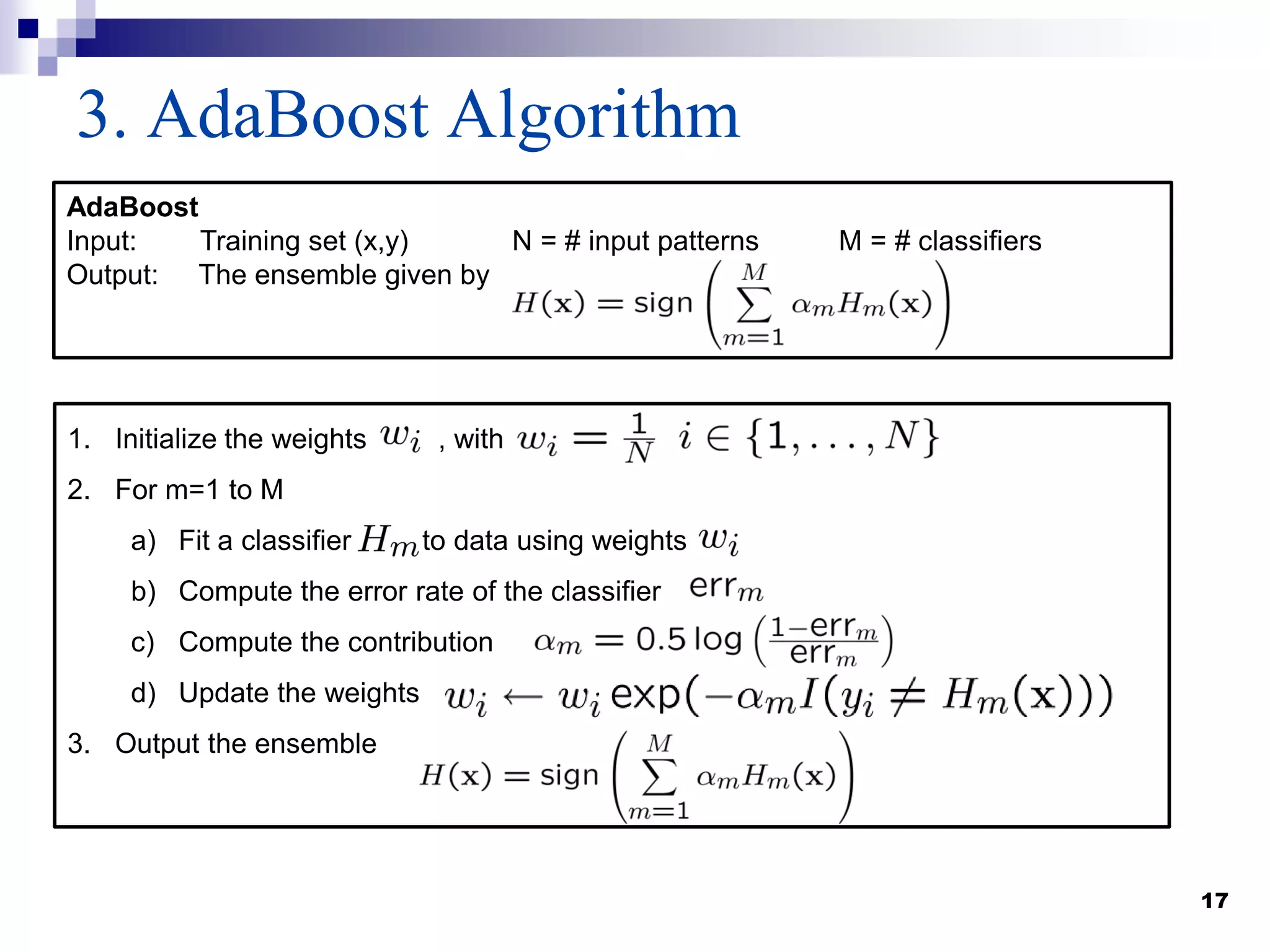
3. AdaBoost Algorithm
1. Initialize the weights , with
2. For m=1 to M
a) Fit a classifier to data using weights
b) Compute the error rate of the classifier
c) Compute the contribution
d) Update the weights
3. Output the ensemble
AdaBoost
Input: Training set (x,y) N = # input patterns M = # classifiers
Output: The ensemble given by
18
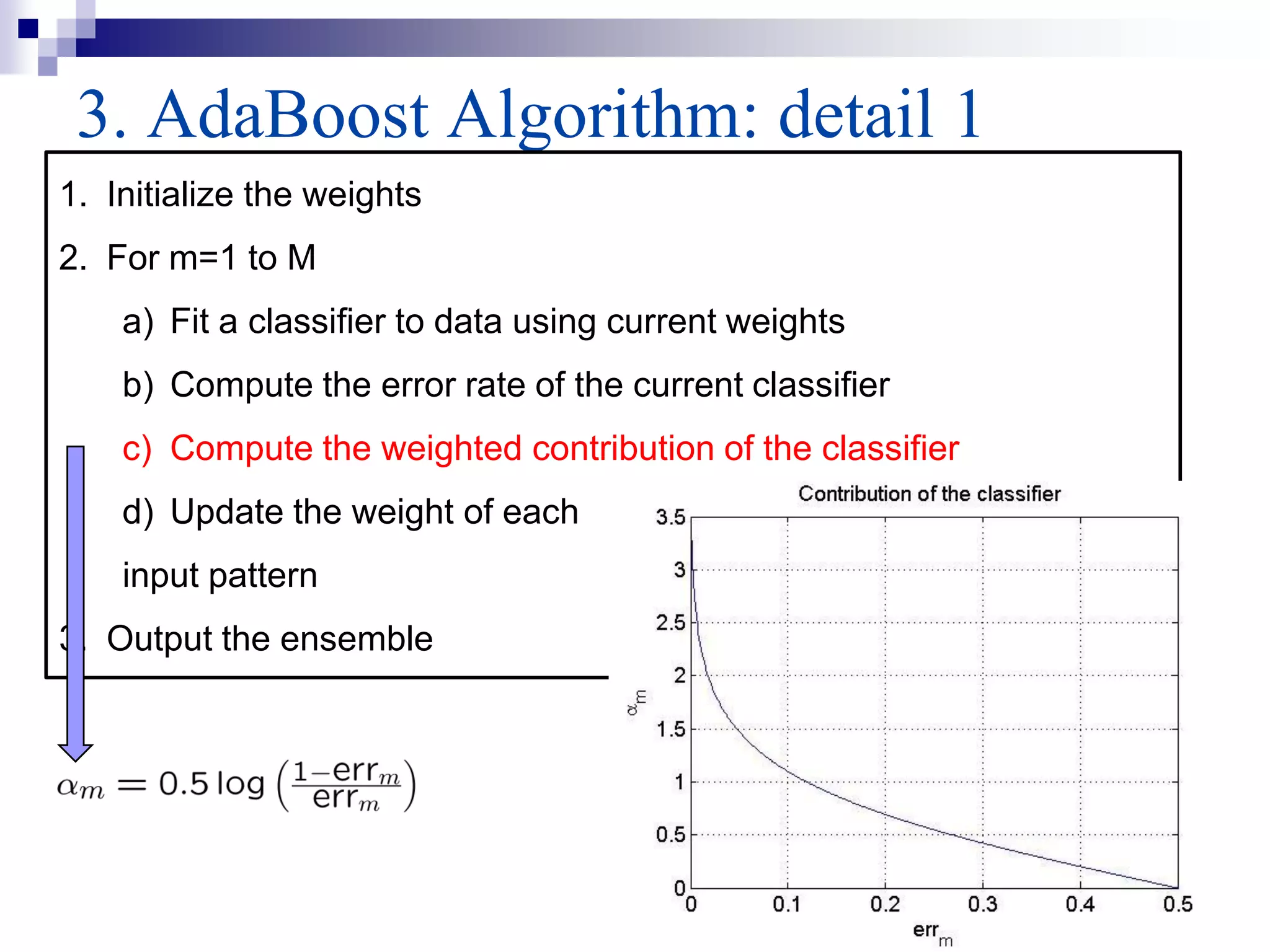
3. AdaBoost Algorithm: detail 1
1. Initialize the weights
2. For m=1 to M
a) Fit a classifier to data using current weights
b) Compute the error rate of the current classifier
c) Compute the weighted contribution of the classifier
d) Update the weight of each
input pattern
3. Output the ensemble
19
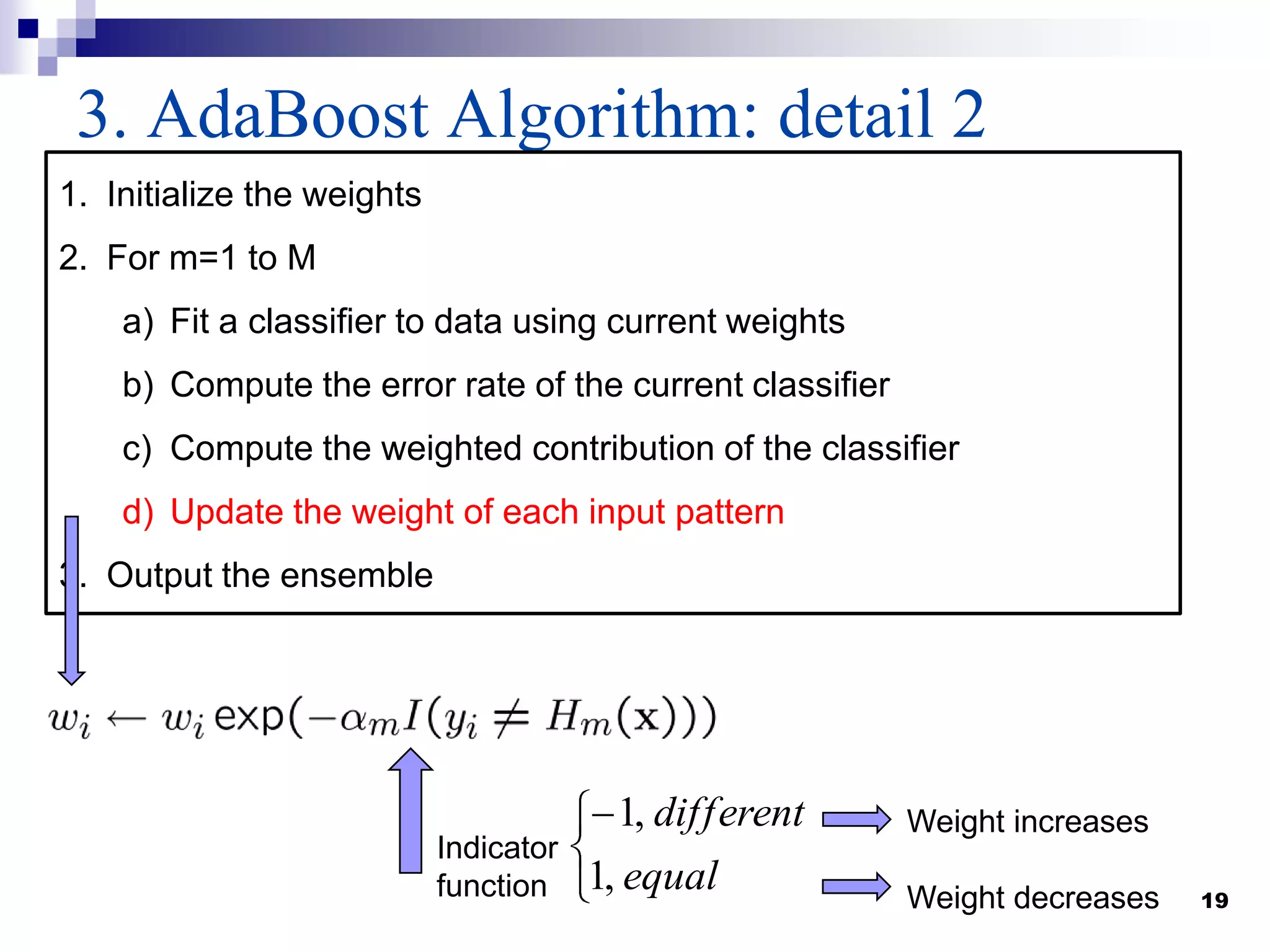
3. AdaBoost Algorithm: detail 2
1. Initialize the weights
2. For m=1 to M
a) Fit a classifier to data using current weights
b) Compute the error rate of the current classifier
c) Compute the weighted contribution of the classifier
d) Update the weight of each input pattern
3. Output the ensemble
Indicator
function equal
different
,1
,1 Weight increases
Weight decreases
20
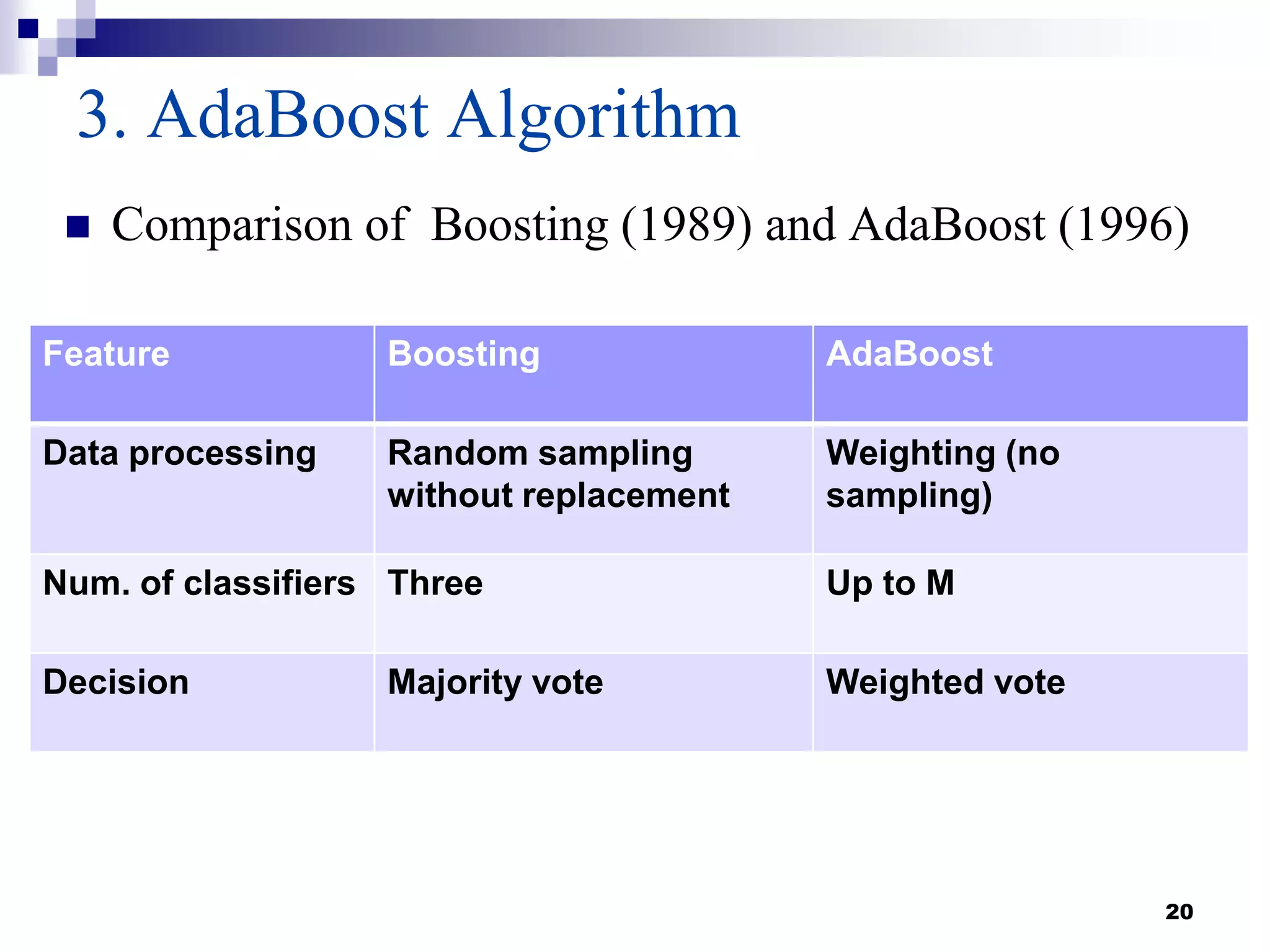
3. AdaBoost Algorithm
 Comparison of Boosting (1989) and AdaBoost (1996)
Feature Boosting AdaBoost
Data processing Random sampling
without replacement
Weighting (no
sampling)
Num. of classifiers Three Up to M
Decision Majority vote Weighted vote
21
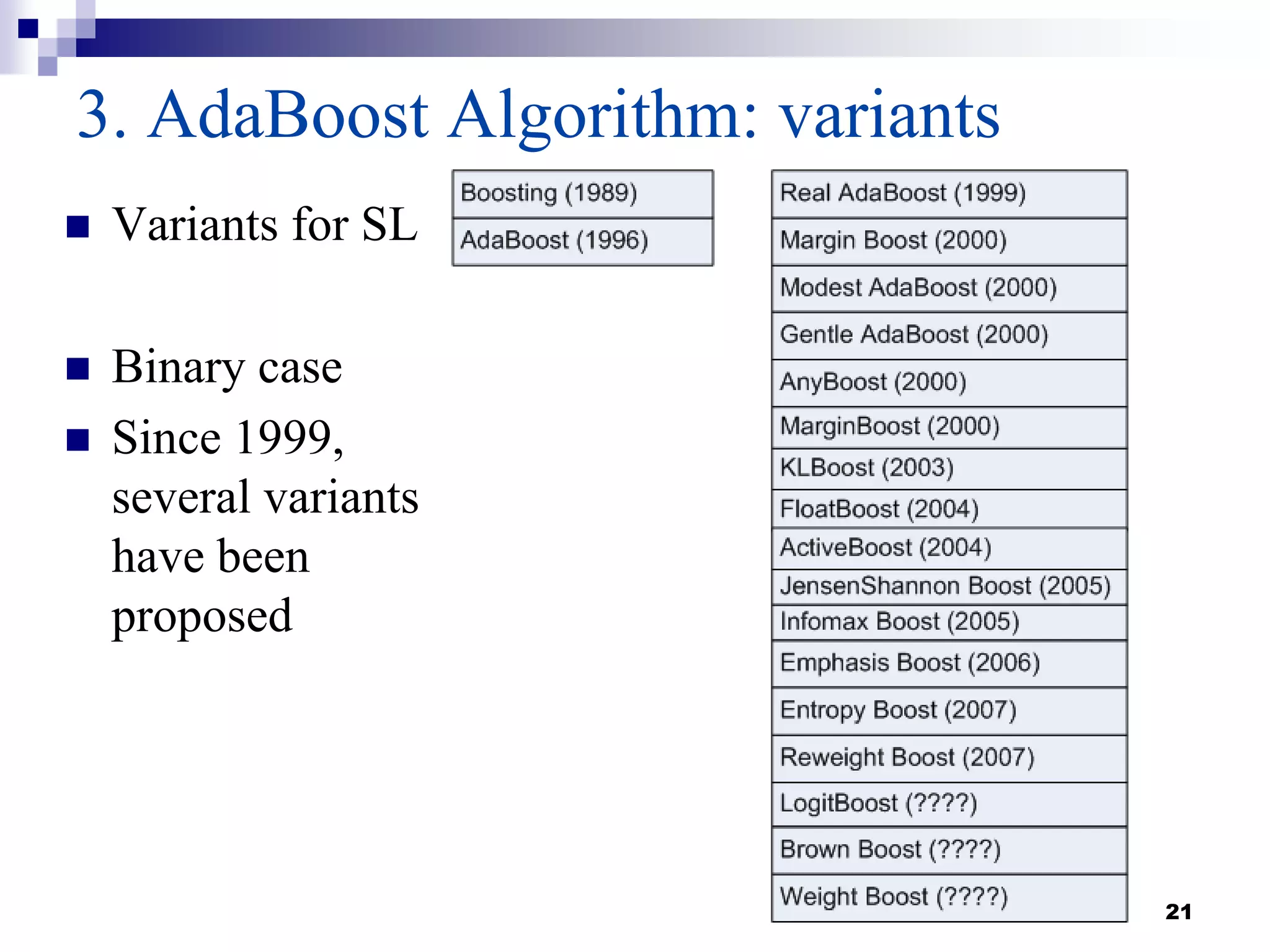
3. AdaBoost Algorithm: variants
 Variants for SL
 Binary case
 Since 1999,
several variants
have been
proposed
22
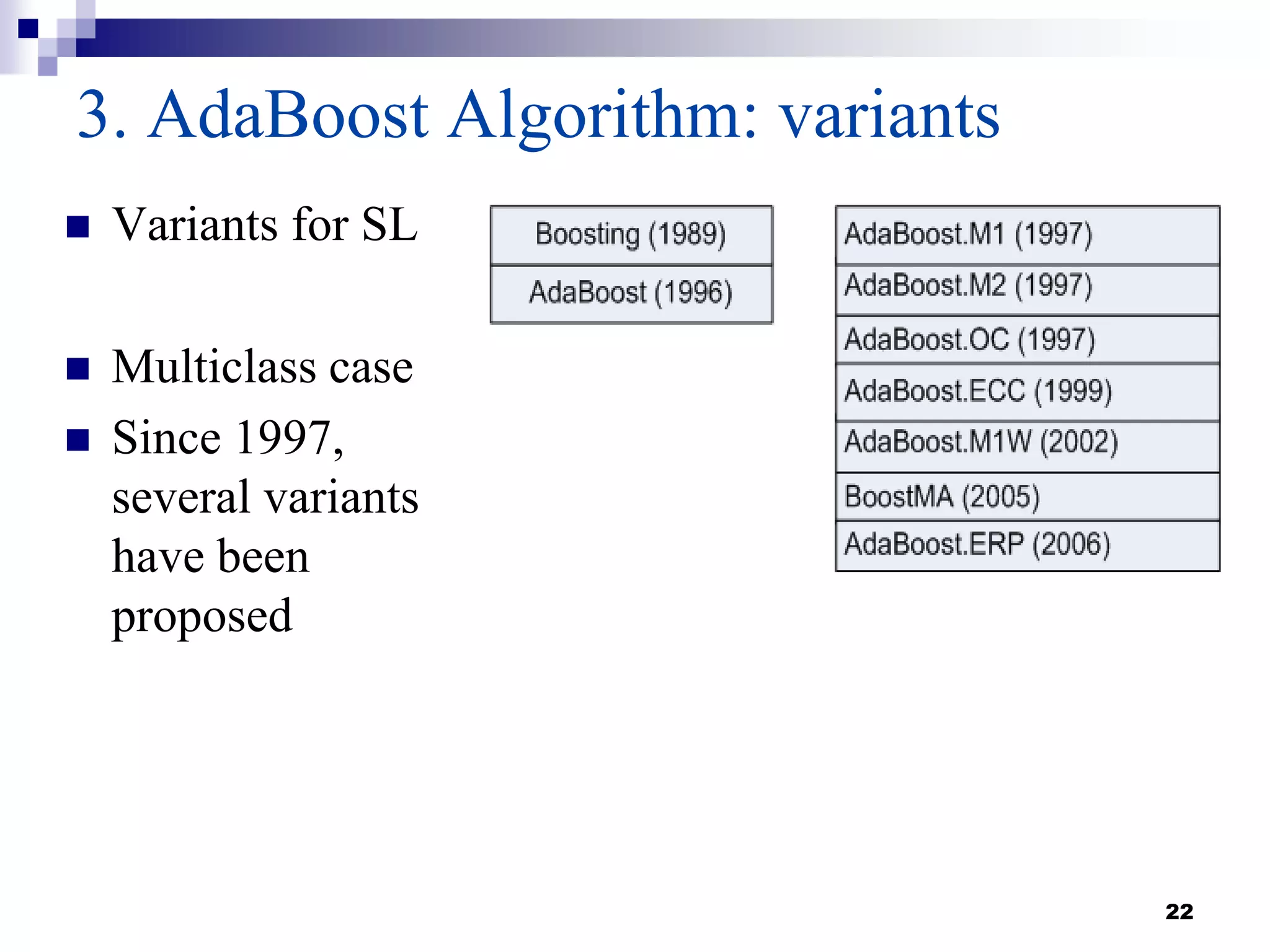
3. AdaBoost Algorithm: variants
 Variants for SL
 Multiclass case
 Since 1997,
several variants
have been
proposed
23
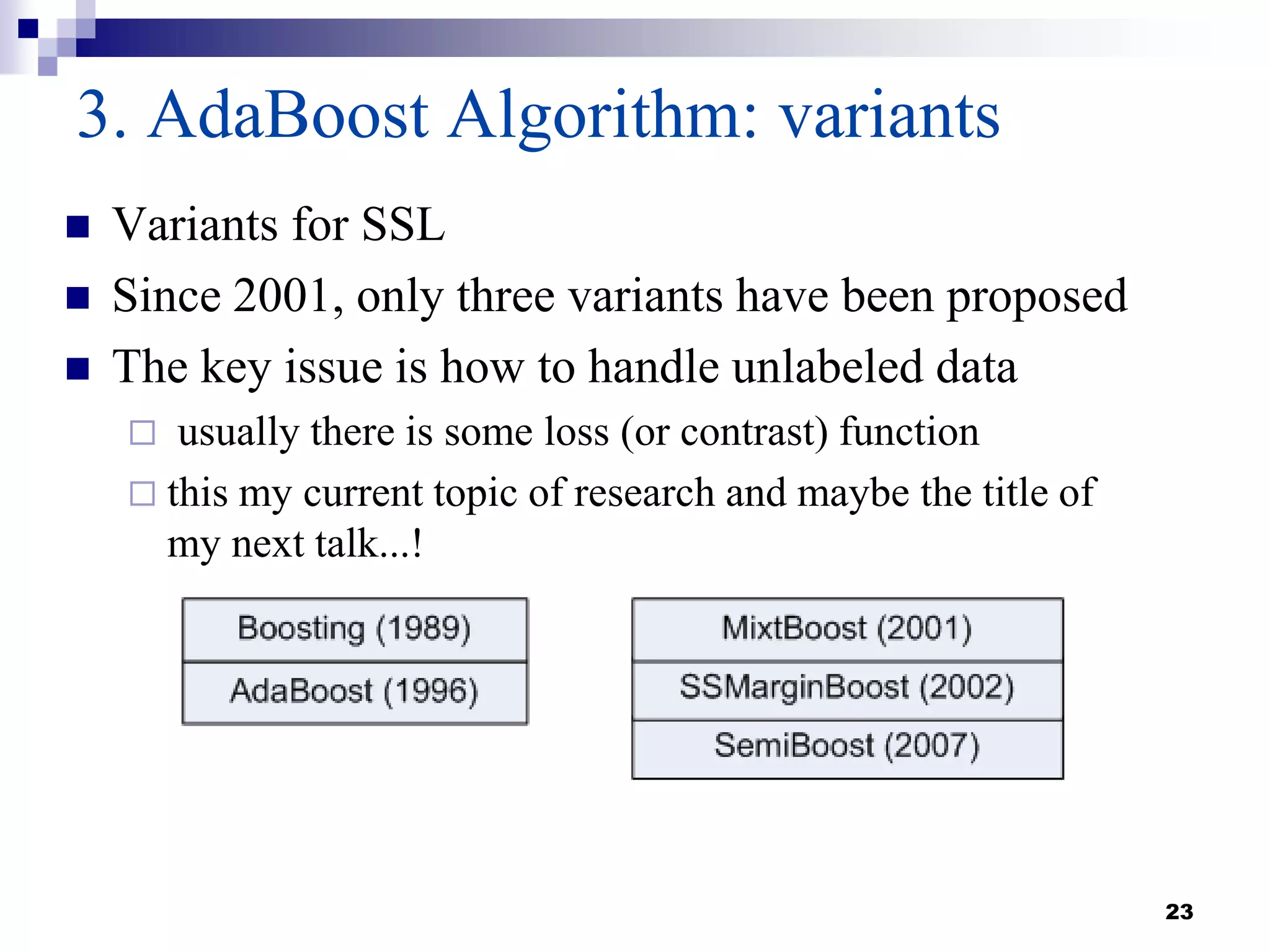
3. AdaBoost Algorithm: variants
 Variants for SSL
 Since 2001, only three variants have been proposed
 The key issue is how to handle unlabeled data
 usually there is some loss (or contrast) function
 this my current topic of research and maybe the title of
my next talk...!
24
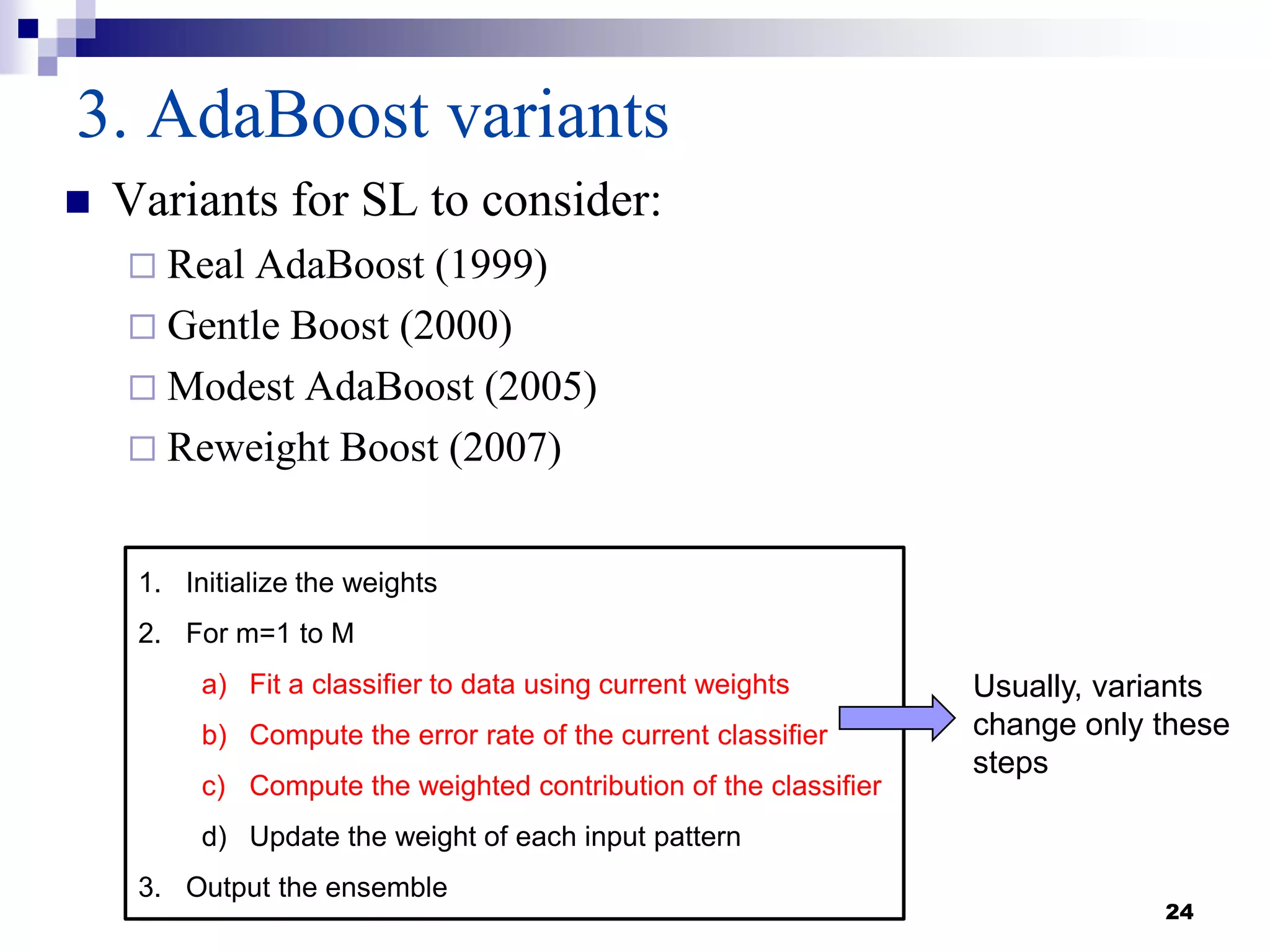
3. AdaBoost variants
 Variants for SL to consider:
 Real AdaBoost (1999)
 Gentle Boost (2000)
 Modest AdaBoost (2005)
 Reweight Boost (2007)
1. Initialize the weights
2. For m=1 to M
a) Fit a classifier to data using current weights
b) Compute the error rate of the current classifier
c) Compute the weighted contribution of the classifier
d) Update the weight of each input pattern
3. Output the ensemble
Usually, variants
change only these
steps
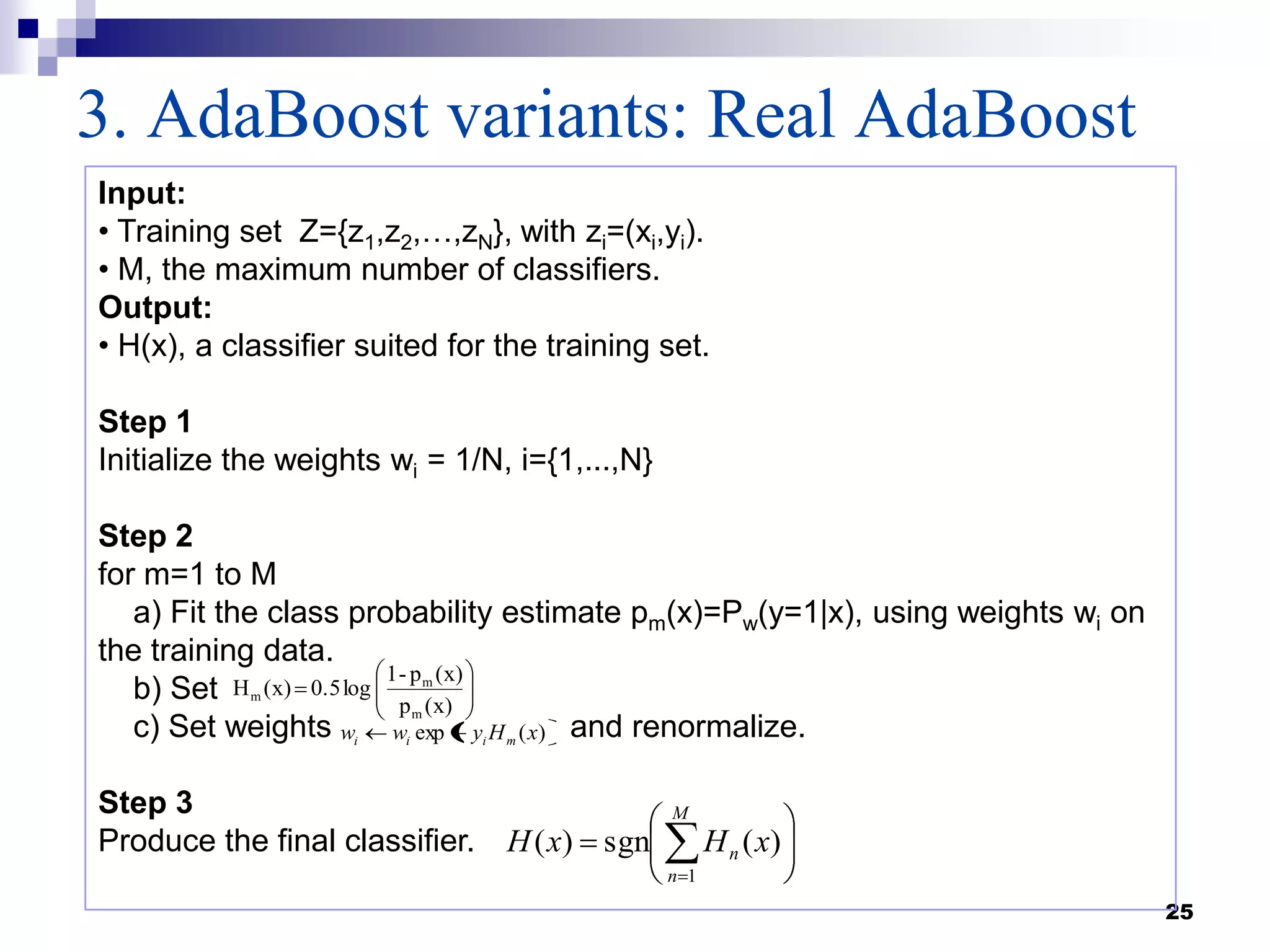
3. AdaBoost variants: Real AdaBoost
25
Input:
• Training set Z={z1,z2,…,zN}, with zi=(xi,yi).
• M, the maximum number of classifiers.
Output:
• H(x), a classifier suited for the training set.
Step 1
Initialize the weights wi = 1/N, i={1,...,N}
Step 2
for m=1 to M
a) Fit the class probability estimate pm(x)=Pw(y=1|x), using weights wi on
the training data.
b) Set
c) Set weights and renormalize.
Step 3
Produce the final classifier.
(x)p
(x)p-1
log0.5(x)H
m
m
m
)(exp xHyww miii
M
n
n xHxH
1
)(sgn)(
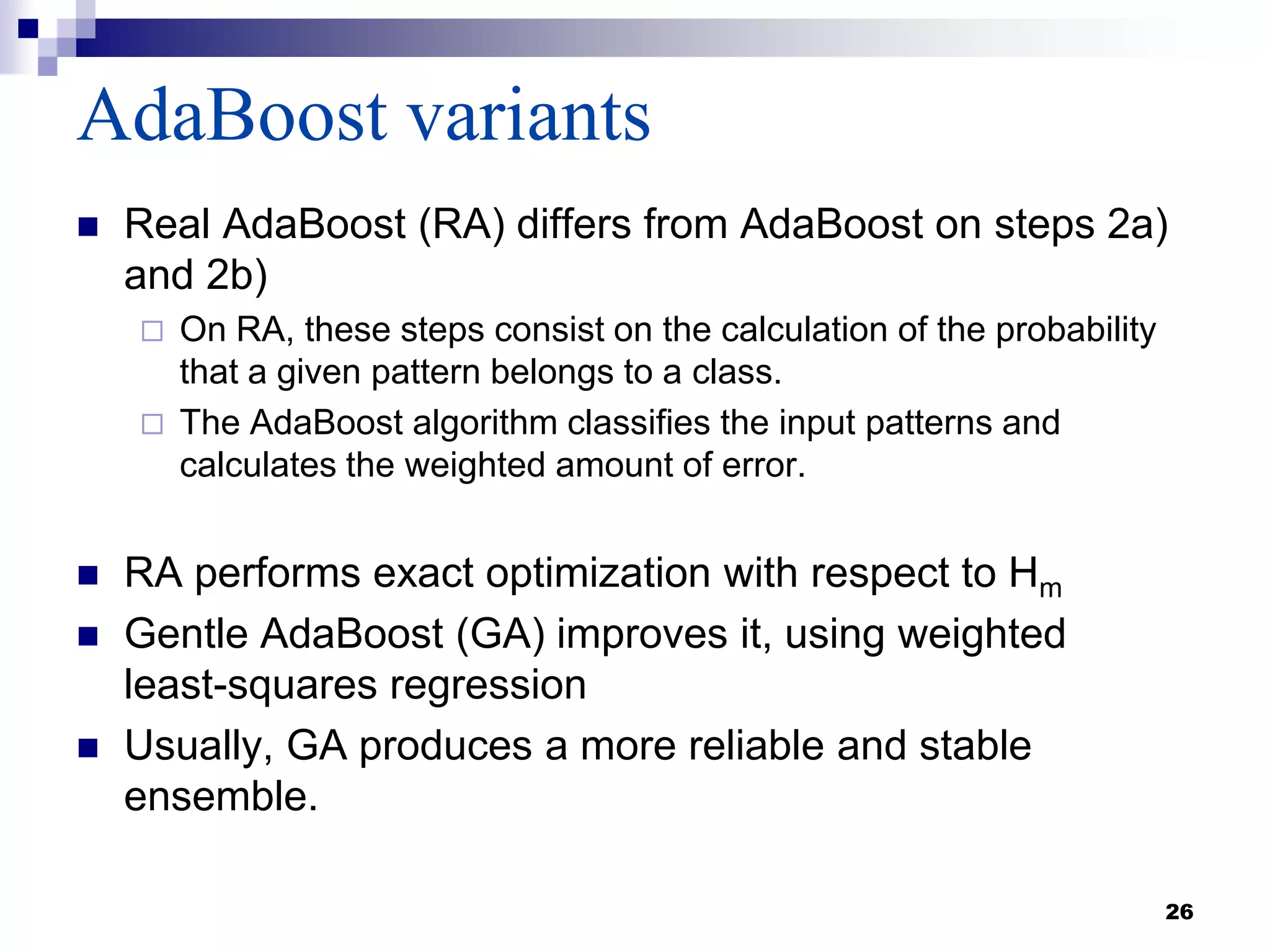
AdaBoost variants
 Real AdaBoost (RA) differs from AdaBoost on steps 2a)
and 2b)
 On RA, these steps consist on the calculation of the probability
that a given pattern belongs to a class.
 The AdaBoost algorithm classifies the input patterns and
calculates the weighted amount of error.
 RA performs exact optimization with respect to Hm
 Gentle AdaBoost (GA) improves it, using weighted
least-squares regression
 Usually, GA produces a more reliable and stable
ensemble.
26
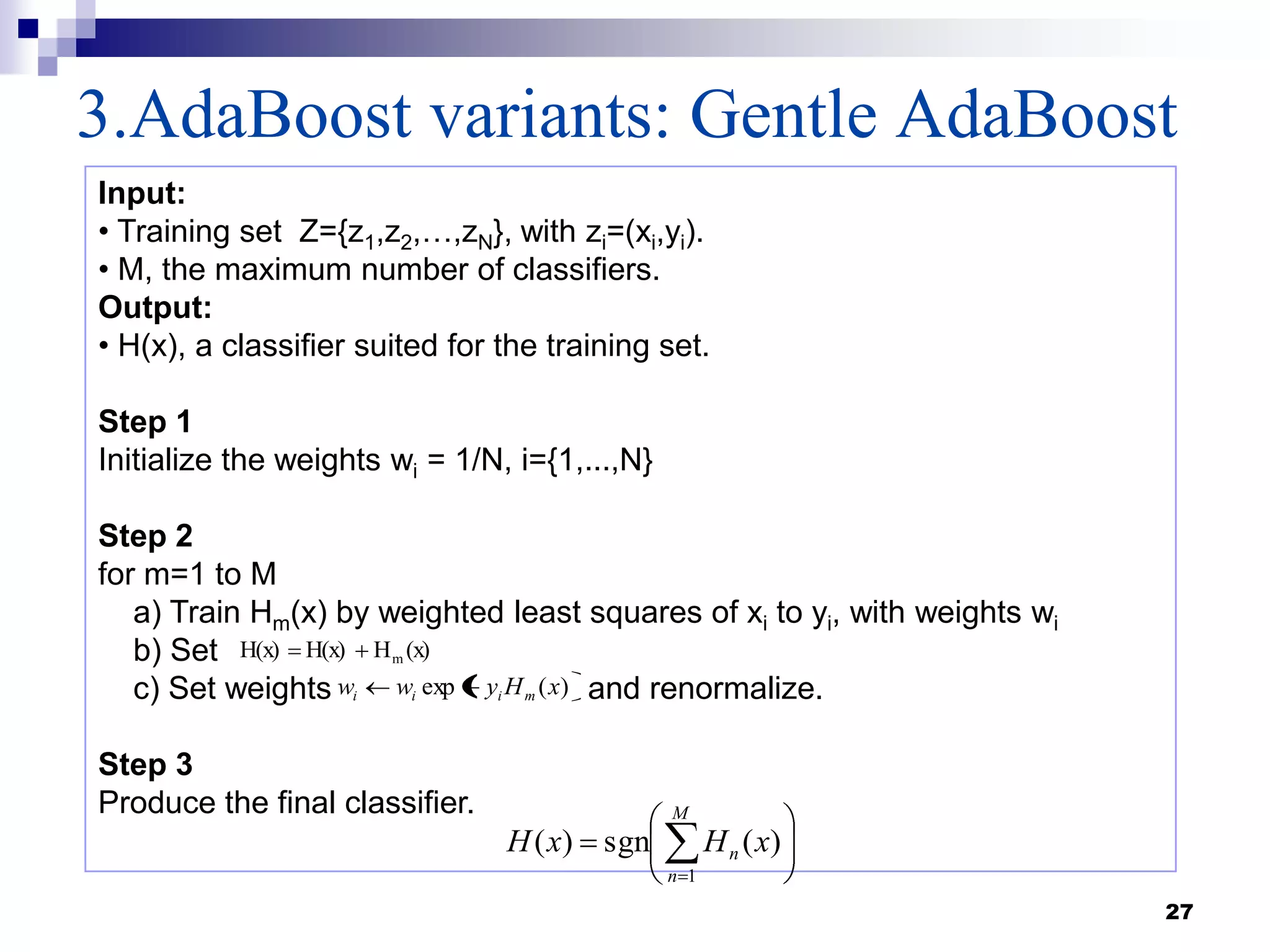
3.AdaBoost variants: Gentle AdaBoost
27
Input:
• Training set Z={z1,z2,…,zN}, with zi=(xi,yi).
• M, the maximum number of classifiers.
Output:
• H(x), a classifier suited for the training set.
Step 1
Initialize the weights wi = 1/N, i={1,...,N}
Step 2
for m=1 to M
a) Train Hm(x) by weighted least squares of xi to yi, with weights wi
b) Set
c) Set weights and renormalize.
Step 3
Produce the final classifier.
(x)HH(x)H(x) m
)(exp xHyww miii
M
n
n xHxH
1
)(sgn)(
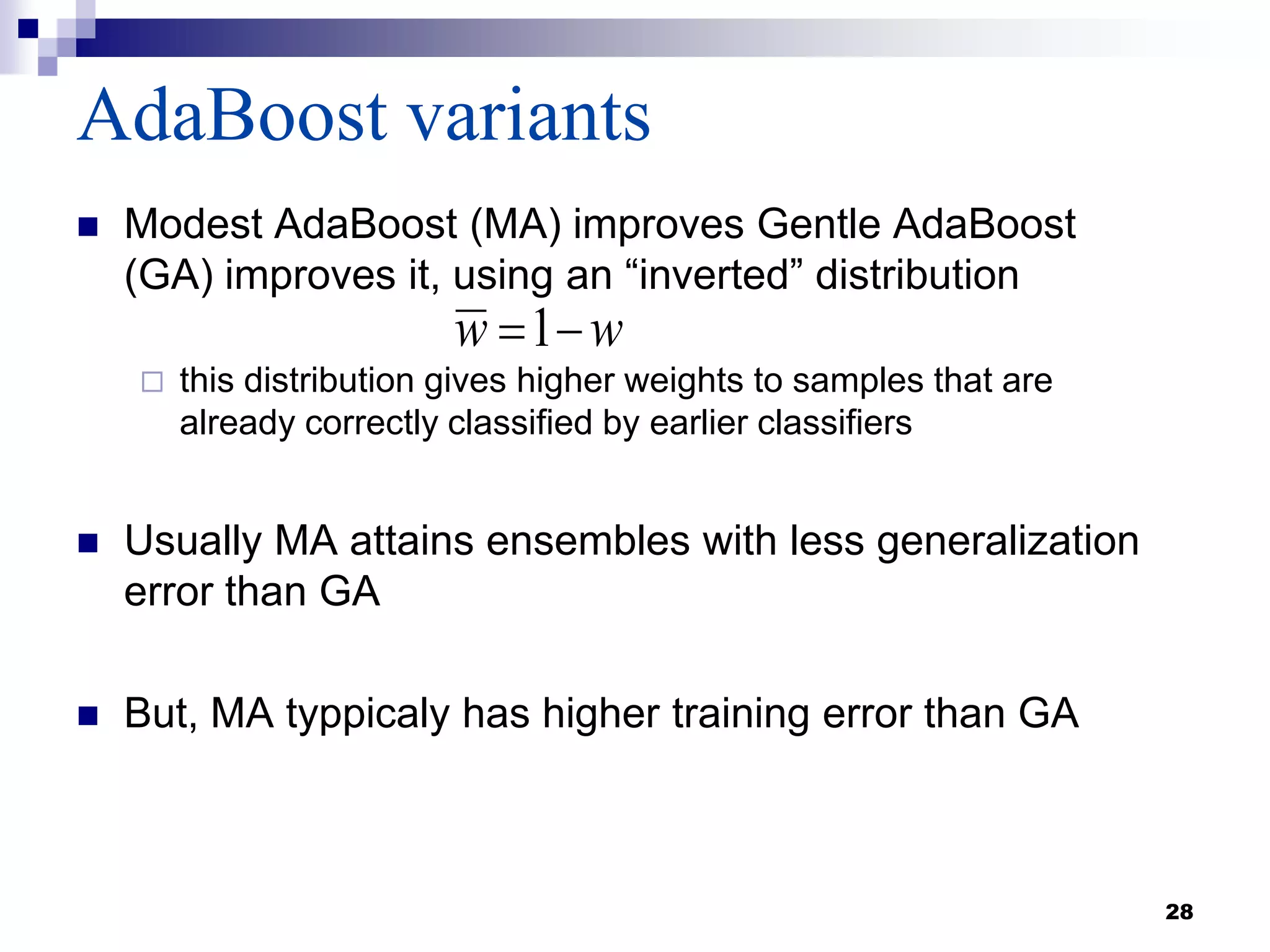
AdaBoost variants
 Modest AdaBoost (MA) improves Gentle AdaBoost
(GA) improves it, using an “inverted” distribution
 this distribution gives higher weights to samples that are
already correctly classified by earlier classifiers
 Usually MA attains ensembles with less generalization
error than GA
 But, MA typpicaly has higher training error than GA
28
ww 1
3.AdaBoost variants: Modest AdaBoost
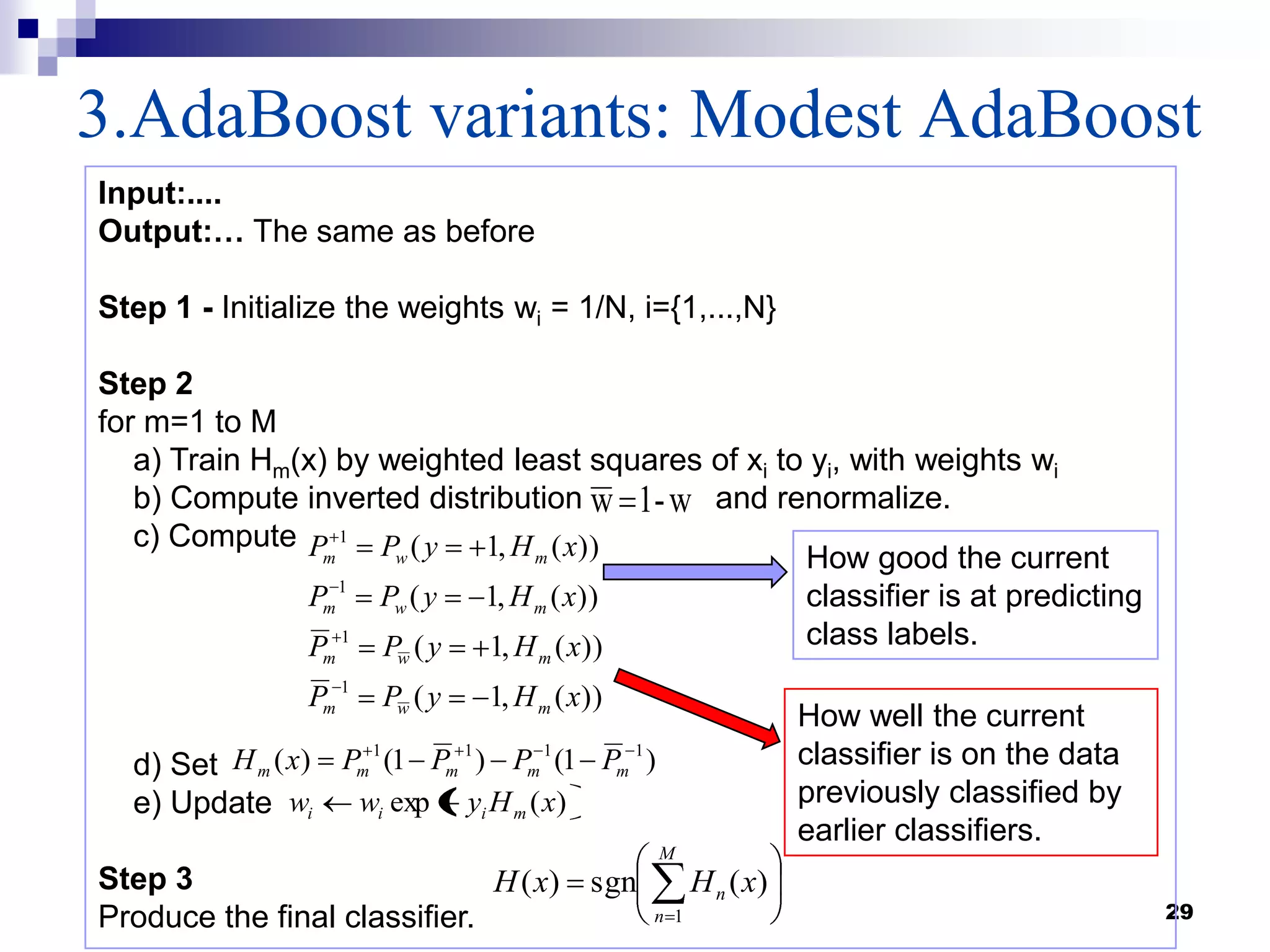
29
Input:....
Output:… The same as before
Step 1 - Initialize the weights wi = 1/N, i={1,...,N}
Step 2
for m=1 to M
a) Train Hm(x) by weighted least squares of xi to yi, with weights wi
b) Compute inverted distribution and renormalize.
c) Compute
d) Set
e) Update
Step 3
Produce the final classifier.
w-1w
)(exp xHyww miii
M
n
n xHxH
1
)(sgn)(
))(,1(
))(,1(
))(,1(
))(,1(
1
1
1
1
xHyPP
xHyPP
xHyPP
xHyPP
mwm
mwm
mwm
mwm
)1()1()( 1111
mmmmm PPPPxH
How good the current
classifier is at predicting
class labels.
How well the current
classifier is on the data
previously classified by
earlier classifiers.
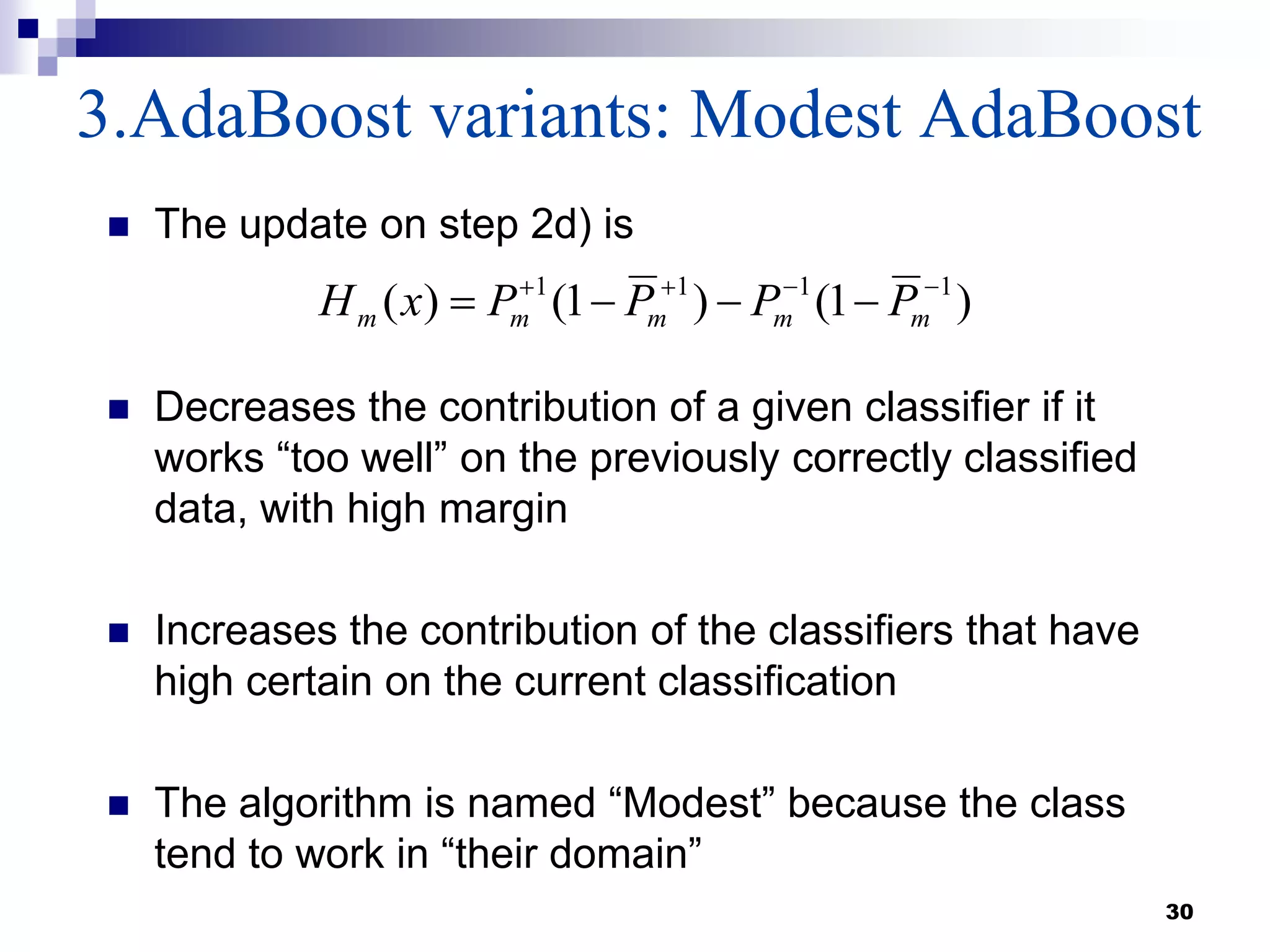
3.AdaBoost variants: Modest AdaBoost
30
 The update on step 2d) is
 Decreases the contribution of a given classifier if it
works “too well” on the previously correctly classified
data, with high margin
 Increases the contribution of the classifiers that have
high certain on the current classification
 The algorithm is named “Modest” because the class
tend to work in “their domain”
)1()1()( 1111
mmmmm PPPPxH
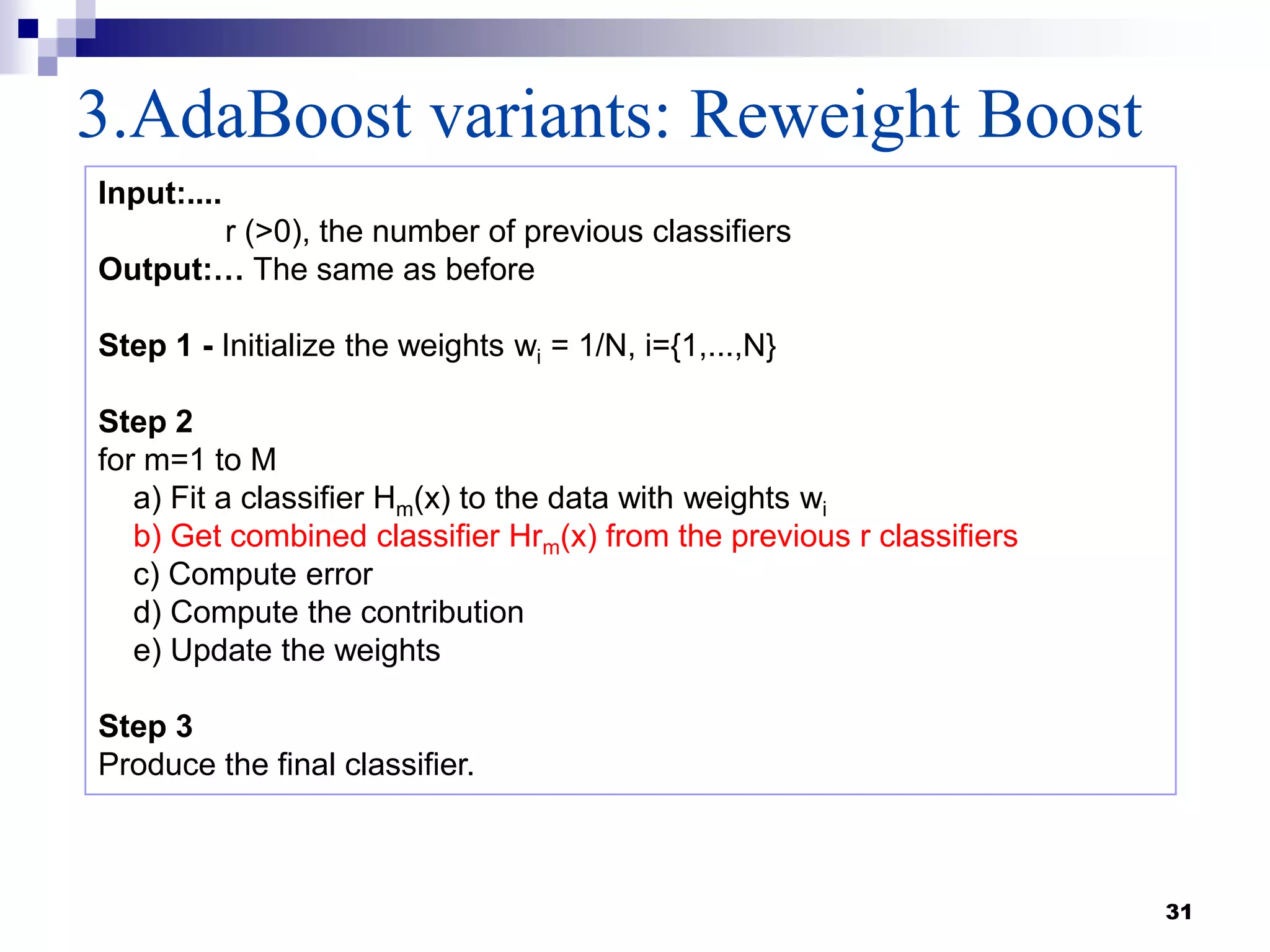
3.AdaBoost variants: Reweight Boost
31
Input:....
r (>0), the number of previous classifiers
Output:… The same as before
Step 1 - Initialize the weights wi = 1/N, i={1,...,N}
Step 2
for m=1 to M
a) Fit a classifier Hm(x) to the data with weights wi
b) Get combined classifier Hrm(x) from the previous r classifiers
c) Compute error
d) Compute the contribution
e) Update the weights
Step 3
Produce the final classifier.
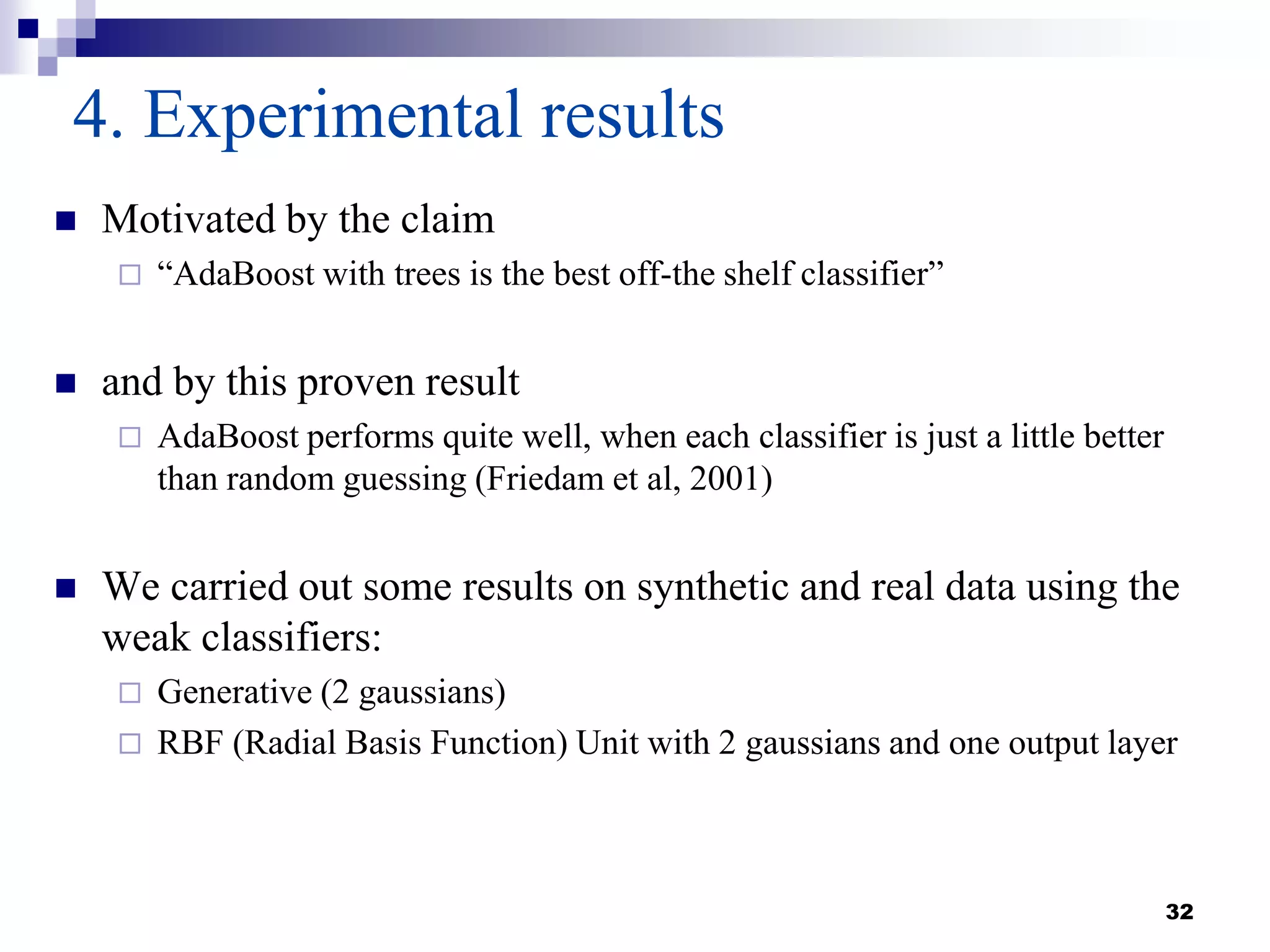
32
4. Experimental results
 Motivated by the claim
 “AdaBoost with trees is the best off-the shelf classifier”
 and by this proven result
 AdaBoost performs quite well, when each classifier is just a little better
than random guessing (Friedam et al, 2001)
 We carried out some results on synthetic and real data using the
weak classifiers:
 Generative (2 gaussians)
 RBF (Radial Basis Function) Unit with 2 gaussians and one output layer
33
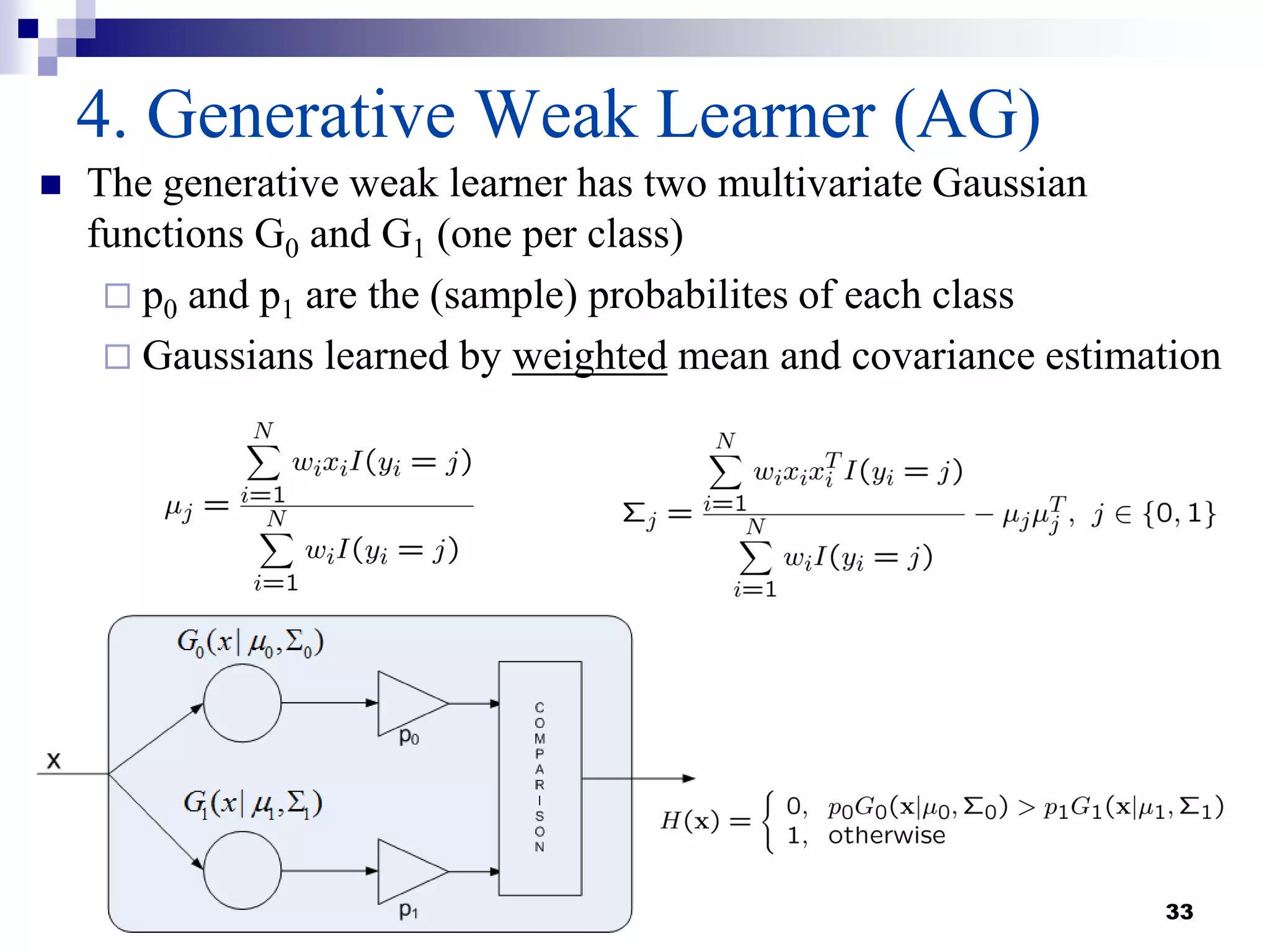
4. Generative Weak Learner (AG)
 The generative weak learner has two multivariate Gaussian
functions G0 and G1 (one per class)
 p0 and p1 are the (sample) probabilites of each class
 Gaussians learned by weighted mean and covariance estimation
34
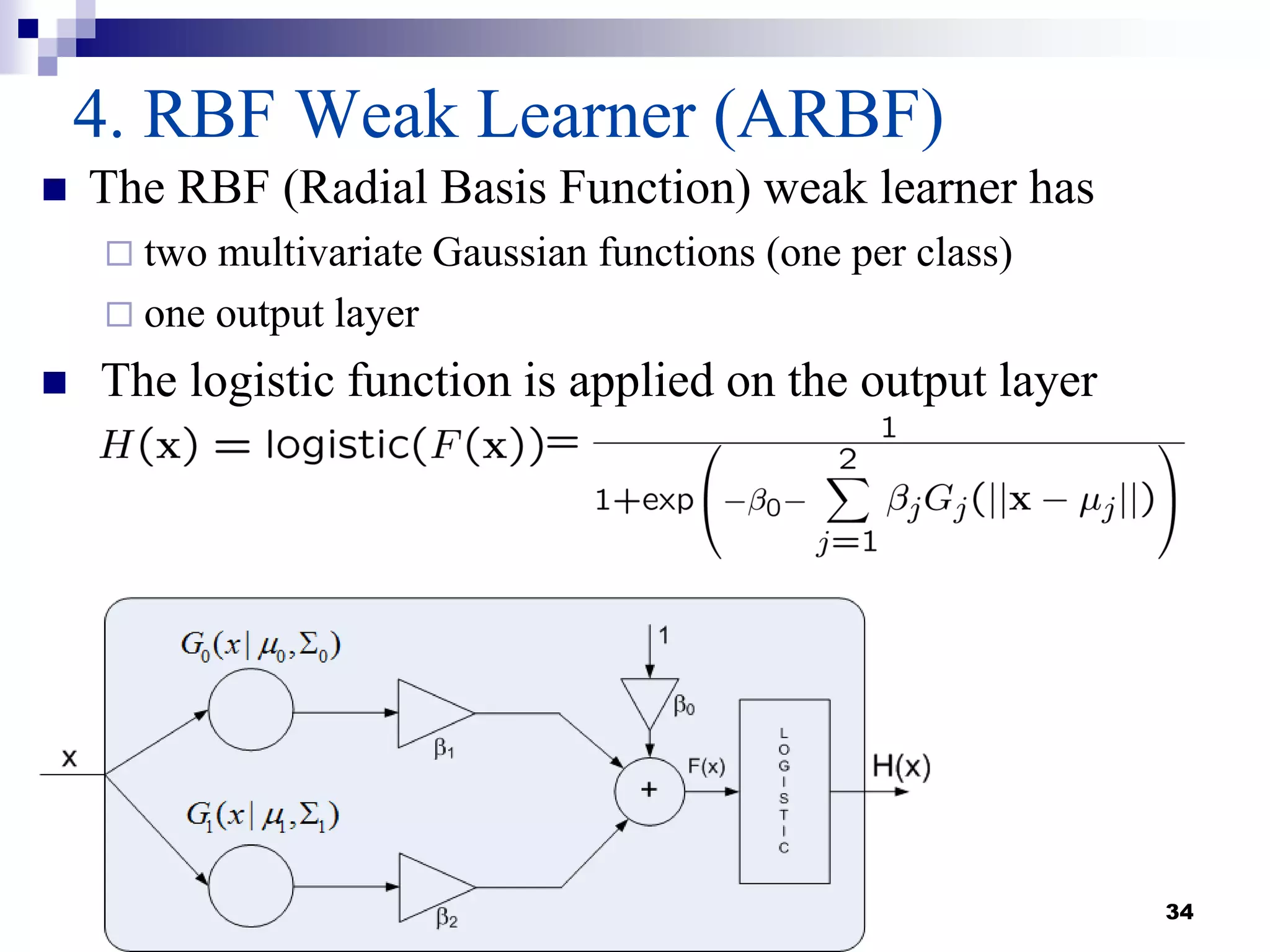
4. RBF Weak Learner (ARBF)
 The RBF (Radial Basis Function) weak learner has
 two multivariate Gaussian functions (one per class)
 one output layer
 The logistic function is applied on the output layer
35
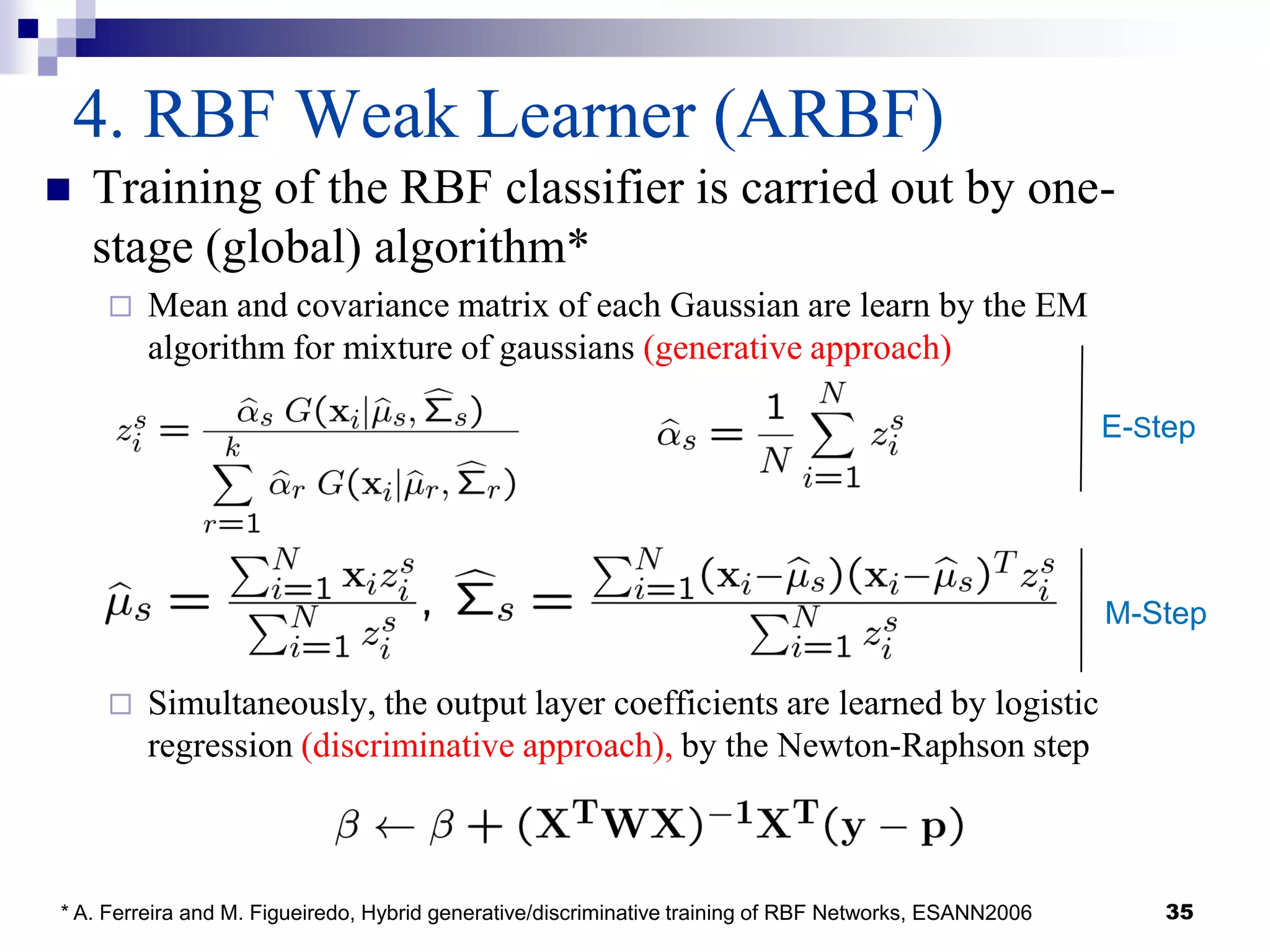
4. RBF Weak Learner (ARBF)
 Training of the RBF classifier is carried out by one-
stage (global) algorithm*
 Mean and covariance matrix of each Gaussian are learn by the EM
algorithm for mixture of gaussians (generative approach)
 Simultaneously, the output layer coefficients are learned by logistic
regression (discriminative approach), by the Newton-Raphson step
* A. Ferreira and M. Figueiredo, Hybrid generative/discriminative training of RBF Networks, ESANN2006
E-Step
M-Step
36
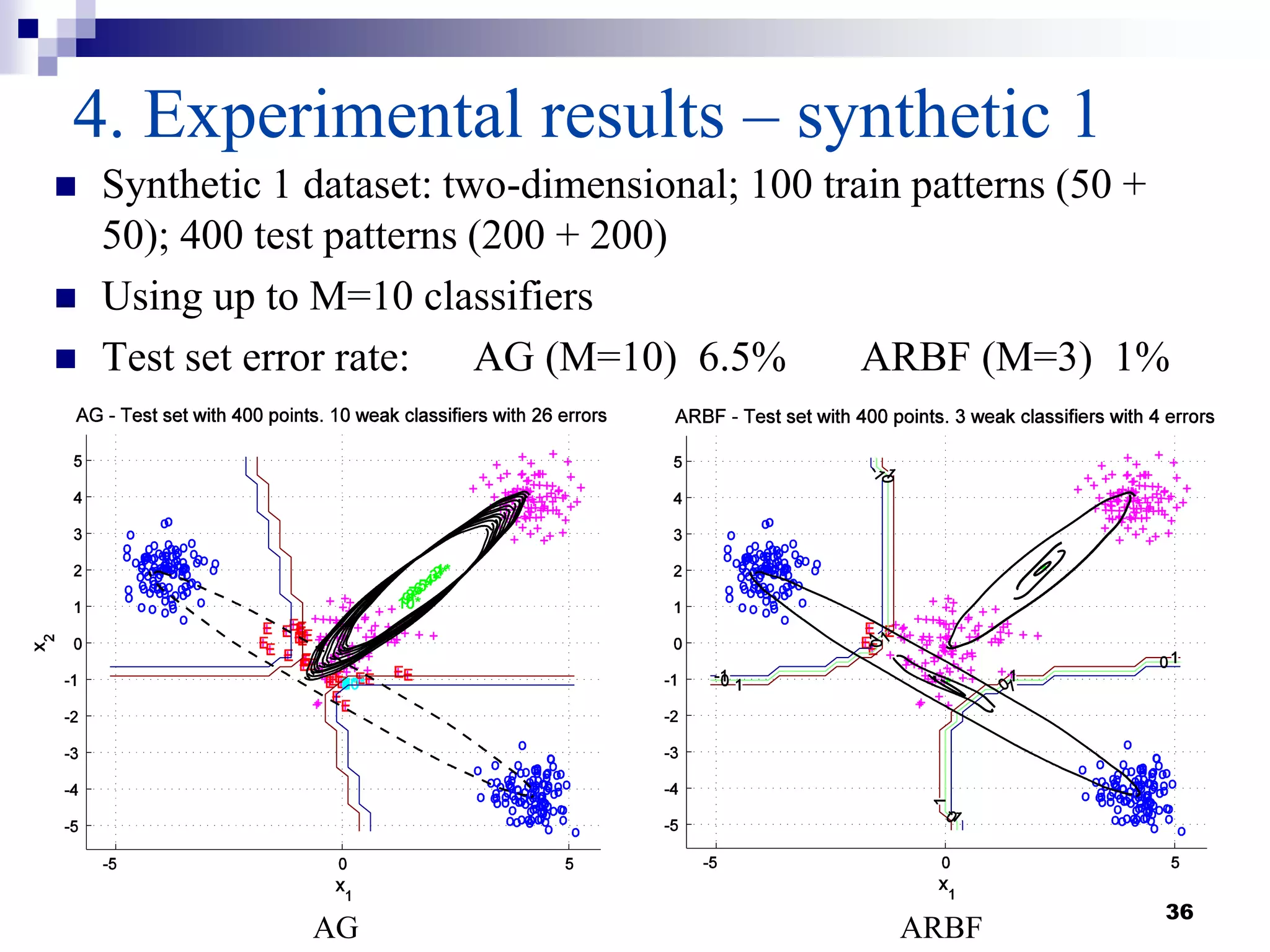
4. Experimental results – synthetic 1
 Synthetic 1 dataset: two-dimensional; 100 train patterns (50 +
50); 400 test patterns (200 + 200)
 Using up to M=10 classifiers
 Test set error rate: AG (M=10) 6.5% ARBF (M=3) 1%
AG ARBF
37
4. Experimental results – synthetic 1
 Synthetic 1 dataset: two-dimensional; 100 train patterns (50 +
50); 400 test patterns (200 + 200)
 Using up to M=10 classifiers
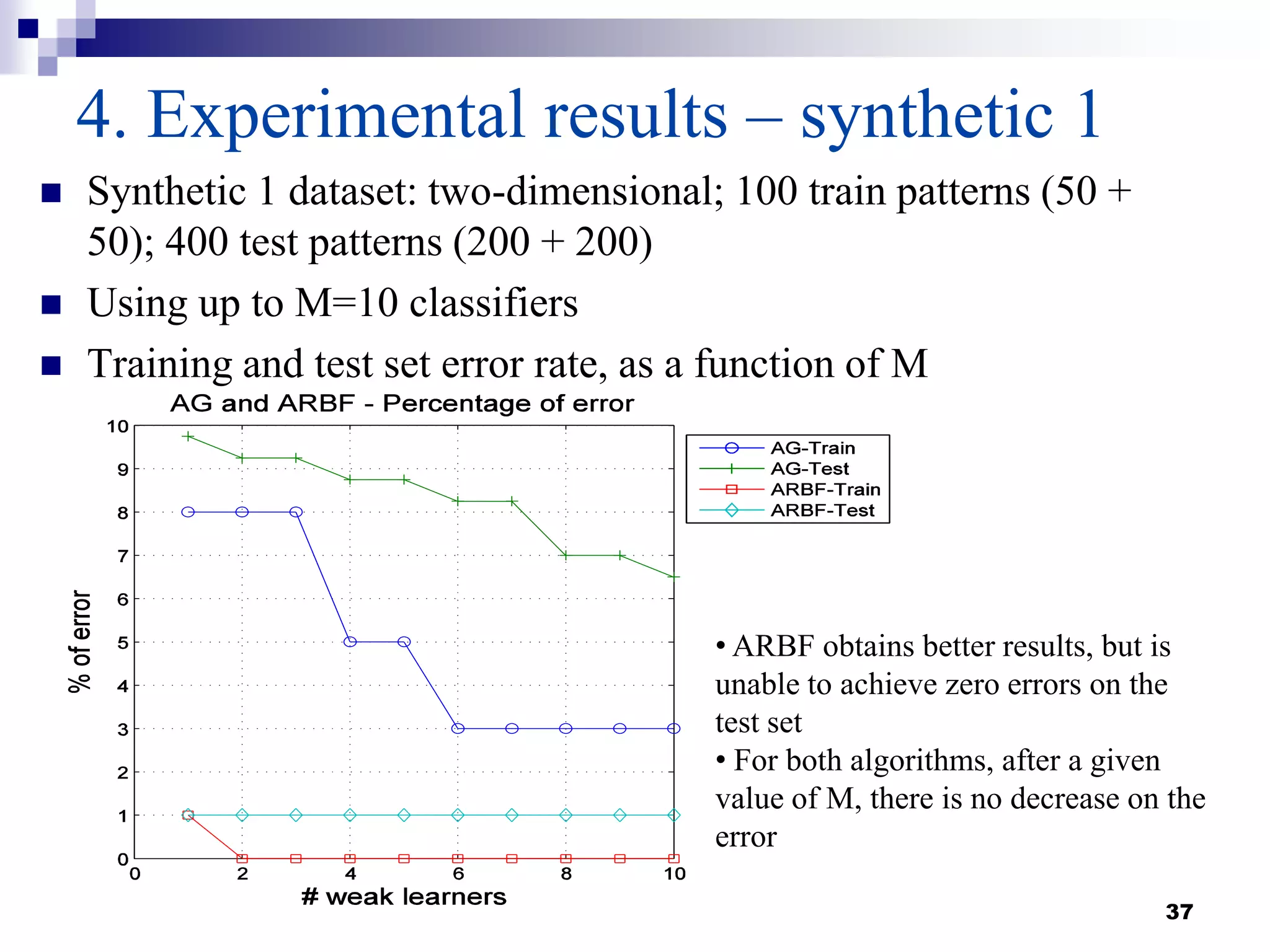
 Training and test set error rate, as a function of M
• ARBF obtains better results, but is
unable to achieve zero errors on the
test set
• For both algorithms, after a given
value of M, there is no decrease on the
error
38
4. Experimental results – synthetic 2
AG ARBF
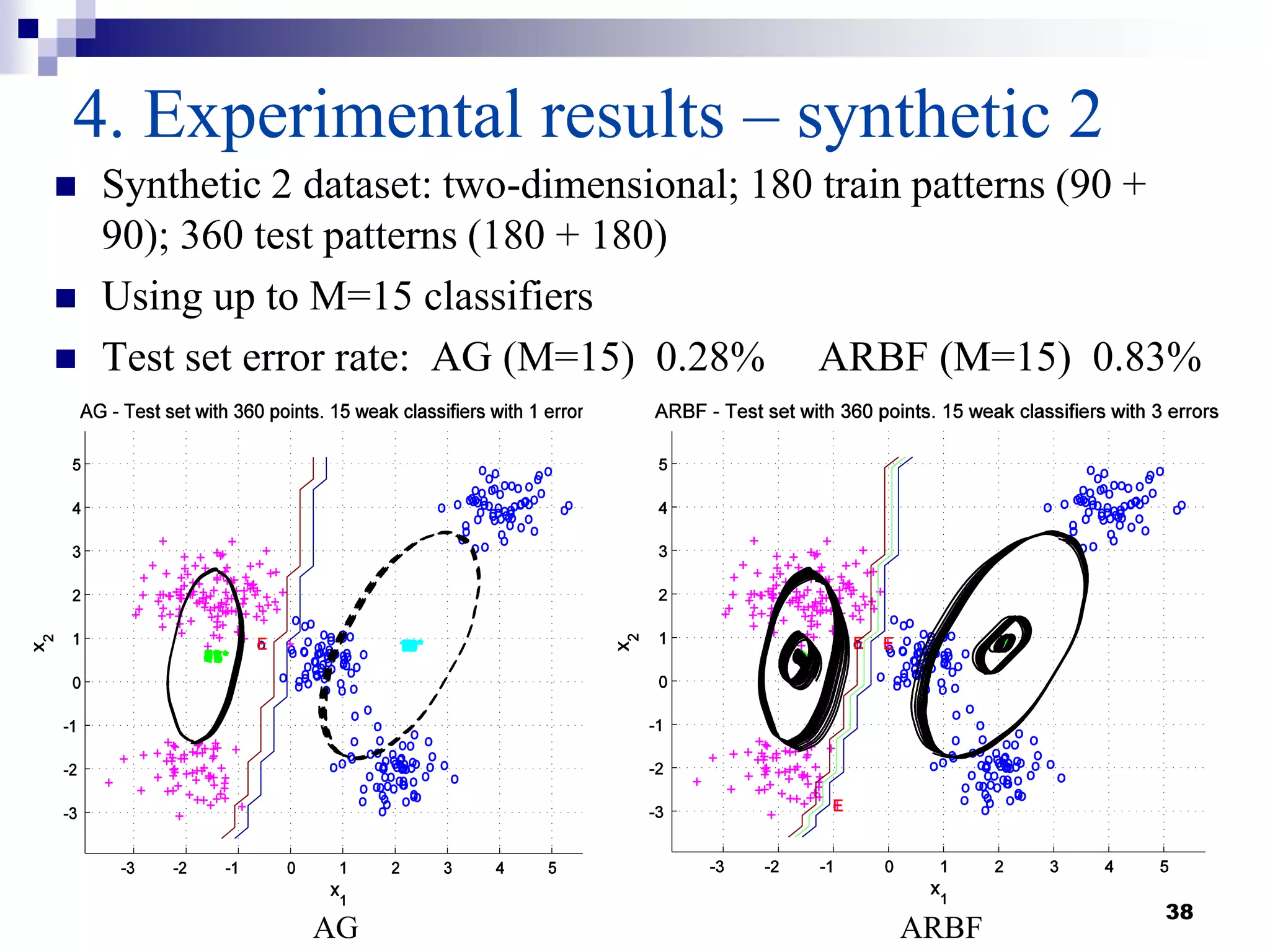
 Synthetic 2 dataset: two-dimensional; 180 train patterns (90 +
90); 360 test patterns (180 + 180)
 Using up to M=15 classifiers
 Test set error rate: AG (M=15) 0.28% ARBF (M=15) 0.83%
39
4. Experimental results – synthetic 2
 Synthetic 2 dataset: two-dimensional; 180 train patterns (90 +
90); 360 test patterns (180 + 180)
 Using up to M=15 classifiers
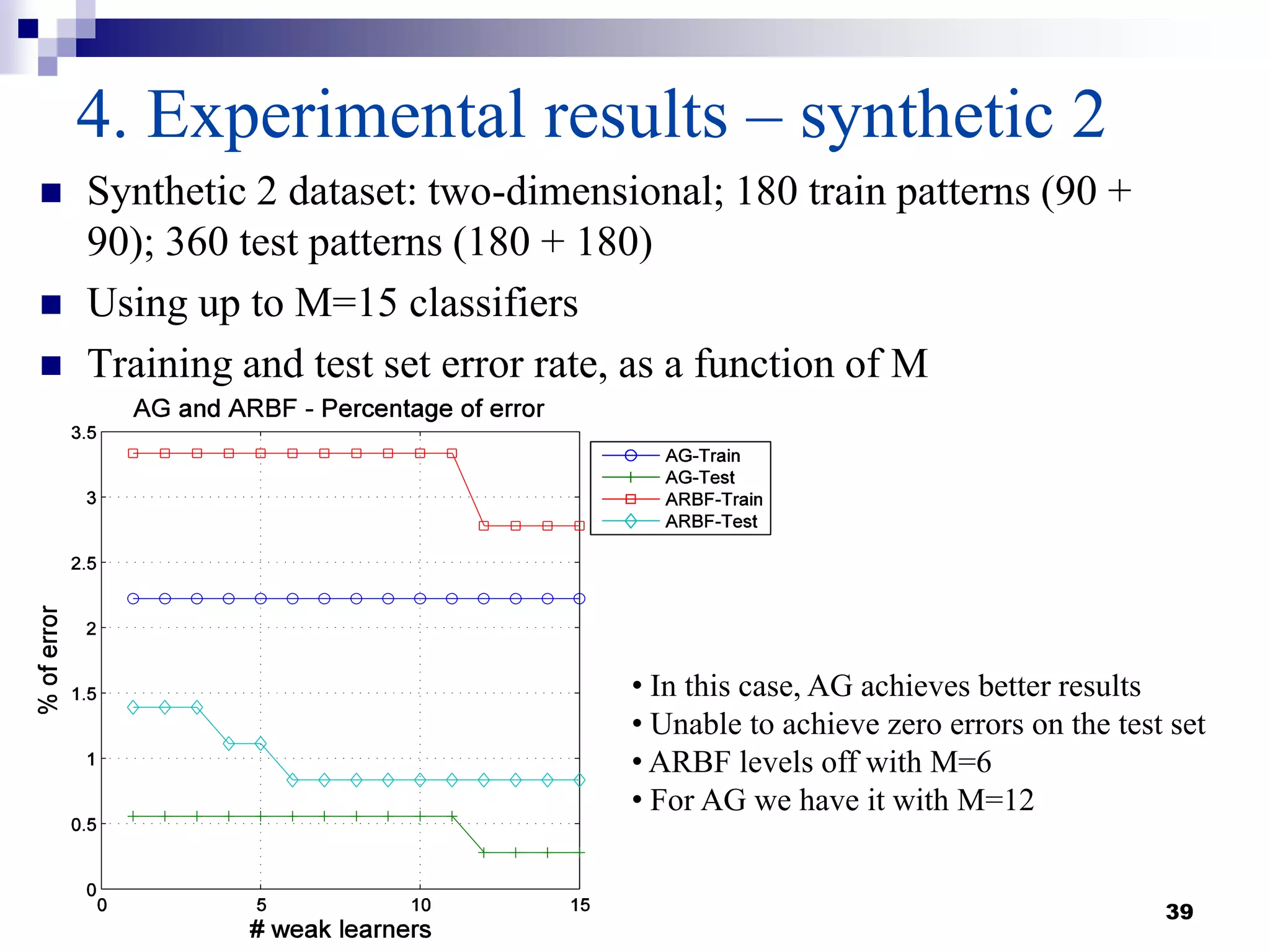
 Training and test set error rate, as a function of M
• In this case, AG achieves better results
• Unable to achieve zero errors on the test set
• ARBF levels off with M=6
• For AG we have it with M=12
40
4. Experimental results – standard data sets
Dataset Dimension Train Test
Kwok 2 200 (1) + 300(0) 4080(1) + 6120(0)
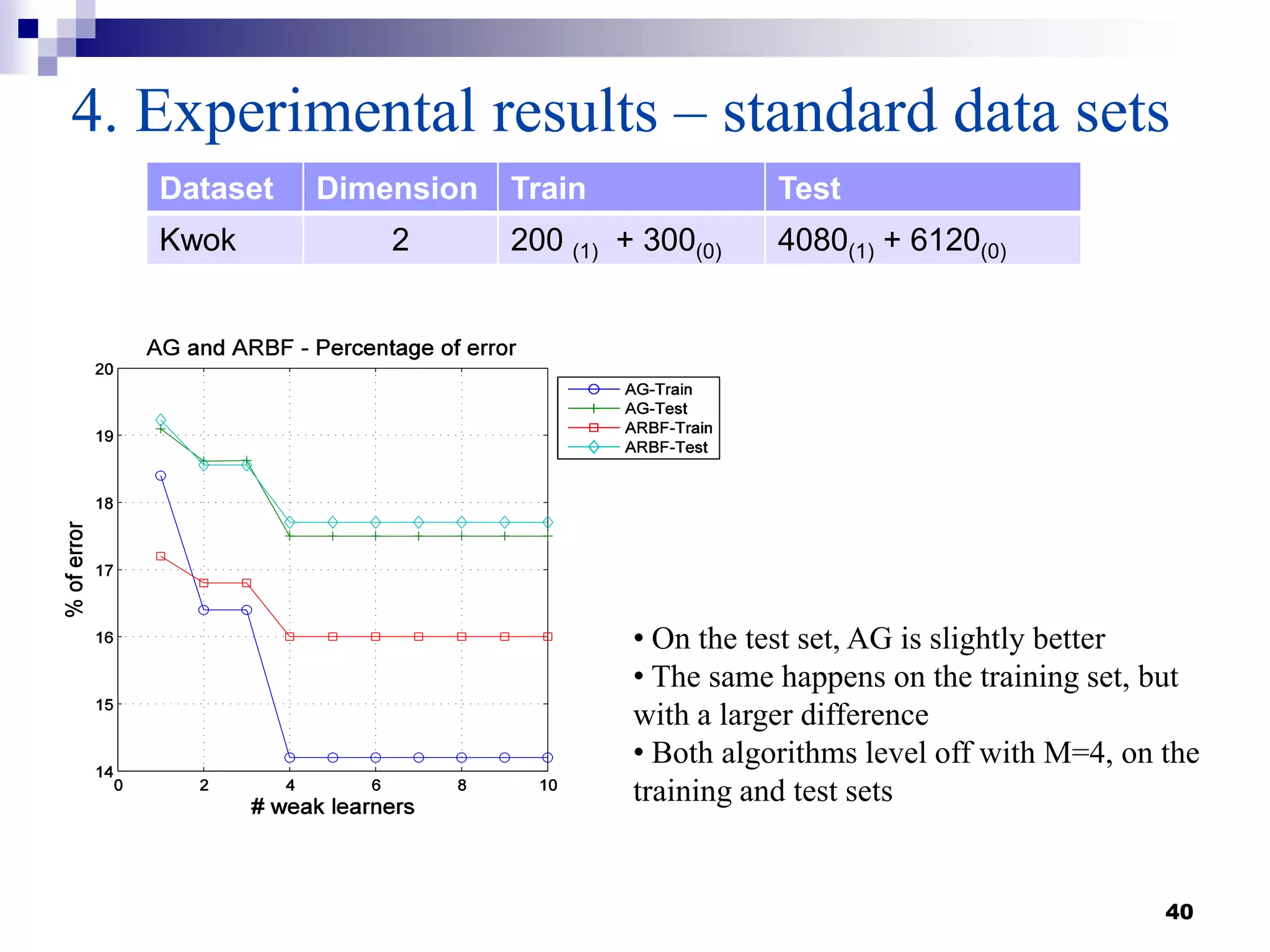
• On the test set, AG is slightly better
• The same happens on the training set, but
with a larger difference
• Both algorithms level off with M=4, on the
training and test sets
41
4. Experimental results – standard data sets
Dataset Dimension Train Test
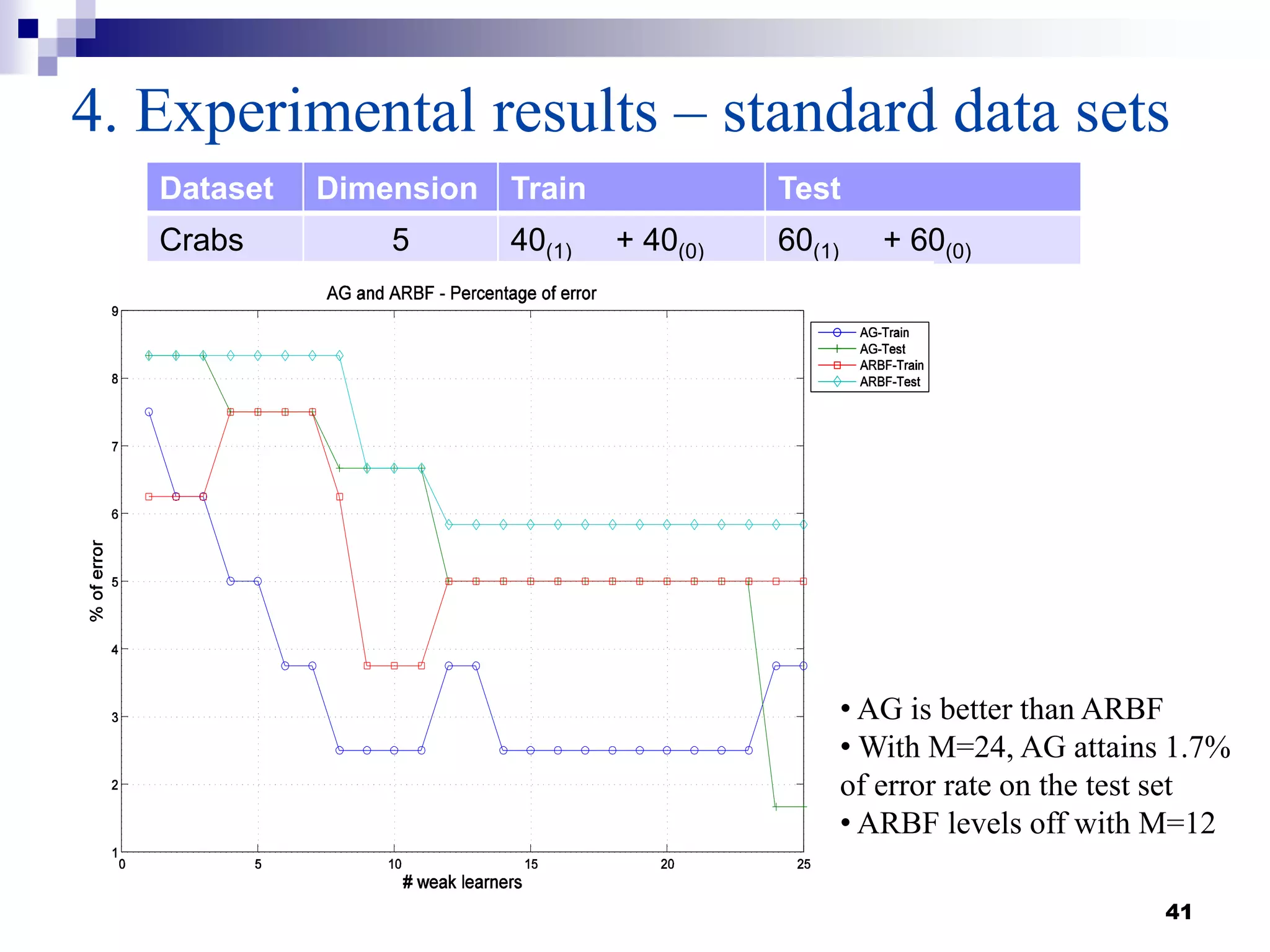
Crabs 5 40(1) + 40(0) 60(1) + 60(0)
• AG is better than ARBF
• With M=24, AG attains 1.7%
of error rate on the test set
• ARBF levels off with M=12
42
4. Experimental results – standard data sets
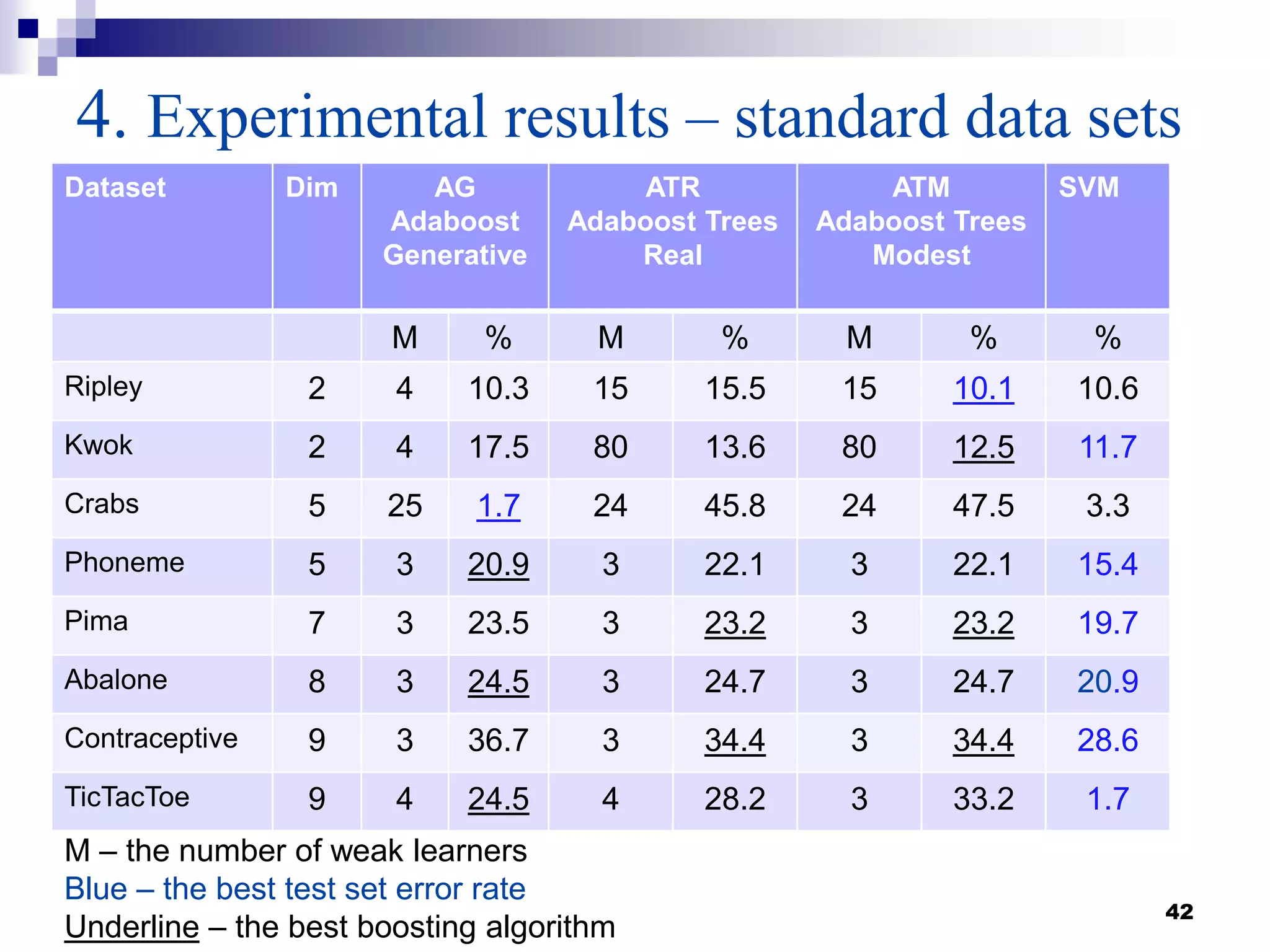
Dataset Dim AG
Adaboost
Generative
ATR
Adaboost Trees
Real
ATM
Adaboost Trees
Modest
SVM
M % M % M % %
Ripley 2 4 10.3 15 15.5 15 10.1 10.6
Kwok 2 4 17.5 80 13.6 80 12.5 11.7
Crabs 5 25 1.7 24 45.8 24 47.5 3.3
Phoneme 5 3 20.9 3 22.1 3 22.1 15.4
Pima 7 3 23.5 3 23.2 3 23.2 19.7
Abalone 8 3 24.5 3 24.7 3 24.7 20.9
Contraceptive 9 3 36.7 3 34.4 3 34.4 28.6
TicTacToe 9 4 24.5 4 28.2 3 33.2 1.7
M – the number of weak learners
Blue – the best test set error rate
Underline – the best boosting algorithm
43
4. Experimental results
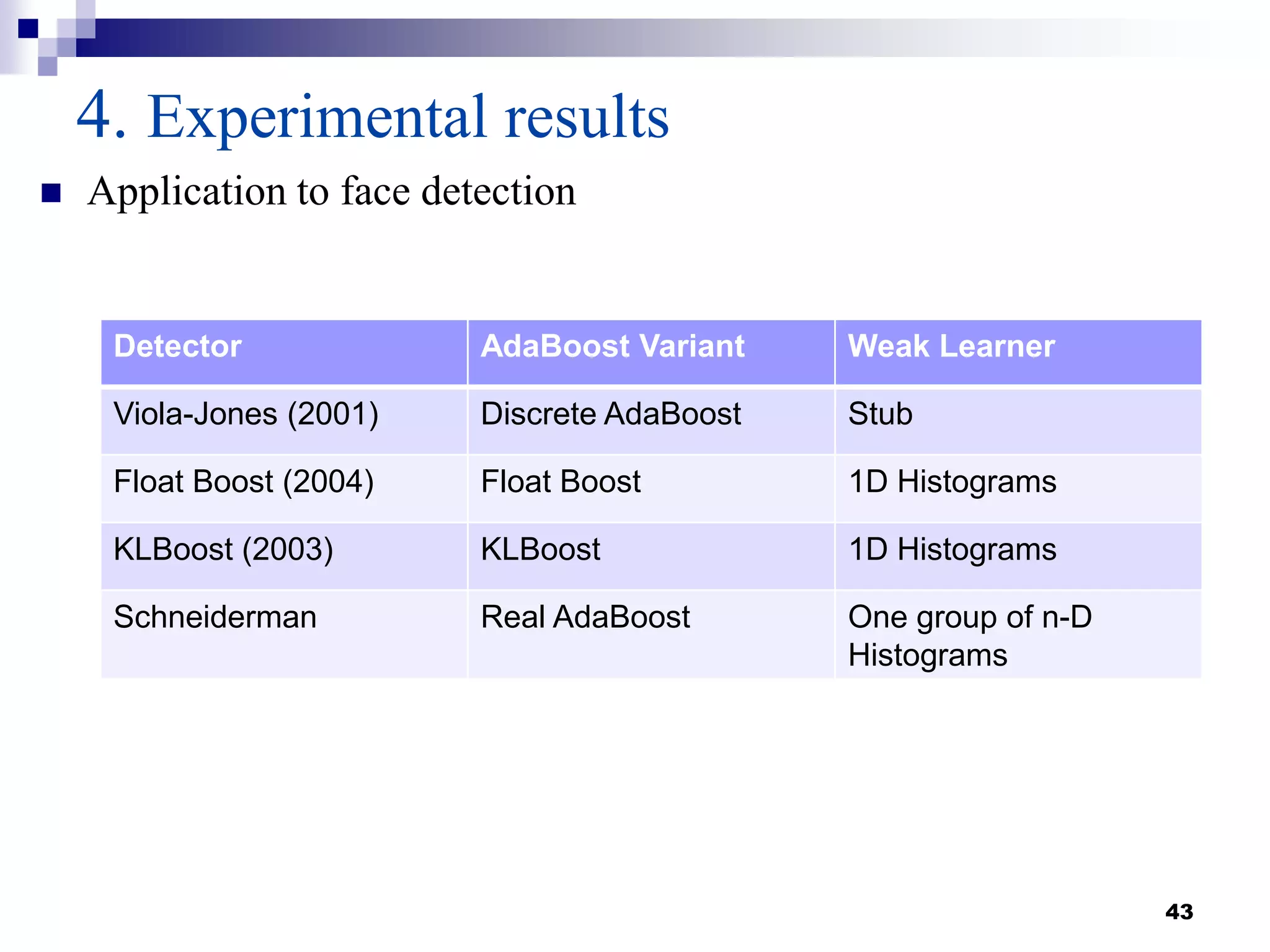
Detector AdaBoost Variant Weak Learner
Viola-Jones (2001) Discrete AdaBoost Stub
Float Boost (2004) Float Boost 1D Histograms
KLBoost (2003) KLBoost 1D Histograms
Schneiderman Real AdaBoost One group of n-D
Histograms
 Application to face detection
44
5. Concluding remarks
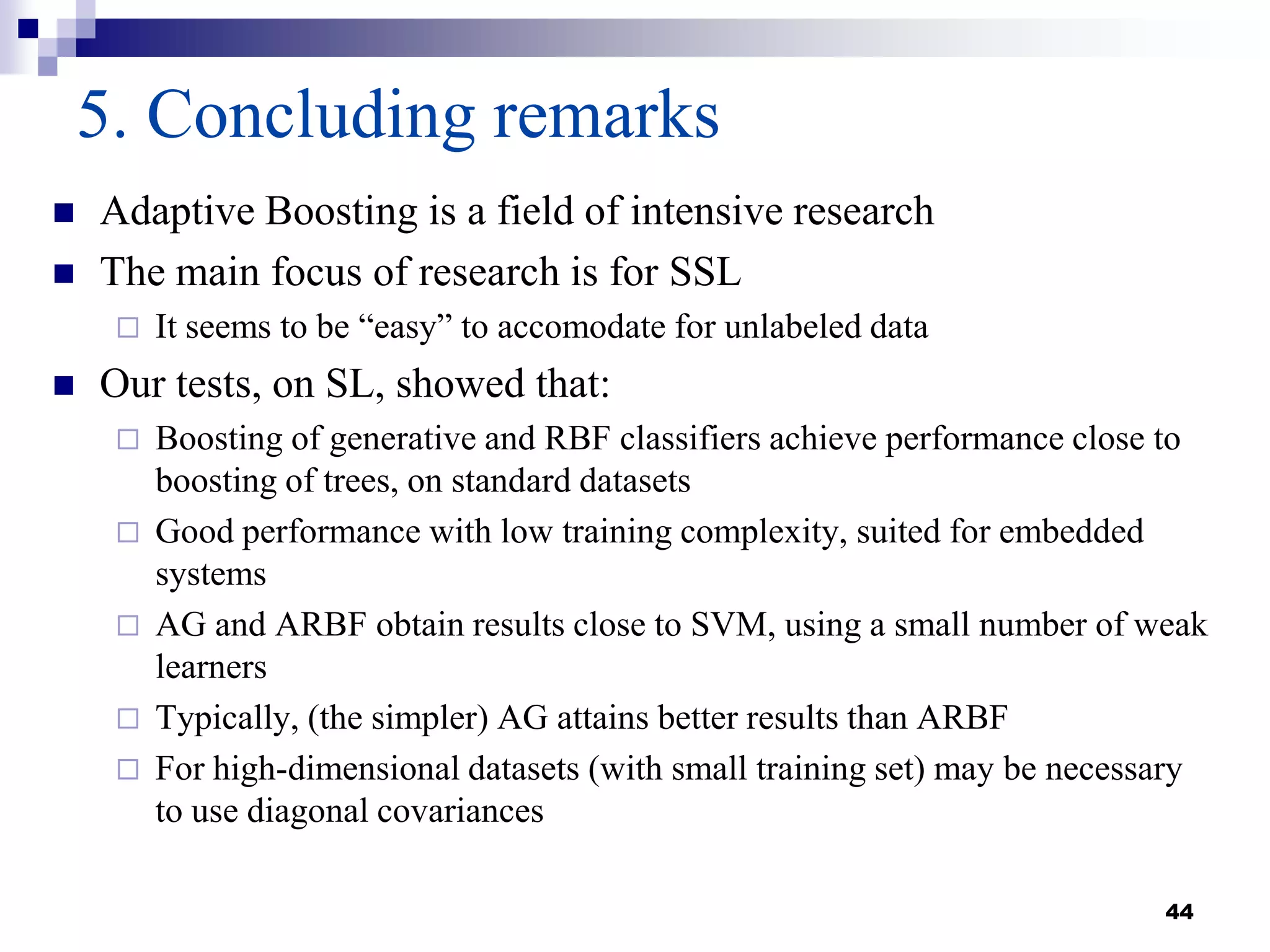
 Adaptive Boosting is a field of intensive research
 The main focus of research is for SSL
 It seems to be “easy” to accomodate for unlabeled data
 Our tests, on SL, showed that:
 Boosting of generative and RBF classifiers achieve performance close to
boosting of trees, on standard datasets
 Good performance with low training complexity, suited for embedded
systems
 AG and ARBF obtain results close to SVM, using a small number of weak
learners
 Typically, (the simpler) AG attains better results than ARBF
 For high-dimensional datasets (with small training set) may be necessary
to use diagonal covariances
45
5. Concluding remarks: ongoing work
 For SL:
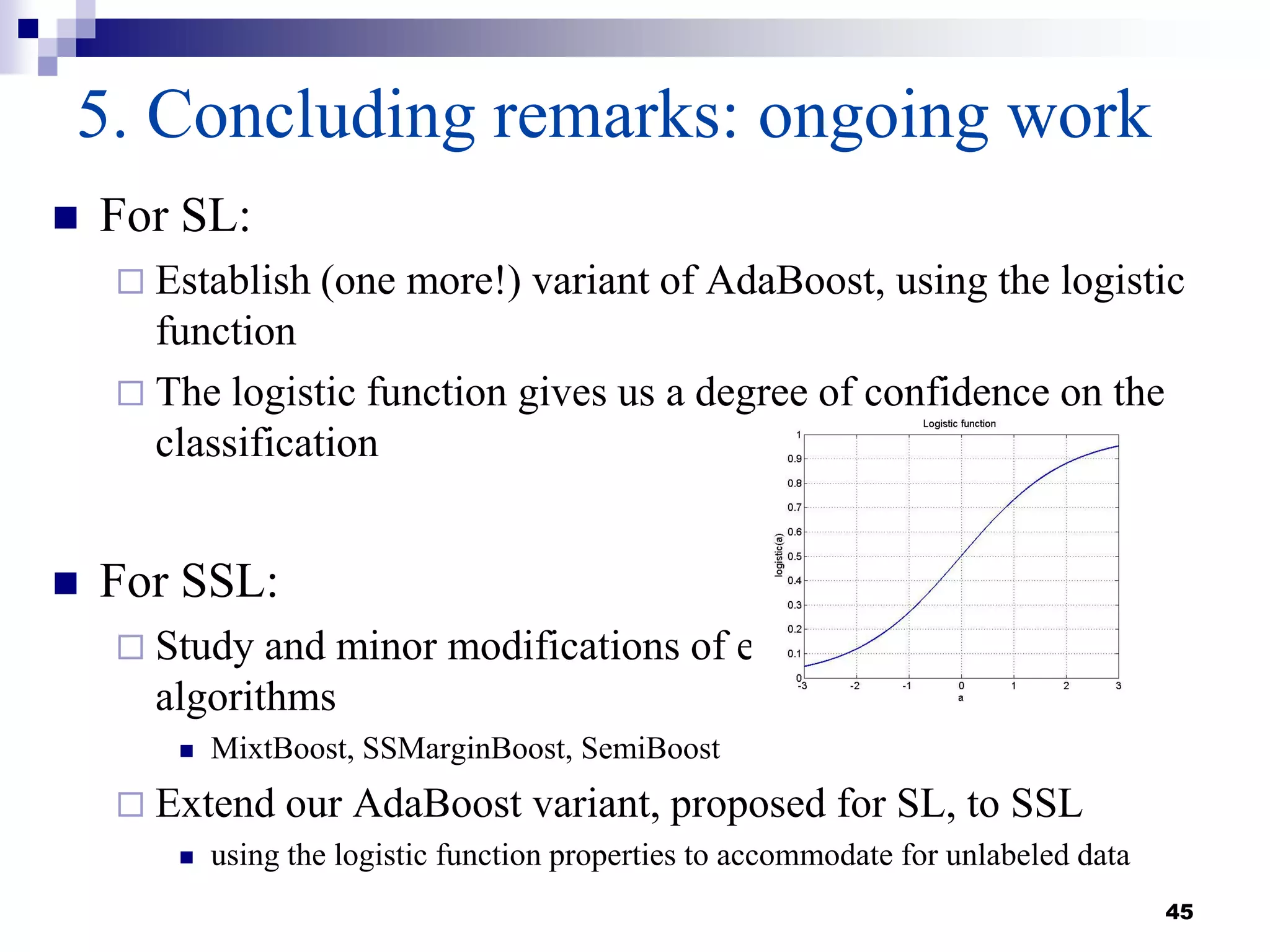
 Establish (one more!) variant of AdaBoost, using the logistic
function
 The logistic function gives us a degree of confidence on the
classification
 For SSL:
 Study and minor modifications of existing boosting
algorithms
 MixtBoost, SSMarginBoost, SemiBoost
 Extend our AdaBoost variant, proposed for SL, to SSL
 using the logistic function properties to accommodate for unlabeled data
46
5. Concluding remarks: ongoing work
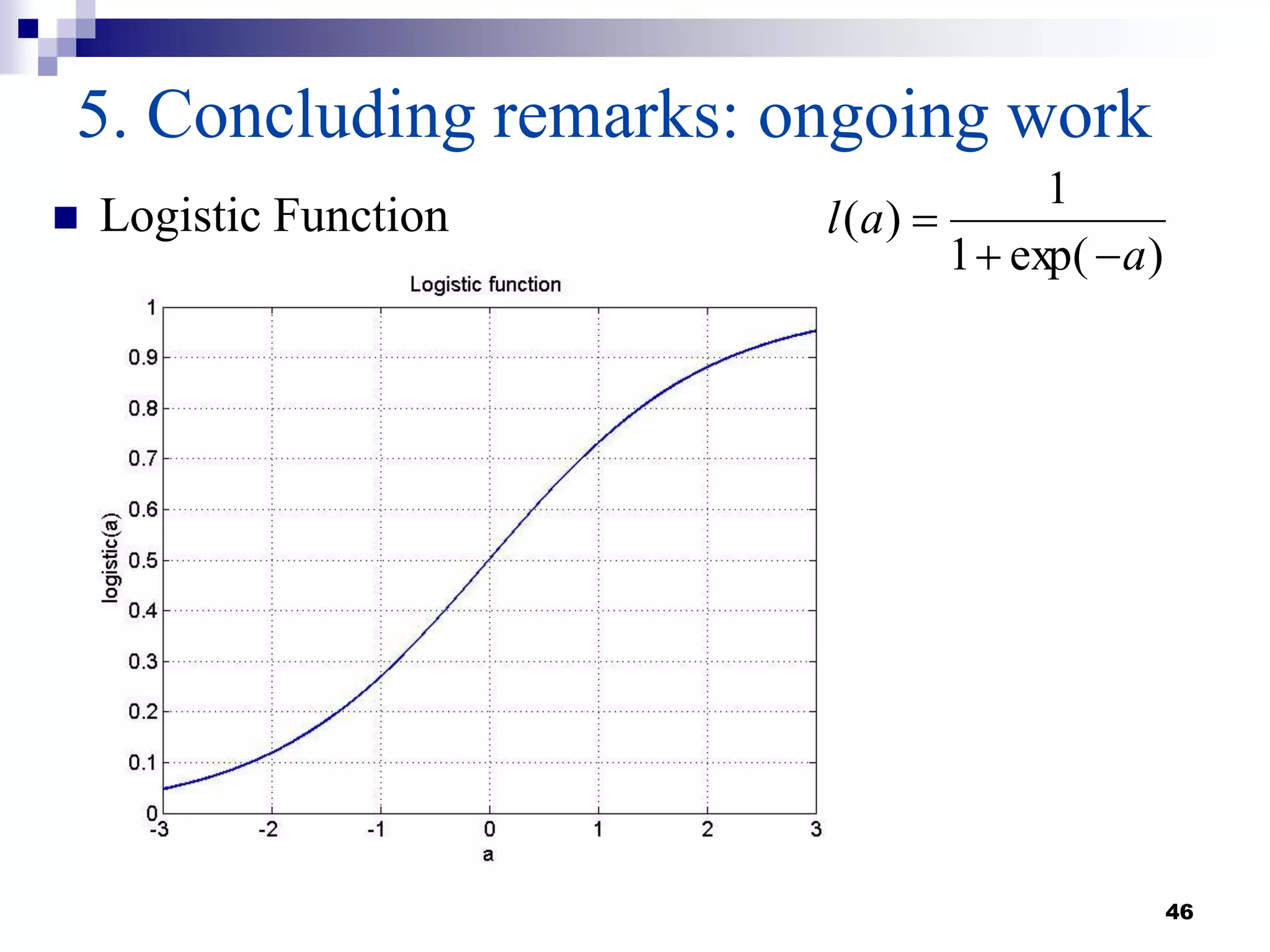
 Logistic Function
)exp(1
1
)(
a
al

2013-1 Machine Learning Lecture 06 - Artur Ferreira - A Survey on Boosting…

  • 1.
    1 A Survey on BoostingAlgorithms for Supervised Learning Artur Ferreira supervisor Prof. Mário Figueiredo 26 November 2007
  • 2.
    2 Summary 1. Ensembles ofclassifiers and boosting 2. Boosting: origins and features 3. The AdaBoost algorithm and its variants  Supervised Learning (SL)  Semi-Supervised Learning (SSL) 4. Experimental results (binary classification)  Comparison with other techniques 5. Concluding remarks (and ongoing work)
  • 3.
    3 1. Ensembles ofclassifiers  Motivation for ensembles of classifiers  Instead of learning a single complex classifier, learn several simple classifiers  Combine the output of the simple classifiers to produce the classification decision  For instance, instead of training a large neural network (NN), train several smaller NN and combine their individual output in order to produce the final output
  • 4.
    4 1. Ensembles ofclassifiers  H1(x),...,HM(x) are the weak learners  The output classification decision is given by H(x)
  • 5.
    5 2. Boosting: originsand features  Boosting builds an ensemble of classifiers  Combine simple classifiers to build a robust classifier  Each classifier has an associated contribution
  • 6.
    6 2. The originsof Boosting  Boosting is related to other techniques such as Bootstrap and Bagging
  • 7.
    7 2. Bootstrap: features General purpose sample-based statistical method  Assesses the statistical accuracy of some estimate S(Z), over a training set Z={z1, z2,…, zN}, with zi=(xi,yi)  Draws randomly with replacement from a set of data points,  Uses B versions of the training set  To check the accuracy, the measure is applied over the B sampled versions of the training set
  • 8.
  • 9.
    9 2. Bootstrap: algorithm Input: •Training set Z={z1,z2,…,zN}, with zi=(xi,yi). • B, number of sampled versions of the training set. Output: • S(Z), statistical estimate and its accuracy. Step 1 for n=1 to B a) Draw, with replacement, L < N samples from the training set Z, obtaining the nth sample Z*n. b) For each sample Z*n, estimate a statistic S (Z*n). end Step 2 Produce the bootstrap estimate S(Z), using S (Z*n) with n={1,…,B}. Step 3 Compute the accuracy of the estimate, using the variance or some other criterion.
  • 10.
    10 2. Bagging: features Proposed by Breiman, 1996  Consists of Bootstrap aggregation  Training set Z={z1, z2,…, zN}, with zi=(xi,yi) for which we intend to fit a model f(x)  Obtain a prediction of f(x) at input x  For each bootstrap sample b we fit our model, giving a prediction fb(x).  The Bagging estimate is the average of the individual estimates
  • 11.
    11 2. Bagging: algorithm(classification) Input: • Training set Z={z1,z2,…,zN}, with zi=(xi,yi). • B, number of sampled versions of the training set. Output: • H(x), a classifier suited for the training set. Step 1 for n=1 to B a) Draw, with replacement, L < N samples from the training set Z, obtaining the nth sample Z*n. b) For each sample Z*n, learn classifier Hn. end Step 2 Produce the final classifier as a vote of Hn with n={1,…,B}. B n n xHxH 1 )(sgn)(
  • 12.
    12 2. Boosting: features Freund and Schapire, 1989  Similar to Bagging, in the sense that uses several versions of the training set  Uses 3 subsets of the training set  Differs from Bagging, in the sense that does not allow replacement  The final classification is done my a majority vote (3 classifiers)
  • 13.
    13 2. Boosting: algorithm(classification) Input: • Training set Z={z1,z2,…,zN}, with zi=(xi,yi). Output: • H(x), a classifier suited for the training set. Step 1 - Draw, without replacement, L < N samples from the training set Z, obtaining Z*1; train weak learner H1 on Z*1 Step 2 - Select L2 < N samples from Z with half of the samples misclassified by H1 to obtain Z*2; train weak learner H2 on it. Step 3 - Select all samples from Z that H1 and H2 disagree on; train weak learner H3, using these samples. Step 4 - Produce the final classifier as a vote of the three weak learners 3 1 )(sgn)( n n xHxH
  • 14.
  • 15.
    15 3. AdaBoost Algorithm Adaptive Boosting  By Freund and Schapire, 1996  Instead of sample, reweight the data  Consecutive classifiers are learned on weigthed versions of the data  The entire training set is considered in order to learn each classifier
  • 16.
    16 3. AdaBoost Algorithm Consecutive classifiers are learned on weigthed versions of the data  The weight is given by the (mis)classification of the previous classifiers  The next classifier focus on the most difficult patterns  The algorithm stops when:  the error rate of a classifier is >0.5  it reaches M classifiers
  • 17.
    17 3. AdaBoost Algorithm 1.Initialize the weights , with 2. For m=1 to M a) Fit a classifier to data using weights b) Compute the error rate of the classifier c) Compute the contribution d) Update the weights 3. Output the ensemble AdaBoost Input: Training set (x,y) N = # input patterns M = # classifiers Output: The ensemble given by
  • 18.
    18 3. AdaBoost Algorithm:detail 1 1. Initialize the weights 2. For m=1 to M a) Fit a classifier to data using current weights b) Compute the error rate of the current classifier c) Compute the weighted contribution of the classifier d) Update the weight of each input pattern 3. Output the ensemble
  • 19.
    19 3. AdaBoost Algorithm:detail 2 1. Initialize the weights 2. For m=1 to M a) Fit a classifier to data using current weights b) Compute the error rate of the current classifier c) Compute the weighted contribution of the classifier d) Update the weight of each input pattern 3. Output the ensemble Indicator function equal different ,1 ,1 Weight increases Weight decreases
  • 20.
    20 3. AdaBoost Algorithm Comparison of Boosting (1989) and AdaBoost (1996) Feature Boosting AdaBoost Data processing Random sampling without replacement Weighting (no sampling) Num. of classifiers Three Up to M Decision Majority vote Weighted vote
  • 21.
    21 3. AdaBoost Algorithm:variants  Variants for SL  Binary case  Since 1999, several variants have been proposed
  • 22.
    22 3. AdaBoost Algorithm:variants  Variants for SL  Multiclass case  Since 1997, several variants have been proposed
  • 23.
    23 3. AdaBoost Algorithm:variants  Variants for SSL  Since 2001, only three variants have been proposed  The key issue is how to handle unlabeled data  usually there is some loss (or contrast) function  this my current topic of research and maybe the title of my next talk...!
  • 24.
    24 3. AdaBoost variants Variants for SL to consider:  Real AdaBoost (1999)  Gentle Boost (2000)  Modest AdaBoost (2005)  Reweight Boost (2007) 1. Initialize the weights 2. For m=1 to M a) Fit a classifier to data using current weights b) Compute the error rate of the current classifier c) Compute the weighted contribution of the classifier d) Update the weight of each input pattern 3. Output the ensemble Usually, variants change only these steps
  • 25.
    3. AdaBoost variants:Real AdaBoost 25 Input: • Training set Z={z1,z2,…,zN}, with zi=(xi,yi). • M, the maximum number of classifiers. Output: • H(x), a classifier suited for the training set. Step 1 Initialize the weights wi = 1/N, i={1,...,N} Step 2 for m=1 to M a) Fit the class probability estimate pm(x)=Pw(y=1|x), using weights wi on the training data. b) Set c) Set weights and renormalize. Step 3 Produce the final classifier. (x)p (x)p-1 log0.5(x)H m m m )(exp xHyww miii M n n xHxH 1 )(sgn)(
  • 26.
    AdaBoost variants  RealAdaBoost (RA) differs from AdaBoost on steps 2a) and 2b)  On RA, these steps consist on the calculation of the probability that a given pattern belongs to a class.  The AdaBoost algorithm classifies the input patterns and calculates the weighted amount of error.  RA performs exact optimization with respect to Hm  Gentle AdaBoost (GA) improves it, using weighted least-squares regression  Usually, GA produces a more reliable and stable ensemble. 26
  • 27.
    3.AdaBoost variants: GentleAdaBoost 27 Input: • Training set Z={z1,z2,…,zN}, with zi=(xi,yi). • M, the maximum number of classifiers. Output: • H(x), a classifier suited for the training set. Step 1 Initialize the weights wi = 1/N, i={1,...,N} Step 2 for m=1 to M a) Train Hm(x) by weighted least squares of xi to yi, with weights wi b) Set c) Set weights and renormalize. Step 3 Produce the final classifier. (x)HH(x)H(x) m )(exp xHyww miii M n n xHxH 1 )(sgn)(
  • 28.
    AdaBoost variants  ModestAdaBoost (MA) improves Gentle AdaBoost (GA) improves it, using an “inverted” distribution  this distribution gives higher weights to samples that are already correctly classified by earlier classifiers  Usually MA attains ensembles with less generalization error than GA  But, MA typpicaly has higher training error than GA 28 ww 1
  • 29.
    3.AdaBoost variants: ModestAdaBoost 29 Input:.... Output:… The same as before Step 1 - Initialize the weights wi = 1/N, i={1,...,N} Step 2 for m=1 to M a) Train Hm(x) by weighted least squares of xi to yi, with weights wi b) Compute inverted distribution and renormalize. c) Compute d) Set e) Update Step 3 Produce the final classifier. w-1w )(exp xHyww miii M n n xHxH 1 )(sgn)( ))(,1( ))(,1( ))(,1( ))(,1( 1 1 1 1 xHyPP xHyPP xHyPP xHyPP mwm mwm mwm mwm )1()1()( 1111 mmmmm PPPPxH How good the current classifier is at predicting class labels. How well the current classifier is on the data previously classified by earlier classifiers.
  • 30.
    3.AdaBoost variants: ModestAdaBoost 30  The update on step 2d) is  Decreases the contribution of a given classifier if it works “too well” on the previously correctly classified data, with high margin  Increases the contribution of the classifiers that have high certain on the current classification  The algorithm is named “Modest” because the class tend to work in “their domain” )1()1()( 1111 mmmmm PPPPxH
  • 31.
    3.AdaBoost variants: ReweightBoost 31 Input:.... r (>0), the number of previous classifiers Output:… The same as before Step 1 - Initialize the weights wi = 1/N, i={1,...,N} Step 2 for m=1 to M a) Fit a classifier Hm(x) to the data with weights wi b) Get combined classifier Hrm(x) from the previous r classifiers c) Compute error d) Compute the contribution e) Update the weights Step 3 Produce the final classifier.
  • 32.
    32 4. Experimental results Motivated by the claim  “AdaBoost with trees is the best off-the shelf classifier”  and by this proven result  AdaBoost performs quite well, when each classifier is just a little better than random guessing (Friedam et al, 2001)  We carried out some results on synthetic and real data using the weak classifiers:  Generative (2 gaussians)  RBF (Radial Basis Function) Unit with 2 gaussians and one output layer
  • 33.
    33 4. Generative WeakLearner (AG)  The generative weak learner has two multivariate Gaussian functions G0 and G1 (one per class)  p0 and p1 are the (sample) probabilites of each class  Gaussians learned by weighted mean and covariance estimation
  • 34.
    34 4. RBF WeakLearner (ARBF)  The RBF (Radial Basis Function) weak learner has  two multivariate Gaussian functions (one per class)  one output layer  The logistic function is applied on the output layer
  • 35.
    35 4. RBF WeakLearner (ARBF)  Training of the RBF classifier is carried out by one- stage (global) algorithm*  Mean and covariance matrix of each Gaussian are learn by the EM algorithm for mixture of gaussians (generative approach)  Simultaneously, the output layer coefficients are learned by logistic regression (discriminative approach), by the Newton-Raphson step * A. Ferreira and M. Figueiredo, Hybrid generative/discriminative training of RBF Networks, ESANN2006 E-Step M-Step
  • 36.
    36 4. Experimental results– synthetic 1  Synthetic 1 dataset: two-dimensional; 100 train patterns (50 + 50); 400 test patterns (200 + 200)  Using up to M=10 classifiers  Test set error rate: AG (M=10) 6.5% ARBF (M=3) 1% AG ARBF
  • 37.
    37 4. Experimental results– synthetic 1  Synthetic 1 dataset: two-dimensional; 100 train patterns (50 + 50); 400 test patterns (200 + 200)  Using up to M=10 classifiers  Training and test set error rate, as a function of M • ARBF obtains better results, but is unable to achieve zero errors on the test set • For both algorithms, after a given value of M, there is no decrease on the error
  • 38.
    38 4. Experimental results– synthetic 2 AG ARBF  Synthetic 2 dataset: two-dimensional; 180 train patterns (90 + 90); 360 test patterns (180 + 180)  Using up to M=15 classifiers  Test set error rate: AG (M=15) 0.28% ARBF (M=15) 0.83%
  • 39.
    39 4. Experimental results– synthetic 2  Synthetic 2 dataset: two-dimensional; 180 train patterns (90 + 90); 360 test patterns (180 + 180)  Using up to M=15 classifiers  Training and test set error rate, as a function of M • In this case, AG achieves better results • Unable to achieve zero errors on the test set • ARBF levels off with M=6 • For AG we have it with M=12
  • 40.
    40 4. Experimental results– standard data sets Dataset Dimension Train Test Kwok 2 200 (1) + 300(0) 4080(1) + 6120(0) • On the test set, AG is slightly better • The same happens on the training set, but with a larger difference • Both algorithms level off with M=4, on the training and test sets
  • 41.
    41 4. Experimental results– standard data sets Dataset Dimension Train Test Crabs 5 40(1) + 40(0) 60(1) + 60(0) • AG is better than ARBF • With M=24, AG attains 1.7% of error rate on the test set • ARBF levels off with M=12
  • 42.
    42 4. Experimental results– standard data sets Dataset Dim AG Adaboost Generative ATR Adaboost Trees Real ATM Adaboost Trees Modest SVM M % M % M % % Ripley 2 4 10.3 15 15.5 15 10.1 10.6 Kwok 2 4 17.5 80 13.6 80 12.5 11.7 Crabs 5 25 1.7 24 45.8 24 47.5 3.3 Phoneme 5 3 20.9 3 22.1 3 22.1 15.4 Pima 7 3 23.5 3 23.2 3 23.2 19.7 Abalone 8 3 24.5 3 24.7 3 24.7 20.9 Contraceptive 9 3 36.7 3 34.4 3 34.4 28.6 TicTacToe 9 4 24.5 4 28.2 3 33.2 1.7 M – the number of weak learners Blue – the best test set error rate Underline – the best boosting algorithm
  • 43.
    43 4. Experimental results DetectorAdaBoost Variant Weak Learner Viola-Jones (2001) Discrete AdaBoost Stub Float Boost (2004) Float Boost 1D Histograms KLBoost (2003) KLBoost 1D Histograms Schneiderman Real AdaBoost One group of n-D Histograms  Application to face detection
  • 44.
    44 5. Concluding remarks Adaptive Boosting is a field of intensive research  The main focus of research is for SSL  It seems to be “easy” to accomodate for unlabeled data  Our tests, on SL, showed that:  Boosting of generative and RBF classifiers achieve performance close to boosting of trees, on standard datasets  Good performance with low training complexity, suited for embedded systems  AG and ARBF obtain results close to SVM, using a small number of weak learners  Typically, (the simpler) AG attains better results than ARBF  For high-dimensional datasets (with small training set) may be necessary to use diagonal covariances
  • 45.
    45 5. Concluding remarks:ongoing work  For SL:  Establish (one more!) variant of AdaBoost, using the logistic function  The logistic function gives us a degree of confidence on the classification  For SSL:  Study and minor modifications of existing boosting algorithms  MixtBoost, SSMarginBoost, SemiBoost  Extend our AdaBoost variant, proposed for SL, to SSL  using the logistic function properties to accommodate for unlabeled data
  • 46.
    46 5. Concluding remarks:ongoing work  Logistic Function )exp(1 1 )( a al