Sanjivani Rural Education Society’s
Sanjivani College of Engineering, Kopargaon-423 603
(An Autonomous Institute, Affiliated to Savitribai Phule Pune University, Pune)
NACC ‘A’ Grade Accredited, ISO 9001:2015 Certified
Department of Computer Engineering
(NBA Accredited)
Prof. S. A. Shivarkar
Assistant Professor
Contact No.8275032712
Email- shivarkarsandipcomp@sanjivani.org.in
Subject- Supervised Modeling and AI Technologies (CO9401)
Unit –III: Supervised Learning- Ensemble Techniques
Content
 Ensemble primer- Bias Vs variance trade off
 Generative models vs Non generative models
 Bagging-Random Forest trees
 Voting types
 Boosting -Ada boost, gradient boosting, XGBoost, and stacking, selection
criterion, constraints of ensemble techniques
Ensemble Learning
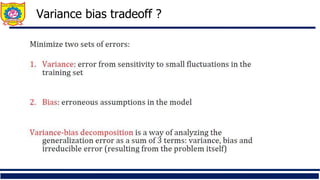
 Ensemble Learning Techniques in models suffer from bias and/or variance. Bias
is the difference between the predicted value and actual value by the model.
Bias is introduced when the model doesn’t consider the variation of data and
creates a simple model. The simple model doesn’t follow the patterns of data,
and hence the model gives errors in predicting training as well as testing data
i.e. the model with high bias and high variance. You Can also read Covariance
and Correlation In Machine Learning
 When the model follows even random quirks of data, as pattern of data, then
the model might do very well on training dataset i.e. it gives low bias, but it
fails on test data and gives high variance.
Ensemble Learning
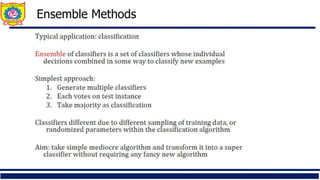
 Therefore, to improve the accuracy (estimate) of the model, ensemble learning
methods are developed. Ensemble is a machine learning concept, in which several
models are trained using machine learning algorithms. It combines low performing
classifiers (also called as weak learners or base learner) and combine individual
model prediction for the final prediction.
 Ensemble learning is a machine learning technique involves training
multiple models and combining their predictions.
 The purpose of using ensemble learning is to reduce overfitting and
improve generalization.
Ensemble Methods
Ensemble Methods- Summary
Variance bias tradeoff ?
Why do Ensemble Methods Work?
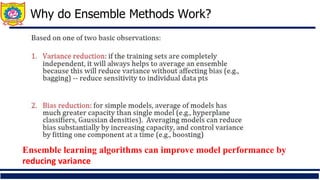
Ensemble learning algorithms can improve model performance by
reducing variance
Ensemble Learning Algorithms
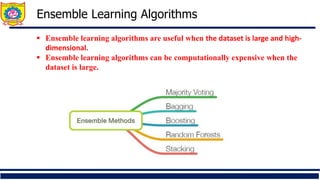
 Ensemble learning algorithms are useful when the dataset is large and high-
dimensional.
 Ensemble learning algorithms can be computationally expensive when the
dataset is large.
Bagging
 Bagging, also known as bootstrap aggregation, is the ensemble learning
method that is commonly used to reduce variance within a noisy data set.
 In bagging, a random sample of data in a training set is selected with
replacement—meaning that the individual data points can be chosen more
than once. After generating several data samples, these weak models are
then trained independently. Depending on the type of task—regression or
classification, for example—the average or majority of those predictions yield
a more accurate estimate.
 Bagging is an ensemble technique that trains multiple models on different subsets
of the data.
 Bagging algorithms are effective in handling imbalanced datasets.
 Bagging ensemble learning algorithm can handle missing values in the dataset.
 Bagging ensemble learning algorithm can handle both numerical and categorical
features effectively.
Bagging
 Consider a scenario where you are looking at the users’ ratings
for a product. Instead of approving one user’s good/bad rating,
we consider average rating given to the product.
 With average rating, we can be considerably sure of quality of
the product. Bagging makes use of this principle.
 Instead of depending on one model, it runs the data through
multiple models in parallel, and average them out as model’s final
output.
What is Bagging and How it Works?
 Bagging is an
acronym for
Bootstrapped
Aggregation.
 Bootstrapping means
random selection of
records with
replacement from the
training dataset.
‘Random selection
with replacement.
What is Bagging and How it Works?
1. Consider that there are 8 samples in the training dataset. Out
of these 8 samples, every weak learner gets 5 samples as
training data for the model. These 5 samples need not be
unique, or non-repetitive.
2. The model (weak learner) is allowed to get a sample multiple
times. For example, as shown in the figure, Rec5 is selected 2
times by the model. Therefore, weak learner1 gets Rec2,
Rec5, Rec8, Rec5, Rec4 as training data.
3. All the samples are available for selection to next weak
learners. Thus all 8 samples will be available for next weak
learner and any sample can be selected multiple times by
next weak learners.
Bagging is a Parallel Method
 Bagging is a parallel method, which means several weak learners
learn the data pattern independently and simultaneously. This can
be best shown in the below diagram:
Bagging is a Parallel Method
 The output of each weak learner is averaged to generate final output
of the model.
 Since the weak learner’s outputs are averaged, this mechanism helps
to reduce variance or variability in the predictions. However, it does
not help to reduce bias of the model.
 Since final prediction is an average of output of each weak learner, it
means that each weak learner has equal say or weight in the final
output.
Bagging Summary
 Bagging is Bootstrapped Aggregation
 It is Parallel method
 Final output is calculated by averaging the outputs produced by
individual weak learner
 Each weak learner has equal say
 Bagging reduces variance
Boosting
 We saw that in bagging every model is given equal preference, but if
one model predicts data more correctly than the other, then higher
weightage should be given to this model over the other.
 Also, the model should attempt to reduce bias.
 These concepts are applied in the second ensemble method that we
are going to learn, that is Boosting.
 Boosting is an ensemble technique that constructs an ensemble by
iteratively updating weights.
 Boosting ensemble learning algorithm is prone to overfitting if the base
models are too complex.
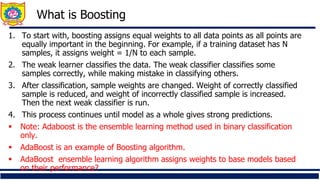
What is Boosting
1. To start with, boosting assigns equal weights to all data points as all
points are equally important in the beginning. For example, if a
training dataset has N samples, it assigns weight = 1/N to each
sample.
2. The weak learner classifies the data. The weak classifier classifies
some samples correctly, while making mistake in classifying others.
3. After classification, sample weights are changed. Weight of correctly
classified sample is reduced, and weight of incorrectly classified
sample is increased. Then the next weak classifier is run.
4. This process continues until model as a whole gives strong predictions.
 Note: Adaboost is the ensemble learning method used in binary
classification only.
What is Boosting
1. To start with, boosting assigns equal weights to all data points as all points are
equally important in the beginning. For example, if a training dataset has N
samples, it assigns weight = 1/N to each sample.
2. The weak learner classifies the data. The weak classifier classifies some
samples correctly, while making mistake in classifying others.
3. After classification, sample weights are changed. Weight of correctly classified
sample is reduced, and weight of incorrectly classified sample is increased.
Then the next weak classifier is run.
4. This process continues until model as a whole gives strong predictions.
 Note: Adaboost is the ensemble learning method used in binary classification
only.
 AdaBoost is an example of Boosting algorithm.
 AdaBoost ensemble learning algorithm assigns weights to base models based
on their performance?
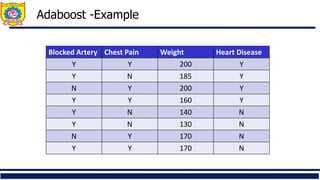
Adaboost -Example
Blocked Artery Chest Pain Weight Heart Disease
Y Y 200 Y
Y N 185 Y
N Y 200 Y
Y Y 160 Y
Y N 140 N
Y N 130 N
N Y 170 N
Y Y 170 N
Adaboost -Example
1. Initialize Weights To
All Training Points
First step is to assign
equal weights to all
samples as all samples
are equally important.
Always, sum of weights
of all samples equals 1.
There are 8 samples, so
each sample will get
weight = 1/8 = 0.125
Blocked
Artery
Chest Pain Weight Heart
Disease
Weights
Assigned
Y Y 200 Y 1/8=0.125
Y N 185 Y 1/8=0.125
N Y 200 Y 1/8=0.125
Y Y 160 Y 1/8=0.125
Y N 140 N 1/8=0.125
Y N 130 N 1/8=0.125
N Y 170 N 1/8=0.125
Y Y 170 N 1/8=0.125
Adaboost -Example
2. Create Stump
 After assigning weight, next step is to create stumps.
 Stump is a decision tree with one node and two leaves.
 Adaboost creates forest of decision stumps.
 To create stump, only one attribute should be chosen.
 But, it is not randomly selected.
 The attribute that does the best job of classifying the sample is
selected first.
Adaboost -Example
2. Create Stump
Adaboost -Example
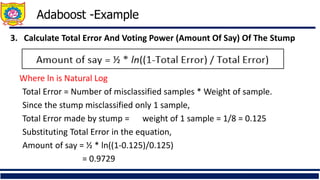
3. Calculate Total Error And Voting Power (Amount Of Say) Of The Stump
Where ln is Natural Log
Total Error = Number of misclassified samples * Weight of sample.
Since the stump misclassified only 1 sample,
Total Error made by stump = weight of 1 sample = 1/8 = 0.125
Substituting Total Error in the equation,
Amount of say = ½ * ln((1-0.125)/0.125)
= 0.9729
Adaboost -Example
3. Calculate Total Error And Voting Power (Amount Of Say) Of The Stump
Where ln is Natural Log
Total Error = Number of misclassified samples * Weight of sample.
Since the stump misclassified only 1 sample,
Total Error made by stump = weight of 1 sample = 1/8 = 0.125
Substituting Total Error in the equation,
Amount of say = ½ * ln((1-0.125)/0.125)
= 0.9729
DEPARTMENT OF COMPUTER ENGINEERING, Sanjivani COE, Kopargaon 26
Reference
 Han, Jiawei Kamber, Micheline Pei and Jian, “Data Mining: Concepts and
Techniques”,Elsevier Publishers, ISBN:9780123814791, 9780123814807.
 Python Machine Learning, 2nd Ed.,

Supervised Learning Ensemble Techniques Machine Learning

  • 1.
    Sanjivani Rural EducationSociety’s Sanjivani College of Engineering, Kopargaon-423 603 (An Autonomous Institute, Affiliated to Savitribai Phule Pune University, Pune) NACC ‘A’ Grade Accredited, ISO 9001:2015 Certified Department of Computer Engineering (NBA Accredited) Prof. S. A. Shivarkar Assistant Professor Contact No.8275032712 Email- shivarkarsandipcomp@sanjivani.org.in Subject- Supervised Modeling and AI Technologies (CO9401) Unit –III: Supervised Learning- Ensemble Techniques
  • 2.
    Content  Ensemble primer-Bias Vs variance trade off  Generative models vs Non generative models  Bagging-Random Forest trees  Voting types  Boosting -Ada boost, gradient boosting, XGBoost, and stacking, selection criterion, constraints of ensemble techniques
  • 3.
    Ensemble Learning  EnsembleLearning Techniques in models suffer from bias and/or variance. Bias is the difference between the predicted value and actual value by the model. Bias is introduced when the model doesn’t consider the variation of data and creates a simple model. The simple model doesn’t follow the patterns of data, and hence the model gives errors in predicting training as well as testing data i.e. the model with high bias and high variance. You Can also read Covariance and Correlation In Machine Learning  When the model follows even random quirks of data, as pattern of data, then the model might do very well on training dataset i.e. it gives low bias, but it fails on test data and gives high variance.
  • 4.
    Ensemble Learning  Therefore,to improve the accuracy (estimate) of the model, ensemble learning methods are developed. Ensemble is a machine learning concept, in which several models are trained using machine learning algorithms. It combines low performing classifiers (also called as weak learners or base learner) and combine individual model prediction for the final prediction.  Ensemble learning is a machine learning technique involves training multiple models and combining their predictions.  The purpose of using ensemble learning is to reduce overfitting and improve generalization.
  • 5.
  • 6.
  • 7.
  • 8.
    Why do EnsembleMethods Work? Ensemble learning algorithms can improve model performance by reducing variance
  • 9.
    Ensemble Learning Algorithms Ensemble learning algorithms are useful when the dataset is large and high- dimensional.  Ensemble learning algorithms can be computationally expensive when the dataset is large.
  • 10.
    Bagging  Bagging, alsoknown as bootstrap aggregation, is the ensemble learning method that is commonly used to reduce variance within a noisy data set.  In bagging, a random sample of data in a training set is selected with replacement—meaning that the individual data points can be chosen more than once. After generating several data samples, these weak models are then trained independently. Depending on the type of task—regression or classification, for example—the average or majority of those predictions yield a more accurate estimate.  Bagging is an ensemble technique that trains multiple models on different subsets of the data.  Bagging algorithms are effective in handling imbalanced datasets.  Bagging ensemble learning algorithm can handle missing values in the dataset.  Bagging ensemble learning algorithm can handle both numerical and categorical features effectively.
  • 11.
    Bagging  Consider ascenario where you are looking at the users’ ratings for a product. Instead of approving one user’s good/bad rating, we consider average rating given to the product.  With average rating, we can be considerably sure of quality of the product. Bagging makes use of this principle.  Instead of depending on one model, it runs the data through multiple models in parallel, and average them out as model’s final output.
  • 12.
    What is Baggingand How it Works?  Bagging is an acronym for Bootstrapped Aggregation.  Bootstrapping means random selection of records with replacement from the training dataset. ‘Random selection with replacement.
  • 13.
    What is Baggingand How it Works? 1. Consider that there are 8 samples in the training dataset. Out of these 8 samples, every weak learner gets 5 samples as training data for the model. These 5 samples need not be unique, or non-repetitive. 2. The model (weak learner) is allowed to get a sample multiple times. For example, as shown in the figure, Rec5 is selected 2 times by the model. Therefore, weak learner1 gets Rec2, Rec5, Rec8, Rec5, Rec4 as training data. 3. All the samples are available for selection to next weak learners. Thus all 8 samples will be available for next weak learner and any sample can be selected multiple times by next weak learners.
  • 14.
    Bagging is aParallel Method  Bagging is a parallel method, which means several weak learners learn the data pattern independently and simultaneously. This can be best shown in the below diagram:
  • 15.
    Bagging is aParallel Method  The output of each weak learner is averaged to generate final output of the model.  Since the weak learner’s outputs are averaged, this mechanism helps to reduce variance or variability in the predictions. However, it does not help to reduce bias of the model.  Since final prediction is an average of output of each weak learner, it means that each weak learner has equal say or weight in the final output.
  • 16.
    Bagging Summary  Baggingis Bootstrapped Aggregation  It is Parallel method  Final output is calculated by averaging the outputs produced by individual weak learner  Each weak learner has equal say  Bagging reduces variance
  • 17.
    Boosting  We sawthat in bagging every model is given equal preference, but if one model predicts data more correctly than the other, then higher weightage should be given to this model over the other.  Also, the model should attempt to reduce bias.  These concepts are applied in the second ensemble method that we are going to learn, that is Boosting.  Boosting is an ensemble technique that constructs an ensemble by iteratively updating weights.  Boosting ensemble learning algorithm is prone to overfitting if the base models are too complex.
  • 18.
    What is Boosting 1.To start with, boosting assigns equal weights to all data points as all points are equally important in the beginning. For example, if a training dataset has N samples, it assigns weight = 1/N to each sample. 2. The weak learner classifies the data. The weak classifier classifies some samples correctly, while making mistake in classifying others. 3. After classification, sample weights are changed. Weight of correctly classified sample is reduced, and weight of incorrectly classified sample is increased. Then the next weak classifier is run. 4. This process continues until model as a whole gives strong predictions.  Note: Adaboost is the ensemble learning method used in binary classification only.
  • 19.
    What is Boosting 1.To start with, boosting assigns equal weights to all data points as all points are equally important in the beginning. For example, if a training dataset has N samples, it assigns weight = 1/N to each sample. 2. The weak learner classifies the data. The weak classifier classifies some samples correctly, while making mistake in classifying others. 3. After classification, sample weights are changed. Weight of correctly classified sample is reduced, and weight of incorrectly classified sample is increased. Then the next weak classifier is run. 4. This process continues until model as a whole gives strong predictions.  Note: Adaboost is the ensemble learning method used in binary classification only.  AdaBoost is an example of Boosting algorithm.  AdaBoost ensemble learning algorithm assigns weights to base models based on their performance?
  • 20.
    Adaboost -Example Blocked ArteryChest Pain Weight Heart Disease Y Y 200 Y Y N 185 Y N Y 200 Y Y Y 160 Y Y N 140 N Y N 130 N N Y 170 N Y Y 170 N
  • 21.
    Adaboost -Example 1. InitializeWeights To All Training Points First step is to assign equal weights to all samples as all samples are equally important. Always, sum of weights of all samples equals 1. There are 8 samples, so each sample will get weight = 1/8 = 0.125 Blocked Artery Chest Pain Weight Heart Disease Weights Assigned Y Y 200 Y 1/8=0.125 Y N 185 Y 1/8=0.125 N Y 200 Y 1/8=0.125 Y Y 160 Y 1/8=0.125 Y N 140 N 1/8=0.125 Y N 130 N 1/8=0.125 N Y 170 N 1/8=0.125 Y Y 170 N 1/8=0.125
  • 22.
    Adaboost -Example 2. CreateStump  After assigning weight, next step is to create stumps.  Stump is a decision tree with one node and two leaves.  Adaboost creates forest of decision stumps.  To create stump, only one attribute should be chosen.  But, it is not randomly selected.  The attribute that does the best job of classifying the sample is selected first.
  • 23.
  • 24.
    Adaboost -Example 3. CalculateTotal Error And Voting Power (Amount Of Say) Of The Stump Where ln is Natural Log Total Error = Number of misclassified samples * Weight of sample. Since the stump misclassified only 1 sample, Total Error made by stump = weight of 1 sample = 1/8 = 0.125 Substituting Total Error in the equation, Amount of say = ½ * ln((1-0.125)/0.125) = 0.9729
  • 25.
    Adaboost -Example 3. CalculateTotal Error And Voting Power (Amount Of Say) Of The Stump Where ln is Natural Log Total Error = Number of misclassified samples * Weight of sample. Since the stump misclassified only 1 sample, Total Error made by stump = weight of 1 sample = 1/8 = 0.125 Substituting Total Error in the equation, Amount of say = ½ * ln((1-0.125)/0.125) = 0.9729
  • 26.
    DEPARTMENT OF COMPUTERENGINEERING, Sanjivani COE, Kopargaon 26 Reference  Han, Jiawei Kamber, Micheline Pei and Jian, “Data Mining: Concepts and Techniques”,Elsevier Publishers, ISBN:9780123814791, 9780123814807.  Python Machine Learning, 2nd Ed.,