An Introduction to Boosting Yoav Freund Banter Inc.
Plan of talk Generative vs. non-generative modeling Boosting Alternating decision trees Boosting and over-fitting Applications
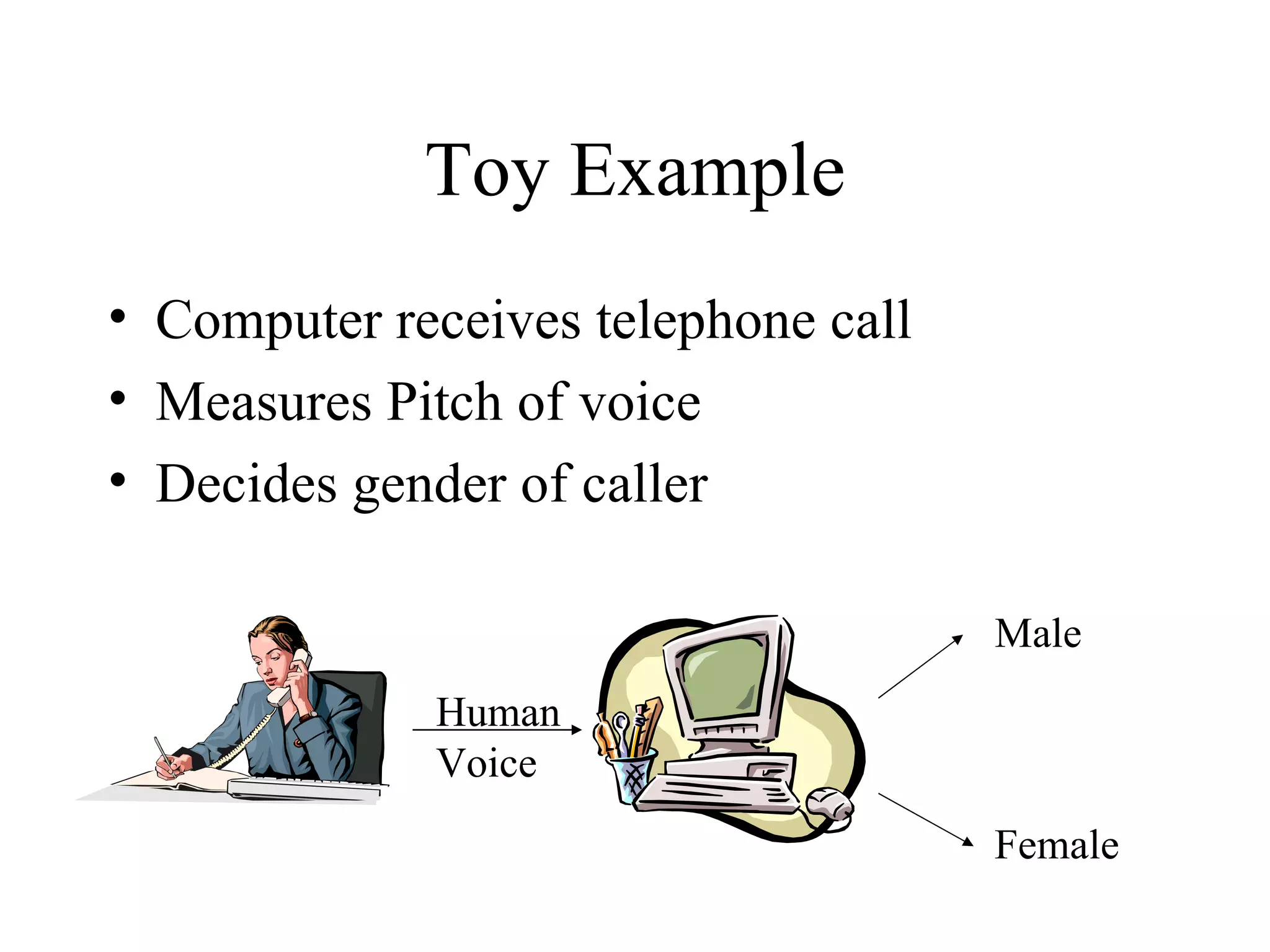
Toy Example Computer receives telephone call Measures Pitch of voice Decides gender of caller Human Voice Male Female
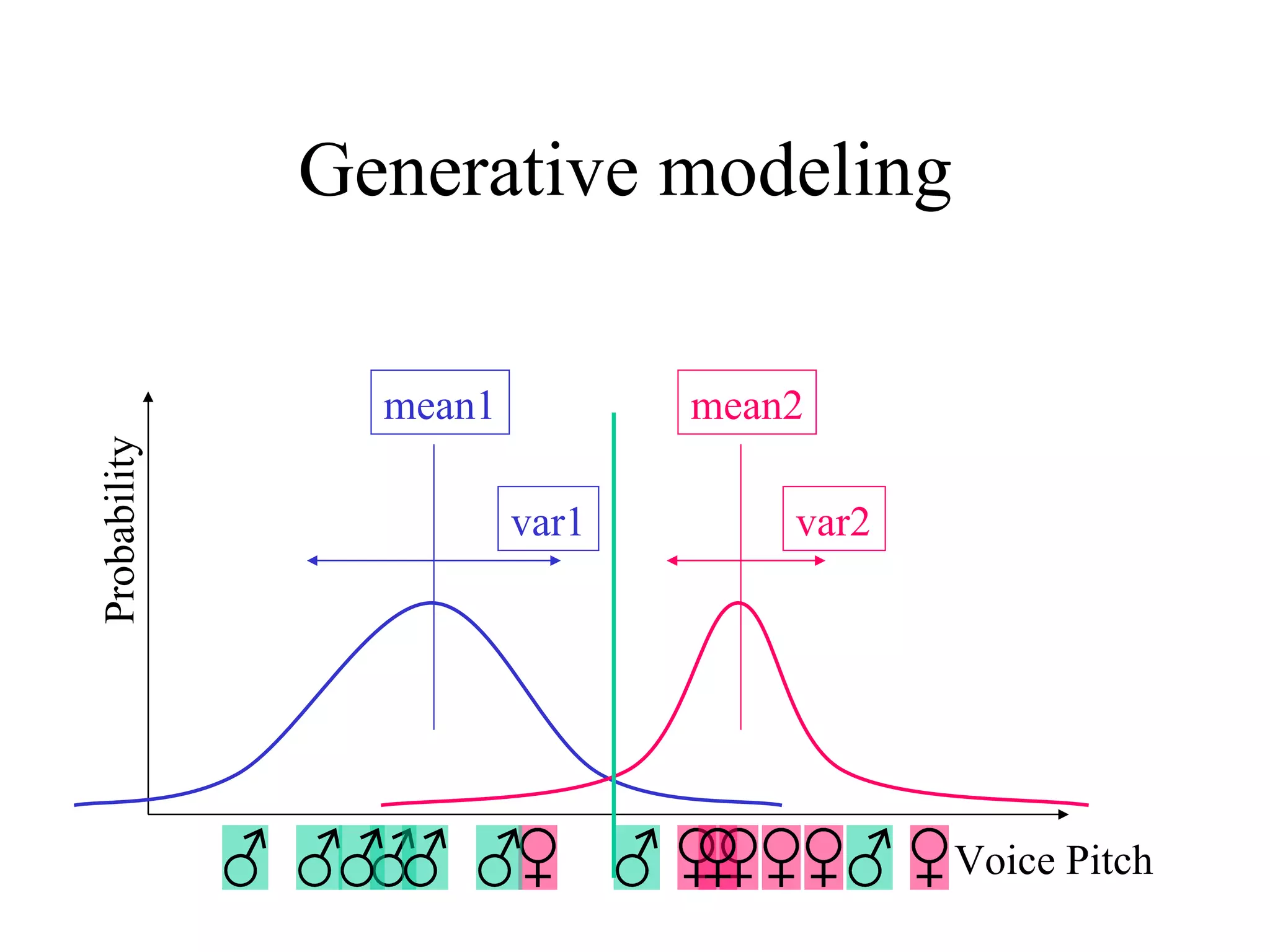
Generative modeling  Voice Pitch Probability mean1 var1 mean2 var2
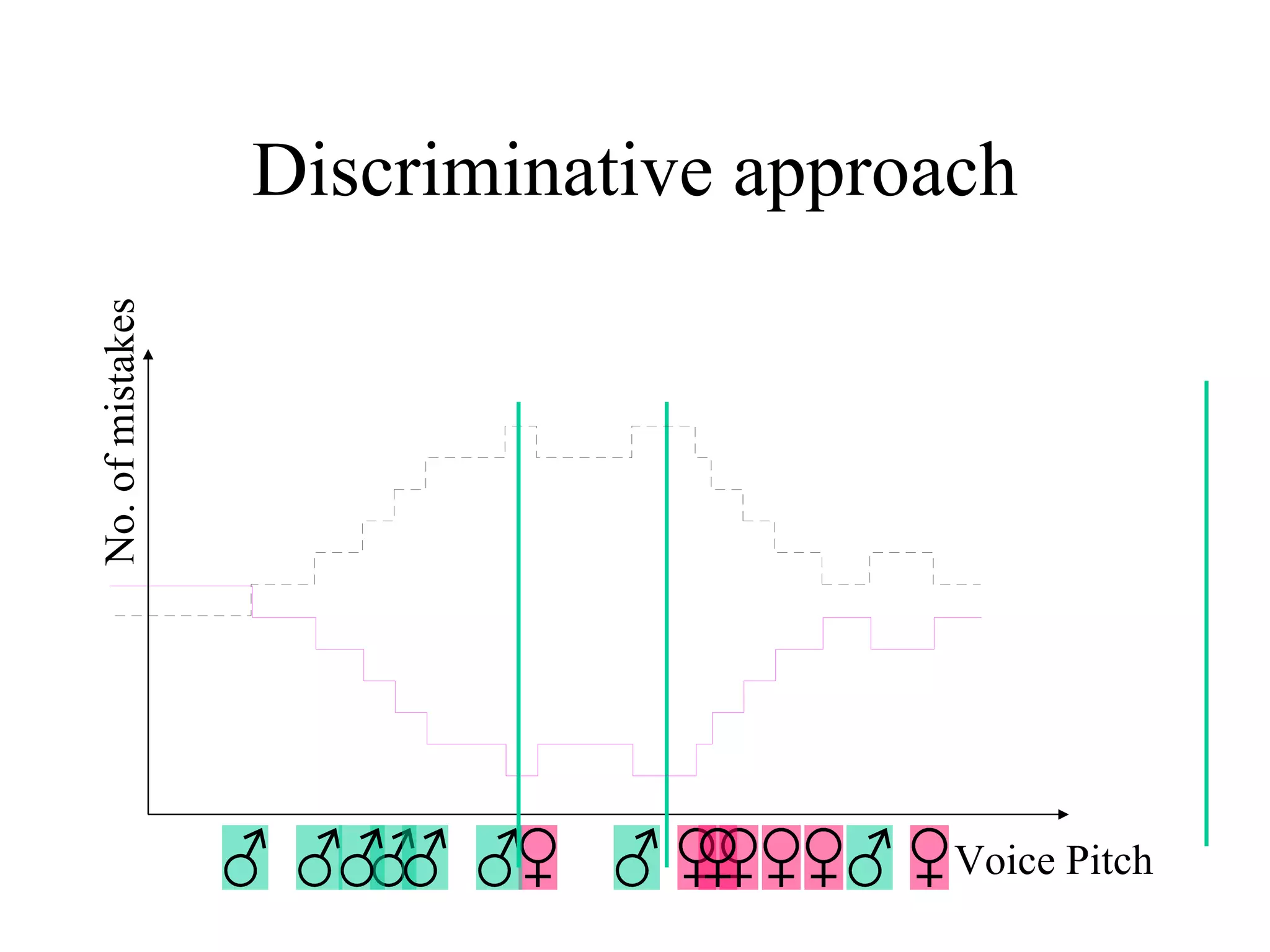
Discriminative approach Voice Pitch No. of mistakes
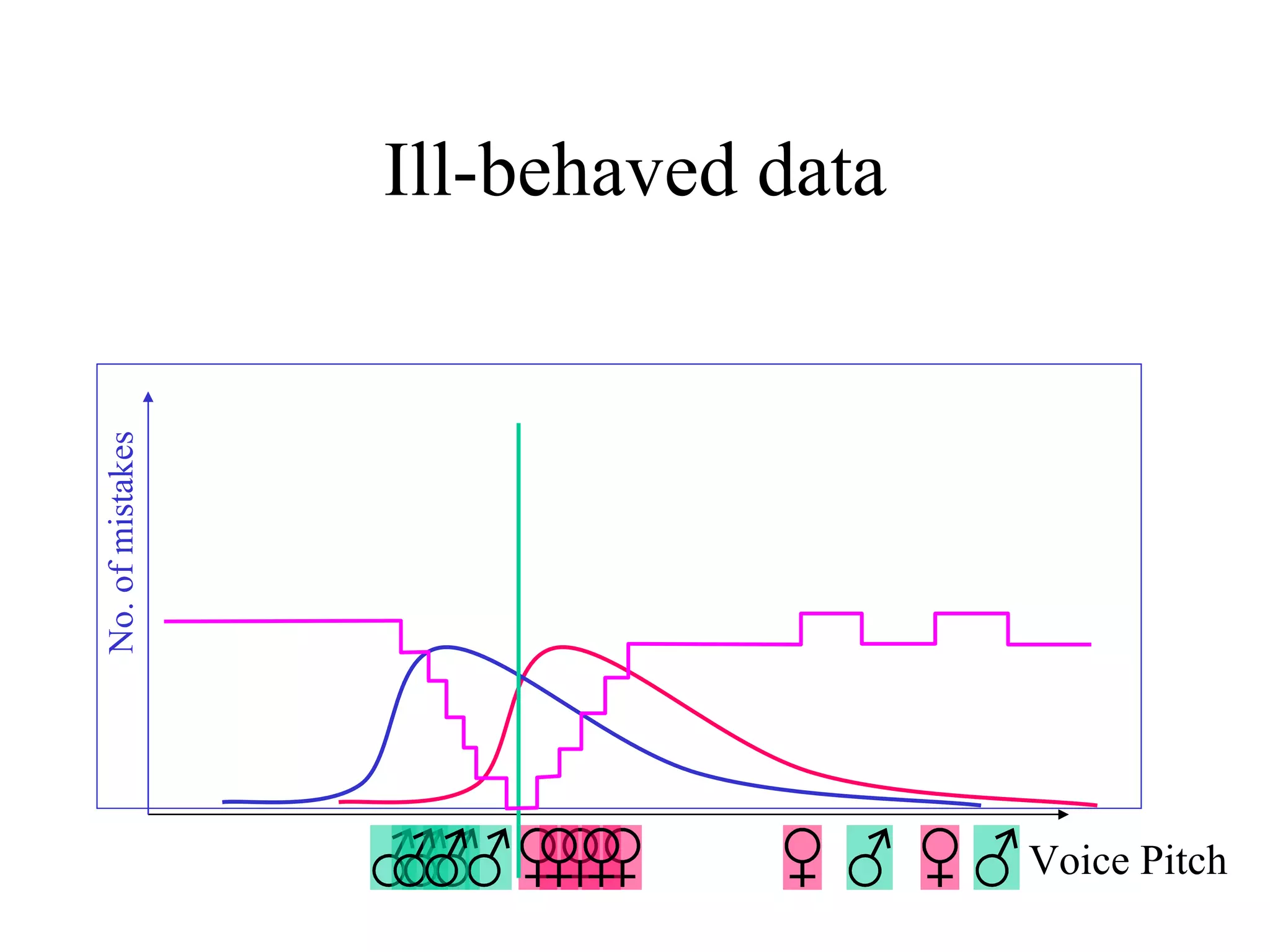
Ill-behaved data Voice Pitch Probability mean1 mean2 No. of mistakes
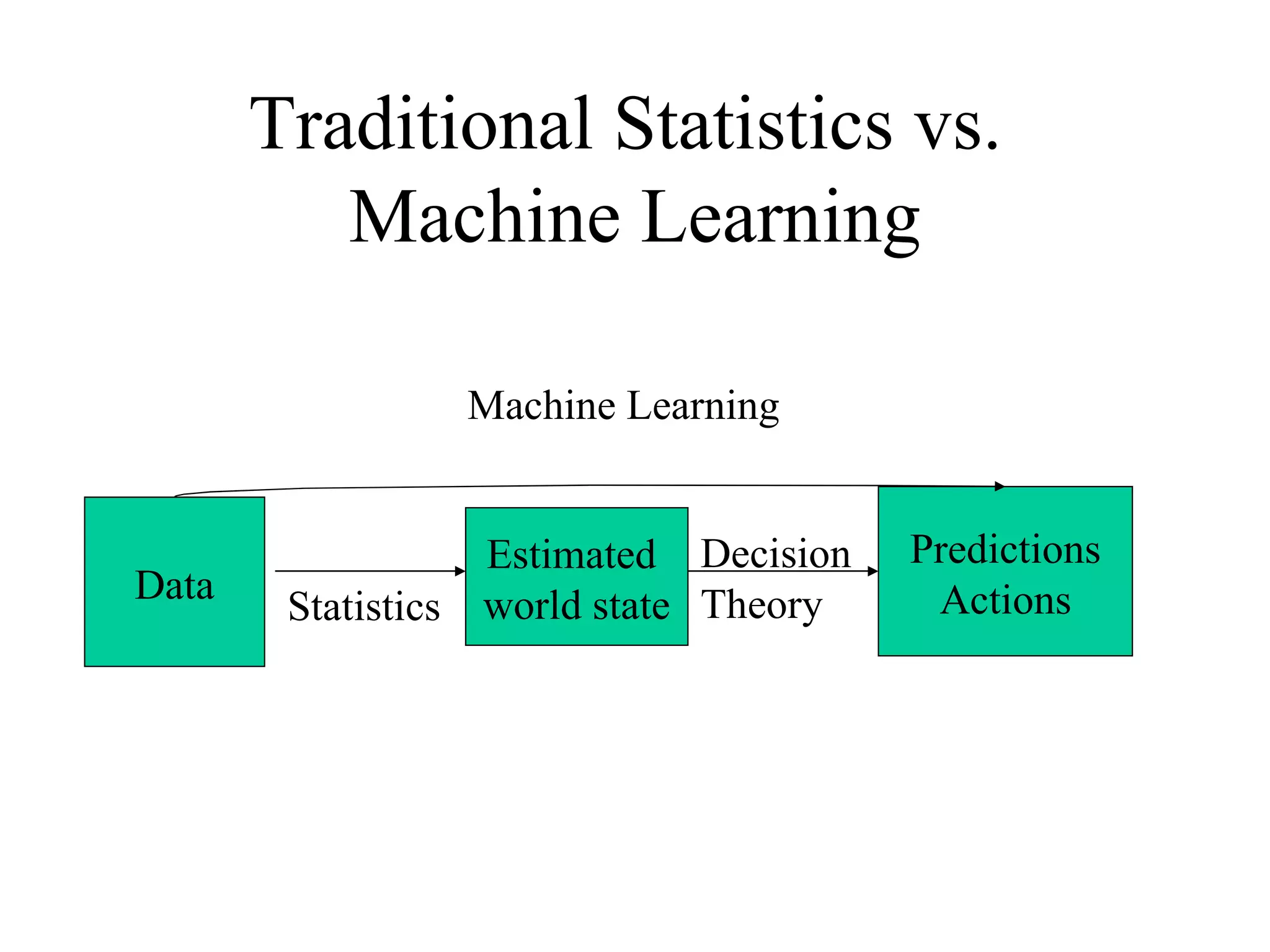
Traditional Statistics vs.  Machine Learning Data Estimated  world state Predictions Actions Statistics Decision  Theory Machine Learning
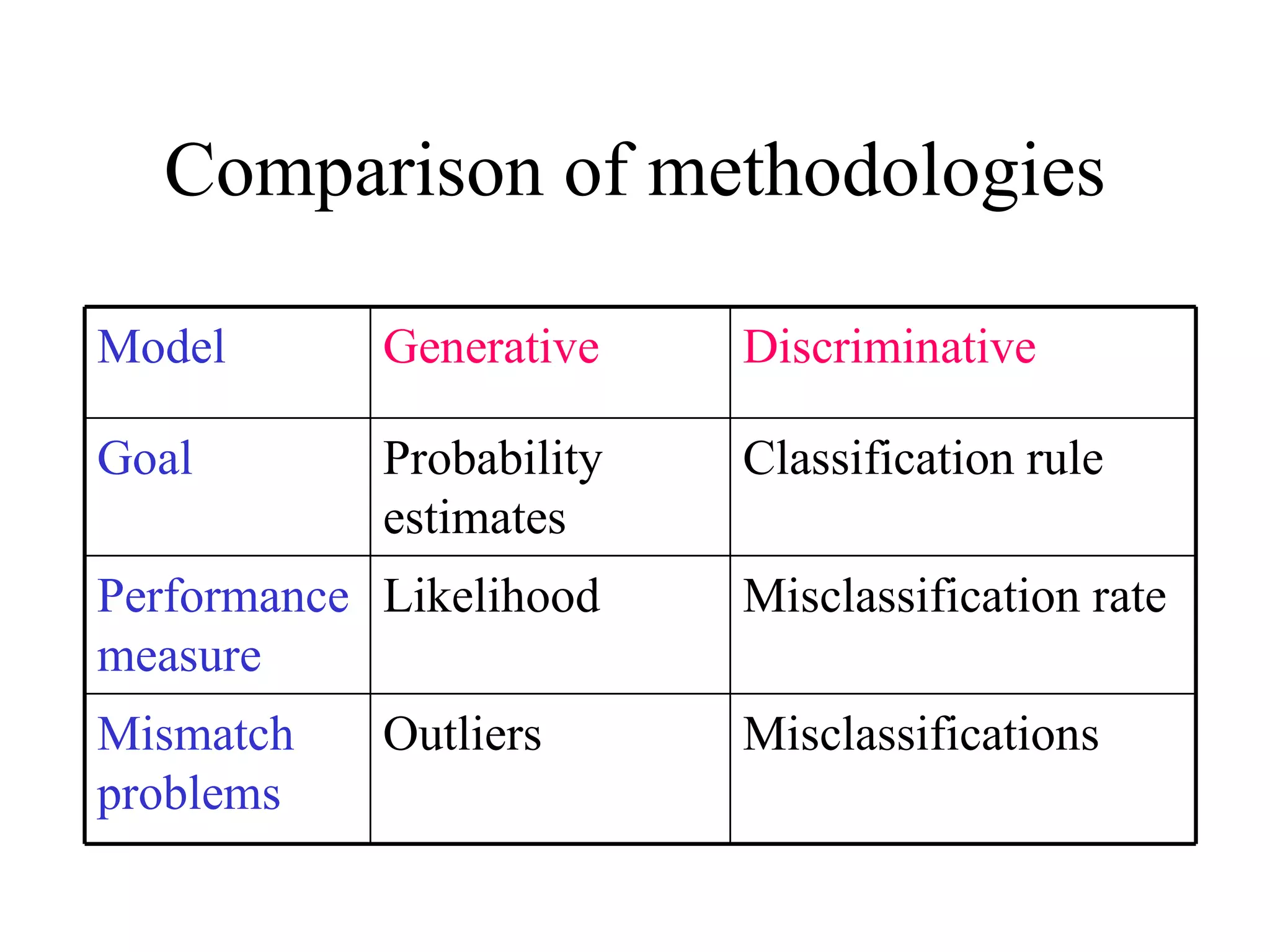
Comparison of methodologies Mismatch   problems Performance   measure Goal Model Misclassifications Outliers Misclassification rate Likelihood Classification rule Probability estimates Discriminative Generative
Boosting
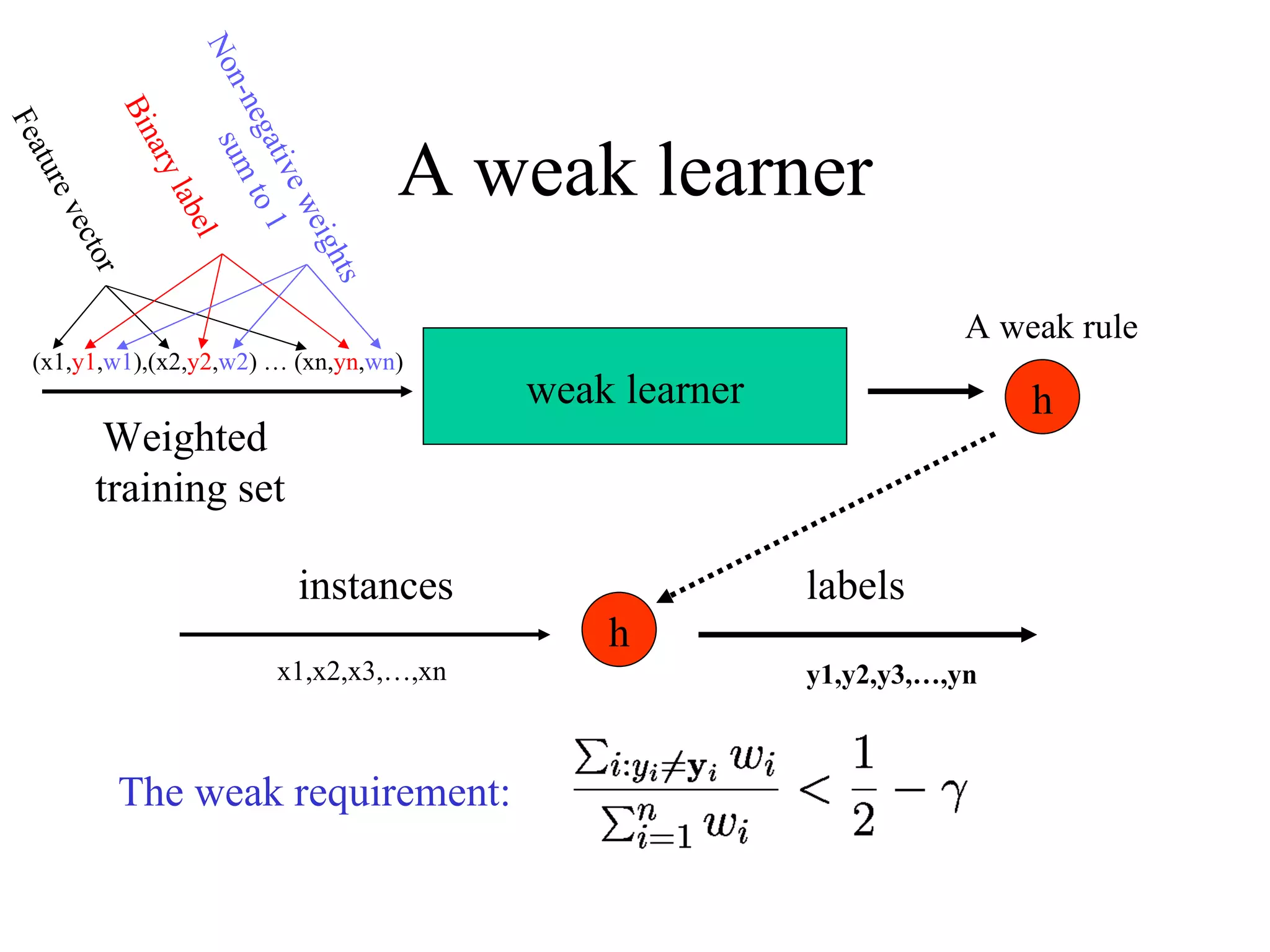
A weak learner weak learner A weak rule h h Weighted training set (x1, y1 , w1 ),(x2, y2 , w2 ) … (xn, yn , wn ) instances x1,x2,x3,…,xn labels y1,y2,y3,…,yn The weak requirement: Feature vector Binary label Non-negative weights sum to 1
The boosting process Final rule: Sign [   ] h1   h2   hT   weak learner h1 (x1,y1, 1/n ), … (xn,yn, 1/n ) weak learner h2 (x1,y1, w1 ), … (xn,yn, wn ) h3 (x1,y1, w1 ), … (xn,yn, wn ) h4 (x1,y1, w1 ), … (xn,yn, wn ) h5 (x1,y1, w1 ), … (xn,yn, wn ) h6 (x1,y1, w1 ), … (xn,yn, wn ) h7 (x1,y1, w1 ), … (xn,yn, wn ) h8 (x1,y1, w1 ), … (xn,yn, wn ) h9 (x1,y1, w1 ), … (xn,yn, wn ) hT (x1,y1, w1 ), … (xn,yn, wn )
Adaboost Binary labels  y  = -1,+1 margin ( x,y ) =  y  [  t  t  h t (x) ] P(x,y)  = (1/Z) exp (-margin(x,y)) Given  h t , we choose   t  to minimize  (x,y)  exp (-margin (x,y) )
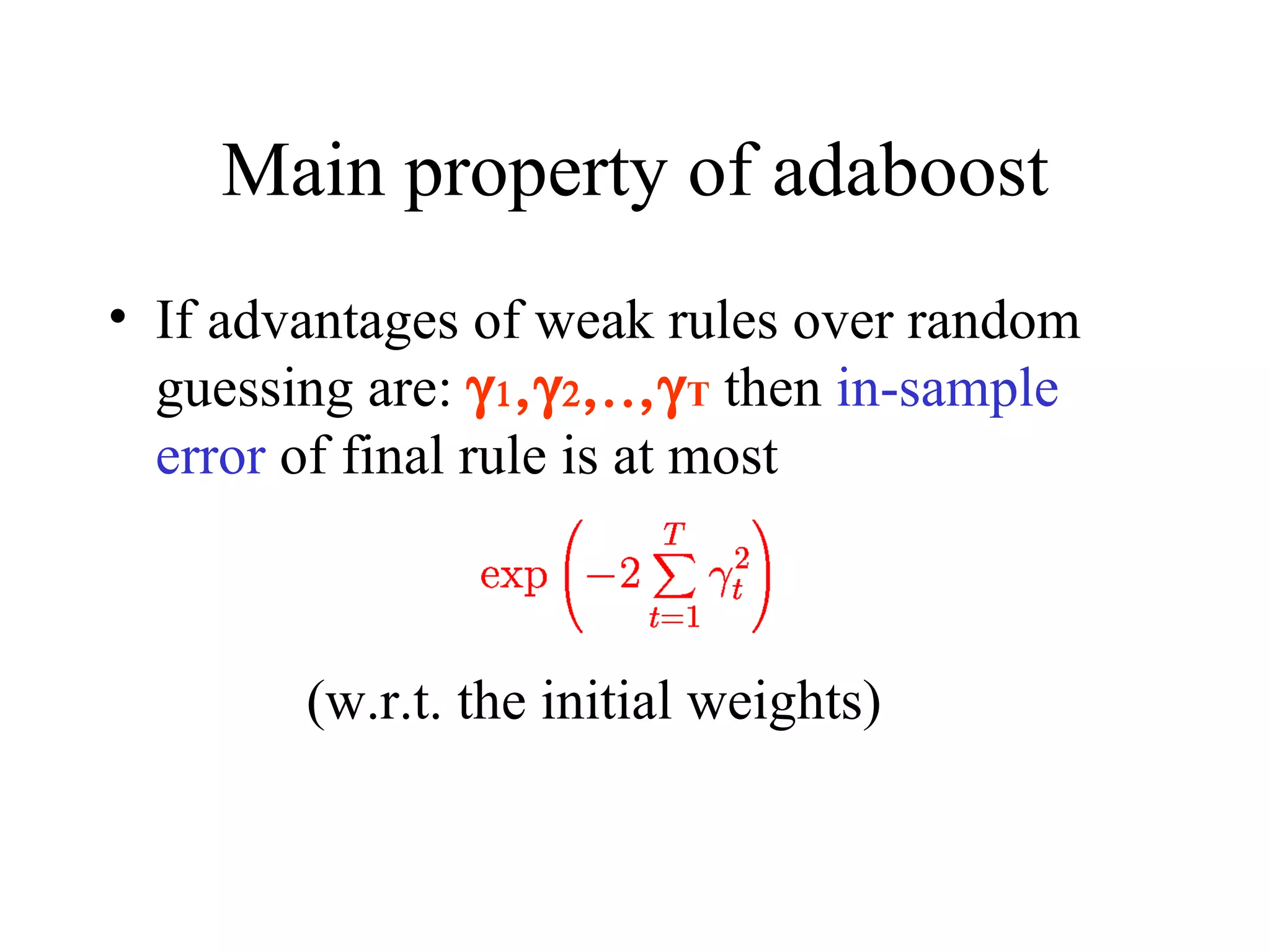
Main property of adaboost If advantages of weak rules over random guessing are:       T   then  in-sample error  of final rule is at most (w.r.t. the initial weights)
A demo www.cs.huji.ac.il/~yoavf/adabooost
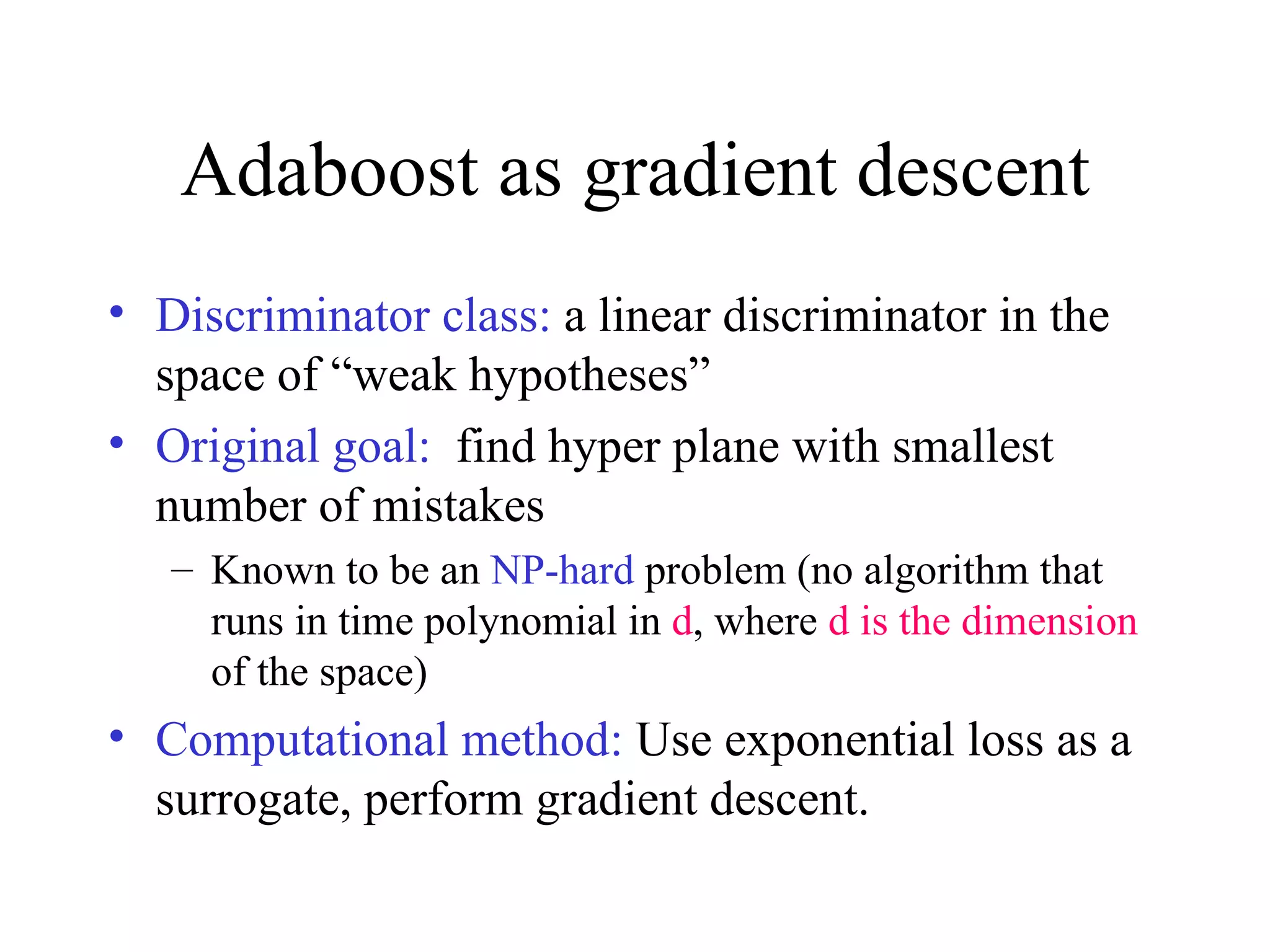
Adaboost as gradient descent Discriminator class:  a linear discriminator in the space of “weak hypotheses” Original goal:   find hyper plane with smallest number of mistakes  Known to be an  NP-hard  problem (no algorithm that runs in time polynomial in  d , where  d is the dimension  of the space) Computational method:  Use exponential loss as a surrogate, perform gradient descent.
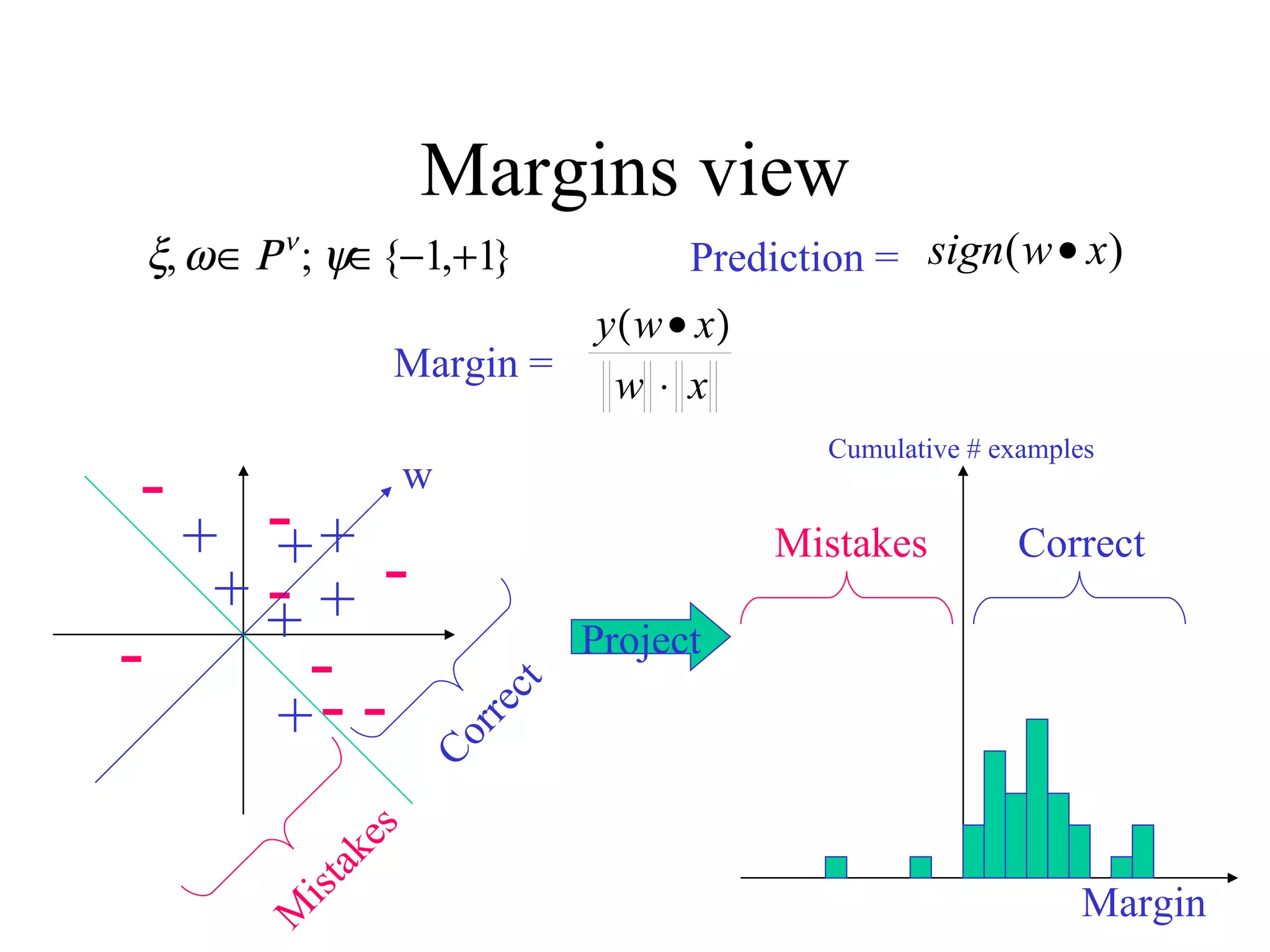
Margins view Project Prediction =  + - + + + + + + - - - - - - - w Correct Mistakes Margin Cumulative # examples Mistakes Correct Margin =
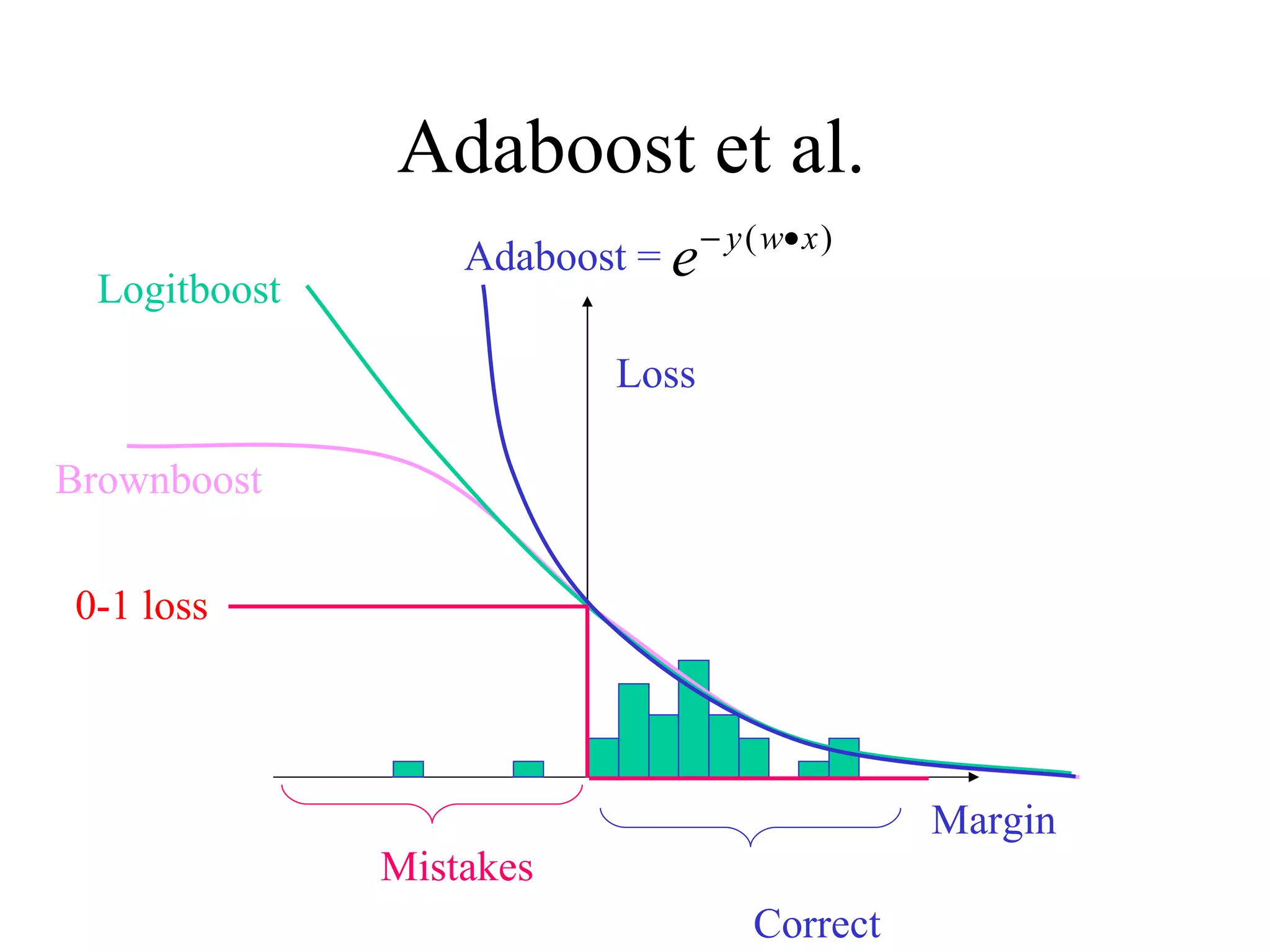
Adaboost et al. Loss Correct Margin Mistakes Brownboost Logitboost Adaboost = 0-1 loss
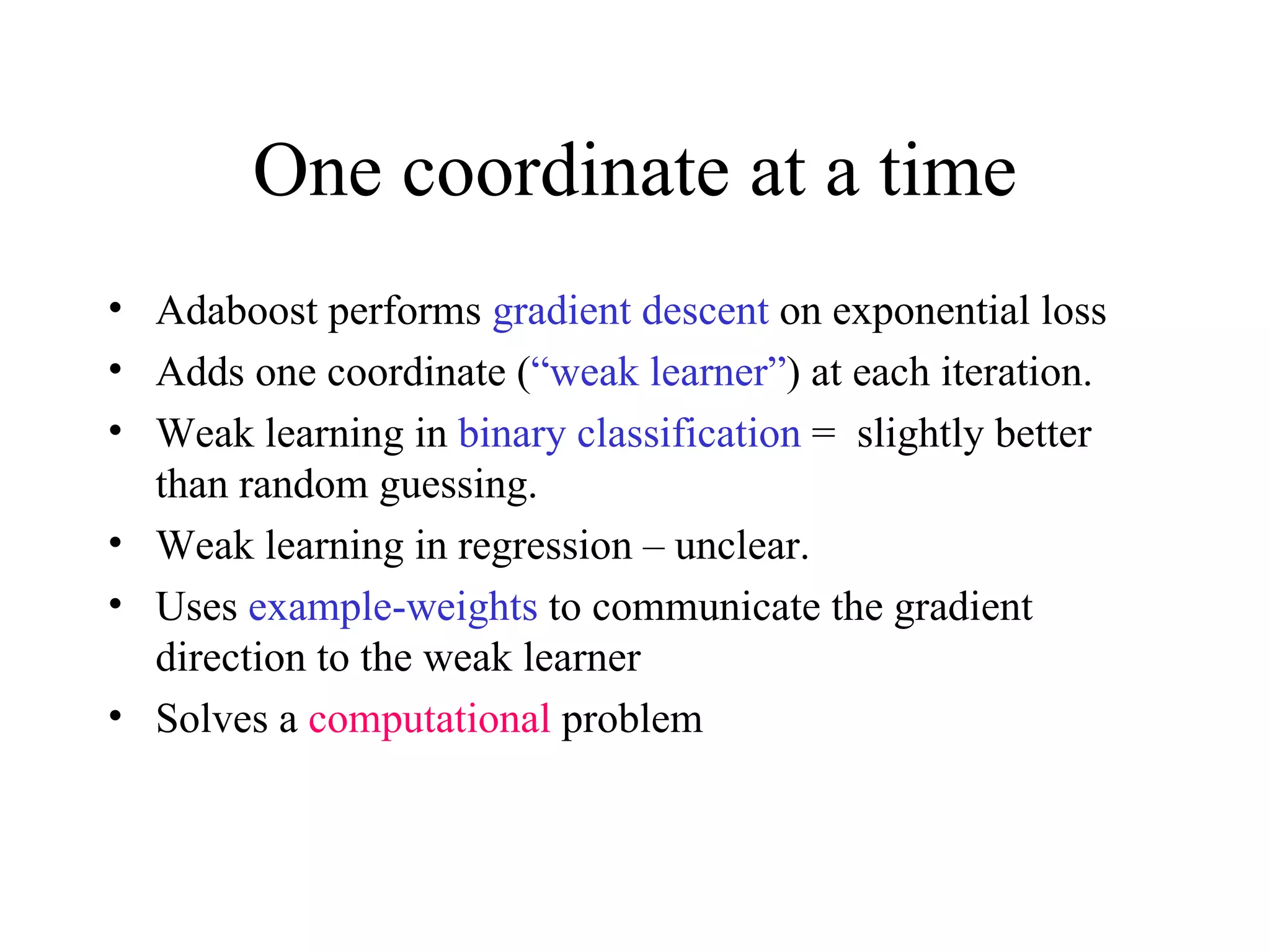
One coordinate at a time Adaboost performs  gradient descent  on exponential loss Adds one coordinate ( “weak learner” ) at each iteration. Weak learning in  binary classification  =  slightly better than random guessing.  Weak learning in regression – unclear. Uses  example-weights  to communicate the gradient direction to the weak learner Solves a  computational  problem
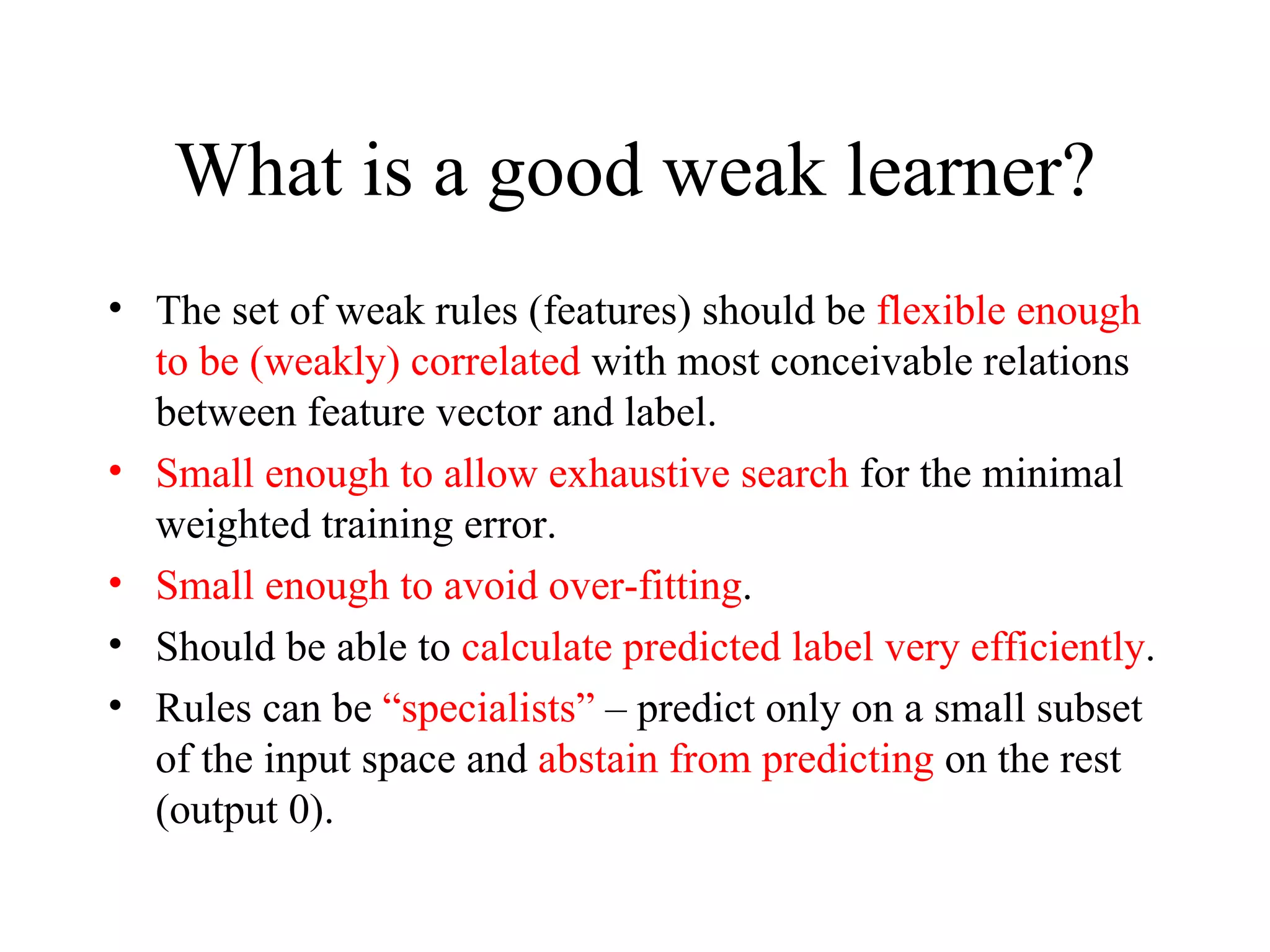
What is a good weak learner? The set of weak rules (features) should be  flexible enough to be (weakly) correlated  with most conceivable relations between feature vector and label. Small enough to allow exhaustive search  for the minimal weighted training error. Small enough to avoid over-fitting . Should be able to  calculate predicted label very efficiently . Rules can be  “specialists”  – predict only on a small subset of the input space and  abstain from predicting  on the rest (output 0).
Alternating Trees Joint work with Llew Mason
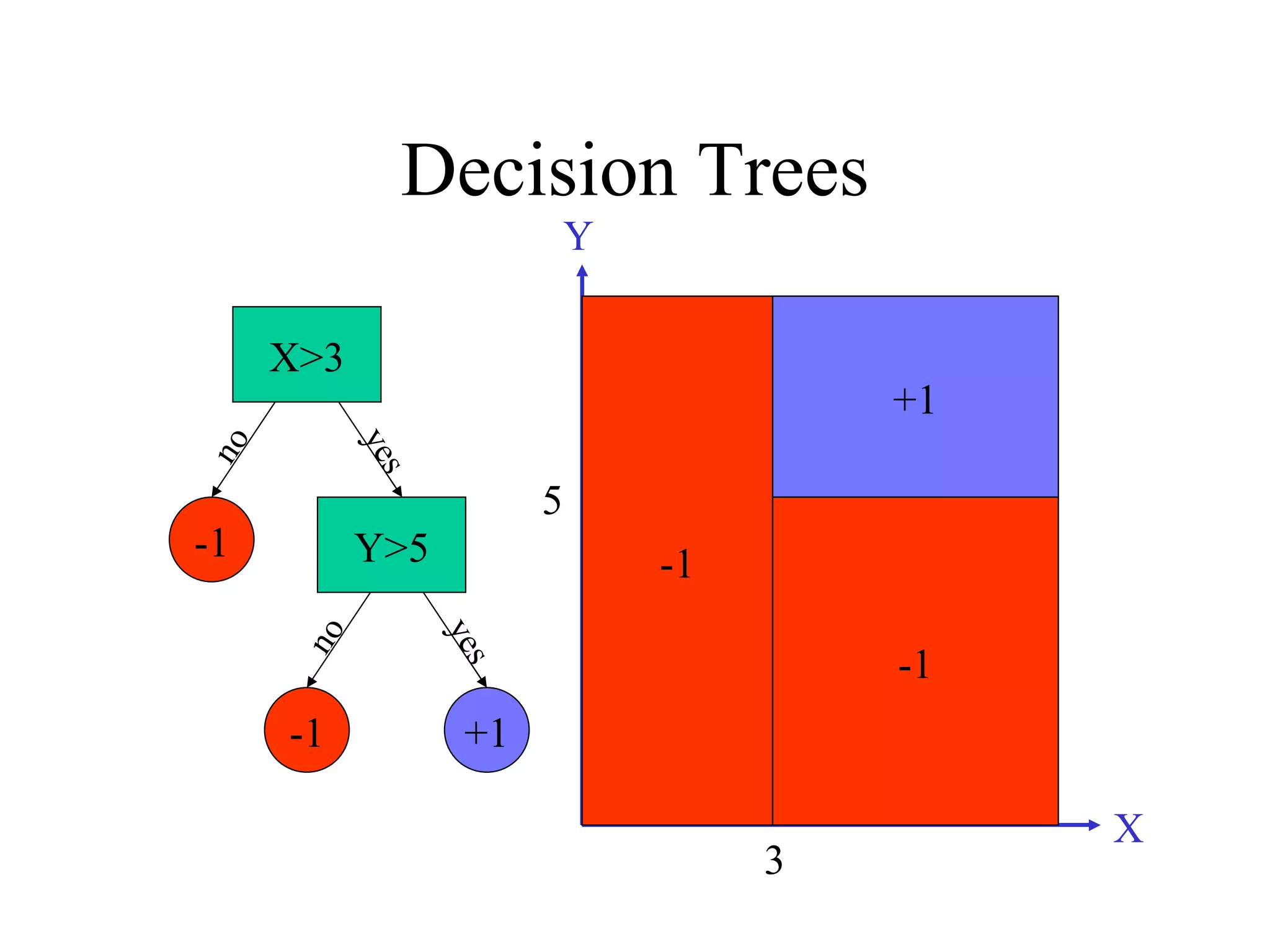
Decision Trees X>3 Y>5 -1 +1 -1 +1 -1 -1 no yes yes no X Y 3 5
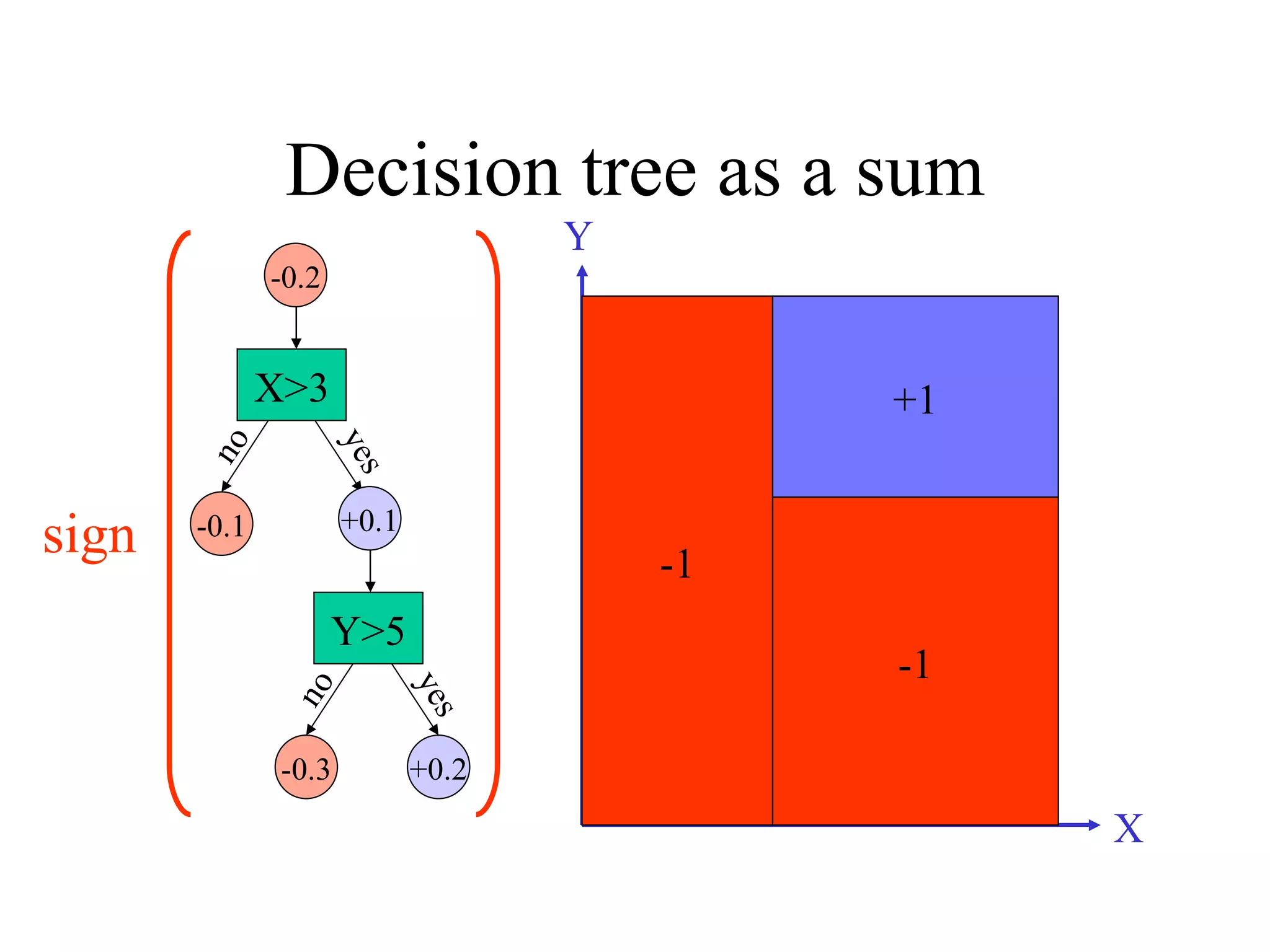
Decision tree as a sum -0.2 -0.2 X Y Y>5 +0.2 -0.3 yes no X>3 -0.1 no yes +0.1 +0.1 -0.1 +0.2 -0.3 +1 -1 -1 sign
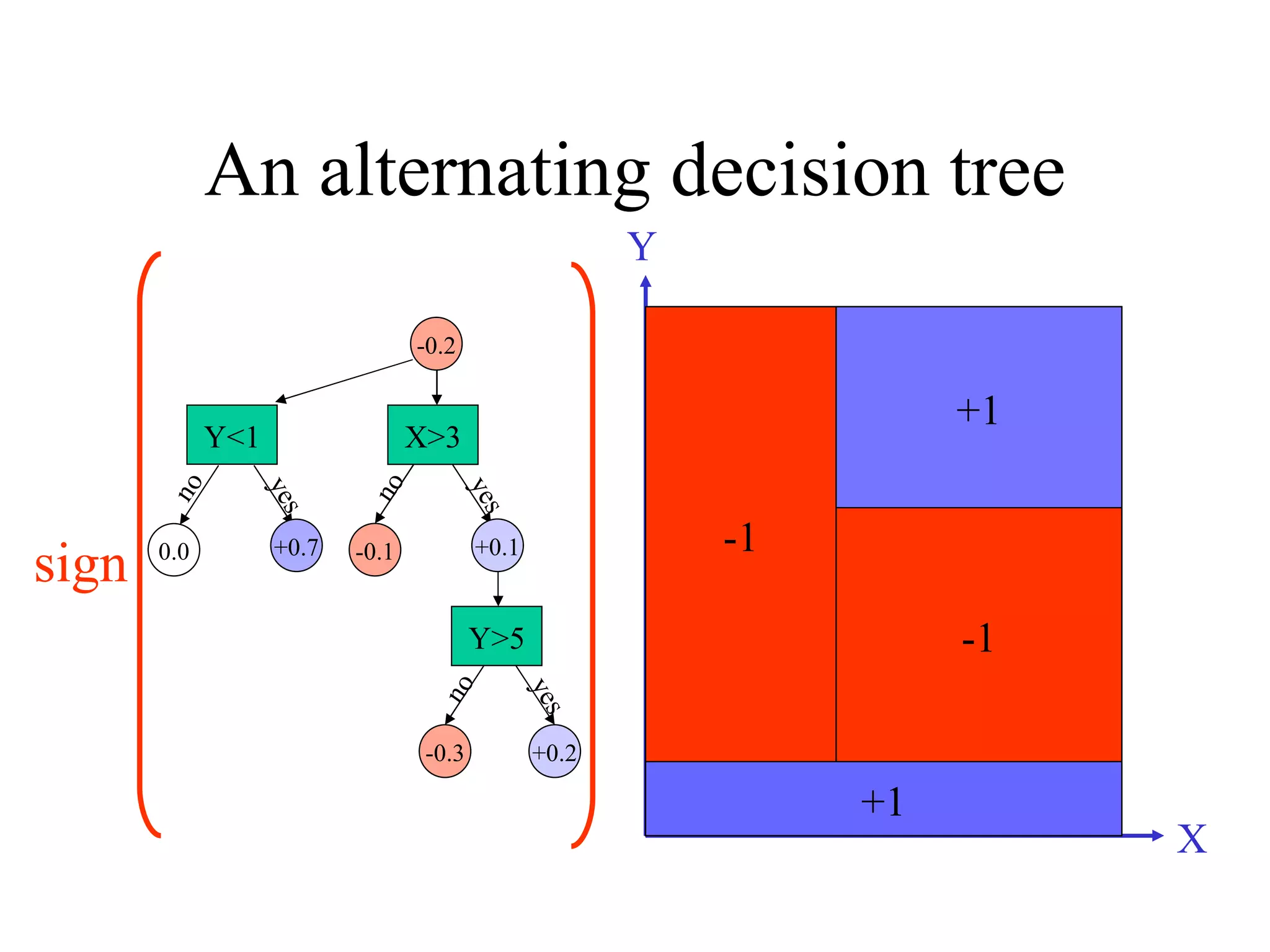
An alternating decision tree -0.2 +0.7 X Y +0.1 -0.1 +0.2 -0.3 sign Y>5 +0.2 -0.3 yes no X>3 -0.1 no yes +0.1 Y<1 0.0 no yes +0.7 +1 -1 -1 +1
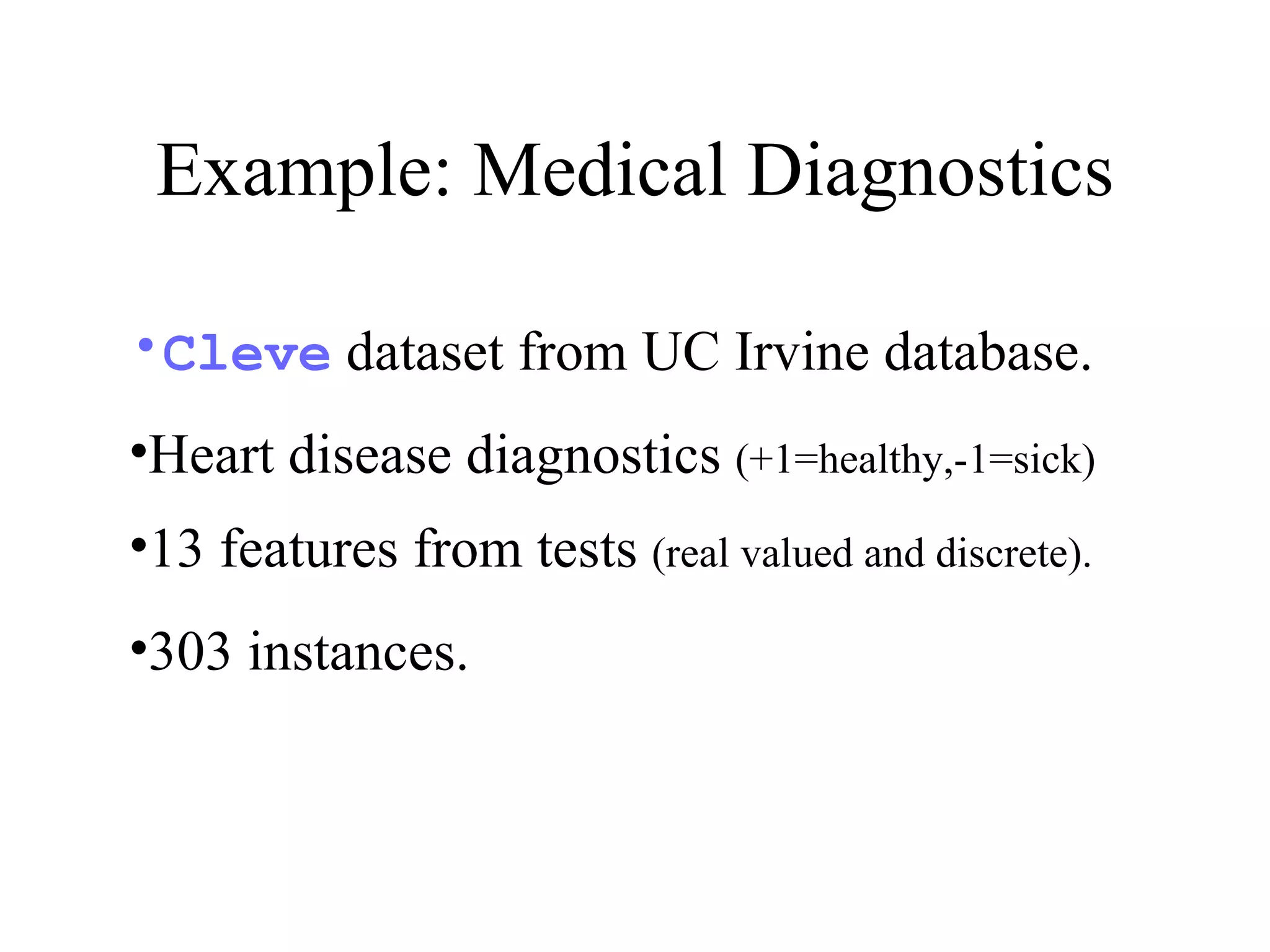
Example: Medical Diagnostics Cleve  dataset from UC Irvine database. Heart disease diagnostics  (+1=healthy,-1=sick)   13 features from tests  (real valued and discrete). 303 instances.
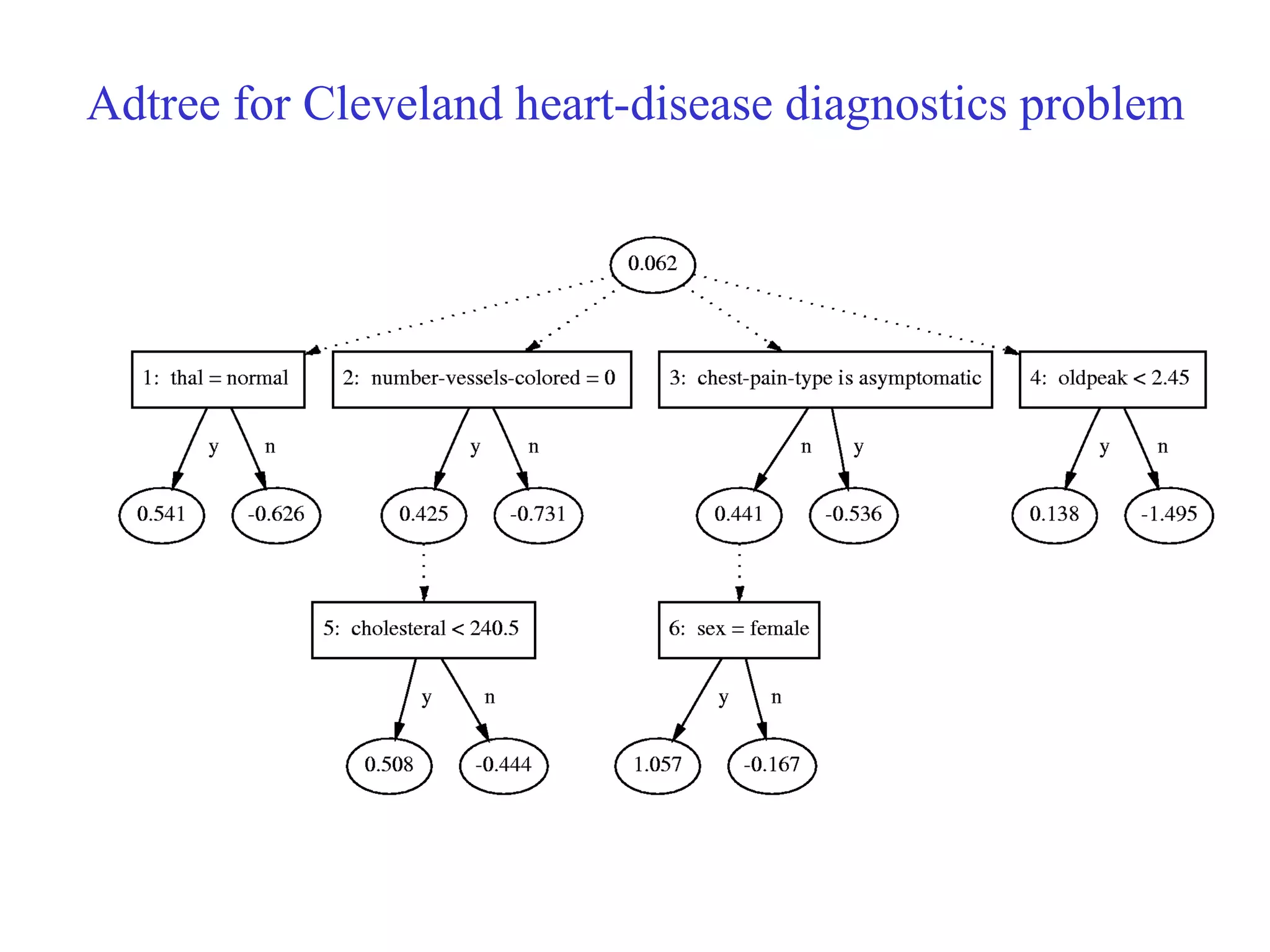
Adtree for Cleveland heart-disease diagnostics problem
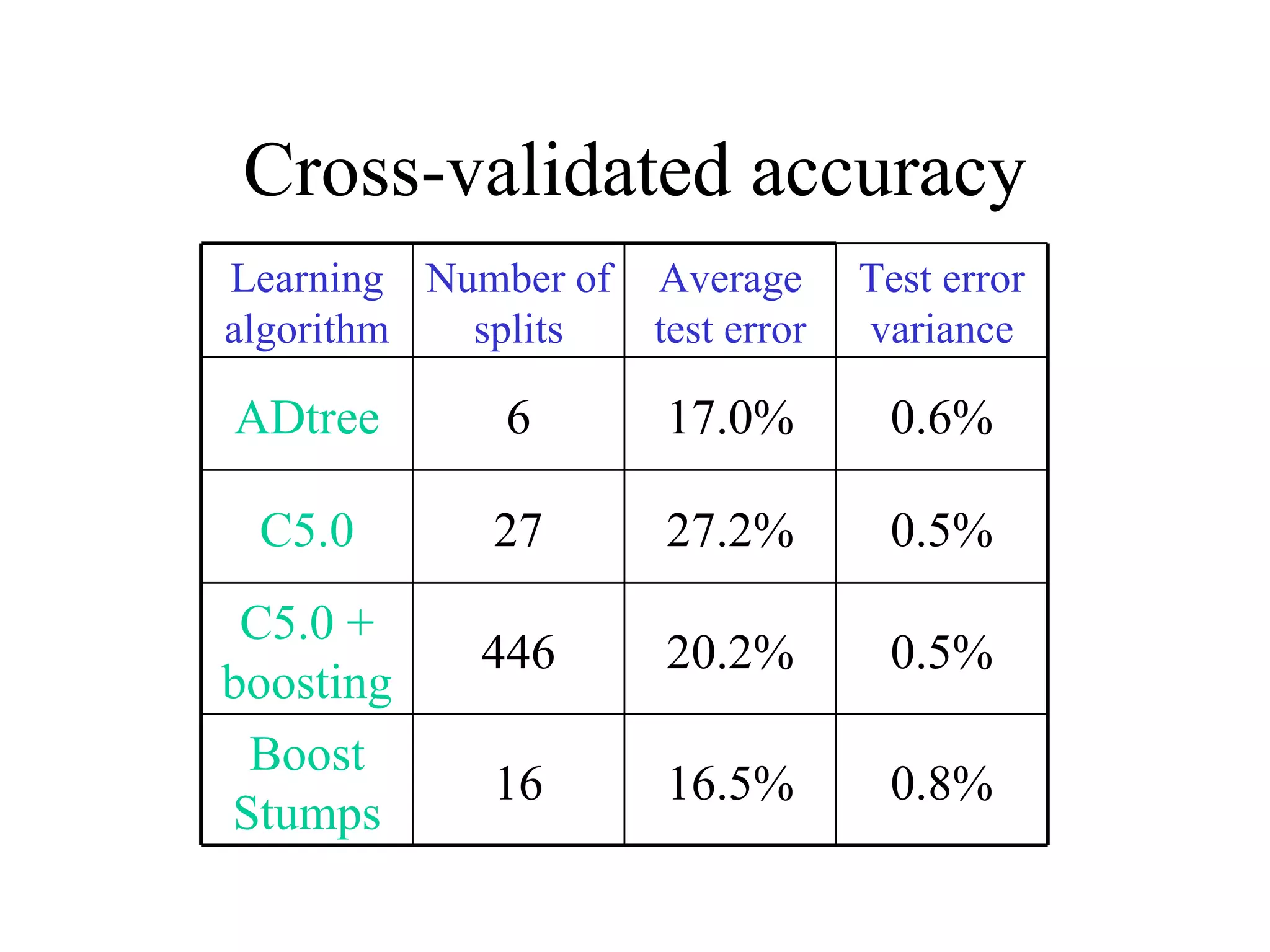
Cross-validated accuracy 0.8% 16.5% 16 Boost Stumps 0.5% 20.2% 446 C5.0 + boosting 0.5% 27.2% 27 C5.0 0.6% 17.0% 6 ADtree Test error variance Average test error Number of splits Learning algorithm
Boosting and over-fitting
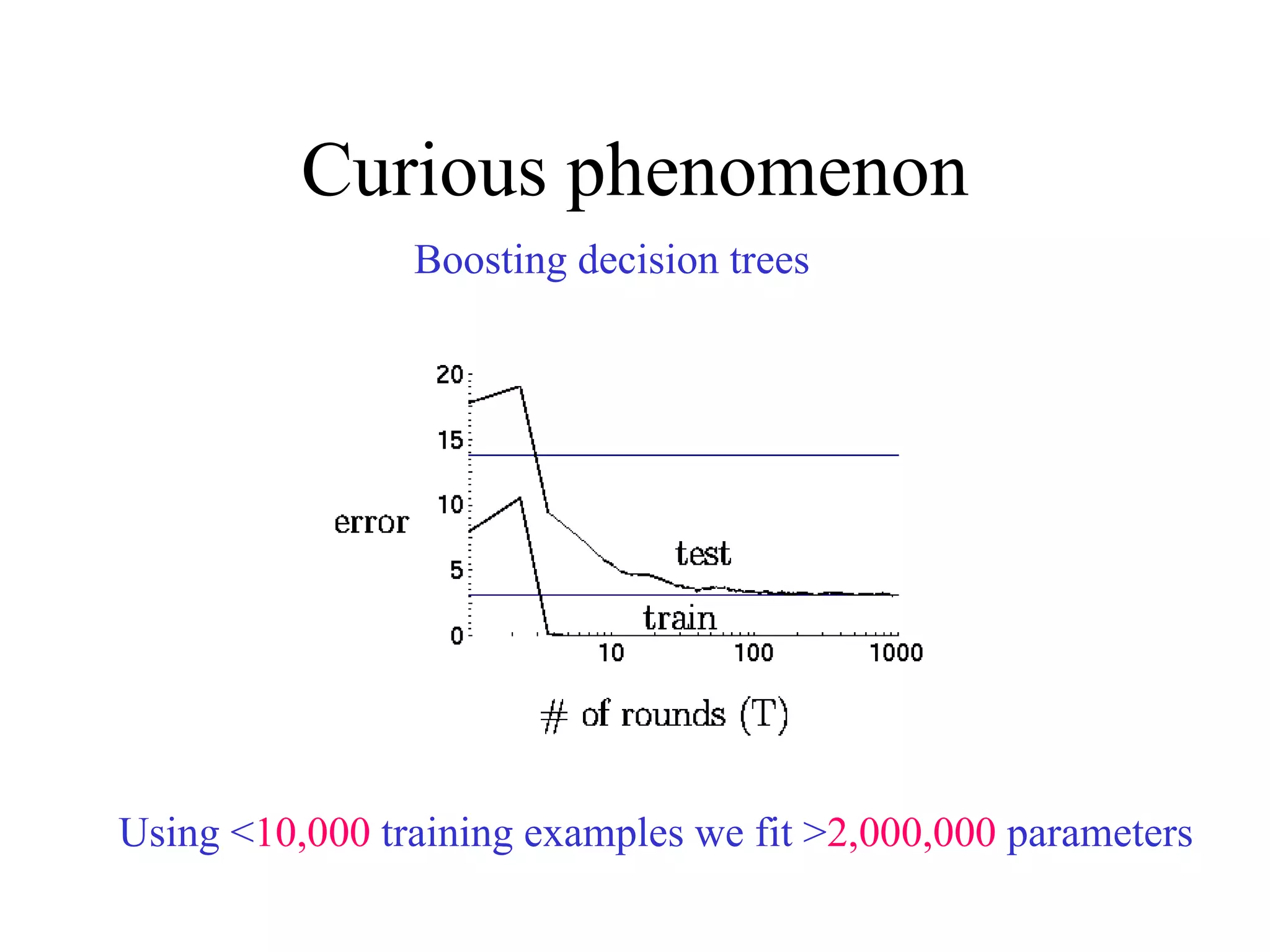
Curious phenomenon Boosting decision trees Using < 10,000  training examples we fit > 2,000,000  parameters
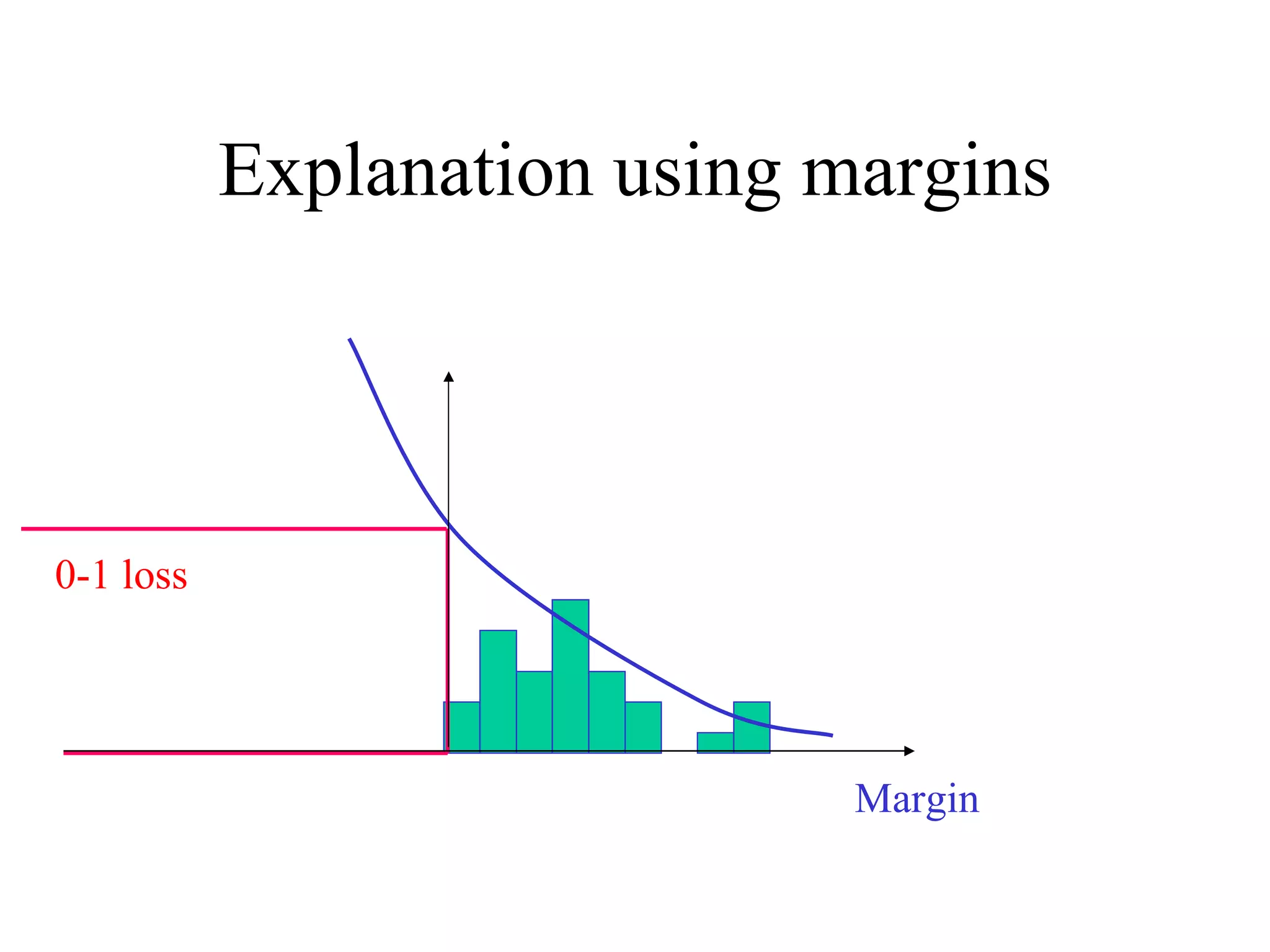
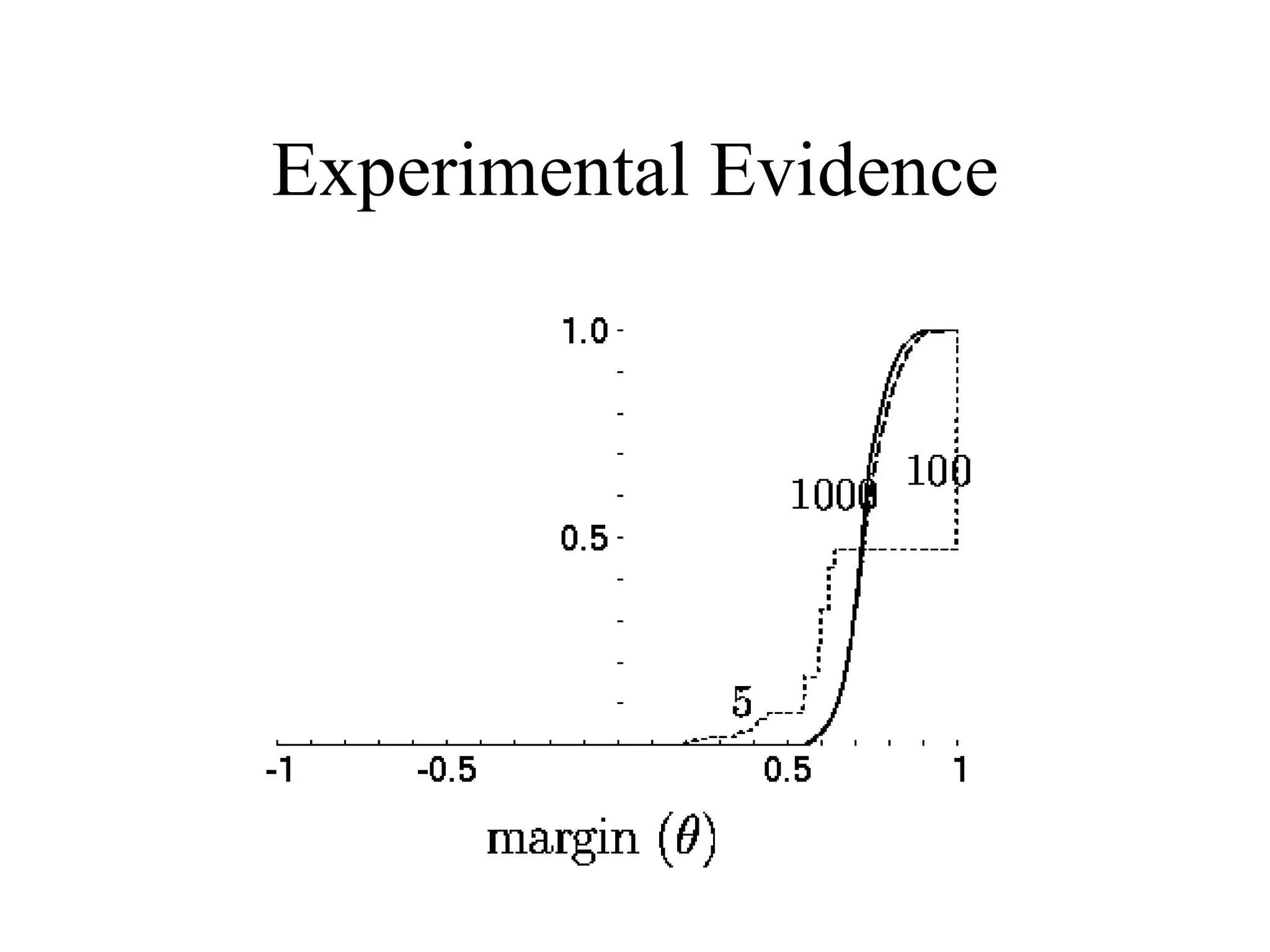
Explanation using margins Margin 0-1 loss
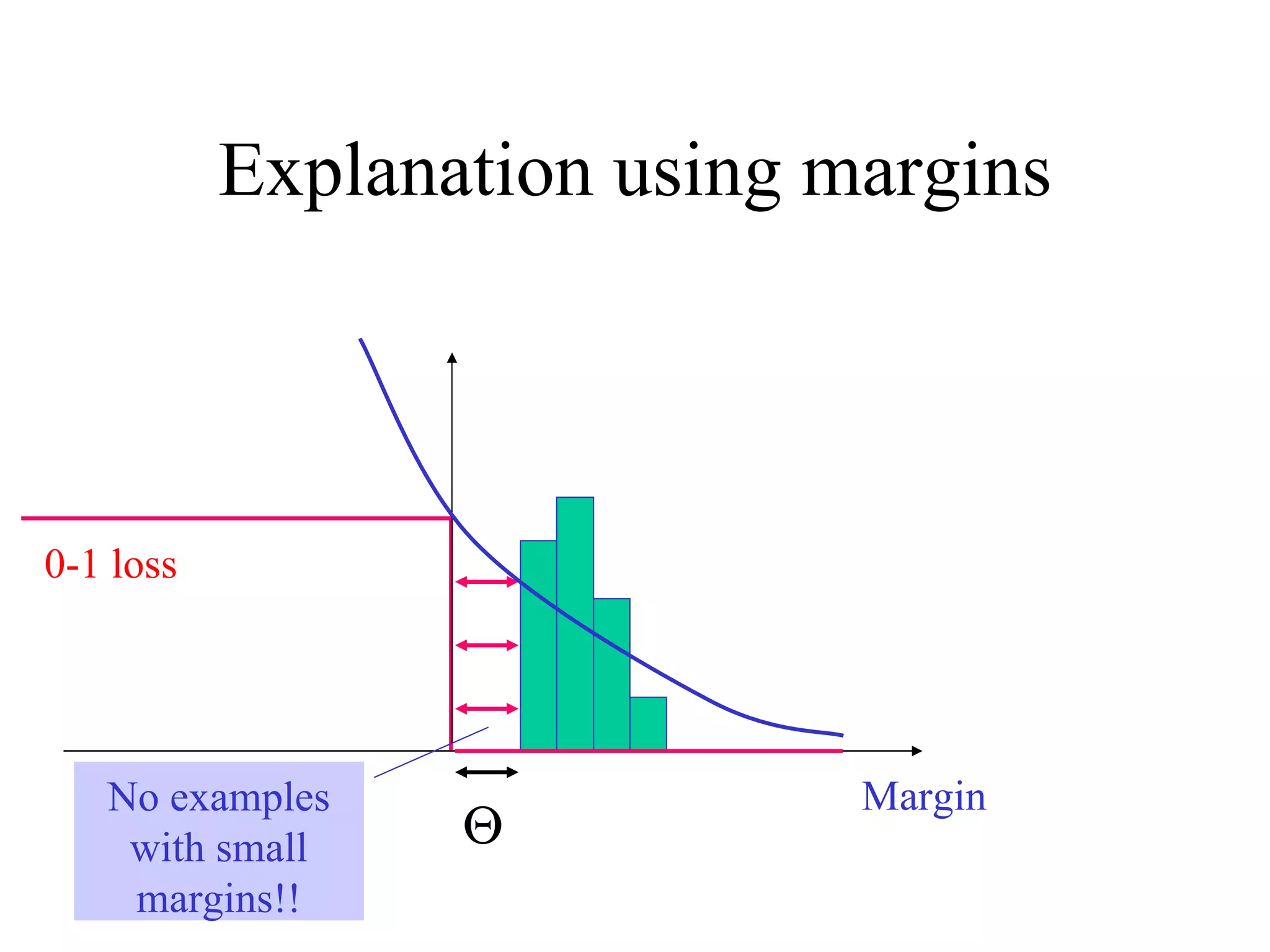
Explanation using margins Margin 0-1 loss No examples with small margins!!
Experimental Evidence
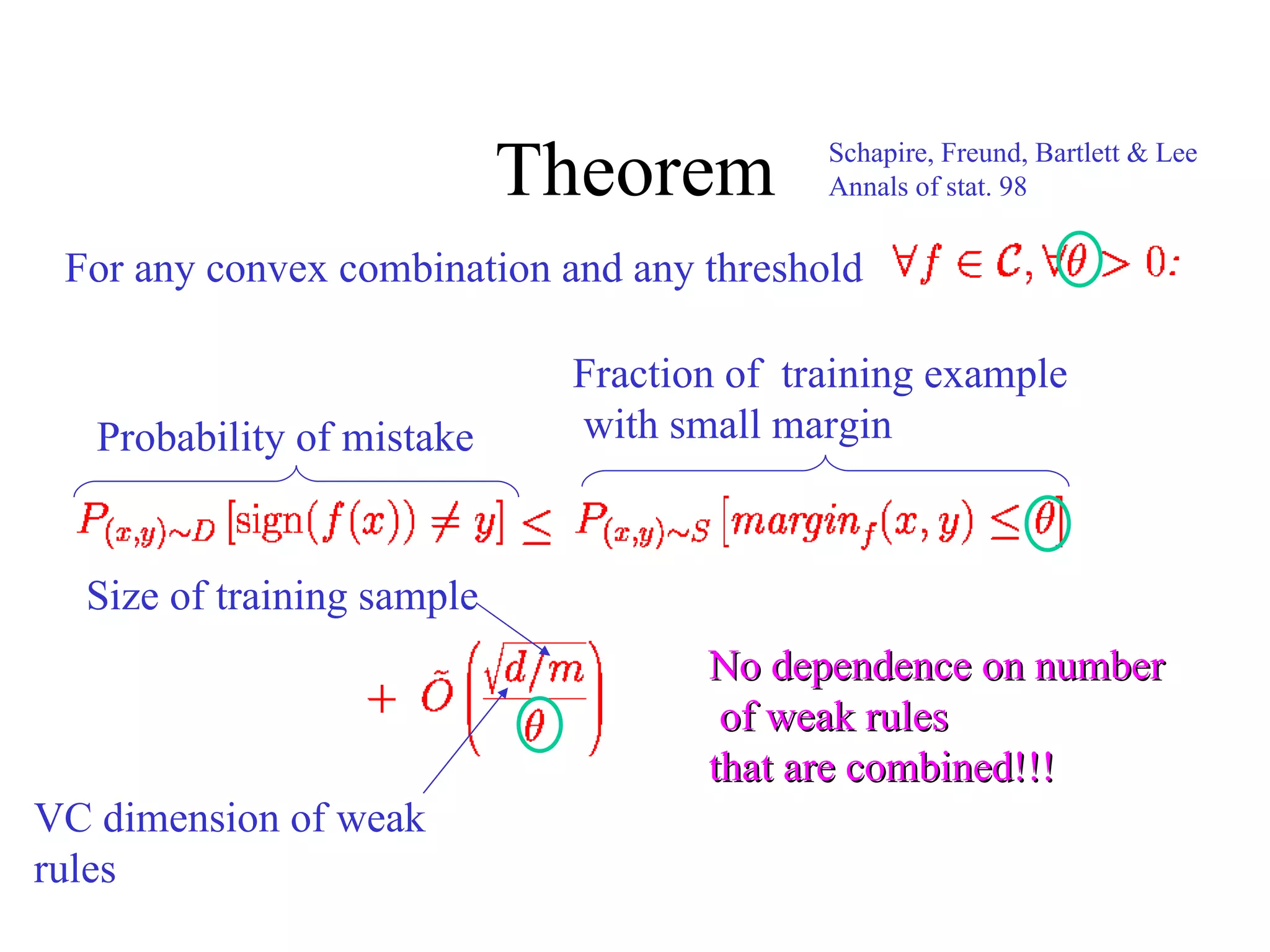
Theorem For any convex combination and any threshold No dependence on number of weak rules  that are combined!!! Schapire, Freund, Bartlett & Lee Annals of stat. 98 Probability of mistake Fraction of  training example with small margin Size of training sample VC dimension of weak rules
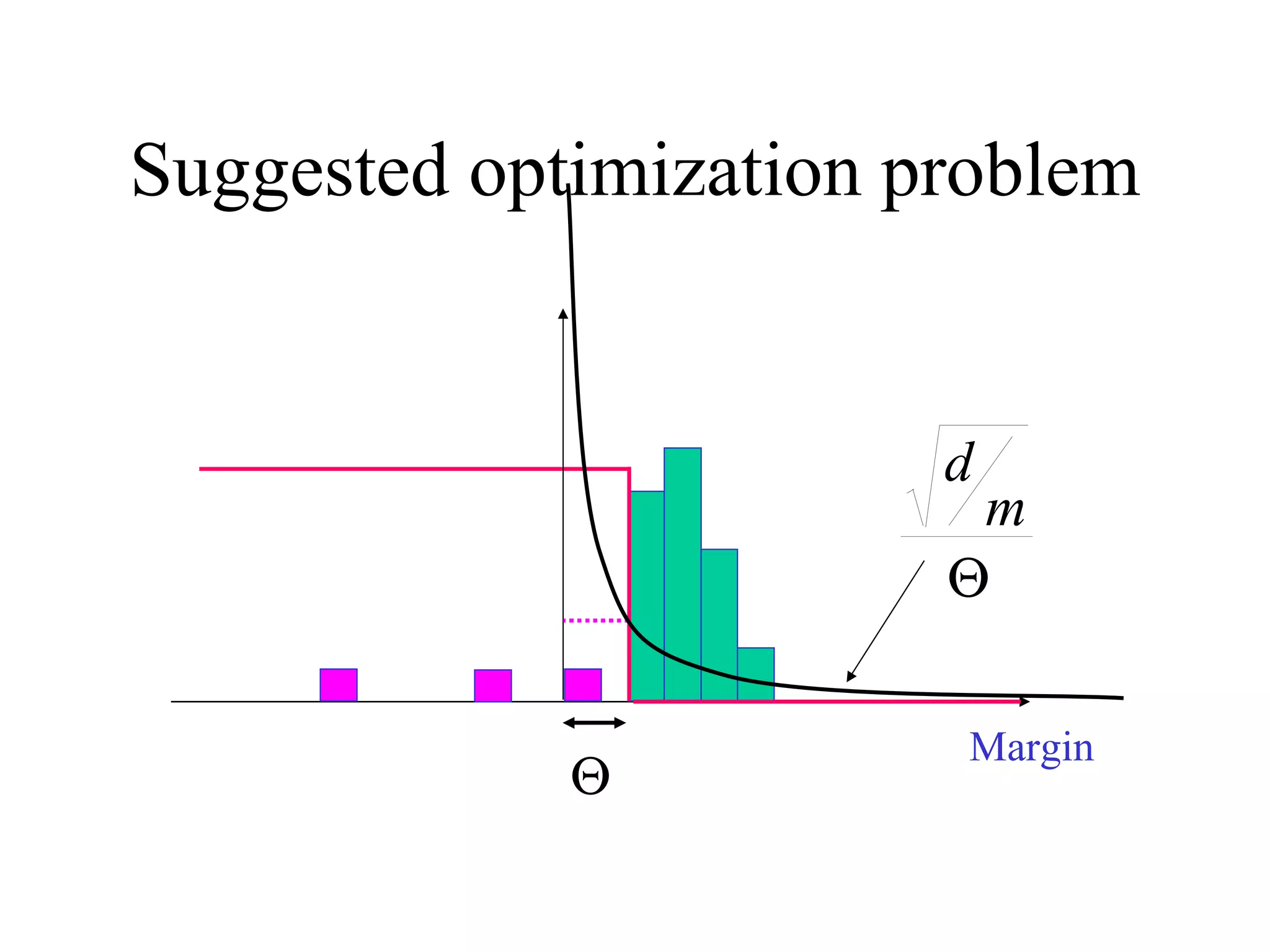
Suggested optimization problem Margin
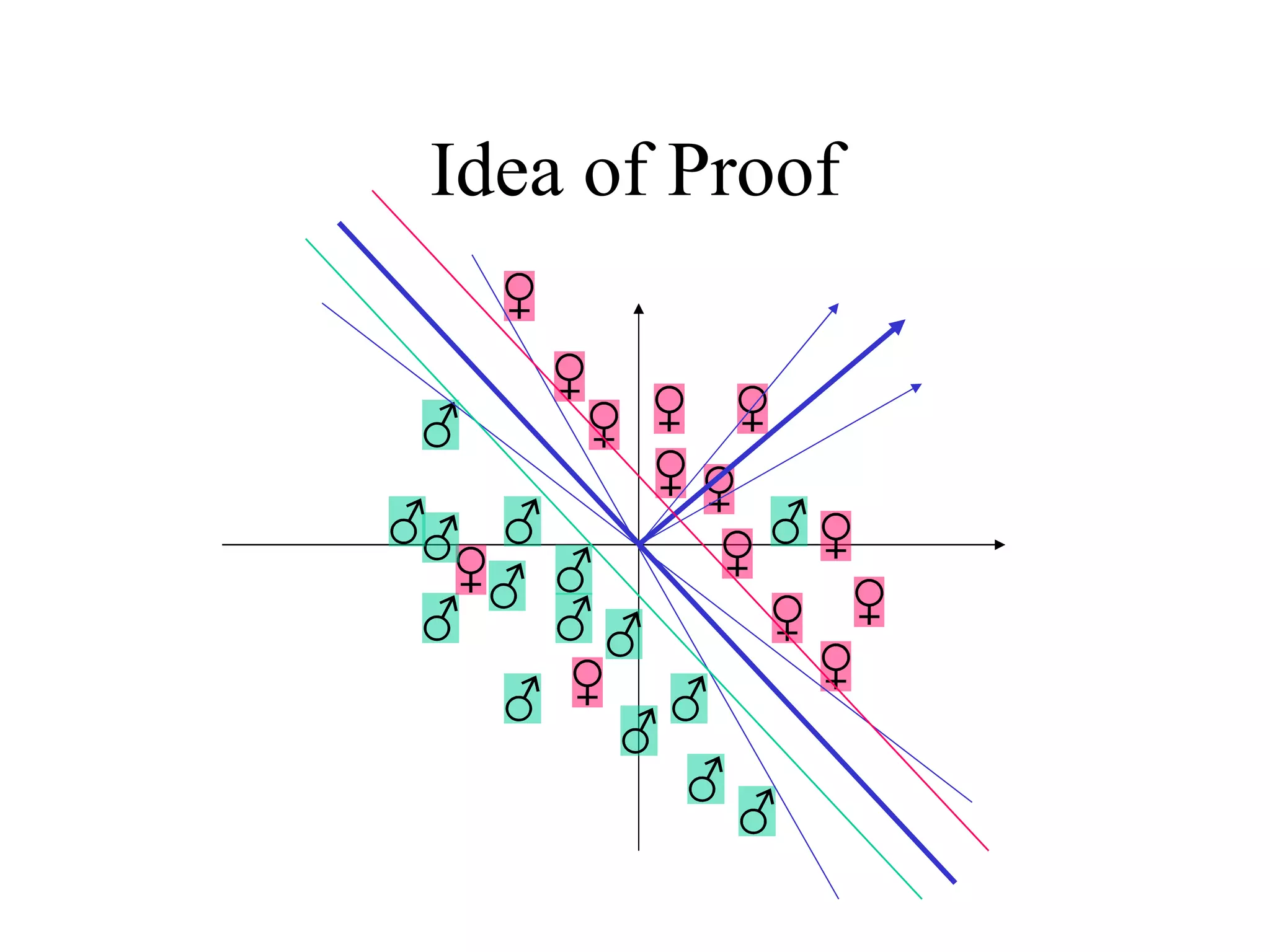
Idea of Proof
Applications
Applications of Boosting Academic research Applied research Commercial deployment
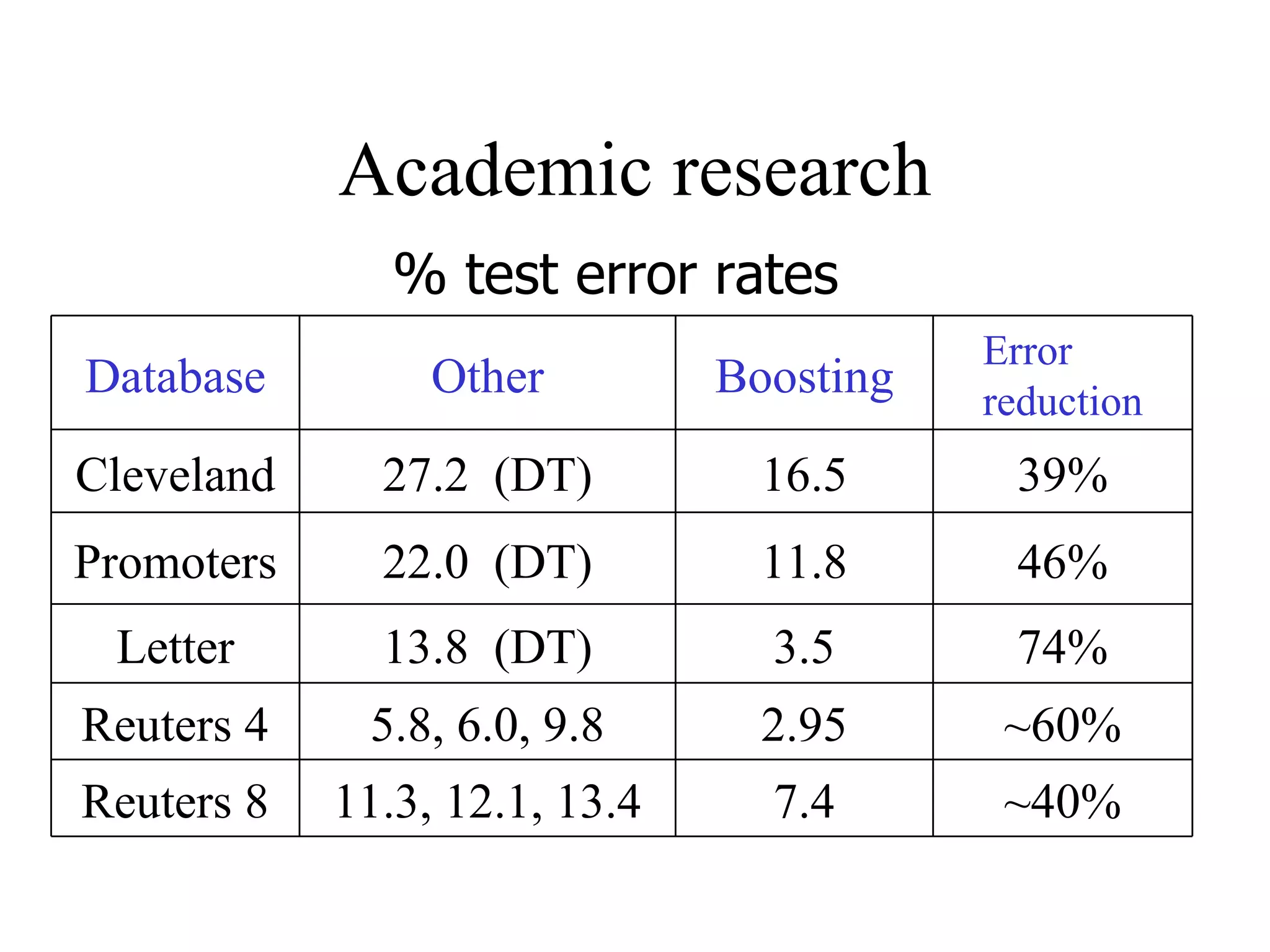
Academic research % test error rates 7.4 2.95 3.5 11.8 16.5 Boosting ~40% ~60% 74% 46% 39% Error reduction 11.3, 12.1, 13.4 Reuters 8 Reuters 4 Letter Promoters Cleveland Database 5.8, 6.0, 9.8 13.8  (DT) 22.0  (DT) 27.2  (DT) Other
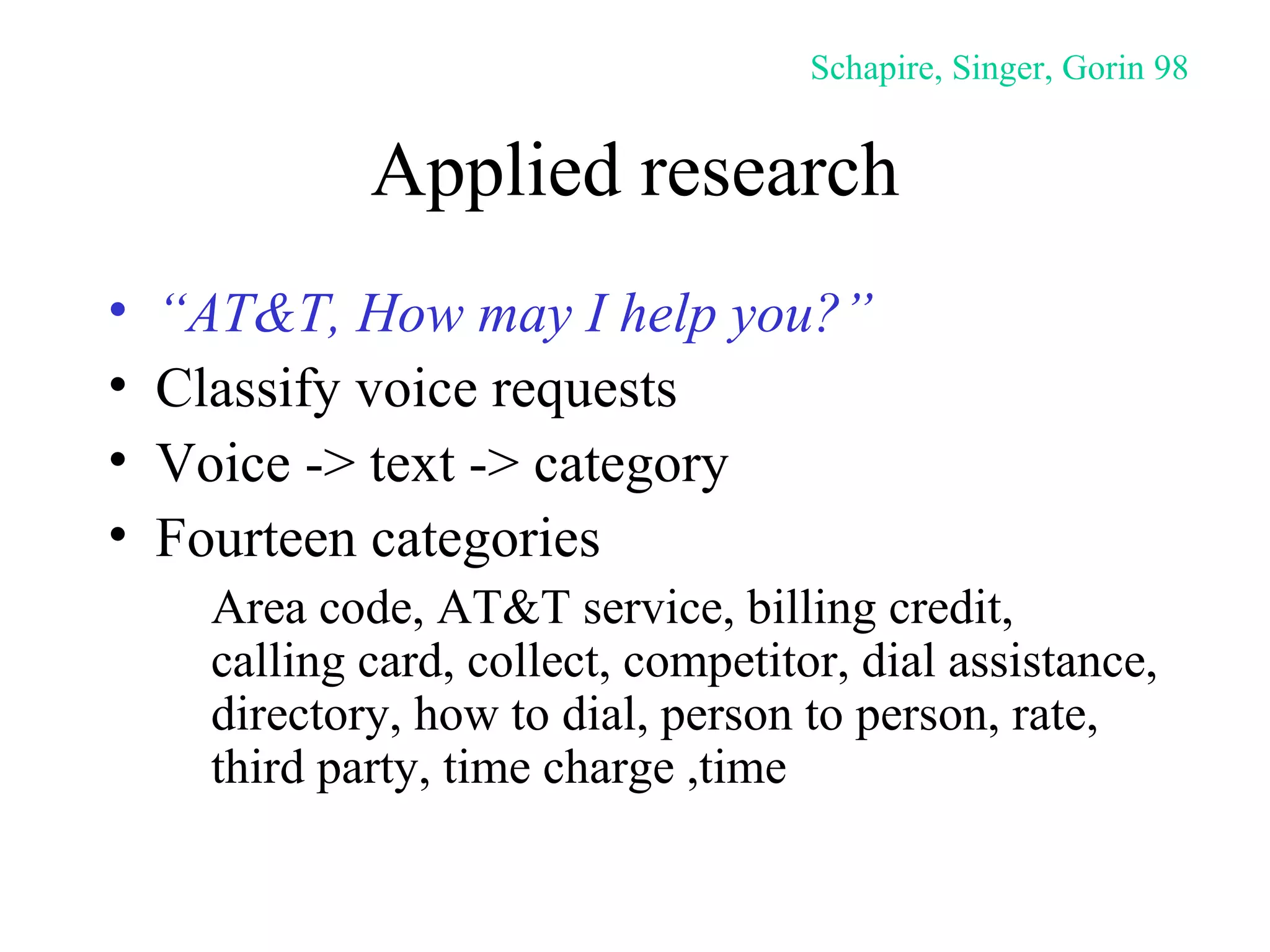
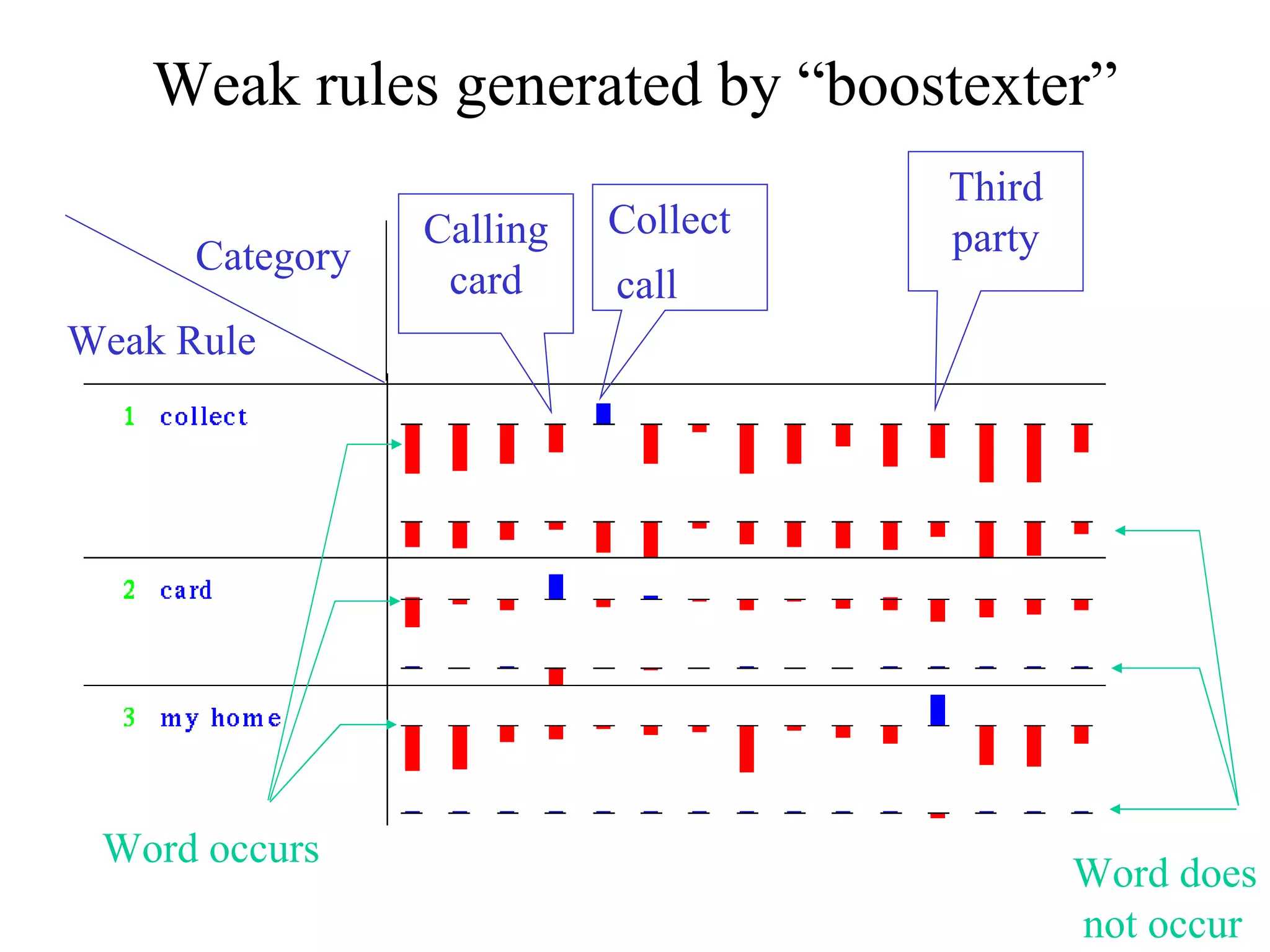
Applied research “ AT&T, How may I help you?” Classify voice requests Voice -> text -> category Fourteen categories Area code, AT&T service, billing credit,  calling card, collect, competitor, dial assistance, directory, how to dial, person to person, rate, third party, time charge ,time Schapire, Singer, Gorin 98
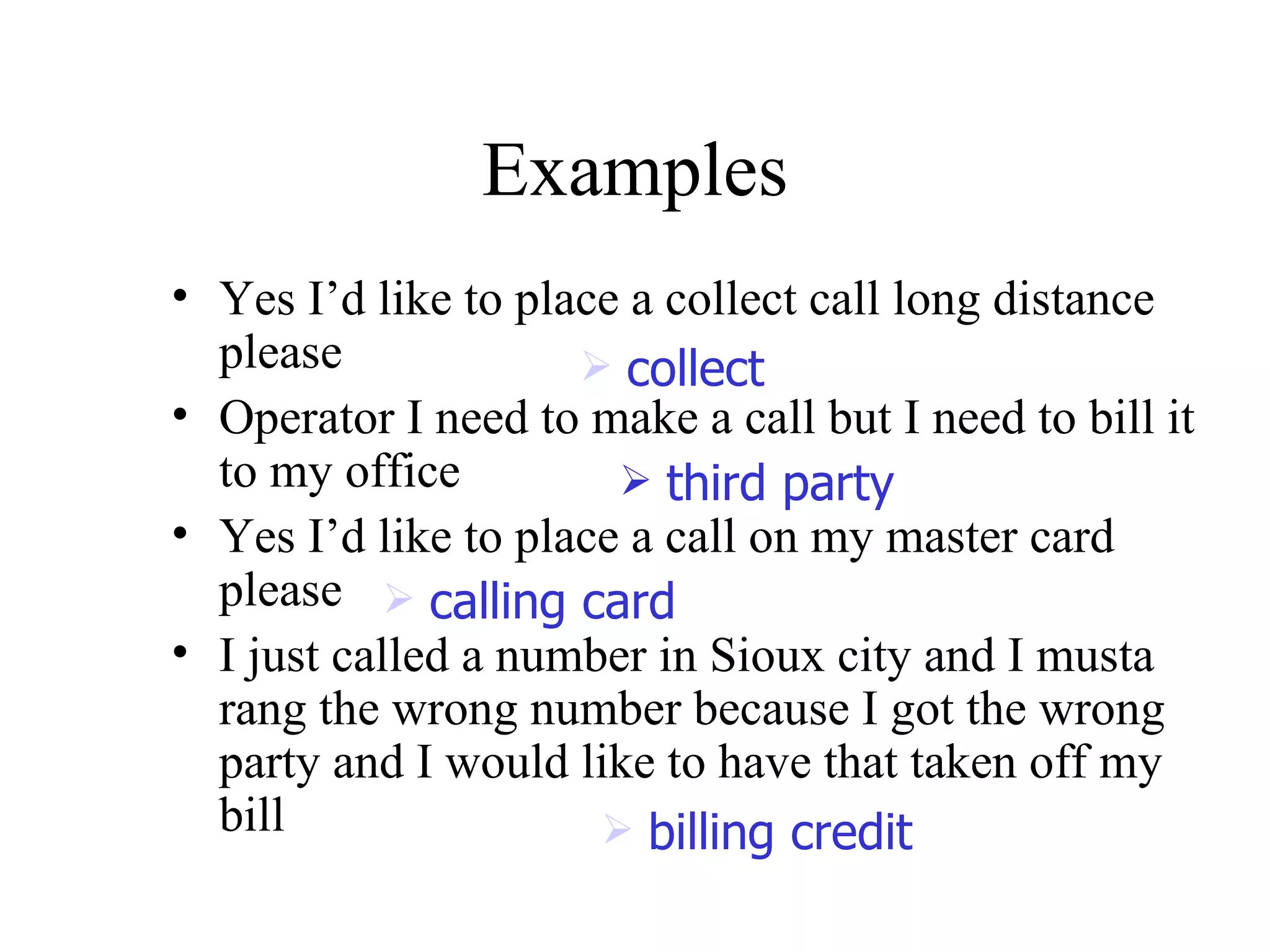
Yes I’d like to place a collect call long distance please Operator I need to make a call but I need to bill it to my office  Yes I’d like to place a call on my master card please  I just called a number in Sioux city and I musta rang the wrong number because I got the wrong party and I would like to have that taken off my bill Examples collect third party billing credit calling card
Weak rules generated by “boostexter” Calling card Collect  call Third party Weak Rule Category Word occurs Word does not occur
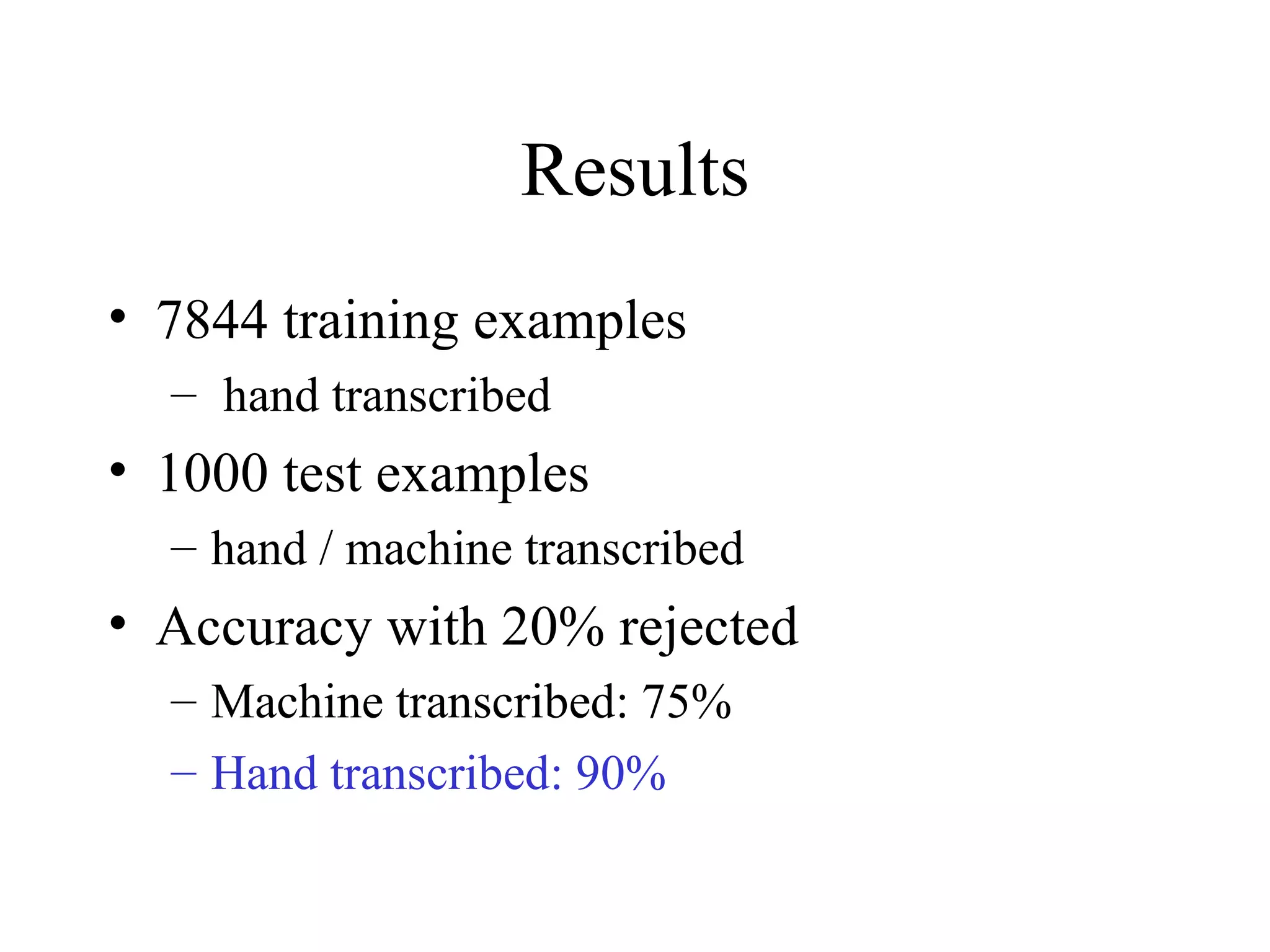
Results 7844 training examples hand transcribed 1000 test examples hand / machine transcribed Accuracy with 20% rejected Machine transcribed: 75% Hand transcribed: 90%
Commercial deployment  Distinguish business/residence customers Using statistics from call-detail records Alternating decision trees Similar to boosting decision trees, more flexible Combines very simple rules Can over-fit, cross validation used to stop Freund, Mason, Rogers, Pregibon, Cortes 2000
Massive datasets 260M  calls / day 230M  telephone numbers Label unknown for  ~30% Hancock : software for computing statistical signatures. 100K  randomly selected training examples,  ~10K  is enough Training takes about  2  hours. Generated classifier has to be both  accurate   and  efficient
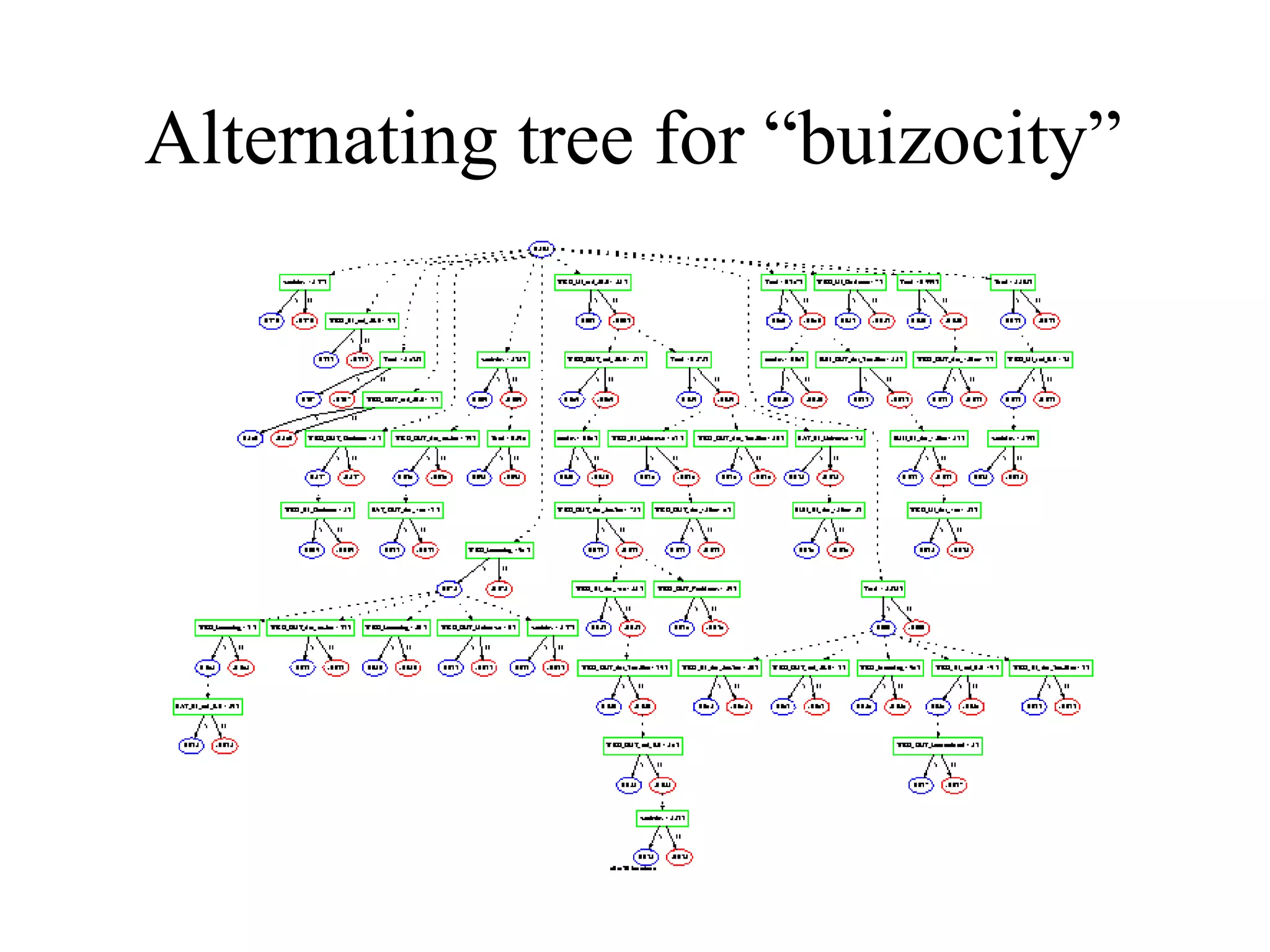
Alternating tree for “buizocity”
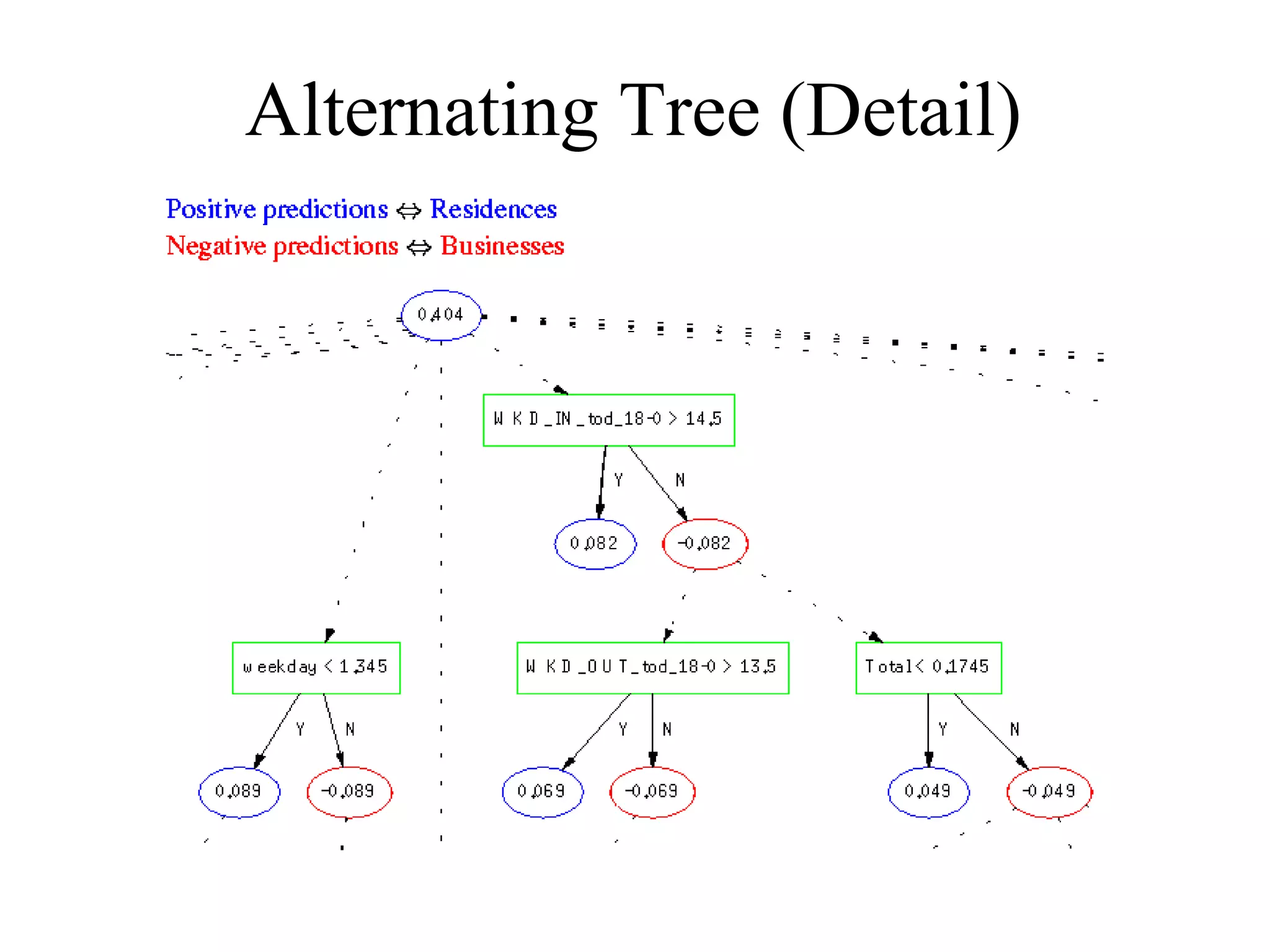
Alternating Tree (Detail)
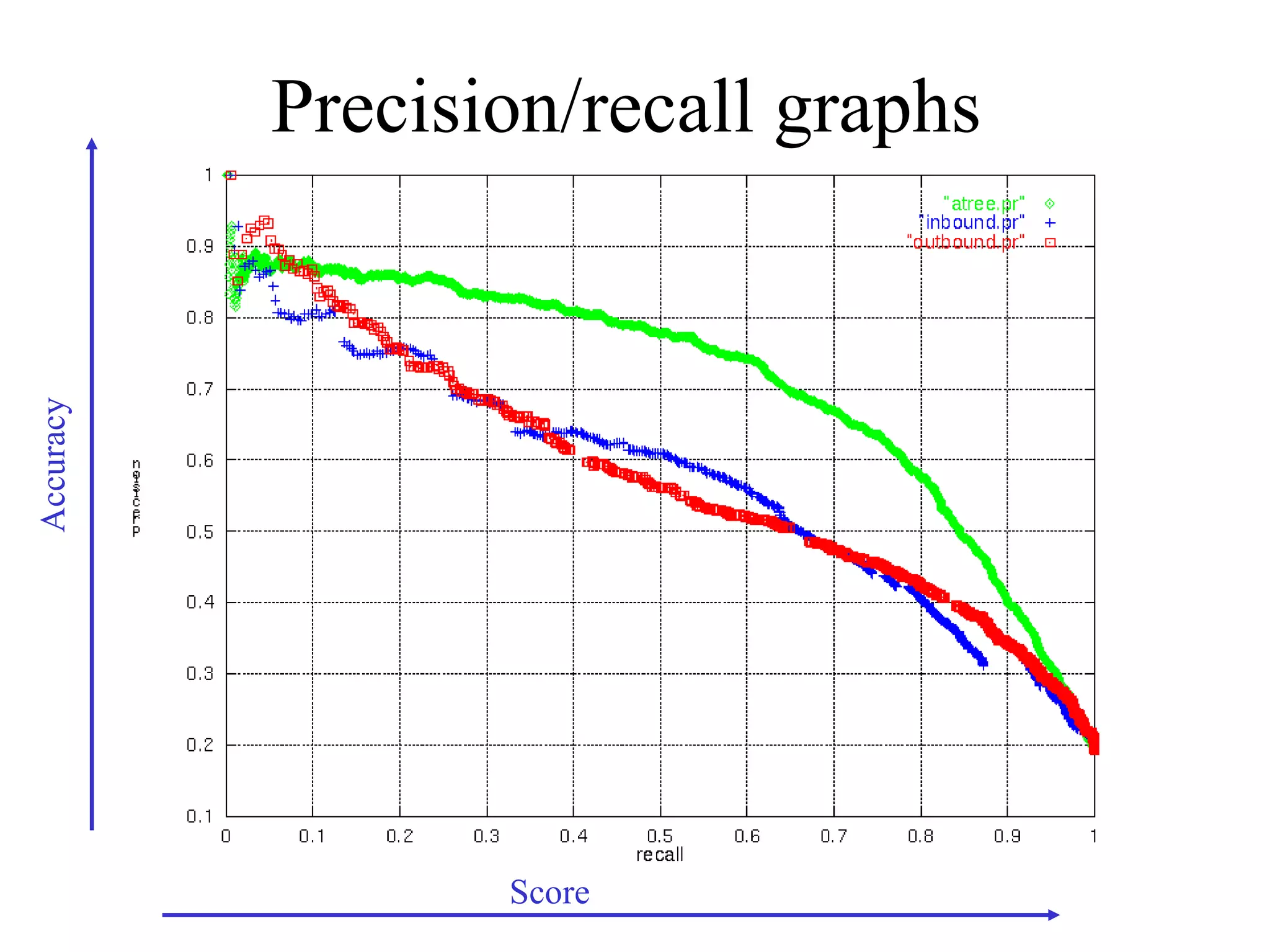
Precision/recall graphs Score Accuracy
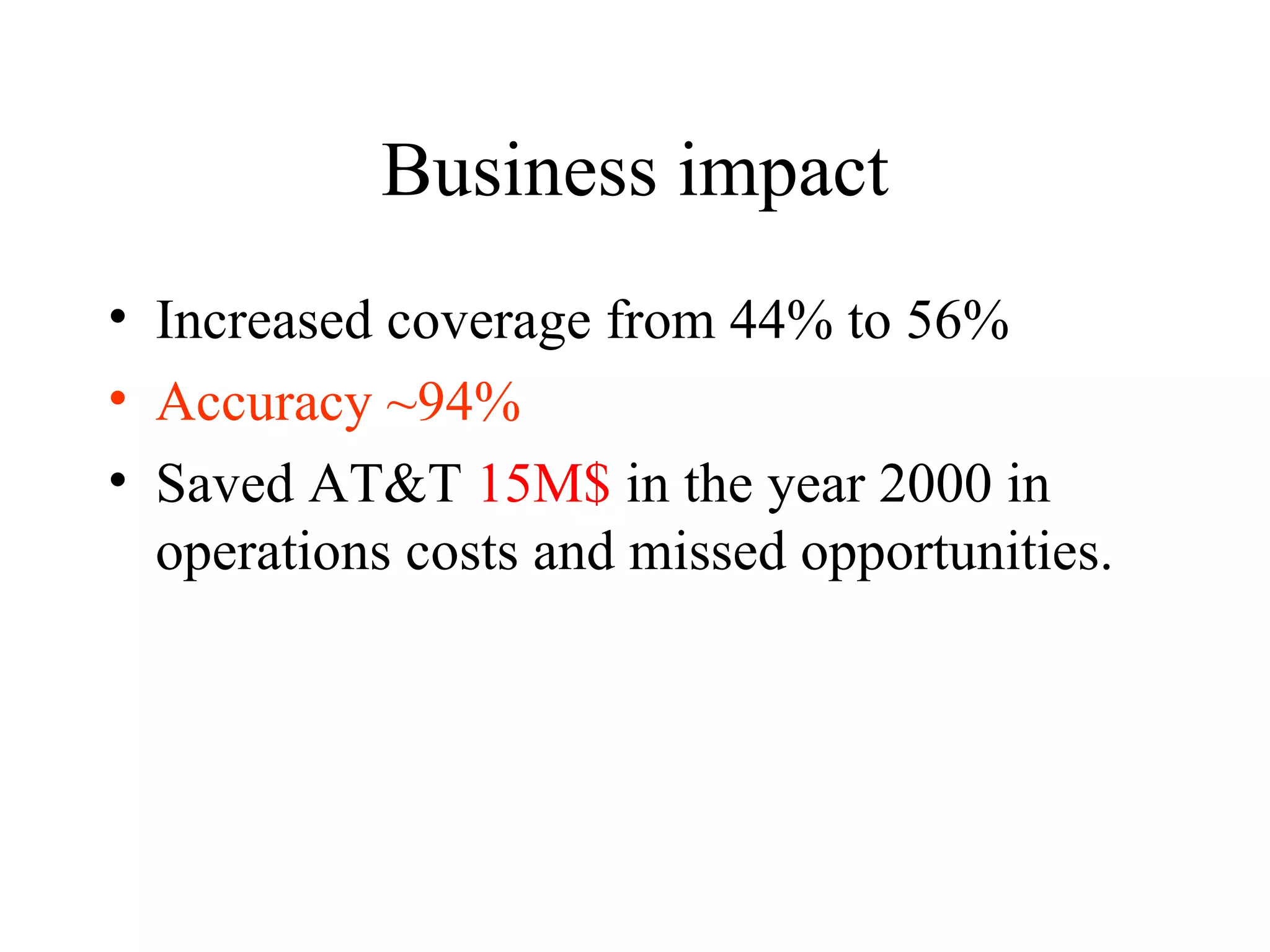
Business impact Increased coverage from 44% to 56% Accuracy ~94% Saved AT&T  15M$  in the year 2000 in operations costs and missed opportunities.
Summary Boosting is a computational method  for learning accurate classifiers Resistance to over-fit explained by  margins Underlying explanation –  large “neighborhoods”  of good classifiers Boosting has been applied successfully to  a variety of classification problems
Come talk with me! [email_address] http://www.cs.huji.ac.il/~yoavf

An Introduction to boosting

  • 1.
    An Introduction toBoosting Yoav Freund Banter Inc.
  • 2.
    Plan of talkGenerative vs. non-generative modeling Boosting Alternating decision trees Boosting and over-fitting Applications
  • 3.
    Toy Example Computerreceives telephone call Measures Pitch of voice Decides gender of caller Human Voice Male Female
  • 4.
    Generative modeling Voice Pitch Probability mean1 var1 mean2 var2
  • 5.
    Discriminative approach VoicePitch No. of mistakes
  • 6.
    Ill-behaved data VoicePitch Probability mean1 mean2 No. of mistakes
  • 7.
    Traditional Statistics vs. Machine Learning Data Estimated world state Predictions Actions Statistics Decision Theory Machine Learning
  • 8.
    Comparison of methodologiesMismatch problems Performance measure Goal Model Misclassifications Outliers Misclassification rate Likelihood Classification rule Probability estimates Discriminative Generative
  • 9.
  • 10.
    A weak learnerweak learner A weak rule h h Weighted training set (x1, y1 , w1 ),(x2, y2 , w2 ) … (xn, yn , wn ) instances x1,x2,x3,…,xn labels y1,y2,y3,…,yn The weak requirement: Feature vector Binary label Non-negative weights sum to 1
  • 11.
    The boosting processFinal rule: Sign [ ] h1   h2   hT   weak learner h1 (x1,y1, 1/n ), … (xn,yn, 1/n ) weak learner h2 (x1,y1, w1 ), … (xn,yn, wn ) h3 (x1,y1, w1 ), … (xn,yn, wn ) h4 (x1,y1, w1 ), … (xn,yn, wn ) h5 (x1,y1, w1 ), … (xn,yn, wn ) h6 (x1,y1, w1 ), … (xn,yn, wn ) h7 (x1,y1, w1 ), … (xn,yn, wn ) h8 (x1,y1, w1 ), … (xn,yn, wn ) h9 (x1,y1, w1 ), … (xn,yn, wn ) hT (x1,y1, w1 ), … (xn,yn, wn )
  • 12.
    Adaboost Binary labels y = -1,+1 margin ( x,y ) = y [  t  t  h t (x) ] P(x,y) = (1/Z) exp (-margin(x,y)) Given h t , we choose  t to minimize  (x,y) exp (-margin (x,y) )
  • 13.
    Main property ofadaboost If advantages of weak rules over random guessing are:      T then in-sample error of final rule is at most (w.r.t. the initial weights)
  • 14.
  • 15.
    Adaboost as gradientdescent Discriminator class: a linear discriminator in the space of “weak hypotheses” Original goal: find hyper plane with smallest number of mistakes Known to be an NP-hard problem (no algorithm that runs in time polynomial in d , where d is the dimension of the space) Computational method: Use exponential loss as a surrogate, perform gradient descent.
  • 16.
    Margins view ProjectPrediction = + - + + + + + + - - - - - - - w Correct Mistakes Margin Cumulative # examples Mistakes Correct Margin =
  • 17.
    Adaboost et al.Loss Correct Margin Mistakes Brownboost Logitboost Adaboost = 0-1 loss
  • 18.
    One coordinate ata time Adaboost performs gradient descent on exponential loss Adds one coordinate ( “weak learner” ) at each iteration. Weak learning in binary classification = slightly better than random guessing. Weak learning in regression – unclear. Uses example-weights to communicate the gradient direction to the weak learner Solves a computational problem
  • 19.
    What is agood weak learner? The set of weak rules (features) should be flexible enough to be (weakly) correlated with most conceivable relations between feature vector and label. Small enough to allow exhaustive search for the minimal weighted training error. Small enough to avoid over-fitting . Should be able to calculate predicted label very efficiently . Rules can be “specialists” – predict only on a small subset of the input space and abstain from predicting on the rest (output 0).
  • 20.
    Alternating Trees Jointwork with Llew Mason
  • 21.
    Decision Trees X>3Y>5 -1 +1 -1 +1 -1 -1 no yes yes no X Y 3 5
  • 22.
    Decision tree asa sum -0.2 -0.2 X Y Y>5 +0.2 -0.3 yes no X>3 -0.1 no yes +0.1 +0.1 -0.1 +0.2 -0.3 +1 -1 -1 sign
  • 23.
    An alternating decisiontree -0.2 +0.7 X Y +0.1 -0.1 +0.2 -0.3 sign Y>5 +0.2 -0.3 yes no X>3 -0.1 no yes +0.1 Y<1 0.0 no yes +0.7 +1 -1 -1 +1
  • 24.
    Example: Medical DiagnosticsCleve dataset from UC Irvine database. Heart disease diagnostics (+1=healthy,-1=sick) 13 features from tests (real valued and discrete). 303 instances.
  • 25.
    Adtree for Clevelandheart-disease diagnostics problem
  • 26.
    Cross-validated accuracy 0.8%16.5% 16 Boost Stumps 0.5% 20.2% 446 C5.0 + boosting 0.5% 27.2% 27 C5.0 0.6% 17.0% 6 ADtree Test error variance Average test error Number of splits Learning algorithm
  • 27.
  • 28.
    Curious phenomenon Boostingdecision trees Using < 10,000 training examples we fit > 2,000,000 parameters
  • 29.
  • 30.
    Explanation using marginsMargin 0-1 loss No examples with small margins!!
  • 31.
  • 32.
    Theorem For anyconvex combination and any threshold No dependence on number of weak rules that are combined!!! Schapire, Freund, Bartlett & Lee Annals of stat. 98 Probability of mistake Fraction of training example with small margin Size of training sample VC dimension of weak rules
  • 33.
  • 34.
  • 35.
  • 36.
    Applications of BoostingAcademic research Applied research Commercial deployment
  • 37.
    Academic research %test error rates 7.4 2.95 3.5 11.8 16.5 Boosting ~40% ~60% 74% 46% 39% Error reduction 11.3, 12.1, 13.4 Reuters 8 Reuters 4 Letter Promoters Cleveland Database 5.8, 6.0, 9.8 13.8 (DT) 22.0 (DT) 27.2 (DT) Other
  • 38.
    Applied research “AT&T, How may I help you?” Classify voice requests Voice -> text -> category Fourteen categories Area code, AT&T service, billing credit, calling card, collect, competitor, dial assistance, directory, how to dial, person to person, rate, third party, time charge ,time Schapire, Singer, Gorin 98
  • 39.
    Yes I’d liketo place a collect call long distance please Operator I need to make a call but I need to bill it to my office Yes I’d like to place a call on my master card please I just called a number in Sioux city and I musta rang the wrong number because I got the wrong party and I would like to have that taken off my bill Examples collect third party billing credit calling card
  • 40.
    Weak rules generatedby “boostexter” Calling card Collect call Third party Weak Rule Category Word occurs Word does not occur
  • 41.
    Results 7844 trainingexamples hand transcribed 1000 test examples hand / machine transcribed Accuracy with 20% rejected Machine transcribed: 75% Hand transcribed: 90%
  • 42.
    Commercial deployment Distinguish business/residence customers Using statistics from call-detail records Alternating decision trees Similar to boosting decision trees, more flexible Combines very simple rules Can over-fit, cross validation used to stop Freund, Mason, Rogers, Pregibon, Cortes 2000
  • 43.
    Massive datasets 260M calls / day 230M telephone numbers Label unknown for ~30% Hancock : software for computing statistical signatures. 100K randomly selected training examples, ~10K is enough Training takes about 2 hours. Generated classifier has to be both accurate and efficient
  • 44.
    Alternating tree for“buizocity”
  • 45.
  • 46.
  • 47.
    Business impact Increasedcoverage from 44% to 56% Accuracy ~94% Saved AT&T 15M$ in the year 2000 in operations costs and missed opportunities.
  • 48.
    Summary Boosting isa computational method for learning accurate classifiers Resistance to over-fit explained by margins Underlying explanation – large “neighborhoods” of good classifiers Boosting has been applied successfully to a variety of classification problems
  • 49.
    Come talk withme! [email_address] http://www.cs.huji.ac.il/~yoavf

Editor's Notes

  • #38 Cleveland: Heart disease, features: blood pressure, etc. Promoters: DNA, indicates that intron is coming Letter: standard b&amp;w OCR benchmark, Frey &amp; Slate 1991, Roman alphabet, 20 distorted fonts, 16 given attributes: # pixels, moments etc. Reuters-21450, 12,902 documents, standard benchmark, Reuters 4: first table A9, A10. Naïve bayes CMU, Rocchio,
  • #39 AT&amp;T service – sign up or drop
  • #43 3 years for fraud
  • #44 Call detail: originating, called, terminated (e.g, for 800, forwarding) #, start, end time, quality, termination code (e.g., for wireless), quality, no rate information Statistics: #calls, Distribution within day, week, # #’s called, type (800, toll, etc.), incoming vs. outgoing