A gentle introduction to the
mathematics of biosurveillance:
Bayes Rule and Bayes Classifiers
Associate Member
The RODS Lab
University of Pittburgh
Carnegie Mellon University
http://rods.health.pitt.edu
Andrew W. Moore
Professor
The Auton Lab
School of Computer Science
Carnegie Mellon University
http://www.autonlab.org
awm@cs.cmu.edu
412-268-7599
2
What we’re going to do
• We will review the concept of reasoning with
uncertainty
• Also known as probability
• This is a fundamental building block
• It’s really going to be worth it
3
Discrete Random Variables
• A is a Boolean-valued random variable if A
denotes an event, and there is some degree
of uncertainty as to whether A occurs.
• Examples
• A = The next patient you examine is suffering
from inhalational anthrax
• A = The next patient you examine has a cough
• A = There is an active terrorist cell in your city
4
Probabilities
• We write P(A) as “the fraction of possible
worlds in which A is true”
• We could at this point spend 2 hours on the
philosophy of this.
• But we won’t.
5
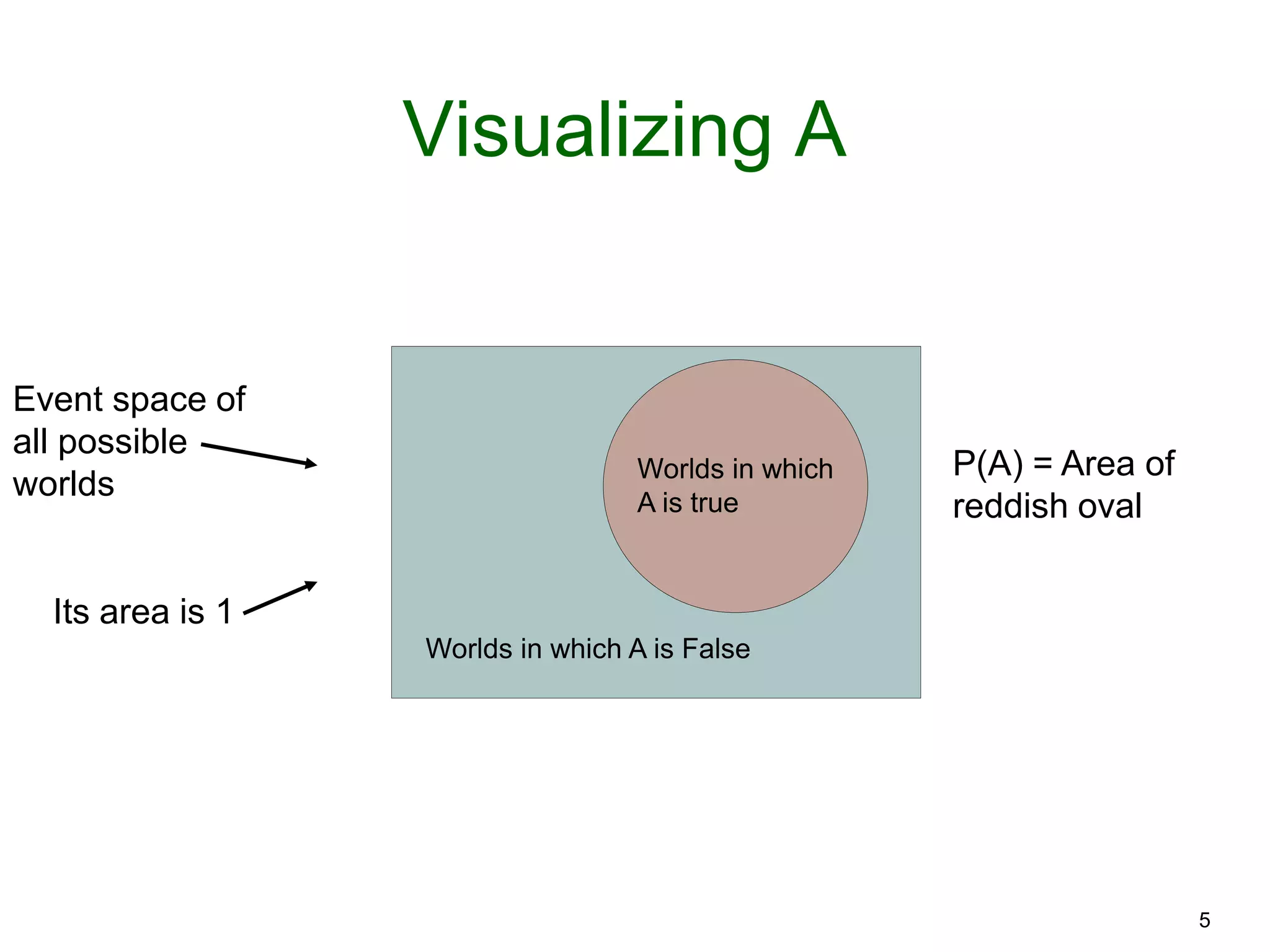
Visualizing A
Event space of
all possible
worlds
Its area is 1
Worlds in which A is False
Worlds in which
A is true
P(A) = Area of
reddish oval
7
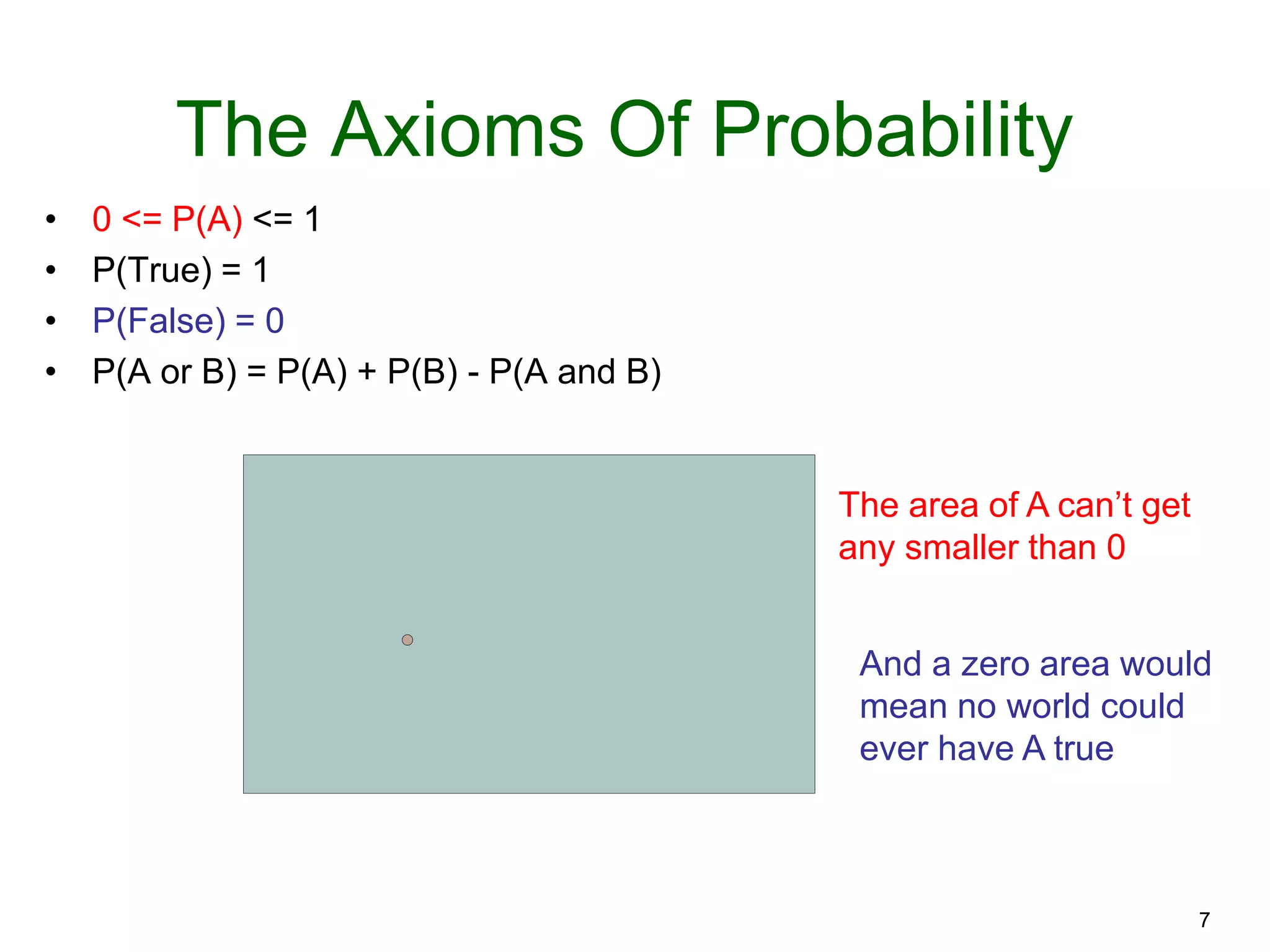
The Axioms Of Probability
• 0 <= P(A) <= 1
• P(True) = 1
• P(False) = 0
• P(A or B) = P(A) + P(B) - P(A and B)
The area of A can’t get
any smaller than 0
And a zero area would
mean no world could
ever have A true
8
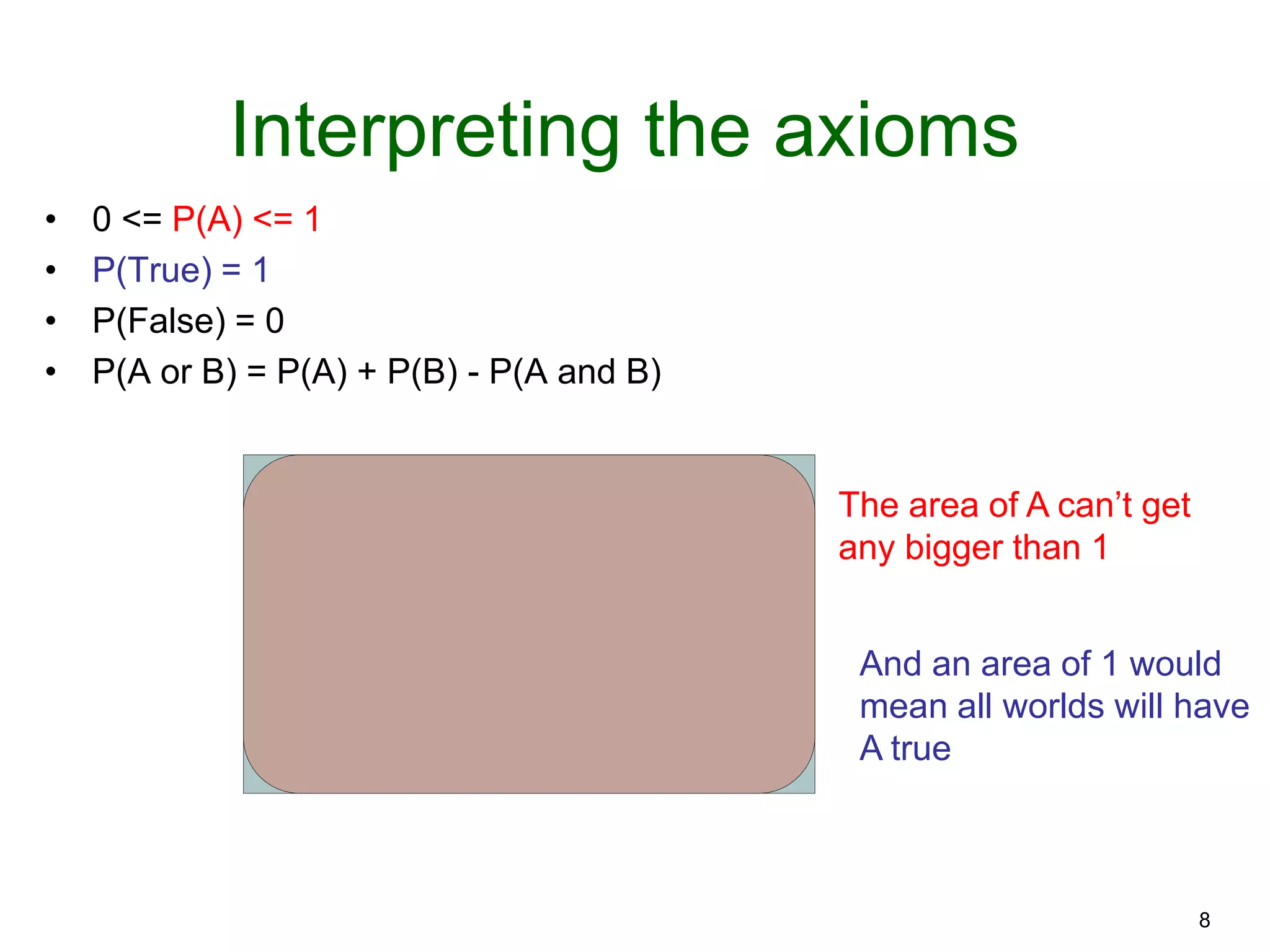
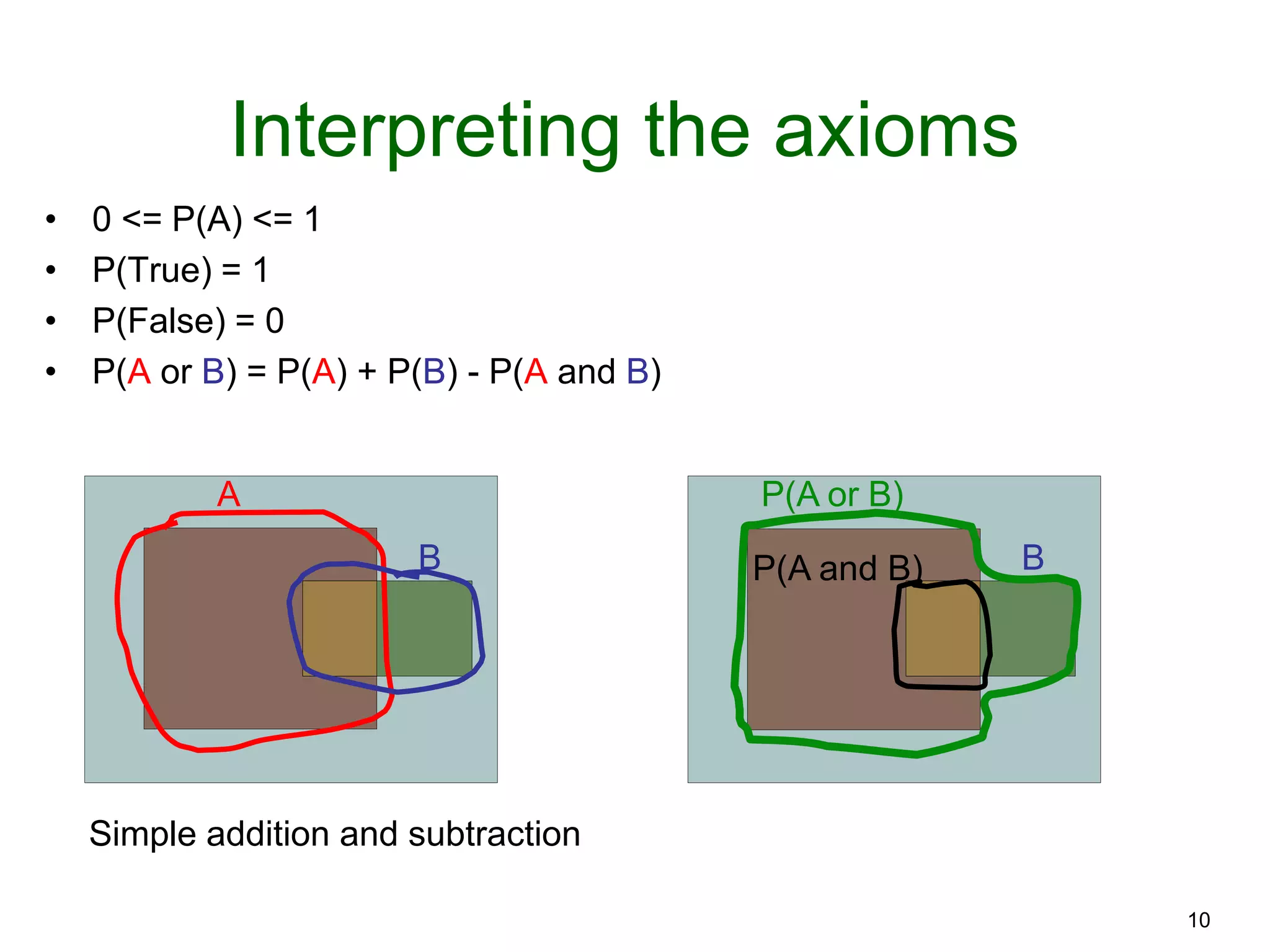
Interpreting the axioms
• 0 <= P(A) <= 1
• P(True) = 1
• P(False) = 0
• P(A or B) = P(A) + P(B) - P(A and B)
The area of A can’t get
any bigger than 1
And an area of 1 would
mean all worlds will have
A true
9
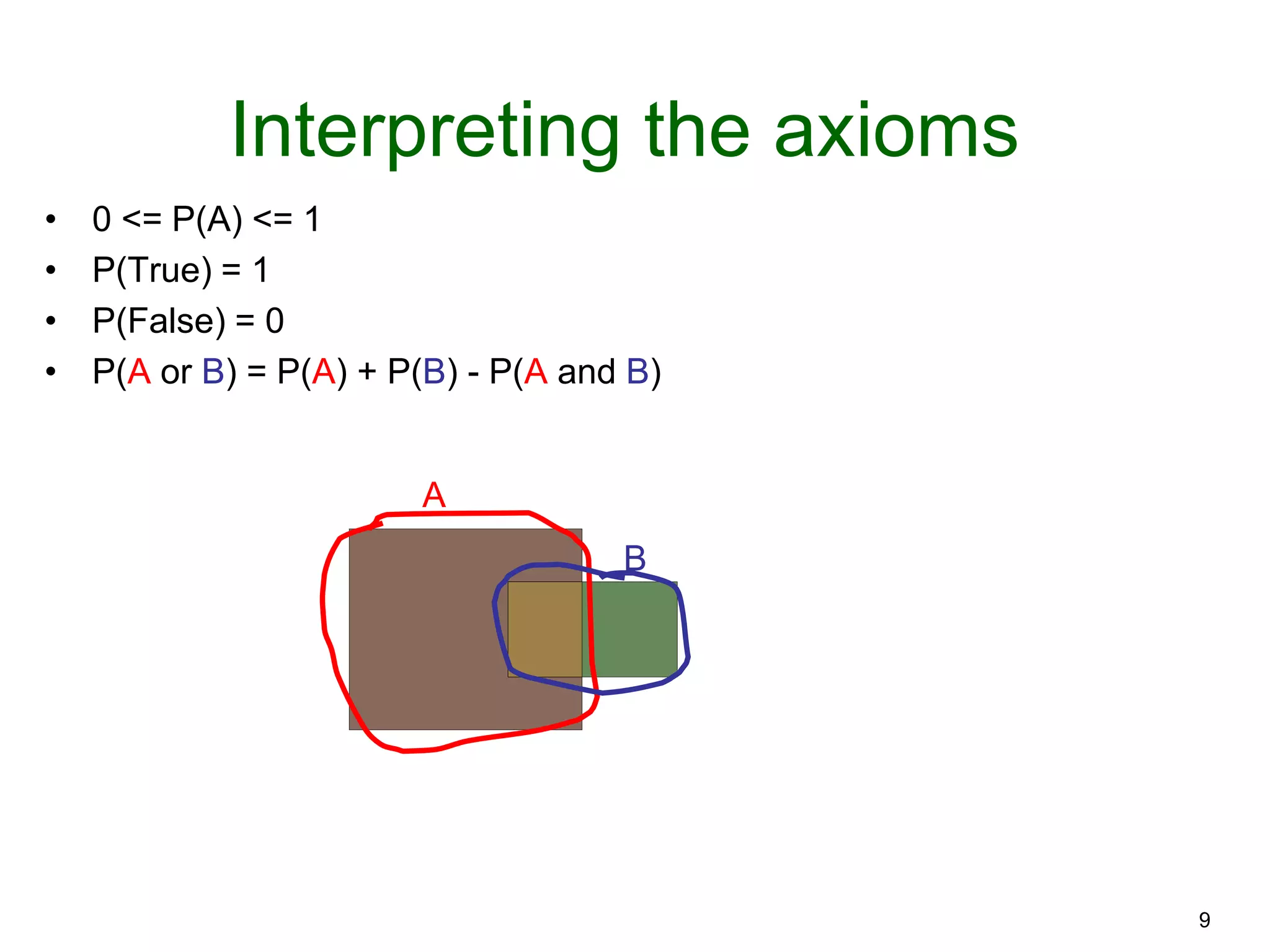
Interpreting the axioms
• 0 <= P(A) <= 1
• P(True) = 1
• P(False) = 0
• P(A or B) = P(A) + P(B) - P(A and B)
A
B
10
A
B
Interpreting the axioms
• 0 <= P(A) <= 1
• P(True) = 1
• P(False) = 0
• P(A or B) = P(A) + P(B) - P(A and B)
P(A or B)
BP(A and B)
Simple addition and subtraction
12
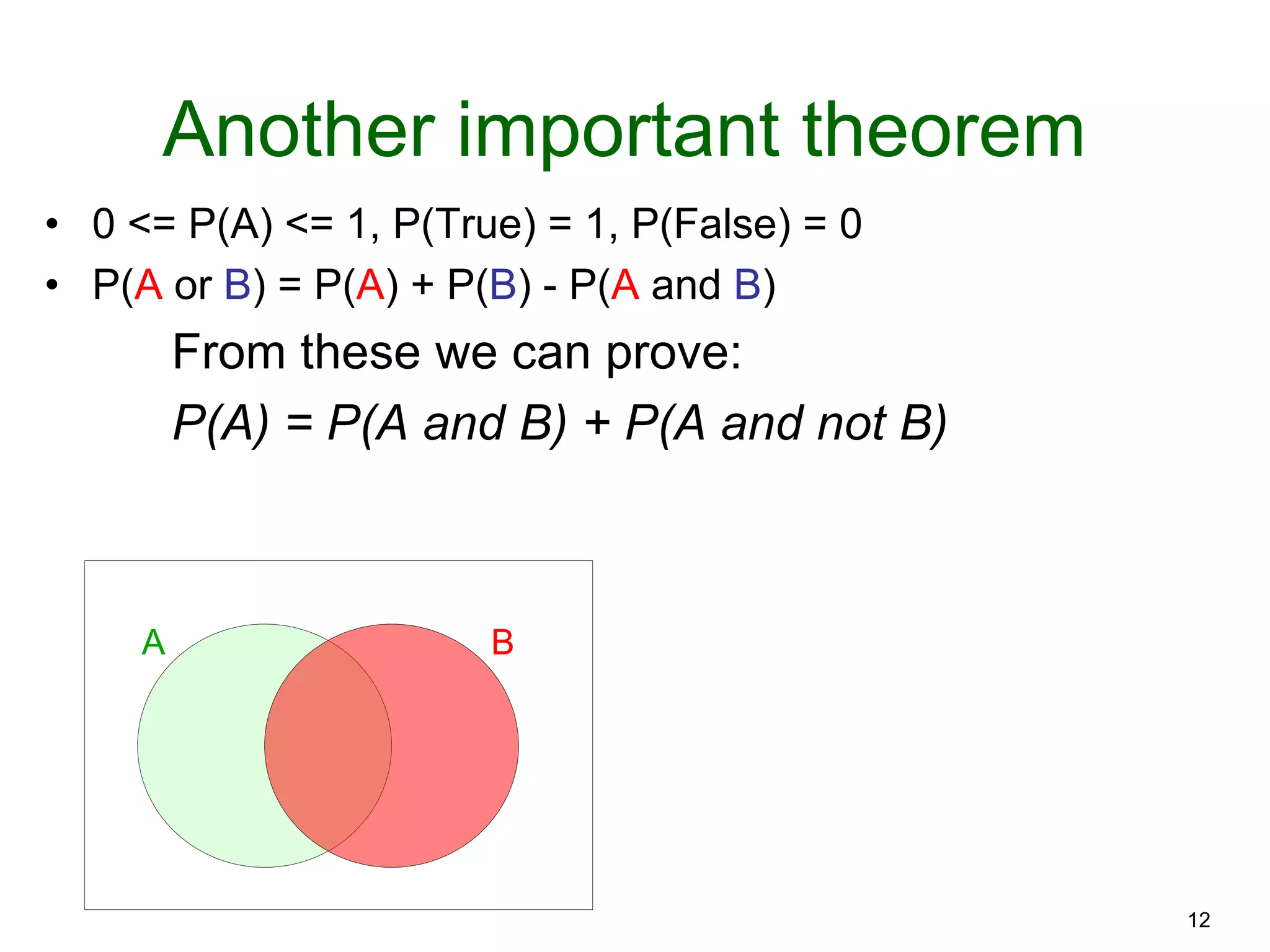
Another important theorem
• 0 <= P(A) <= 1, P(True) = 1, P(False) = 0
• P(A or B) = P(A) + P(B) - P(A and B)
From these we can prove:
P(A) = P(A and B) + P(A and not B)
A B
13
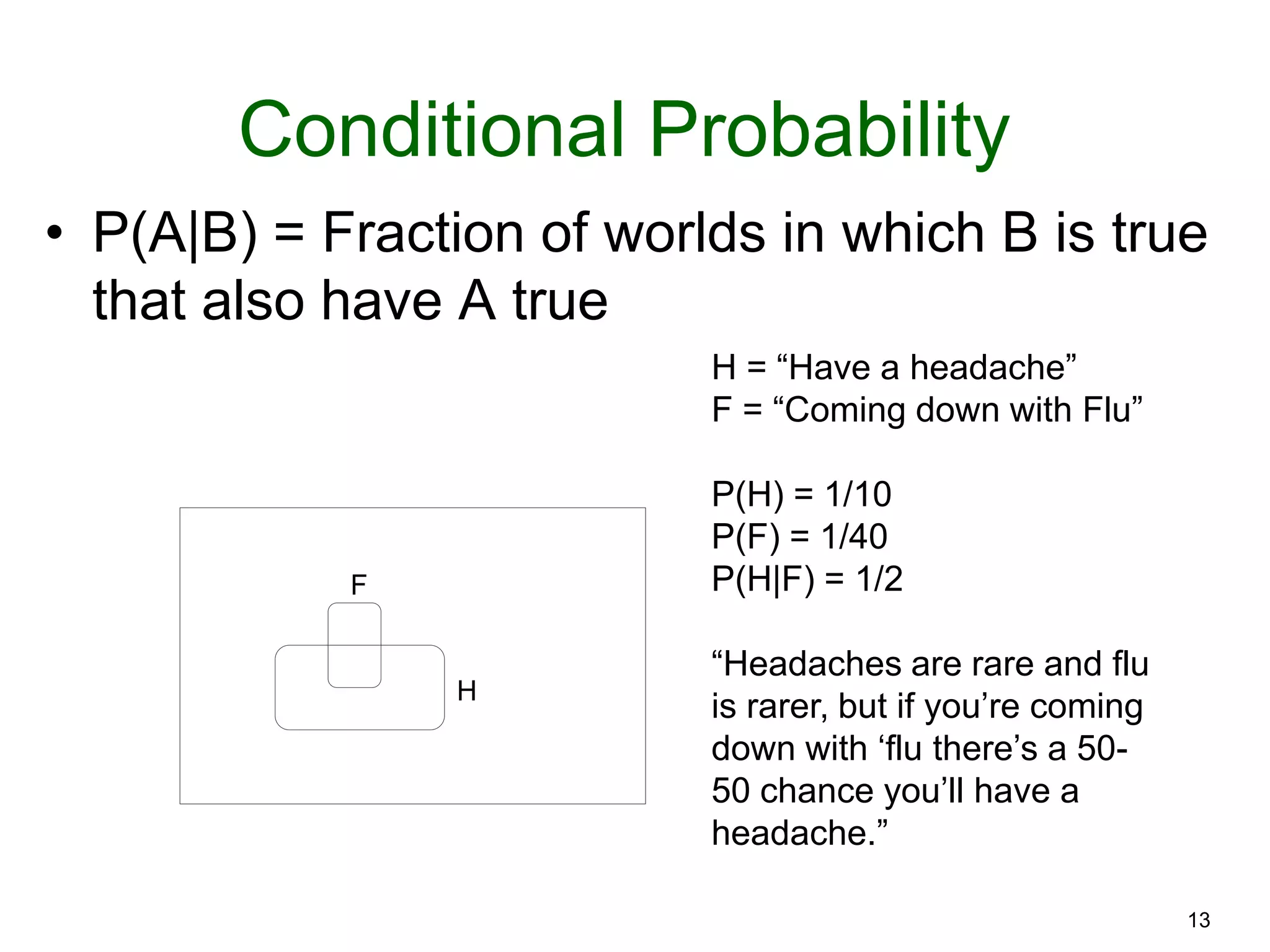
Conditional Probability
• P(A|B) = Fraction of worlds in which B is true
that also have A true
F
H
H = “Have a headache”
F = “Coming down with Flu”
P(H) = 1/10
P(F) = 1/40
P(H|F) = 1/2
“Headaches are rare and flu
is rarer, but if you’re coming
down with ‘flu there’s a 50-
50 chance you’ll have a
headache.”
14
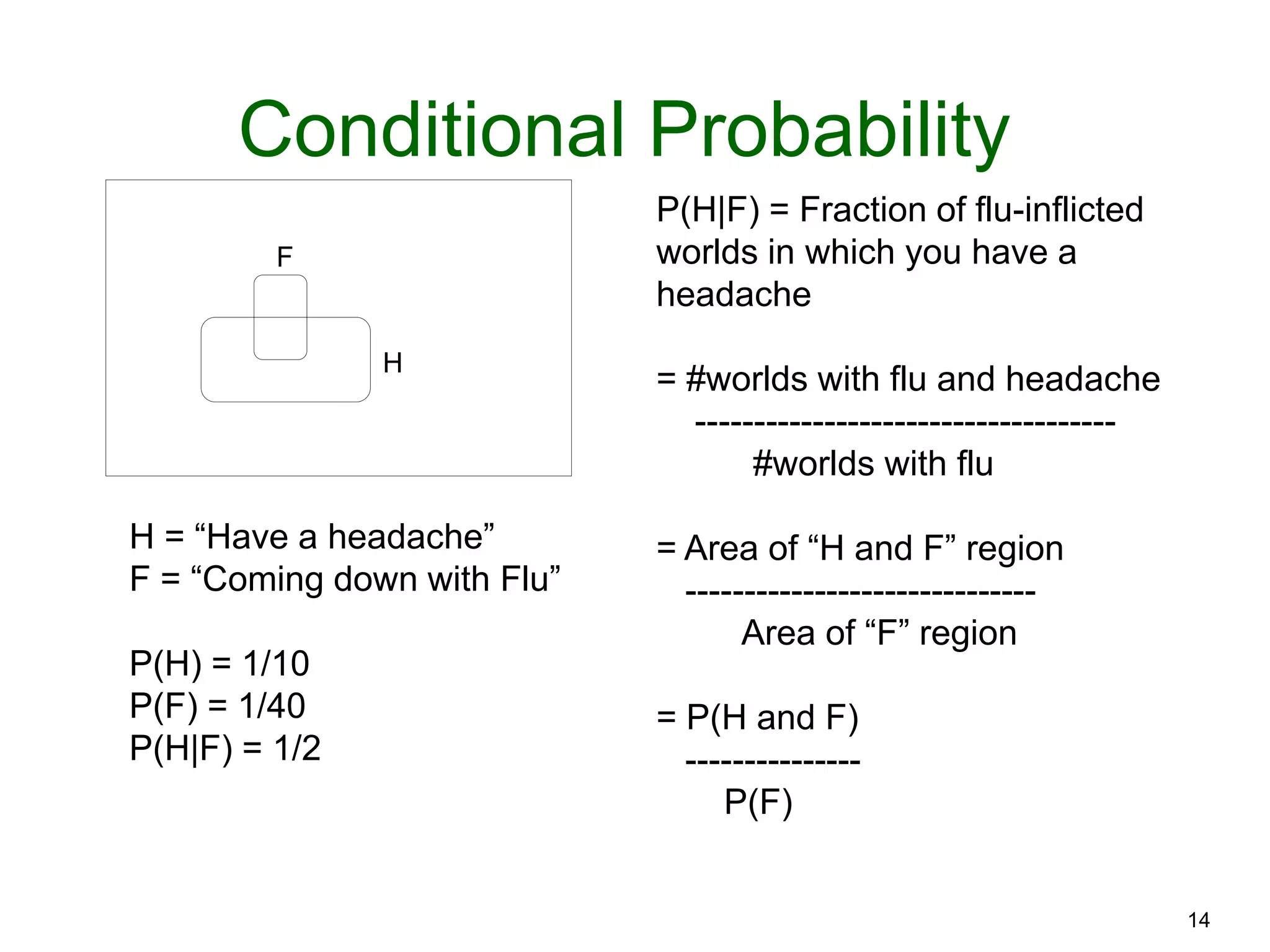
Conditional Probability
F
H
H = “Have a headache”
F = “Coming down with Flu”
P(H) = 1/10
P(F) = 1/40
P(H|F) = 1/2
P(H|F) = Fraction of flu-inflicted
worlds in which you have a
headache
= #worlds with flu and headache
------------------------------------
#worlds with flu
= Area of “H and F” region
------------------------------
Area of “F” region
= P(H and F)
---------------
P(F)
15
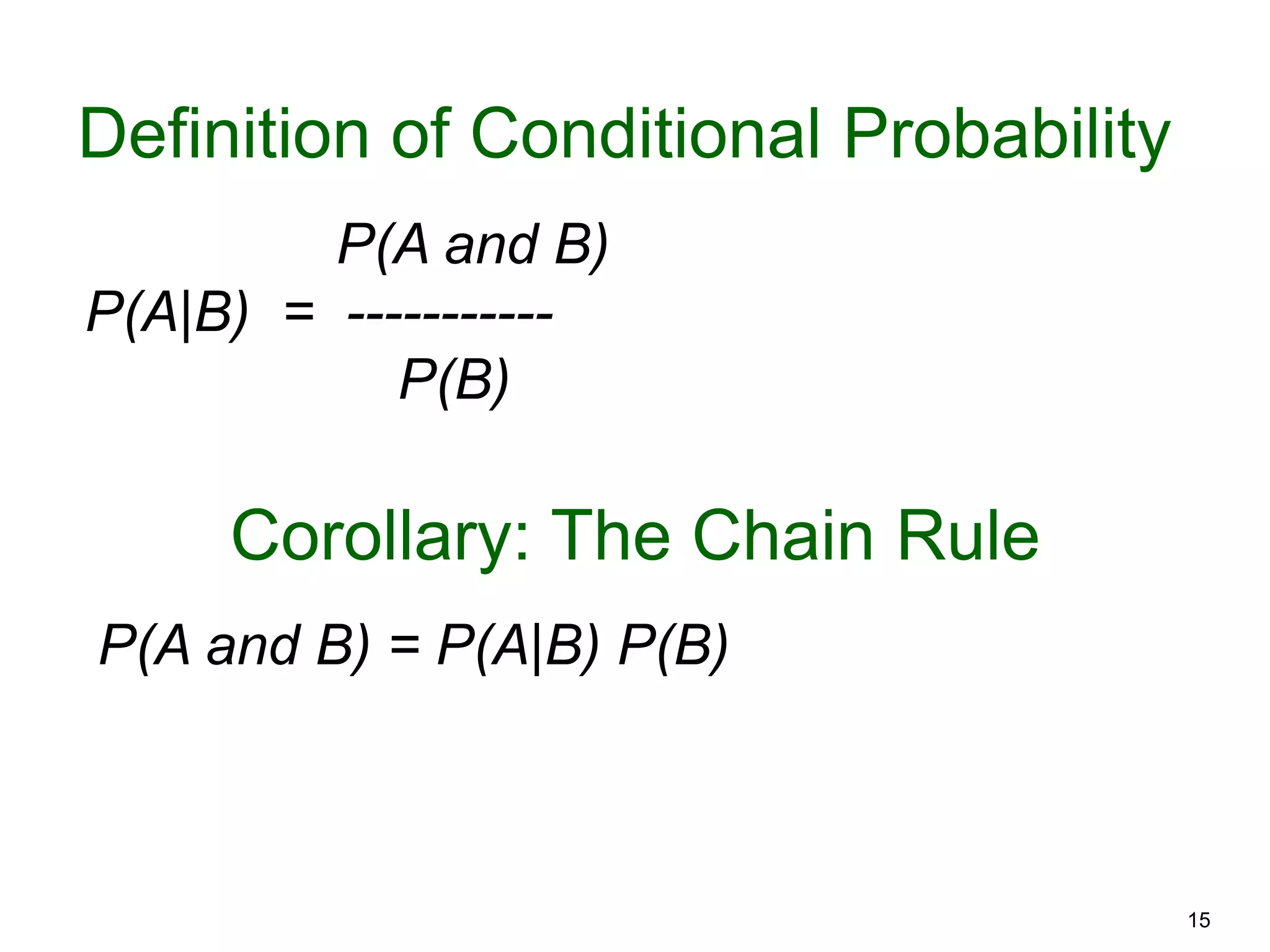
Definition of Conditional Probability
P(A and B)
P(A|B) = -----------
P(B)
Corollary: The Chain Rule
P(A and B) = P(A|B) P(B)
16
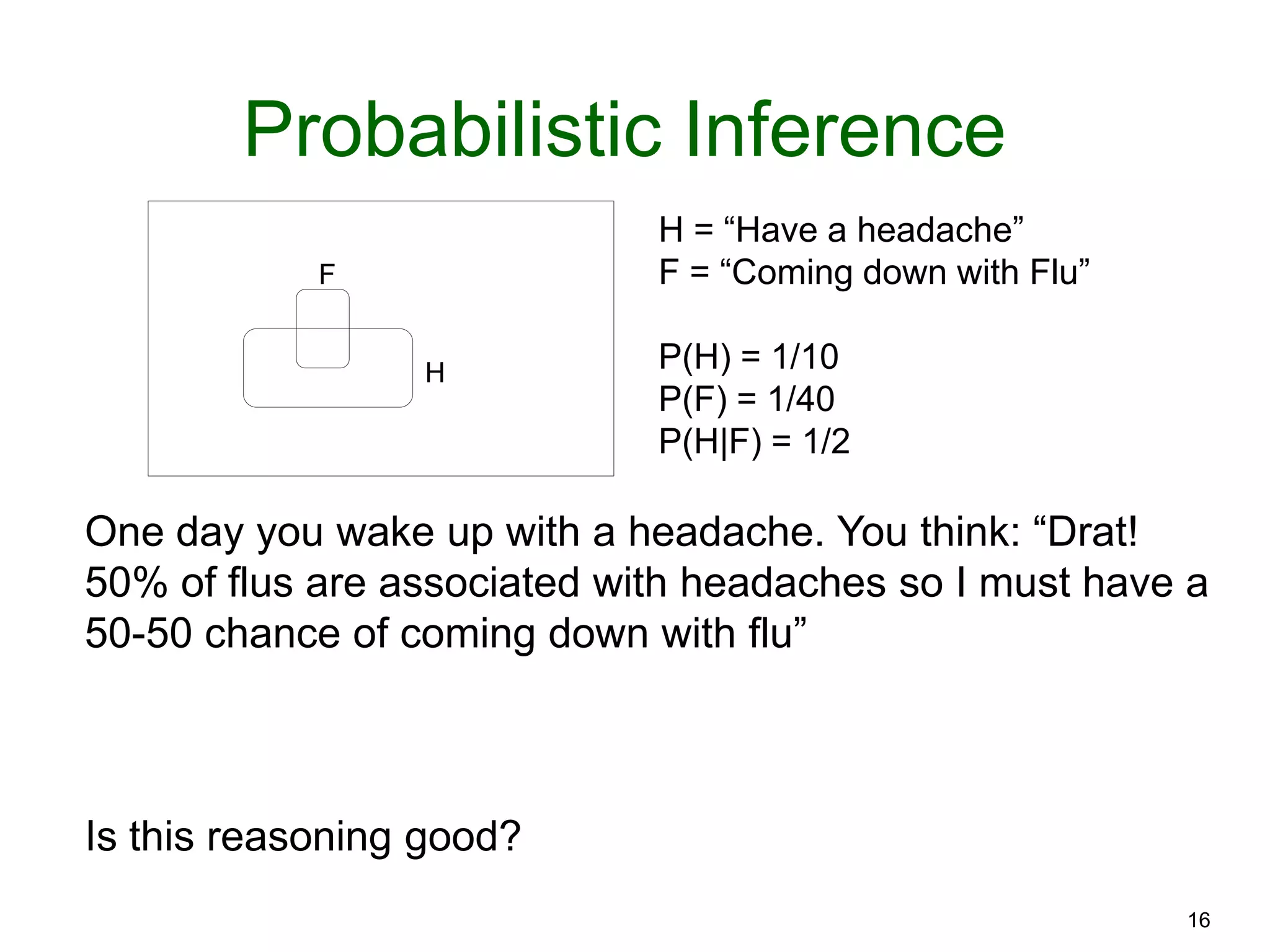
Probabilistic Inference
F
H
H = “Have a headache”
F = “Coming down with Flu”
P(H) = 1/10
P(F) = 1/40
P(H|F) = 1/2
One day you wake up with a headache. You think: “Drat!
50% of flus are associated with headaches so I must have a
50-50 chance of coming down with flu”
Is this reasoning good?
17
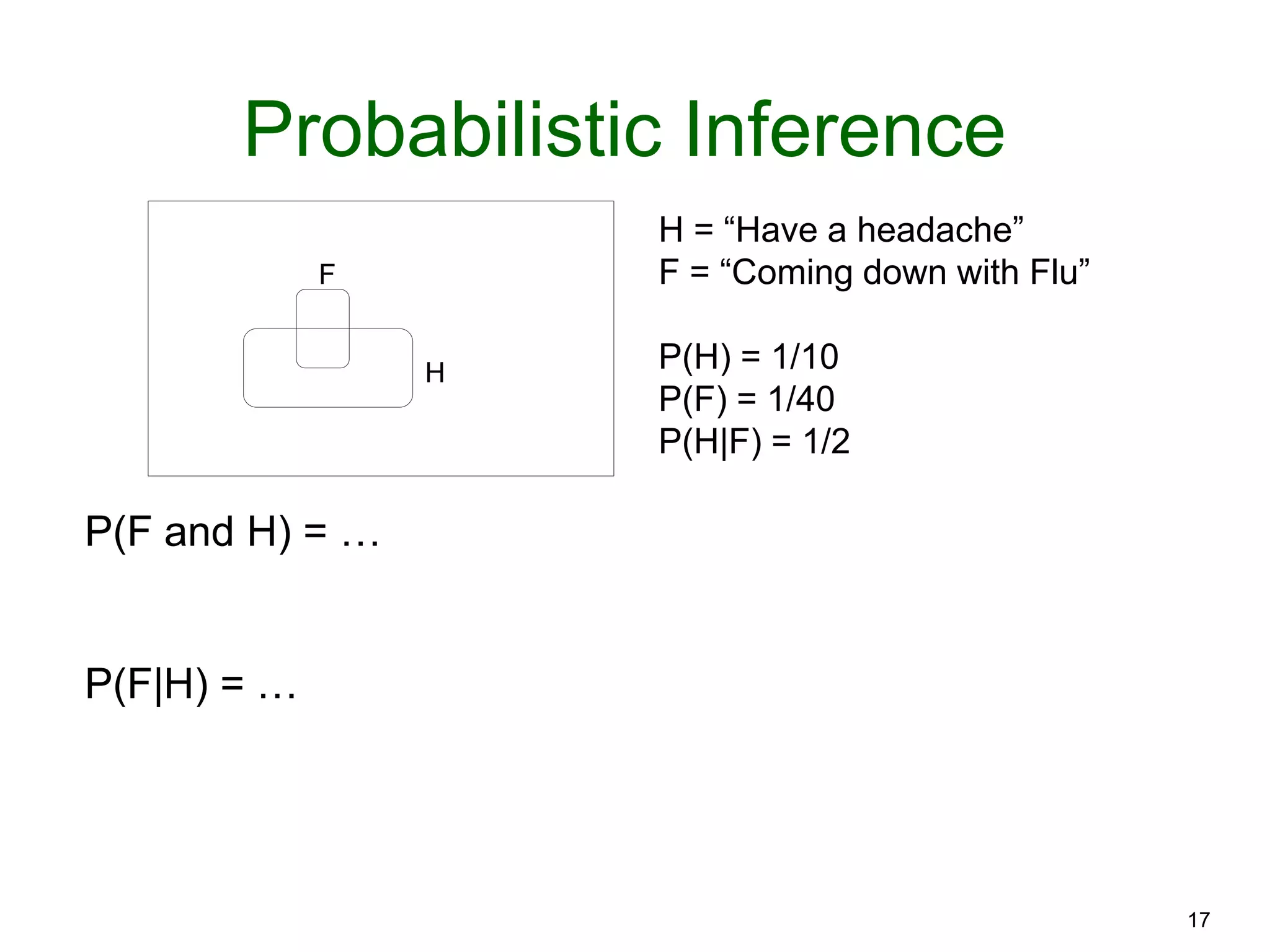
Probabilistic Inference
F
H
H = “Have a headache”
F = “Coming down with Flu”
P(H) = 1/10
P(F) = 1/40
P(H|F) = 1/2
P(F and H) = …
P(F|H) = …
18
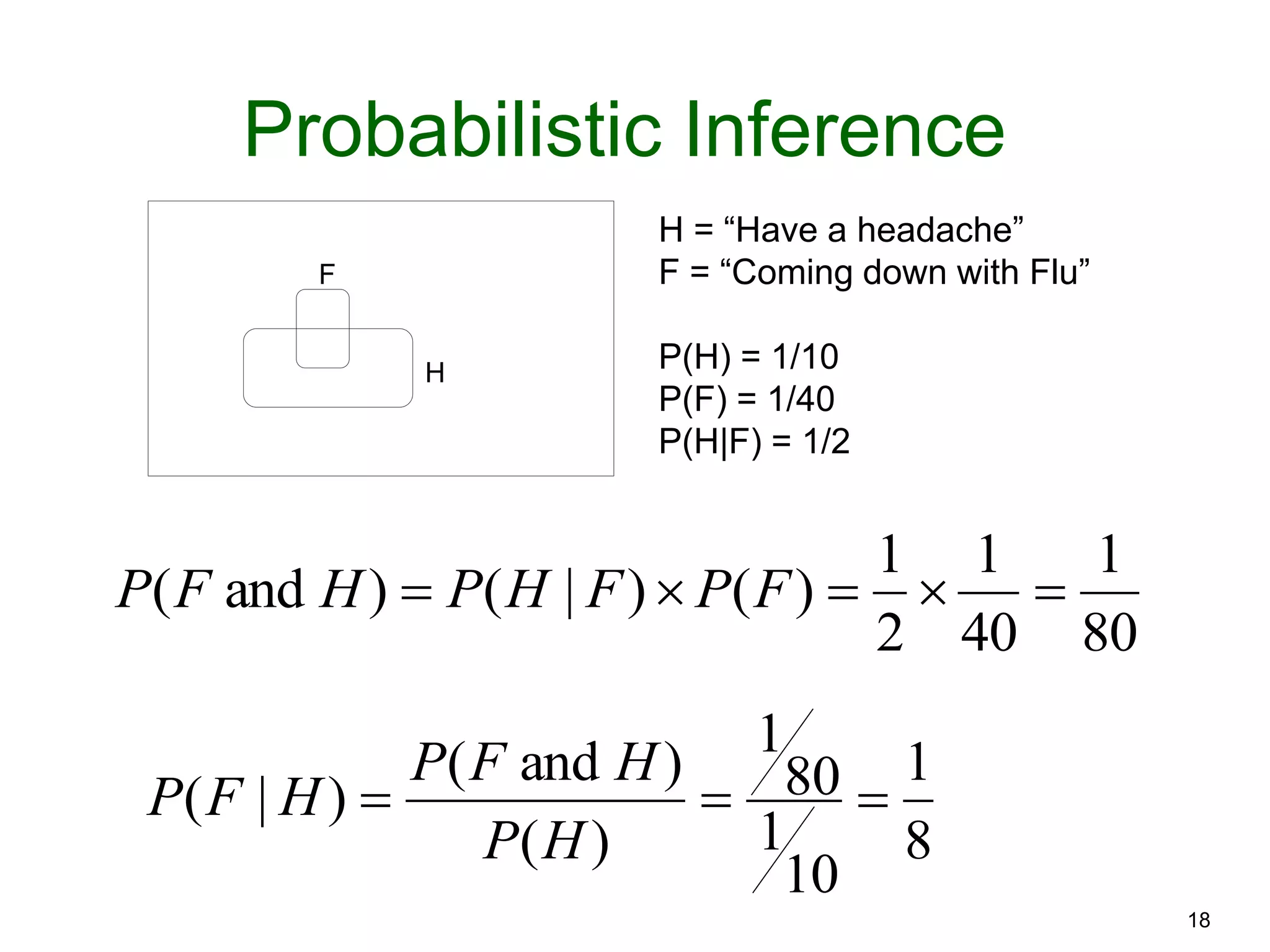
Probabilistic Inference
F
H
H = “Have a headache”
F = “Coming down with Flu”
P(H) = 1/10
P(F) = 1/40
P(H|F) = 1/2
8
1
10
1
80
1
)(
)and(
)|( 
HP
HFP
HFP
80
1
40
1
2
1
)()|()and(  FPFHPHFP
19
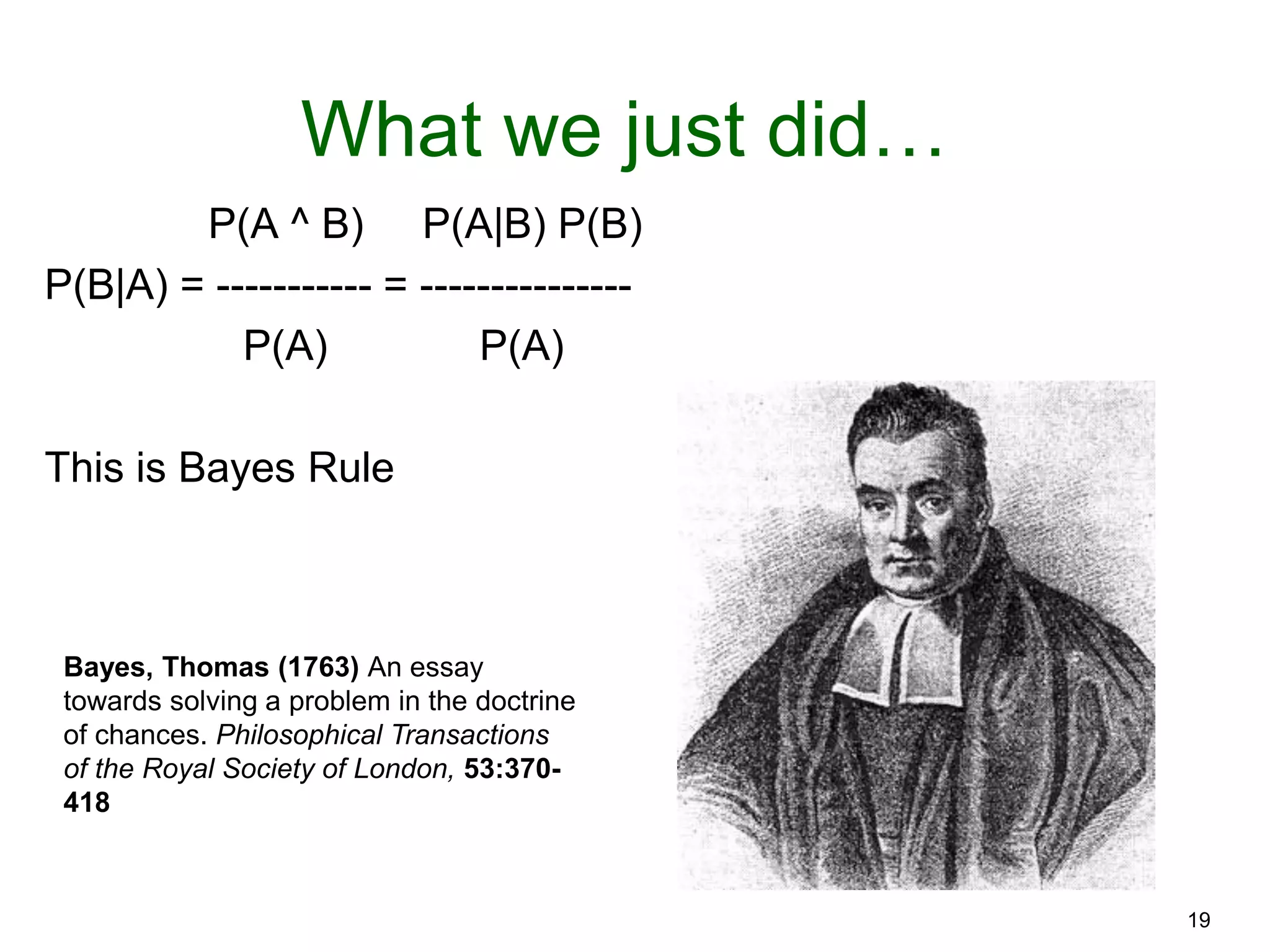
What we just did…
P(A ^ B) P(A|B) P(B)
P(B|A) = ----------- = ---------------
P(A) P(A)
This is Bayes Rule
Bayes, Thomas (1763) An essay
towards solving a problem in the doctrine
of chances. Philosophical Transactions
of the Royal Society of London, 53:370-
418
20
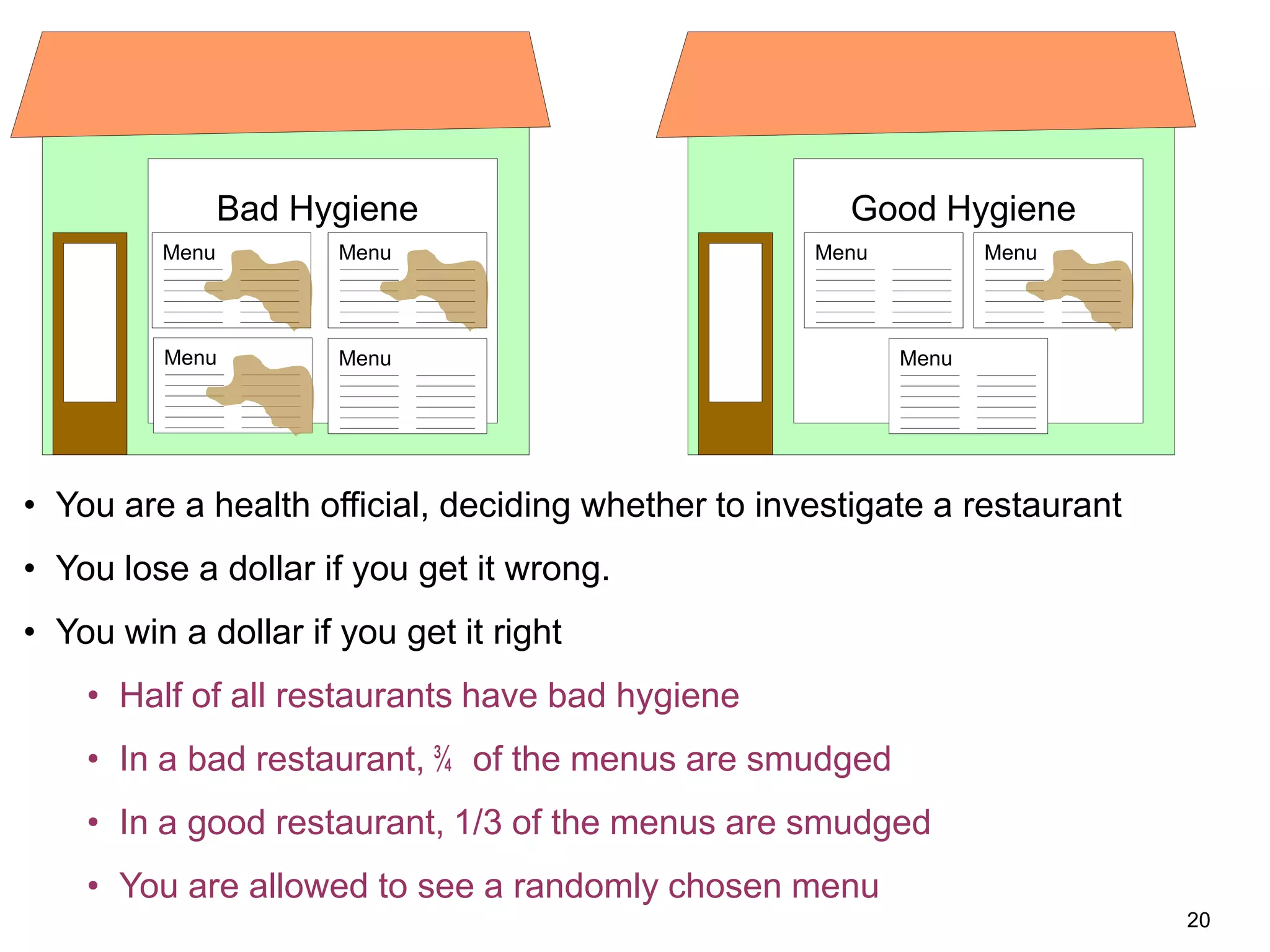
Menu
Bad Hygiene Good Hygiene
MenuMenu
Menu
MenuMenu
Menu
• You are a health official, deciding whether to investigate a restaurant
• You lose a dollar if you get it wrong.
• You win a dollar if you get it right
• Half of all restaurants have bad hygiene
• In a bad restaurant, ¾ of the menus are smudged
• In a good restaurant, 1/3 of the menus are smudged
• You are allowed to see a randomly chosen menu
21
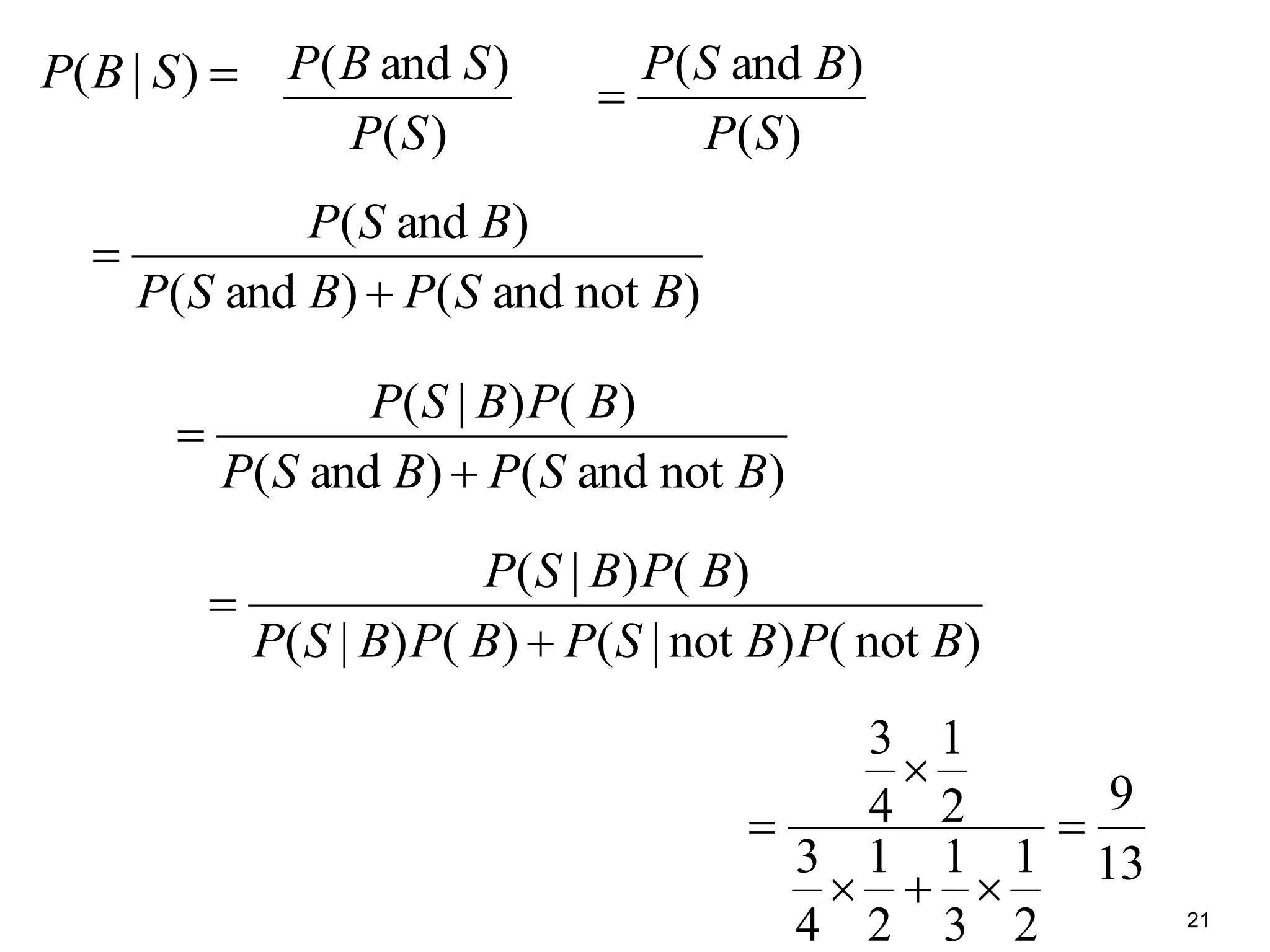
)|( SBP
)(
)and(
SP
SBP
)(
)and(
SP
BSP

)notand()and(
)and(
BSPBSP
BSP


)notand()and(
)()|(
BSPBSP
BPBSP


)not()not|()()|(
)()|(
BPBSPBPBSP
BPBSP


13
9
2
1
3
1
2
1
4
3
2
1
4
3




22
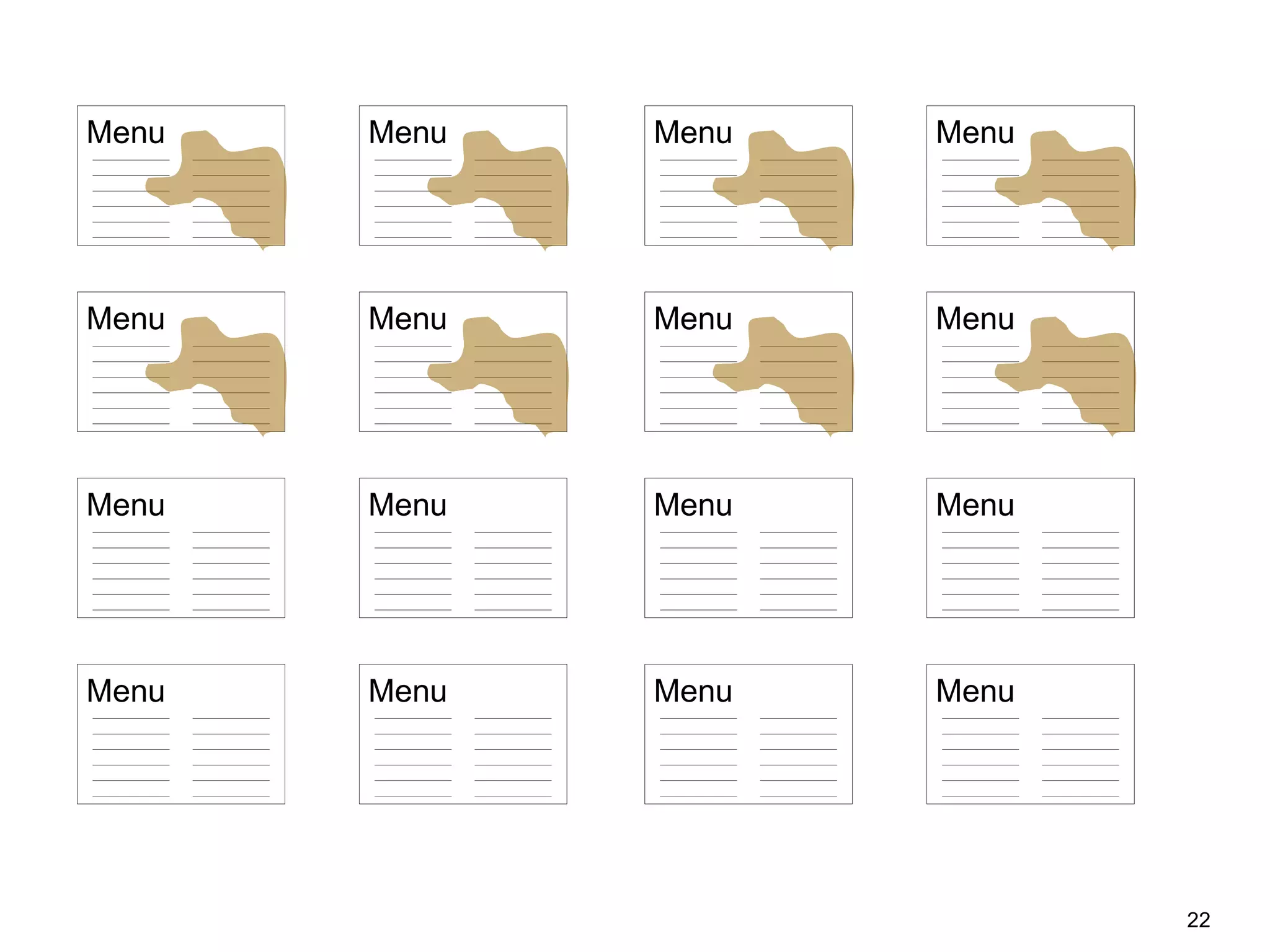
Menu
Menu
Menu
Menu
Menu
Menu
Menu
Menu
Menu Menu Menu Menu
Menu Menu Menu Menu
23
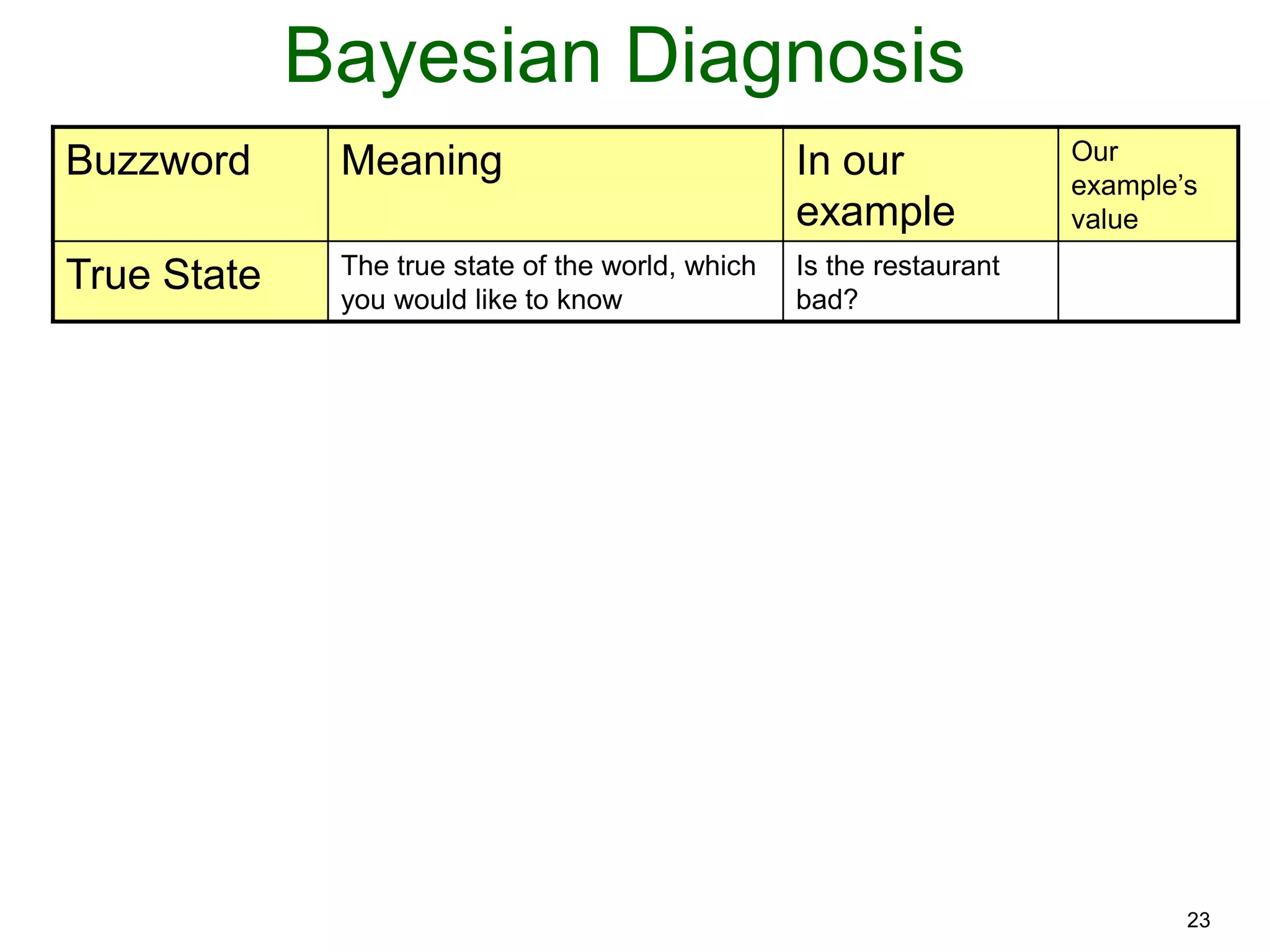
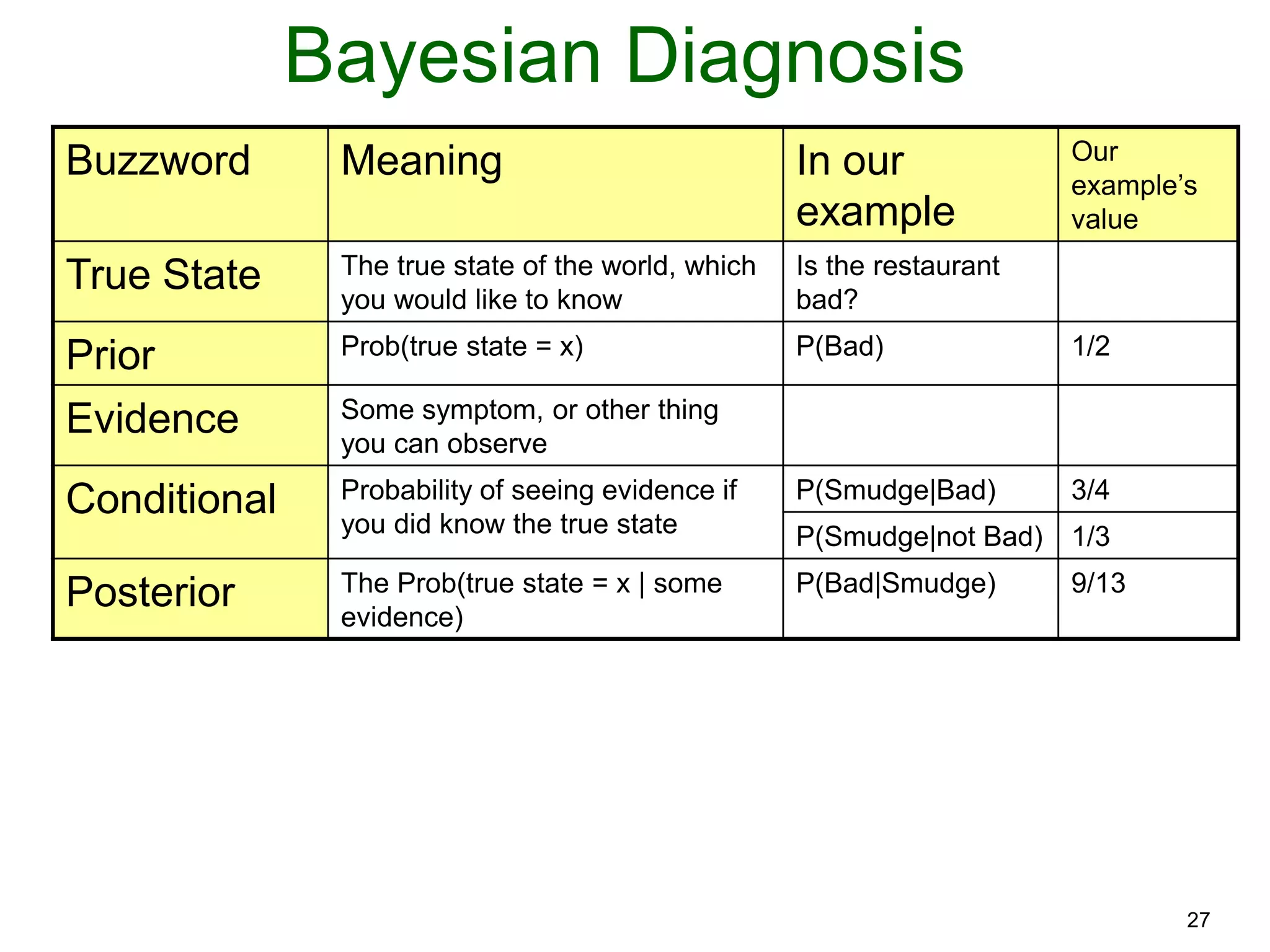
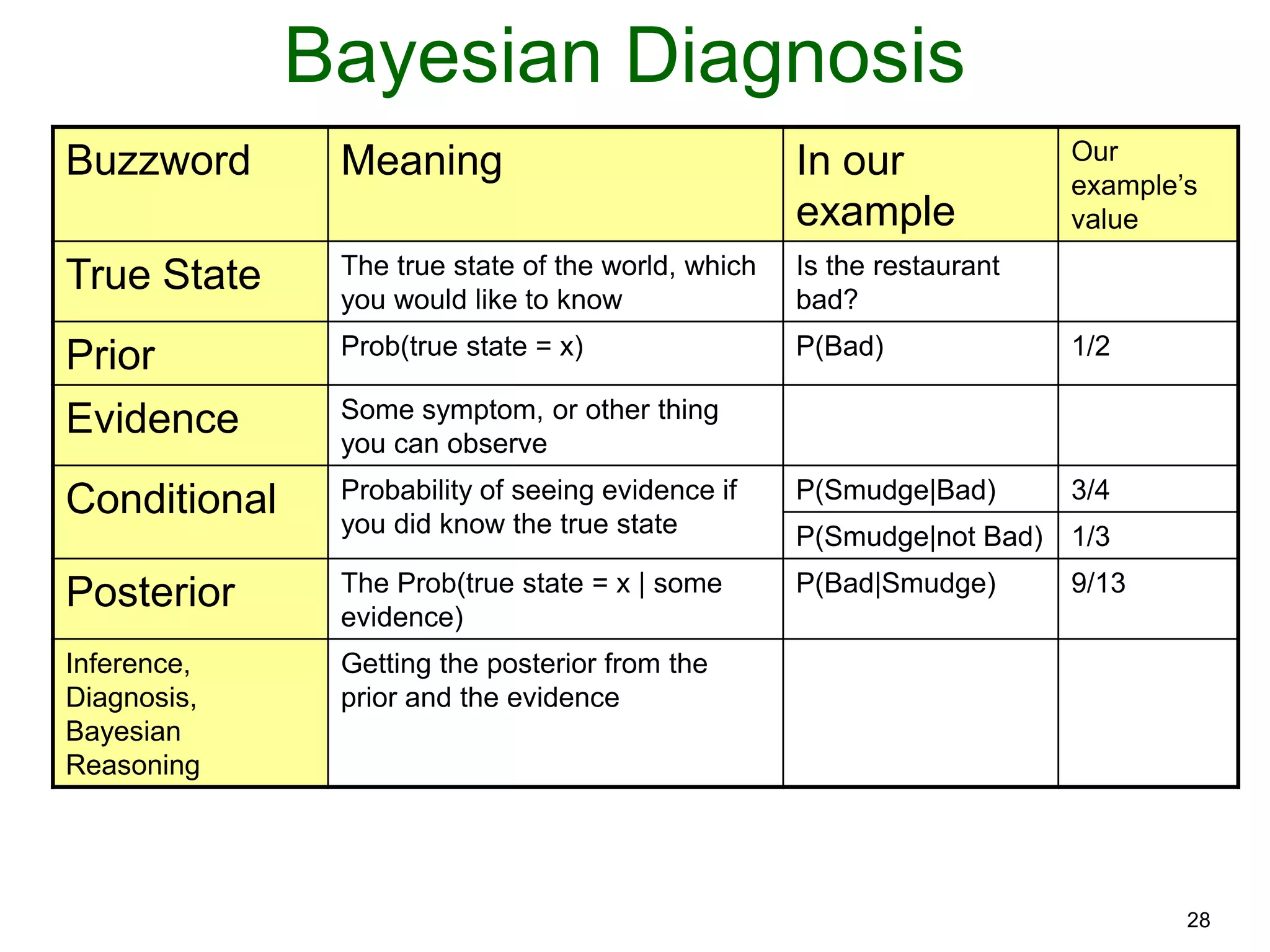
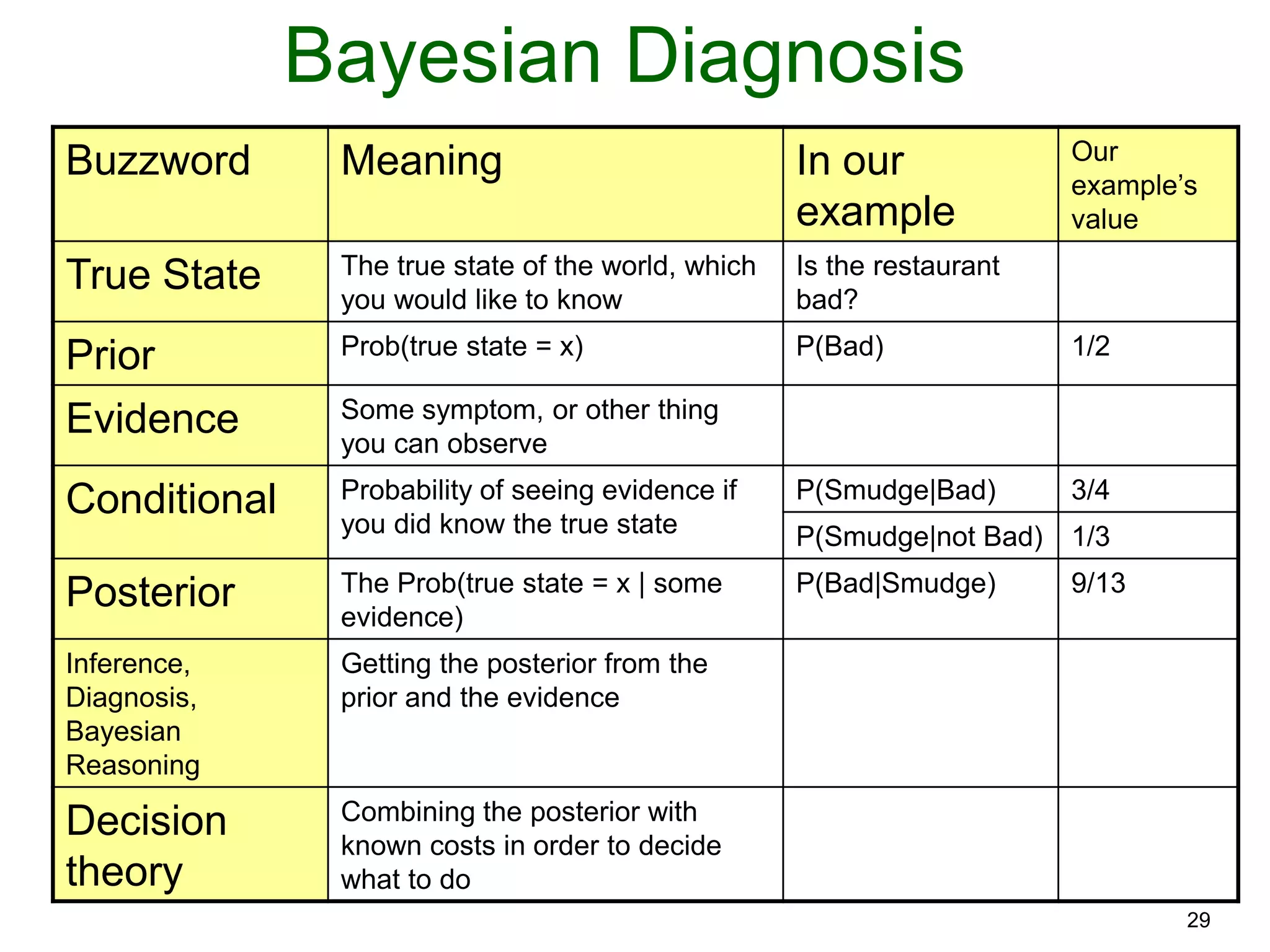
Bayesian Diagnosis
Buzzword Meaning In our
example
Our
example’s
value
True State The true state of the world, which
you would like to know
Is the restaurant
bad?
24
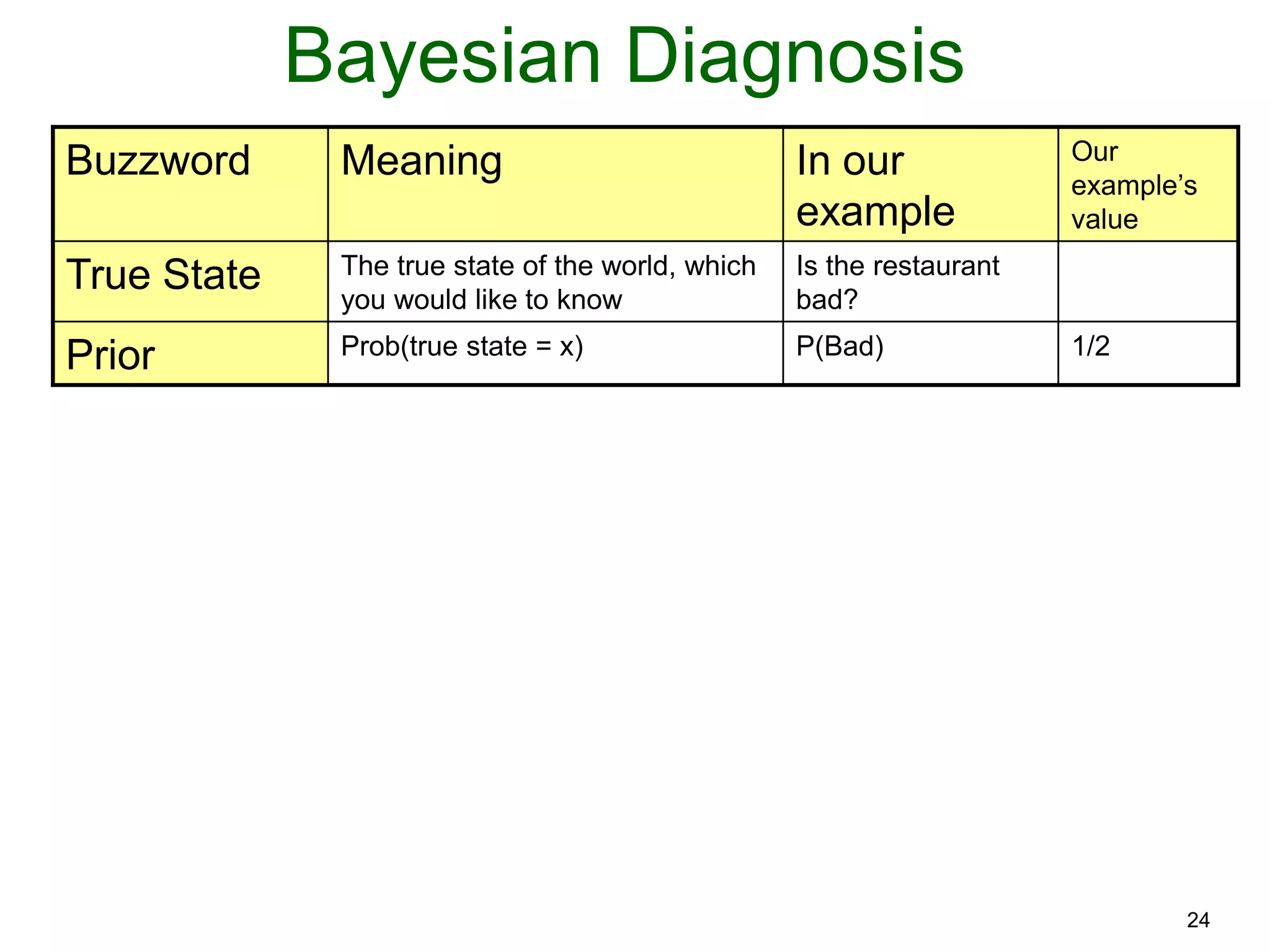
Bayesian Diagnosis
Buzzword Meaning In our
example
Our
example’s
value
True State The true state of the world, which
you would like to know
Is the restaurant
bad?
Prior Prob(true state = x) P(Bad) 1/2
25
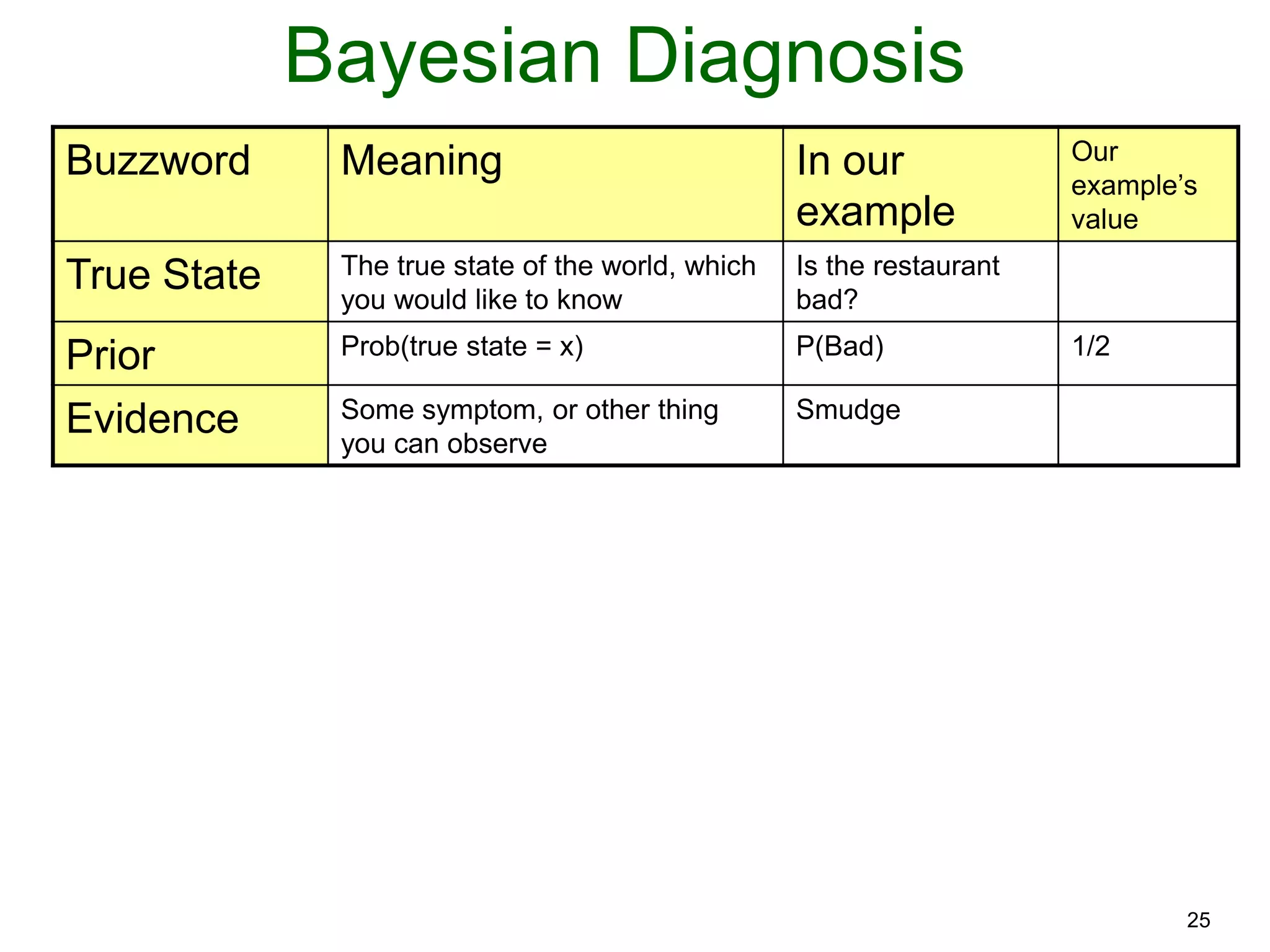
Bayesian Diagnosis
Buzzword Meaning In our
example
Our
example’s
value
True State The true state of the world, which
you would like to know
Is the restaurant
bad?
Prior Prob(true state = x) P(Bad) 1/2
Evidence Some symptom, or other thing
you can observe
Smudge
26
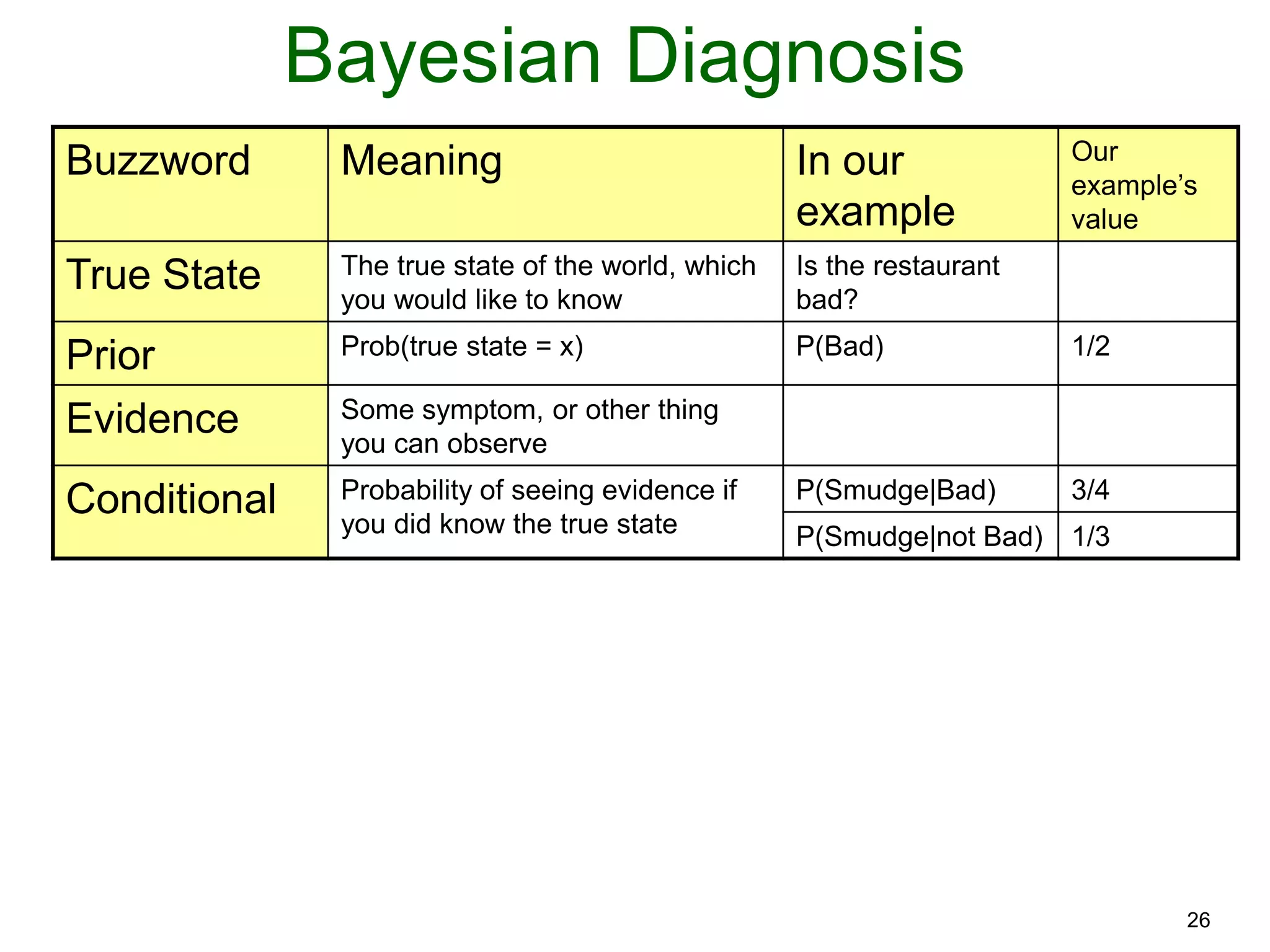
Bayesian Diagnosis
Buzzword Meaning In our
example
Our
example’s
value
True State The true state of the world, which
you would like to know
Is the restaurant
bad?
Prior Prob(true state = x) P(Bad) 1/2
Evidence Some symptom, or other thing
you can observe
Conditional Probability of seeing evidence if
you did know the true state
P(Smudge|Bad) 3/4
P(Smudge|not Bad) 1/3
27
Bayesian Diagnosis
Buzzword Meaning In our
example
Our
example’s
value
True State The true state of the world, which
you would like to know
Is the restaurant
bad?
Prior Prob(true state = x) P(Bad) 1/2
Evidence Some symptom, or other thing
you can observe
Conditional Probability of seeing evidence if
you did know the true state
P(Smudge|Bad) 3/4
P(Smudge|not Bad) 1/3
Posterior The Prob(true state = x | some
evidence)
P(Bad|Smudge) 9/13
28
Bayesian Diagnosis
Buzzword Meaning In our
example
Our
example’s
value
True State The true state of the world, which
you would like to know
Is the restaurant
bad?
Prior Prob(true state = x) P(Bad) 1/2
Evidence Some symptom, or other thing
you can observe
Conditional Probability of seeing evidence if
you did know the true state
P(Smudge|Bad) 3/4
P(Smudge|not Bad) 1/3
Posterior The Prob(true state = x | some
evidence)
P(Bad|Smudge) 9/13
Inference,
Diagnosis,
Bayesian
Reasoning
Getting the posterior from the
prior and the evidence
29
Bayesian Diagnosis
Buzzword Meaning In our
example
Our
example’s
value
True State The true state of the world, which
you would like to know
Is the restaurant
bad?
Prior Prob(true state = x) P(Bad) 1/2
Evidence Some symptom, or other thing
you can observe
Conditional Probability of seeing evidence if
you did know the true state
P(Smudge|Bad) 3/4
P(Smudge|not Bad) 1/3
Posterior The Prob(true state = x | some
evidence)
P(Bad|Smudge) 9/13
Inference,
Diagnosis,
Bayesian
Reasoning
Getting the posterior from the
prior and the evidence
Decision
theory
Combining the posterior with
known costs in order to decide
what to do
30
Many Pieces of Evidence
31
Many Pieces of Evidence
Pat walks in to the surgery.
Pat is sore and has a headache but no cough
32
Many Pieces of Evidence
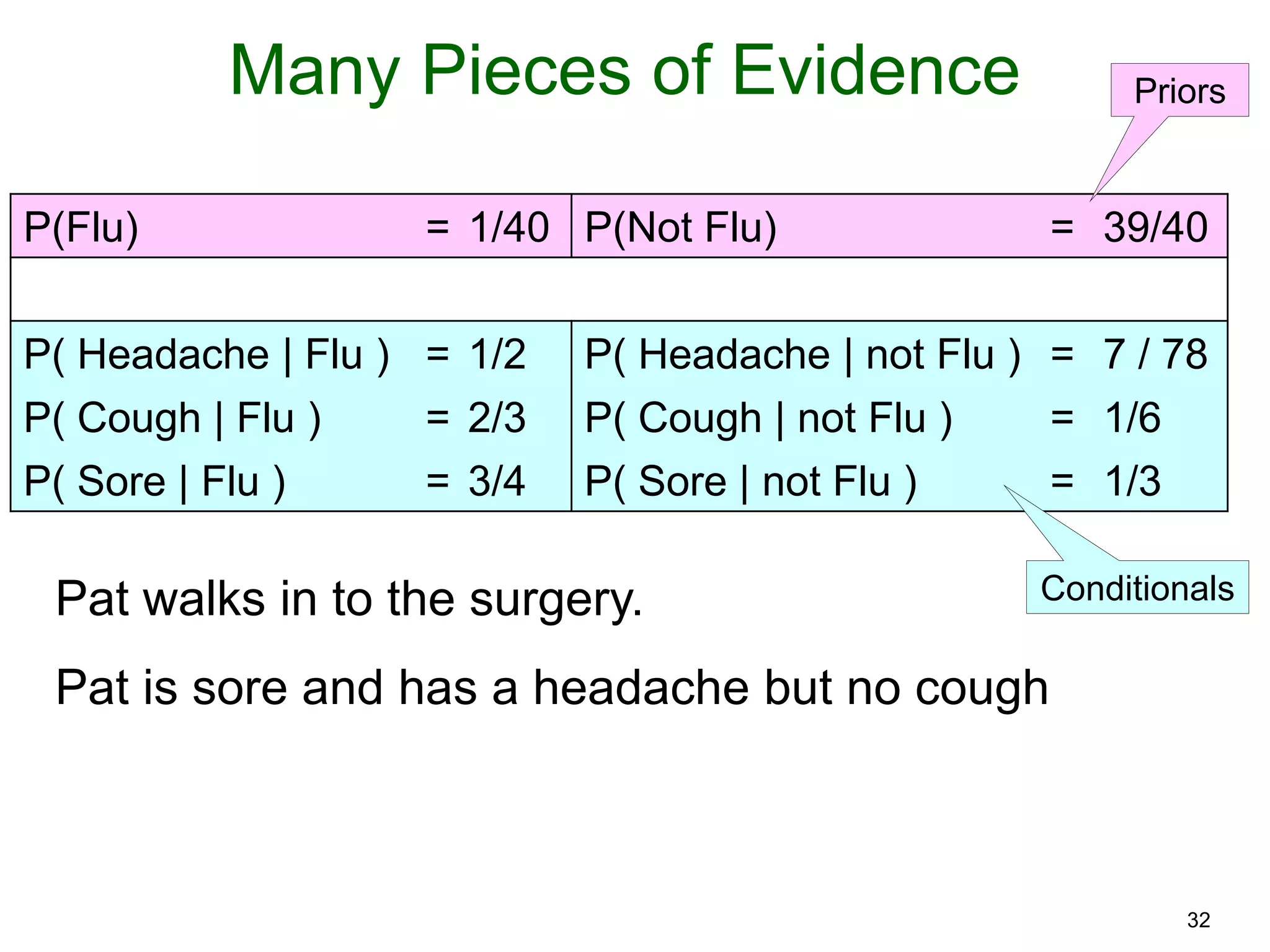
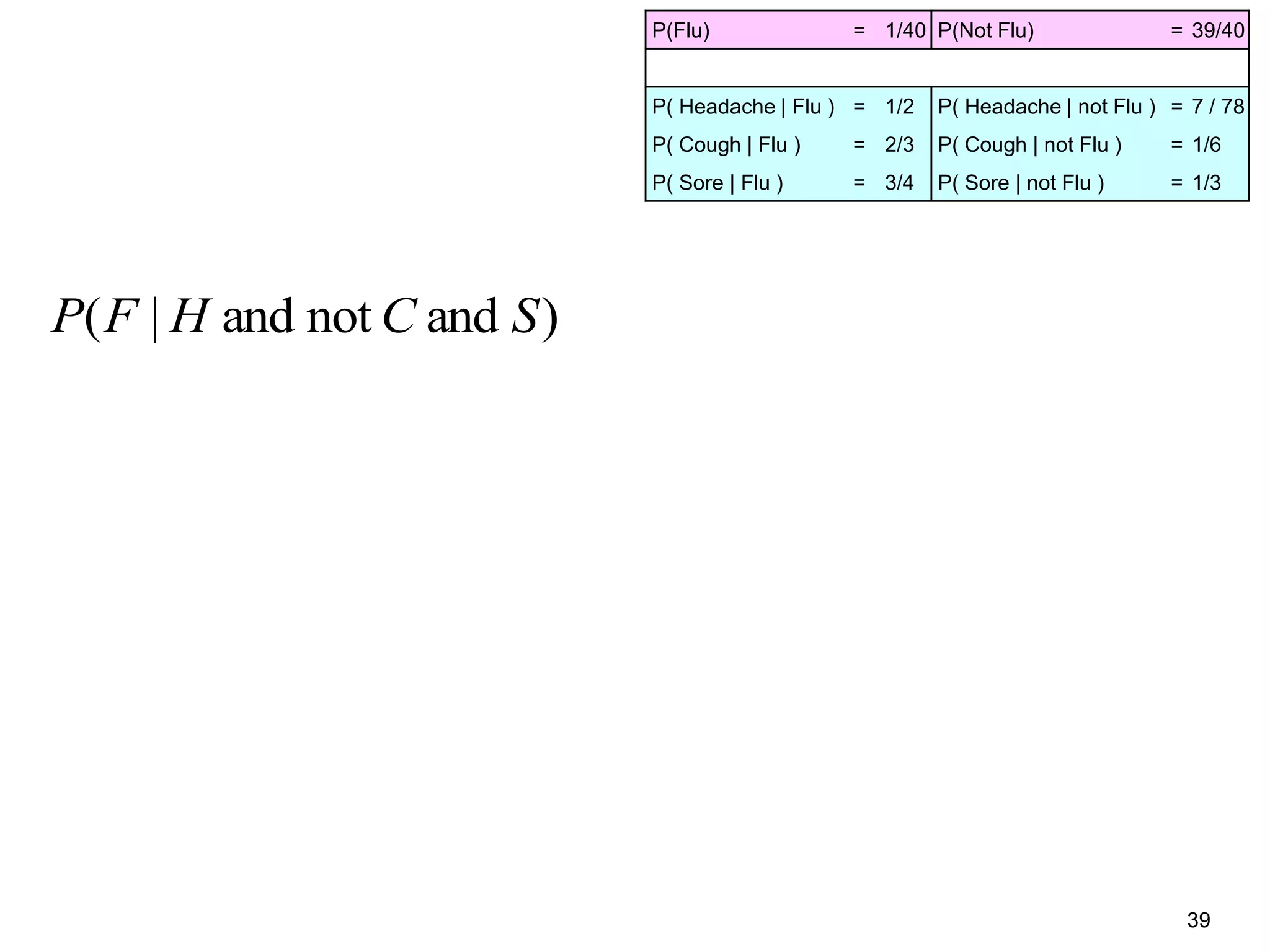
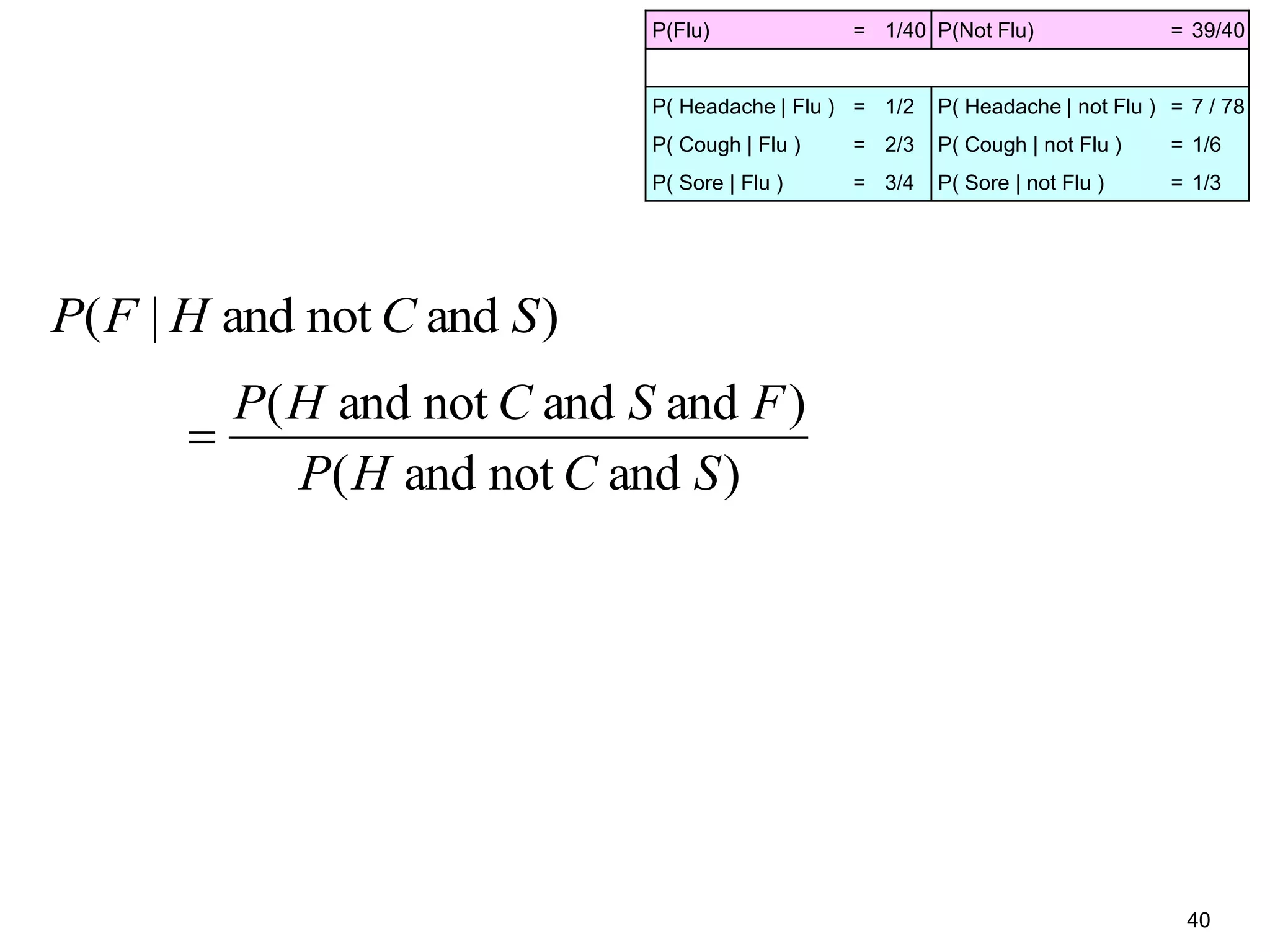
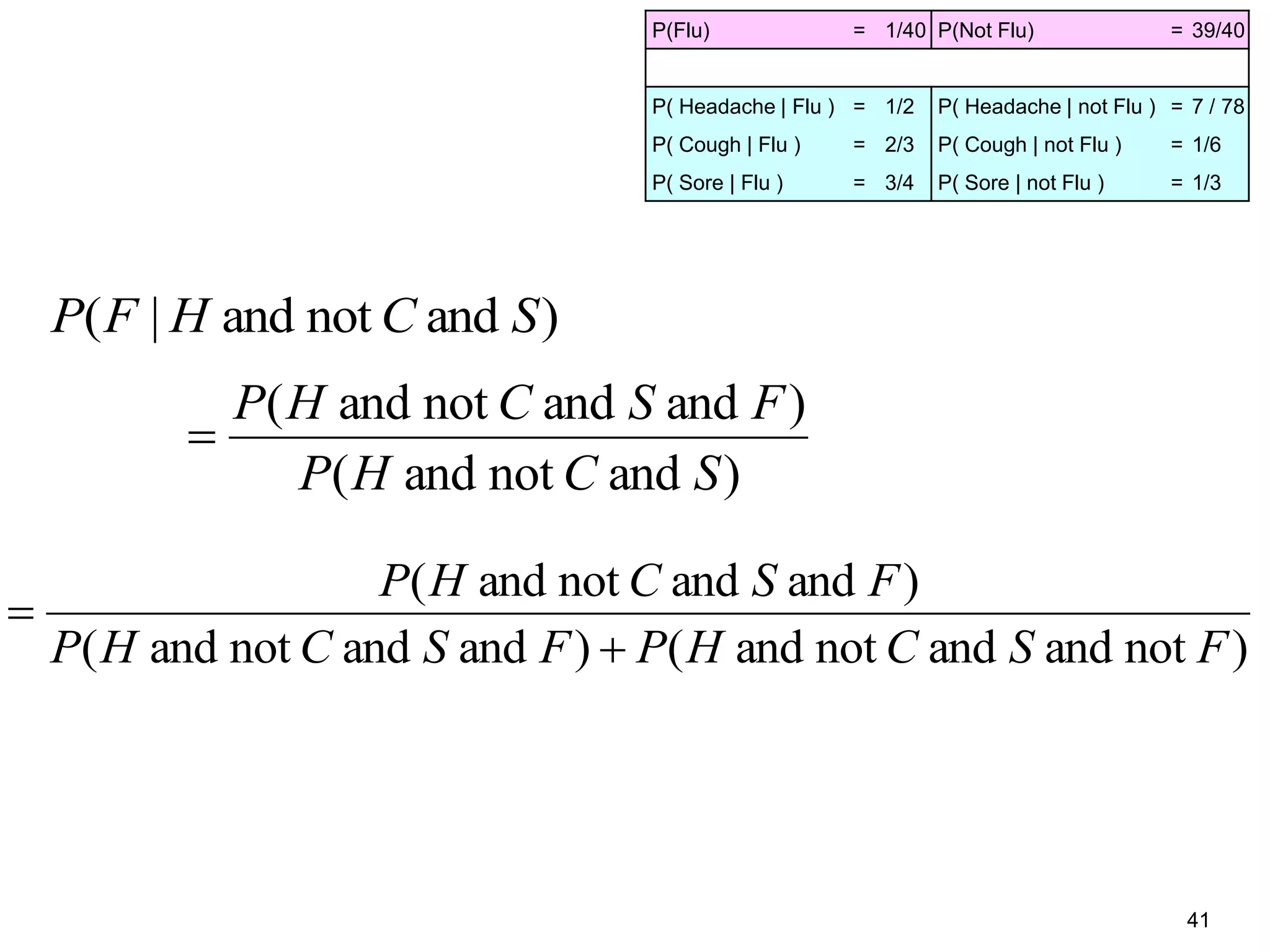
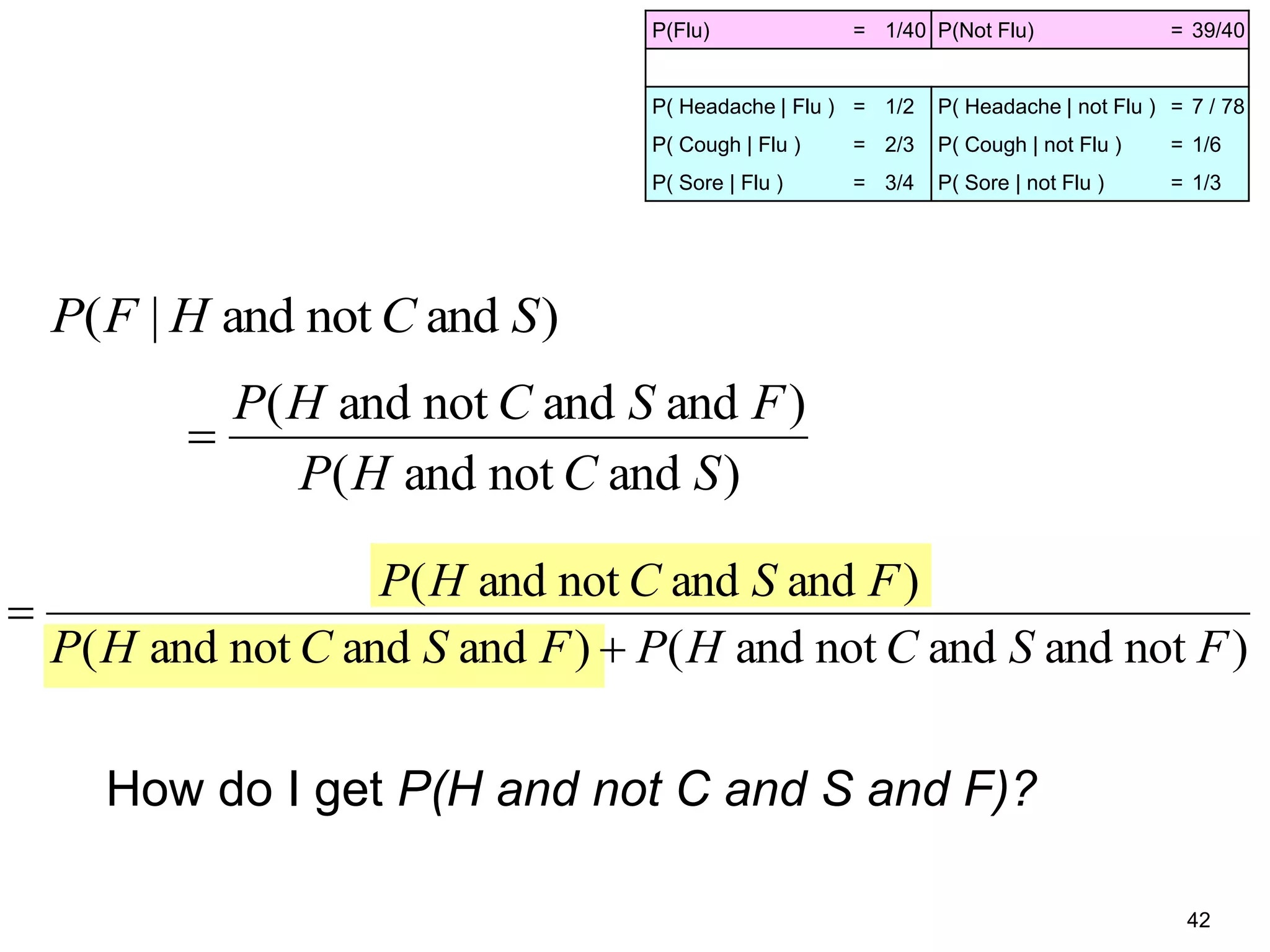
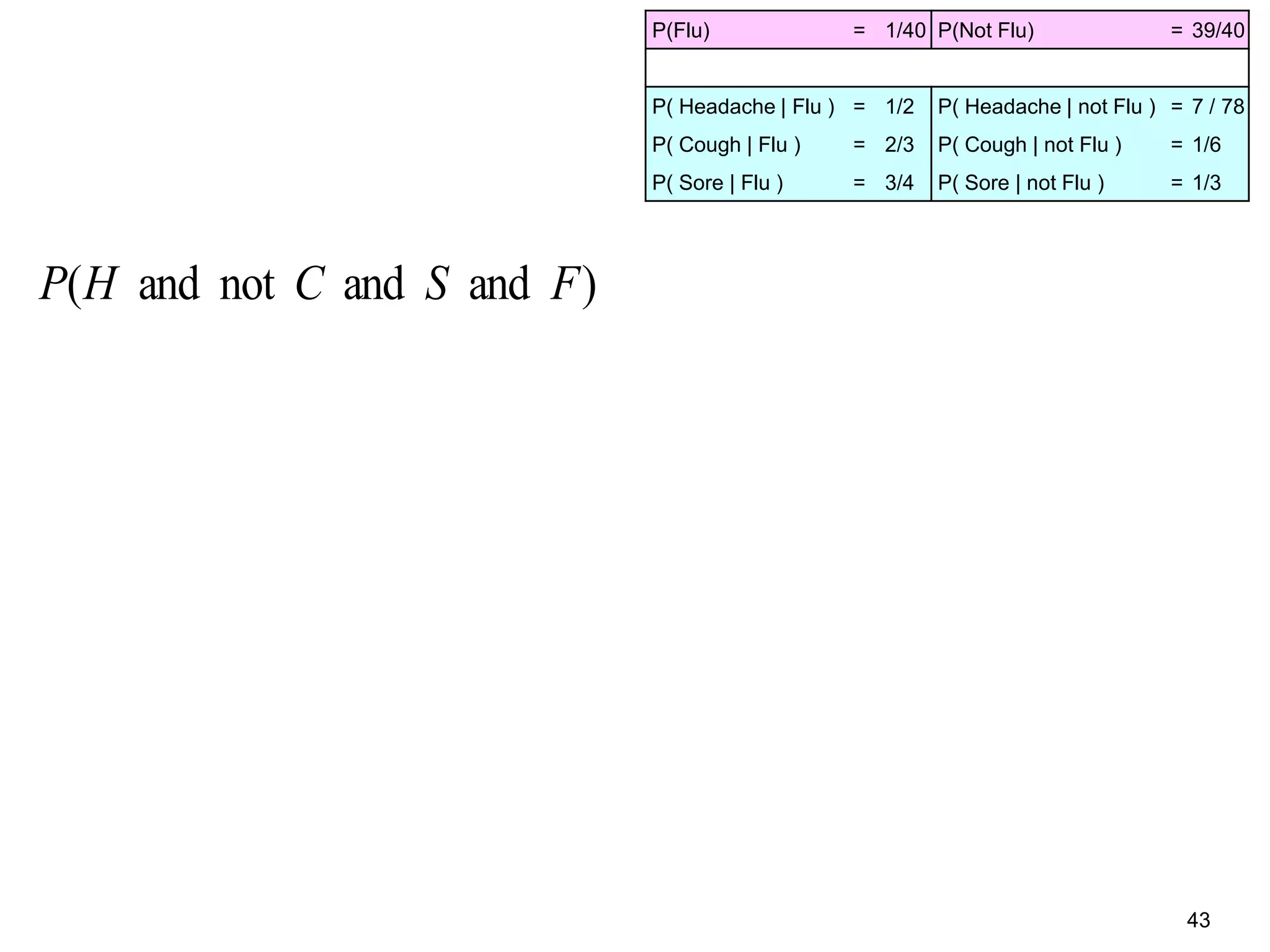
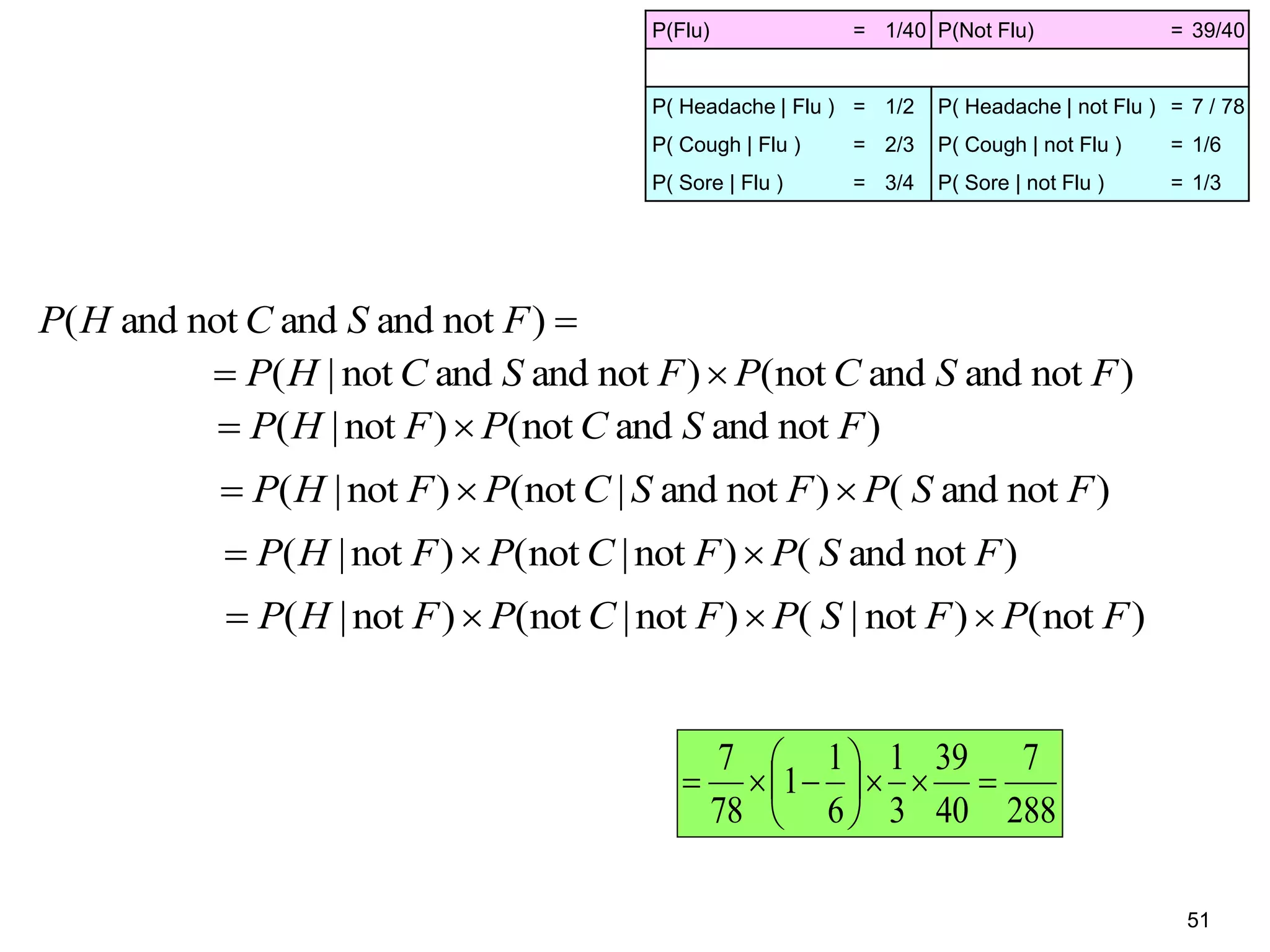
P(Flu) = 1/40 P(Not Flu) = 39/40
P( Headache | Flu ) = 1/2 P( Headache | not Flu ) = 7 / 78
P( Cough | Flu ) = 2/3 P( Cough | not Flu ) = 1/6
P( Sore | Flu ) = 3/4 P( Sore | not Flu ) = 1/3
Pat walks in to the surgery.
Pat is sore and has a headache but no cough
Priors
Conditionals
33
Many Pieces of Evidence
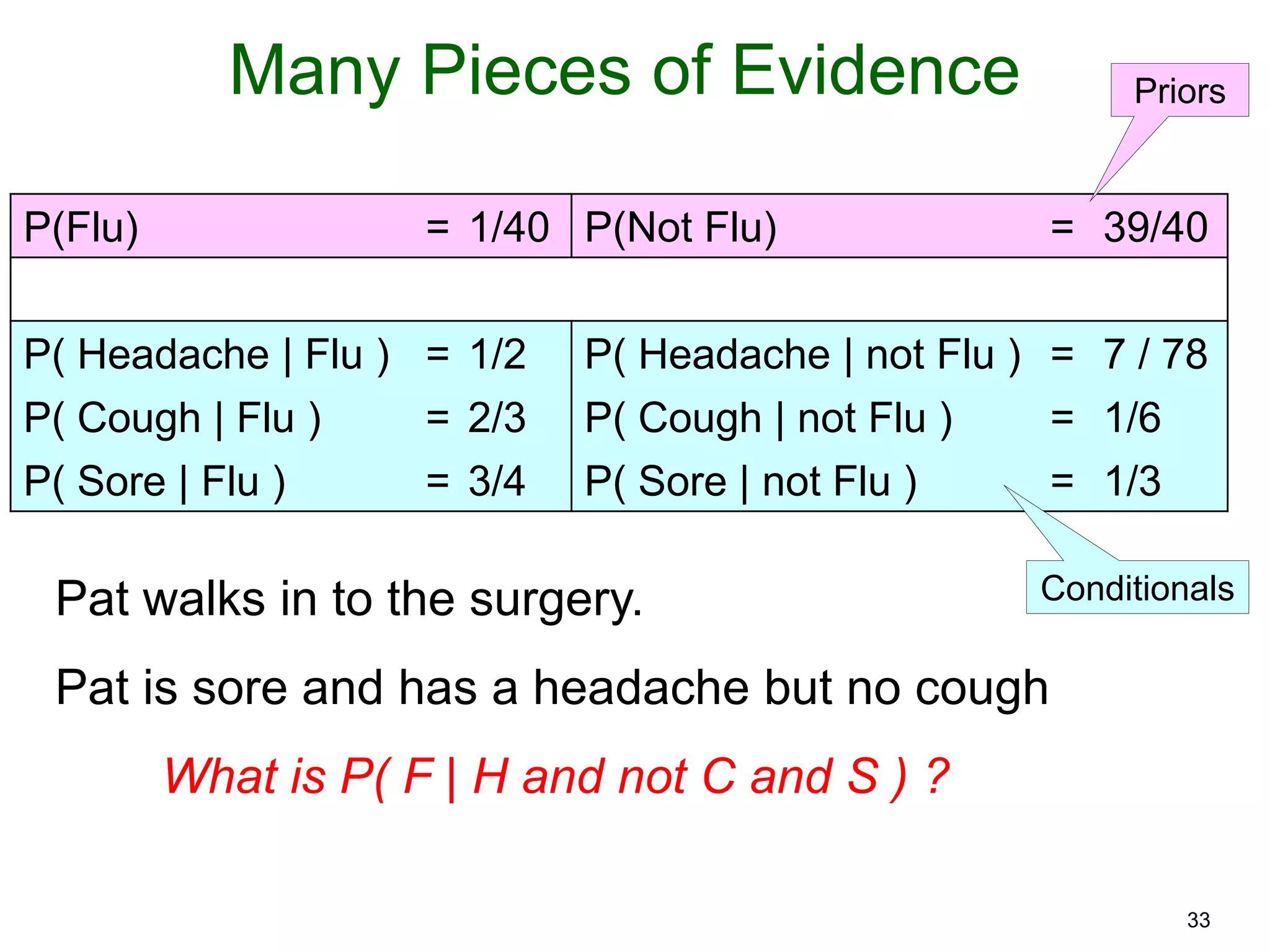
P(Flu) = 1/40 P(Not Flu) = 39/40
P( Headache | Flu ) = 1/2 P( Headache | not Flu ) = 7 / 78
P( Cough | Flu ) = 2/3 P( Cough | not Flu ) = 1/6
P( Sore | Flu ) = 3/4 P( Sore | not Flu ) = 1/3
Pat walks in to the surgery.
Pat is sore and has a headache but no cough
What is P( F | H and not C and S ) ?
Priors
Conditionals
34
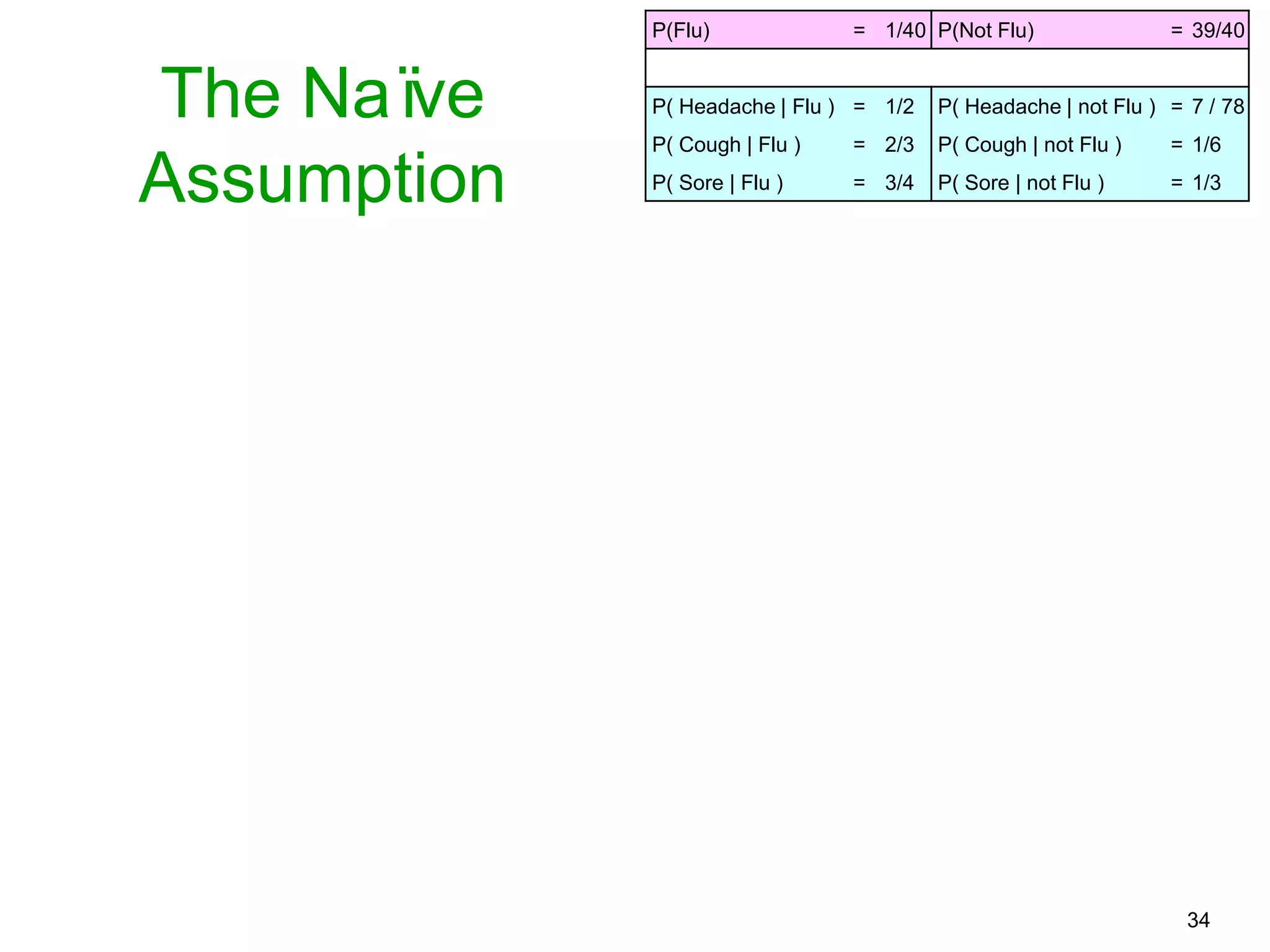
P(Flu) = 1/40 P(Not Flu) = 39/40
P( Headache | Flu ) = 1/2 P( Headache | not Flu ) = 7 / 78
P( Cough | Flu ) = 2/3 P( Cough | not Flu ) = 1/6
P( Sore | Flu ) = 3/4 P( Sore | not Flu ) = 1/3
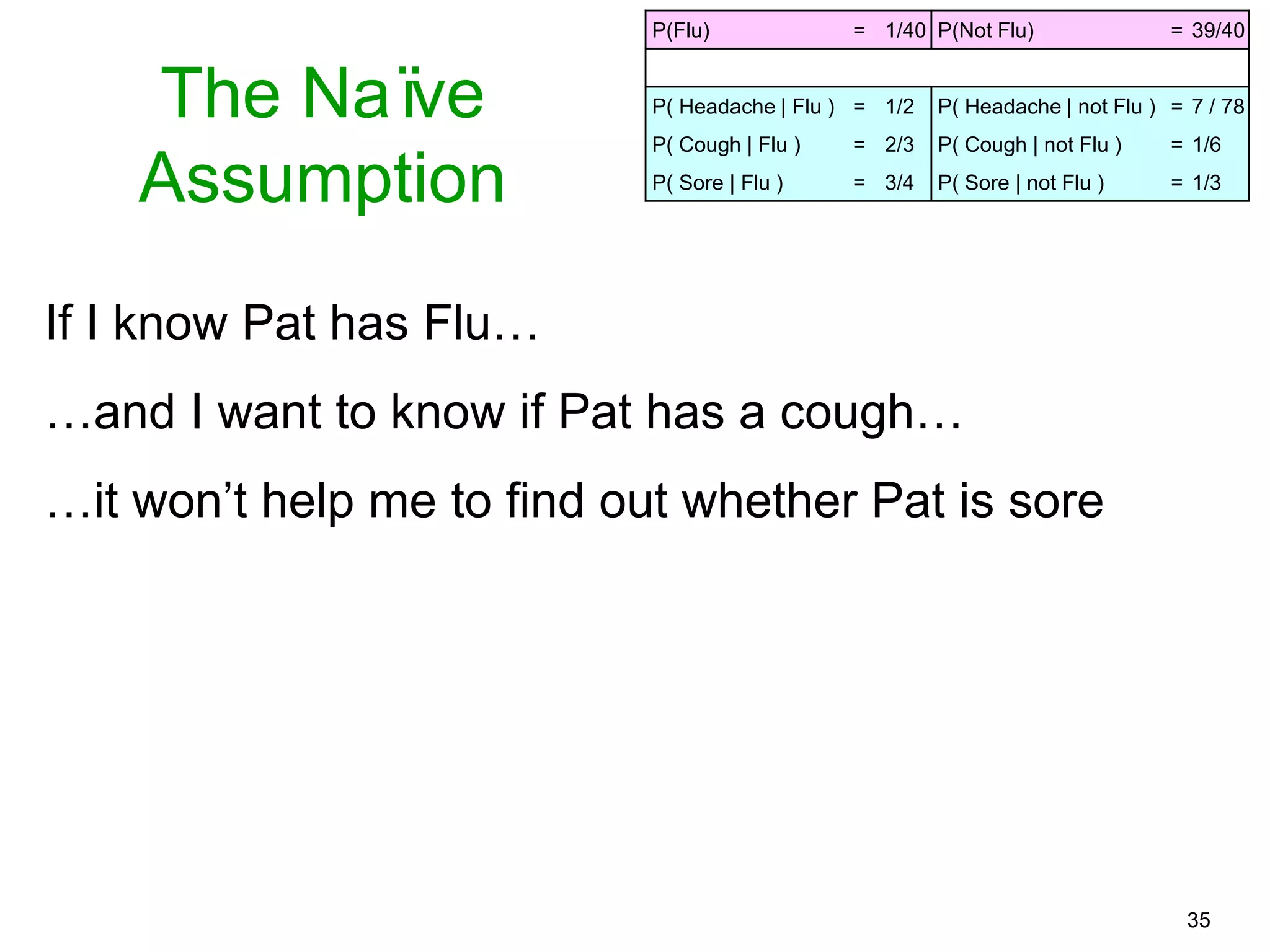
The Naïve
Assumption
35
If I know Pat has Flu…
…and I want to know if Pat has a cough…
…it won’t help me to find out whether Pat is sore
P(Flu) = 1/40 P(Not Flu) = 39/40
P( Headache | Flu ) = 1/2 P( Headache | not Flu ) = 7 / 78
P( Cough | Flu ) = 2/3 P( Cough | not Flu ) = 1/6
P( Sore | Flu ) = 3/4 P( Sore | not Flu ) = 1/3
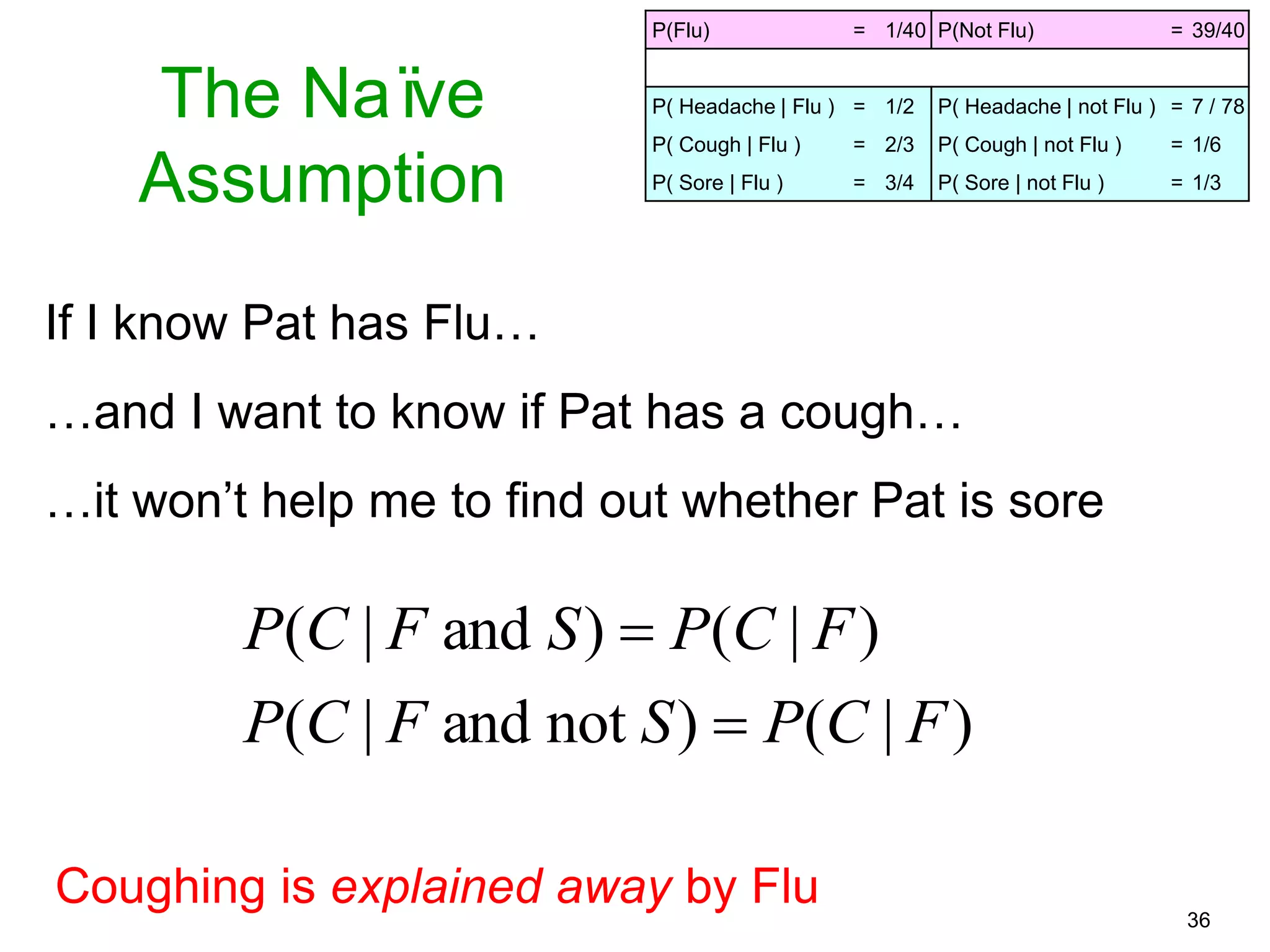
The Naïve
Assumption
36
If I know Pat has Flu…
…and I want to know if Pat has a cough…
…it won’t help me to find out whether Pat is sore
)|()notand|(
)|()and|(
FCPSFCP
FCPSFCP


Coughing is explained away by Flu
P(Flu) = 1/40 P(Not Flu) = 39/40
P( Headache | Flu ) = 1/2 P( Headache | not Flu ) = 7 / 78
P( Cough | Flu ) = 2/3 P( Cough | not Flu ) = 1/6
P( Sore | Flu ) = 3/4 P( Sore | not Flu ) = 1/3
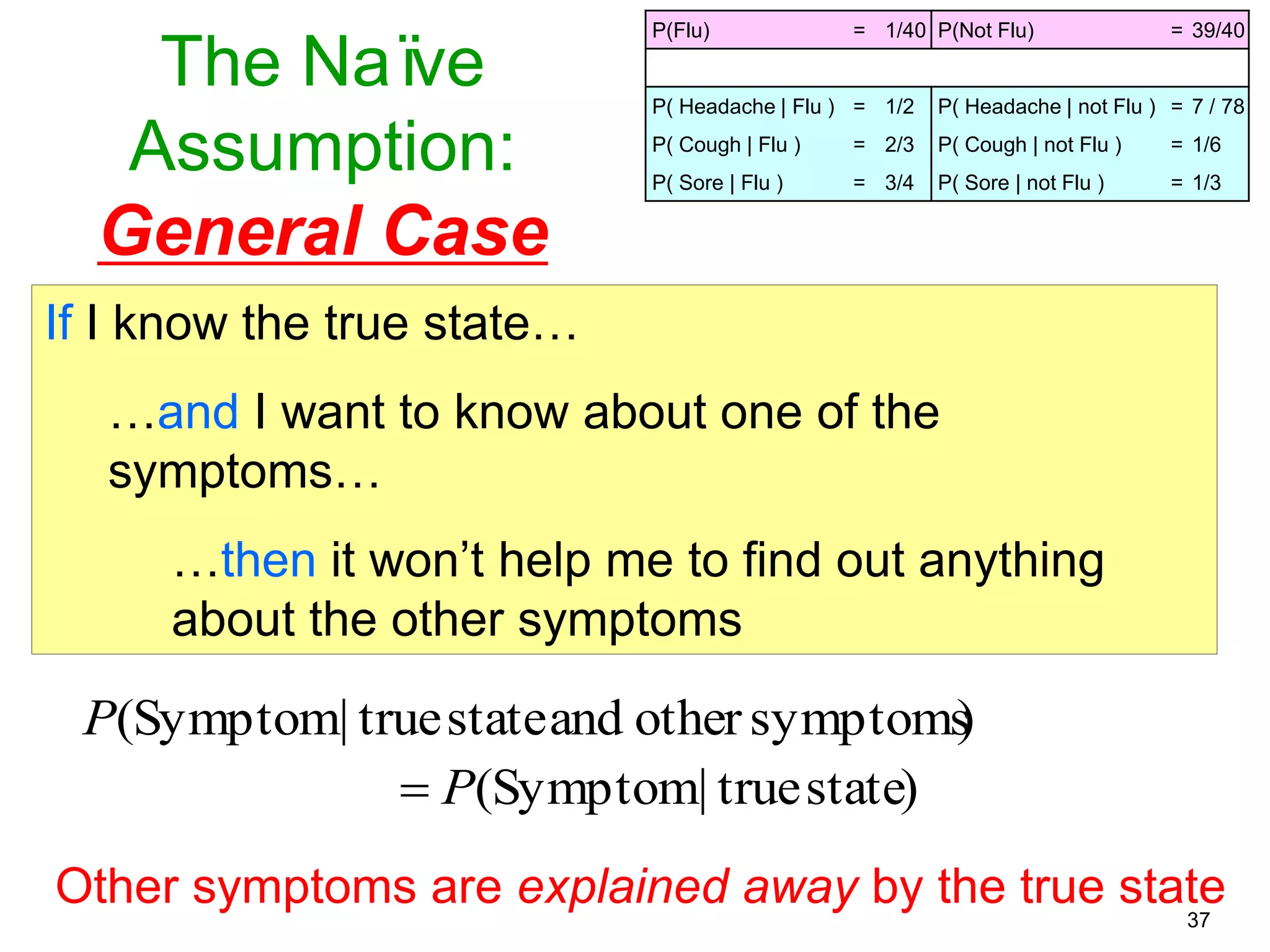
The Naïve
Assumption
37
P(Flu) = 1/40 P(Not Flu) = 39/40
P( Headache | Flu ) = 1/2 P( Headache | not Flu ) = 7 / 78
P( Cough | Flu ) = 2/3 P( Cough | not Flu ) = 1/6
P( Sore | Flu ) = 3/4 P( Sore | not Flu ) = 1/3
The Naïve
Assumption:
General Case
If I know the true state…
…and I want to know about one of the
symptoms…
…then it won’t help me to find out anything
about the other symptoms
)symptomsotherandstatetrue|Symptom(P
Other symptoms are explained away by the true state
)statetrue|Symptom(P
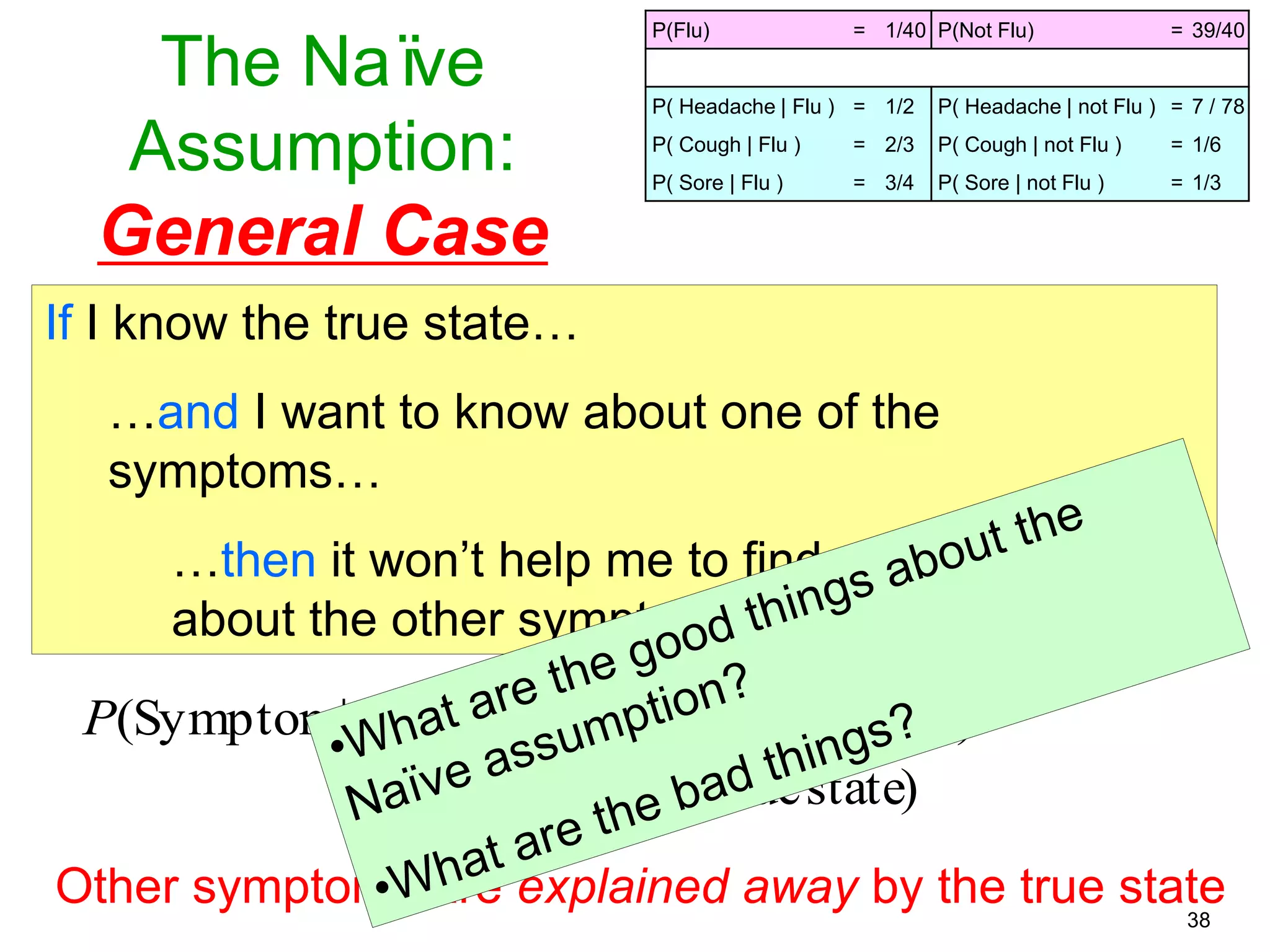
38
P(Flu) = 1/40 P(Not Flu) = 39/40
P( Headache | Flu ) = 1/2 P( Headache | not Flu ) = 7 / 78
P( Cough | Flu ) = 2/3 P( Cough | not Flu ) = 1/6
P( Sore | Flu ) = 3/4 P( Sore | not Flu ) = 1/3
The Naïve
Assumption:
General Case
If I know the true state…
…and I want to know about one of the
symptoms…
…then it won’t help me to find out anything
about the other symptoms
)symptomsotherandstatetrue|Symptom(P
Other symptoms are explained away by the true state
)statetrue|Symptom(P
39
)andnotand|( SCHFP
P(Flu) = 1/40 P(Not Flu) = 39/40
P( Headache | Flu ) = 1/2 P( Headache | not Flu ) = 7 / 78
P( Cough | Flu ) = 2/3 P( Cough | not Flu ) = 1/6
P( Sore | Flu ) = 3/4 P( Sore | not Flu ) = 1/3
40
)andnotand|( SCHFP
)andnotand(
)andandnotand(
SCHP
FSCHP

P(Flu) = 1/40 P(Not Flu) = 39/40
P( Headache | Flu ) = 1/2 P( Headache | not Flu ) = 7 / 78
P( Cough | Flu ) = 2/3 P( Cough | not Flu ) = 1/6
P( Sore | Flu ) = 3/4 P( Sore | not Flu ) = 1/3
41
)andnotand|( SCHFP
)andnotand(
)andandnotand(
SCHP
FSCHP

)notandandnotand()andandnotand(
)andandnotand(
FSCHPFSCHP
FSCHP


P(Flu) = 1/40 P(Not Flu) = 39/40
P( Headache | Flu ) = 1/2 P( Headache | not Flu ) = 7 / 78
P( Cough | Flu ) = 2/3 P( Cough | not Flu ) = 1/6
P( Sore | Flu ) = 3/4 P( Sore | not Flu ) = 1/3
42
)andnotand|( SCHFP
)andnotand(
)andandnotand(
SCHP
FSCHP

)notandandnotand()andandnotand(
)andandnotand(
FSCHPFSCHP
FSCHP


How do I get P(H and not C and S and F)?
P(Flu) = 1/40 P(Not Flu) = 39/40
P( Headache | Flu ) = 1/2 P( Headache | not Flu ) = 7 / 78
P( Cough | Flu ) = 2/3 P( Cough | not Flu ) = 1/6
P( Sore | Flu ) = 3/4 P( Sore | not Flu ) = 1/3
43
P(Flu) = 1/40 P(Not Flu) = 39/40
P( Headache | Flu ) = 1/2 P( Headache | not Flu ) = 7 / 78
P( Cough | Flu ) = 2/3 P( Cough | not Flu ) = 1/6
P( Sore | Flu ) = 3/4 P( Sore | not Flu ) = 1/3
)andandnotand( FSCHP
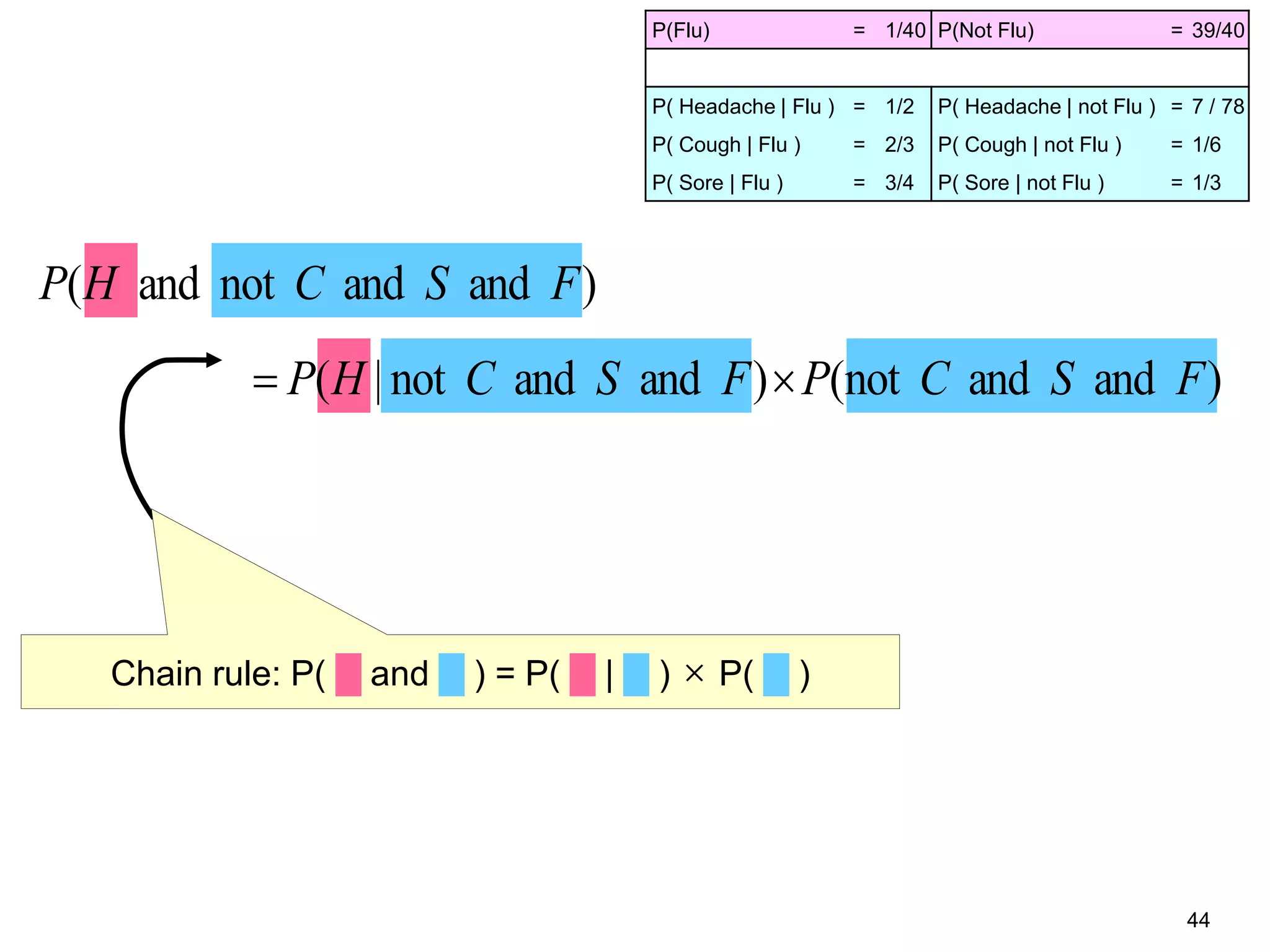
44
P(Flu) = 1/40 P(Not Flu) = 39/40
P( Headache | Flu ) = 1/2 P( Headache | not Flu ) = 7 / 78
P( Cough | Flu ) = 2/3 P( Cough | not Flu ) = 1/6
P( Sore | Flu ) = 3/4 P( Sore | not Flu ) = 1/3
)andandnot()andandnot|( FSCPFSCHP 
)andandnotand( FSCHP
Chain rule: P( █ and █ ) = P( █ | █ ) × P( █ )
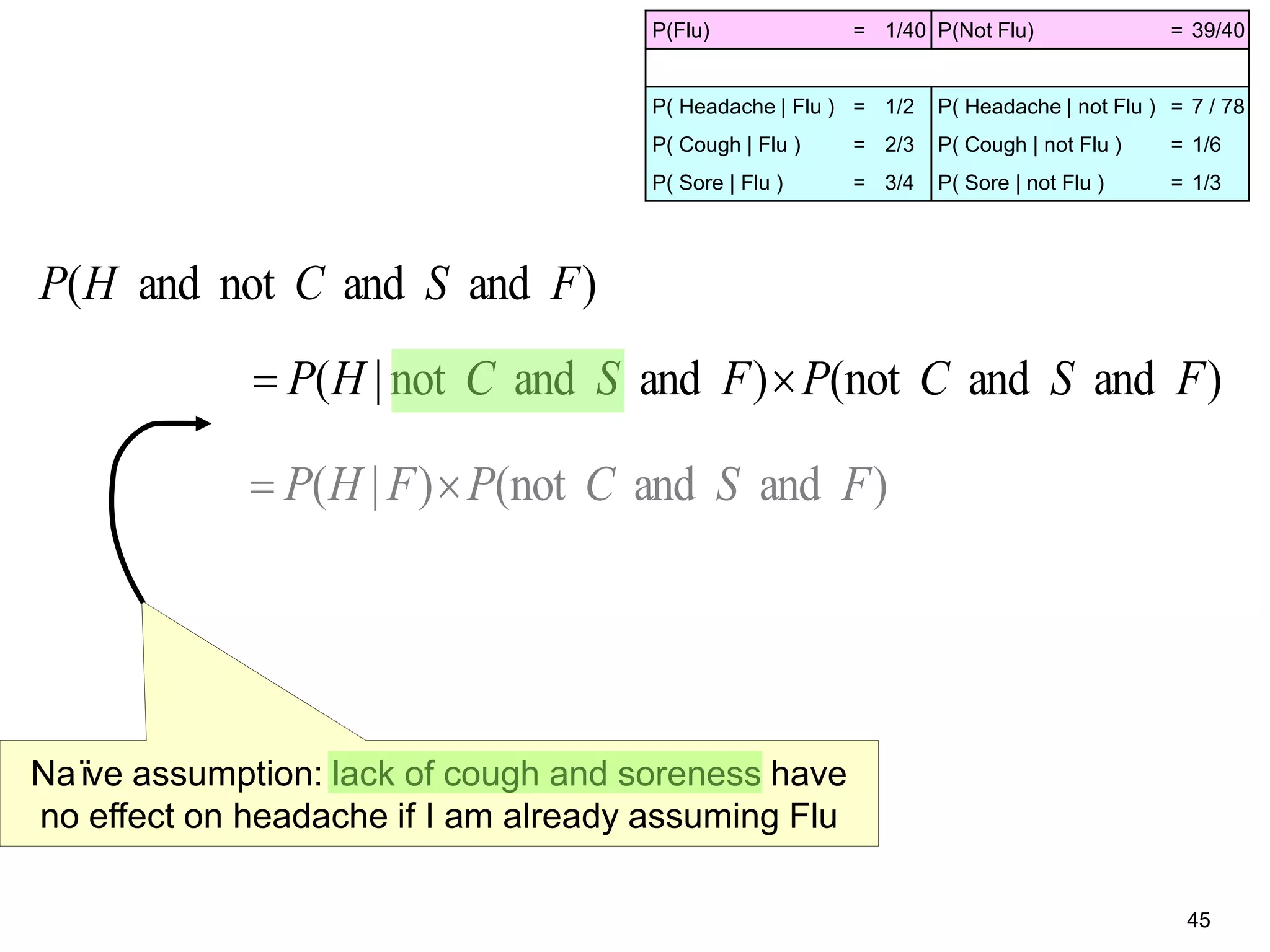
45
P(Flu) = 1/40 P(Not Flu) = 39/40
P( Headache | Flu ) = 1/2 P( Headache | not Flu ) = 7 / 78
P( Cough | Flu ) = 2/3 P( Cough | not Flu ) = 1/6
P( Sore | Flu ) = 3/4 P( Sore | not Flu ) = 1/3
)andandnot()andandnot|( FSCPFSCHP 
)andandnotand( FSCHP
Naïve assumption: lack of cough and soreness have
no effect on headache if I am already assuming Flu
)andandnot()|( FSCPFHP 
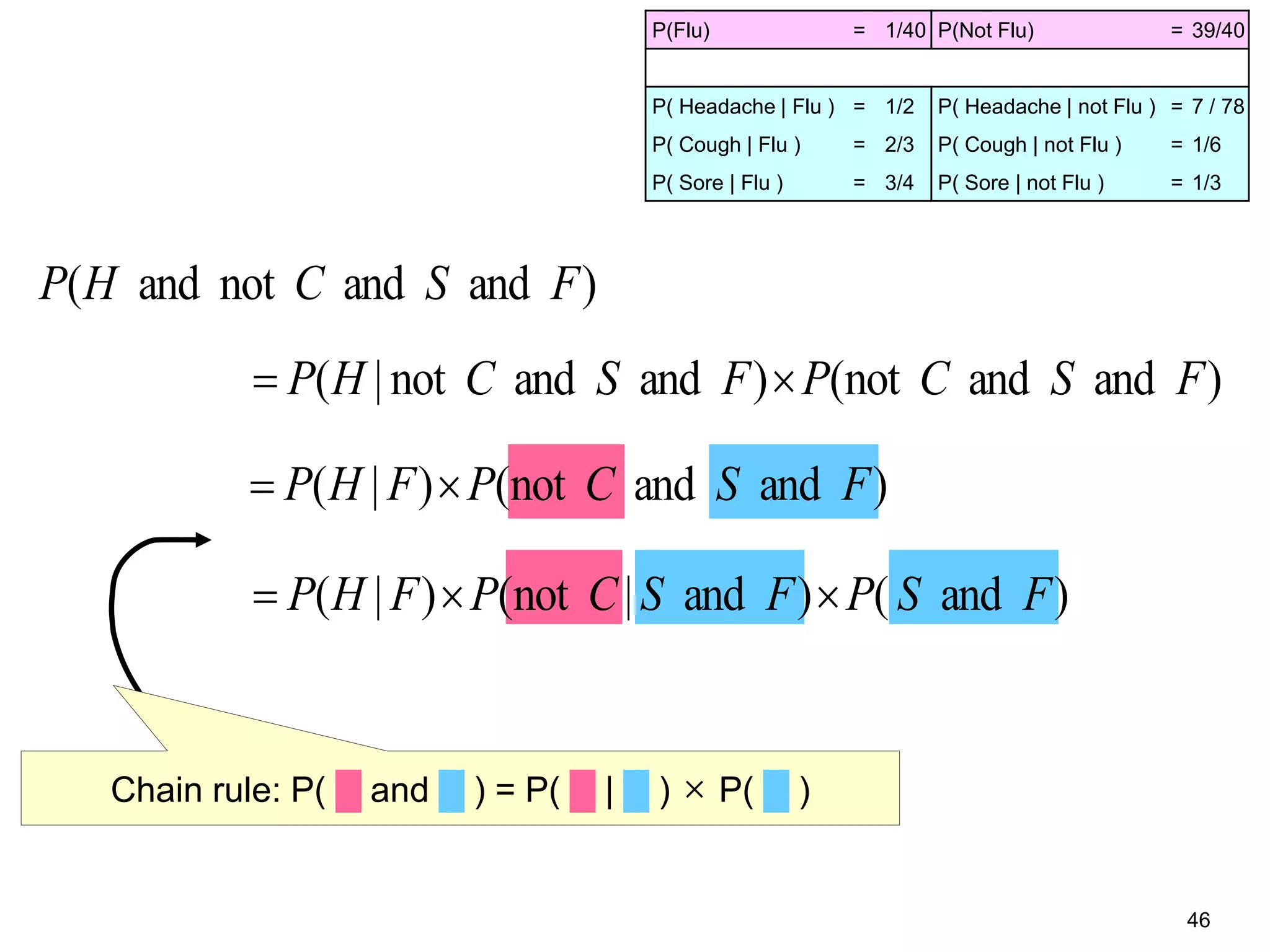
46
P(Flu) = 1/40 P(Not Flu) = 39/40
P( Headache | Flu ) = 1/2 P( Headache | not Flu ) = 7 / 78
P( Cough | Flu ) = 2/3 P( Cough | not Flu ) = 1/6
P( Sore | Flu ) = 3/4 P( Sore | not Flu ) = 1/3
)andandnot()andandnot|( FSCPFSCHP 
)andandnot()|( FSCPFHP 
)and()and|not()|( FSPFSCPFHP 
)andandnotand( FSCHP
Chain rule: P( █ and █ ) = P( █ | █ ) × P( █ )
47
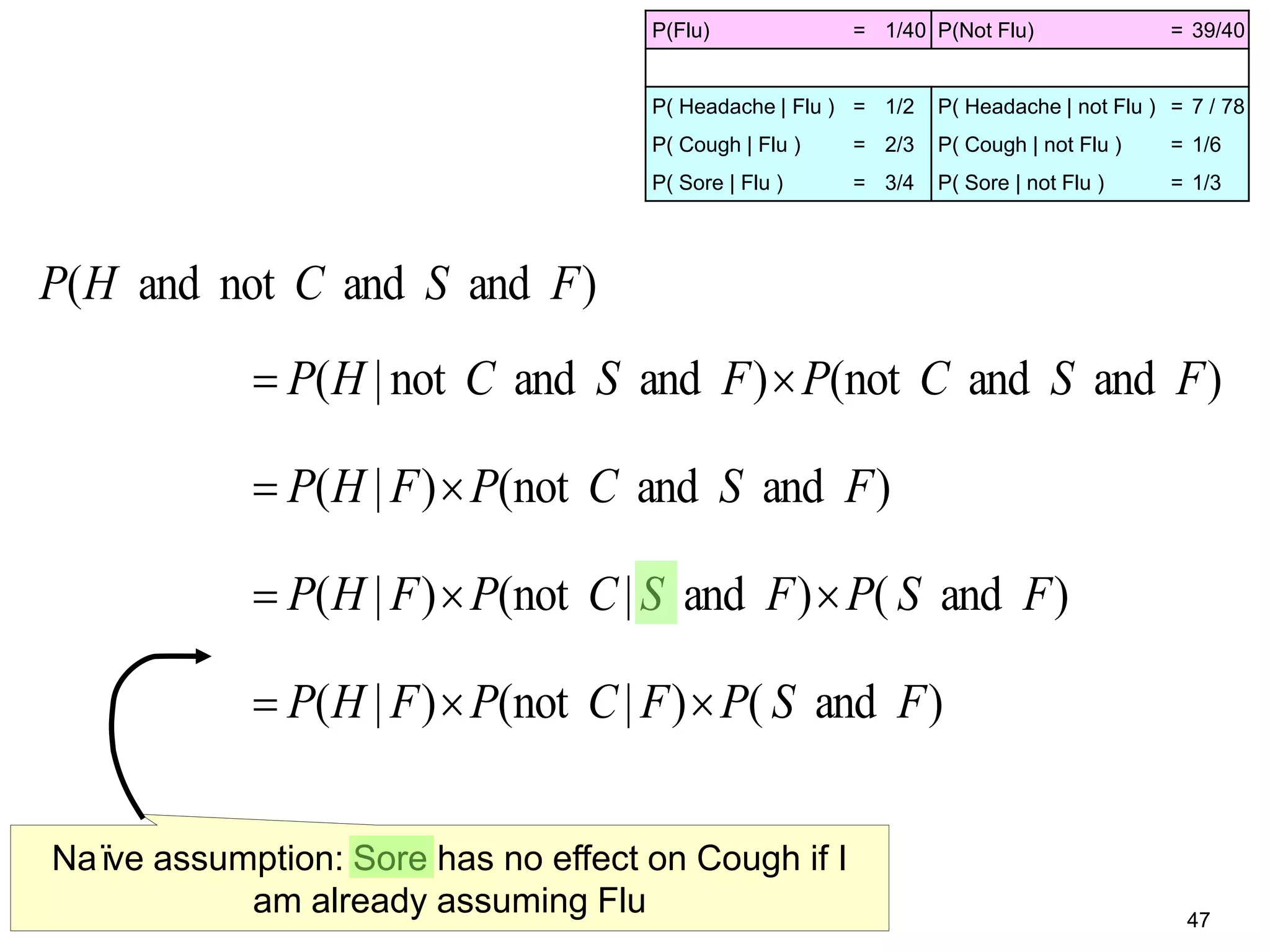
P(Flu) = 1/40 P(Not Flu) = 39/40
P( Headache | Flu ) = 1/2 P( Headache | not Flu ) = 7 / 78
P( Cough | Flu ) = 2/3 P( Cough | not Flu ) = 1/6
P( Sore | Flu ) = 3/4 P( Sore | not Flu ) = 1/3
)andandnot()andandnot|( FSCPFSCHP 
)andandnot()|( FSCPFHP 
)and()and|not()|( FSPFSCPFHP 
)and()|not()|( FSPFCPFHP 
)andandnotand( FSCHP
Naïve assumption: Sore has no effect on Cough if I
am already assuming Flu
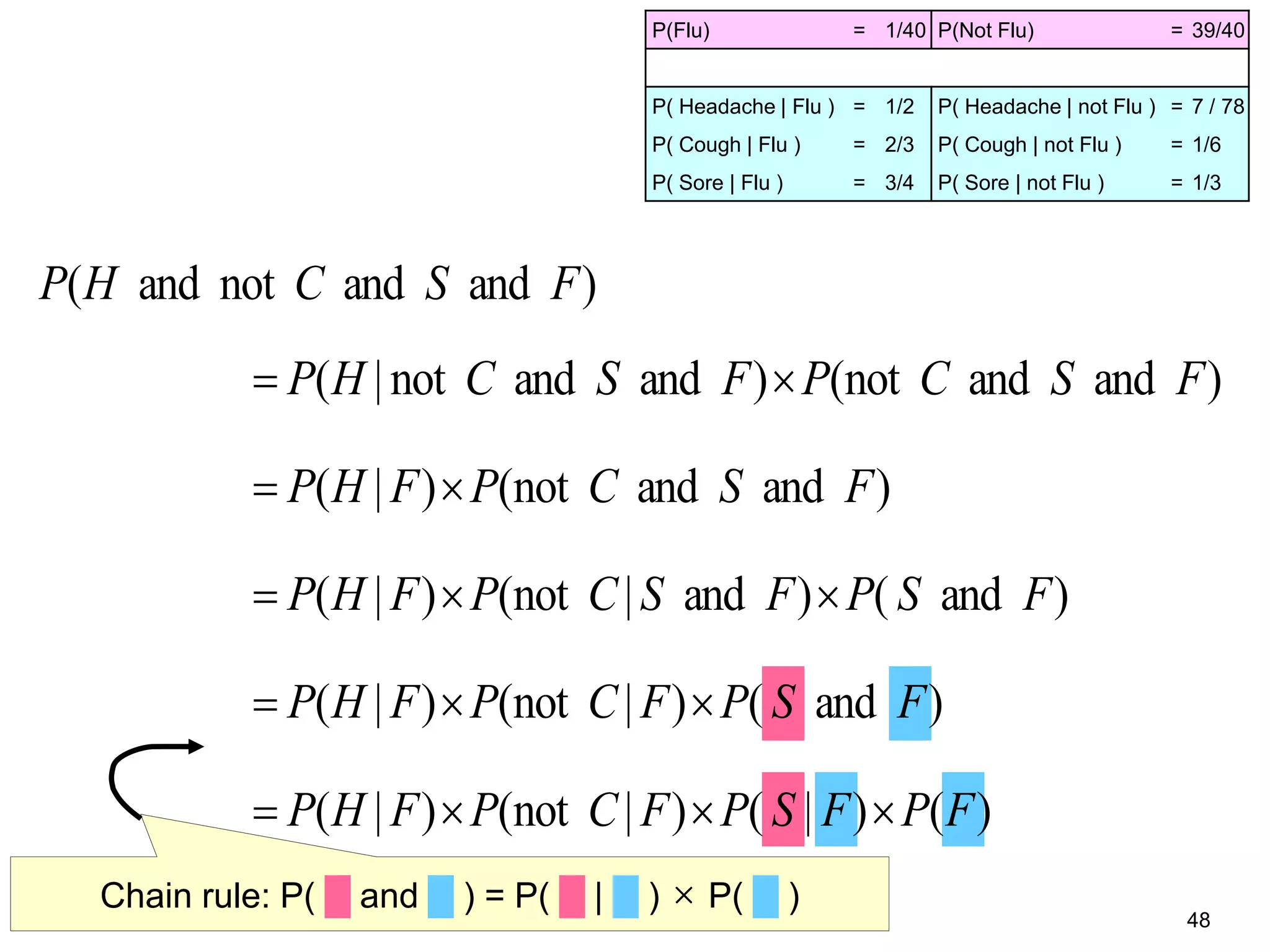
48
P(Flu) = 1/40 P(Not Flu) = 39/40
P( Headache | Flu ) = 1/2 P( Headache | not Flu ) = 7 / 78
P( Cough | Flu ) = 2/3 P( Cough | not Flu ) = 1/6
P( Sore | Flu ) = 3/4 P( Sore | not Flu ) = 1/3
)andandnot()andandnot|( FSCPFSCHP 
)andandnot()|( FSCPFHP 
)and()and|not()|( FSPFSCPFHP 
)and()|not()|( FSPFCPFHP 
)()|()|not()|( FPFSPFCPFHP 
)andandnotand( FSCHP
Chain rule: P( █ and █ ) = P( █ | █ ) × P( █ )
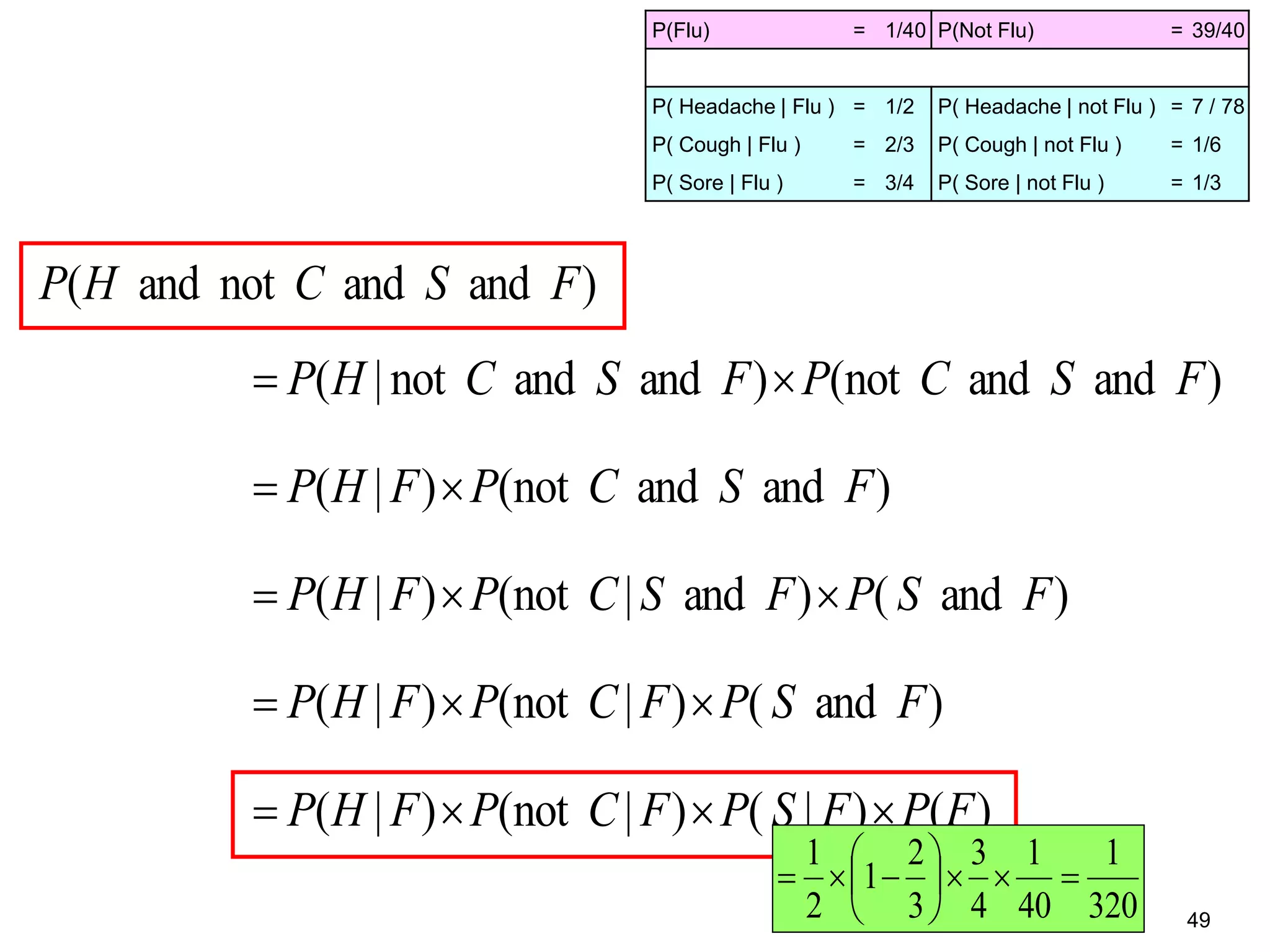
49
P(Flu) = 1/40 P(Not Flu) = 39/40
P( Headache | Flu ) = 1/2 P( Headache | not Flu ) = 7 / 78
P( Cough | Flu ) = 2/3 P( Cough | not Flu ) = 1/6
P( Sore | Flu ) = 3/4 P( Sore | not Flu ) = 1/3
)andandnot()andandnot|( FSCPFSCHP 
)andandnot()|( FSCPFHP 
)and()and|not()|( FSPFSCPFHP 
)and()|not()|( FSPFCPFHP 
)()|()|not()|( FPFSPFCPFHP 
)andandnotand( FSCHP
320
1
40
1
4
3
3
2
1
2
1







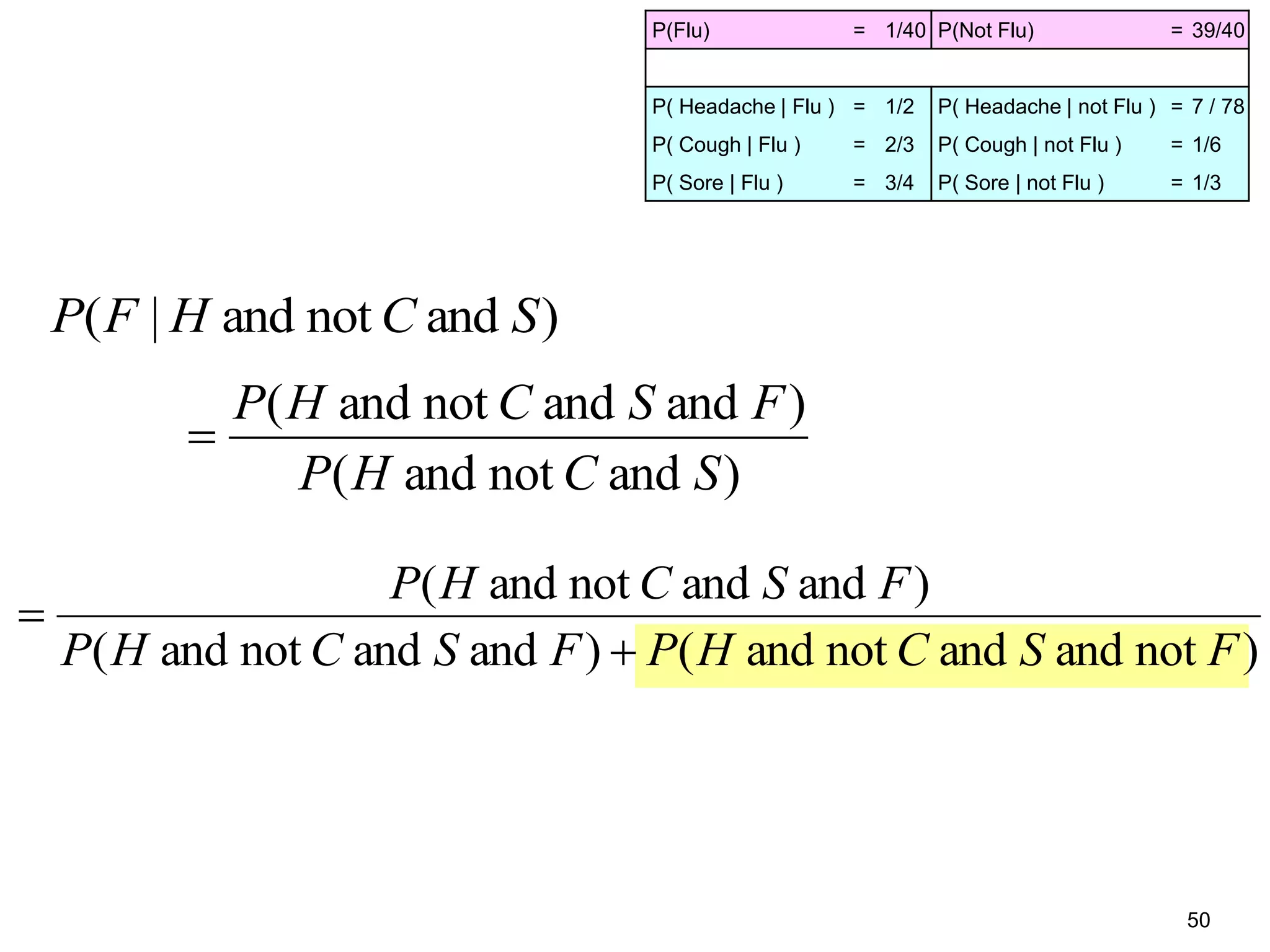
50
)andnotand|( SCHFP
)andnotand(
)andandnotand(
SCHP
FSCHP

)notandandnotand()andandnotand(
)andandnotand(
FSCHPFSCHP
FSCHP


P(Flu) = 1/40 P(Not Flu) = 39/40
P( Headache | Flu ) = 1/2 P( Headache | not Flu ) = 7 / 78
P( Cough | Flu ) = 2/3 P( Cough | not Flu ) = 1/6
P( Sore | Flu ) = 3/4 P( Sore | not Flu ) = 1/3
51
)notandandnot()not|( FSCPFHP 
)notand()notand|not()not|( FSPFSCPFHP 
)notand()not|not()not|( FSPFCPFHP 
)not()not|()not|not()not|( FPFSPFCPFHP 
)notandandnotand( FSCHP
)notandandnot()notandandnot|( FSCPFSCHP 
P(Flu) = 1/40 P(Not Flu) = 39/40
P( Headache | Flu ) = 1/2 P( Headache | not Flu ) = 7 / 78
P( Cough | Flu ) = 2/3 P( Cough | not Flu ) = 1/6
P( Sore | Flu ) = 3/4 P( Sore | not Flu ) = 1/3
288
7
40
39
3
1
6
1
1
78
7







52
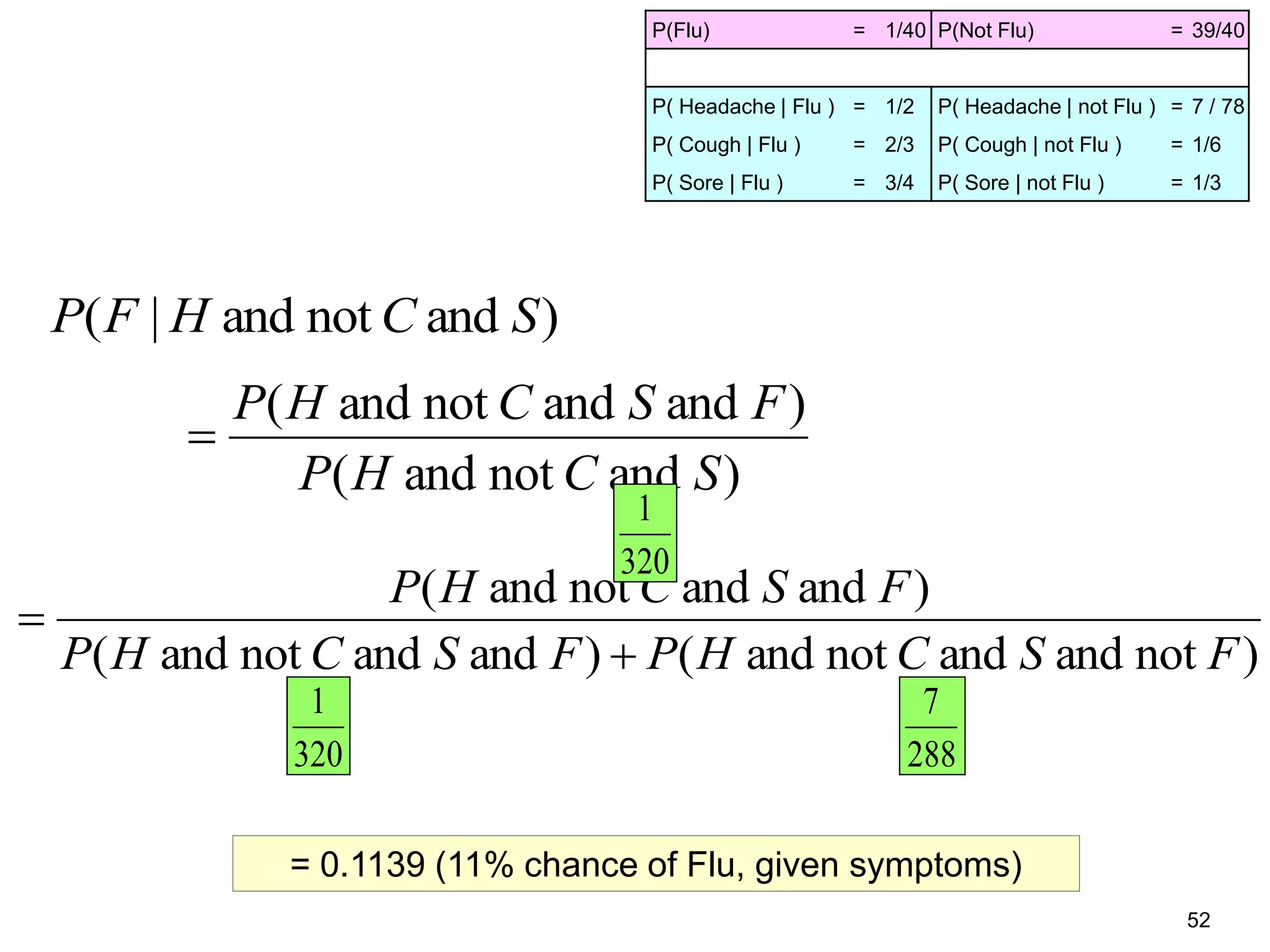
)andnotand|( SCHFP
)andnotand(
)andandnotand(
SCHP
FSCHP

)notandandnotand()andandnotand(
)andandnotand(
FSCHPFSCHP
FSCHP


P(Flu) = 1/40 P(Not Flu) = 39/40
P( Headache | Flu ) = 1/2 P( Headache | not Flu ) = 7 / 78
P( Cough | Flu ) = 2/3 P( Cough | not Flu ) = 1/6
P( Sore | Flu ) = 3/4 P( Sore | not Flu ) = 1/3
288
7
320
1
320
1
= 0.1139 (11% chance of Flu, given symptoms)
53
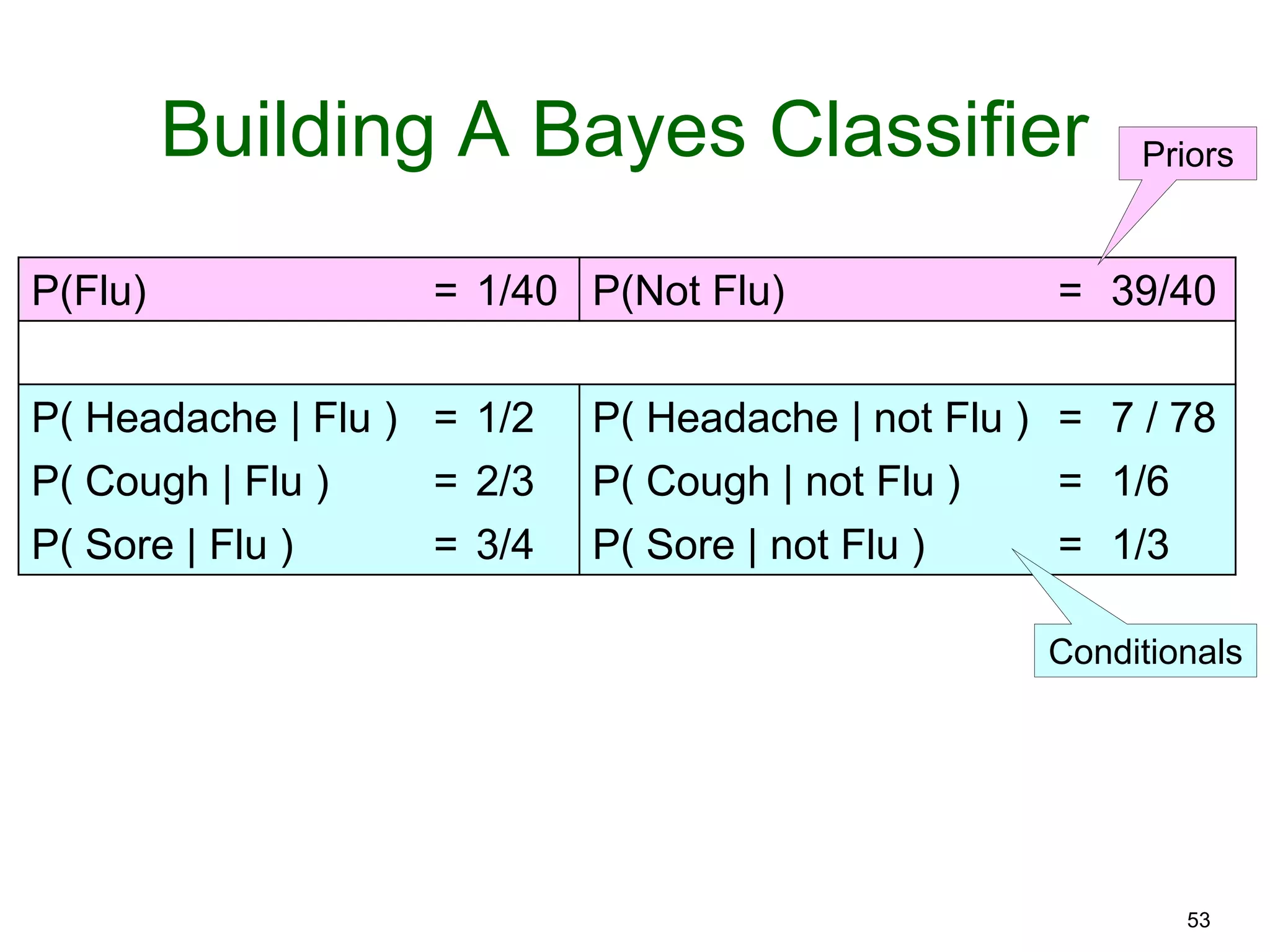
Building A Bayes Classifier
P(Flu) = 1/40 P(Not Flu) = 39/40
P( Headache | Flu ) = 1/2 P( Headache | not Flu ) = 7 / 78
P( Cough | Flu ) = 2/3 P( Cough | not Flu ) = 1/6
P( Sore | Flu ) = 3/4 P( Sore | not Flu ) = 1/3
Priors
Conditionals
54
The General Case
55
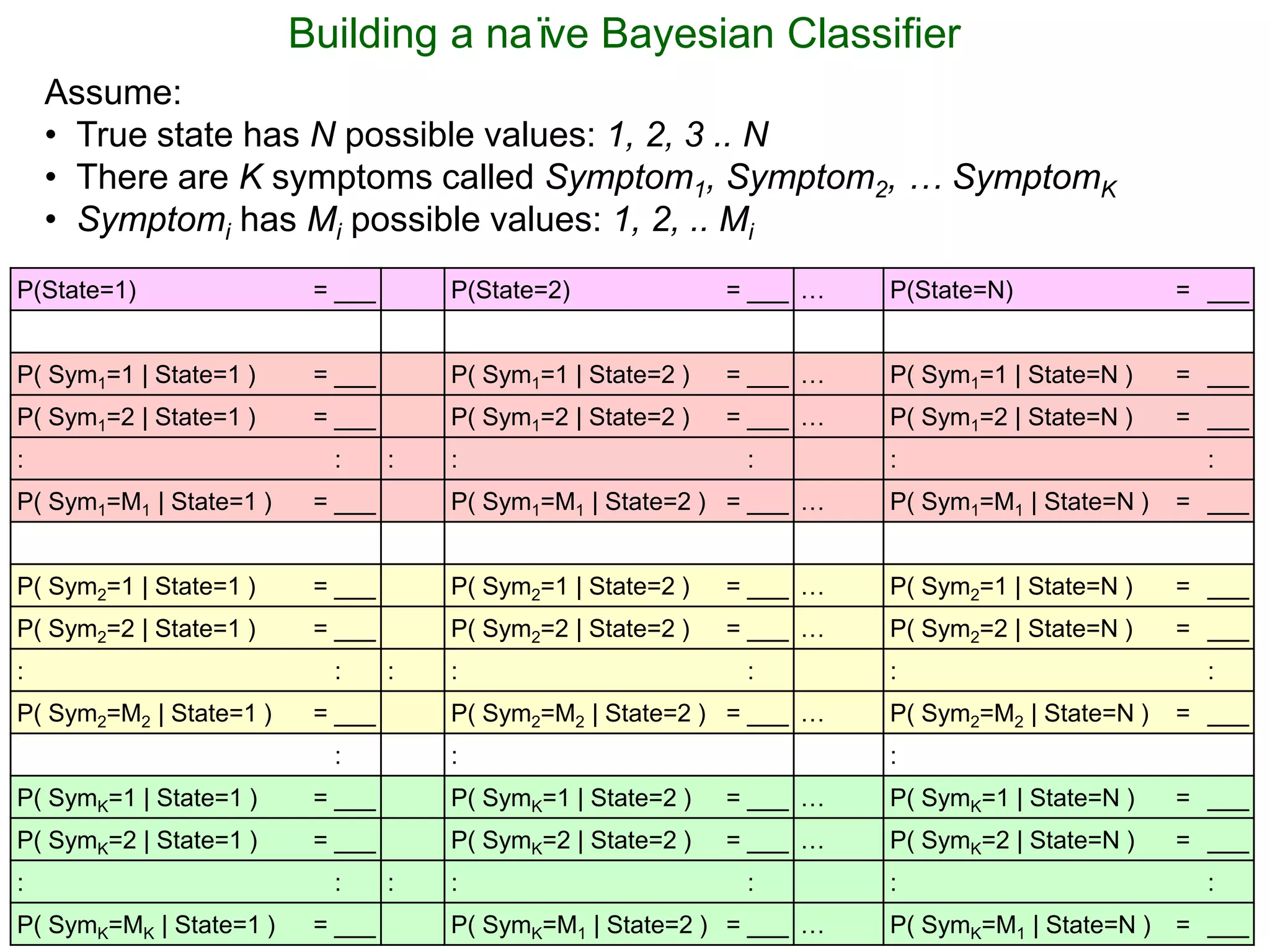
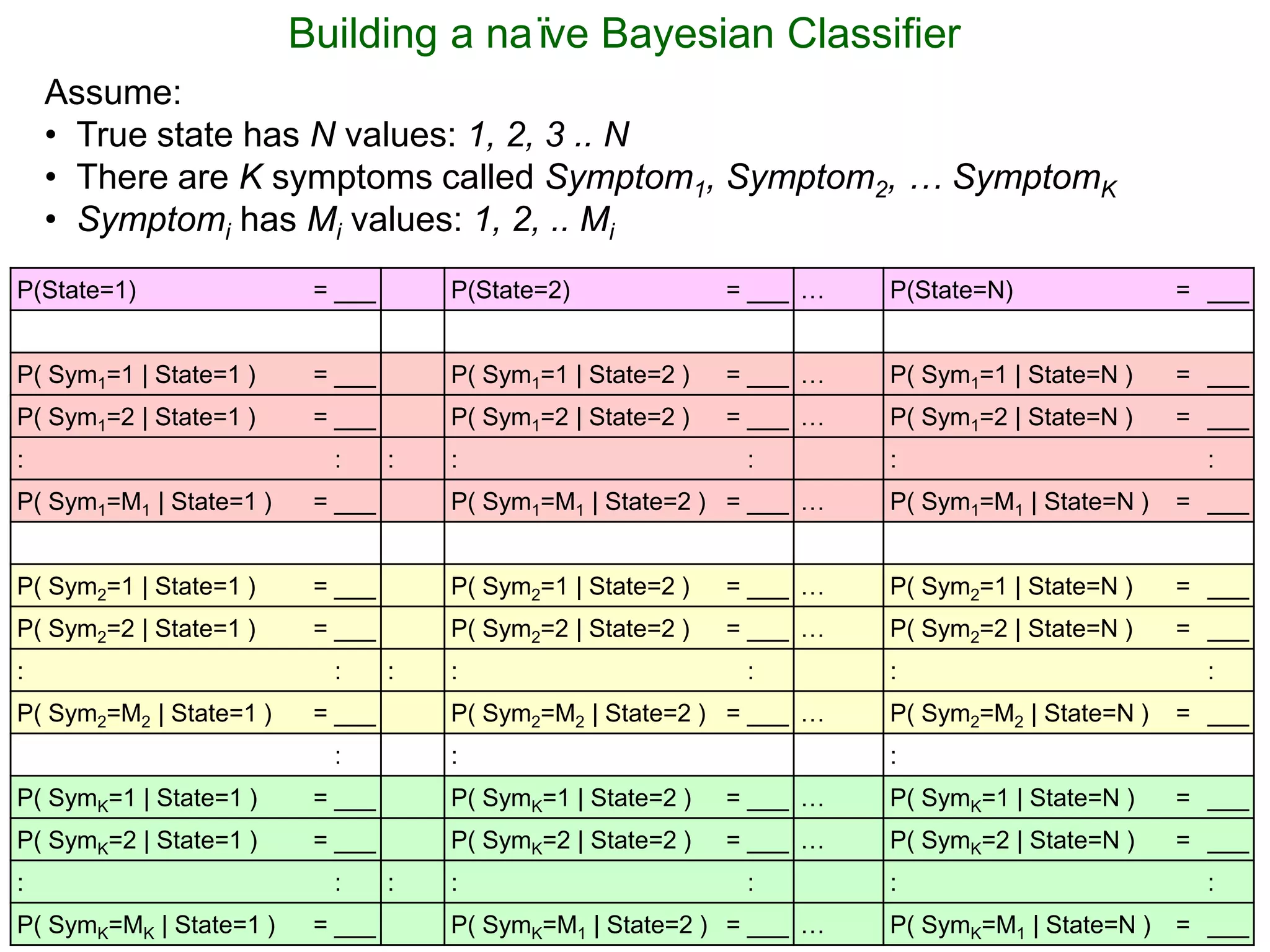
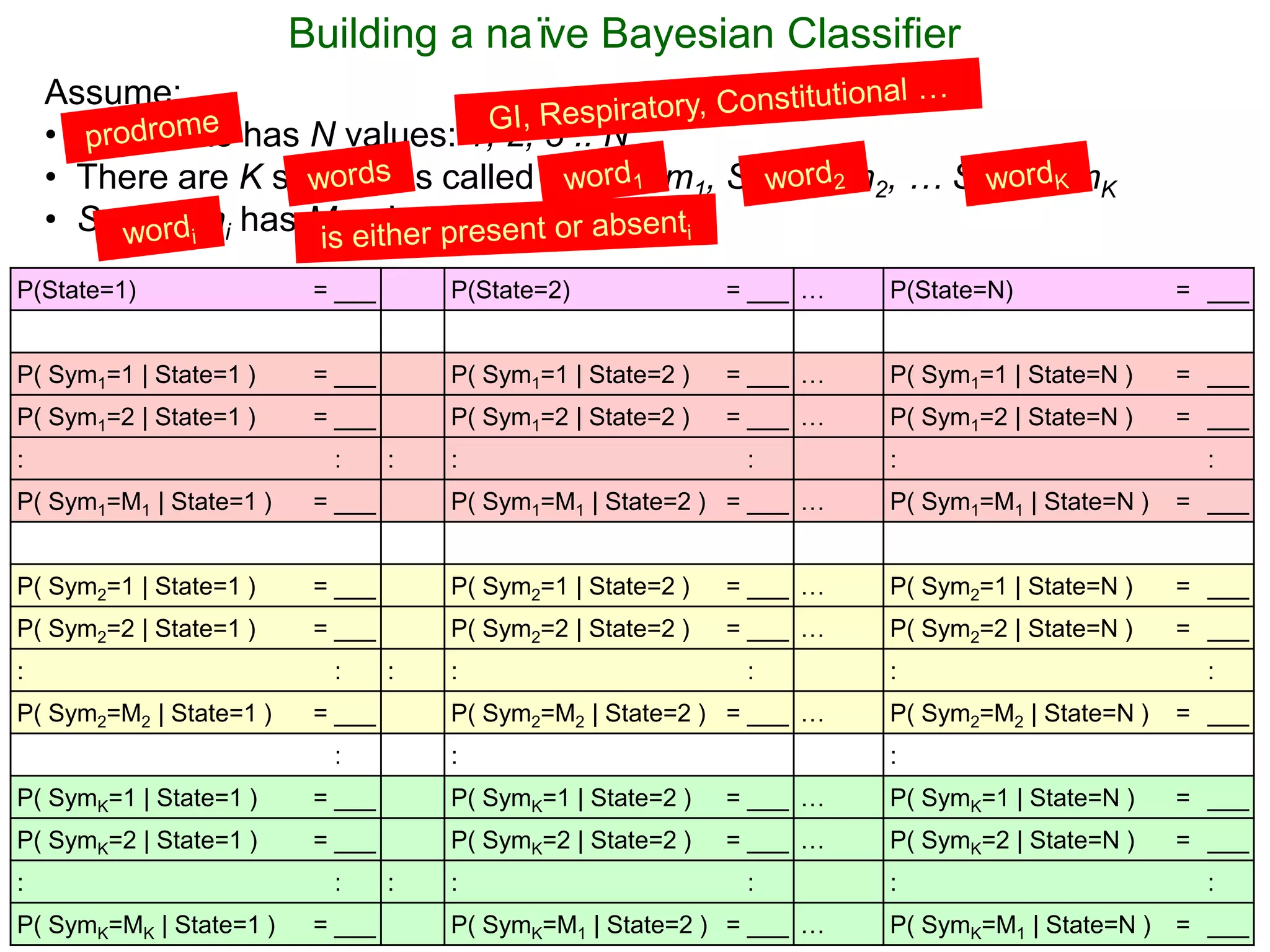
Building a naïve Bayesian Classifier
P(State=1) = ___ P(State=2) = ___ … P(State=N) = ___
P( Sym1=1 | State=1 ) = ___ P( Sym1=1 | State=2 ) = ___ … P( Sym1=1 | State=N ) = ___
P( Sym1=2 | State=1 ) = ___ P( Sym1=2 | State=2 ) = ___ … P( Sym1=2 | State=N ) = ___
: : : : : : :
P( Sym1=M1 | State=1 ) = ___ P( Sym1=M1 | State=2 ) = ___ … P( Sym1=M1 | State=N ) = ___
P( Sym2=1 | State=1 ) = ___ P( Sym2=1 | State=2 ) = ___ … P( Sym2=1 | State=N ) = ___
P( Sym2=2 | State=1 ) = ___ P( Sym2=2 | State=2 ) = ___ … P( Sym2=2 | State=N ) = ___
: : : : : : :
P( Sym2=M2 | State=1 ) = ___ P( Sym2=M2 | State=2 ) = ___ … P( Sym2=M2 | State=N ) = ___
: : :
P( SymK=1 | State=1 ) = ___ P( SymK=1 | State=2 ) = ___ … P( SymK=1 | State=N ) = ___
P( SymK=2 | State=1 ) = ___ P( SymK=2 | State=2 ) = ___ … P( SymK=2 | State=N ) = ___
: : : : : : :
P( SymK=MK | State=1 ) = ___ P( SymK=M1 | State=2 ) = ___ … P( SymK=M1 | State=N ) = ___
Assume:
• True state has N possible values: 1, 2, 3 .. N
• There are K symptoms called Symptom1, Symptom2, … SymptomK
• Symptomi has Mi possible values: 1, 2, .. Mi
56
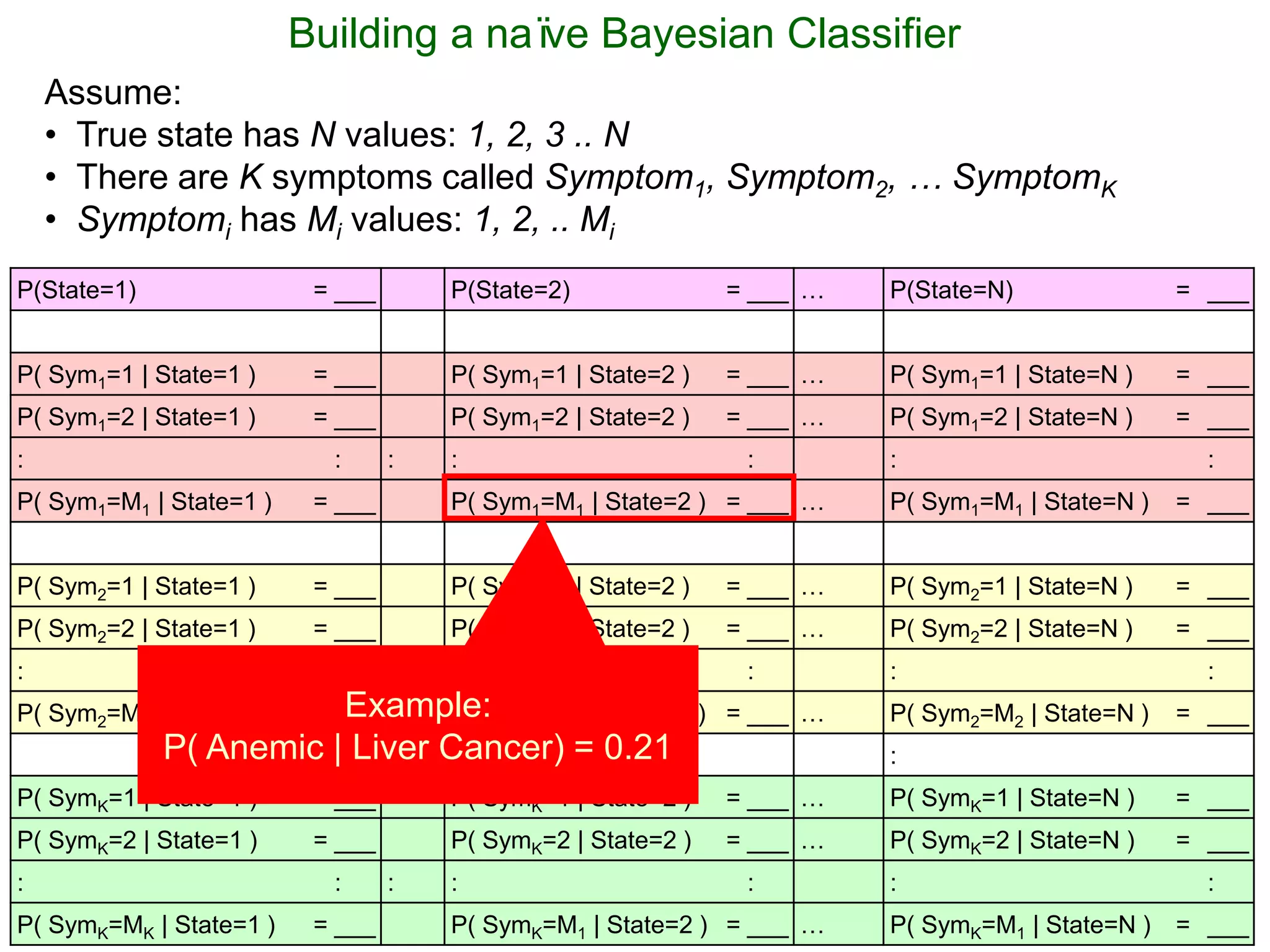
Building a naïve Bayesian Classifier
P(State=1) = ___ P(State=2) = ___ … P(State=N) = ___
P( Sym1=1 | State=1 ) = ___ P( Sym1=1 | State=2 ) = ___ … P( Sym1=1 | State=N ) = ___
P( Sym1=2 | State=1 ) = ___ P( Sym1=2 | State=2 ) = ___ … P( Sym1=2 | State=N ) = ___
: : : : : : :
P( Sym1=M1 | State=1 ) = ___ P( Sym1=M1 | State=2 ) = ___ … P( Sym1=M1 | State=N ) = ___
P( Sym2=1 | State=1 ) = ___ P( Sym2=1 | State=2 ) = ___ … P( Sym2=1 | State=N ) = ___
P( Sym2=2 | State=1 ) = ___ P( Sym2=2 | State=2 ) = ___ … P( Sym2=2 | State=N ) = ___
: : : : : : :
P( Sym2=M2 | State=1 ) = ___ P( Sym2=M2 | State=2 ) = ___ … P( Sym2=M2 | State=N ) = ___
: : :
P( SymK=1 | State=1 ) = ___ P( SymK=1 | State=2 ) = ___ … P( SymK=1 | State=N ) = ___
P( SymK=2 | State=1 ) = ___ P( SymK=2 | State=2 ) = ___ … P( SymK=2 | State=N ) = ___
: : : : : : :
P( SymK=MK | State=1 ) = ___ P( SymK=M1 | State=2 ) = ___ … P( SymK=M1 | State=N ) = ___
Assume:
• True state has N values: 1, 2, 3 .. N
• There are K symptoms called Symptom1, Symptom2, … SymptomK
• Symptomi has Mi values: 1, 2, .. Mi
Example:
P( Anemic | Liver Cancer) = 0.21
57
P(State=1) = ___ P(State=2) = ___ … P(State=N) = ___
P( Sym1=1 | State=1 ) = ___ P( Sym1=1 | State=2 ) = ___ … P( Sym1=1 | State=N ) = ___
P( Sym1=2 | State=1 ) = ___ P( Sym1=2 | State=2 ) = ___ … P( Sym1=2 | State=N ) = ___
: : : : : : :
P( Sym1=M1 | State=1 ) = ___ P( Sym1=M1 | State=2 ) = ___ … P( Sym1=M1 | State=N ) = ___
P( Sym2=1 | State=1 ) = ___ P( Sym2=1 | State=2 ) = ___ … P( Sym2=1 | State=N ) = ___
P( Sym2=2 | State=1 ) = ___ P( Sym2=2 | State=2 ) = ___ … P( Sym2=2 | State=N ) = ___
: : : : : : :
P( Sym2=M2 | State=1 ) = ___ P( Sym2=M2 | State=2 ) = ___ … P( Sym2=M2 | State=N ) = ___
: : :
P( SymK=1 | State=1 ) = ___ P( SymK=1 | State=2 ) = ___ … P( SymK=1 | State=N ) = ___
P( SymK=2 | State=1 ) = ___ P( SymK=2 | State=2 ) = ___ … P( SymK=2 | State=N ) = ___
: : : : : : :
P( SymK=MK | State=1 ) = ___ P( SymK=M1 | State=2 ) = ___ … P( SymK=M1 | State=N ) = ___
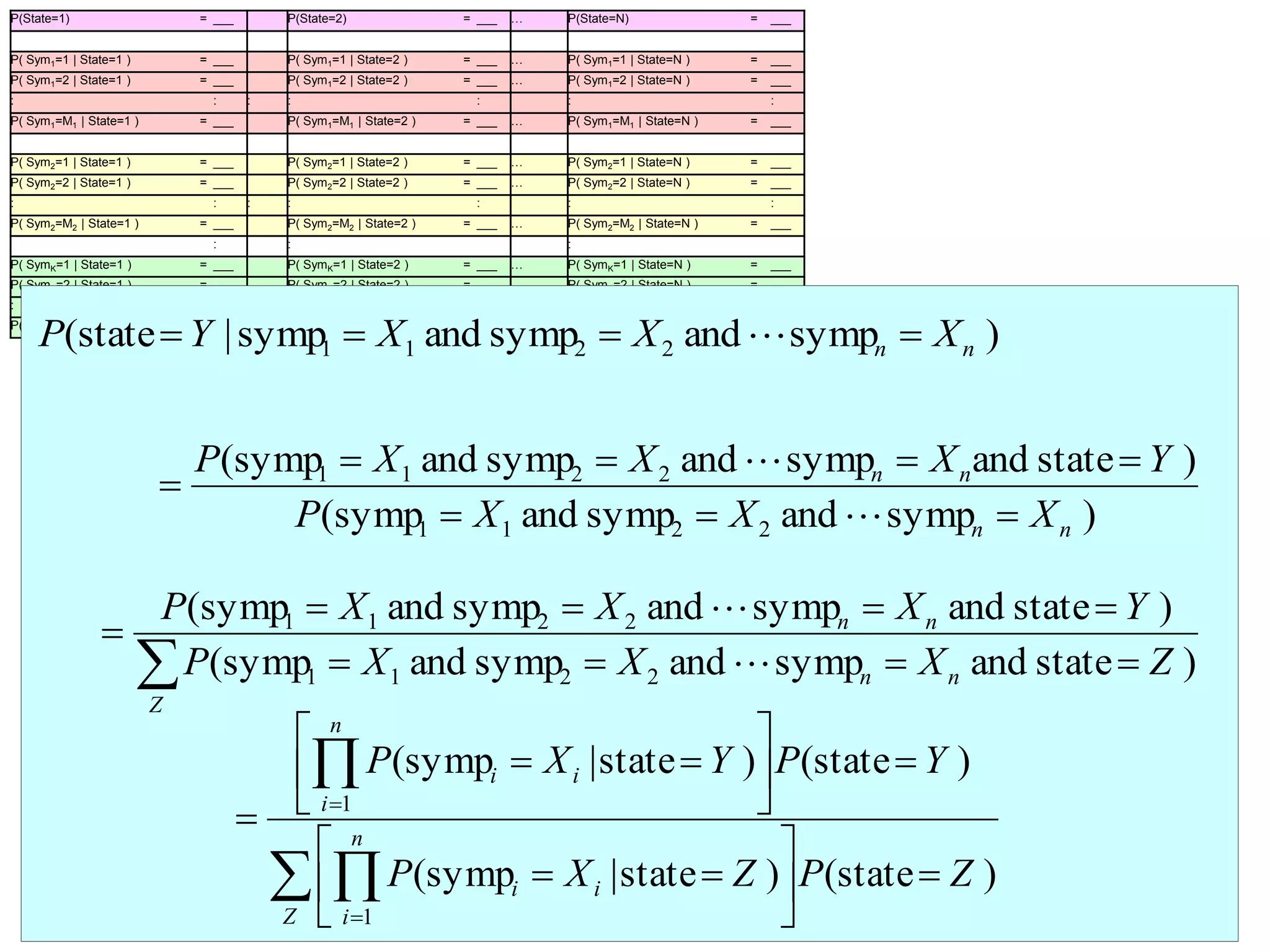
)sympandsympandsymp|state( 2211 nn XXXYP  
)sympandsympandsymp(
)stateandsympandsympandsymp(
2211
2211
nn
nn
XXXP
YXXXP





 


Z
nn
nn
ZXXXP
YXXXP
)stateandsympandsympandsymp(
2211
2211


 


















Z
n
i
ii
n
i
ii
ZPZ|XP
YPY|XP
)state()statesymp(
)state()statesymp(
1
1
58
P(State=1) = ___ P(State=2) = ___ … P(State=N) = ___
P( Sym1=1 | State=1 ) = ___ P( Sym1=1 | State=2 ) = ___ … P( Sym1=1 | State=N ) = ___
P( Sym1=2 | State=1 ) = ___ P( Sym1=2 | State=2 ) = ___ … P( Sym1=2 | State=N ) = ___
: : : : : : :
P( Sym1=M1 | State=1 ) = ___ P( Sym1=M1 | State=2 ) = ___ … P( Sym1=M1 | State=N ) = ___
P( Sym2=1 | State=1 ) = ___ P( Sym2=1 | State=2 ) = ___ … P( Sym2=1 | State=N ) = ___
P( Sym2=2 | State=1 ) = ___ P( Sym2=2 | State=2 ) = ___ … P( Sym2=2 | State=N ) = ___
: : : : : : :
P( Sym2=M2 | State=1 ) = ___ P( Sym2=M2 | State=2 ) = ___ … P( Sym2=M2 | State=N ) = ___
: : :
P( SymK=1 | State=1 ) = ___ P( SymK=1 | State=2 ) = ___ … P( SymK=1 | State=N ) = ___
P( SymK=2 | State=1 ) = ___ P( SymK=2 | State=2 ) = ___ … P( SymK=2 | State=N ) = ___
: : : : : : :
P( SymK=MK | State=1 ) = ___ P( SymK=M1 | State=2 ) = ___ … P( SymK=M1 | State=N ) = ___
)sympandsympandsymp|state( 2211 nn XXXYP  
)sympandsympandsymp(
)stateandsympandsympandsymp(
2211
2211
nn
nn
XXXP
YXXXP





 


Z
nn
nn
ZXXXP
YXXXP
)stateandsympandsympandsymp(
2211
2211


 


















Z
n
i
ii
n
i
ii
ZPZ|XP
YPY|XP
)state()statesymp(
)state()statesymp(
1
1
59
Conclusion
• You will hear lots of “Bayesian” this and
“conditional probability” that this week.
• It’s simple: don’t let wooly academic types trick you
into thinking it is fancy.
• You should know:
• What are: Bayesian Reasoning, Conditional
Probabilities, Priors, Posteriors.
• Appreciate how conditional probabilities are manipulated.
• Why the Naïve Bayes Assumption is Good.
• Why the Naïve Bayes Assumption is Evil.
60
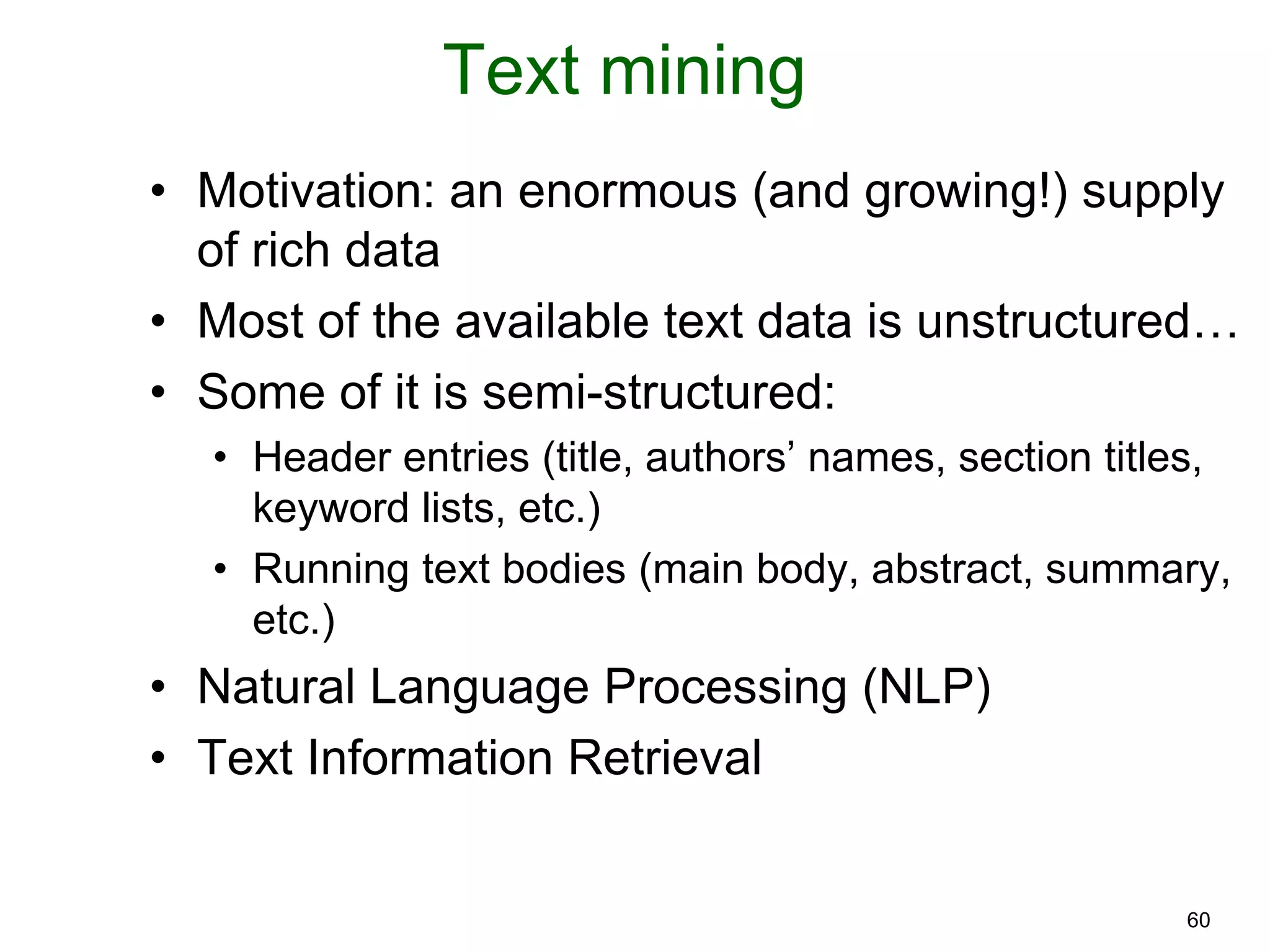
Text mining
• Motivation: an enormous (and growing!) supply
of rich data
• Most of the available text data is unstructured…
• Some of it is semi-structured:
• Header entries (title, authors’ names, section titles,
keyword lists, etc.)
• Running text bodies (main body, abstract, summary,
etc.)
• Natural Language Processing (NLP)
• Text Information Retrieval
61
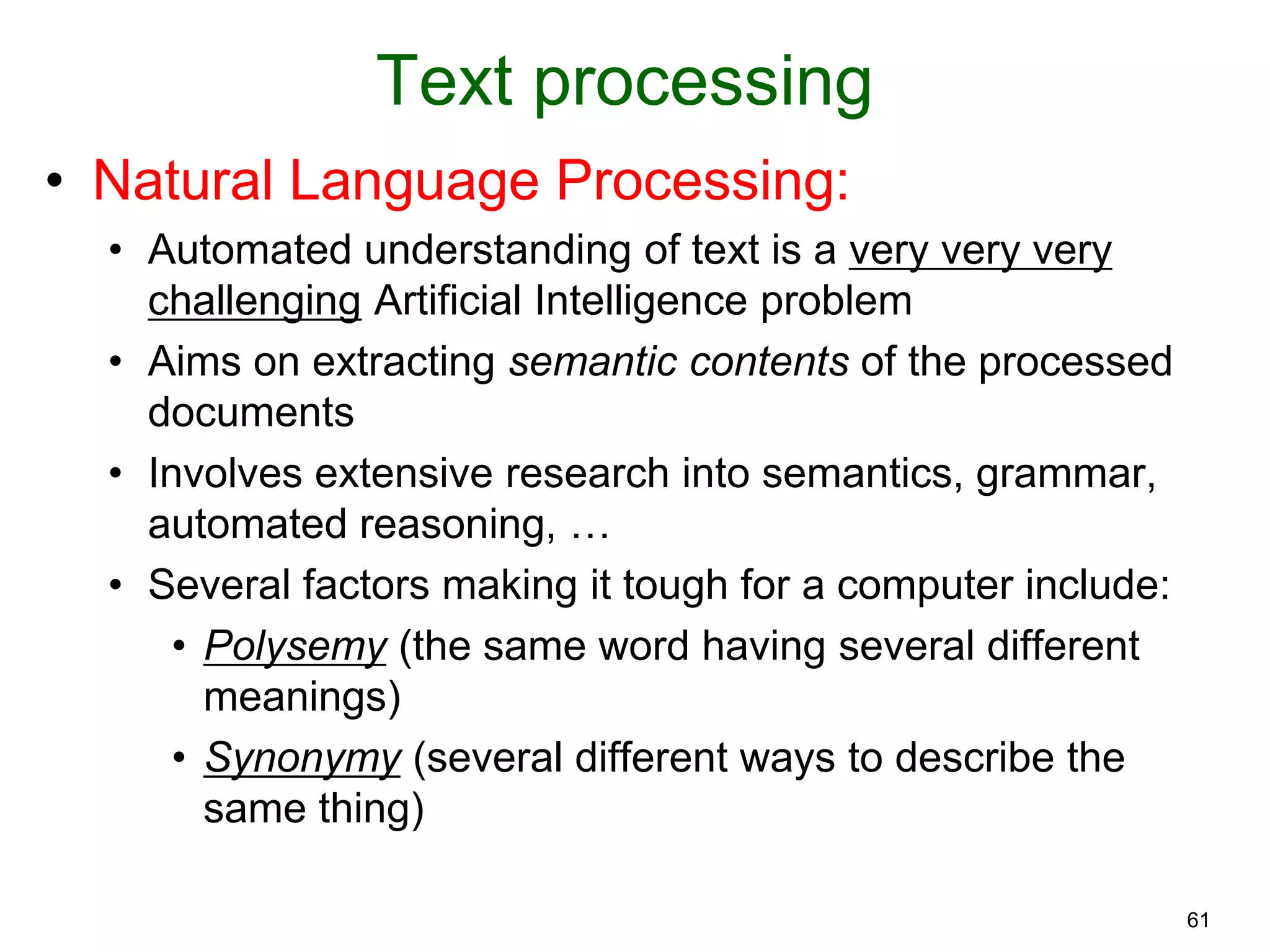
Text processing
• Natural Language Processing:
• Automated understanding of text is a very very very
challenging Artificial Intelligence problem
• Aims on extracting semantic contents of the processed
documents
• Involves extensive research into semantics, grammar,
automated reasoning, …
• Several factors making it tough for a computer include:
• Polysemy (the same word having several different
meanings)
• Synonymy (several different ways to describe the
same thing)
62
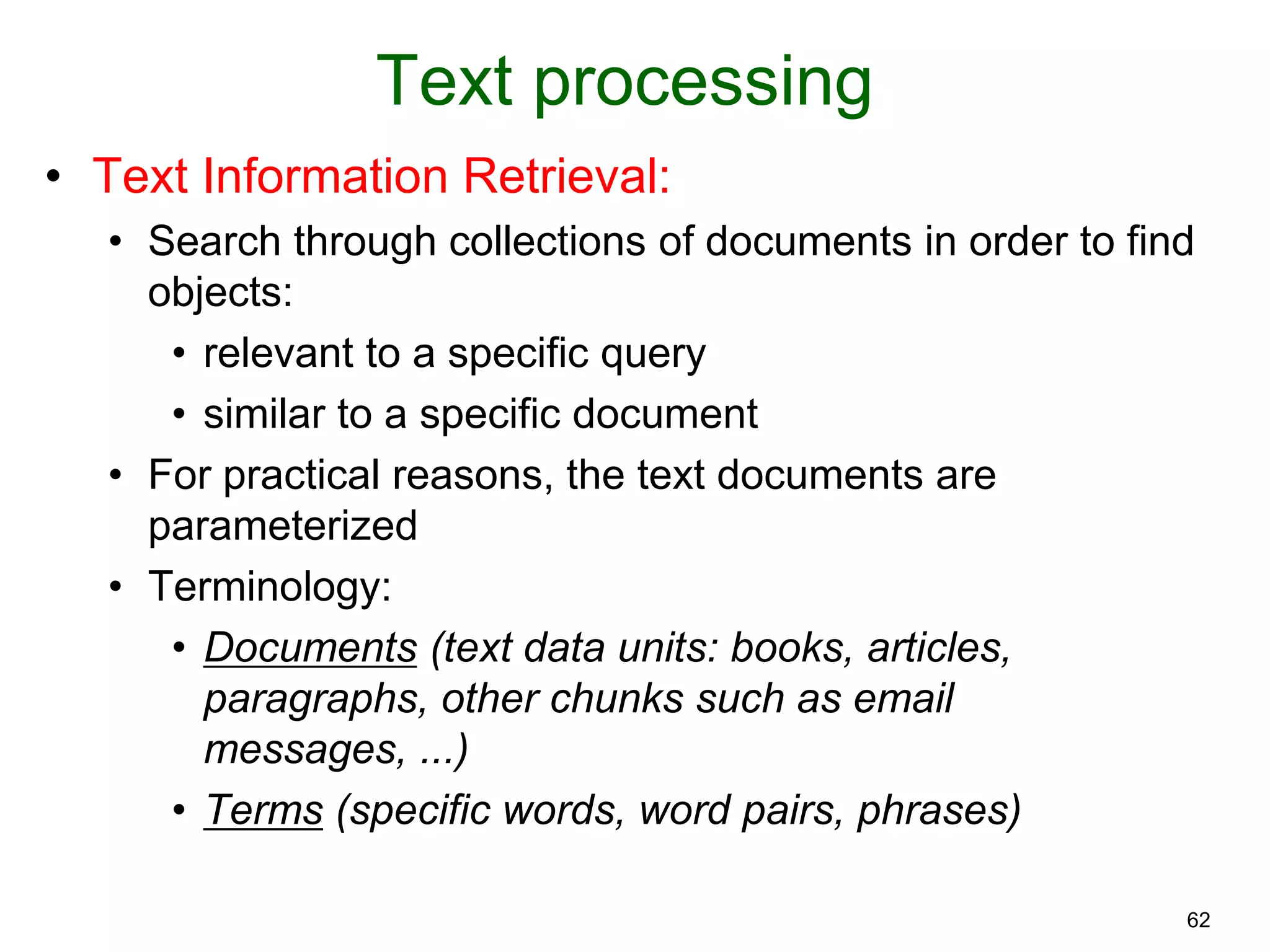
Text processing
• Text Information Retrieval:
• Search through collections of documents in order to find
objects:
• relevant to a specific query
• similar to a specific document
• For practical reasons, the text documents are
parameterized
• Terminology:
• Documents (text data units: books, articles,
paragraphs, other chunks such as email
messages, ...)
• Terms (specific words, word pairs, phrases)
63
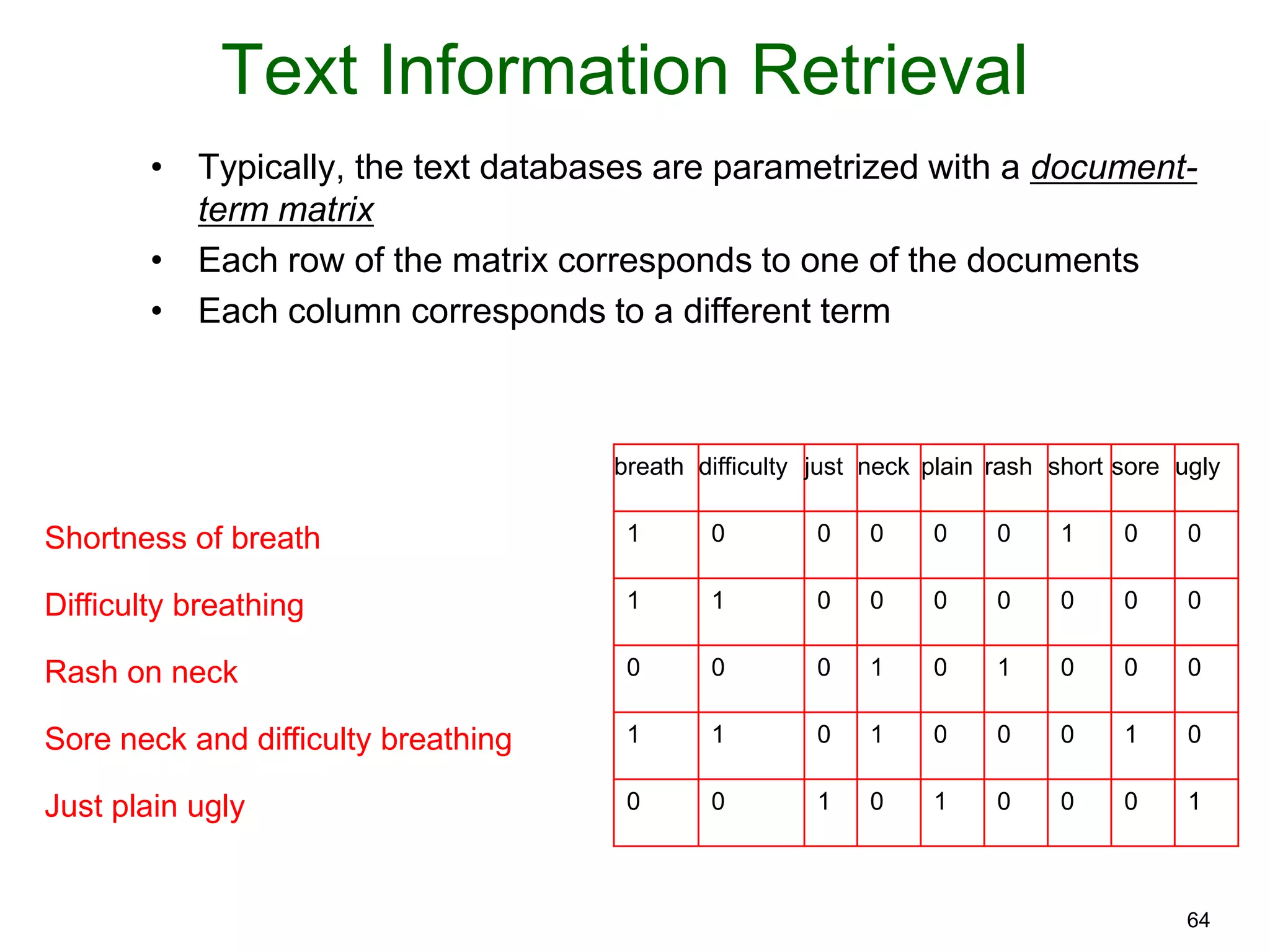
Text Information Retrieval
• Typically, the text databases are parametrized with a document-
term matrix
• Each row of the matrix corresponds to one of the documents
• Each column corresponds to a different term
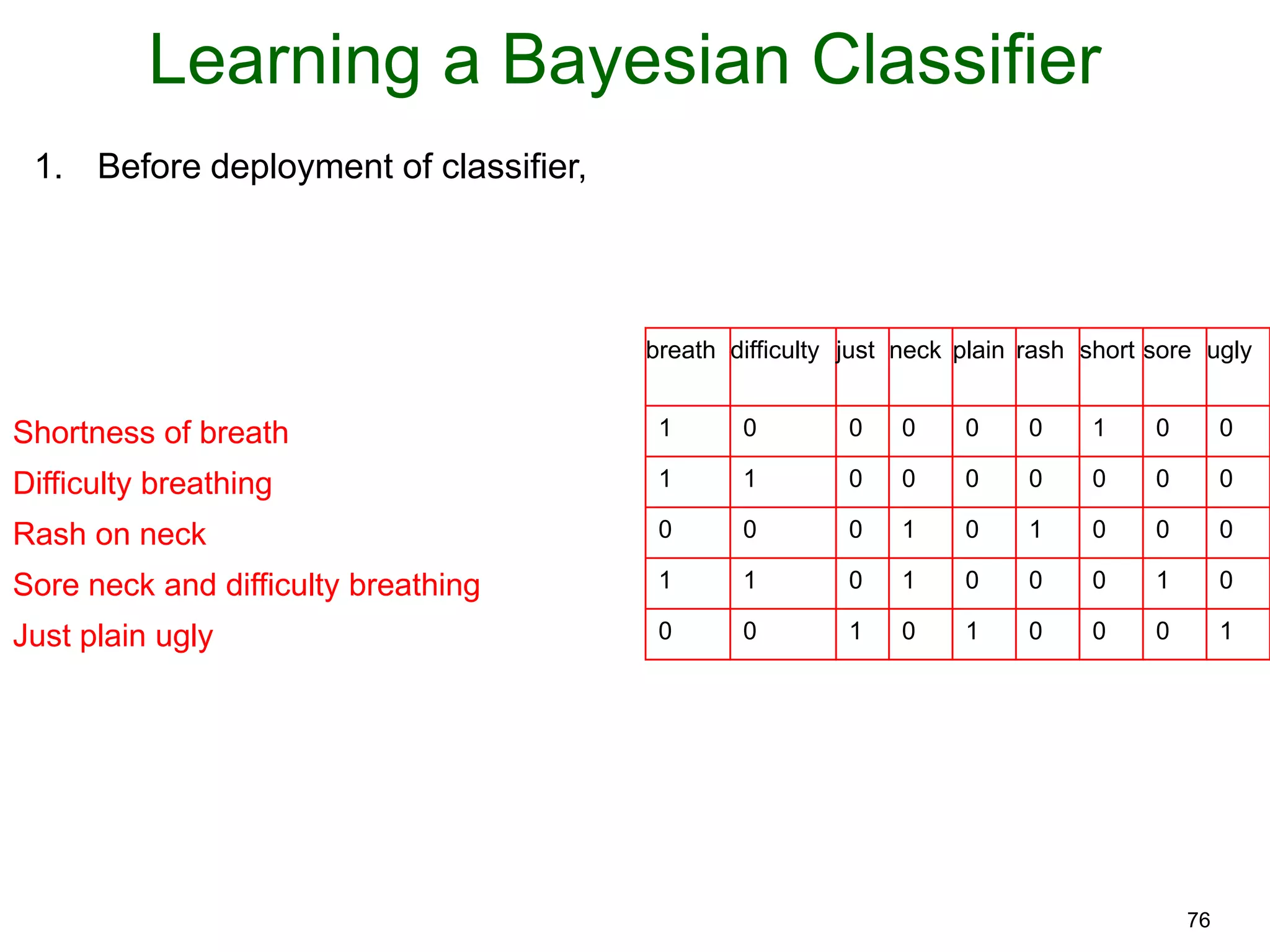
Shortness of breath
Difficulty breathing
Rash on neck
Sore neck and difficulty breathing
Just plain ugly
64
Text Information Retrieval
• Typically, the text databases are parametrized with a document-
term matrix
• Each row of the matrix corresponds to one of the documents
• Each column corresponds to a different term
breath difficulty just neck plain rash short sore ugly
Shortness of breath 1 0 0 0 0 0 1 0 0
Difficulty breathing 1 1 0 0 0 0 0 0 0
Rash on neck 0 0 0 1 0 1 0 0 0
Sore neck and difficulty breathing 1 1 0 1 0 0 0 1 0
Just plain ugly 0 0 1 0 1 0 0 0 1
65
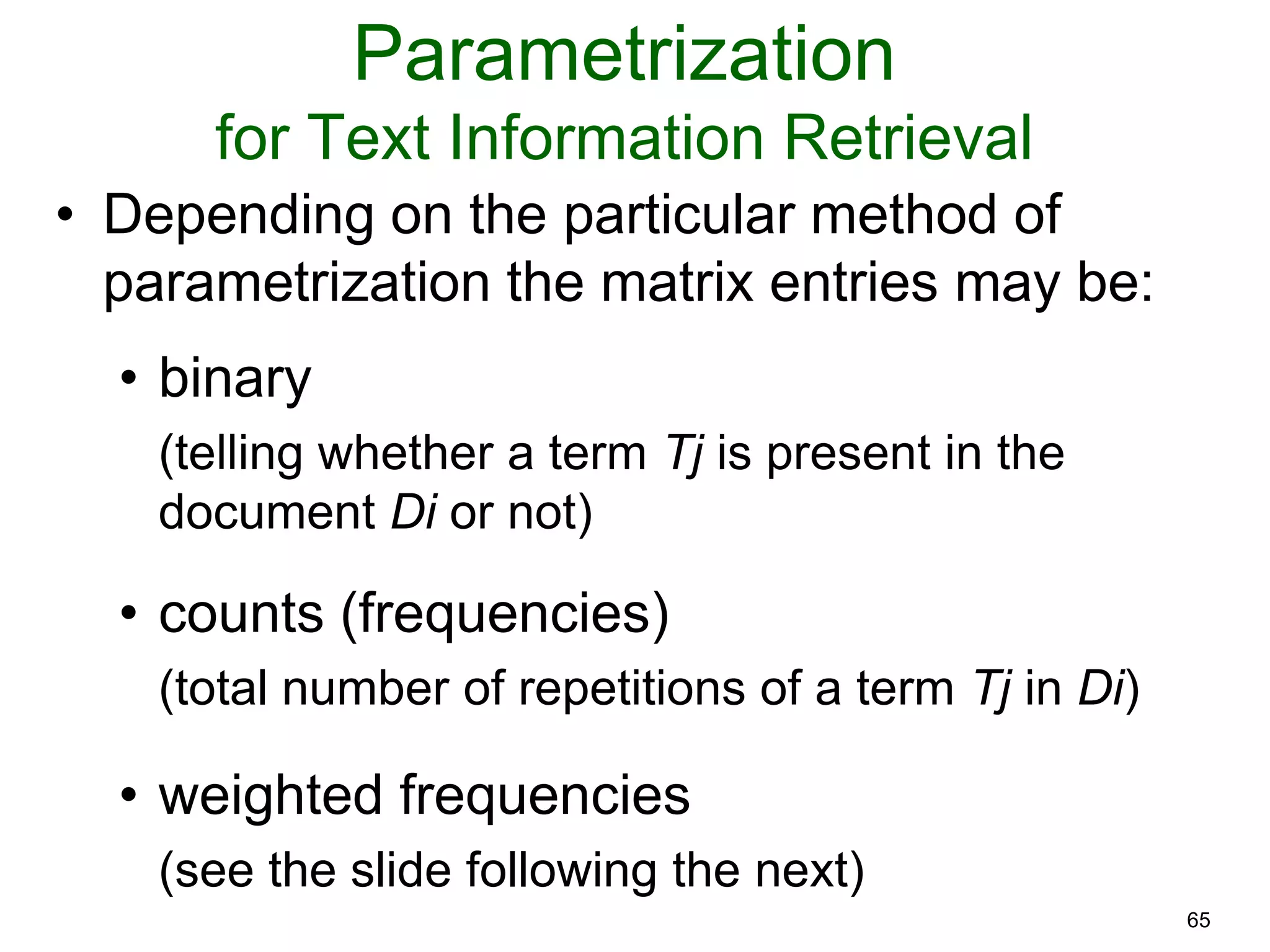
Parametrization
for Text Information Retrieval
• Depending on the particular method of
parametrization the matrix entries may be:
• binary
(telling whether a term Tj is present in the
document Di or not)
• counts (frequencies)
(total number of repetitions of a term Tj in Di)
• weighted frequencies
(see the slide following the next)
66
Typical applications of Text IR
• Document indexing and classification
(e.g. library systems)
• Search engines
(e.g. the Web)
• Extraction of information from textual sources
(e.g. profiling of personal records, consumer
complaint processing)
67
Typical applications of Text IR
• Document indexing and classification
(e.g. library systems)
• Search engines
(e.g. the Web)
• Extraction of information from textual sources
(e.g. profiling of personal records, consumer
complaint processing)
68
Building a naïve Bayesian Classifier
P(State=1) = ___ P(State=2) = ___ … P(State=N) = ___
P( Sym1=1 | State=1 ) = ___ P( Sym1=1 | State=2 ) = ___ … P( Sym1=1 | State=N ) = ___
P( Sym1=2 | State=1 ) = ___ P( Sym1=2 | State=2 ) = ___ … P( Sym1=2 | State=N ) = ___
: : : : : : :
P( Sym1=M1 | State=1 ) = ___ P( Sym1=M1 | State=2 ) = ___ … P( Sym1=M1 | State=N ) = ___
P( Sym2=1 | State=1 ) = ___ P( Sym2=1 | State=2 ) = ___ … P( Sym2=1 | State=N ) = ___
P( Sym2=2 | State=1 ) = ___ P( Sym2=2 | State=2 ) = ___ … P( Sym2=2 | State=N ) = ___
: : : : : : :
P( Sym2=M2 | State=1 ) = ___ P( Sym2=M2 | State=2 ) = ___ … P( Sym2=M2 | State=N ) = ___
: : :
P( SymK=1 | State=1 ) = ___ P( SymK=1 | State=2 ) = ___ … P( SymK=1 | State=N ) = ___
P( SymK=2 | State=1 ) = ___ P( SymK=2 | State=2 ) = ___ … P( SymK=2 | State=N ) = ___
: : : : : : :
P( SymK=MK | State=1 ) = ___ P( SymK=M1 | State=2 ) = ___ … P( SymK=M1 | State=N ) = ___
Assume:
• True state has N values: 1, 2, 3 .. N
• There are K symptoms called Symptom1, Symptom2, … SymptomK
• Symptomi has Mi values: 1, 2, .. Mi
69
Building a naïve Bayesian Classifier
P(State=1) = ___ P(State=2) = ___ … P(State=N) = ___
P( Sym1=1 | State=1 ) = ___ P( Sym1=1 | State=2 ) = ___ … P( Sym1=1 | State=N ) = ___
P( Sym1=2 | State=1 ) = ___ P( Sym1=2 | State=2 ) = ___ … P( Sym1=2 | State=N ) = ___
: : : : : : :
P( Sym1=M1 | State=1 ) = ___ P( Sym1=M1 | State=2 ) = ___ … P( Sym1=M1 | State=N ) = ___
P( Sym2=1 | State=1 ) = ___ P( Sym2=1 | State=2 ) = ___ … P( Sym2=1 | State=N ) = ___
P( Sym2=2 | State=1 ) = ___ P( Sym2=2 | State=2 ) = ___ … P( Sym2=2 | State=N ) = ___
: : : : : : :
P( Sym2=M2 | State=1 ) = ___ P( Sym2=M2 | State=2 ) = ___ … P( Sym2=M2 | State=N ) = ___
: : :
P( SymK=1 | State=1 ) = ___ P( SymK=1 | State=2 ) = ___ … P( SymK=1 | State=N ) = ___
P( SymK=2 | State=1 ) = ___ P( SymK=2 | State=2 ) = ___ … P( SymK=2 | State=N ) = ___
: : : : : : :
P( SymK=MK | State=1 ) = ___ P( SymK=M1 | State=2 ) = ___ … P( SymK=M1 | State=N ) = ___
Assume:
• True state has N values: 1, 2, 3 .. N
• There are K symptoms called Symptom1, Symptom2, … SymptomK
• Symptomi has Mi values: 1, 2, .. Mi
70
Building a naïve Bayesian Classifier
P(State=1) = ___ P(State=2) = ___ … P(State=N) = ___
P( Sym1=1 | State=1 ) = ___ P( Sym1=1 | State=2 ) = ___ … P( Sym1=1 | State=N ) = ___
P( Sym1=2 | State=1 ) = ___ P( Sym1=2 | State=2 ) = ___ … P( Sym1=2 | State=N ) = ___
: : : : : : :
P( Sym1=M1 | State=1 ) = ___ P( Sym1=M1 | State=2 ) = ___ … P( Sym1=M1 | State=N ) = ___
P( Sym2=1 | State=1 ) = ___ P( Sym2=1 | State=2 ) = ___ … P( Sym2=1 | State=N ) = ___
P( Sym2=2 | State=1 ) = ___ P( Sym2=2 | State=2 ) = ___ … P( Sym2=2 | State=N ) = ___
: : : : : : :
P( Sym2=M2 | State=1 ) = ___ P( Sym2=M2 | State=2 ) = ___ … P( Sym2=M2 | State=N ) = ___
: : :
P( SymK=1 | State=1 ) = ___ P( SymK=1 | State=2 ) = ___ … P( SymK=1 | State=N ) = ___
P( SymK=2 | State=1 ) = ___ P( SymK=2 | State=2 ) = ___ … P( SymK=2 | State=N ) = ___
: : : : : : :
P( SymK=MK | State=1 ) = ___ P( SymK=M1 | State=2 ) = ___ … P( SymK=M1 | State=N ) = ___
Assume:
• True state has N values: 1, 2, 3 .. N
• There are K symptoms called Symptom1, Symptom2, … SymptomK
• Symptomi has Mi values: 1, 2, .. Mi
71
Building a naïve Bayesian Classifier
P(State=1) = ___ P(State=2) = ___ … P(State=N) = ___
P( Sym1=1 | State=1 ) = ___ P( Sym1=1 | State=2 ) = ___ … P( Sym1=1 | State=N ) = ___
P( Sym1=2 | State=1 ) = ___ P( Sym1=2 | State=2 ) = ___ … P( Sym1=2 | State=N ) = ___
: : : : : : :
P( Sym1=M1 | State=1 ) = ___ P( Sym1=M1 | State=2 ) = ___ … P( Sym1=M1 | State=N ) = ___
P( Sym2=1 | State=1 ) = ___ P( Sym2=1 | State=2 ) = ___ … P( Sym2=1 | State=N ) = ___
P( Sym2=2 | State=1 ) = ___ P( Sym2=2 | State=2 ) = ___ … P( Sym2=2 | State=N ) = ___
: : : : : : :
P( Sym2=M2 | State=1 ) = ___ P( Sym2=M2 | State=2 ) = ___ … P( Sym2=M2 | State=N ) = ___
: : :
P( SymK=1 | State=1 ) = ___ P( SymK=1 | State=2 ) = ___ … P( SymK=1 | State=N ) = ___
P( SymK=2 | State=1 ) = ___ P( SymK=2 | State=2 ) = ___ … P( SymK=2 | State=N ) = ___
: : : : : : :
P( SymK=MK | State=1 ) = ___ P( SymK=M1 | State=2 ) = ___ … P( SymK=M1 | State=N ) = ___
Assume:
• True state has N values: 1, 2, 3 .. N
• There are K symptoms called Symptom1, Symptom2, … SymptomK
• Symptomi has Mi values: 1, 2, .. Mi
72
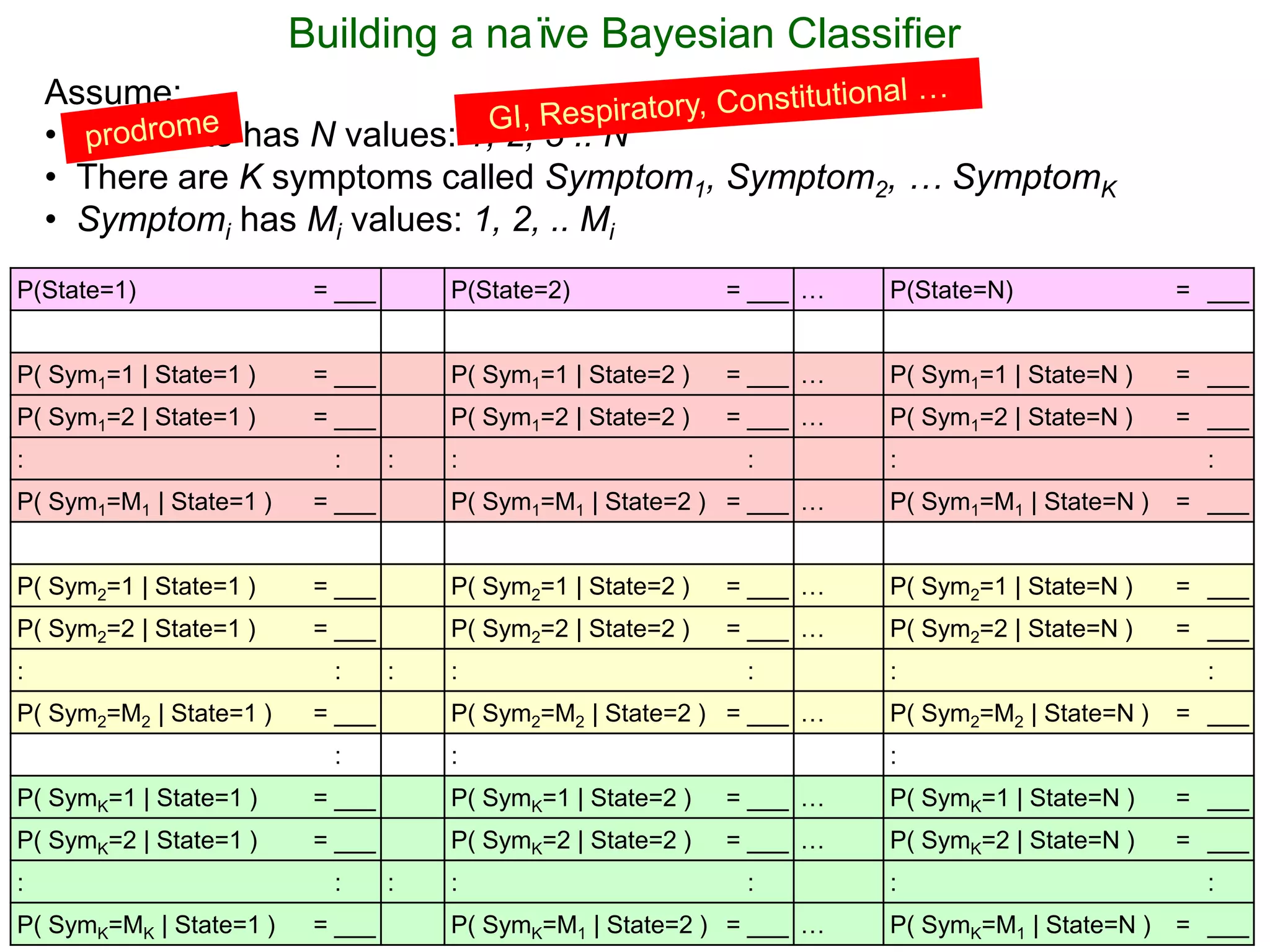
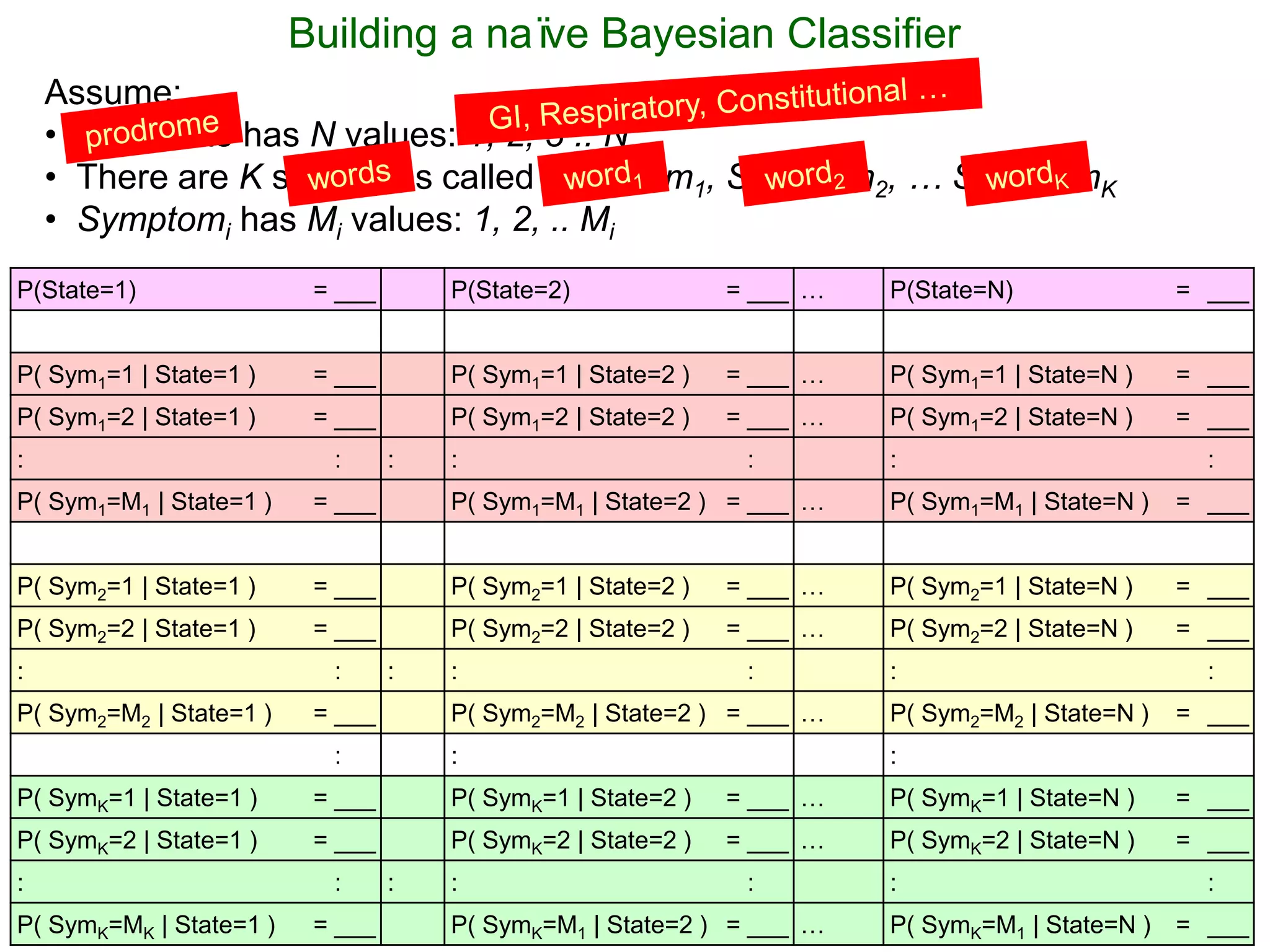
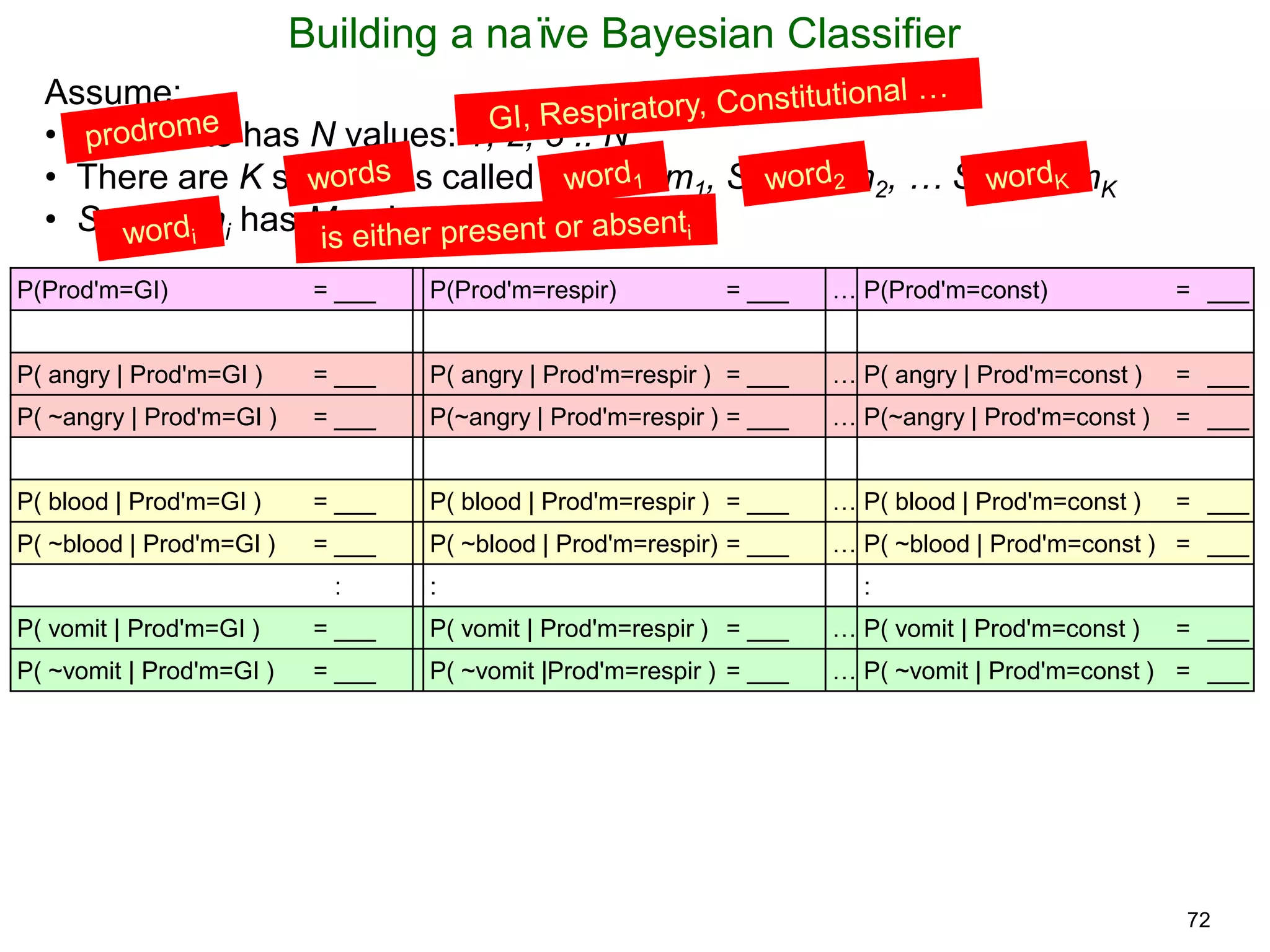
Building a naïve Bayesian Classifier
Assume:
• True state has N values: 1, 2, 3 .. N
• There are K symptoms called Symptom1, Symptom2, … SymptomK
• Symptomi has Mi values: 1, 2, .. Mi
P(Prod'm=GI) = ___ P(Prod'm=respir) = ___ … P(Prod'm=const) = ___
P( angry | Prod'm=GI ) = ___ P( angry | Prod'm=respir ) = ___ … P( angry | Prod'm=const ) = ___
P( ~angry | Prod'm=GI ) = ___ P(~angry | Prod'm=respir ) = ___ … P(~angry | Prod'm=const ) = ___
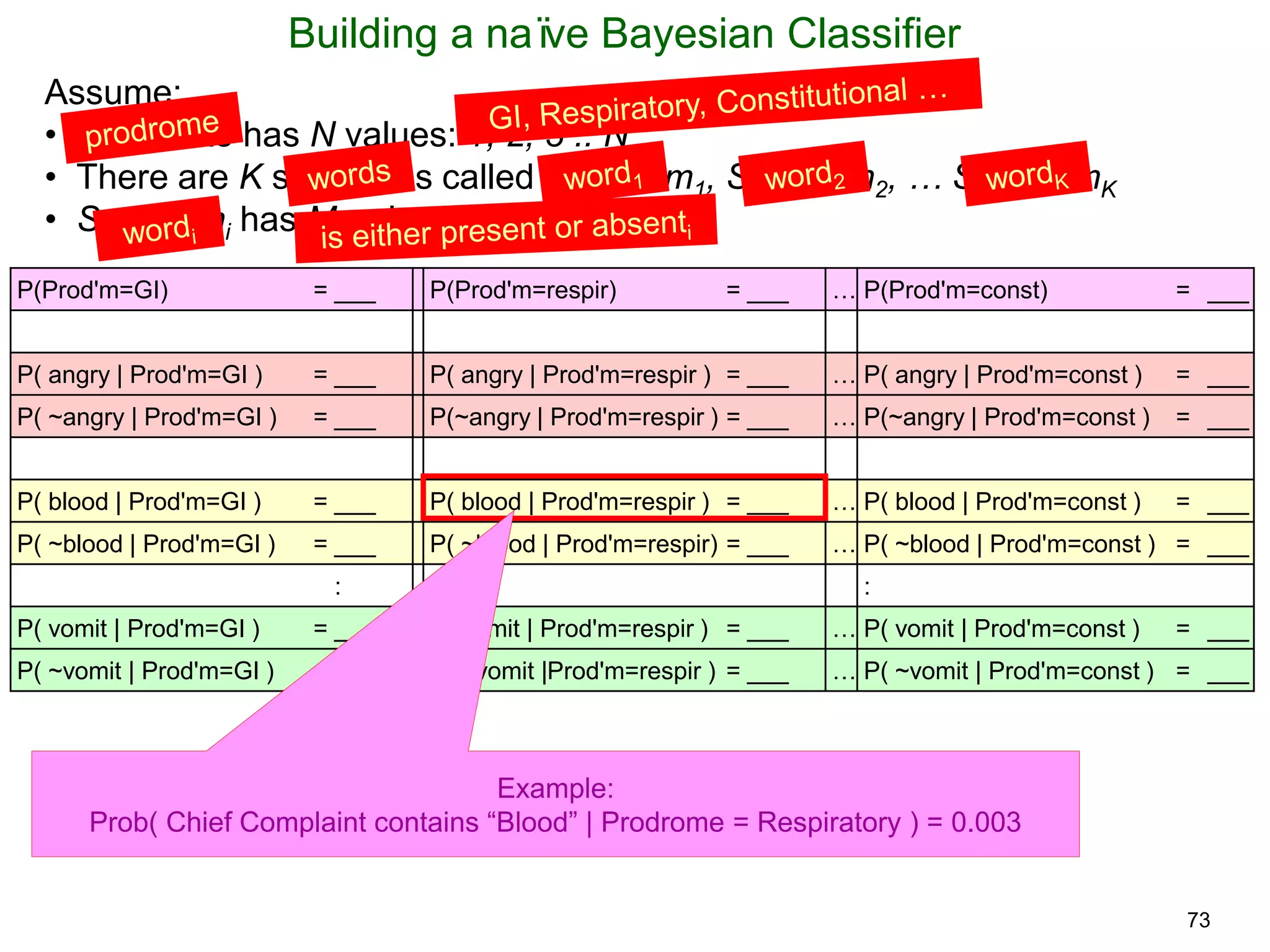
P( blood | Prod'm=GI ) = ___ P( blood | Prod'm=respir ) = ___ … P( blood | Prod'm=const ) = ___
P( ~blood | Prod'm=GI ) = ___ P( ~blood | Prod'm=respir) = ___ … P( ~blood | Prod'm=const ) = ___
: : :
P( vomit | Prod'm=GI ) = ___ P( vomit | Prod'm=respir ) = ___ … P( vomit | Prod'm=const ) = ___
P( ~vomit | Prod'm=GI ) = ___ P( ~vomit |Prod'm=respir ) = ___ … P( ~vomit | Prod'm=const ) = ___
73
Building a naïve Bayesian Classifier
Assume:
• True state has N values: 1, 2, 3 .. N
• There are K symptoms called Symptom1, Symptom2, … SymptomK
• Symptomi has Mi values: 1, 2, .. Mi
P(Prod'm=GI) = ___ P(Prod'm=respir) = ___ … P(Prod'm=const) = ___
P( angry | Prod'm=GI ) = ___ P( angry | Prod'm=respir ) = ___ … P( angry | Prod'm=const ) = ___
P( ~angry | Prod'm=GI ) = ___ P(~angry | Prod'm=respir ) = ___ … P(~angry | Prod'm=const ) = ___
P( blood | Prod'm=GI ) = ___ P( blood | Prod'm=respir ) = ___ … P( blood | Prod'm=const ) = ___
P( ~blood | Prod'm=GI ) = ___ P( ~blood | Prod'm=respir) = ___ … P( ~blood | Prod'm=const ) = ___
: : :
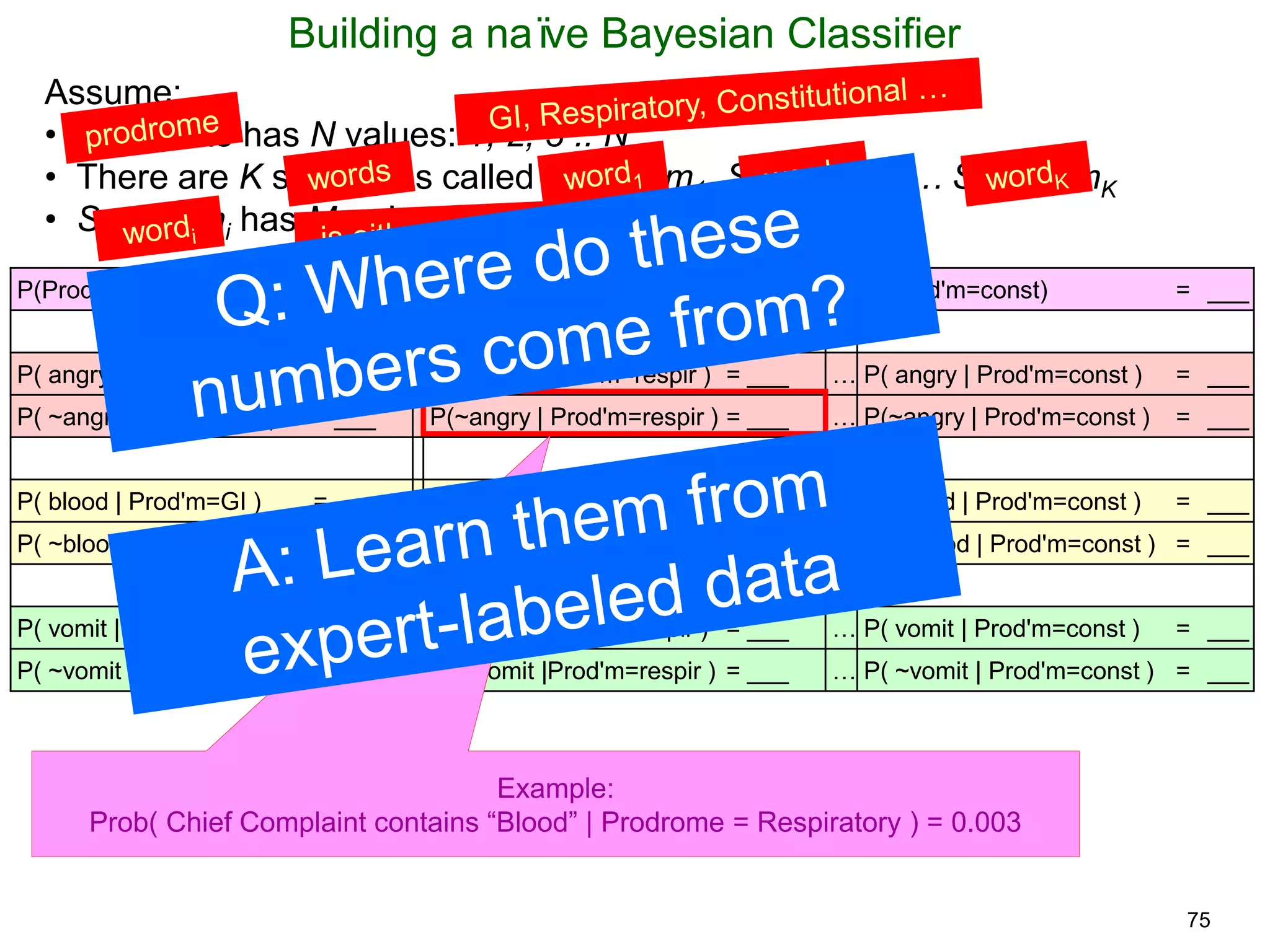
P( vomit | Prod'm=GI ) = ___ P( vomit | Prod'm=respir ) = ___ … P( vomit | Prod'm=const ) = ___
P( ~vomit | Prod'm=GI ) = ___ P( ~vomit |Prod'm=respir ) = ___ … P( ~vomit | Prod'm=const ) = ___
Example:
Prob( Chief Complaint contains “Blood” | Prodrome = Respiratory ) = 0.003
74
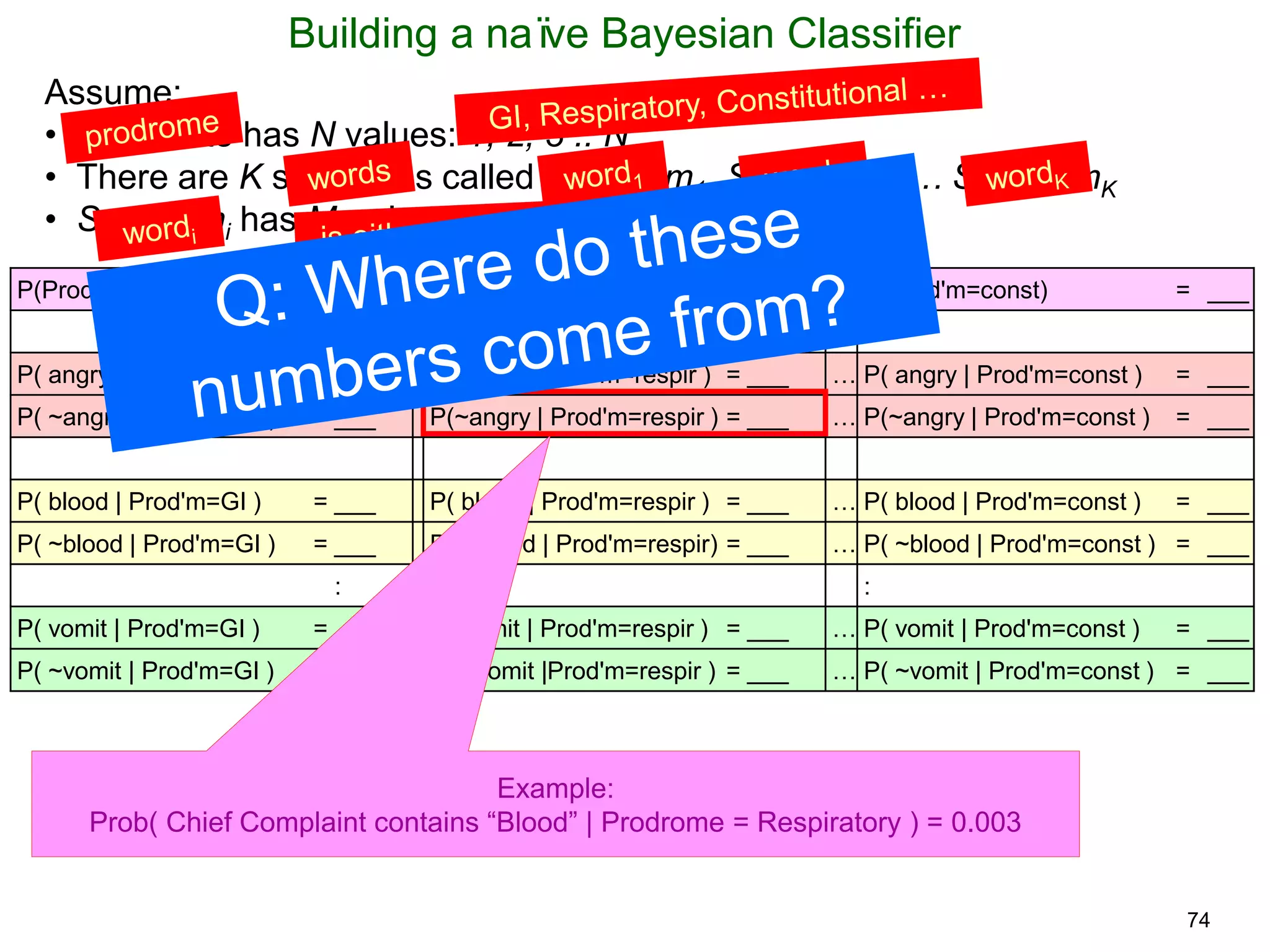
Building a naïve Bayesian Classifier
Assume:
• True state has N values: 1, 2, 3 .. N
• There are K symptoms called Symptom1, Symptom2, … SymptomK
• Symptomi has Mi values: 1, 2, .. Mi
P(Prod'm=GI) = ___ P(Prod'm=respir) = ___ … P(Prod'm=const) = ___
P( angry | Prod'm=GI ) = ___ P( angry | Prod'm=respir ) = ___ … P( angry | Prod'm=const ) = ___
P( ~angry | Prod'm=GI ) = ___ P(~angry | Prod'm=respir ) = ___ … P(~angry | Prod'm=const ) = ___
P( blood | Prod'm=GI ) = ___ P( blood | Prod'm=respir ) = ___ … P( blood | Prod'm=const ) = ___
P( ~blood | Prod'm=GI ) = ___ P( ~blood | Prod'm=respir) = ___ … P( ~blood | Prod'm=const ) = ___
: : :
P( vomit | Prod'm=GI ) = ___ P( vomit | Prod'm=respir ) = ___ … P( vomit | Prod'm=const ) = ___
P( ~vomit | Prod'm=GI ) = ___ P( ~vomit |Prod'm=respir ) = ___ … P( ~vomit | Prod'm=const ) = ___
Example:
Prob( Chief Complaint contains “Blood” | Prodrome = Respiratory ) = 0.003
75
Building a naïve Bayesian Classifier
Assume:
• True state has N values: 1, 2, 3 .. N
• There are K symptoms called Symptom1, Symptom2, … SymptomK
• Symptomi has Mi values: 1, 2, .. Mi
P(Prod'm=GI) = ___ P(Prod'm=respir) = ___ … P(Prod'm=const) = ___
P( angry | Prod'm=GI ) = ___ P( angry | Prod'm=respir ) = ___ … P( angry | Prod'm=const ) = ___
P( ~angry | Prod'm=GI ) = ___ P(~angry | Prod'm=respir ) = ___ … P(~angry | Prod'm=const ) = ___
P( blood | Prod'm=GI ) = ___ P( blood | Prod'm=respir ) = ___ … P( blood | Prod'm=const ) = ___
P( ~blood | Prod'm=GI ) = ___ P( ~blood | Prod'm=respir) = ___ … P( ~blood | Prod'm=const ) = ___
: : :
P( vomit | Prod'm=GI ) = ___ P( vomit | Prod'm=respir ) = ___ … P( vomit | Prod'm=const ) = ___
P( ~vomit | Prod'm=GI ) = ___ P( ~vomit |Prod'm=respir ) = ___ … P( ~vomit | Prod'm=const ) = ___
Example:
Prob( Chief Complaint contains “Blood” | Prodrome = Respiratory ) = 0.003
76
Learning a Bayesian Classifier
breath difficulty just neck plain rash short sore ugly
Shortness of breath 1 0 0 0 0 0 1 0 0
Difficulty breathing 1 1 0 0 0 0 0 0 0
Rash on neck 0 0 0 1 0 1 0 0 0
Sore neck and difficulty breathing 1 1 0 1 0 0 0 1 0
Just plain ugly 0 0 1 0 1 0 0 0 1
1. Before deployment of classifier,
77
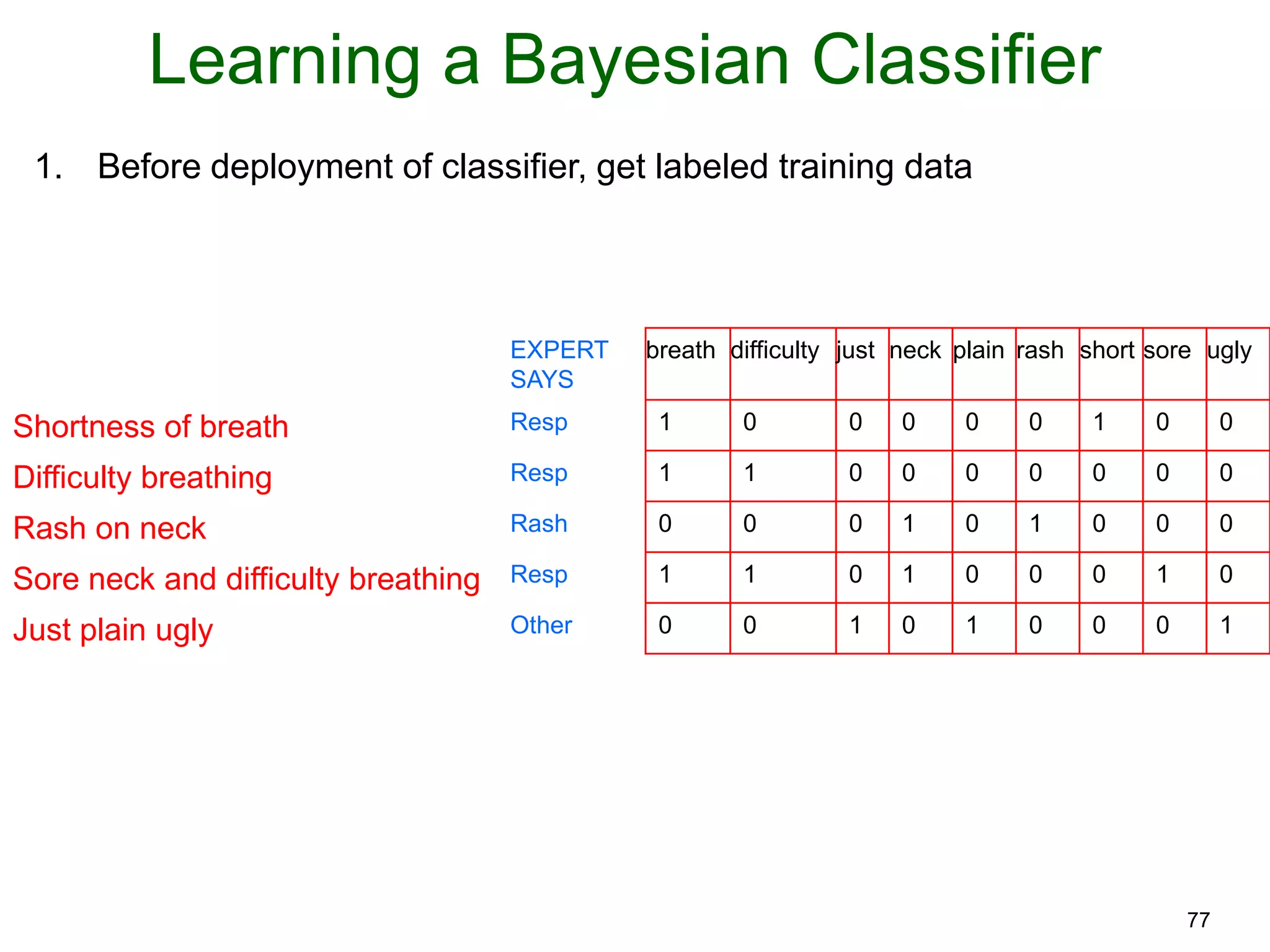
Learning a Bayesian Classifier
EXPERT
SAYS
breath difficulty just neck plain rash short sore ugly
Shortness of breath Resp 1 0 0 0 0 0 1 0 0
Difficulty breathing Resp 1 1 0 0 0 0 0 0 0
Rash on neck Rash 0 0 0 1 0 1 0 0 0
Sore neck and difficulty breathing Resp 1 1 0 1 0 0 0 1 0
Just plain ugly Other 0 0 1 0 1 0 0 0 1
1. Before deployment of classifier, get labeled training data
78
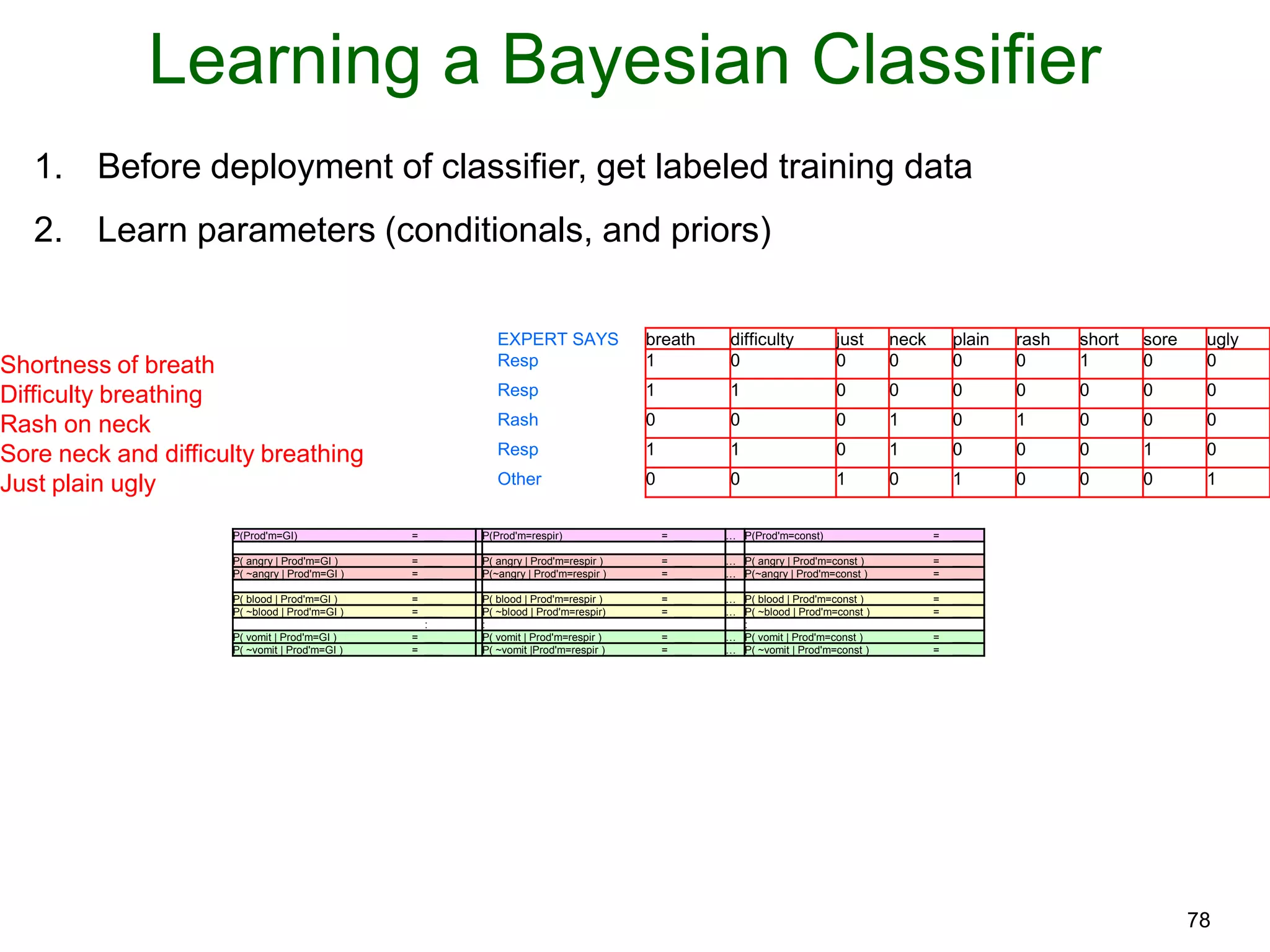
Learning a Bayesian Classifier
EXPERT SAYS breath difficulty just neck plain rash short sore ugly
Shortness of breath Resp 1 0 0 0 0 0 1 0 0
Difficulty breathing Resp 1 1 0 0 0 0 0 0 0
Rash on neck Rash 0 0 0 1 0 1 0 0 0
Sore neck and difficulty breathing Resp 1 1 0 1 0 0 0 1 0
Just plain ugly Other 0 0 1 0 1 0 0 0 1
1. Before deployment of classifier, get labeled training data
2. Learn parameters (conditionals, and priors)
P(Prod'm=GI) = ___ P(Prod'm=respir) = ___ … P(Prod'm=const) = ___
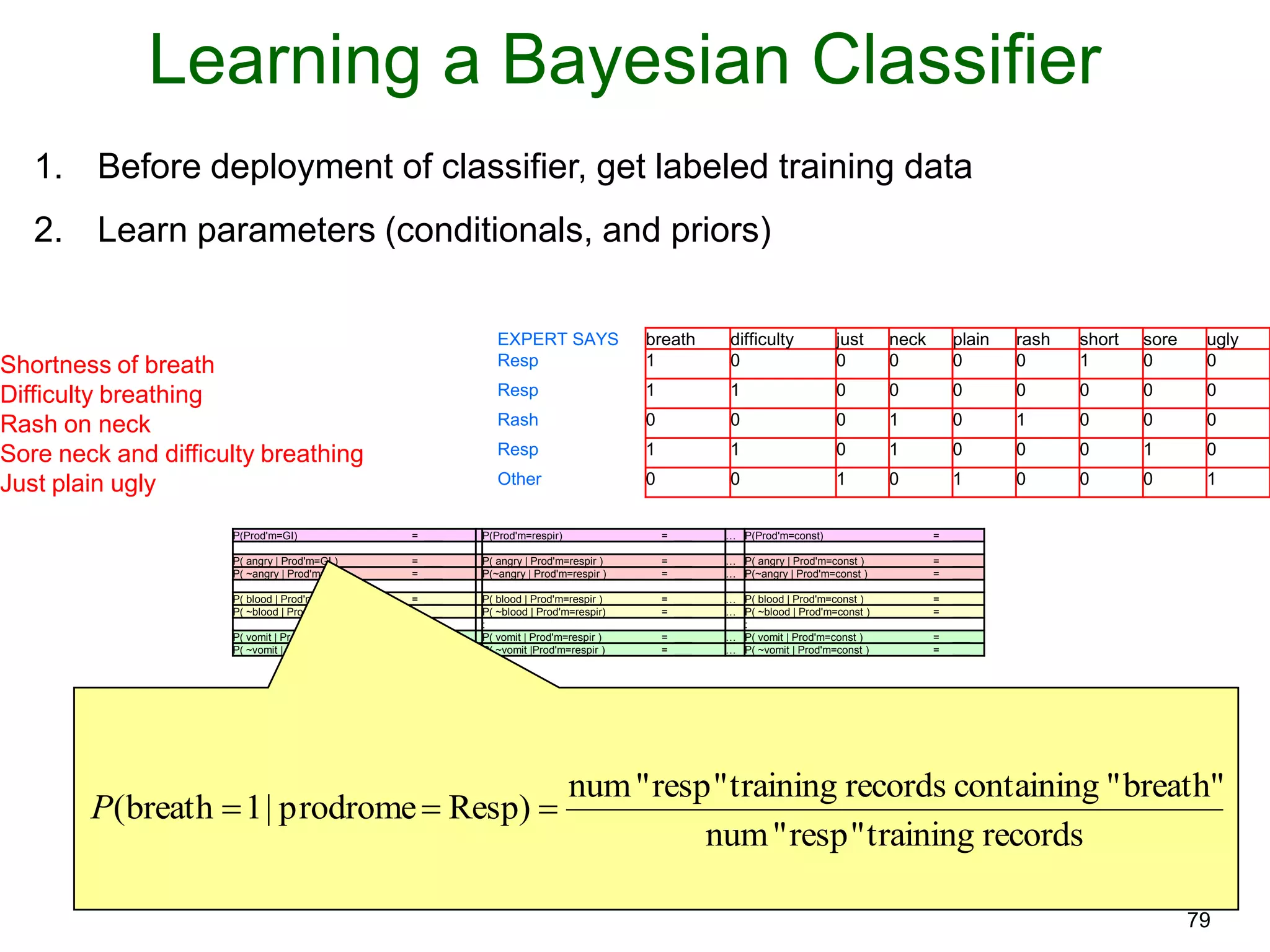
P( angry | Prod'm=GI ) = ___ P( angry | Prod'm=respir ) = ___ … P( angry | Prod'm=const ) = ___
P( ~angry | Prod'm=GI ) = ___ P(~angry | Prod'm=respir ) = ___ … P(~angry | Prod'm=const ) = ___
P( blood | Prod'm=GI ) = ___ P( blood | Prod'm=respir ) = ___ … P( blood | Prod'm=const ) = ___
P( ~blood | Prod'm=GI ) = ___ P( ~blood | Prod'm=respir) = ___ … P( ~blood | Prod'm=const ) = ___
: : :
P( vomit | Prod'm=GI ) = ___ P( vomit | Prod'm=respir ) = ___ … P( vomit | Prod'm=const ) = ___
P( ~vomit | Prod'm=GI ) = ___ P( ~vomit |Prod'm=respir ) = ___ … P( ~vomit | Prod'm=const ) = ___
79
Learning a Bayesian Classifier
EXPERT SAYS breath difficulty just neck plain rash short sore ugly
Shortness of breath Resp 1 0 0 0 0 0 1 0 0
Difficulty breathing Resp 1 1 0 0 0 0 0 0 0
Rash on neck Rash 0 0 0 1 0 1 0 0 0
Sore neck and difficulty breathing Resp 1 1 0 1 0 0 0 1 0
Just plain ugly Other 0 0 1 0 1 0 0 0 1
1. Before deployment of classifier, get labeled training data
2. Learn parameters (conditionals, and priors)
P(Prod'm=GI) = ___ P(Prod'm=respir) = ___ … P(Prod'm=const) = ___
P( angry | Prod'm=GI ) = ___ P( angry | Prod'm=respir ) = ___ … P( angry | Prod'm=const ) = ___
P( ~angry | Prod'm=GI ) = ___ P(~angry | Prod'm=respir ) = ___ … P(~angry | Prod'm=const ) = ___
P( blood | Prod'm=GI ) = ___ P( blood | Prod'm=respir ) = ___ … P( blood | Prod'm=const ) = ___
P( ~blood | Prod'm=GI ) = ___ P( ~blood | Prod'm=respir) = ___ … P( ~blood | Prod'm=const ) = ___
: : :
P( vomit | Prod'm=GI ) = ___ P( vomit | Prod'm=respir ) = ___ … P( vomit | Prod'm=const ) = ___
P( ~vomit | Prod'm=GI ) = ___ P( ~vomit |Prod'm=respir ) = ___ … P( ~vomit | Prod'm=const ) = ___
recordstrainingresp""num
breath""containingrecordstrainingresp""num
)Respprodrome|1breath( P
80
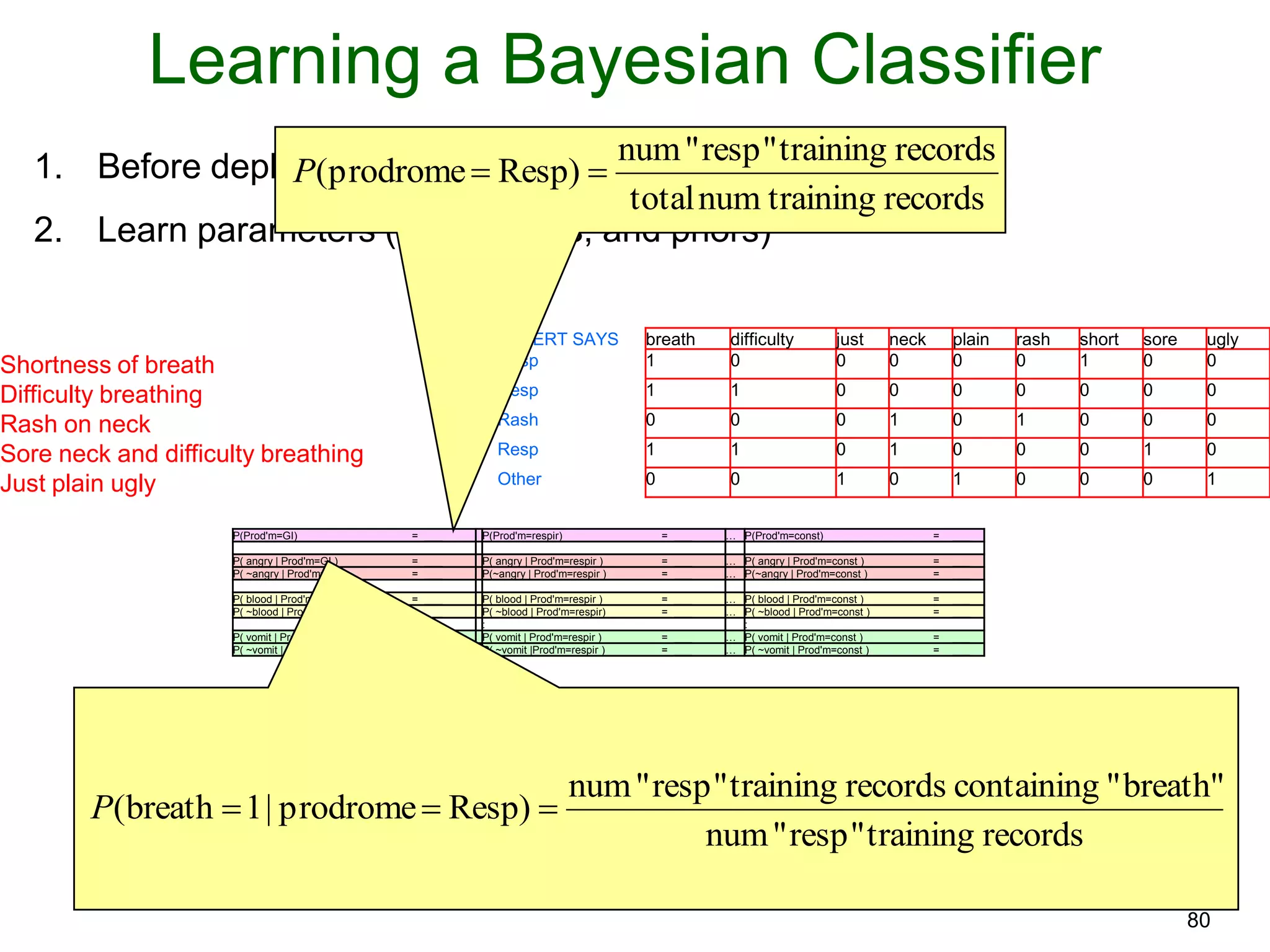
Learning a Bayesian Classifier
EXPERT SAYS breath difficulty just neck plain rash short sore ugly
Shortness of breath Resp 1 0 0 0 0 0 1 0 0
Difficulty breathing Resp 1 1 0 0 0 0 0 0 0
Rash on neck Rash 0 0 0 1 0 1 0 0 0
Sore neck and difficulty breathing Resp 1 1 0 1 0 0 0 1 0
Just plain ugly Other 0 0 1 0 1 0 0 0 1
1. Before deployment of classifier, get labeled training data
2. Learn parameters (conditionals, and priors)
P(Prod'm=GI) = ___ P(Prod'm=respir) = ___ … P(Prod'm=const) = ___
P( angry | Prod'm=GI ) = ___ P( angry | Prod'm=respir ) = ___ … P( angry | Prod'm=const ) = ___
P( ~angry | Prod'm=GI ) = ___ P(~angry | Prod'm=respir ) = ___ … P(~angry | Prod'm=const ) = ___
P( blood | Prod'm=GI ) = ___ P( blood | Prod'm=respir ) = ___ … P( blood | Prod'm=const ) = ___
P( ~blood | Prod'm=GI ) = ___ P( ~blood | Prod'm=respir) = ___ … P( ~blood | Prod'm=const ) = ___
: : :
P( vomit | Prod'm=GI ) = ___ P( vomit | Prod'm=respir ) = ___ … P( vomit | Prod'm=const ) = ___
P( ~vomit | Prod'm=GI ) = ___ P( ~vomit |Prod'm=respir ) = ___ … P( ~vomit | Prod'm=const ) = ___
recordstrainingresp""num
breath""containingrecordstrainingresp""num
)Respprodrome|1breath( P
recordstrainingnumtotal
recordstrainingresp""num
)Respprodrome( P
81
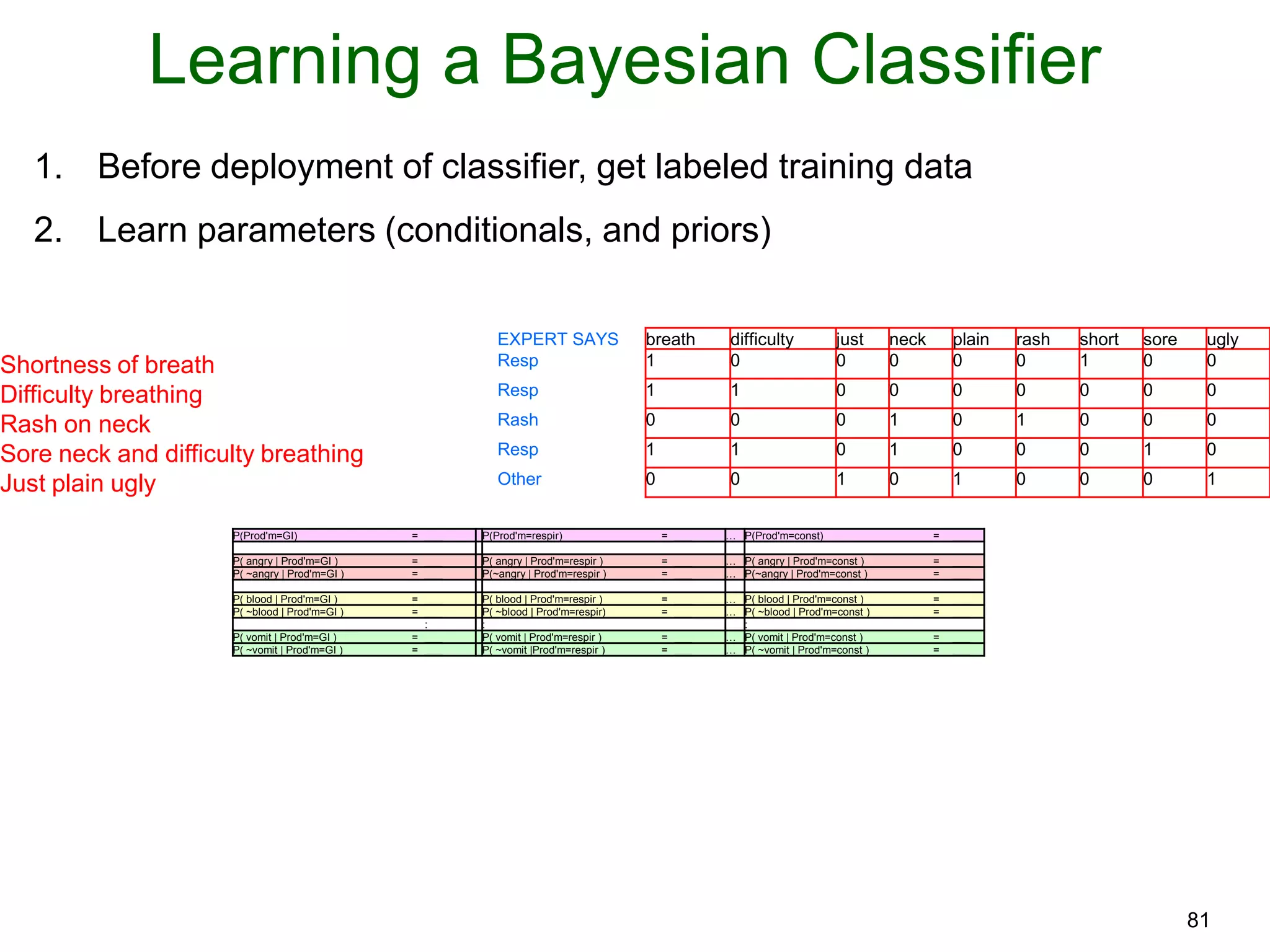
Learning a Bayesian Classifier
EXPERT SAYS breath difficulty just neck plain rash short sore ugly
Shortness of breath Resp 1 0 0 0 0 0 1 0 0
Difficulty breathing Resp 1 1 0 0 0 0 0 0 0
Rash on neck Rash 0 0 0 1 0 1 0 0 0
Sore neck and difficulty breathing Resp 1 1 0 1 0 0 0 1 0
Just plain ugly Other 0 0 1 0 1 0 0 0 1
1. Before deployment of classifier, get labeled training data
2. Learn parameters (conditionals, and priors)
P(Prod'm=GI) = ___ P(Prod'm=respir) = ___ … P(Prod'm=const) = ___
P( angry | Prod'm=GI ) = ___ P( angry | Prod'm=respir ) = ___ … P( angry | Prod'm=const ) = ___
P( ~angry | Prod'm=GI ) = ___ P(~angry | Prod'm=respir ) = ___ … P(~angry | Prod'm=const ) = ___
P( blood | Prod'm=GI ) = ___ P( blood | Prod'm=respir ) = ___ … P( blood | Prod'm=const ) = ___
P( ~blood | Prod'm=GI ) = ___ P( ~blood | Prod'm=respir) = ___ … P( ~blood | Prod'm=const ) = ___
: : :
P( vomit | Prod'm=GI ) = ___ P( vomit | Prod'm=respir ) = ___ … P( vomit | Prod'm=const ) = ___
P( ~vomit | Prod'm=GI ) = ___ P( ~vomit |Prod'm=respir ) = ___ … P( ~vomit | Prod'm=const ) = ___
82
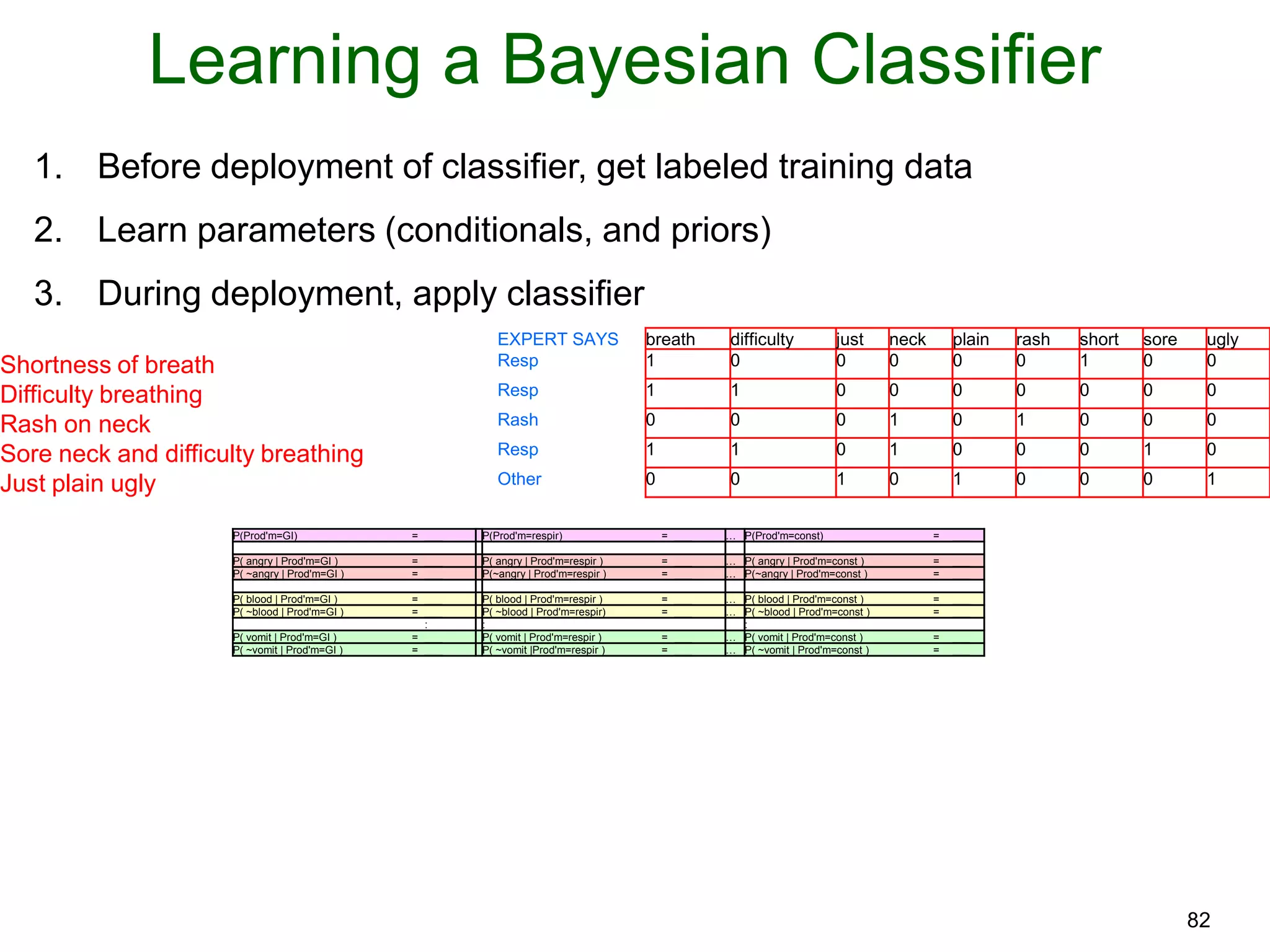
Learning a Bayesian Classifier
EXPERT SAYS breath difficulty just neck plain rash short sore ugly
Shortness of breath Resp 1 0 0 0 0 0 1 0 0
Difficulty breathing Resp 1 1 0 0 0 0 0 0 0
Rash on neck Rash 0 0 0 1 0 1 0 0 0
Sore neck and difficulty breathing Resp 1 1 0 1 0 0 0 1 0
Just plain ugly Other 0 0 1 0 1 0 0 0 1
1. Before deployment of classifier, get labeled training data
2. Learn parameters (conditionals, and priors)
3. During deployment, apply classifier
P(Prod'm=GI) = ___ P(Prod'm=respir) = ___ … P(Prod'm=const) = ___
P( angry | Prod'm=GI ) = ___ P( angry | Prod'm=respir ) = ___ … P( angry | Prod'm=const ) = ___
P( ~angry | Prod'm=GI ) = ___ P(~angry | Prod'm=respir ) = ___ … P(~angry | Prod'm=const ) = ___
P( blood | Prod'm=GI ) = ___ P( blood | Prod'm=respir ) = ___ … P( blood | Prod'm=const ) = ___
P( ~blood | Prod'm=GI ) = ___ P( ~blood | Prod'm=respir) = ___ … P( ~blood | Prod'm=const ) = ___
: : :
P( vomit | Prod'm=GI ) = ___ P( vomit | Prod'm=respir ) = ___ … P( vomit | Prod'm=const ) = ___
P( ~vomit | Prod'm=GI ) = ___ P( ~vomit |Prod'm=respir ) = ___ … P( ~vomit | Prod'm=const ) = ___
83
Learning a Bayesian Classifier
EXPERT SAYS breath difficulty just neck plain rash short sore ugly
Shortness of breath Resp 1 0 0 0 0 0 1 0 0
Difficulty breathing Resp 1 1 0 0 0 0 0 0 0
Rash on neck Rash 0 0 0 1 0 1 0 0 0
Sore neck and difficulty breathing Resp 1 1 0 1 0 0 0 1 0
Just plain ugly Other 0 0 1 0 1 0 0 0 1
1. Before deployment of classifier, get labeled training data
2. Learn parameters (conditionals, and priors)
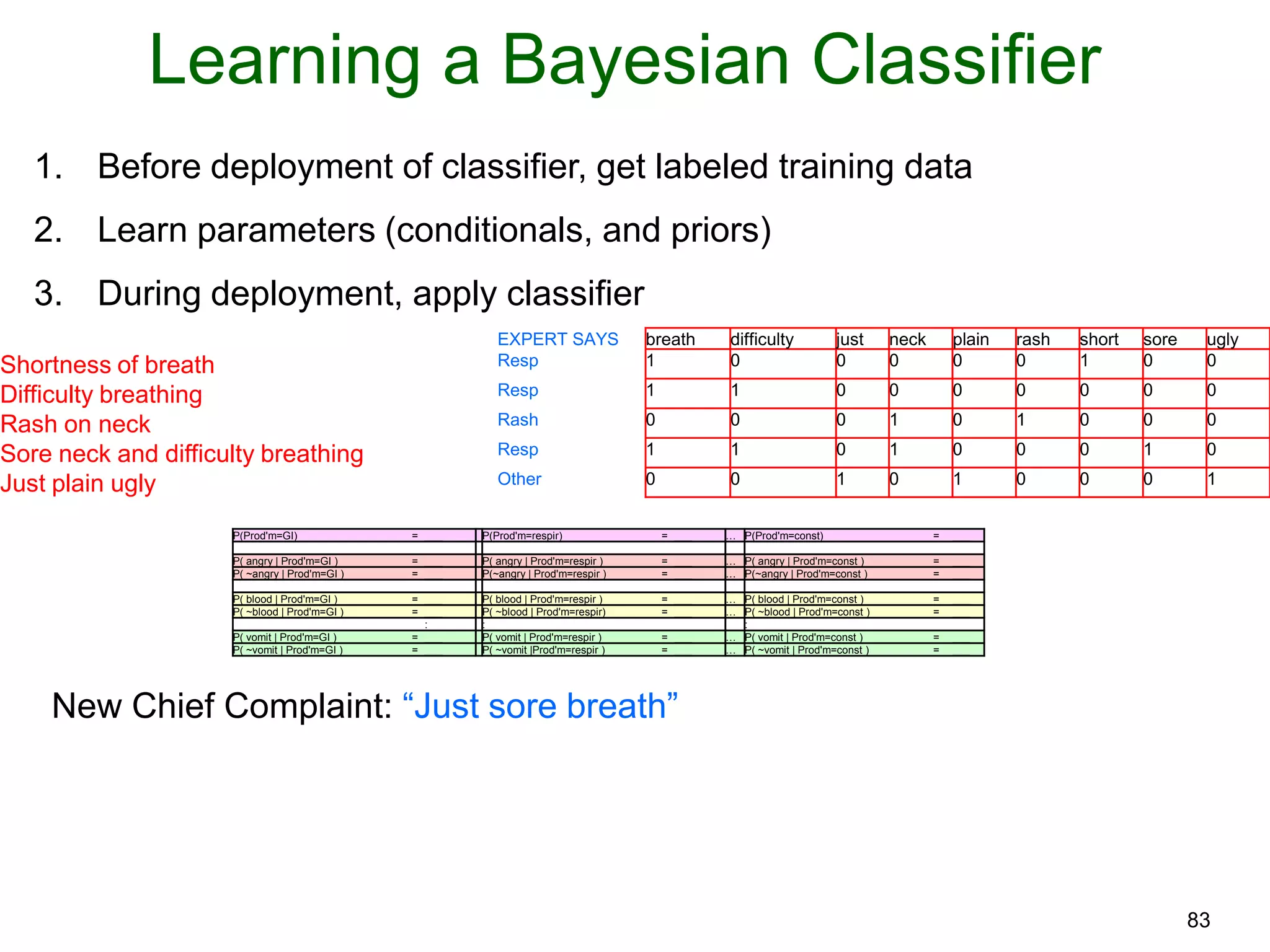
3. During deployment, apply classifier
New Chief Complaint: “Just sore breath”
P(Prod'm=GI) = ___ P(Prod'm=respir) = ___ … P(Prod'm=const) = ___
P( angry | Prod'm=GI ) = ___ P( angry | Prod'm=respir ) = ___ … P( angry | Prod'm=const ) = ___
P( ~angry | Prod'm=GI ) = ___ P(~angry | Prod'm=respir ) = ___ … P(~angry | Prod'm=const ) = ___
P( blood | Prod'm=GI ) = ___ P( blood | Prod'm=respir ) = ___ … P( blood | Prod'm=const ) = ___
P( ~blood | Prod'm=GI ) = ___ P( ~blood | Prod'm=respir) = ___ … P( ~blood | Prod'm=const ) = ___
: : :
P( vomit | Prod'm=GI ) = ___ P( vomit | Prod'm=respir ) = ___ … P( vomit | Prod'm=const ) = ___
P( ~vomit | Prod'm=GI ) = ___ P( ~vomit |Prod'm=respir ) = ___ … P( ~vomit | Prod'm=const ) = ___
84
Learning a Bayesian Classifier
EXPERT SAYS breath difficulty just neck plain rash short sore ugly
Shortness of breath Resp 1 0 0 0 0 0 1 0 0
Difficulty breathing Resp 1 1 0 0 0 0 0 0 0
Rash on neck Rash 0 0 0 1 0 1 0 0 0
Sore neck and difficulty breathing Resp 1 1 0 1 0 0 0 1 0
Just plain ugly Other 0 0 1 0 1 0 0 0 1
1. Before deployment of classifier, get labeled training data
2. Learn parameters (conditionals, and priors)
3. During deployment, apply classifier
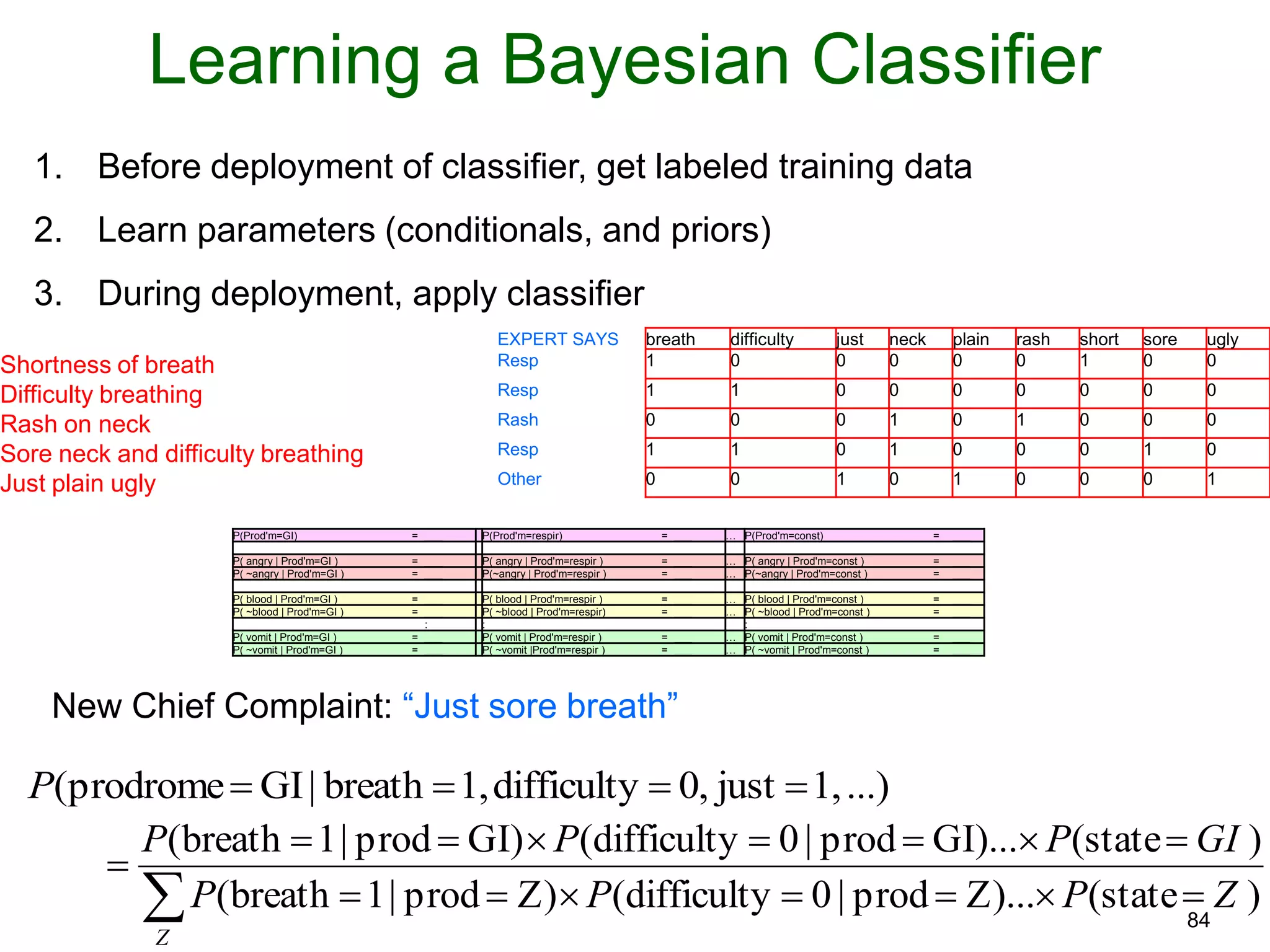
...)1,just0,difficulty1,breath|GIprodrome( P
 


Z
ZPPP
GIPPP
)state(Z)...prod|0difficulty(Z)prod|1breath(
)state(GI)...prod|0difficulty(GI)prod|1breath(
New Chief Complaint: “Just sore breath”
P(Prod'm=GI) = ___ P(Prod'm=respir) = ___ … P(Prod'm=const) = ___
P( angry | Prod'm=GI ) = ___ P( angry | Prod'm=respir ) = ___ … P( angry | Prod'm=const ) = ___
P( ~angry | Prod'm=GI ) = ___ P(~angry | Prod'm=respir ) = ___ … P(~angry | Prod'm=const ) = ___
P( blood | Prod'm=GI ) = ___ P( blood | Prod'm=respir ) = ___ … P( blood | Prod'm=const ) = ___
P( ~blood | Prod'm=GI ) = ___ P( ~blood | Prod'm=respir) = ___ … P( ~blood | Prod'm=const ) = ___
: : :
P( vomit | Prod'm=GI ) = ___ P( vomit | Prod'm=respir ) = ___ … P( vomit | Prod'm=const ) = ___
P( ~vomit | Prod'm=GI ) = ___ P( ~vomit |Prod'm=respir ) = ___ … P( ~vomit | Prod'm=const ) = ___
85
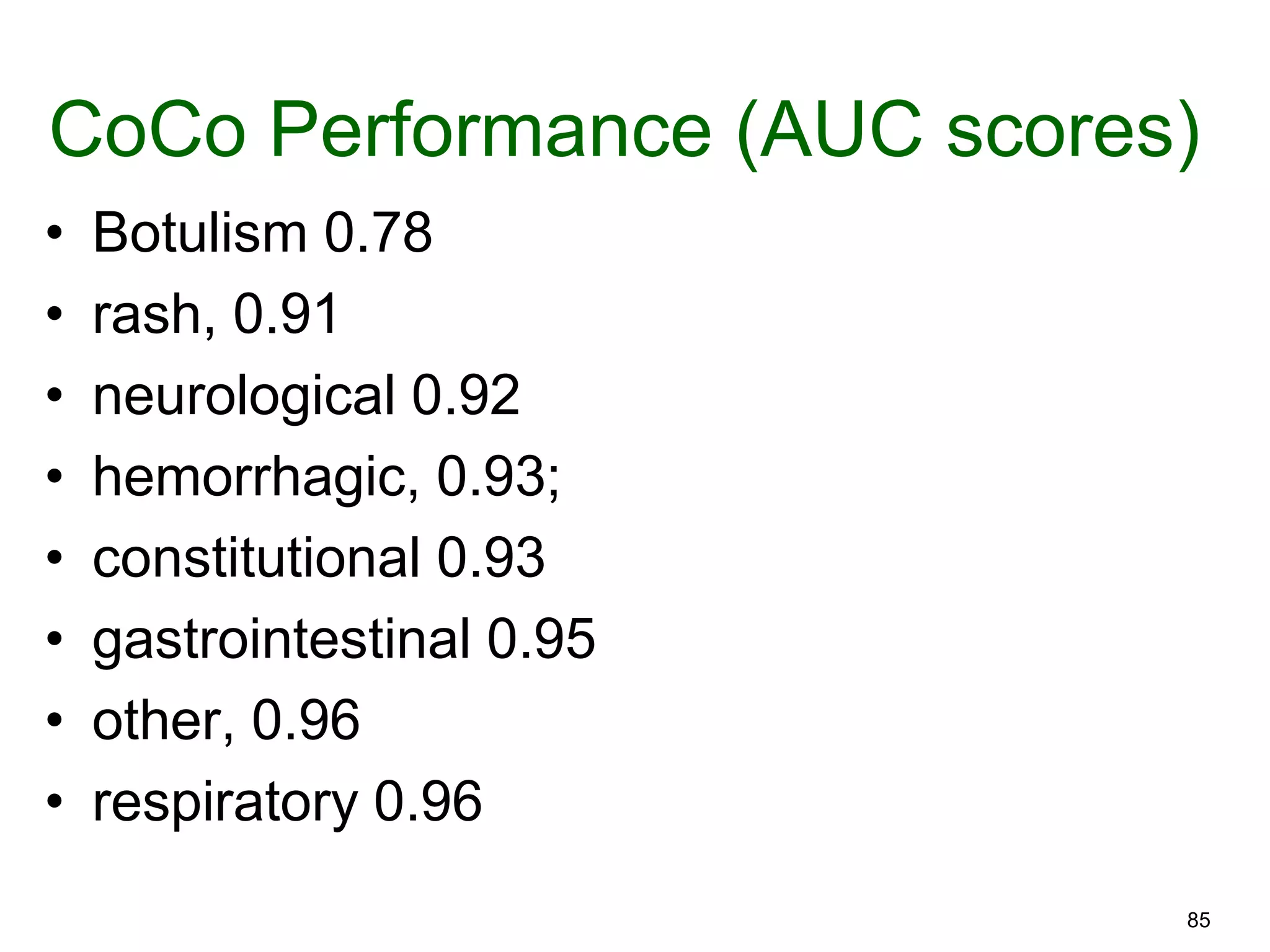
CoCo Performance (AUC scores)
• Botulism 0.78
• rash, 0.91
• neurological 0.92
• hemorrhagic, 0.93;
• constitutional 0.93
• gastrointestinal 0.95
• other, 0.96
• respiratory 0.96
86
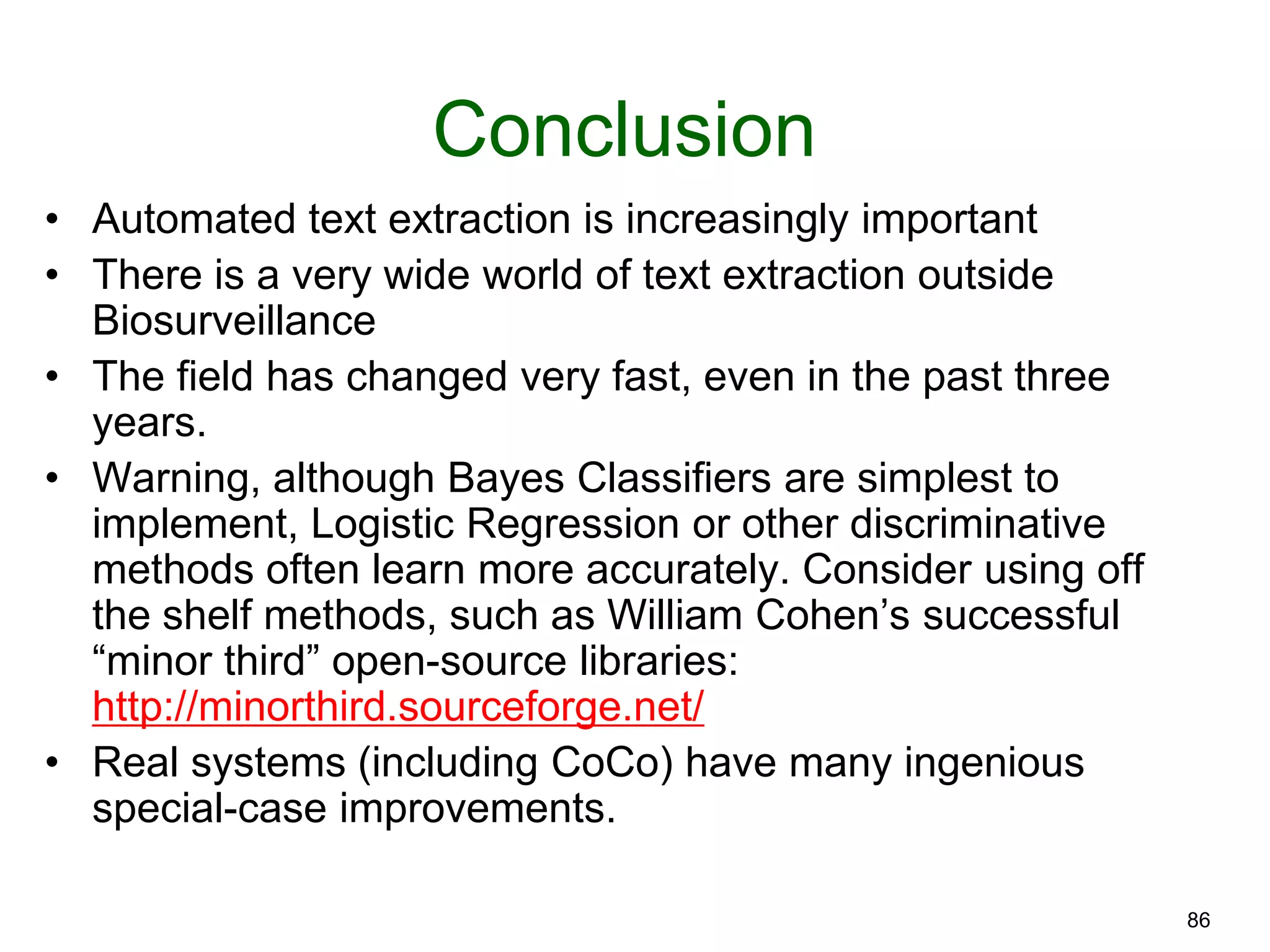
Conclusion
• Automated text extraction is increasingly important
• There is a very wide world of text extraction outside
Biosurveillance
• The field has changed very fast, even in the past three
years.
• Warning, although Bayes Classifiers are simplest to
implement, Logistic Regression or other discriminative
methods often learn more accurately. Consider using off
the shelf methods, such as William Cohen’s successful
“minor third” open-source libraries:
http://minorthird.sourceforge.net/
• Real systems (including CoCo) have many ingenious
special-case improvements.
87
Discussion
1. What new data sources should we apply
algorithms to?
1. EG Self-reporting?
2. What are related surveillance problems to which
these kinds of algorithms can be applied?
3. Where are the gaps in the current algorithms
world?
4. Are there other spatial problems out there?
5. Could new or pre-existing algorithms help in the
period after an outbreak is detected?
6. Other comments about favorite tools of the trade.

2013-1 Machine Learning Lecture 03 - Andrew Moore - a gentle introduction …

  • 1.
    A gentle introductionto the mathematics of biosurveillance: Bayes Rule and Bayes Classifiers Associate Member The RODS Lab University of Pittburgh Carnegie Mellon University http://rods.health.pitt.edu Andrew W. Moore Professor The Auton Lab School of Computer Science Carnegie Mellon University http://www.autonlab.org awm@cs.cmu.edu 412-268-7599
  • 2.
    2 What we’re goingto do • We will review the concept of reasoning with uncertainty • Also known as probability • This is a fundamental building block • It’s really going to be worth it
  • 3.
    3 Discrete Random Variables •A is a Boolean-valued random variable if A denotes an event, and there is some degree of uncertainty as to whether A occurs. • Examples • A = The next patient you examine is suffering from inhalational anthrax • A = The next patient you examine has a cough • A = There is an active terrorist cell in your city
  • 4.
    4 Probabilities • We writeP(A) as “the fraction of possible worlds in which A is true” • We could at this point spend 2 hours on the philosophy of this. • But we won’t.
  • 5.
    5 Visualizing A Event spaceof all possible worlds Its area is 1 Worlds in which A is False Worlds in which A is true P(A) = Area of reddish oval
  • 6.
    7 The Axioms OfProbability • 0 <= P(A) <= 1 • P(True) = 1 • P(False) = 0 • P(A or B) = P(A) + P(B) - P(A and B) The area of A can’t get any smaller than 0 And a zero area would mean no world could ever have A true
  • 7.
    8 Interpreting the axioms •0 <= P(A) <= 1 • P(True) = 1 • P(False) = 0 • P(A or B) = P(A) + P(B) - P(A and B) The area of A can’t get any bigger than 1 And an area of 1 would mean all worlds will have A true
  • 8.
    9 Interpreting the axioms •0 <= P(A) <= 1 • P(True) = 1 • P(False) = 0 • P(A or B) = P(A) + P(B) - P(A and B) A B
  • 9.
    10 A B Interpreting the axioms •0 <= P(A) <= 1 • P(True) = 1 • P(False) = 0 • P(A or B) = P(A) + P(B) - P(A and B) P(A or B) BP(A and B) Simple addition and subtraction
  • 10.
    12 Another important theorem •0 <= P(A) <= 1, P(True) = 1, P(False) = 0 • P(A or B) = P(A) + P(B) - P(A and B) From these we can prove: P(A) = P(A and B) + P(A and not B) A B
  • 11.
    13 Conditional Probability • P(A|B)= Fraction of worlds in which B is true that also have A true F H H = “Have a headache” F = “Coming down with Flu” P(H) = 1/10 P(F) = 1/40 P(H|F) = 1/2 “Headaches are rare and flu is rarer, but if you’re coming down with ‘flu there’s a 50- 50 chance you’ll have a headache.”
  • 12.
    14 Conditional Probability F H H =“Have a headache” F = “Coming down with Flu” P(H) = 1/10 P(F) = 1/40 P(H|F) = 1/2 P(H|F) = Fraction of flu-inflicted worlds in which you have a headache = #worlds with flu and headache ------------------------------------ #worlds with flu = Area of “H and F” region ------------------------------ Area of “F” region = P(H and F) --------------- P(F)
  • 13.
    15 Definition of ConditionalProbability P(A and B) P(A|B) = ----------- P(B) Corollary: The Chain Rule P(A and B) = P(A|B) P(B)
  • 14.
    16 Probabilistic Inference F H H =“Have a headache” F = “Coming down with Flu” P(H) = 1/10 P(F) = 1/40 P(H|F) = 1/2 One day you wake up with a headache. You think: “Drat! 50% of flus are associated with headaches so I must have a 50-50 chance of coming down with flu” Is this reasoning good?
  • 15.
    17 Probabilistic Inference F H H =“Have a headache” F = “Coming down with Flu” P(H) = 1/10 P(F) = 1/40 P(H|F) = 1/2 P(F and H) = … P(F|H) = …
  • 16.
    18 Probabilistic Inference F H H =“Have a headache” F = “Coming down with Flu” P(H) = 1/10 P(F) = 1/40 P(H|F) = 1/2 8 1 10 1 80 1 )( )and( )|(  HP HFP HFP 80 1 40 1 2 1 )()|()and(  FPFHPHFP
  • 17.
    19 What we justdid… P(A ^ B) P(A|B) P(B) P(B|A) = ----------- = --------------- P(A) P(A) This is Bayes Rule Bayes, Thomas (1763) An essay towards solving a problem in the doctrine of chances. Philosophical Transactions of the Royal Society of London, 53:370- 418
  • 18.
    20 Menu Bad Hygiene GoodHygiene MenuMenu Menu MenuMenu Menu • You are a health official, deciding whether to investigate a restaurant • You lose a dollar if you get it wrong. • You win a dollar if you get it right • Half of all restaurants have bad hygiene • In a bad restaurant, ¾ of the menus are smudged • In a good restaurant, 1/3 of the menus are smudged • You are allowed to see a randomly chosen menu
  • 19.
  • 20.
  • 21.
    23 Bayesian Diagnosis Buzzword MeaningIn our example Our example’s value True State The true state of the world, which you would like to know Is the restaurant bad?
  • 22.
    24 Bayesian Diagnosis Buzzword MeaningIn our example Our example’s value True State The true state of the world, which you would like to know Is the restaurant bad? Prior Prob(true state = x) P(Bad) 1/2
  • 23.
    25 Bayesian Diagnosis Buzzword MeaningIn our example Our example’s value True State The true state of the world, which you would like to know Is the restaurant bad? Prior Prob(true state = x) P(Bad) 1/2 Evidence Some symptom, or other thing you can observe Smudge
  • 24.
    26 Bayesian Diagnosis Buzzword MeaningIn our example Our example’s value True State The true state of the world, which you would like to know Is the restaurant bad? Prior Prob(true state = x) P(Bad) 1/2 Evidence Some symptom, or other thing you can observe Conditional Probability of seeing evidence if you did know the true state P(Smudge|Bad) 3/4 P(Smudge|not Bad) 1/3
  • 25.
    27 Bayesian Diagnosis Buzzword MeaningIn our example Our example’s value True State The true state of the world, which you would like to know Is the restaurant bad? Prior Prob(true state = x) P(Bad) 1/2 Evidence Some symptom, or other thing you can observe Conditional Probability of seeing evidence if you did know the true state P(Smudge|Bad) 3/4 P(Smudge|not Bad) 1/3 Posterior The Prob(true state = x | some evidence) P(Bad|Smudge) 9/13
  • 26.
    28 Bayesian Diagnosis Buzzword MeaningIn our example Our example’s value True State The true state of the world, which you would like to know Is the restaurant bad? Prior Prob(true state = x) P(Bad) 1/2 Evidence Some symptom, or other thing you can observe Conditional Probability of seeing evidence if you did know the true state P(Smudge|Bad) 3/4 P(Smudge|not Bad) 1/3 Posterior The Prob(true state = x | some evidence) P(Bad|Smudge) 9/13 Inference, Diagnosis, Bayesian Reasoning Getting the posterior from the prior and the evidence
  • 27.
    29 Bayesian Diagnosis Buzzword MeaningIn our example Our example’s value True State The true state of the world, which you would like to know Is the restaurant bad? Prior Prob(true state = x) P(Bad) 1/2 Evidence Some symptom, or other thing you can observe Conditional Probability of seeing evidence if you did know the true state P(Smudge|Bad) 3/4 P(Smudge|not Bad) 1/3 Posterior The Prob(true state = x | some evidence) P(Bad|Smudge) 9/13 Inference, Diagnosis, Bayesian Reasoning Getting the posterior from the prior and the evidence Decision theory Combining the posterior with known costs in order to decide what to do
  • 28.
  • 29.
    31 Many Pieces ofEvidence Pat walks in to the surgery. Pat is sore and has a headache but no cough
  • 30.
    32 Many Pieces ofEvidence P(Flu) = 1/40 P(Not Flu) = 39/40 P( Headache | Flu ) = 1/2 P( Headache | not Flu ) = 7 / 78 P( Cough | Flu ) = 2/3 P( Cough | not Flu ) = 1/6 P( Sore | Flu ) = 3/4 P( Sore | not Flu ) = 1/3 Pat walks in to the surgery. Pat is sore and has a headache but no cough Priors Conditionals
  • 31.
    33 Many Pieces ofEvidence P(Flu) = 1/40 P(Not Flu) = 39/40 P( Headache | Flu ) = 1/2 P( Headache | not Flu ) = 7 / 78 P( Cough | Flu ) = 2/3 P( Cough | not Flu ) = 1/6 P( Sore | Flu ) = 3/4 P( Sore | not Flu ) = 1/3 Pat walks in to the surgery. Pat is sore and has a headache but no cough What is P( F | H and not C and S ) ? Priors Conditionals
  • 32.
    34 P(Flu) = 1/40P(Not Flu) = 39/40 P( Headache | Flu ) = 1/2 P( Headache | not Flu ) = 7 / 78 P( Cough | Flu ) = 2/3 P( Cough | not Flu ) = 1/6 P( Sore | Flu ) = 3/4 P( Sore | not Flu ) = 1/3 The Naïve Assumption
  • 33.
    35 If I knowPat has Flu… …and I want to know if Pat has a cough… …it won’t help me to find out whether Pat is sore P(Flu) = 1/40 P(Not Flu) = 39/40 P( Headache | Flu ) = 1/2 P( Headache | not Flu ) = 7 / 78 P( Cough | Flu ) = 2/3 P( Cough | not Flu ) = 1/6 P( Sore | Flu ) = 3/4 P( Sore | not Flu ) = 1/3 The Naïve Assumption
  • 34.
    36 If I knowPat has Flu… …and I want to know if Pat has a cough… …it won’t help me to find out whether Pat is sore )|()notand|( )|()and|( FCPSFCP FCPSFCP   Coughing is explained away by Flu P(Flu) = 1/40 P(Not Flu) = 39/40 P( Headache | Flu ) = 1/2 P( Headache | not Flu ) = 7 / 78 P( Cough | Flu ) = 2/3 P( Cough | not Flu ) = 1/6 P( Sore | Flu ) = 3/4 P( Sore | not Flu ) = 1/3 The Naïve Assumption
  • 35.
    37 P(Flu) = 1/40P(Not Flu) = 39/40 P( Headache | Flu ) = 1/2 P( Headache | not Flu ) = 7 / 78 P( Cough | Flu ) = 2/3 P( Cough | not Flu ) = 1/6 P( Sore | Flu ) = 3/4 P( Sore | not Flu ) = 1/3 The Naïve Assumption: General Case If I know the true state… …and I want to know about one of the symptoms… …then it won’t help me to find out anything about the other symptoms )symptomsotherandstatetrue|Symptom(P Other symptoms are explained away by the true state )statetrue|Symptom(P
  • 36.
    38 P(Flu) = 1/40P(Not Flu) = 39/40 P( Headache | Flu ) = 1/2 P( Headache | not Flu ) = 7 / 78 P( Cough | Flu ) = 2/3 P( Cough | not Flu ) = 1/6 P( Sore | Flu ) = 3/4 P( Sore | not Flu ) = 1/3 The Naïve Assumption: General Case If I know the true state… …and I want to know about one of the symptoms… …then it won’t help me to find out anything about the other symptoms )symptomsotherandstatetrue|Symptom(P Other symptoms are explained away by the true state )statetrue|Symptom(P
  • 37.
    39 )andnotand|( SCHFP P(Flu) =1/40 P(Not Flu) = 39/40 P( Headache | Flu ) = 1/2 P( Headache | not Flu ) = 7 / 78 P( Cough | Flu ) = 2/3 P( Cough | not Flu ) = 1/6 P( Sore | Flu ) = 3/4 P( Sore | not Flu ) = 1/3
  • 38.
    40 )andnotand|( SCHFP )andnotand( )andandnotand( SCHP FSCHP  P(Flu) =1/40 P(Not Flu) = 39/40 P( Headache | Flu ) = 1/2 P( Headache | not Flu ) = 7 / 78 P( Cough | Flu ) = 2/3 P( Cough | not Flu ) = 1/6 P( Sore | Flu ) = 3/4 P( Sore | not Flu ) = 1/3
  • 39.
    41 )andnotand|( SCHFP )andnotand( )andandnotand( SCHP FSCHP  )notandandnotand()andandnotand( )andandnotand( FSCHPFSCHP FSCHP   P(Flu) =1/40 P(Not Flu) = 39/40 P( Headache | Flu ) = 1/2 P( Headache | not Flu ) = 7 / 78 P( Cough | Flu ) = 2/3 P( Cough | not Flu ) = 1/6 P( Sore | Flu ) = 3/4 P( Sore | not Flu ) = 1/3
  • 40.
    42 )andnotand|( SCHFP )andnotand( )andandnotand( SCHP FSCHP  )notandandnotand()andandnotand( )andandnotand( FSCHPFSCHP FSCHP   How doI get P(H and not C and S and F)? P(Flu) = 1/40 P(Not Flu) = 39/40 P( Headache | Flu ) = 1/2 P( Headache | not Flu ) = 7 / 78 P( Cough | Flu ) = 2/3 P( Cough | not Flu ) = 1/6 P( Sore | Flu ) = 3/4 P( Sore | not Flu ) = 1/3
  • 41.
    43 P(Flu) = 1/40P(Not Flu) = 39/40 P( Headache | Flu ) = 1/2 P( Headache | not Flu ) = 7 / 78 P( Cough | Flu ) = 2/3 P( Cough | not Flu ) = 1/6 P( Sore | Flu ) = 3/4 P( Sore | not Flu ) = 1/3 )andandnotand( FSCHP
  • 42.
    44 P(Flu) = 1/40P(Not Flu) = 39/40 P( Headache | Flu ) = 1/2 P( Headache | not Flu ) = 7 / 78 P( Cough | Flu ) = 2/3 P( Cough | not Flu ) = 1/6 P( Sore | Flu ) = 3/4 P( Sore | not Flu ) = 1/3 )andandnot()andandnot|( FSCPFSCHP  )andandnotand( FSCHP Chain rule: P( █ and █ ) = P( █ | █ ) × P( █ )
  • 43.
    45 P(Flu) = 1/40P(Not Flu) = 39/40 P( Headache | Flu ) = 1/2 P( Headache | not Flu ) = 7 / 78 P( Cough | Flu ) = 2/3 P( Cough | not Flu ) = 1/6 P( Sore | Flu ) = 3/4 P( Sore | not Flu ) = 1/3 )andandnot()andandnot|( FSCPFSCHP  )andandnotand( FSCHP Naïve assumption: lack of cough and soreness have no effect on headache if I am already assuming Flu )andandnot()|( FSCPFHP 
  • 44.
    46 P(Flu) = 1/40P(Not Flu) = 39/40 P( Headache | Flu ) = 1/2 P( Headache | not Flu ) = 7 / 78 P( Cough | Flu ) = 2/3 P( Cough | not Flu ) = 1/6 P( Sore | Flu ) = 3/4 P( Sore | not Flu ) = 1/3 )andandnot()andandnot|( FSCPFSCHP  )andandnot()|( FSCPFHP  )and()and|not()|( FSPFSCPFHP  )andandnotand( FSCHP Chain rule: P( █ and █ ) = P( █ | █ ) × P( █ )
  • 45.
    47 P(Flu) = 1/40P(Not Flu) = 39/40 P( Headache | Flu ) = 1/2 P( Headache | not Flu ) = 7 / 78 P( Cough | Flu ) = 2/3 P( Cough | not Flu ) = 1/6 P( Sore | Flu ) = 3/4 P( Sore | not Flu ) = 1/3 )andandnot()andandnot|( FSCPFSCHP  )andandnot()|( FSCPFHP  )and()and|not()|( FSPFSCPFHP  )and()|not()|( FSPFCPFHP  )andandnotand( FSCHP Naïve assumption: Sore has no effect on Cough if I am already assuming Flu
  • 46.
    48 P(Flu) = 1/40P(Not Flu) = 39/40 P( Headache | Flu ) = 1/2 P( Headache | not Flu ) = 7 / 78 P( Cough | Flu ) = 2/3 P( Cough | not Flu ) = 1/6 P( Sore | Flu ) = 3/4 P( Sore | not Flu ) = 1/3 )andandnot()andandnot|( FSCPFSCHP  )andandnot()|( FSCPFHP  )and()and|not()|( FSPFSCPFHP  )and()|not()|( FSPFCPFHP  )()|()|not()|( FPFSPFCPFHP  )andandnotand( FSCHP Chain rule: P( █ and █ ) = P( █ | █ ) × P( █ )
  • 47.
    49 P(Flu) = 1/40P(Not Flu) = 39/40 P( Headache | Flu ) = 1/2 P( Headache | not Flu ) = 7 / 78 P( Cough | Flu ) = 2/3 P( Cough | not Flu ) = 1/6 P( Sore | Flu ) = 3/4 P( Sore | not Flu ) = 1/3 )andandnot()andandnot|( FSCPFSCHP  )andandnot()|( FSCPFHP  )and()and|not()|( FSPFSCPFHP  )and()|not()|( FSPFCPFHP  )()|()|not()|( FPFSPFCPFHP  )andandnotand( FSCHP 320 1 40 1 4 3 3 2 1 2 1       
  • 48.
    50 )andnotand|( SCHFP )andnotand( )andandnotand( SCHP FSCHP  )notandandnotand()andandnotand( )andandnotand( FSCHPFSCHP FSCHP   P(Flu) =1/40 P(Not Flu) = 39/40 P( Headache | Flu ) = 1/2 P( Headache | not Flu ) = 7 / 78 P( Cough | Flu ) = 2/3 P( Cough | not Flu ) = 1/6 P( Sore | Flu ) = 3/4 P( Sore | not Flu ) = 1/3
  • 49.
    51 )notandandnot()not|( FSCPFHP  )notand()notand|not()not|(FSPFSCPFHP  )notand()not|not()not|( FSPFCPFHP  )not()not|()not|not()not|( FPFSPFCPFHP  )notandandnotand( FSCHP )notandandnot()notandandnot|( FSCPFSCHP  P(Flu) = 1/40 P(Not Flu) = 39/40 P( Headache | Flu ) = 1/2 P( Headache | not Flu ) = 7 / 78 P( Cough | Flu ) = 2/3 P( Cough | not Flu ) = 1/6 P( Sore | Flu ) = 3/4 P( Sore | not Flu ) = 1/3 288 7 40 39 3 1 6 1 1 78 7       
  • 50.
    52 )andnotand|( SCHFP )andnotand( )andandnotand( SCHP FSCHP  )notandandnotand()andandnotand( )andandnotand( FSCHPFSCHP FSCHP   P(Flu) =1/40 P(Not Flu) = 39/40 P( Headache | Flu ) = 1/2 P( Headache | not Flu ) = 7 / 78 P( Cough | Flu ) = 2/3 P( Cough | not Flu ) = 1/6 P( Sore | Flu ) = 3/4 P( Sore | not Flu ) = 1/3 288 7 320 1 320 1 = 0.1139 (11% chance of Flu, given symptoms)
  • 51.
    53 Building A BayesClassifier P(Flu) = 1/40 P(Not Flu) = 39/40 P( Headache | Flu ) = 1/2 P( Headache | not Flu ) = 7 / 78 P( Cough | Flu ) = 2/3 P( Cough | not Flu ) = 1/6 P( Sore | Flu ) = 3/4 P( Sore | not Flu ) = 1/3 Priors Conditionals
  • 52.
  • 53.
    55 Building a naïveBayesian Classifier P(State=1) = ___ P(State=2) = ___ … P(State=N) = ___ P( Sym1=1 | State=1 ) = ___ P( Sym1=1 | State=2 ) = ___ … P( Sym1=1 | State=N ) = ___ P( Sym1=2 | State=1 ) = ___ P( Sym1=2 | State=2 ) = ___ … P( Sym1=2 | State=N ) = ___ : : : : : : : P( Sym1=M1 | State=1 ) = ___ P( Sym1=M1 | State=2 ) = ___ … P( Sym1=M1 | State=N ) = ___ P( Sym2=1 | State=1 ) = ___ P( Sym2=1 | State=2 ) = ___ … P( Sym2=1 | State=N ) = ___ P( Sym2=2 | State=1 ) = ___ P( Sym2=2 | State=2 ) = ___ … P( Sym2=2 | State=N ) = ___ : : : : : : : P( Sym2=M2 | State=1 ) = ___ P( Sym2=M2 | State=2 ) = ___ … P( Sym2=M2 | State=N ) = ___ : : : P( SymK=1 | State=1 ) = ___ P( SymK=1 | State=2 ) = ___ … P( SymK=1 | State=N ) = ___ P( SymK=2 | State=1 ) = ___ P( SymK=2 | State=2 ) = ___ … P( SymK=2 | State=N ) = ___ : : : : : : : P( SymK=MK | State=1 ) = ___ P( SymK=M1 | State=2 ) = ___ … P( SymK=M1 | State=N ) = ___ Assume: • True state has N possible values: 1, 2, 3 .. N • There are K symptoms called Symptom1, Symptom2, … SymptomK • Symptomi has Mi possible values: 1, 2, .. Mi
  • 54.
    56 Building a naïveBayesian Classifier P(State=1) = ___ P(State=2) = ___ … P(State=N) = ___ P( Sym1=1 | State=1 ) = ___ P( Sym1=1 | State=2 ) = ___ … P( Sym1=1 | State=N ) = ___ P( Sym1=2 | State=1 ) = ___ P( Sym1=2 | State=2 ) = ___ … P( Sym1=2 | State=N ) = ___ : : : : : : : P( Sym1=M1 | State=1 ) = ___ P( Sym1=M1 | State=2 ) = ___ … P( Sym1=M1 | State=N ) = ___ P( Sym2=1 | State=1 ) = ___ P( Sym2=1 | State=2 ) = ___ … P( Sym2=1 | State=N ) = ___ P( Sym2=2 | State=1 ) = ___ P( Sym2=2 | State=2 ) = ___ … P( Sym2=2 | State=N ) = ___ : : : : : : : P( Sym2=M2 | State=1 ) = ___ P( Sym2=M2 | State=2 ) = ___ … P( Sym2=M2 | State=N ) = ___ : : : P( SymK=1 | State=1 ) = ___ P( SymK=1 | State=2 ) = ___ … P( SymK=1 | State=N ) = ___ P( SymK=2 | State=1 ) = ___ P( SymK=2 | State=2 ) = ___ … P( SymK=2 | State=N ) = ___ : : : : : : : P( SymK=MK | State=1 ) = ___ P( SymK=M1 | State=2 ) = ___ … P( SymK=M1 | State=N ) = ___ Assume: • True state has N values: 1, 2, 3 .. N • There are K symptoms called Symptom1, Symptom2, … SymptomK • Symptomi has Mi values: 1, 2, .. Mi Example: P( Anemic | Liver Cancer) = 0.21
  • 55.
    57 P(State=1) = ___P(State=2) = ___ … P(State=N) = ___ P( Sym1=1 | State=1 ) = ___ P( Sym1=1 | State=2 ) = ___ … P( Sym1=1 | State=N ) = ___ P( Sym1=2 | State=1 ) = ___ P( Sym1=2 | State=2 ) = ___ … P( Sym1=2 | State=N ) = ___ : : : : : : : P( Sym1=M1 | State=1 ) = ___ P( Sym1=M1 | State=2 ) = ___ … P( Sym1=M1 | State=N ) = ___ P( Sym2=1 | State=1 ) = ___ P( Sym2=1 | State=2 ) = ___ … P( Sym2=1 | State=N ) = ___ P( Sym2=2 | State=1 ) = ___ P( Sym2=2 | State=2 ) = ___ … P( Sym2=2 | State=N ) = ___ : : : : : : : P( Sym2=M2 | State=1 ) = ___ P( Sym2=M2 | State=2 ) = ___ … P( Sym2=M2 | State=N ) = ___ : : : P( SymK=1 | State=1 ) = ___ P( SymK=1 | State=2 ) = ___ … P( SymK=1 | State=N ) = ___ P( SymK=2 | State=1 ) = ___ P( SymK=2 | State=2 ) = ___ … P( SymK=2 | State=N ) = ___ : : : : : : : P( SymK=MK | State=1 ) = ___ P( SymK=M1 | State=2 ) = ___ … P( SymK=M1 | State=N ) = ___ )sympandsympandsymp|state( 2211 nn XXXYP   )sympandsympandsymp( )stateandsympandsympandsymp( 2211 2211 nn nn XXXP YXXXP          Z nn nn ZXXXP YXXXP )stateandsympandsympandsymp( )stateandsympandsympandsymp( 2211 2211                       Z n i ii n i ii ZPZ|XP YPY|XP )state()statesymp( )state()statesymp( 1 1
  • 56.
    58 P(State=1) = ___P(State=2) = ___ … P(State=N) = ___ P( Sym1=1 | State=1 ) = ___ P( Sym1=1 | State=2 ) = ___ … P( Sym1=1 | State=N ) = ___ P( Sym1=2 | State=1 ) = ___ P( Sym1=2 | State=2 ) = ___ … P( Sym1=2 | State=N ) = ___ : : : : : : : P( Sym1=M1 | State=1 ) = ___ P( Sym1=M1 | State=2 ) = ___ … P( Sym1=M1 | State=N ) = ___ P( Sym2=1 | State=1 ) = ___ P( Sym2=1 | State=2 ) = ___ … P( Sym2=1 | State=N ) = ___ P( Sym2=2 | State=1 ) = ___ P( Sym2=2 | State=2 ) = ___ … P( Sym2=2 | State=N ) = ___ : : : : : : : P( Sym2=M2 | State=1 ) = ___ P( Sym2=M2 | State=2 ) = ___ … P( Sym2=M2 | State=N ) = ___ : : : P( SymK=1 | State=1 ) = ___ P( SymK=1 | State=2 ) = ___ … P( SymK=1 | State=N ) = ___ P( SymK=2 | State=1 ) = ___ P( SymK=2 | State=2 ) = ___ … P( SymK=2 | State=N ) = ___ : : : : : : : P( SymK=MK | State=1 ) = ___ P( SymK=M1 | State=2 ) = ___ … P( SymK=M1 | State=N ) = ___ )sympandsympandsymp|state( 2211 nn XXXYP   )sympandsympandsymp( )stateandsympandsympandsymp( 2211 2211 nn nn XXXP YXXXP          Z nn nn ZXXXP YXXXP )stateandsympandsympandsymp( )stateandsympandsympandsymp( 2211 2211                       Z n i ii n i ii ZPZ|XP YPY|XP )state()statesymp( )state()statesymp( 1 1
  • 57.
    59 Conclusion • You willhear lots of “Bayesian” this and “conditional probability” that this week. • It’s simple: don’t let wooly academic types trick you into thinking it is fancy. • You should know: • What are: Bayesian Reasoning, Conditional Probabilities, Priors, Posteriors. • Appreciate how conditional probabilities are manipulated. • Why the Naïve Bayes Assumption is Good. • Why the Naïve Bayes Assumption is Evil.
  • 58.
    60 Text mining • Motivation:an enormous (and growing!) supply of rich data • Most of the available text data is unstructured… • Some of it is semi-structured: • Header entries (title, authors’ names, section titles, keyword lists, etc.) • Running text bodies (main body, abstract, summary, etc.) • Natural Language Processing (NLP) • Text Information Retrieval
  • 59.
    61 Text processing • NaturalLanguage Processing: • Automated understanding of text is a very very very challenging Artificial Intelligence problem • Aims on extracting semantic contents of the processed documents • Involves extensive research into semantics, grammar, automated reasoning, … • Several factors making it tough for a computer include: • Polysemy (the same word having several different meanings) • Synonymy (several different ways to describe the same thing)
  • 60.
    62 Text processing • TextInformation Retrieval: • Search through collections of documents in order to find objects: • relevant to a specific query • similar to a specific document • For practical reasons, the text documents are parameterized • Terminology: • Documents (text data units: books, articles, paragraphs, other chunks such as email messages, ...) • Terms (specific words, word pairs, phrases)
  • 61.
    63 Text Information Retrieval •Typically, the text databases are parametrized with a document- term matrix • Each row of the matrix corresponds to one of the documents • Each column corresponds to a different term Shortness of breath Difficulty breathing Rash on neck Sore neck and difficulty breathing Just plain ugly
  • 62.
    64 Text Information Retrieval •Typically, the text databases are parametrized with a document- term matrix • Each row of the matrix corresponds to one of the documents • Each column corresponds to a different term breath difficulty just neck plain rash short sore ugly Shortness of breath 1 0 0 0 0 0 1 0 0 Difficulty breathing 1 1 0 0 0 0 0 0 0 Rash on neck 0 0 0 1 0 1 0 0 0 Sore neck and difficulty breathing 1 1 0 1 0 0 0 1 0 Just plain ugly 0 0 1 0 1 0 0 0 1
  • 63.
    65 Parametrization for Text InformationRetrieval • Depending on the particular method of parametrization the matrix entries may be: • binary (telling whether a term Tj is present in the document Di or not) • counts (frequencies) (total number of repetitions of a term Tj in Di) • weighted frequencies (see the slide following the next)
  • 64.
    66 Typical applications ofText IR • Document indexing and classification (e.g. library systems) • Search engines (e.g. the Web) • Extraction of information from textual sources (e.g. profiling of personal records, consumer complaint processing)
  • 65.
    67 Typical applications ofText IR • Document indexing and classification (e.g. library systems) • Search engines (e.g. the Web) • Extraction of information from textual sources (e.g. profiling of personal records, consumer complaint processing)
  • 66.
    68 Building a naïveBayesian Classifier P(State=1) = ___ P(State=2) = ___ … P(State=N) = ___ P( Sym1=1 | State=1 ) = ___ P( Sym1=1 | State=2 ) = ___ … P( Sym1=1 | State=N ) = ___ P( Sym1=2 | State=1 ) = ___ P( Sym1=2 | State=2 ) = ___ … P( Sym1=2 | State=N ) = ___ : : : : : : : P( Sym1=M1 | State=1 ) = ___ P( Sym1=M1 | State=2 ) = ___ … P( Sym1=M1 | State=N ) = ___ P( Sym2=1 | State=1 ) = ___ P( Sym2=1 | State=2 ) = ___ … P( Sym2=1 | State=N ) = ___ P( Sym2=2 | State=1 ) = ___ P( Sym2=2 | State=2 ) = ___ … P( Sym2=2 | State=N ) = ___ : : : : : : : P( Sym2=M2 | State=1 ) = ___ P( Sym2=M2 | State=2 ) = ___ … P( Sym2=M2 | State=N ) = ___ : : : P( SymK=1 | State=1 ) = ___ P( SymK=1 | State=2 ) = ___ … P( SymK=1 | State=N ) = ___ P( SymK=2 | State=1 ) = ___ P( SymK=2 | State=2 ) = ___ … P( SymK=2 | State=N ) = ___ : : : : : : : P( SymK=MK | State=1 ) = ___ P( SymK=M1 | State=2 ) = ___ … P( SymK=M1 | State=N ) = ___ Assume: • True state has N values: 1, 2, 3 .. N • There are K symptoms called Symptom1, Symptom2, … SymptomK • Symptomi has Mi values: 1, 2, .. Mi
  • 67.
    69 Building a naïveBayesian Classifier P(State=1) = ___ P(State=2) = ___ … P(State=N) = ___ P( Sym1=1 | State=1 ) = ___ P( Sym1=1 | State=2 ) = ___ … P( Sym1=1 | State=N ) = ___ P( Sym1=2 | State=1 ) = ___ P( Sym1=2 | State=2 ) = ___ … P( Sym1=2 | State=N ) = ___ : : : : : : : P( Sym1=M1 | State=1 ) = ___ P( Sym1=M1 | State=2 ) = ___ … P( Sym1=M1 | State=N ) = ___ P( Sym2=1 | State=1 ) = ___ P( Sym2=1 | State=2 ) = ___ … P( Sym2=1 | State=N ) = ___ P( Sym2=2 | State=1 ) = ___ P( Sym2=2 | State=2 ) = ___ … P( Sym2=2 | State=N ) = ___ : : : : : : : P( Sym2=M2 | State=1 ) = ___ P( Sym2=M2 | State=2 ) = ___ … P( Sym2=M2 | State=N ) = ___ : : : P( SymK=1 | State=1 ) = ___ P( SymK=1 | State=2 ) = ___ … P( SymK=1 | State=N ) = ___ P( SymK=2 | State=1 ) = ___ P( SymK=2 | State=2 ) = ___ … P( SymK=2 | State=N ) = ___ : : : : : : : P( SymK=MK | State=1 ) = ___ P( SymK=M1 | State=2 ) = ___ … P( SymK=M1 | State=N ) = ___ Assume: • True state has N values: 1, 2, 3 .. N • There are K symptoms called Symptom1, Symptom2, … SymptomK • Symptomi has Mi values: 1, 2, .. Mi
  • 68.
    70 Building a naïveBayesian Classifier P(State=1) = ___ P(State=2) = ___ … P(State=N) = ___ P( Sym1=1 | State=1 ) = ___ P( Sym1=1 | State=2 ) = ___ … P( Sym1=1 | State=N ) = ___ P( Sym1=2 | State=1 ) = ___ P( Sym1=2 | State=2 ) = ___ … P( Sym1=2 | State=N ) = ___ : : : : : : : P( Sym1=M1 | State=1 ) = ___ P( Sym1=M1 | State=2 ) = ___ … P( Sym1=M1 | State=N ) = ___ P( Sym2=1 | State=1 ) = ___ P( Sym2=1 | State=2 ) = ___ … P( Sym2=1 | State=N ) = ___ P( Sym2=2 | State=1 ) = ___ P( Sym2=2 | State=2 ) = ___ … P( Sym2=2 | State=N ) = ___ : : : : : : : P( Sym2=M2 | State=1 ) = ___ P( Sym2=M2 | State=2 ) = ___ … P( Sym2=M2 | State=N ) = ___ : : : P( SymK=1 | State=1 ) = ___ P( SymK=1 | State=2 ) = ___ … P( SymK=1 | State=N ) = ___ P( SymK=2 | State=1 ) = ___ P( SymK=2 | State=2 ) = ___ … P( SymK=2 | State=N ) = ___ : : : : : : : P( SymK=MK | State=1 ) = ___ P( SymK=M1 | State=2 ) = ___ … P( SymK=M1 | State=N ) = ___ Assume: • True state has N values: 1, 2, 3 .. N • There are K symptoms called Symptom1, Symptom2, … SymptomK • Symptomi has Mi values: 1, 2, .. Mi
  • 69.
    71 Building a naïveBayesian Classifier P(State=1) = ___ P(State=2) = ___ … P(State=N) = ___ P( Sym1=1 | State=1 ) = ___ P( Sym1=1 | State=2 ) = ___ … P( Sym1=1 | State=N ) = ___ P( Sym1=2 | State=1 ) = ___ P( Sym1=2 | State=2 ) = ___ … P( Sym1=2 | State=N ) = ___ : : : : : : : P( Sym1=M1 | State=1 ) = ___ P( Sym1=M1 | State=2 ) = ___ … P( Sym1=M1 | State=N ) = ___ P( Sym2=1 | State=1 ) = ___ P( Sym2=1 | State=2 ) = ___ … P( Sym2=1 | State=N ) = ___ P( Sym2=2 | State=1 ) = ___ P( Sym2=2 | State=2 ) = ___ … P( Sym2=2 | State=N ) = ___ : : : : : : : P( Sym2=M2 | State=1 ) = ___ P( Sym2=M2 | State=2 ) = ___ … P( Sym2=M2 | State=N ) = ___ : : : P( SymK=1 | State=1 ) = ___ P( SymK=1 | State=2 ) = ___ … P( SymK=1 | State=N ) = ___ P( SymK=2 | State=1 ) = ___ P( SymK=2 | State=2 ) = ___ … P( SymK=2 | State=N ) = ___ : : : : : : : P( SymK=MK | State=1 ) = ___ P( SymK=M1 | State=2 ) = ___ … P( SymK=M1 | State=N ) = ___ Assume: • True state has N values: 1, 2, 3 .. N • There are K symptoms called Symptom1, Symptom2, … SymptomK • Symptomi has Mi values: 1, 2, .. Mi
  • 70.
    72 Building a naïveBayesian Classifier Assume: • True state has N values: 1, 2, 3 .. N • There are K symptoms called Symptom1, Symptom2, … SymptomK • Symptomi has Mi values: 1, 2, .. Mi P(Prod'm=GI) = ___ P(Prod'm=respir) = ___ … P(Prod'm=const) = ___ P( angry | Prod'm=GI ) = ___ P( angry | Prod'm=respir ) = ___ … P( angry | Prod'm=const ) = ___ P( ~angry | Prod'm=GI ) = ___ P(~angry | Prod'm=respir ) = ___ … P(~angry | Prod'm=const ) = ___ P( blood | Prod'm=GI ) = ___ P( blood | Prod'm=respir ) = ___ … P( blood | Prod'm=const ) = ___ P( ~blood | Prod'm=GI ) = ___ P( ~blood | Prod'm=respir) = ___ … P( ~blood | Prod'm=const ) = ___ : : : P( vomit | Prod'm=GI ) = ___ P( vomit | Prod'm=respir ) = ___ … P( vomit | Prod'm=const ) = ___ P( ~vomit | Prod'm=GI ) = ___ P( ~vomit |Prod'm=respir ) = ___ … P( ~vomit | Prod'm=const ) = ___
  • 71.
    73 Building a naïveBayesian Classifier Assume: • True state has N values: 1, 2, 3 .. N • There are K symptoms called Symptom1, Symptom2, … SymptomK • Symptomi has Mi values: 1, 2, .. Mi P(Prod'm=GI) = ___ P(Prod'm=respir) = ___ … P(Prod'm=const) = ___ P( angry | Prod'm=GI ) = ___ P( angry | Prod'm=respir ) = ___ … P( angry | Prod'm=const ) = ___ P( ~angry | Prod'm=GI ) = ___ P(~angry | Prod'm=respir ) = ___ … P(~angry | Prod'm=const ) = ___ P( blood | Prod'm=GI ) = ___ P( blood | Prod'm=respir ) = ___ … P( blood | Prod'm=const ) = ___ P( ~blood | Prod'm=GI ) = ___ P( ~blood | Prod'm=respir) = ___ … P( ~blood | Prod'm=const ) = ___ : : : P( vomit | Prod'm=GI ) = ___ P( vomit | Prod'm=respir ) = ___ … P( vomit | Prod'm=const ) = ___ P( ~vomit | Prod'm=GI ) = ___ P( ~vomit |Prod'm=respir ) = ___ … P( ~vomit | Prod'm=const ) = ___ Example: Prob( Chief Complaint contains “Blood” | Prodrome = Respiratory ) = 0.003
  • 72.
    74 Building a naïveBayesian Classifier Assume: • True state has N values: 1, 2, 3 .. N • There are K symptoms called Symptom1, Symptom2, … SymptomK • Symptomi has Mi values: 1, 2, .. Mi P(Prod'm=GI) = ___ P(Prod'm=respir) = ___ … P(Prod'm=const) = ___ P( angry | Prod'm=GI ) = ___ P( angry | Prod'm=respir ) = ___ … P( angry | Prod'm=const ) = ___ P( ~angry | Prod'm=GI ) = ___ P(~angry | Prod'm=respir ) = ___ … P(~angry | Prod'm=const ) = ___ P( blood | Prod'm=GI ) = ___ P( blood | Prod'm=respir ) = ___ … P( blood | Prod'm=const ) = ___ P( ~blood | Prod'm=GI ) = ___ P( ~blood | Prod'm=respir) = ___ … P( ~blood | Prod'm=const ) = ___ : : : P( vomit | Prod'm=GI ) = ___ P( vomit | Prod'm=respir ) = ___ … P( vomit | Prod'm=const ) = ___ P( ~vomit | Prod'm=GI ) = ___ P( ~vomit |Prod'm=respir ) = ___ … P( ~vomit | Prod'm=const ) = ___ Example: Prob( Chief Complaint contains “Blood” | Prodrome = Respiratory ) = 0.003
  • 73.
    75 Building a naïveBayesian Classifier Assume: • True state has N values: 1, 2, 3 .. N • There are K symptoms called Symptom1, Symptom2, … SymptomK • Symptomi has Mi values: 1, 2, .. Mi P(Prod'm=GI) = ___ P(Prod'm=respir) = ___ … P(Prod'm=const) = ___ P( angry | Prod'm=GI ) = ___ P( angry | Prod'm=respir ) = ___ … P( angry | Prod'm=const ) = ___ P( ~angry | Prod'm=GI ) = ___ P(~angry | Prod'm=respir ) = ___ … P(~angry | Prod'm=const ) = ___ P( blood | Prod'm=GI ) = ___ P( blood | Prod'm=respir ) = ___ … P( blood | Prod'm=const ) = ___ P( ~blood | Prod'm=GI ) = ___ P( ~blood | Prod'm=respir) = ___ … P( ~blood | Prod'm=const ) = ___ : : : P( vomit | Prod'm=GI ) = ___ P( vomit | Prod'm=respir ) = ___ … P( vomit | Prod'm=const ) = ___ P( ~vomit | Prod'm=GI ) = ___ P( ~vomit |Prod'm=respir ) = ___ … P( ~vomit | Prod'm=const ) = ___ Example: Prob( Chief Complaint contains “Blood” | Prodrome = Respiratory ) = 0.003
  • 74.
    76 Learning a BayesianClassifier breath difficulty just neck plain rash short sore ugly Shortness of breath 1 0 0 0 0 0 1 0 0 Difficulty breathing 1 1 0 0 0 0 0 0 0 Rash on neck 0 0 0 1 0 1 0 0 0 Sore neck and difficulty breathing 1 1 0 1 0 0 0 1 0 Just plain ugly 0 0 1 0 1 0 0 0 1 1. Before deployment of classifier,
  • 75.
    77 Learning a BayesianClassifier EXPERT SAYS breath difficulty just neck plain rash short sore ugly Shortness of breath Resp 1 0 0 0 0 0 1 0 0 Difficulty breathing Resp 1 1 0 0 0 0 0 0 0 Rash on neck Rash 0 0 0 1 0 1 0 0 0 Sore neck and difficulty breathing Resp 1 1 0 1 0 0 0 1 0 Just plain ugly Other 0 0 1 0 1 0 0 0 1 1. Before deployment of classifier, get labeled training data
  • 76.
    78 Learning a BayesianClassifier EXPERT SAYS breath difficulty just neck plain rash short sore ugly Shortness of breath Resp 1 0 0 0 0 0 1 0 0 Difficulty breathing Resp 1 1 0 0 0 0 0 0 0 Rash on neck Rash 0 0 0 1 0 1 0 0 0 Sore neck and difficulty breathing Resp 1 1 0 1 0 0 0 1 0 Just plain ugly Other 0 0 1 0 1 0 0 0 1 1. Before deployment of classifier, get labeled training data 2. Learn parameters (conditionals, and priors) P(Prod'm=GI) = ___ P(Prod'm=respir) = ___ … P(Prod'm=const) = ___ P( angry | Prod'm=GI ) = ___ P( angry | Prod'm=respir ) = ___ … P( angry | Prod'm=const ) = ___ P( ~angry | Prod'm=GI ) = ___ P(~angry | Prod'm=respir ) = ___ … P(~angry | Prod'm=const ) = ___ P( blood | Prod'm=GI ) = ___ P( blood | Prod'm=respir ) = ___ … P( blood | Prod'm=const ) = ___ P( ~blood | Prod'm=GI ) = ___ P( ~blood | Prod'm=respir) = ___ … P( ~blood | Prod'm=const ) = ___ : : : P( vomit | Prod'm=GI ) = ___ P( vomit | Prod'm=respir ) = ___ … P( vomit | Prod'm=const ) = ___ P( ~vomit | Prod'm=GI ) = ___ P( ~vomit |Prod'm=respir ) = ___ … P( ~vomit | Prod'm=const ) = ___
  • 77.
    79 Learning a BayesianClassifier EXPERT SAYS breath difficulty just neck plain rash short sore ugly Shortness of breath Resp 1 0 0 0 0 0 1 0 0 Difficulty breathing Resp 1 1 0 0 0 0 0 0 0 Rash on neck Rash 0 0 0 1 0 1 0 0 0 Sore neck and difficulty breathing Resp 1 1 0 1 0 0 0 1 0 Just plain ugly Other 0 0 1 0 1 0 0 0 1 1. Before deployment of classifier, get labeled training data 2. Learn parameters (conditionals, and priors) P(Prod'm=GI) = ___ P(Prod'm=respir) = ___ … P(Prod'm=const) = ___ P( angry | Prod'm=GI ) = ___ P( angry | Prod'm=respir ) = ___ … P( angry | Prod'm=const ) = ___ P( ~angry | Prod'm=GI ) = ___ P(~angry | Prod'm=respir ) = ___ … P(~angry | Prod'm=const ) = ___ P( blood | Prod'm=GI ) = ___ P( blood | Prod'm=respir ) = ___ … P( blood | Prod'm=const ) = ___ P( ~blood | Prod'm=GI ) = ___ P( ~blood | Prod'm=respir) = ___ … P( ~blood | Prod'm=const ) = ___ : : : P( vomit | Prod'm=GI ) = ___ P( vomit | Prod'm=respir ) = ___ … P( vomit | Prod'm=const ) = ___ P( ~vomit | Prod'm=GI ) = ___ P( ~vomit |Prod'm=respir ) = ___ … P( ~vomit | Prod'm=const ) = ___ recordstrainingresp""num breath""containingrecordstrainingresp""num )Respprodrome|1breath( P
  • 78.
    80 Learning a BayesianClassifier EXPERT SAYS breath difficulty just neck plain rash short sore ugly Shortness of breath Resp 1 0 0 0 0 0 1 0 0 Difficulty breathing Resp 1 1 0 0 0 0 0 0 0 Rash on neck Rash 0 0 0 1 0 1 0 0 0 Sore neck and difficulty breathing Resp 1 1 0 1 0 0 0 1 0 Just plain ugly Other 0 0 1 0 1 0 0 0 1 1. Before deployment of classifier, get labeled training data 2. Learn parameters (conditionals, and priors) P(Prod'm=GI) = ___ P(Prod'm=respir) = ___ … P(Prod'm=const) = ___ P( angry | Prod'm=GI ) = ___ P( angry | Prod'm=respir ) = ___ … P( angry | Prod'm=const ) = ___ P( ~angry | Prod'm=GI ) = ___ P(~angry | Prod'm=respir ) = ___ … P(~angry | Prod'm=const ) = ___ P( blood | Prod'm=GI ) = ___ P( blood | Prod'm=respir ) = ___ … P( blood | Prod'm=const ) = ___ P( ~blood | Prod'm=GI ) = ___ P( ~blood | Prod'm=respir) = ___ … P( ~blood | Prod'm=const ) = ___ : : : P( vomit | Prod'm=GI ) = ___ P( vomit | Prod'm=respir ) = ___ … P( vomit | Prod'm=const ) = ___ P( ~vomit | Prod'm=GI ) = ___ P( ~vomit |Prod'm=respir ) = ___ … P( ~vomit | Prod'm=const ) = ___ recordstrainingresp""num breath""containingrecordstrainingresp""num )Respprodrome|1breath( P recordstrainingnumtotal recordstrainingresp""num )Respprodrome( P
  • 79.
    81 Learning a BayesianClassifier EXPERT SAYS breath difficulty just neck plain rash short sore ugly Shortness of breath Resp 1 0 0 0 0 0 1 0 0 Difficulty breathing Resp 1 1 0 0 0 0 0 0 0 Rash on neck Rash 0 0 0 1 0 1 0 0 0 Sore neck and difficulty breathing Resp 1 1 0 1 0 0 0 1 0 Just plain ugly Other 0 0 1 0 1 0 0 0 1 1. Before deployment of classifier, get labeled training data 2. Learn parameters (conditionals, and priors) P(Prod'm=GI) = ___ P(Prod'm=respir) = ___ … P(Prod'm=const) = ___ P( angry | Prod'm=GI ) = ___ P( angry | Prod'm=respir ) = ___ … P( angry | Prod'm=const ) = ___ P( ~angry | Prod'm=GI ) = ___ P(~angry | Prod'm=respir ) = ___ … P(~angry | Prod'm=const ) = ___ P( blood | Prod'm=GI ) = ___ P( blood | Prod'm=respir ) = ___ … P( blood | Prod'm=const ) = ___ P( ~blood | Prod'm=GI ) = ___ P( ~blood | Prod'm=respir) = ___ … P( ~blood | Prod'm=const ) = ___ : : : P( vomit | Prod'm=GI ) = ___ P( vomit | Prod'm=respir ) = ___ … P( vomit | Prod'm=const ) = ___ P( ~vomit | Prod'm=GI ) = ___ P( ~vomit |Prod'm=respir ) = ___ … P( ~vomit | Prod'm=const ) = ___
  • 80.
    82 Learning a BayesianClassifier EXPERT SAYS breath difficulty just neck plain rash short sore ugly Shortness of breath Resp 1 0 0 0 0 0 1 0 0 Difficulty breathing Resp 1 1 0 0 0 0 0 0 0 Rash on neck Rash 0 0 0 1 0 1 0 0 0 Sore neck and difficulty breathing Resp 1 1 0 1 0 0 0 1 0 Just plain ugly Other 0 0 1 0 1 0 0 0 1 1. Before deployment of classifier, get labeled training data 2. Learn parameters (conditionals, and priors) 3. During deployment, apply classifier P(Prod'm=GI) = ___ P(Prod'm=respir) = ___ … P(Prod'm=const) = ___ P( angry | Prod'm=GI ) = ___ P( angry | Prod'm=respir ) = ___ … P( angry | Prod'm=const ) = ___ P( ~angry | Prod'm=GI ) = ___ P(~angry | Prod'm=respir ) = ___ … P(~angry | Prod'm=const ) = ___ P( blood | Prod'm=GI ) = ___ P( blood | Prod'm=respir ) = ___ … P( blood | Prod'm=const ) = ___ P( ~blood | Prod'm=GI ) = ___ P( ~blood | Prod'm=respir) = ___ … P( ~blood | Prod'm=const ) = ___ : : : P( vomit | Prod'm=GI ) = ___ P( vomit | Prod'm=respir ) = ___ … P( vomit | Prod'm=const ) = ___ P( ~vomit | Prod'm=GI ) = ___ P( ~vomit |Prod'm=respir ) = ___ … P( ~vomit | Prod'm=const ) = ___
  • 81.
    83 Learning a BayesianClassifier EXPERT SAYS breath difficulty just neck plain rash short sore ugly Shortness of breath Resp 1 0 0 0 0 0 1 0 0 Difficulty breathing Resp 1 1 0 0 0 0 0 0 0 Rash on neck Rash 0 0 0 1 0 1 0 0 0 Sore neck and difficulty breathing Resp 1 1 0 1 0 0 0 1 0 Just plain ugly Other 0 0 1 0 1 0 0 0 1 1. Before deployment of classifier, get labeled training data 2. Learn parameters (conditionals, and priors) 3. During deployment, apply classifier New Chief Complaint: “Just sore breath” P(Prod'm=GI) = ___ P(Prod'm=respir) = ___ … P(Prod'm=const) = ___ P( angry | Prod'm=GI ) = ___ P( angry | Prod'm=respir ) = ___ … P( angry | Prod'm=const ) = ___ P( ~angry | Prod'm=GI ) = ___ P(~angry | Prod'm=respir ) = ___ … P(~angry | Prod'm=const ) = ___ P( blood | Prod'm=GI ) = ___ P( blood | Prod'm=respir ) = ___ … P( blood | Prod'm=const ) = ___ P( ~blood | Prod'm=GI ) = ___ P( ~blood | Prod'm=respir) = ___ … P( ~blood | Prod'm=const ) = ___ : : : P( vomit | Prod'm=GI ) = ___ P( vomit | Prod'm=respir ) = ___ … P( vomit | Prod'm=const ) = ___ P( ~vomit | Prod'm=GI ) = ___ P( ~vomit |Prod'm=respir ) = ___ … P( ~vomit | Prod'm=const ) = ___
  • 82.
    84 Learning a BayesianClassifier EXPERT SAYS breath difficulty just neck plain rash short sore ugly Shortness of breath Resp 1 0 0 0 0 0 1 0 0 Difficulty breathing Resp 1 1 0 0 0 0 0 0 0 Rash on neck Rash 0 0 0 1 0 1 0 0 0 Sore neck and difficulty breathing Resp 1 1 0 1 0 0 0 1 0 Just plain ugly Other 0 0 1 0 1 0 0 0 1 1. Before deployment of classifier, get labeled training data 2. Learn parameters (conditionals, and priors) 3. During deployment, apply classifier ...)1,just0,difficulty1,breath|GIprodrome( P     Z ZPPP GIPPP )state(Z)...prod|0difficulty(Z)prod|1breath( )state(GI)...prod|0difficulty(GI)prod|1breath( New Chief Complaint: “Just sore breath” P(Prod'm=GI) = ___ P(Prod'm=respir) = ___ … P(Prod'm=const) = ___ P( angry | Prod'm=GI ) = ___ P( angry | Prod'm=respir ) = ___ … P( angry | Prod'm=const ) = ___ P( ~angry | Prod'm=GI ) = ___ P(~angry | Prod'm=respir ) = ___ … P(~angry | Prod'm=const ) = ___ P( blood | Prod'm=GI ) = ___ P( blood | Prod'm=respir ) = ___ … P( blood | Prod'm=const ) = ___ P( ~blood | Prod'm=GI ) = ___ P( ~blood | Prod'm=respir) = ___ … P( ~blood | Prod'm=const ) = ___ : : : P( vomit | Prod'm=GI ) = ___ P( vomit | Prod'm=respir ) = ___ … P( vomit | Prod'm=const ) = ___ P( ~vomit | Prod'm=GI ) = ___ P( ~vomit |Prod'm=respir ) = ___ … P( ~vomit | Prod'm=const ) = ___
  • 83.
    85 CoCo Performance (AUCscores) • Botulism 0.78 • rash, 0.91 • neurological 0.92 • hemorrhagic, 0.93; • constitutional 0.93 • gastrointestinal 0.95 • other, 0.96 • respiratory 0.96
  • 84.
    86 Conclusion • Automated textextraction is increasingly important • There is a very wide world of text extraction outside Biosurveillance • The field has changed very fast, even in the past three years. • Warning, although Bayes Classifiers are simplest to implement, Logistic Regression or other discriminative methods often learn more accurately. Consider using off the shelf methods, such as William Cohen’s successful “minor third” open-source libraries: http://minorthird.sourceforge.net/ • Real systems (including CoCo) have many ingenious special-case improvements.
  • 85.
    87 Discussion 1. What newdata sources should we apply algorithms to? 1. EG Self-reporting? 2. What are related surveillance problems to which these kinds of algorithms can be applied? 3. Where are the gaps in the current algorithms world? 4. Are there other spatial problems out there? 5. Could new or pre-existing algorithms help in the period after an outbreak is detected? 6. Other comments about favorite tools of the trade.