Adaboost
1
Isaac
Overview
 Adative boosting base on three ideas:
1. Aggregation multiple weak learners
2. For each weak learner have different weight
3. Resample
 Advantage
1. Reduce Bias
2. Models for Low Variance & High Bias
2
Algorithm
3
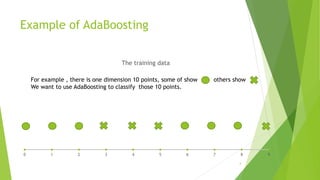
Example of AdaBoosting
0 1 2 3 4 5 6 7 8 9
The training data
4
For example , there is one dimension 10 points, some of show others show
We want to use AdaBoosting to classify those 10 points.
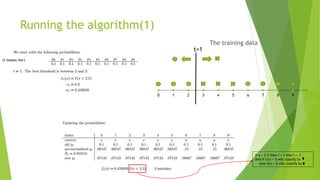
Running the algorithm(1)
5
0 1 2 3 4 5 6 7 8 9 10
The training data
t=1
(t means iter)
If x < 2.5 then I = 1 else I = -1
And if f(x) > 0 will classify to
else f(x) < 0 will classify to
Running the algorithm(2)
6
0 1 2 3 4 5 6 7 8 9 10
The training data
t=2
Running the algorithm(3)
7
0 1 2 3 4 5 6 7 8 9 10
The training data
t=3
Running the algorithm(4)
8
0 2 4 6 8 10
The training data
t=3 t=2t=1
For example : we want to decide point 4 is or ,
we need to follow
f3(x) = 0.423649 * (-1) + 0.6496 * (-1) + 0.752 * 1
= -0.321249
So, point 4 will classify to
Benifit
1. Adaboost is a high precise classifier
2. We can use many models to build subclassifier
3. When using simple classifier the calculated result is easy to understand
4. No need to do feature selection
5. No need to worry about overfitting
9
Disadvantages
1. Very sensitive to outlier(means outlier may do big influence)
10

adaboost

  • 1.
  • 2.
    Overview  Adative boostingbase on three ideas: 1. Aggregation multiple weak learners 2. For each weak learner have different weight 3. Resample  Advantage 1. Reduce Bias 2. Models for Low Variance & High Bias 2
  • 3.
  • 4.
    Example of AdaBoosting 01 2 3 4 5 6 7 8 9 The training data 4 For example , there is one dimension 10 points, some of show others show We want to use AdaBoosting to classify those 10 points.
  • 5.
    Running the algorithm(1) 5 01 2 3 4 5 6 7 8 9 10 The training data t=1 (t means iter) If x < 2.5 then I = 1 else I = -1 And if f(x) > 0 will classify to else f(x) < 0 will classify to
  • 6.
    Running the algorithm(2) 6 01 2 3 4 5 6 7 8 9 10 The training data t=2
  • 7.
    Running the algorithm(3) 7 01 2 3 4 5 6 7 8 9 10 The training data t=3
  • 8.
    Running the algorithm(4) 8 02 4 6 8 10 The training data t=3 t=2t=1 For example : we want to decide point 4 is or , we need to follow f3(x) = 0.423649 * (-1) + 0.6496 * (-1) + 0.752 * 1 = -0.321249 So, point 4 will classify to
  • 9.
    Benifit 1. Adaboost isa high precise classifier 2. We can use many models to build subclassifier 3. When using simple classifier the calculated result is easy to understand 4. No need to do feature selection 5. No need to worry about overfitting 9
  • 10.
    Disadvantages 1. Very sensitiveto outlier(means outlier may do big influence) 10

Editor's Notes

  • #3 AdaBoost方法中使用的分類器可能很弱(比如出現很大錯誤率),但只要它的分類效果比隨機好一點(比如兩類問題分類錯誤率略小於0.5),就能夠改善最終得到的模型。而錯誤率高於隨機分類器的弱分類器也是有用的,因為在最終得到的多個分類器的線性組合中,可以給它們賦予負係數,同樣也能提升分類效果。
  • #11 https://blog.csdn.net/v_JULY_v/article/details/40718799