Approach
To
Orthopedic
Oncology
OUTLINE
Introduction
Classification of Bone tumors
Clinical Presentation
Staging of Bone tumors
Primary Bone tumors
Case Presentation
 A bone tumor is an abnormal growth of
cells within a bone.
 The definate cause of bone tumors is
unknown.
Possible causes include:
1.Genetic defects passed down
through families
2.Radiation
3.Injury
 They often occur in areas of rapid bone
growth.
Medline plus: Service of U.S national Library of Medicine
http://www.nlm.nih.gov/medlineplus/ency/article/001230.htm
 Cancers that start in the bones are
referred to as primary bone tumors.
 Cancers that start in another part of the
body (such as the breast, lungs, or colon)
are called secondary or metastatic bone
tumors.
Medline plus: Service of U.S national Library of Medicine
http://www.nlm.nih.gov/medlineplus/ency/article/001230.htm
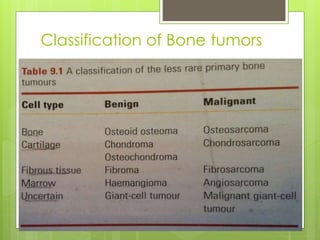
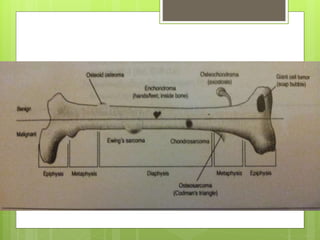
Classification of Bone tumors
 Most classifications of bone tumors are
based on the dominant tissue in the
various lesions.
Classification of Bone tumors
Clinical presentation
 History
 Examination
 Imaging
 Biopsy
 Important differential diagnosis
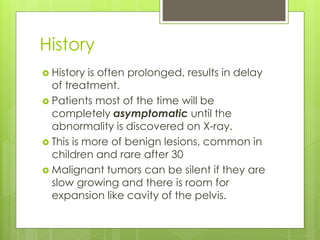
History
 History is often prolonged, results in delay
of treatment.
 Patients most of the time will be
completely asymptomatic until the
abnormality is discovered on X-ray.
 This is more of benign lesions, common in
children and rare after 30
 Malignant tumors can be silent if they are
slow growing and there is room for
expansion like cavity of the pelvis.
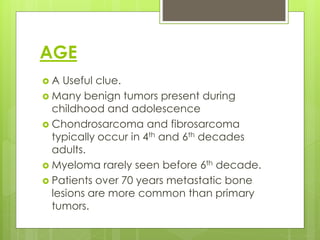
AGE
 A Useful clue.
 Many benign tumors present during
childhood and adolescence
 Chondrosarcoma and fibrosarcoma
typically occur in 4th and 6th decades
adults.
 Myeloma rarely seen before 6th decade.
 Patients over 70 years metastatic bone
lesions are more common than primary
tumors.
PAIN
 common complaint and gives little
indication of the nature of lesion.
 Progressive and unremitting pain is a very
important symptom though.
 It may be caused by:
1. Rapid expansion
2. Central hemorrhage or degeneration of
the tumor
3. Pathological fracture.
Pathological fracture
may be the first and only clinical sign.
In elderly people whose bones usually
fracture at the cortico-cancellous
junctions, if they get mid shaft fracture
it is regarded as pathological until
proven otherwise.
Other presentations
 Swelling:
Appearance of a lump, may be alarming.
 Neurological symptoms:
Parasthesia and numbness may be caused
by pressure or stretching of a peripheral
nerve.
 Progressive dysfunction is alarming and
suggests invasion by an aggressive tumor.
Examination
 If there is a lump: Where does it arise?
 Is it well defined or not?
 Soft, hard or pulsatile?
 Tender?
 Swelling can be diffuse and the overlying
skin warm and inflamed which makes it
hard to distinguish from infection and
hematoma.
 If it is near a joint:
is there any movement limitation?
 Spinal lesions cause muscle spasm, back
stiffness or painful scoliosis.
 Examination will focus on symptomatic part
but it should include :
lymph nodes
pelvis
abdomen
chest and spine.
Imaging
X-ray:
 it’s not useless imaging technique..
 There might be obvious abnormality of the
bone:
1. Cortical thickening
2. Discrete lump
3. Cyst
4. Ill-defined destruction
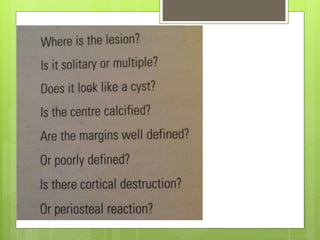
Is it in the metaphysis or diaphysis?
Is it solitary or multiple lesions?
Margins are well or ill defined?
Note: cystic lesions are not necessarily
hollow cavities: any radiolucent material
may look like a cyst (e.g fibroma and
chondroma)
 If the boundaries of the cyst is well defined is
mostly benign.
 If it is hazy and diffuse it is mostly invasive tumor.
 Bone surfaces: periosteal new bone formation
and extension of the tumor to the soft tissues
are suggestive of a malignant tumor.
 Soft tissues:
are the muscle planes distorted by the
swelling?
Is there any calcification?
 X-ray is not a definitive diagnosis and further
investigation must be done to confirm.
 Other techniques of imaging used are :
Radionuclide scanning
CT
MRI
 They all help in viewing the lesions better, view
soft tissue and detect skip lesions too.
 Patient must not go for biopsy if MRI or CT is
planned for him as it will distort the image and
appearances.
Biopsy
 There are three ways:
1.Needle biopsy:
Must be performed by experienced personal.
2. Open biopsy:
most reliable way of obtaining a representative
sample.
3. Excisional biopsy: for benign tumors.
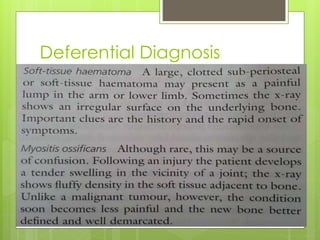
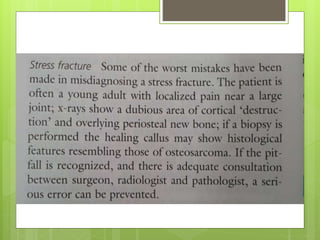
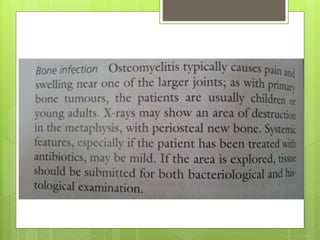
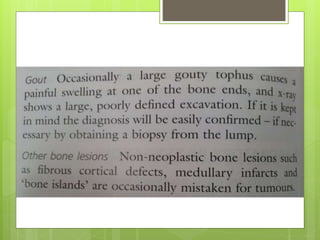
Deferential Diagnosis
Staging of bone tumors
Staging is the process of finding out how
far the cancer may have spread.
This is very important because the type of
treatment and the outlook for recovery
(prognosis) depend on the stage of the
cancer.
 In treating tumors we are facing two conflicting
principles:
1. Lesion must be removed widely to ensure it
doesn’t recur.
2. Damage must be kept minimal.
 The balance between the 2 conflicting objectives
depends on knowing:
1. How the tumor behaves (Aggressiveness)
2. How far it has spread.
The answers to these two questions are embodied in
the staging system of Enneking.
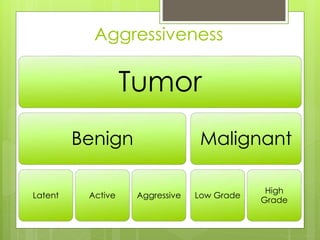
Tumor
Benign
Latent Active Aggressive
Malignant
Low Grade
High
Grade
Aggressiveness
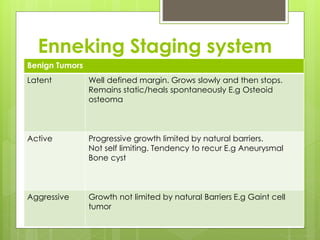
Enneking Staging system
Benign Tumors
Latent Well defined margin. Grows slowly and then stops.
Remains static/heals spontaneously E.g Osteoid
osteoma
Active Progressive growth limited by natural barriers.
Not self limiting. Tendency to recur E.g Aneurysmal
Bone cyst
Aggressive Growth not limited by natural Barriers E.g Gaint cell
tumor
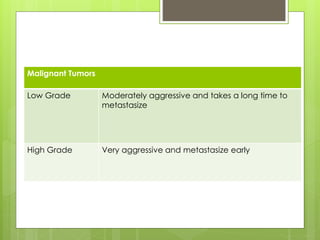
Malignant Tumors
Low Grade Moderately aggressive and takes a long time to
metastasize
High Grade Very aggressive and metastasize early
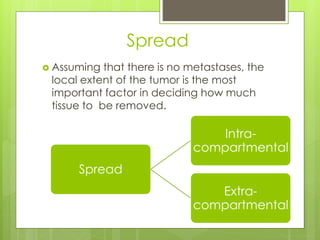
Spread
 Assuming that there is no metastases, the
local extent of the tumor is the most
important factor in deciding how much
tissue to be removed.
Spread
Intra-
compartmental
Extra-
compartmental
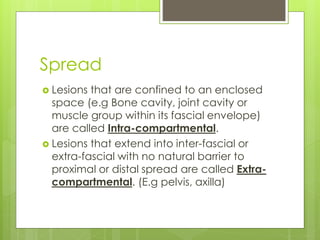
Spread
 Lesions that are confined to an enclosed
space (e.g Bone cavity, joint cavity or
muscle group within its fascial envelope)
are called Intra-compartmental.
 Lesions that extend into inter-fascial or
extra-fascial with no natural barrier to
proximal or distal spread are called Extra-
compartmental. (E.g pelvis, axilla)
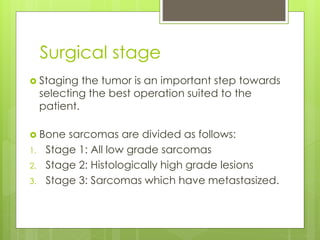
Surgical stage
 Staging the tumor is an important step towards
selecting the best operation suited to the
patient.
 Bone sarcomas are divided as follows:
1. Stage 1: All low grade sarcomas
2. Stage 2: Histologically high grade lesions
3. Stage 3: Sarcomas which have metastasized.
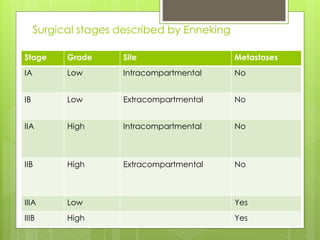
Surgical stages described by Enneking
Stage Grade Site Metastases
IA Low Intracompartmental No
IB Low Extracompartmental No
IIA High Intracompartmental No
IIB High Extracompartmental No
IIIA Low Yes
IIIB High Yes
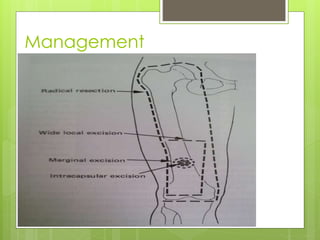
Management
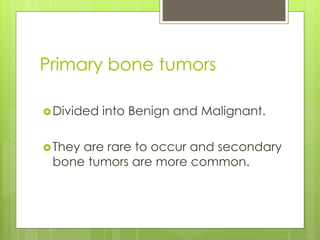
Primary bone tumors
Divided into Benign and Malignant.
They are rare to occur and secondary
bone tumors are more common.
Osteoid Osteoma
Giant cell Tumor
Enchondroma
Benign Tumors
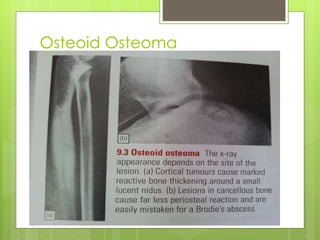
Osteoid Osteoma
 peak incidence in 2nd and 3rd decades,
M:F = 3:1
 small, round radiolucent nidus (<1 cm) surrounded
by dense bone
 tibia and femur most common
 produces severe intermittent pain, mostly at night
 characteristically relieved by NSAIDs
Osteoid Osteoma
Osteochondroma
 2nd and 3rd decades, M:F = 1.8:1
 metaphysis of long bone
 cartilage-capped bony spur on surface of bone
may be multiple
 higher risk of malignant change
 generally asymptomatic unless impinging on
neurovascular structure
 malignant degeneration occurs in 1-2%
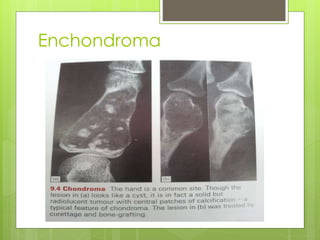
Enchondroma
 2nd and 3rd decades
 50% occur in the small tubular bones of the hand
and foot; others in femur, humerus, ribs
 benign cartilaginous growth, develops in
medullary cavity
 single/multiple enlarged rarefied areas in tubular
bones
 lytic lesion with sharp margination and central
calcification
 malignant degeneration occurs in 1-2%
Enchondroma
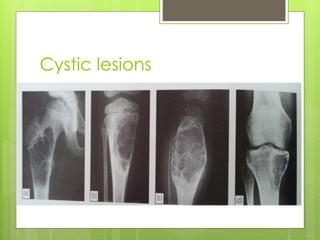
Cystic lesions
 Include
unicameral/solitary bone cyst (most common),
fibrous cortical defect
 children and young adults
 local pain, pathological fracture or incidental
detection
 lytic translucent area on metaphyseal side of
growth plate
 cortex thinned/expanded; well defined lesion
 treatment of unicameral bone cyst with steroid
injections ± bone graft
 treatment only necessary if symptomatic
 osteochondroma: resection
 cystic lesions: curettage and bone graft
Cystic lesions
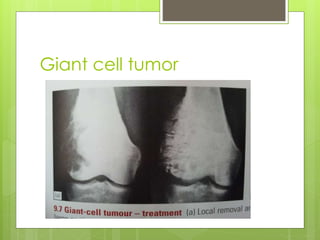
Giant cell Tumor
 affects patients of skeletal maturity, peak 3rd decade
 distal femur, proximal tibia, distal radius, sacrum, tarsal
bones, spinal (osteoblastoma)
 cortex appears thinned, expanded; well-demarcated
sclerotic margin
 local tenderness and swelling
 aggressively destroy bone
 15% recur within 2 years of surgery
 giant cell tumour occasionally metastasizes (1-2%)
 Treatment
 intralesional curettage + bone graft or cement
 wide local excision of expendable bones
Giant cell tumor
Malignant tumors
Multiple myeloma
Osteosarcoma
Ewing’s sarcoma
Chondrosarcoma
Osteosarcoma
 mostly frequently diagnosed in 2nd decade of life (60%)
 Mostly affects distal femur (45%), proximal tibia (20%)
and proximal humerus (15%)
 invasive, variable histology; frequent metastases without
treatment
 painful, poorly defined swelling
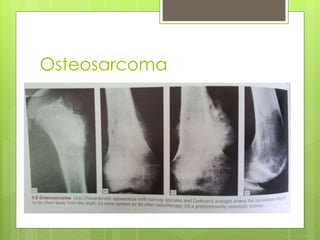
 x-ray shows
 characteristic periosteal elevation and spicule formation
representing tumour extension into periosteum
 treatment: complete resection (limb salvage, rarely
amputation), chemotherapy
 survival “ 70%
Osteosarcoma
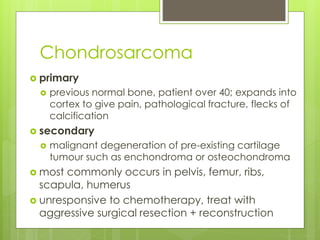
Chondrosarcoma
 primary
 previous normal bone, patient over 40; expands into
cortex to give pain, pathological fracture, flecks of
calcification
 secondary
 malignant degeneration of pre-existing cartilage
tumour such as enchondroma or osteochondroma
 most commonly occurs in pelvis, femur, ribs,
scapula, humerus
 unresponsive to chemotherapy, treat with
aggressive surgical resection + reconstruction
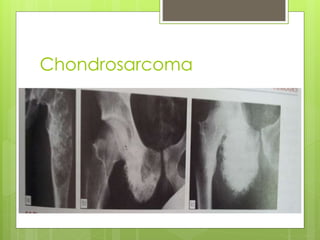
Chondrosarcoma
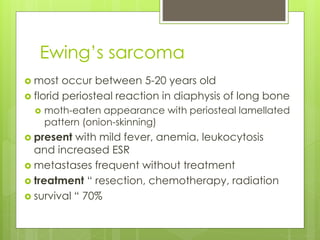
Ewing’s sarcoma
 most occur between 5-20 years old
 florid periosteal reaction in diaphysis of long bone
 moth-eaten appearance with periosteal lamellated
pattern (onion-skinning)
 present with mild fever, anemia, leukocytosis
and increased ESR
 metastases frequent without treatment
 treatment “ resection, chemotherapy, radiation
 survival “ 70%
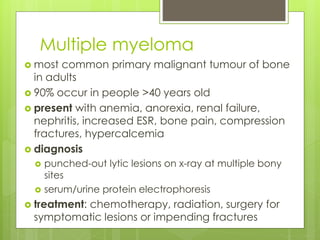
Multiple myeloma
 most common primary malignant tumour of bone
in adults
 90% occur in people >40 years old
 present with anemia, anorexia, renal failure,
nephritis, increased ESR, bone pain, compression
fractures, hypercalcemia
 diagnosis
 punched-out lytic lesions on x-ray at multiple bony
sites
 serum/urine protein electrophoresis
 treatment: chemotherapy, radiation, surgery for
symptomatic lesions or impending fractures
References
 Medline plus: Service of U.S national Library of
Medicine
http://www.nlm.nih.gov/medlineplus/ency/article/00
1230.htm
 Apley’s system of orthopedics and fractures (Ninth
Edition)
 Apley’s Concise system of orthopedics and fractures
(Third Edition)
 American Cancer society
http://www.cancer.org/Cancer/BoneCancer/Overvi
ewGuide/bone-cancer-overview-staging
 First Aid for the USMLE Step 1 2011
 Toronto notes 2009
Bone tumors

Bone tumors

  • 1.
  • 2.
    OUTLINE Introduction Classification of Bonetumors Clinical Presentation Staging of Bone tumors Primary Bone tumors Case Presentation
  • 3.
     A bonetumor is an abnormal growth of cells within a bone.  The definate cause of bone tumors is unknown. Possible causes include: 1.Genetic defects passed down through families 2.Radiation 3.Injury  They often occur in areas of rapid bone growth. Medline plus: Service of U.S national Library of Medicine http://www.nlm.nih.gov/medlineplus/ency/article/001230.htm
  • 4.
     Cancers thatstart in the bones are referred to as primary bone tumors.  Cancers that start in another part of the body (such as the breast, lungs, or colon) are called secondary or metastatic bone tumors. Medline plus: Service of U.S national Library of Medicine http://www.nlm.nih.gov/medlineplus/ency/article/001230.htm
  • 5.
    Classification of Bonetumors  Most classifications of bone tumors are based on the dominant tissue in the various lesions.
  • 6.
  • 7.
    Clinical presentation  History Examination  Imaging  Biopsy  Important differential diagnosis
  • 8.
    History  History isoften prolonged, results in delay of treatment.  Patients most of the time will be completely asymptomatic until the abnormality is discovered on X-ray.  This is more of benign lesions, common in children and rare after 30  Malignant tumors can be silent if they are slow growing and there is room for expansion like cavity of the pelvis.
  • 9.
    AGE  A Usefulclue.  Many benign tumors present during childhood and adolescence  Chondrosarcoma and fibrosarcoma typically occur in 4th and 6th decades adults.  Myeloma rarely seen before 6th decade.  Patients over 70 years metastatic bone lesions are more common than primary tumors.
  • 10.
    PAIN  common complaintand gives little indication of the nature of lesion.  Progressive and unremitting pain is a very important symptom though.  It may be caused by: 1. Rapid expansion 2. Central hemorrhage or degeneration of the tumor 3. Pathological fracture.
  • 11.
    Pathological fracture may bethe first and only clinical sign. In elderly people whose bones usually fracture at the cortico-cancellous junctions, if they get mid shaft fracture it is regarded as pathological until proven otherwise.
  • 12.
    Other presentations  Swelling: Appearanceof a lump, may be alarming.  Neurological symptoms: Parasthesia and numbness may be caused by pressure or stretching of a peripheral nerve.  Progressive dysfunction is alarming and suggests invasion by an aggressive tumor.
  • 13.
    Examination  If thereis a lump: Where does it arise?  Is it well defined or not?  Soft, hard or pulsatile?  Tender?  Swelling can be diffuse and the overlying skin warm and inflamed which makes it hard to distinguish from infection and hematoma.
  • 14.
     If itis near a joint: is there any movement limitation?  Spinal lesions cause muscle spasm, back stiffness or painful scoliosis.  Examination will focus on symptomatic part but it should include : lymph nodes pelvis abdomen chest and spine.
  • 15.
    Imaging X-ray:  it’s notuseless imaging technique..  There might be obvious abnormality of the bone: 1. Cortical thickening 2. Discrete lump 3. Cyst 4. Ill-defined destruction
  • 16.
    Is it inthe metaphysis or diaphysis? Is it solitary or multiple lesions? Margins are well or ill defined? Note: cystic lesions are not necessarily hollow cavities: any radiolucent material may look like a cyst (e.g fibroma and chondroma)
  • 17.
     If theboundaries of the cyst is well defined is mostly benign.  If it is hazy and diffuse it is mostly invasive tumor.  Bone surfaces: periosteal new bone formation and extension of the tumor to the soft tissues are suggestive of a malignant tumor.
  • 18.
     Soft tissues: arethe muscle planes distorted by the swelling? Is there any calcification?  X-ray is not a definitive diagnosis and further investigation must be done to confirm.
  • 20.
     Other techniquesof imaging used are : Radionuclide scanning CT MRI  They all help in viewing the lesions better, view soft tissue and detect skip lesions too.  Patient must not go for biopsy if MRI or CT is planned for him as it will distort the image and appearances.
  • 21.
    Biopsy  There arethree ways: 1.Needle biopsy: Must be performed by experienced personal. 2. Open biopsy: most reliable way of obtaining a representative sample. 3. Excisional biopsy: for benign tumors.
  • 22.
  • 26.
    Staging of bonetumors Staging is the process of finding out how far the cancer may have spread. This is very important because the type of treatment and the outlook for recovery (prognosis) depend on the stage of the cancer.
  • 27.
     In treatingtumors we are facing two conflicting principles: 1. Lesion must be removed widely to ensure it doesn’t recur. 2. Damage must be kept minimal.
  • 28.
     The balancebetween the 2 conflicting objectives depends on knowing: 1. How the tumor behaves (Aggressiveness) 2. How far it has spread. The answers to these two questions are embodied in the staging system of Enneking.
  • 29.
  • 30.
    Enneking Staging system BenignTumors Latent Well defined margin. Grows slowly and then stops. Remains static/heals spontaneously E.g Osteoid osteoma Active Progressive growth limited by natural barriers. Not self limiting. Tendency to recur E.g Aneurysmal Bone cyst Aggressive Growth not limited by natural Barriers E.g Gaint cell tumor
  • 31.
    Malignant Tumors Low GradeModerately aggressive and takes a long time to metastasize High Grade Very aggressive and metastasize early
  • 32.
    Spread  Assuming thatthere is no metastases, the local extent of the tumor is the most important factor in deciding how much tissue to be removed. Spread Intra- compartmental Extra- compartmental
  • 33.
    Spread  Lesions thatare confined to an enclosed space (e.g Bone cavity, joint cavity or muscle group within its fascial envelope) are called Intra-compartmental.  Lesions that extend into inter-fascial or extra-fascial with no natural barrier to proximal or distal spread are called Extra- compartmental. (E.g pelvis, axilla)
  • 34.
    Surgical stage  Stagingthe tumor is an important step towards selecting the best operation suited to the patient.  Bone sarcomas are divided as follows: 1. Stage 1: All low grade sarcomas 2. Stage 2: Histologically high grade lesions 3. Stage 3: Sarcomas which have metastasized.
  • 35.
    Surgical stages describedby Enneking Stage Grade Site Metastases IA Low Intracompartmental No IB Low Extracompartmental No IIA High Intracompartmental No IIB High Extracompartmental No IIIA Low Yes IIIB High Yes
  • 36.
  • 37.
    Primary bone tumors Dividedinto Benign and Malignant. They are rare to occur and secondary bone tumors are more common.
  • 38.
    Osteoid Osteoma Giant cellTumor Enchondroma Benign Tumors
  • 39.
    Osteoid Osteoma  peakincidence in 2nd and 3rd decades, M:F = 3:1  small, round radiolucent nidus (<1 cm) surrounded by dense bone  tibia and femur most common  produces severe intermittent pain, mostly at night  characteristically relieved by NSAIDs
  • 40.
  • 41.
    Osteochondroma  2nd and3rd decades, M:F = 1.8:1  metaphysis of long bone  cartilage-capped bony spur on surface of bone may be multiple  higher risk of malignant change  generally asymptomatic unless impinging on neurovascular structure  malignant degeneration occurs in 1-2%
  • 42.
    Enchondroma  2nd and3rd decades  50% occur in the small tubular bones of the hand and foot; others in femur, humerus, ribs  benign cartilaginous growth, develops in medullary cavity  single/multiple enlarged rarefied areas in tubular bones  lytic lesion with sharp margination and central calcification  malignant degeneration occurs in 1-2%
  • 43.
  • 44.
    Cystic lesions  Include unicameral/solitarybone cyst (most common), fibrous cortical defect  children and young adults  local pain, pathological fracture or incidental detection  lytic translucent area on metaphyseal side of growth plate  cortex thinned/expanded; well defined lesion  treatment of unicameral bone cyst with steroid injections ± bone graft
  • 45.
     treatment onlynecessary if symptomatic  osteochondroma: resection  cystic lesions: curettage and bone graft
  • 46.
  • 47.
    Giant cell Tumor affects patients of skeletal maturity, peak 3rd decade  distal femur, proximal tibia, distal radius, sacrum, tarsal bones, spinal (osteoblastoma)  cortex appears thinned, expanded; well-demarcated sclerotic margin  local tenderness and swelling  aggressively destroy bone  15% recur within 2 years of surgery  giant cell tumour occasionally metastasizes (1-2%)  Treatment  intralesional curettage + bone graft or cement  wide local excision of expendable bones
  • 48.
  • 49.
  • 50.
    Osteosarcoma  mostly frequentlydiagnosed in 2nd decade of life (60%)  Mostly affects distal femur (45%), proximal tibia (20%) and proximal humerus (15%)  invasive, variable histology; frequent metastases without treatment  painful, poorly defined swelling  x-ray shows  characteristic periosteal elevation and spicule formation representing tumour extension into periosteum  treatment: complete resection (limb salvage, rarely amputation), chemotherapy  survival “ 70%
  • 51.
  • 52.
    Chondrosarcoma  primary  previousnormal bone, patient over 40; expands into cortex to give pain, pathological fracture, flecks of calcification  secondary  malignant degeneration of pre-existing cartilage tumour such as enchondroma or osteochondroma  most commonly occurs in pelvis, femur, ribs, scapula, humerus  unresponsive to chemotherapy, treat with aggressive surgical resection + reconstruction
  • 53.
  • 54.
    Ewing’s sarcoma  mostoccur between 5-20 years old  florid periosteal reaction in diaphysis of long bone  moth-eaten appearance with periosteal lamellated pattern (onion-skinning)  present with mild fever, anemia, leukocytosis and increased ESR  metastases frequent without treatment  treatment “ resection, chemotherapy, radiation  survival “ 70%
  • 55.
    Multiple myeloma  mostcommon primary malignant tumour of bone in adults  90% occur in people >40 years old  present with anemia, anorexia, renal failure, nephritis, increased ESR, bone pain, compression fractures, hypercalcemia  diagnosis  punched-out lytic lesions on x-ray at multiple bony sites  serum/urine protein electrophoresis  treatment: chemotherapy, radiation, surgery for symptomatic lesions or impending fractures
  • 57.
    References  Medline plus:Service of U.S national Library of Medicine http://www.nlm.nih.gov/medlineplus/ency/article/00 1230.htm  Apley’s system of orthopedics and fractures (Ninth Edition)  Apley’s Concise system of orthopedics and fractures (Third Edition)  American Cancer society http://www.cancer.org/Cancer/BoneCancer/Overvi ewGuide/bone-cancer-overview-staging  First Aid for the USMLE Step 1 2011  Toronto notes 2009