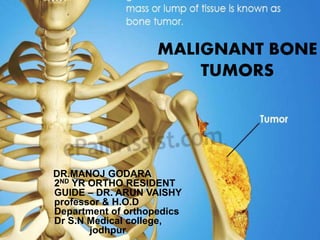
MALIGNANT BONE
TUMORS
DR.MANOJ GODARA
2ND YR ORTHO RESIDENT
GUIDE – DR. ARUN VAISHY
professor & H.O.D
Department of orthopedics
Dr S.N Medical college,
jodhpur
DEFINATION –
. Malignant bone tumors are those that are biologically
more aggressive not only they cause rapid tissue
destruction but also have greater incidence of spread and
metastasis
. Malignant tumor of bone and cartilage
constitute about 0.5% of all malignant tumor
. Primary bone tumors are relatively rare
. Metastatic bone tumors are the most common malignant
tumors of skeleton system.
70%of all malignant tumors are metastatic in nature
Characteristics of malignant bone
tumors
. They have aggressive spread, metastasis and
invasiveness to surrounding tissue
. More rapid increase in size.
. less differentiation
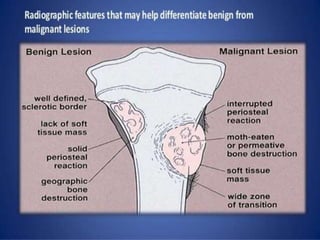
. They have wide zone of transition and interrupted
periosteal reaction.
. ill-defined and irregular bone margins
CLASSIFICATION OF MALIGNANT BONE TUMORS
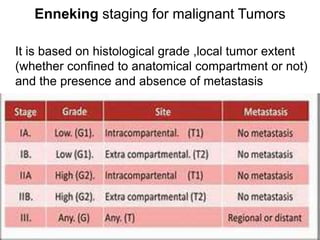
Enneking staging for malignant Tumors
It is based on histological grade ,local tumor extent
(whether confined to anatomical compartment or not)
and the presence and absence of metastasis
Malignant bone tumor
Primary bone tumors
30%
Secondary bone
tumors 70%
Multiple myeloma -most commo
Osteosarcoma
– 2ndmost common
. Chondrosarcoma
. Ewing's sarcoma
. Chordoma
. Fibrosarcoma
Secondaries are metastasis of
other primary tumors of body.
They arises from Lungs, breast
or prostrate cancer.
Most common site of deposition
of secondaries are vertebra and
pelvis
Osteosarcoma
• Def :-Primary malignant tumor in which
malignant mesenchymal cell
produces osteoid or immature bone
. most common primary malignant tumor of the bone
excluding those of hematopoietic origin like multiple
myeloma
. Incidence :- 1:3 per 1 million /year
peak incidence at second decade of life
more prevalent in male then in female.
• Classified as Primary and secondary
osteosarcoma
PRIMARY OSTEOSARCOMA
. High grade – Conventional osteosarcoma ,
Telangiectatic osteosarcoma
small cell osteosarcoma
.low grade – central osteosarcoma
perosteal osteosarcoma
.intermediate grade – periosteal
osteosarcoma
Clinical features
• .Most patients usually present with
persistent pain
. Deep ,firm , fixed mass
. Swelling usually develops at the end of
long bones and its consistency varies
from soft ,almost fluctuant to firm and
indurated to bony hard
. Overlying skin may become stretched,
thin and glossy
. Motion of adjacent joint is unimpaired until the
muscle acting on the joint became involved
Diagnostic
• Plain x-ray finding
variable mixture of radio-opacity due to
osteogensis and radiolucency due to
destructive changes .
• . Irregular destruction in metaphysis .
.New bone formation
. Periosteal reaction
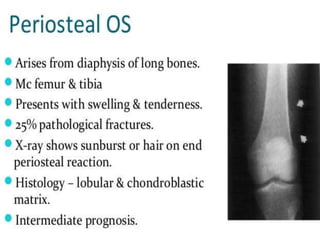
.sunburst appearance :-> fine lines of increase densities ,
representing newly formed spicule of bone ,radiate laterally
from bone at the right angle from the shaft
Sometimes pathological
fractures may be seen
on
X-RAY imaging
. MRI
help to determine the level of resection and preoperative
planning
Used to know the soft tissue extent
•
to screen the skip lesion and find out the involvement of
the medullary canal,epiphysis and physeal plate
CT-SCAN
Not much of use in diagnosis of
osteosarcoma
H RCT chest to detect lung metastasis which is the most
common site of metastasis.
Angiogram
Bone scan
Laboratory findings
• No pain and no tenderness
• Wide sx excision is the t/t
Prognostic factor
• Poor prognostic factor includes
-Mets at the time of presentation
-Primary tumor located in axial skeleton
-large tumor
-increase ALP and LDH
-Poor response to prior chemo
Treatment protocol
.For high grade osteosarcoma - surgical excision of
primary tumor with chemotherapy
.Multi agent chemotherapy is the standard care in
osteosarcoma
.Most current protocol incorporate these agent in
three or four drug combinations
CHEMOTHERAPY
Surgery
LIMB SALVAGE
SURGERY
ROTATIONPLASTY
FOLLOW-UP AND
PROGNOSIS
CHONDROSARCOMA
• Chondrosarcoma is a malignant tumor of cartilage
producing cells.
• Most common sarcoma of bone in patient over 20 yrs of
age.
9 percent of all primary malignancy of bone…
.Usually beyond 3rd decade of life but peak incidence in the
5th to 7th decade
.M.F= 3:2
.Pelvic is the most common site (ilium) followed by
proximal humerus ,proximal femur and ribs are the
other site
Who classification
Clinical features
. Deep ,dull pain (worsen at night ,insidious
progression over months )is most
common presentation
. local swelling
.pathological fractures (in high grade
chondrosarcoma)rare
presentation
.Neurovascular disturbance with loss of motion
Diagnostic
• On Plain radiograph (X-RAY)
. Expansion of medullary portion of bone with
cortical thickening is typical finding.
. Periosteal reaction is scant/absent
. Irregular matrix calcification- punctuate ,
popcorn, comma shaped calcification( rings and
arcs appearance) •
• CT SCAN
Differentiate benign from malignant lesion • For
characterization of lesion in anatomically complex
areas- sacrum and spine
MRI
.Depict high water content of lesion with lobulation
at margins
.Best to see intramedullary extent , Cortical
erosion, bone destruction, reactionary edema, soft
tissue extention are well depicted.
.It helps in differentiating Enchondromas with
chondrosarcoma
MRI
Bone biopsy and histological findings
• Histology Composed of malignant cells with abundant
cartilaginous matrix, cartilage permeates the host
bony trabeculae
Histologically three grades
Grade 1- less cellular and less nuclear atypia.
Grade 2 - ↑ cellularity and nuclear atypia
Grade 3- ↑ ↑ cellularity and pleomorphic anaplastic
cells
Gross appearance
Differential Diagnosis
Enchondroma
.enchondroma and low grade chondrosarcoma
radiologically as well as histologically appear
similar
Both located in metaphysis with stippled calcification
and endosteal scalloping
•
But in chondrosarcoma endosteal scalloping is
present in >2/3 rd of area and aggressive changes
such as bone destruction ,cortical erosion ,periosteal
reaction , soft tissue mass is more marked
Treatment
. These tumor generally not sensitive to chemotherapy and
radiotherapy and surgery is the only reliable treatment
.for grade 1 chondrosarcoma-
if endosteal scalloping and cortical erosion absent on x-ray ,no
contrast uptake and no mass on MRI then extended
intralesional curettage can be done but if present then we goes
for wide resection
.for grade 2 & 3 –
wide resection is the only treatment modality
10 yr survival rate
grade 1 – 90%
grade 2 – 40-50%
grade 3 – 15-20%
SECONDARY CHONDROSARCOMA
• Chondrosarcoma arising in a known benign precursor
lesion
ex- osteochondroma , enchondroma
olliers disease, Maffuccic syndrome-25-30%
.develops at somewhat earlier age then primary
.usually low grade malignancy and have favorable
prognosis
.plain radiograph shows increase thickness in
cartilaginous cap in osteochondroma and destructive
permeation of bone and soft tissue mass in
enchondroma
T/t- complete wide surgical excision
INTRODUCTION
• 2ND most common malignant tumor of late childhood
and early adulthood
• incidence 0.3/100000/yr
• This small blue round cell tumor is arise from
mesenchymal cells
• more common in males
• Peak incidence during first two decade of life
• cytogenetic- most commonly a reciprocal
translocation with FLI1 gene on chromosome 11
t(11;22)
• CT scan- to evaluate the pattern of bone
destruction
• MRI- to identify extra osseous and bone
marrow involvement
• v
CHORDOMA
• Low to intermediate grade malignant tumor of cranium and
spine
• Arise from the embryonic remnant of notochord
• account 1-4% of all bone malignancy
• Age- 5th -6th decade of life
• M>F
• Site- sacrococcygeal region (40-50%)
base of skull(35-40%)
vertebrae (15-20%)
C/F- mild and intermittent pain in rectal and anal region
constipation and urinary difficulty
neurological spine in chordoma of spine
cranial nerve palsy in skull base chordoma
• Plain x-ray shows destructive bony lesion with
in the vertebral body and surrounding soft
tissue mass.
Complete en bloc surgical resection is the
treatment of choice
• local recurrence varies from 15-20%
• 5% of chordoma show lung ,skin and brain
Mets
MULTIPLE MYELOMA
• MRI – for detecting thoracic and lumber spine lesion
• Bone scan – more then 50% lesion can be missed
• plain radiography shows diffuse osteoporosis and lytic
lesion
• no reactive bone formation
Malignant bone tumor

Malignant bone tumor

  • 1.
    MALIGNANT BONE TUMORS DR.MANOJ GODARA 2NDYR ORTHO RESIDENT GUIDE – DR. ARUN VAISHY professor & H.O.D Department of orthopedics Dr S.N Medical college, jodhpur
  • 2.
    DEFINATION – . Malignantbone tumors are those that are biologically more aggressive not only they cause rapid tissue destruction but also have greater incidence of spread and metastasis . Malignant tumor of bone and cartilage constitute about 0.5% of all malignant tumor . Primary bone tumors are relatively rare . Metastatic bone tumors are the most common malignant tumors of skeleton system. 70%of all malignant tumors are metastatic in nature
  • 3.
    Characteristics of malignantbone tumors . They have aggressive spread, metastasis and invasiveness to surrounding tissue . More rapid increase in size. . less differentiation . They have wide zone of transition and interrupted periosteal reaction. . ill-defined and irregular bone margins
  • 5.
  • 8.
    Enneking staging formalignant Tumors It is based on histological grade ,local tumor extent (whether confined to anatomical compartment or not) and the presence and absence of metastasis
  • 9.
    Malignant bone tumor Primarybone tumors 30% Secondary bone tumors 70% Multiple myeloma -most commo Osteosarcoma – 2ndmost common . Chondrosarcoma . Ewing's sarcoma . Chordoma . Fibrosarcoma Secondaries are metastasis of other primary tumors of body. They arises from Lungs, breast or prostrate cancer. Most common site of deposition of secondaries are vertebra and pelvis
  • 10.
    Osteosarcoma • Def :-Primarymalignant tumor in which malignant mesenchymal cell produces osteoid or immature bone . most common primary malignant tumor of the bone excluding those of hematopoietic origin like multiple myeloma . Incidence :- 1:3 per 1 million /year peak incidence at second decade of life more prevalent in male then in female.
  • 12.
    • Classified asPrimary and secondary osteosarcoma PRIMARY OSTEOSARCOMA . High grade – Conventional osteosarcoma , Telangiectatic osteosarcoma small cell osteosarcoma .low grade – central osteosarcoma perosteal osteosarcoma .intermediate grade – periosteal osteosarcoma
  • 15.
    Clinical features • .Mostpatients usually present with persistent pain . Deep ,firm , fixed mass . Swelling usually develops at the end of long bones and its consistency varies from soft ,almost fluctuant to firm and indurated to bony hard . Overlying skin may become stretched, thin and glossy . Motion of adjacent joint is unimpaired until the muscle acting on the joint became involved
  • 17.
    Diagnostic • Plain x-rayfinding variable mixture of radio-opacity due to osteogensis and radiolucency due to destructive changes .
  • 18.
    • . Irregulardestruction in metaphysis . .New bone formation . Periosteal reaction .sunburst appearance :-> fine lines of increase densities , representing newly formed spicule of bone ,radiate laterally from bone at the right angle from the shaft
  • 20.
    Sometimes pathological fractures maybe seen on X-RAY imaging
  • 21.
    . MRI help todetermine the level of resection and preoperative planning Used to know the soft tissue extent • to screen the skip lesion and find out the involvement of the medullary canal,epiphysis and physeal plate CT-SCAN Not much of use in diagnosis of osteosarcoma H RCT chest to detect lung metastasis which is the most common site of metastasis.
  • 22.
  • 23.
  • 24.
  • 28.
    • No painand no tenderness • Wide sx excision is the t/t
  • 29.
    Prognostic factor • Poorprognostic factor includes -Mets at the time of presentation -Primary tumor located in axial skeleton -large tumor -increase ALP and LDH -Poor response to prior chemo
  • 30.
  • 31.
    .For high gradeosteosarcoma - surgical excision of primary tumor with chemotherapy .Multi agent chemotherapy is the standard care in osteosarcoma .Most current protocol incorporate these agent in three or four drug combinations
  • 32.
  • 34.
  • 35.
  • 37.
  • 40.
  • 41.
    CHONDROSARCOMA • Chondrosarcoma isa malignant tumor of cartilage producing cells. • Most common sarcoma of bone in patient over 20 yrs of age. 9 percent of all primary malignancy of bone… .Usually beyond 3rd decade of life but peak incidence in the 5th to 7th decade .M.F= 3:2 .Pelvic is the most common site (ilium) followed by proximal humerus ,proximal femur and ribs are the other site
  • 42.
  • 44.
    Clinical features . Deep,dull pain (worsen at night ,insidious progression over months )is most common presentation . local swelling .pathological fractures (in high grade chondrosarcoma)rare presentation .Neurovascular disturbance with loss of motion
  • 45.
    Diagnostic • On Plainradiograph (X-RAY) . Expansion of medullary portion of bone with cortical thickening is typical finding. . Periosteal reaction is scant/absent . Irregular matrix calcification- punctuate , popcorn, comma shaped calcification( rings and arcs appearance) •
  • 49.
    • CT SCAN Differentiatebenign from malignant lesion • For characterization of lesion in anatomically complex areas- sacrum and spine MRI .Depict high water content of lesion with lobulation at margins .Best to see intramedullary extent , Cortical erosion, bone destruction, reactionary edema, soft tissue extention are well depicted. .It helps in differentiating Enchondromas with chondrosarcoma
  • 50.
  • 52.
    Bone biopsy andhistological findings • Histology Composed of malignant cells with abundant cartilaginous matrix, cartilage permeates the host bony trabeculae Histologically three grades Grade 1- less cellular and less nuclear atypia. Grade 2 - ↑ cellularity and nuclear atypia Grade 3- ↑ ↑ cellularity and pleomorphic anaplastic cells
  • 53.
  • 54.
    Differential Diagnosis Enchondroma .enchondroma andlow grade chondrosarcoma radiologically as well as histologically appear similar Both located in metaphysis with stippled calcification and endosteal scalloping • But in chondrosarcoma endosteal scalloping is present in >2/3 rd of area and aggressive changes such as bone destruction ,cortical erosion ,periosteal reaction , soft tissue mass is more marked
  • 56.
    Treatment . These tumorgenerally not sensitive to chemotherapy and radiotherapy and surgery is the only reliable treatment .for grade 1 chondrosarcoma- if endosteal scalloping and cortical erosion absent on x-ray ,no contrast uptake and no mass on MRI then extended intralesional curettage can be done but if present then we goes for wide resection .for grade 2 & 3 – wide resection is the only treatment modality 10 yr survival rate grade 1 – 90% grade 2 – 40-50% grade 3 – 15-20%
  • 57.
    SECONDARY CHONDROSARCOMA • Chondrosarcomaarising in a known benign precursor lesion ex- osteochondroma , enchondroma olliers disease, Maffuccic syndrome-25-30% .develops at somewhat earlier age then primary .usually low grade malignancy and have favorable prognosis .plain radiograph shows increase thickness in cartilaginous cap in osteochondroma and destructive permeation of bone and soft tissue mass in enchondroma T/t- complete wide surgical excision
  • 59.
    INTRODUCTION • 2ND mostcommon malignant tumor of late childhood and early adulthood • incidence 0.3/100000/yr • This small blue round cell tumor is arise from mesenchymal cells • more common in males • Peak incidence during first two decade of life • cytogenetic- most commonly a reciprocal translocation with FLI1 gene on chromosome 11 t(11;22)
  • 64.
    • CT scan-to evaluate the pattern of bone destruction • MRI- to identify extra osseous and bone marrow involvement • v
  • 73.
    CHORDOMA • Low tointermediate grade malignant tumor of cranium and spine • Arise from the embryonic remnant of notochord • account 1-4% of all bone malignancy • Age- 5th -6th decade of life • M>F • Site- sacrococcygeal region (40-50%) base of skull(35-40%) vertebrae (15-20%) C/F- mild and intermittent pain in rectal and anal region constipation and urinary difficulty neurological spine in chordoma of spine cranial nerve palsy in skull base chordoma
  • 74.
    • Plain x-rayshows destructive bony lesion with in the vertebral body and surrounding soft tissue mass.
  • 75.
    Complete en blocsurgical resection is the treatment of choice • local recurrence varies from 15-20% • 5% of chordoma show lung ,skin and brain Mets
  • 76.
  • 82.
    • MRI –for detecting thoracic and lumber spine lesion • Bone scan – more then 50% lesion can be missed • plain radiography shows diffuse osteoporosis and lytic lesion • no reactive bone formation