Bone tumours Dr.Surya prakash sharma MBBS D’ortho (PG Student) MMC Chennai
Bone tumours Commonest bone tumour is secondaries from other sites Commonest primary bone tumour is multiple myeloma, second osteosarcoma.
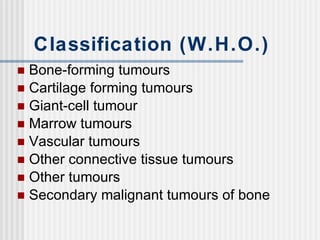
Classification (W.H.O.) Bone-forming tumours Cartilage forming tumours Giant-cell tumour Marrow tumours Vascular tumours Other connective tissue tumours Other tumours Secondary malignant tumours of bone
Bone forming tumours
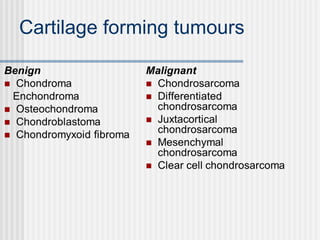
Cartilage forming tumours
Giant cell tumour Osteoclastoma
Marrow tumours Ewing’s sarcoma Neuroectodermal tumour Malignant lymphoma of bone (Primary/secondary) Myeloma
Vascular tumours Benign Haemangioma Lymphangioma Glomus tumour Intermediate Haemangio endothelioma Haemangio pericytoma Malignant Angiosarcoma Malignant haemangio pericytoma
Other connective tissue tumours Benign Benign fibrous histiocytoma Lipoma Intermediate Desmoplastic fibroma Malignant Fibrosarcoma Malignant fibrous histiocytoma Liposarcoma Malignant mesenchymoma Leiomyosarcoma Undifferentiated sarcoma
Other tumours Benign Neurilemmoma Neurofibroma Malignant Chordoma Adamantinoma
Secondary malignant tumours of bone From primary in: Thyroid Breast Bronchus Kidney Prostate
Diagnosis Clinical examination Imaging Laboratory investigations Biopsy
Imaging Radiographs CT scan MRI Radio nuclide bone scan Arteriogram
Radiographs Exact location of the tumour Borders of the tumour Pattern of bone destruction Matrix formation Periosteal reaction
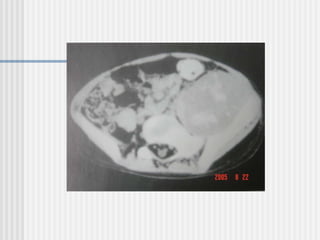
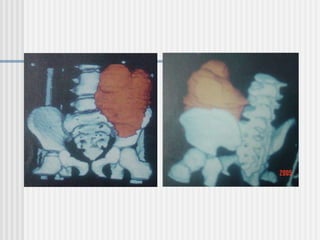
CT Scan Very useful in early diagnosis Extra osseous extension Early detection of pulmonary secondaries Exact measurement for limb salvage procecures (Prosthesis/allograft)
 
 
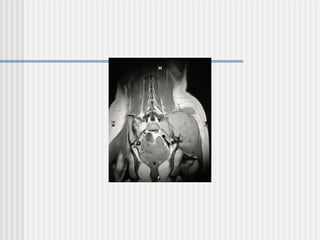
MRI Intra medullary extension Soft tissue extension Defines the relationship to the nearby major blood vessels
 
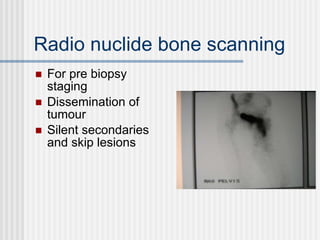
Radio nuclide bone scanning For pre biopsy staging Dissemination of tumour Silent secondaries and skip lesions
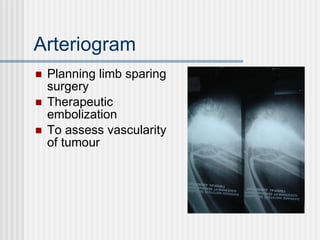
Arteriogram Planning limb sparing surgery Therapeutic embolization To assess vascularity of tumour
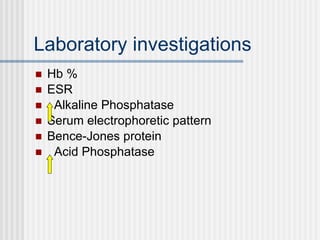
Laboratory investigations Hb % ESR Alkaline Phosphatase Serum electrophoretic pattern Bence-Jones protein Acid Phosphatase
Biopsy Closed biopsy FNAC Needle biopsy Open biopsy Incisional biopsy Excisional biopsy
Principles of biopsy From boundary or edge of tumor Take several samples Incision strategically placed Ideally done by the treating surgeon Wound closed without drain
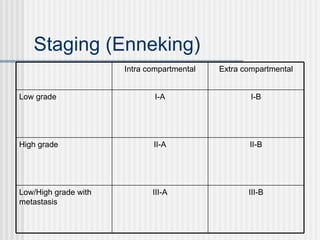
Staging of the tumor By Enneking (1986) Based on aggressiveness of the tumor and Spread
Staging (Enneking) Intra compartmental Extra compartmental Low grade I-A I-B High grade II-A II-B Low/High grade with metastasis III-A III-B
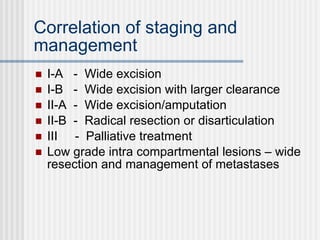
Correlation of staging and management I-A  -  Wide excision I-B  -  Wide excision with larger clearance II-A  -  Wide excision/amputation II-B  -  Radical resection or disarticulation III  -  Palliative treatment Low grade intra compartmental lesions – wide resection and management of metastases
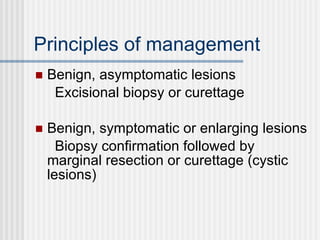
Principles of management Benign, asymptomatic lesions Excisional biopsy or curettage Benign, symptomatic or enlarging lesions Biopsy confirmation followed by marginal resection or curettage (cystic lesions)
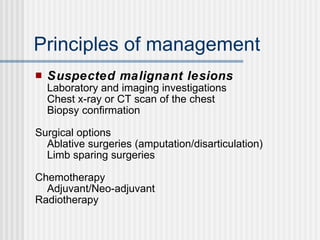
Principles of management Suspected malignant lesions Laboratory and imaging investigations Chest x-ray or CT scan of the chest Biopsy confirmation Surgical options Ablative surgeries (amputation/disarticulation) Limb sparing surgeries Chemotherapy Adjuvant/Neo-adjuvant Radiotherapy
Thank You

Bone tumours

  • 1.
    Bone tumours Dr.Suryaprakash sharma MBBS D’ortho (PG Student) MMC Chennai
  • 2.
    Bone tumours Commonestbone tumour is secondaries from other sites Commonest primary bone tumour is multiple myeloma, second osteosarcoma.
  • 3.
    Classification (W.H.O.) Bone-formingtumours Cartilage forming tumours Giant-cell tumour Marrow tumours Vascular tumours Other connective tissue tumours Other tumours Secondary malignant tumours of bone
  • 4.
  • 5.
  • 6.
    Giant cell tumourOsteoclastoma
  • 7.
    Marrow tumours Ewing’ssarcoma Neuroectodermal tumour Malignant lymphoma of bone (Primary/secondary) Myeloma
  • 8.
    Vascular tumours BenignHaemangioma Lymphangioma Glomus tumour Intermediate Haemangio endothelioma Haemangio pericytoma Malignant Angiosarcoma Malignant haemangio pericytoma
  • 9.
    Other connective tissuetumours Benign Benign fibrous histiocytoma Lipoma Intermediate Desmoplastic fibroma Malignant Fibrosarcoma Malignant fibrous histiocytoma Liposarcoma Malignant mesenchymoma Leiomyosarcoma Undifferentiated sarcoma
  • 10.
    Other tumours BenignNeurilemmoma Neurofibroma Malignant Chordoma Adamantinoma
  • 11.
    Secondary malignant tumoursof bone From primary in: Thyroid Breast Bronchus Kidney Prostate
  • 12.
    Diagnosis Clinical examinationImaging Laboratory investigations Biopsy
  • 13.
    Imaging Radiographs CTscan MRI Radio nuclide bone scan Arteriogram
  • 14.
    Radiographs Exact locationof the tumour Borders of the tumour Pattern of bone destruction Matrix formation Periosteal reaction
  • 15.
    CT Scan Veryuseful in early diagnosis Extra osseous extension Early detection of pulmonary secondaries Exact measurement for limb salvage procecures (Prosthesis/allograft)
  • 16.
  • 17.
  • 18.
    MRI Intra medullaryextension Soft tissue extension Defines the relationship to the nearby major blood vessels
  • 19.
  • 20.
    Radio nuclide bonescanning For pre biopsy staging Dissemination of tumour Silent secondaries and skip lesions
  • 21.
    Arteriogram Planning limbsparing surgery Therapeutic embolization To assess vascularity of tumour
  • 22.
    Laboratory investigations Hb% ESR Alkaline Phosphatase Serum electrophoretic pattern Bence-Jones protein Acid Phosphatase
  • 23.
    Biopsy Closed biopsyFNAC Needle biopsy Open biopsy Incisional biopsy Excisional biopsy
  • 24.
    Principles of biopsyFrom boundary or edge of tumor Take several samples Incision strategically placed Ideally done by the treating surgeon Wound closed without drain
  • 25.
    Staging of thetumor By Enneking (1986) Based on aggressiveness of the tumor and Spread
  • 26.
    Staging (Enneking) Intracompartmental Extra compartmental Low grade I-A I-B High grade II-A II-B Low/High grade with metastasis III-A III-B
  • 27.
    Correlation of stagingand management I-A - Wide excision I-B - Wide excision with larger clearance II-A - Wide excision/amputation II-B - Radical resection or disarticulation III - Palliative treatment Low grade intra compartmental lesions – wide resection and management of metastases
  • 28.
    Principles of managementBenign, asymptomatic lesions Excisional biopsy or curettage Benign, symptomatic or enlarging lesions Biopsy confirmation followed by marginal resection or curettage (cystic lesions)
  • 29.
    Principles of managementSuspected malignant lesions Laboratory and imaging investigations Chest x-ray or CT scan of the chest Biopsy confirmation Surgical options Ablative surgeries (amputation/disarticulation) Limb sparing surgeries Chemotherapy Adjuvant/Neo-adjuvant Radiotherapy
  • 30.