• osteology
• Bony & cartilaginous framework of the body
• Exoskeleton
• Endoskeleton = visceral and somatic
• Functions-
• Rigid framework of the body
• Protection to the viscera
• Provides leverage for body movements.
• stores ca++
• erytrhropoiesis
• electrolyte balance
• detoxification
• assist in respiration
Bone
Highly vascular mineralized connective tissue ,
consisting of cells & dense intercellular organic matrix
impregnated with organic salts.
• CLASSIFICATION OF BONES
•
1. Intramembranous = starts as fibrous membrane,calcium gradually
deposited until structure becomes ossified  intramembranous
ossification
embryonic mesenchye directly forms bony tissue; usually occurs in embryo
e.g.: bones of the skull and face, clavicle
2. Cartilagenous = starts as cartilage, gradually ossified
enchondral or intracartilagenous ossification.
e.g.: long bones except clavicle, short bone and irregular bones
3. Membrano-cartiligenous
at the junction of vault ad base of skull bones are formed by this method
• According to structure
1. compact = solid mass; dense & hard
= forms the outer layer of bone structure
= functional unit --- Haversian system
2. cancellous or spongy = contain spaces
filled with bone marrow and lamellae are arranged flat
= incomplete Haversian system
2 Types of Bone
Compact bone
Spongy bone
•
A X I A L
skull
Cranium & fascial 22
hyoid 1
ossicles 6
Vertebrae 26
Ribs & sternum
24+1_
80
APPENDICULAR
Upper Extremities Lower Extremities
clavicle 2 hip bone 2
scapula 2 femur 2
humerus 2 patella 2
radius 2 tibia 2
ulna 2 fibula 2
carpals 16 tarsals 14
metacarpals 10 metatarsals 10
phalanges 28 phalanges 28
64 62
•
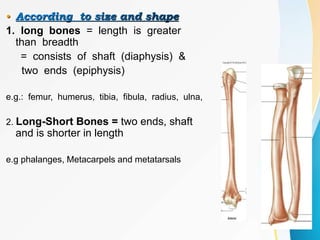
1. long bones = length is greater
than breadth
= consists of shaft (diaphysis) &
two ends (epiphysis)
e.g.: femur, humerus, tibia, fibula, radius, ulna,
2. Long-Short Bones = two ends, shaft
and is shorter in length
e.g phalanges, Metacarpels and metatarsals
3. short bones = cuboidal in shape
= spongy bone with thin coat of compact bone
e.g.: carpals (wrist), tarsal (ankle) bones
4. flat bones = broad or elongated flat plates
= for protection & muscle attachments
composition: 2 thin layers of compact bone. enclosing
a thin layer of spongy bone
e.g.: bones of the skull, sternum, ribs, scapula
5. Irregular bones = all other bones not assigned to the
previous groups
e.g: vertebrae, pelvic bones ,bones of the base of the skull
5. MISCELLANEOUS CLASSIFICATION
a. Sesamoid bone = short bone that develops in a tendon e.g:patella ,
pisiform
b. Pneumatic bones- flat or irregular bones possessing a hollow space with in
their body, contains air.
e.g.: ethmoid, maxilla ,mastoid part of temporal bone.
c. Accessory bones- develop in relation to axial skeleton
e.g:cervical rib, lumbar rib , two frontal bones
d. Supernumerary bones- develop in relation to appendicular skeleton
e.g polydactyle
e. wormian bone- rarely found. some times a centre of ossification appears in
the middle primitive frontal lobe which forms wormian bone
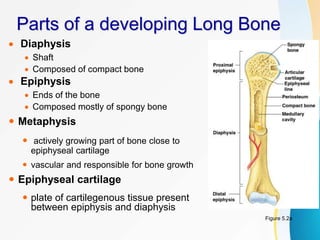
Parts of a developing Long Bone
 Diaphysis
 Shaft
 Composed of compact bone
 Epiphysis
 Ends of the bone
 Composed mostly of spongy bone
 Metaphysis
 actively growing part of bone close to
epiphyseal cartilage
 vascular and responsible for bone growth
 Epiphyseal cartilage
 plate of cartilegenous tissue present
between epiphysis and diaphysis
Figure 5.2a
Gross Structures of a Long Bone
 Medullary cavity
 Cavity of the shaft, walls are hard that
make the shaft strong
 ends are articular, smoot and covered by
hyaline cartilage
 Nutrient foramen
 lined by endosteum
 contains gellatinous material
 Yellow marrow (fibro-fatty mass) in
adults
 Red marrow (for blood cell formation,
erythropoiesis) in infants
 found in ends of long bones bodies of
verebrae, sternum and falt bones of skull
 no marrow cavity in clavicle and ribs
 Periosteum
 Outside covering of the diaphysis
 Fibrous connective tissue
membrane
 Sharpey’s fibers
 peroiosteal collagenous fribers
 Secure periosteum to underlying
bone
 it is sensitive due to rich nerve
supply derived from the nerves
supplying the muscles attached to
the bone
Blood Supply of Bones
Numerous, supply spongy and compact bone
» enter through nutrient foramen
» reach medullary cavity
» gives ascending and desecnding branches
» anastomose with periosteal and end-blood vessels
» branchs also enters volkman’s and haversian canals
» branches are called “nutritiae
» arises from two sources
» a) periarticular anastomosis = these vessels are called
juxta epiphyseal vessels of lexer
» b) from the arteries passing over that region
here
additional epiphyseal and metaphyseal
arteries are present
periosteal arteries
supplied by
periosteal and nutrient arteries which
anastomose with eachother
periosteal arteries
periosteal and middle meningeal artery
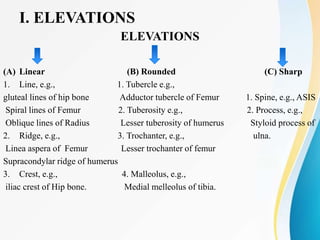
I. ELEVATIONS
ELEVATIONS
(A) Linear (B) Rounded (C) Sharp
1. Line, e.g., 1. Tubercle e.g.,
gluteal lines of hip bone Adductor tubercle of Femur 1. Spine, e.g., ASIS
Spiral lines of Femur 2. Tuberosity e.g., 2. Process, e.g.,
Oblique lines of Radius Lesser tuberosity of humerus Styloid process of
2. Ridge, e.g., 3. Trochanter, e.g., ulna.
Linea aspera of Femur Lesser trochanter of femur
Supracondylar ridge of humerus
3. Crest, e.g., 4. Malleolus, e.g.,
iliac crest of Hip bone. Medial melleolus of tibia.
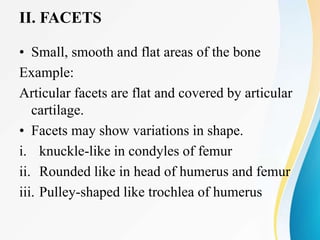
II. FACETS
• Small, smooth and flat areas of the bone
Example:
Articular facets are flat and covered by articular
cartilage.
• Facets may show variations in shape.
i. knuckle-like in condyles of femur
ii. Rounded like in head of humerus and femur
iii. Pulley-shaped like trochlea of humerus
III. DEPRESSIONS
• They are of following types
(A) Pit or Fovea
Very small and shallow depression
(B) Fossa
Slightly large and deep depression
(C) Notch or incisura
Depression bridged by a ligament
(D) Groove or sulcus
Depression with some length
(E) Foramen
Perforated depression or hole in the bone
(F) Canal or Meatus
Foramen with some length
CARTILAGE
The cartilage is a phylogenetically old type of connective
tissue, with wide spread distribution in vertebrates, which is
characterized by the presence of rigid but flexible matrix.
General Features
1. Covered by fibro-vasculo-cellular membrane called
pericondrium.
2. High tensile strength and resistence
3. Avascular
4. Metabolic rate is low
5. No lymphatics and nerves
6. Regeneration is not effective
CARTILAGE
• Types
It is composed of :
1. Cells (chondroblasts & chondrocytes)
2. Matrix (consists of ground substances and
connective tissue fibers)
• Depending on the matrix there are three types of
cartilage.

GA bone 1.pptx

  • 2.
    • osteology • Bony& cartilaginous framework of the body • Exoskeleton • Endoskeleton = visceral and somatic • Functions- • Rigid framework of the body • Protection to the viscera • Provides leverage for body movements. • stores ca++ • erytrhropoiesis • electrolyte balance • detoxification • assist in respiration
  • 3.
    Bone Highly vascular mineralizedconnective tissue , consisting of cells & dense intercellular organic matrix impregnated with organic salts.
  • 4.
  • 5.
    • 1. Intramembranous =starts as fibrous membrane,calcium gradually deposited until structure becomes ossified  intramembranous ossification embryonic mesenchye directly forms bony tissue; usually occurs in embryo e.g.: bones of the skull and face, clavicle 2. Cartilagenous = starts as cartilage, gradually ossified enchondral or intracartilagenous ossification. e.g.: long bones except clavicle, short bone and irregular bones 3. Membrano-cartiligenous at the junction of vault ad base of skull bones are formed by this method
  • 6.
    • According tostructure 1. compact = solid mass; dense & hard = forms the outer layer of bone structure = functional unit --- Haversian system 2. cancellous or spongy = contain spaces filled with bone marrow and lamellae are arranged flat = incomplete Haversian system
  • 7.
    2 Types ofBone Compact bone Spongy bone
  • 8.
    • A X IA L skull Cranium & fascial 22 hyoid 1 ossicles 6 Vertebrae 26 Ribs & sternum 24+1_ 80 APPENDICULAR Upper Extremities Lower Extremities clavicle 2 hip bone 2 scapula 2 femur 2 humerus 2 patella 2 radius 2 tibia 2 ulna 2 fibula 2 carpals 16 tarsals 14 metacarpals 10 metatarsals 10 phalanges 28 phalanges 28 64 62
  • 13.
    • 1. long bones= length is greater than breadth = consists of shaft (diaphysis) & two ends (epiphysis) e.g.: femur, humerus, tibia, fibula, radius, ulna, 2. Long-Short Bones = two ends, shaft and is shorter in length e.g phalanges, Metacarpels and metatarsals
  • 14.
    3. short bones= cuboidal in shape = spongy bone with thin coat of compact bone e.g.: carpals (wrist), tarsal (ankle) bones 4. flat bones = broad or elongated flat plates = for protection & muscle attachments composition: 2 thin layers of compact bone. enclosing a thin layer of spongy bone e.g.: bones of the skull, sternum, ribs, scapula
  • 16.
    5. Irregular bones= all other bones not assigned to the previous groups e.g: vertebrae, pelvic bones ,bones of the base of the skull 5. MISCELLANEOUS CLASSIFICATION a. Sesamoid bone = short bone that develops in a tendon e.g:patella , pisiform b. Pneumatic bones- flat or irregular bones possessing a hollow space with in their body, contains air. e.g.: ethmoid, maxilla ,mastoid part of temporal bone. c. Accessory bones- develop in relation to axial skeleton e.g:cervical rib, lumbar rib , two frontal bones d. Supernumerary bones- develop in relation to appendicular skeleton e.g polydactyle e. wormian bone- rarely found. some times a centre of ossification appears in the middle primitive frontal lobe which forms wormian bone
  • 19.
    Parts of adeveloping Long Bone  Diaphysis  Shaft  Composed of compact bone  Epiphysis  Ends of the bone  Composed mostly of spongy bone  Metaphysis  actively growing part of bone close to epiphyseal cartilage  vascular and responsible for bone growth  Epiphyseal cartilage  plate of cartilegenous tissue present between epiphysis and diaphysis Figure 5.2a
  • 20.
    Gross Structures ofa Long Bone  Medullary cavity  Cavity of the shaft, walls are hard that make the shaft strong  ends are articular, smoot and covered by hyaline cartilage  Nutrient foramen  lined by endosteum  contains gellatinous material  Yellow marrow (fibro-fatty mass) in adults  Red marrow (for blood cell formation, erythropoiesis) in infants  found in ends of long bones bodies of verebrae, sternum and falt bones of skull  no marrow cavity in clavicle and ribs
  • 21.
     Periosteum  Outsidecovering of the diaphysis  Fibrous connective tissue membrane  Sharpey’s fibers  peroiosteal collagenous fribers  Secure periosteum to underlying bone  it is sensitive due to rich nerve supply derived from the nerves supplying the muscles attached to the bone
  • 22.
    Blood Supply ofBones Numerous, supply spongy and compact bone » enter through nutrient foramen » reach medullary cavity » gives ascending and desecnding branches » anastomose with periosteal and end-blood vessels » branchs also enters volkman’s and haversian canals » branches are called “nutritiae » arises from two sources » a) periarticular anastomosis = these vessels are called juxta epiphyseal vessels of lexer » b) from the arteries passing over that region
  • 23.
    here additional epiphyseal andmetaphyseal arteries are present periosteal arteries supplied by periosteal and nutrient arteries which anastomose with eachother periosteal arteries periosteal and middle meningeal artery
  • 24.
    I. ELEVATIONS ELEVATIONS (A) Linear(B) Rounded (C) Sharp 1. Line, e.g., 1. Tubercle e.g., gluteal lines of hip bone Adductor tubercle of Femur 1. Spine, e.g., ASIS Spiral lines of Femur 2. Tuberosity e.g., 2. Process, e.g., Oblique lines of Radius Lesser tuberosity of humerus Styloid process of 2. Ridge, e.g., 3. Trochanter, e.g., ulna. Linea aspera of Femur Lesser trochanter of femur Supracondylar ridge of humerus 3. Crest, e.g., 4. Malleolus, e.g., iliac crest of Hip bone. Medial melleolus of tibia.
  • 25.
    II. FACETS • Small,smooth and flat areas of the bone Example: Articular facets are flat and covered by articular cartilage. • Facets may show variations in shape. i. knuckle-like in condyles of femur ii. Rounded like in head of humerus and femur iii. Pulley-shaped like trochlea of humerus
  • 26.
    III. DEPRESSIONS • Theyare of following types (A) Pit or Fovea Very small and shallow depression (B) Fossa Slightly large and deep depression (C) Notch or incisura Depression bridged by a ligament (D) Groove or sulcus Depression with some length (E) Foramen Perforated depression or hole in the bone (F) Canal or Meatus Foramen with some length
  • 27.
    CARTILAGE The cartilage isa phylogenetically old type of connective tissue, with wide spread distribution in vertebrates, which is characterized by the presence of rigid but flexible matrix. General Features 1. Covered by fibro-vasculo-cellular membrane called pericondrium. 2. High tensile strength and resistence 3. Avascular 4. Metabolic rate is low 5. No lymphatics and nerves 6. Regeneration is not effective
  • 28.
    CARTILAGE • Types It iscomposed of : 1. Cells (chondroblasts & chondrocytes) 2. Matrix (consists of ground substances and connective tissue fibers)
  • 29.
    • Depending onthe matrix there are three types of cartilage.