Human Body Systems BY:  Marcus Gunn Bryan cunningham Dustin Scriven
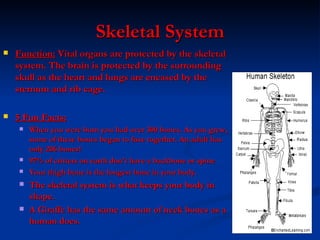
Skeletal System Function:   Vital organs are protected by the skeletal system. The brain is protected by the surrounding skull as the heart and lungs are encased by the sternum and rib cage. 5 Fun Facts: When you were born you had over 300 bones. As you grew, some of these bones began to fuse together. An adult has only 206 bones!  97% of critters on earth don't have a backbone or spine   Your thigh bone is the longest bone in your body. The skeletal system is what keeps your body in shape. A Giraffe has the same amount of neck bones as a human does.
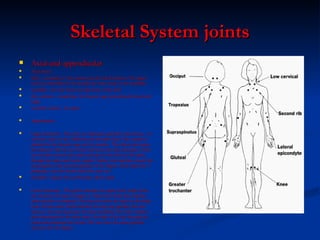
Skeletal System joints Axial and appendicular  Axial bones skull - consisting of  the cranium and the facial skeleton. The upper teeth are embedded in the maxilla; the lower teeth, in the mandible.  mandible - the only freely movable bone of the skull  ribs, sternum - comprising  the thoracic cage, protecting the heart and lungs  vertebral column - the spine Appendicular  Upper Extremity - The arms are ultimately attached to the thorax,  via synovial  joints, at the collarbone and shoulder bone. The scapula is attached to the thoracic cage only by muscles.  The elbow joint unites the humerus with the two lower arm bones the ulna and radius. Three sets of joints connect the radius and ulna to the bones of the palm, through the eight small wrist carpals. Further, the knuckles connect the metacarpals to the proximal phalanx of the fingers. Each finger has 3 phalanges, cept the thumb which has only two.  shoulder/ scapula arm and forearm, elbow hand  Lower Extremity - The pelvis transmits the upper body weight from the sacrum to the legs. It begins as 3 hip bones which fuse together when growth is completed. The hip joint unites the pelvis to the thigh bone, he knee joint, which includes the knee cap (patella), links the femur to the lower leg bones the tibia and fibula. The body weight is then transmitted to the heels and to the balls of the feet through the tarsal and metatarsal foot bones. The toes have the same generaln structure like the fingers.
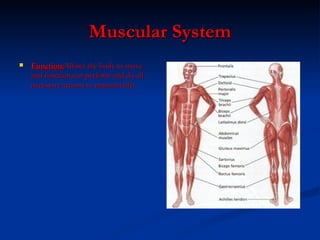
Muscular System Function: Allows the body to move and function,run perform and do all necessary actions to maintain life.
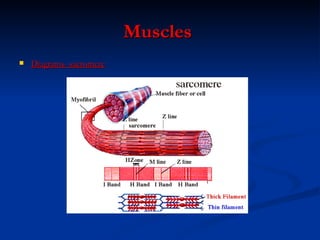
Muscles   Diagrams- sacromere
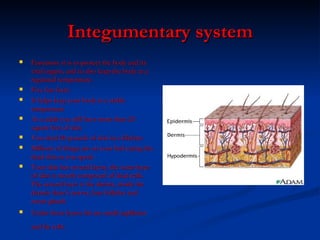
Integumentary system Functions: it is to protect the body and its vital organs, and to also keep the body at a regulated temperature.  Five fun facts:  It helps keep your body at a stable temperature As a adult you will have more then 20 sqaure feet of skin You shed 20 pounds of skin in a lifetime Millions of things are on your bed eating the dead skin as you speek Your skin has several layers, the outer layer of skin is mostly composed of dead cells. The second layer is the dermis, inside the dermis there’s nerves, hair follicles and sweat glands Under these layers the are small capillaries and fat cells.
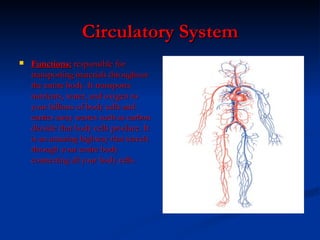
Circulatory System Functions:  responsible for transporting materials throughout the entire body. It transports nutrients, water, and oxygen to your billions of body cells and carries away wastes such as carbon dioxide that body cells produce. It is an amazing highway that travels through your entire body connecting all your body cells.
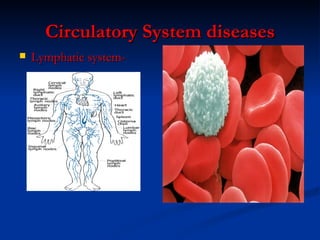
Circulatory System diseases Lymphatic system-
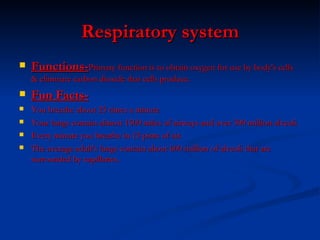
Respiratory system Functions- Primary function is to obtain oxygen for use by body's cells & eliminate carbon dioxide that cells produce. Fun Facts- You breathe about 25 times a minute Your lungs contain almost 1500 miles of airways and over 300 million alveoli.  Every minute you breathe in 13 pints of air.  The average adult's lungs contain about 600 million of alveoli that are surrounded by capillaries.
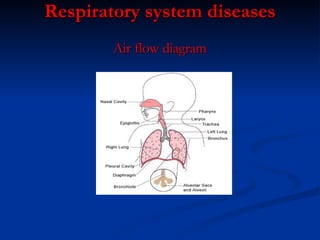
Respiratory system diseases Air flow diagram
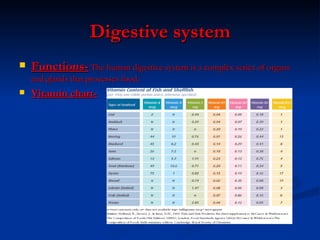
Digestive system Functions-  The human digestive system is a complex series of organs and glands that processes food. Vitamin chart-
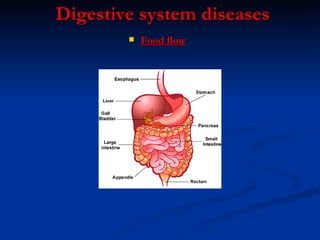
Digestive system diseases Food flow
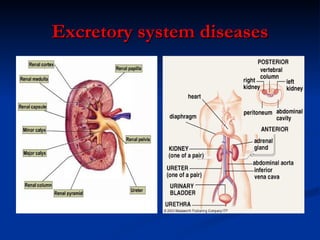
Excretory system Function-  is to maintain the volume and composition of body fluids within normal limits. One aspect of this function is to rid the body of waste products that accumulate as a result of cellular metabolism Fun Facts- Collect water and filter body fluids.  Remove and concentrate waste products from body fluids and return other substances to body fluids as necessary for homeostasis.  Eliminate excretory products from the body.  It also regulates the amount of water and ions present in the body fluids. The job of the excretory system is to remove various produced by the body
Excretory system diseases
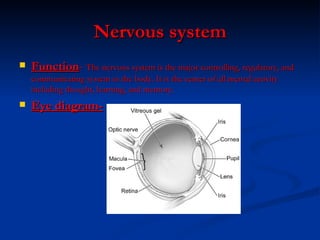
Nervous system Function -  The nervous system is the major controlling, regulatory, and communicating system in the body. It is the center of all mental activity including thought, learning, and memory. Eye diagram-
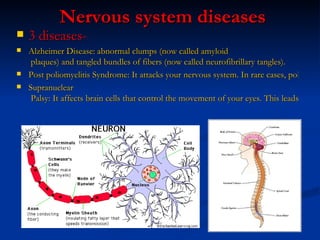
Nervous system diseases 3 diseases- Alzheimer Disease: abnormal clumps (now called  amyloid  plaques) and tangled bundles of fibers (now called  neurofibrillary  tangles). Post poliomyelitis Syndrome: It attacks your nervous system. In rare cases, polio infection can cause paralysis. Supranuclear  Palsy: It affects brain cells that control the movement of your eyes. This leads to serious and permanent problems with balance and the way you walk.
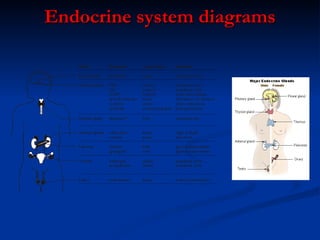
Endocrine system Functions-   The Endocrine system (along with the nervous system) controls and regulates the complex activities of the body. The Endocrine system regulates the activities of the body by secreting complex chemical substances (hormones) into the blood stream. These secretions come from a variety of glands which control various organs of the body. The key functions are:  To regulate the metabolic functions of the body.  To regulate the rate of chemical reactions in various cells.  To influence the ability of substances to transport themselves through cell membranes
Endocrine system diagrams
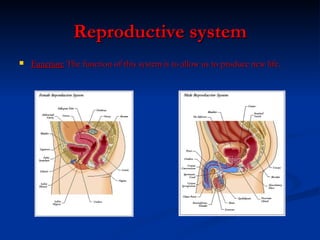
Reproductive system Function:  The function of this system is to allow us to produce new life.
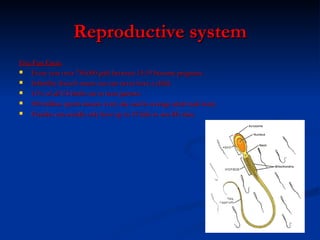
Reproductive system Five Fun Facts: Every year over 750,000 girls between 15-19 become pregnant. Infertility doesn’t mean you can never have a child. 11% of all US births are to teen parents. 500 million sperm mature every day and in average adult male body Females can usually only have up to 35 kids in one life time.

Body Systems

  • 1.
    Human Body SystemsBY: Marcus Gunn Bryan cunningham Dustin Scriven
  • 2.
    Skeletal System Function: Vital organs are protected by the skeletal system. The brain is protected by the surrounding skull as the heart and lungs are encased by the sternum and rib cage. 5 Fun Facts: When you were born you had over 300 bones. As you grew, some of these bones began to fuse together. An adult has only 206 bones! 97% of critters on earth don't have a backbone or spine Your thigh bone is the longest bone in your body. The skeletal system is what keeps your body in shape. A Giraffe has the same amount of neck bones as a human does.
  • 3.
    Skeletal System jointsAxial and appendicular Axial bones skull - consisting of the cranium and the facial skeleton. The upper teeth are embedded in the maxilla; the lower teeth, in the mandible. mandible - the only freely movable bone of the skull ribs, sternum - comprising the thoracic cage, protecting the heart and lungs vertebral column - the spine Appendicular Upper Extremity - The arms are ultimately attached to the thorax, via synovial joints, at the collarbone and shoulder bone. The scapula is attached to the thoracic cage only by muscles. The elbow joint unites the humerus with the two lower arm bones the ulna and radius. Three sets of joints connect the radius and ulna to the bones of the palm, through the eight small wrist carpals. Further, the knuckles connect the metacarpals to the proximal phalanx of the fingers. Each finger has 3 phalanges, cept the thumb which has only two. shoulder/ scapula arm and forearm, elbow hand Lower Extremity - The pelvis transmits the upper body weight from the sacrum to the legs. It begins as 3 hip bones which fuse together when growth is completed. The hip joint unites the pelvis to the thigh bone, he knee joint, which includes the knee cap (patella), links the femur to the lower leg bones the tibia and fibula. The body weight is then transmitted to the heels and to the balls of the feet through the tarsal and metatarsal foot bones. The toes have the same generaln structure like the fingers.
  • 4.
    Muscular System Function:Allows the body to move and function,run perform and do all necessary actions to maintain life.
  • 5.
    Muscles Diagrams- sacromere
  • 6.
    Integumentary system Functions:it is to protect the body and its vital organs, and to also keep the body at a regulated temperature. Five fun facts: It helps keep your body at a stable temperature As a adult you will have more then 20 sqaure feet of skin You shed 20 pounds of skin in a lifetime Millions of things are on your bed eating the dead skin as you speek Your skin has several layers, the outer layer of skin is mostly composed of dead cells. The second layer is the dermis, inside the dermis there’s nerves, hair follicles and sweat glands Under these layers the are small capillaries and fat cells.
  • 7.
    Circulatory System Functions: responsible for transporting materials throughout the entire body. It transports nutrients, water, and oxygen to your billions of body cells and carries away wastes such as carbon dioxide that body cells produce. It is an amazing highway that travels through your entire body connecting all your body cells.
  • 8.
    Circulatory System diseasesLymphatic system-
  • 9.
    Respiratory system Functions-Primary function is to obtain oxygen for use by body's cells & eliminate carbon dioxide that cells produce. Fun Facts- You breathe about 25 times a minute Your lungs contain almost 1500 miles of airways and over 300 million alveoli. Every minute you breathe in 13 pints of air. The average adult's lungs contain about 600 million of alveoli that are surrounded by capillaries.
  • 10.
  • 11.
    Digestive system Functions- The human digestive system is a complex series of organs and glands that processes food. Vitamin chart-
  • 12.
  • 13.
    Excretory system Function- is to maintain the volume and composition of body fluids within normal limits. One aspect of this function is to rid the body of waste products that accumulate as a result of cellular metabolism Fun Facts- Collect water and filter body fluids. Remove and concentrate waste products from body fluids and return other substances to body fluids as necessary for homeostasis. Eliminate excretory products from the body. It also regulates the amount of water and ions present in the body fluids. The job of the excretory system is to remove various produced by the body
  • 14.
  • 15.
    Nervous system Function- The nervous system is the major controlling, regulatory, and communicating system in the body. It is the center of all mental activity including thought, learning, and memory. Eye diagram-
  • 16.
    Nervous system diseases3 diseases- Alzheimer Disease: abnormal clumps (now called amyloid plaques) and tangled bundles of fibers (now called neurofibrillary tangles). Post poliomyelitis Syndrome: It attacks your nervous system. In rare cases, polio infection can cause paralysis. Supranuclear Palsy: It affects brain cells that control the movement of your eyes. This leads to serious and permanent problems with balance and the way you walk.
  • 17.
    Endocrine system Functions- The Endocrine system (along with the nervous system) controls and regulates the complex activities of the body. The Endocrine system regulates the activities of the body by secreting complex chemical substances (hormones) into the blood stream. These secretions come from a variety of glands which control various organs of the body. The key functions are: To regulate the metabolic functions of the body. To regulate the rate of chemical reactions in various cells. To influence the ability of substances to transport themselves through cell membranes
  • 18.
  • 19.
    Reproductive system Function: The function of this system is to allow us to produce new life.
  • 20.
    Reproductive system FiveFun Facts: Every year over 750,000 girls between 15-19 become pregnant. Infertility doesn’t mean you can never have a child. 11% of all US births are to teen parents. 500 million sperm mature every day and in average adult male body Females can usually only have up to 35 kids in one life time.