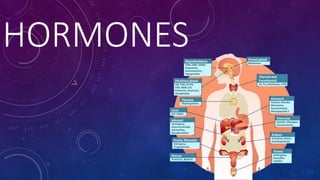
HORMONES
WHAT ARE HORMONES ?
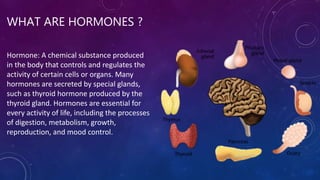
Hormone: A chemical substance produced
in the body that controls and regulates the
activity of certain cells or organs. Many
hormones are secreted by special glands,
such as thyroid hormone produced by the
thyroid gland. Hormones are essential for
every activity of life, including the processes
of digestion, metabolism, growth,
reproduction, and mood control.
CLASSIFICATION OF HORMONES
1-Bassed on the chemical nature;
The hormones can be categorized into three groups considering their chemical nature;-
A-Protein or peptide hormones e.g. insulin, glucagon, antidiuretic hormone, oxytocin.
B-Steroid hormones e.g. glucocorticoids, mineralocorticoids, sex hormones.
C-Amino acid derivatives e.g. epinephrine, norepinephrine, thyroxine(T4), Triiodothyronine(T3)
2-Bassed on mechanism of action
Hormones are classified into two broad groups (I and II) based on the location of the stimulate
the release of certain molecules, namely the second messengers which, in turn, perform the
biochemical functions. Thus, hormones themselves are the first messengers.
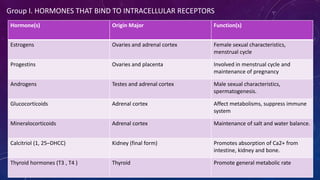
Group I. HORMONES THAT BIND TO INTRACELLULAR RECEPTORS
Hormone(s) Origin Major Function(s)
Estrogens Ovaries and adrenal cortex Female sexual characteristics,
menstrual cycle
Progestins Ovaries and placenta Involved in menstrual cycle and
maintenance of pregnancy
Androgens Testes and adrenal cortex Male sexual characteristics,
spermatogenesis.
Glucocorticoids Adrenal cortex Affect metabolisms, suppress immune
system
Mineralocorticoids Adrenal cortex Maintenance of salt and water balance.
Calcitriol (1, 25–DHCC) Kidney (final form) Promotes absorption of Ca2+ from
intestine, kidney and bone.
Thyroid hormones (T3 , T4 ) Thyroid Promote general metabolic rate
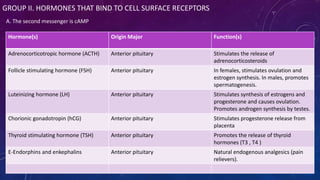
GROUP II. HORMONES THAT BIND TO CELL SURFACE RECEPTORS
A. The second messenger is cAMP
Hormone(s) Origin Major Function(s)
Adrenocorticotropic hormone (ACTH) Anterior pituitary Stimulates the release of
adrenocorticosteroids
Follicle stimulating hormone (FSH) Anterior pituitary In females, stimulates ovulation and
estrogen synthesis. In males, promotes
spermatogenesis.
Luteinizing hormone (LH) Anterior pituitary Stimulates synthesis of estrogens and
progesterone and causes ovulation.
Promotes androgen synthesis by testes.
Chorionic gonadotropin (hCG) Anterior pituitary Stimulates progesterone release from
placenta
Thyroid stimulating hormone (TSH) Anterior pituitary Promotes the release of thyroid
hormones (T3 , T4 )
E-Endorphins and enkephalins Anterior pituitary Natural endogenous analgesics (pain
relievers).
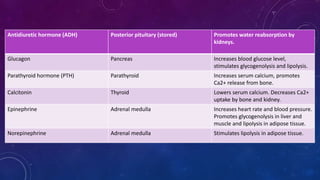
Antidiuretic hormone (ADH) Posterior pituitary (stored) Promotes water reabsorption by
kidneys.
Glucagon Pancreas Increases blood glucose level,
stimulates glycogenolysis and lipolysis.
Parathyroid hormone (PTH) Parathyroid Increases serum calcium, promotes
Ca2+ release from bone.
Calcitonin Thyroid Lowers serum calcium. Decreases Ca2+
uptake by bone and kidney.
Epinephrine Adrenal medulla Increases heart rate and blood pressure.
Promotes glycogenolysis in liver and
muscle and lipolysis in adipose tissue.
Norepinephrine Adrenal medulla Stimulates lipolysis in adipose tissue.
B. THE SECOND MESSENGER IS PHOSPHATIDYL INOSITOL/CALCIUM
Hormone(s) Origin Major Function(s)
Thyrotropin-releasing hormone (TRH) Hypothalamus Promotes TSH release
Gonadotropin-releasing hormone
(GnRH)
Hypothalamus Stimulates release of FSH and LH.
Gastrin Stomach Stimulates gastric HCI and pepsinogen
secretion.
Cholecystokinin (CCK) Intestine Stimulates contraction of gall bladder
and secretion of pancreatic enzymes.
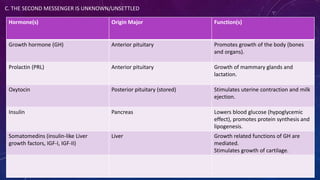
C. THE SECOND MESSENGER IS UNKNOWN/UNSETTLED
Hormone(s) Origin Major Function(s)
Growth hormone (GH) Anterior pituitary Promotes growth of the body (bones
and organs).
Prolactin (PRL) Anterior pituitary Growth of mammary glands and
lactation.
Oxytocin Posterior pituitary (stored) Stimulates uterine contraction and milk
ejection.
Insulin Pancreas Lowers blood glucose (hypoglycemic
effect), promotes protein synthesis and
lipogenesis.
Somatomedins (insulin-like Liver
growth factors, IGF-I, IGF-II)
Liver Growth related functions of GH are
mediated.
Stimulates growth of cartilage.
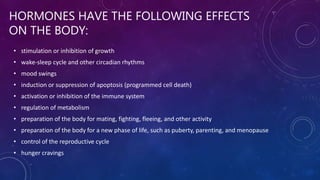
HORMONES HAVE THE FOLLOWING EFFECTS
ON THE BODY:
• stimulation or inhibition of growth
• wake-sleep cycle and other circadian rhythms
• mood swings
• induction or suppression of apoptosis (programmed cell death)
• activation or inhibition of the immune system
• regulation of metabolism
• preparation of the body for mating, fighting, fleeing, and other activity
• preparation of the body for a new phase of life, such as puberty, parenting, and menopause
• control of the reproductive cycle
• hunger cravings
HOW HORMONES WORK
?
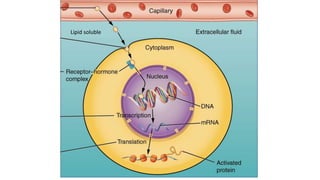
Lipid soluble
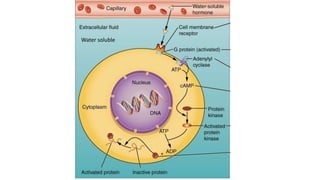
Water soluble
Hormones mediate changes in target cells by binding to specific hormone receptors. In this
way, even though hormones circulate throughout the body and come into contact with
many different cell types, they only affect cells that possess the necessary receptors.
Receptors for a specific hormone may be found on many different cells or may be limited to
a small number of specialized cells. For example, thyroid hormones act on many different
tissue types, stimulating metabolic activity throughout the body. Cells can have many
receptors for the same hormone, but often also possess receptors for different types of
hormones. The number of receptors that respond to a hormone determines the cell’s
sensitivity to that hormone and the resulting cellular response. Additionally, the number of
receptors that respond to a hormone can change over time, resulting in increased or
decreased cell sensitivity. In up-regulation, the number of receptors increases in response
to rising hormone levels, making the cell more sensitive to the hormone, allowing for more
cellular activity. When the number of receptors decreases in response to rising hormone
levels, called down-regulation, cellular activity is reduced.
Cells respond to a hormone when they express a specific receptor for that hormone. The
hormone binds to the receptor protein, resulting in the activation of a signal transduction
mechanism that ultimately leads to cell type-specific responses. Receptor binding alters
cellular activity, resulting in an increase or decrease in normal body processes. Depending
on the location of the protein receptor on the target cell and the chemical structure of the
hormone, hormones can mediate changes directly by binding to intracellular hormone
receptors and modulating gene transcription, or indirectly by binding to cell surface
receptors and stimulating signaling pathways.
SEVERAL FACTORS MAY REGULATE THE HORMONAL
ACTION, THIS FACTORS INCLUDE:
1- Rate of synthesis and secretion of hormone by neuroendocrine mechanism,
feedback control mechanism or endocrine rhythm.
2- The efficacy of the transport system in plasma.
3- The efficacy of hormone-sensitive specific receptor.
4- The rate of hormone degradation.
The rate of hormone biosynthesis and secretion is often regulated by a homeostatic negative
feedback control mechanism. Such a mechanism depends on factors that influence the
metabolism and excretion of hormones. Thus, higher hormone concentration alone cannot
trigger the negative feedback mechanism. Negative feedback must be triggered by
overproduction of an "effect" of the hormone.
Hormone secretion can be stimulated and inhibited by:
• Other hormones (stimulating- or releasing -hormones)
• Plasma concentrations of ions or nutrients, as well as binding globulins
• Neurons and mental activity
• Environmental changes, e.g., of light or temperature
• One special group of hormones is the tropic hormones that stimulate the hormone
production of other endocrine glands. For example, thyroid-stimulating hormone (TSH)
causes growth and increased activity of another endocrine gland, the thyroid, which
increases output of thyroid hormones.
• To release active hormones quickly into the circulation, hormone biosynthetic cells may
produce and store biologically inactive hormones in the form of pre- or prohormones.
These can then be quickly converted into their active hormone form in response to a
particular stimulus.
• Eicosanoids are considered to act as local hormones. They are considered to be "local"
because they possess specific effects on target cells close to their site of formation. They
also have a rapid degradation cycle, making sure they do not reach distant sites within
the body.
• Hormones are also regulated by receptor agonists. Hormones are ligands, which are any
kinds of molecules that produce a signal by binding to a receptor site on a protein.
Hormone effects can be inhibited, thus regulated, by competing ligands that bind to the
same target receptor as the hormone in question. When a competing ligand is bound to
the receptor site, the hormone is unable to bind to that site and is unable to elicit a
response from the target cell. These competing ligands are called antagonists of the
hormone.
REFERENCES
• Biochemistry_Satyanarayan_4th_Edition.pd
• https://bio.libretexts.org/

Hormones

  • 1.
  • 2.
    WHAT ARE HORMONES? Hormone: A chemical substance produced in the body that controls and regulates the activity of certain cells or organs. Many hormones are secreted by special glands, such as thyroid hormone produced by the thyroid gland. Hormones are essential for every activity of life, including the processes of digestion, metabolism, growth, reproduction, and mood control.
  • 3.
    CLASSIFICATION OF HORMONES 1-Bassedon the chemical nature; The hormones can be categorized into three groups considering their chemical nature;- A-Protein or peptide hormones e.g. insulin, glucagon, antidiuretic hormone, oxytocin. B-Steroid hormones e.g. glucocorticoids, mineralocorticoids, sex hormones. C-Amino acid derivatives e.g. epinephrine, norepinephrine, thyroxine(T4), Triiodothyronine(T3) 2-Bassed on mechanism of action Hormones are classified into two broad groups (I and II) based on the location of the stimulate the release of certain molecules, namely the second messengers which, in turn, perform the biochemical functions. Thus, hormones themselves are the first messengers.
  • 4.
    Group I. HORMONESTHAT BIND TO INTRACELLULAR RECEPTORS Hormone(s) Origin Major Function(s) Estrogens Ovaries and adrenal cortex Female sexual characteristics, menstrual cycle Progestins Ovaries and placenta Involved in menstrual cycle and maintenance of pregnancy Androgens Testes and adrenal cortex Male sexual characteristics, spermatogenesis. Glucocorticoids Adrenal cortex Affect metabolisms, suppress immune system Mineralocorticoids Adrenal cortex Maintenance of salt and water balance. Calcitriol (1, 25–DHCC) Kidney (final form) Promotes absorption of Ca2+ from intestine, kidney and bone. Thyroid hormones (T3 , T4 ) Thyroid Promote general metabolic rate
  • 5.
    GROUP II. HORMONESTHAT BIND TO CELL SURFACE RECEPTORS A. The second messenger is cAMP Hormone(s) Origin Major Function(s) Adrenocorticotropic hormone (ACTH) Anterior pituitary Stimulates the release of adrenocorticosteroids Follicle stimulating hormone (FSH) Anterior pituitary In females, stimulates ovulation and estrogen synthesis. In males, promotes spermatogenesis. Luteinizing hormone (LH) Anterior pituitary Stimulates synthesis of estrogens and progesterone and causes ovulation. Promotes androgen synthesis by testes. Chorionic gonadotropin (hCG) Anterior pituitary Stimulates progesterone release from placenta Thyroid stimulating hormone (TSH) Anterior pituitary Promotes the release of thyroid hormones (T3 , T4 ) E-Endorphins and enkephalins Anterior pituitary Natural endogenous analgesics (pain relievers).
  • 6.
    Antidiuretic hormone (ADH)Posterior pituitary (stored) Promotes water reabsorption by kidneys. Glucagon Pancreas Increases blood glucose level, stimulates glycogenolysis and lipolysis. Parathyroid hormone (PTH) Parathyroid Increases serum calcium, promotes Ca2+ release from bone. Calcitonin Thyroid Lowers serum calcium. Decreases Ca2+ uptake by bone and kidney. Epinephrine Adrenal medulla Increases heart rate and blood pressure. Promotes glycogenolysis in liver and muscle and lipolysis in adipose tissue. Norepinephrine Adrenal medulla Stimulates lipolysis in adipose tissue.
  • 7.
    B. THE SECONDMESSENGER IS PHOSPHATIDYL INOSITOL/CALCIUM Hormone(s) Origin Major Function(s) Thyrotropin-releasing hormone (TRH) Hypothalamus Promotes TSH release Gonadotropin-releasing hormone (GnRH) Hypothalamus Stimulates release of FSH and LH. Gastrin Stomach Stimulates gastric HCI and pepsinogen secretion. Cholecystokinin (CCK) Intestine Stimulates contraction of gall bladder and secretion of pancreatic enzymes.
  • 8.
    C. THE SECONDMESSENGER IS UNKNOWN/UNSETTLED Hormone(s) Origin Major Function(s) Growth hormone (GH) Anterior pituitary Promotes growth of the body (bones and organs). Prolactin (PRL) Anterior pituitary Growth of mammary glands and lactation. Oxytocin Posterior pituitary (stored) Stimulates uterine contraction and milk ejection. Insulin Pancreas Lowers blood glucose (hypoglycemic effect), promotes protein synthesis and lipogenesis. Somatomedins (insulin-like Liver growth factors, IGF-I, IGF-II) Liver Growth related functions of GH are mediated. Stimulates growth of cartilage.
  • 9.
    HORMONES HAVE THEFOLLOWING EFFECTS ON THE BODY: • stimulation or inhibition of growth • wake-sleep cycle and other circadian rhythms • mood swings • induction or suppression of apoptosis (programmed cell death) • activation or inhibition of the immune system • regulation of metabolism • preparation of the body for mating, fighting, fleeing, and other activity • preparation of the body for a new phase of life, such as puberty, parenting, and menopause • control of the reproductive cycle • hunger cravings
  • 10.
  • 11.
  • 12.
  • 13.
    Hormones mediate changesin target cells by binding to specific hormone receptors. In this way, even though hormones circulate throughout the body and come into contact with many different cell types, they only affect cells that possess the necessary receptors. Receptors for a specific hormone may be found on many different cells or may be limited to a small number of specialized cells. For example, thyroid hormones act on many different tissue types, stimulating metabolic activity throughout the body. Cells can have many receptors for the same hormone, but often also possess receptors for different types of hormones. The number of receptors that respond to a hormone determines the cell’s sensitivity to that hormone and the resulting cellular response. Additionally, the number of receptors that respond to a hormone can change over time, resulting in increased or decreased cell sensitivity. In up-regulation, the number of receptors increases in response to rising hormone levels, making the cell more sensitive to the hormone, allowing for more cellular activity. When the number of receptors decreases in response to rising hormone levels, called down-regulation, cellular activity is reduced.
  • 14.
    Cells respond toa hormone when they express a specific receptor for that hormone. The hormone binds to the receptor protein, resulting in the activation of a signal transduction mechanism that ultimately leads to cell type-specific responses. Receptor binding alters cellular activity, resulting in an increase or decrease in normal body processes. Depending on the location of the protein receptor on the target cell and the chemical structure of the hormone, hormones can mediate changes directly by binding to intracellular hormone receptors and modulating gene transcription, or indirectly by binding to cell surface receptors and stimulating signaling pathways.
  • 15.
    SEVERAL FACTORS MAYREGULATE THE HORMONAL ACTION, THIS FACTORS INCLUDE: 1- Rate of synthesis and secretion of hormone by neuroendocrine mechanism, feedback control mechanism or endocrine rhythm. 2- The efficacy of the transport system in plasma. 3- The efficacy of hormone-sensitive specific receptor. 4- The rate of hormone degradation.
  • 16.
    The rate ofhormone biosynthesis and secretion is often regulated by a homeostatic negative feedback control mechanism. Such a mechanism depends on factors that influence the metabolism and excretion of hormones. Thus, higher hormone concentration alone cannot trigger the negative feedback mechanism. Negative feedback must be triggered by overproduction of an "effect" of the hormone. Hormone secretion can be stimulated and inhibited by: • Other hormones (stimulating- or releasing -hormones) • Plasma concentrations of ions or nutrients, as well as binding globulins • Neurons and mental activity • Environmental changes, e.g., of light or temperature
  • 17.
    • One specialgroup of hormones is the tropic hormones that stimulate the hormone production of other endocrine glands. For example, thyroid-stimulating hormone (TSH) causes growth and increased activity of another endocrine gland, the thyroid, which increases output of thyroid hormones. • To release active hormones quickly into the circulation, hormone biosynthetic cells may produce and store biologically inactive hormones in the form of pre- or prohormones. These can then be quickly converted into their active hormone form in response to a particular stimulus.
  • 18.
    • Eicosanoids areconsidered to act as local hormones. They are considered to be "local" because they possess specific effects on target cells close to their site of formation. They also have a rapid degradation cycle, making sure they do not reach distant sites within the body. • Hormones are also regulated by receptor agonists. Hormones are ligands, which are any kinds of molecules that produce a signal by binding to a receptor site on a protein. Hormone effects can be inhibited, thus regulated, by competing ligands that bind to the same target receptor as the hormone in question. When a competing ligand is bound to the receptor site, the hormone is unable to bind to that site and is unable to elicit a response from the target cell. These competing ligands are called antagonists of the hormone.
  • 19.