Skeletal System
Skeletal system is made up of your bones, ligaments, and tendons.  It determines the shape and symmetry of the body; acts as a protective device for your organs; acts as a firm base for the attachments of muscles (without bones, your muscles would not function properly); and the marrow tissues in the cavity of the bones produces red cells and some white cells, required in your blood.
Endoskeleton Human have an endoskeleton, meaning that they are located inside the body. It consists of about 200 bones.  The number of bones varies, because some bones fuse at different periods of time.  Most bones are hollow with marrow cells inside. Ligaments connect bones to bones, and tendons connect bones to muscles.
Axial Skeleton The skull is made up of number of bones fused together.  The backbone is composed of 33 separate different size and shaped vertebrae, and each of them are composed of centrum (base portion), and neural arch (surrounds and protects spinal cord.) 12 pairs of flat bones make up the rib basket. Its function is to support the chest wall, and prevents it from collapsing, when the diaphragm contracts.
Appendicular Skeleton Appendicular skeleton are made up of pelvic girdles (consists of 3 fused hipbones), pectoral girdles (consists of 2 collar bones - "clavicles"), and 2 scapulas (shoulder blades.)
Bone The Functions of a Bone  Store Minerals  Bones store calcium, phospherus and other minerals used by your body. Protects  Bones help protect the body from injury. The spine and skull protect the CNS (Central Nervous System).
Movement  Bones provide form and structure for muscles to work against. Muscles can contract, but not extend. Using bones as levers one muscle can contract to extend another.  Blood Cells  Red blood cells and some white blood cells are formed in the epiphysie of long bones. Red blood cells carry oxygen throughout the body. White blood cells help fight off infections.
Structure and Support  The skeletal system provides a framework of support for the body to be built upon. The bones of the legs and back support the body's entire weight.
Parts of a Long Bone   
Types of Bones  Long Bones  Long bones have a tubular shaft and articular surface at each end. The femurs, tibias, fibulas, humeri, radii, ulnas, metacarpals, metatarsals, phalanges, and clavicles are long bones.  Flat Bones  Flat bones are thin and have broad surfaces. The ribs, scapula, sternum, and ilium are all flat bones.
Short, or Irregular, Bones  Short bones are variable in size and shape. These bones are generally compact in nature and are distributed throughout the skeleton. These include the entire vertebral column, carpal bones, and tarsal bones.
The Joints Fibrous Fibrous joints connect bones without allowing any movement. The bones of your skull and pelvis are held together by fibrous joints. The union of the spinous processes and vertebrae are fibrous joints.  Cartilaginous Cartilaginous joints are joints in which the bones are attached by cartilage. These joints allow for only a little movment, such as in the spine or ribs.
Synovial Synovial joints allow for much more movement than cartilaginous joints. Cavities between bones in synovial joints are filled with synovial fluid. This fluid helps lubricate and protect the bones. Bursa sacks contain* the synovial fluid.  * to enclose within fixed limits
Hinge  A hinge joint allows extension and retraction of an apendage.
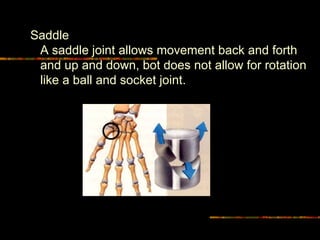
Saddle  A saddle joint allows movement back and forth and up and down, bot does not allow for rotation like a ball and socket joint.
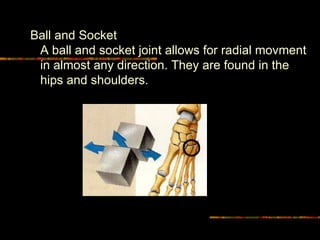
Ball and Socket  A ball and socket joint allows for radial movment in almost any direction. They are found in the hips and shoulders.
Pivot  Pivot joints allow rotation around an axis. The neck and forearms have pivot joints. In the neck the occipital bone spins over the top of the axis. In the forearms the radius and ulna twist around each other. Ellipsoid  Ellipsoid joints are similar to a ball and socket joint. They allow the same type of movment to a lesser magnitude. The wrist is an ellipsoid joint. 

Skeletal system

  • 1.
  • 2.
    Skeletal system ismade up of your bones, ligaments, and tendons. It determines the shape and symmetry of the body; acts as a protective device for your organs; acts as a firm base for the attachments of muscles (without bones, your muscles would not function properly); and the marrow tissues in the cavity of the bones produces red cells and some white cells, required in your blood.
  • 3.
    Endoskeleton Human havean endoskeleton, meaning that they are located inside the body. It consists of about 200 bones. The number of bones varies, because some bones fuse at different periods of time. Most bones are hollow with marrow cells inside. Ligaments connect bones to bones, and tendons connect bones to muscles.
  • 4.
    Axial Skeleton Theskull is made up of number of bones fused together. The backbone is composed of 33 separate different size and shaped vertebrae, and each of them are composed of centrum (base portion), and neural arch (surrounds and protects spinal cord.) 12 pairs of flat bones make up the rib basket. Its function is to support the chest wall, and prevents it from collapsing, when the diaphragm contracts.
  • 5.
    Appendicular Skeleton Appendicularskeleton are made up of pelvic girdles (consists of 3 fused hipbones), pectoral girdles (consists of 2 collar bones - "clavicles"), and 2 scapulas (shoulder blades.)
  • 6.
    Bone The Functionsof a Bone Store Minerals Bones store calcium, phospherus and other minerals used by your body. Protects Bones help protect the body from injury. The spine and skull protect the CNS (Central Nervous System).
  • 7.
    Movement Bonesprovide form and structure for muscles to work against. Muscles can contract, but not extend. Using bones as levers one muscle can contract to extend another. Blood Cells Red blood cells and some white blood cells are formed in the epiphysie of long bones. Red blood cells carry oxygen throughout the body. White blood cells help fight off infections.
  • 8.
    Structure and Support The skeletal system provides a framework of support for the body to be built upon. The bones of the legs and back support the body's entire weight.
  • 9.
    Parts of aLong Bone  
  • 10.
    Types of Bones Long Bones Long bones have a tubular shaft and articular surface at each end. The femurs, tibias, fibulas, humeri, radii, ulnas, metacarpals, metatarsals, phalanges, and clavicles are long bones. Flat Bones Flat bones are thin and have broad surfaces. The ribs, scapula, sternum, and ilium are all flat bones.
  • 11.
    Short, or Irregular,Bones Short bones are variable in size and shape. These bones are generally compact in nature and are distributed throughout the skeleton. These include the entire vertebral column, carpal bones, and tarsal bones.
  • 12.
    The Joints FibrousFibrous joints connect bones without allowing any movement. The bones of your skull and pelvis are held together by fibrous joints. The union of the spinous processes and vertebrae are fibrous joints. Cartilaginous Cartilaginous joints are joints in which the bones are attached by cartilage. These joints allow for only a little movment, such as in the spine or ribs.
  • 13.
    Synovial Synovial jointsallow for much more movement than cartilaginous joints. Cavities between bones in synovial joints are filled with synovial fluid. This fluid helps lubricate and protect the bones. Bursa sacks contain* the synovial fluid. * to enclose within fixed limits
  • 14.
    Hinge Ahinge joint allows extension and retraction of an apendage.
  • 15.
    Saddle Asaddle joint allows movement back and forth and up and down, bot does not allow for rotation like a ball and socket joint.
  • 16.
    Ball and Socket A ball and socket joint allows for radial movment in almost any direction. They are found in the hips and shoulders.
  • 17.
    Pivot Pivotjoints allow rotation around an axis. The neck and forearms have pivot joints. In the neck the occipital bone spins over the top of the axis. In the forearms the radius and ulna twist around each other. Ellipsoid Ellipsoid joints are similar to a ball and socket joint. They allow the same type of movment to a lesser magnitude. The wrist is an ellipsoid joint.Â