Introduction
Locomotion
Importance of locomotion
Joints and their types
Skeletal system &its parts
Muscular system
Locomotion in different animals
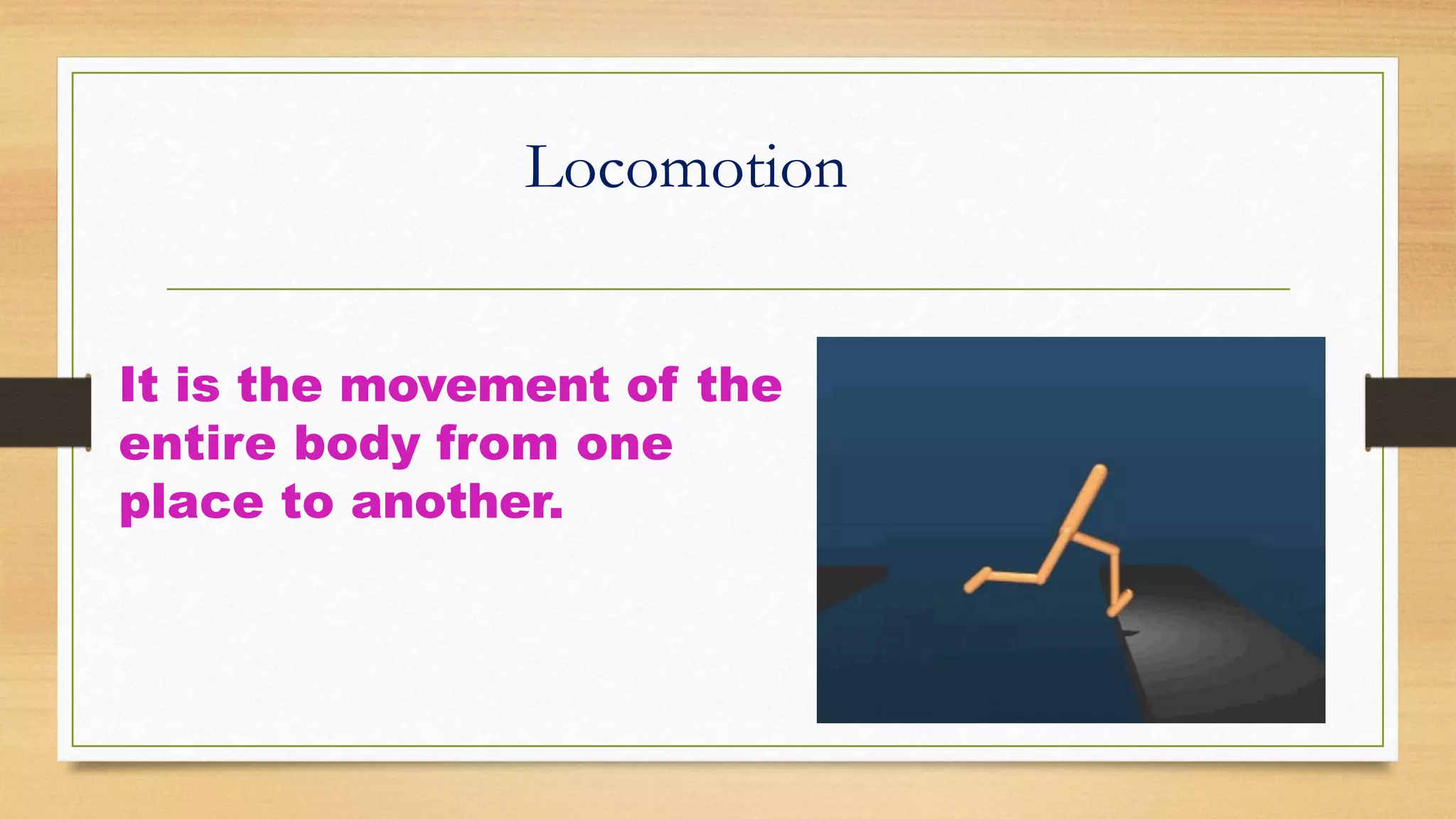
Locomotion
It is the movement of the
entire body from one
place to another.
Skeletal
system
Joints
Fixed
Ribs, joint to the
sternum, bones of skull
movable
ball and socket hinge pivot gliding
partially movable;
joints in vertebral
column.
JOINTS
Joints
 The place where two or more bones join.
 Ends of bones forming a joint is lined with a layer of tough and
elastic tissue called cartilage. It helps to reduce friction between
the bones during movement.
 It is also present in other parts e.g., upper part of ear and front part
of nose.
 There are three types of joints- Immovable or fixed, slightly
movable joint and freely movable.
Type of Joint
Joint
Movable
Joint
Immovable
Joint
Hinge Joint
Pivot Joint
Fixed
Joint
Gliding Joint
Ball & Socket Joint
Hinge Joint
• A hinge joint (ginglymus) is a bone
joint in which the articular surfaces
are molded to each other in such a
manner as to permit motion only in
one plane.
• Examples of The knee joints and ankle
joints are less typical, as they allow a
slight degree of rotation or of side-to-
side movement in certain positions of
the limb.
Allows back and forth movements.
Hinge joint:
HINGE JOINT
Ball and Socket Joint
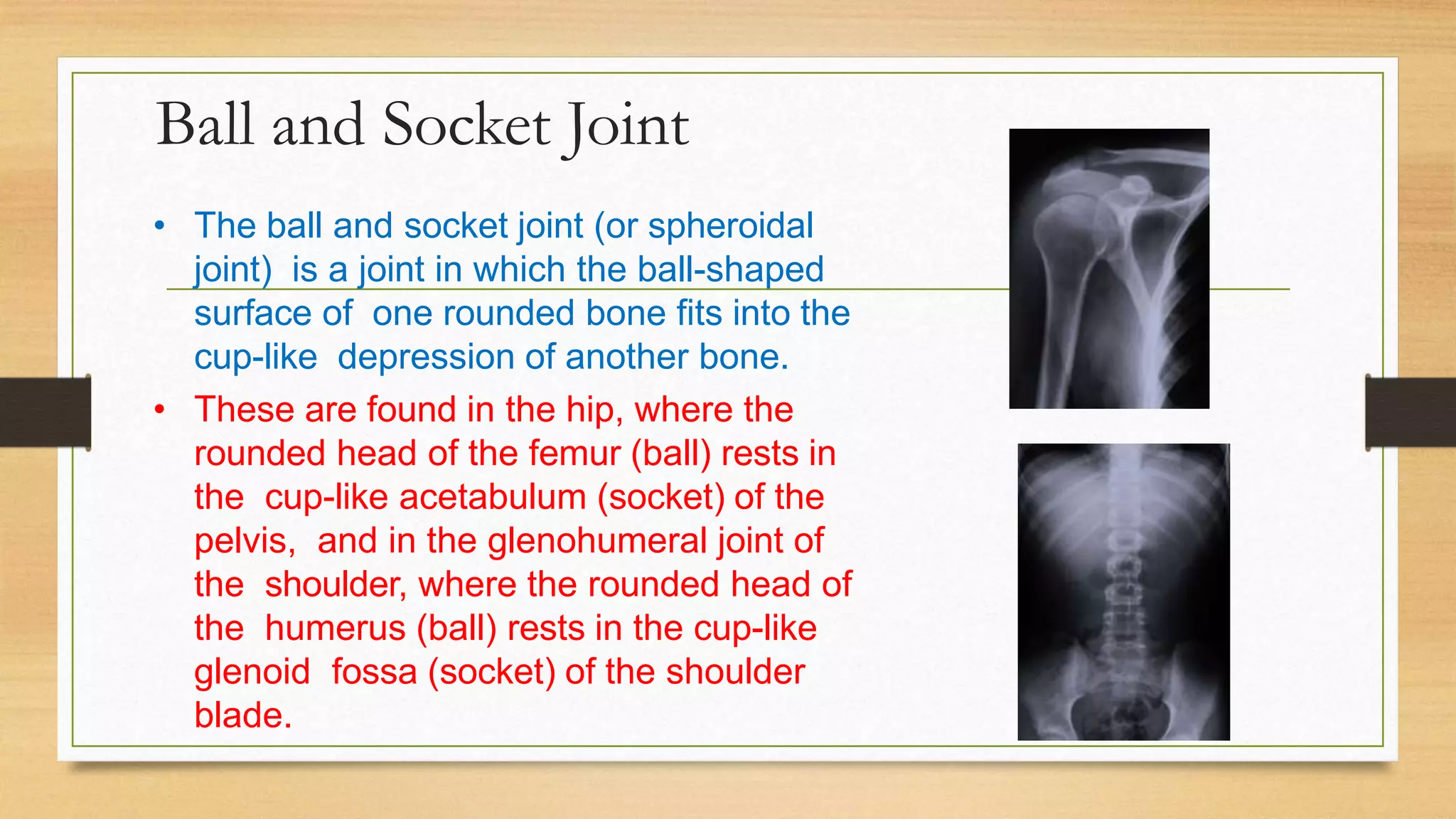
• The ball and socket joint (or spheroidal
joint) is a joint in which the ball-shaped
surface of one rounded bone fits into the
cup-like depression of another bone.
• These are found in the hip, where the
rounded head of the femur (ball) rests in
the cup-like acetabulum (socket) of the
pelvis, and in the glenohumeral joint of
the shoulder, where the rounded head of
the humerus (ball) rests in the cup-like
glenoid fossa (socket) of the shoulder
blade.
Ball & Socket Joint
Pivot Joint
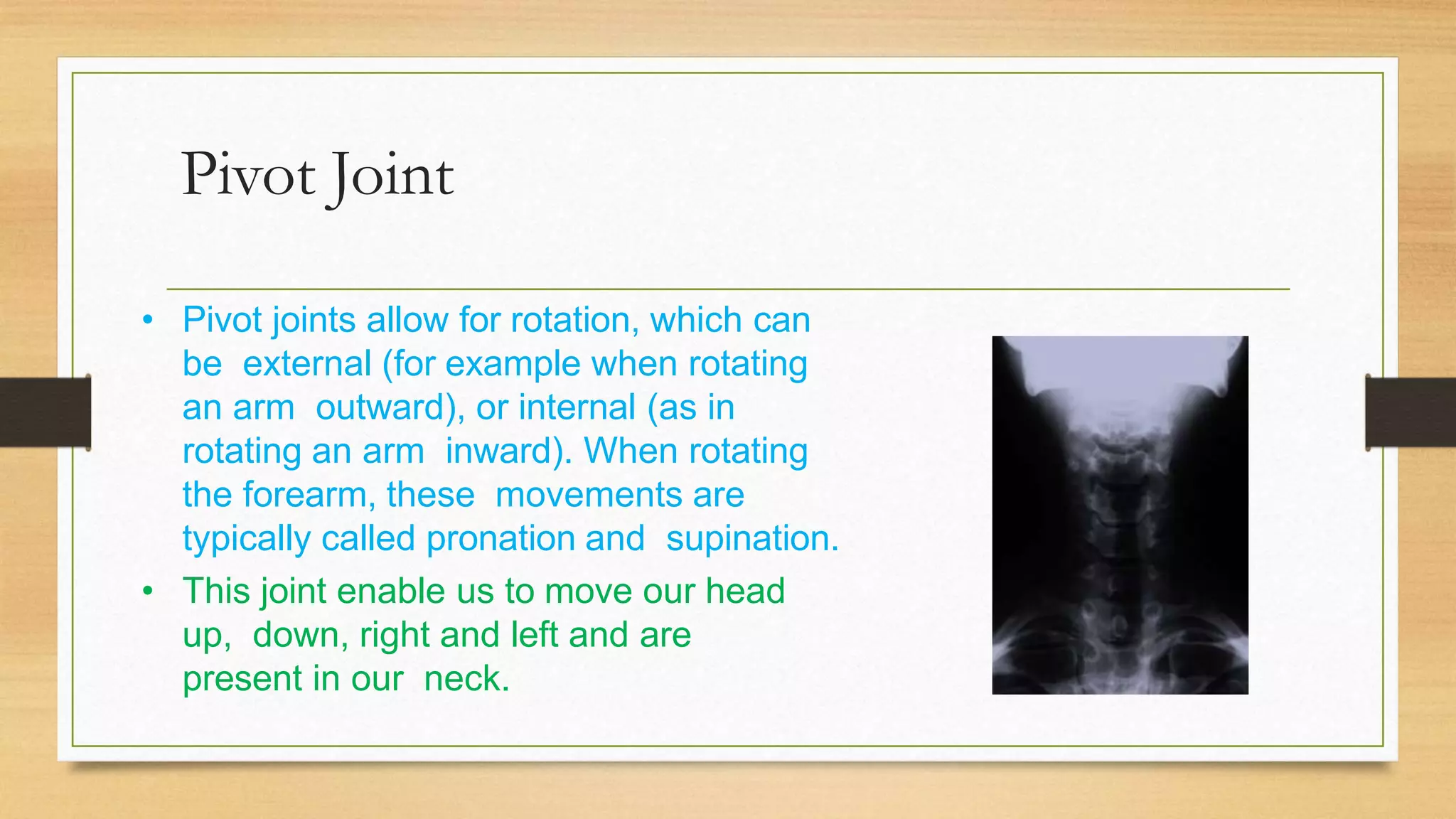
• Pivot joints allow for rotation, which can
be external (for example when rotating
an arm outward), or internal (as in
rotating an arm inward). When rotating
the forearm, these movements are
typically called pronation and supination.
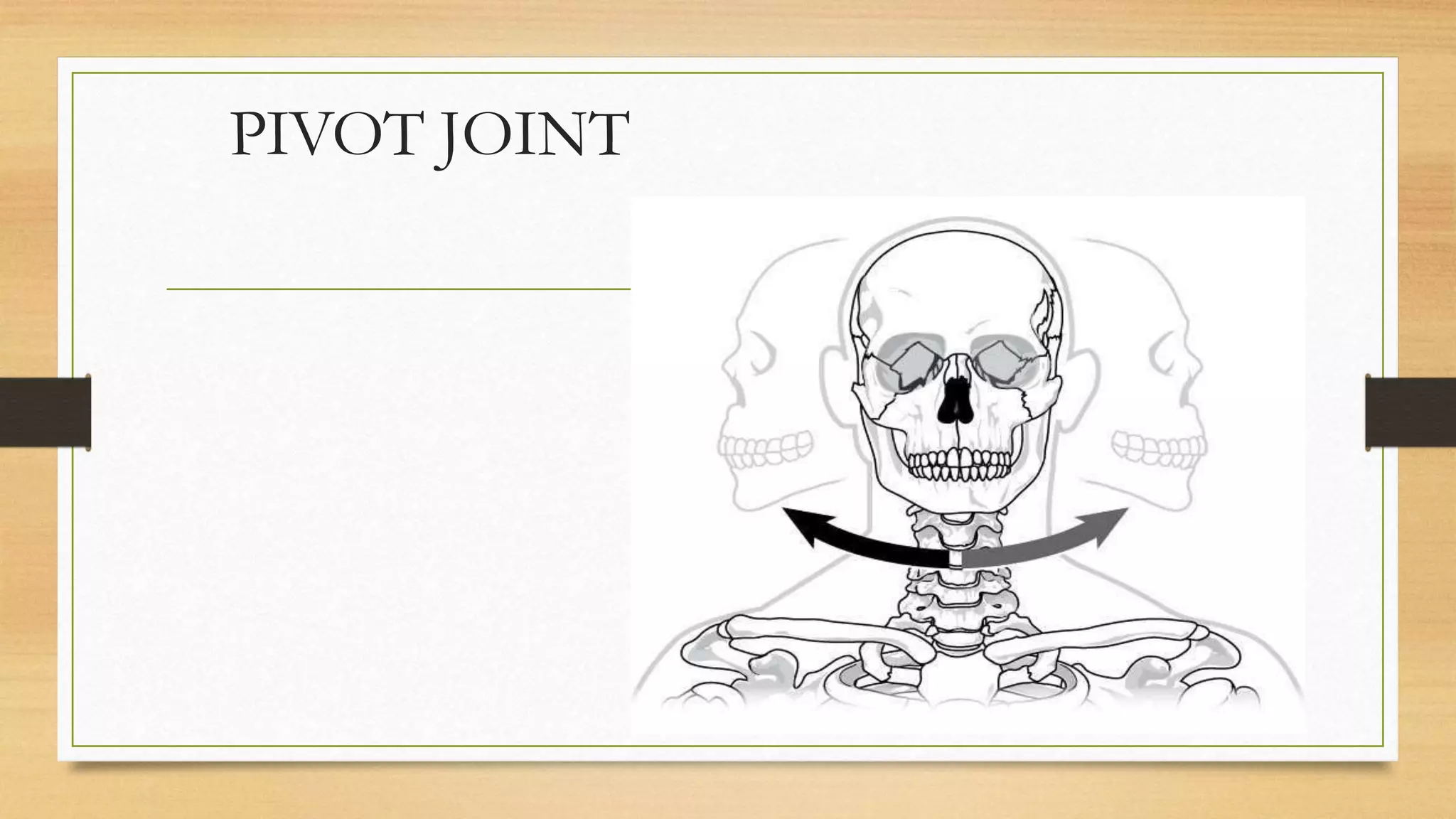
• This joint enable us to move our head
up, down, right and left and are
present in our neck.
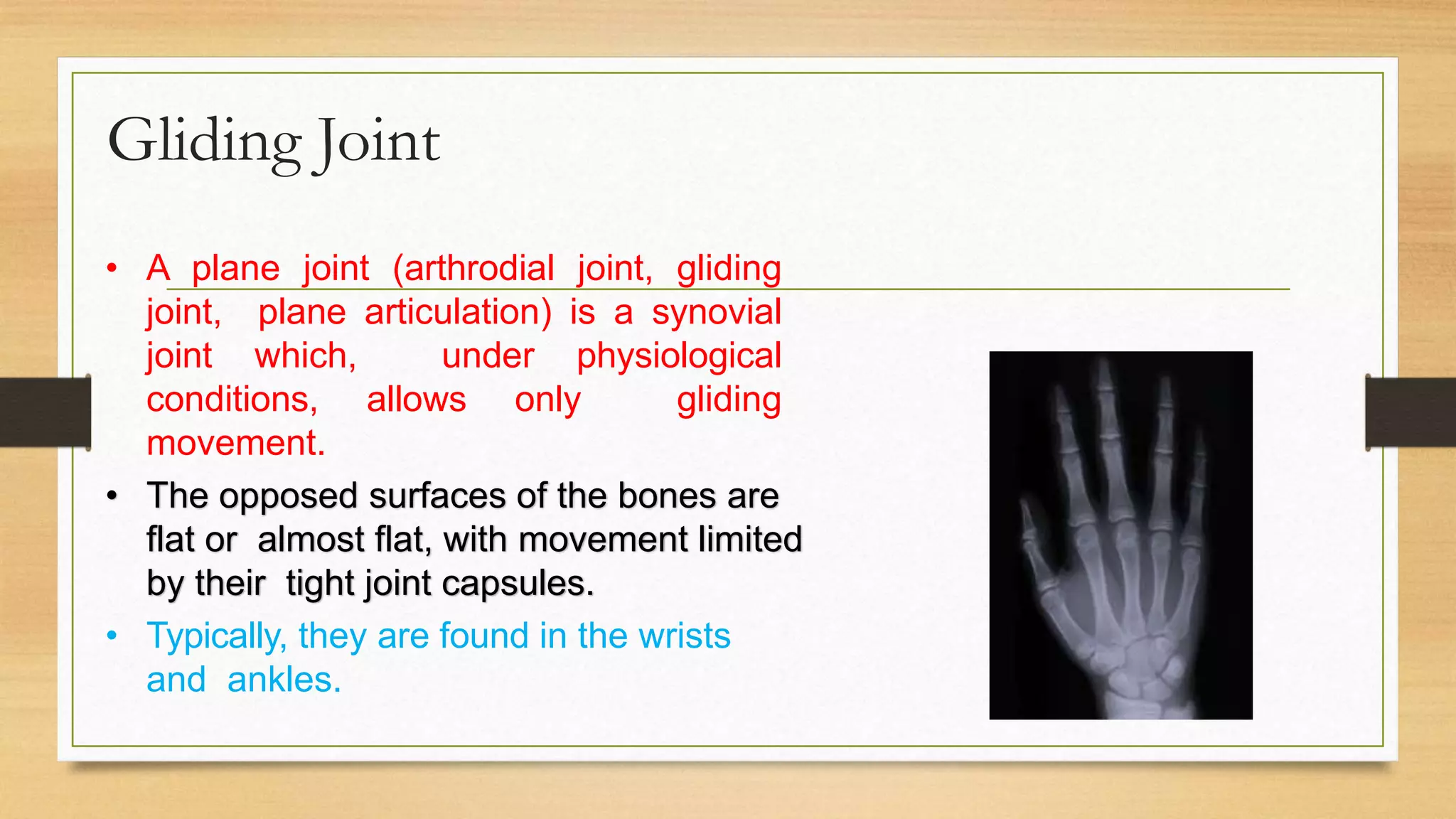
• A plane joint (arthrodial joint, gliding
joint, plane articulation) is a synovial
joint which, under physiological
conditions, allows only gliding
movement.
• The opposed surfaces of the bones are
flat or almost flat, with movement limited
by their tight joint capsules.
• Typically, they are found in the wrists
and ankles.
Gliding Joint
Fixed Joint
• Some joints between bone in our head
are different from those we have
dicussed as it doesn’t move.
• Fixed bones are only found in our upper
jaw and skull and our teeth
PIVOT JOINT
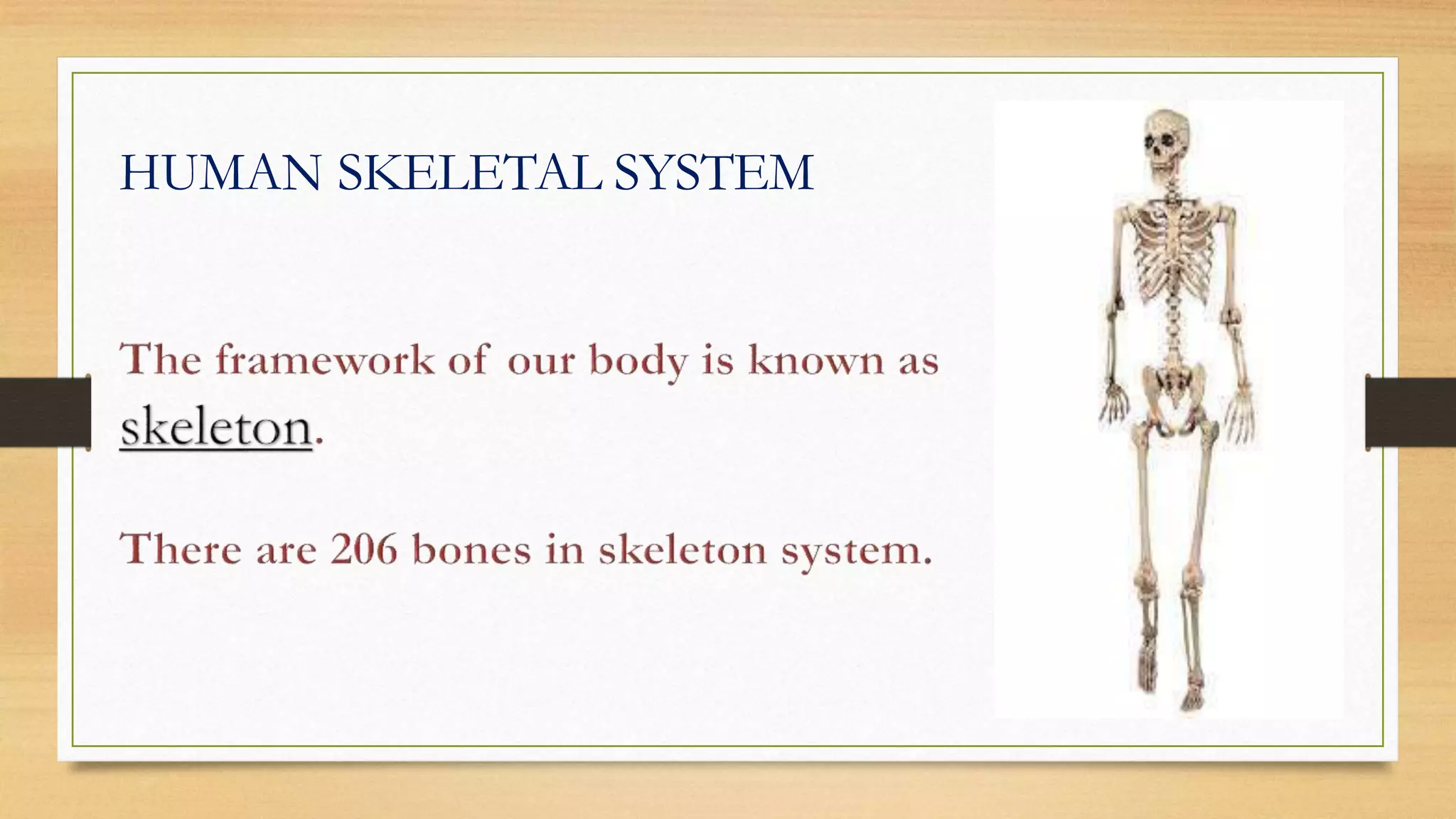
HUMAN SKELETAL SYSTEM
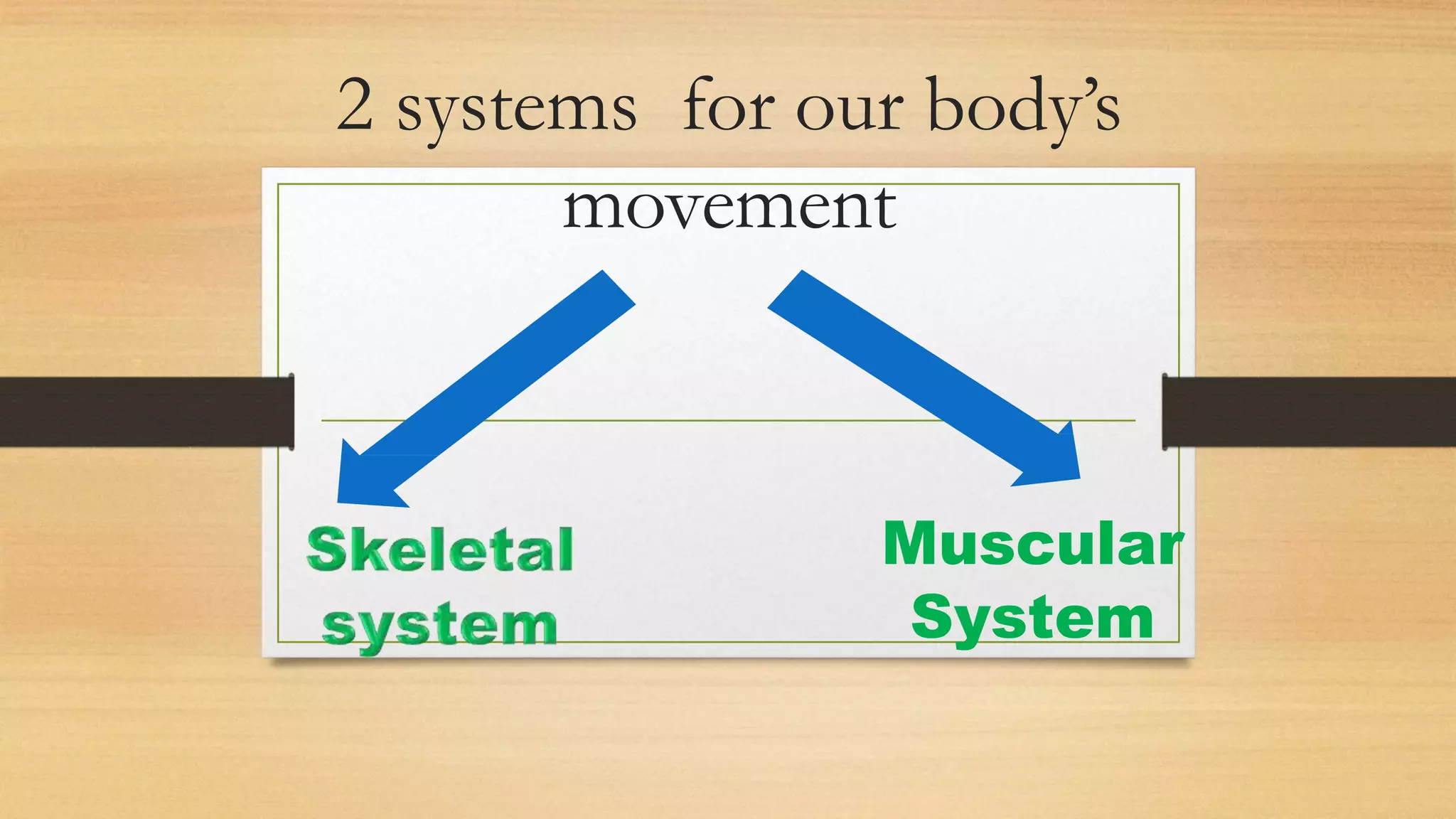
2 systems for our body’s
movement
Muscular
System
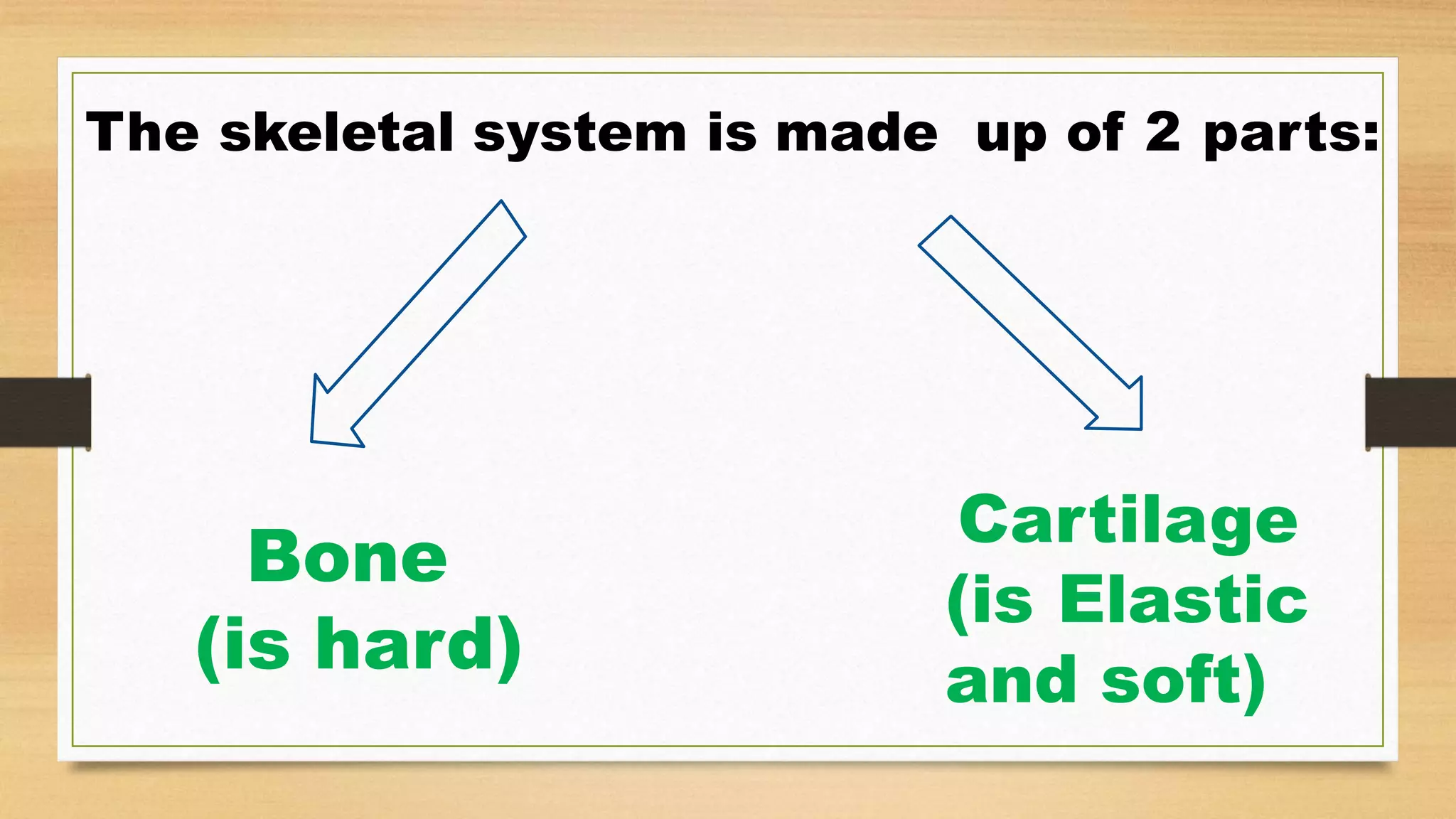
The skeletal system is made up of 2 parts:
Bone
(is hard)
Cartilage
(is Elastic
and soft)
Cartilage
ear lobe
cartilage
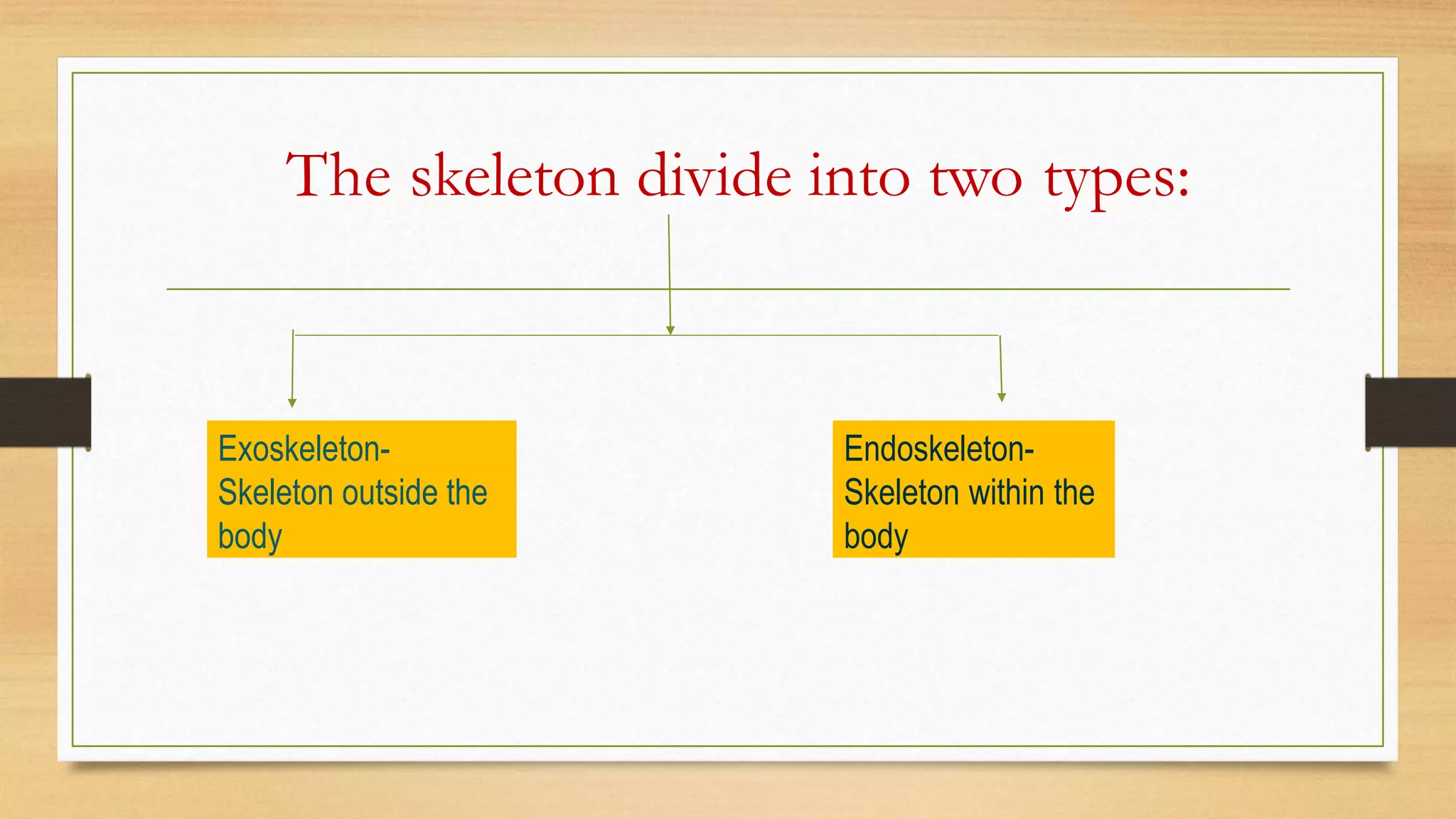
The skeleton divide into two types:
Endoskeleton-
Skeleton within the
body
Exoskeleton-
Skeleton outside the
body
Usually insects have EXOSKELETONS.
HUMAN SKELETAL SYSTEM
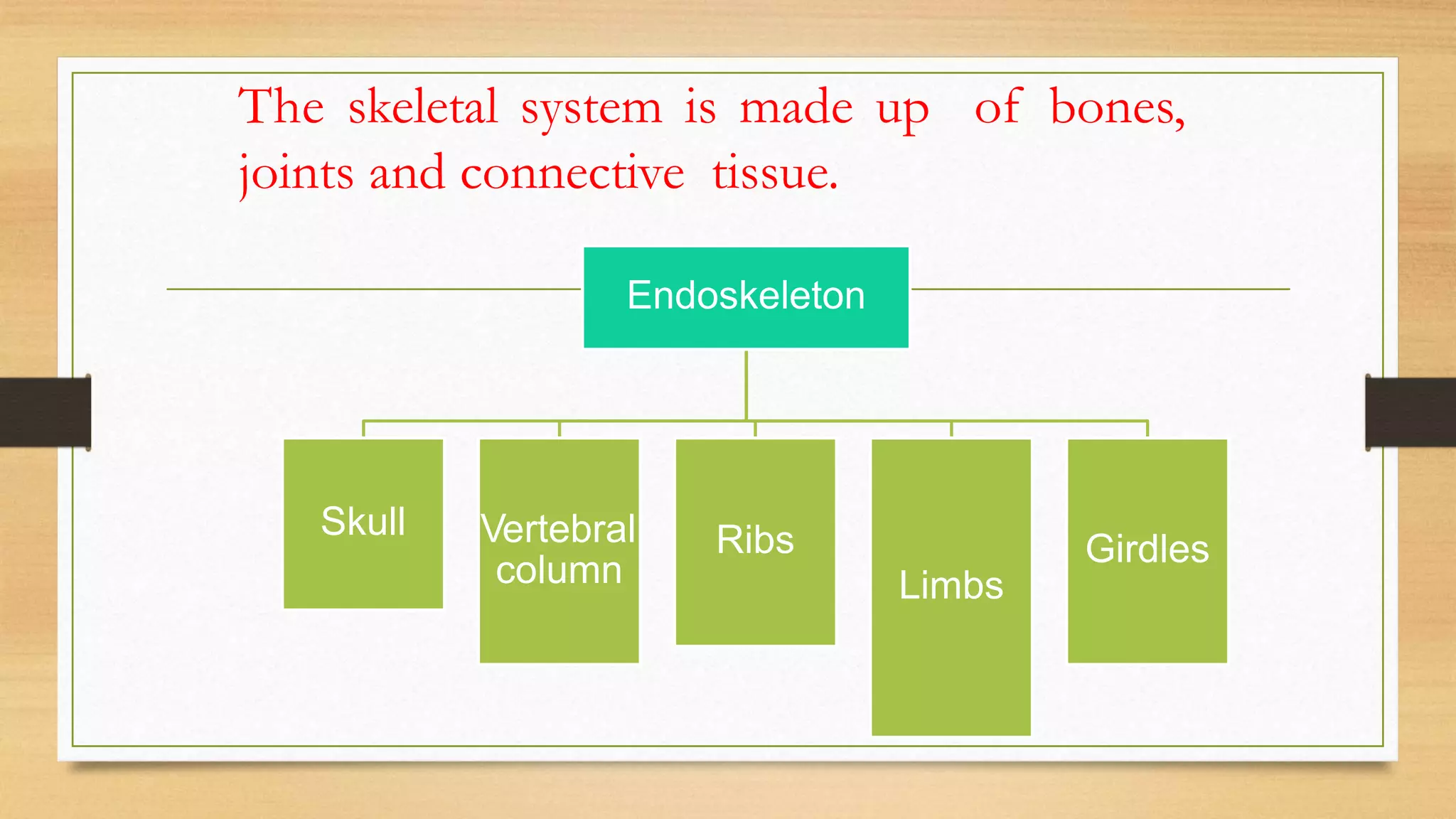
The skeletal system is made up of bones,
joints and connective tissue.
Endoskeleton
Skull Vertebral
column
Ribs
Limbs
Girdles
FUNCTIONS OF THE SKELETON SYSTEM
• Shape and support to the body.
•Protects the soft and delicate vital organs of the
body.
• Movement of the body.
•Some bones enclose bone marrow-a blood-forming
tissue.
•Bones store calcium and phosphorus making them
strong and hard.
Bones and their function
• Bones are rigid organ that constitute part of
the endoskeleton of vertebrates consist of
calcium.
• They support and protect the various organs
of the body, produce red and white blood
cells and store minerals.
• Protection —bones can serve to protect
internal organs, such as the skull protecting
the brain or the ribs protecting the heart and
lungs.
• Bones provide a frame to keep the body
supported.
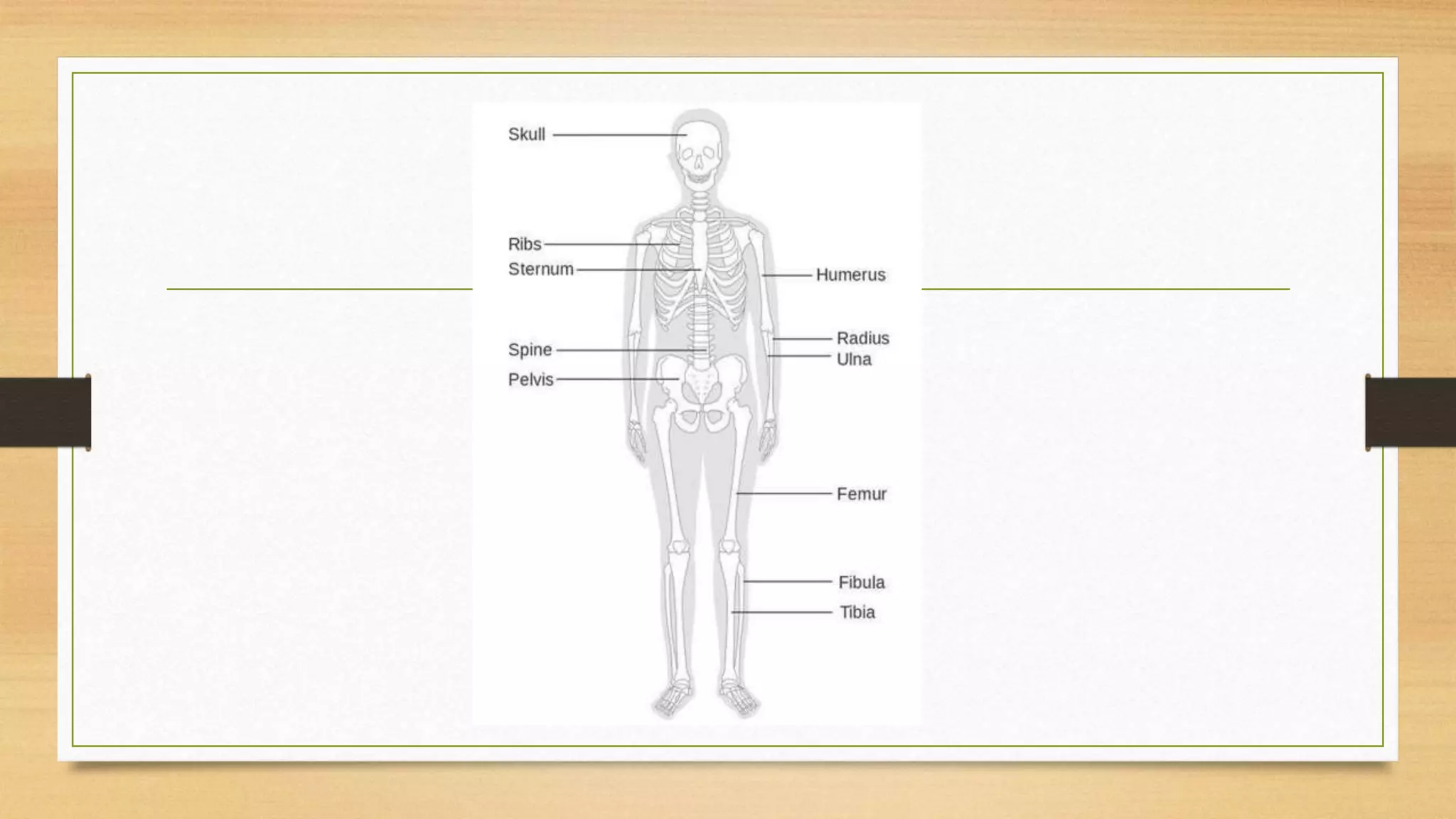
Human Skeletal System
It comprisesof-
 Skull
Backbone
Ribcage
Pelvic bones
Girdles
Skull
Cranium
Lower jaw
Backbone (Spine)
Vertebrae
Cartilage
RIBCAGE
HIP GIRDLE (Pelvic girdle)
Hip girdle
Backbone
SHOULDER
GIRDLE
Collar bone
Shoulder girdle
Humerus
WHAT ARE TENDONS AND
LIGAMENTS?
Muscles help in movement only by contracting
Earthworm
• Earthworms do not have bones.
• The body is made up of muscle
rings.
• Food: it eats soil.
Snail
1) Snails do not have bones.
2) Snail has soft & moist body.
3) Snail does not like sunshine
because the body dries up.
4) Snail does not come out from
shell during dry day.
5) Snail comes out during rainy
season.
Snail
6) Snail has rounded structure
(not a bone) on its back called
the shell.
7) The rounded structure helps in
protection.
8) Below the shell, there is head
and thick structure.
9) Thick structure (made up of strong
muscles) is its foot which helps
in movement.
Cockroach
Birds
Bird
• How do they move from
place to place?
• They fly in the air or walk
on the ground.
1) Birds have light and hallow
bones.
2) They have hind limb bones
which help in walking.
3) The forelimbs bones are
modified as wings.
4) They have strong shoulder
bones.
Fish
3) The head and the tail of the fish are smaller and
the middle portion is bigger.
4) This boat shape body is called streamlined.
1) Fish has a bone.
2) The skeleton of the fish is
covered with strong muscles.
5) During swimming, fins help in movement
while muscles help to push forward.
Snake
1) Snakes have bones.
2) Snakes have a long
backbone and ribs.
3) They have many thin
muscles.
snake skeleton
THANK
YOU

chapter- body movements

  • 4.
    Introduction Locomotion Importance of locomotion Jointsand their types Skeletal system &its parts Muscular system Locomotion in different animals
  • 5.
    Locomotion It is themovement of the entire body from one place to another.
  • 7.
    Skeletal system Joints Fixed Ribs, joint tothe sternum, bones of skull movable ball and socket hinge pivot gliding partially movable; joints in vertebral column.
  • 8.
  • 9.
    Joints  The placewhere two or more bones join.  Ends of bones forming a joint is lined with a layer of tough and elastic tissue called cartilage. It helps to reduce friction between the bones during movement.  It is also present in other parts e.g., upper part of ear and front part of nose.  There are three types of joints- Immovable or fixed, slightly movable joint and freely movable.
  • 10.
    Type of Joint Joint Movable Joint Immovable Joint HingeJoint Pivot Joint Fixed Joint Gliding Joint Ball & Socket Joint
  • 11.
    Hinge Joint • Ahinge joint (ginglymus) is a bone joint in which the articular surfaces are molded to each other in such a manner as to permit motion only in one plane. • Examples of The knee joints and ankle joints are less typical, as they allow a slight degree of rotation or of side-to- side movement in certain positions of the limb. Allows back and forth movements.
  • 12.
  • 13.
  • 14.
    Ball and SocketJoint • The ball and socket joint (or spheroidal joint) is a joint in which the ball-shaped surface of one rounded bone fits into the cup-like depression of another bone. • These are found in the hip, where the rounded head of the femur (ball) rests in the cup-like acetabulum (socket) of the pelvis, and in the glenohumeral joint of the shoulder, where the rounded head of the humerus (ball) rests in the cup-like glenoid fossa (socket) of the shoulder blade.
  • 15.
  • 16.
    Pivot Joint • Pivotjoints allow for rotation, which can be external (for example when rotating an arm outward), or internal (as in rotating an arm inward). When rotating the forearm, these movements are typically called pronation and supination. • This joint enable us to move our head up, down, right and left and are present in our neck.
  • 17.
    • A planejoint (arthrodial joint, gliding joint, plane articulation) is a synovial joint which, under physiological conditions, allows only gliding movement. • The opposed surfaces of the bones are flat or almost flat, with movement limited by their tight joint capsules. • Typically, they are found in the wrists and ankles. Gliding Joint
  • 18.
    Fixed Joint • Somejoints between bone in our head are different from those we have dicussed as it doesn’t move. • Fixed bones are only found in our upper jaw and skull and our teeth
  • 19.
  • 20.
  • 21.
    2 systems forour body’s movement Muscular System
  • 22.
    The skeletal systemis made up of 2 parts: Bone (is hard) Cartilage (is Elastic and soft)
  • 24.
  • 25.
    The skeleton divideinto two types: Endoskeleton- Skeleton within the body Exoskeleton- Skeleton outside the body
  • 27.
    Usually insects haveEXOSKELETONS.
  • 28.
  • 31.
    The skeletal systemis made up of bones, joints and connective tissue. Endoskeleton Skull Vertebral column Ribs Limbs Girdles
  • 32.
    FUNCTIONS OF THESKELETON SYSTEM • Shape and support to the body. •Protects the soft and delicate vital organs of the body. • Movement of the body. •Some bones enclose bone marrow-a blood-forming tissue. •Bones store calcium and phosphorus making them strong and hard.
  • 33.
    Bones and theirfunction • Bones are rigid organ that constitute part of the endoskeleton of vertebrates consist of calcium. • They support and protect the various organs of the body, produce red and white blood cells and store minerals. • Protection —bones can serve to protect internal organs, such as the skull protecting the brain or the ribs protecting the heart and lungs. • Bones provide a frame to keep the body supported.
  • 34.
    Human Skeletal System Itcomprisesof-  Skull Backbone Ribcage Pelvic bones Girdles
  • 35.
  • 37.
  • 38.
  • 39.
    HIP GIRDLE (Pelvicgirdle) Hip girdle Backbone
  • 41.
  • 42.
    WHAT ARE TENDONSAND LIGAMENTS?
  • 43.
    Muscles help inmovement only by contracting
  • 45.
    Earthworm • Earthworms donot have bones. • The body is made up of muscle rings. • Food: it eats soil.
  • 46.
    Snail 1) Snails donot have bones. 2) Snail has soft & moist body. 3) Snail does not like sunshine because the body dries up. 4) Snail does not come out from shell during dry day. 5) Snail comes out during rainy season.
  • 47.
    Snail 6) Snail hasrounded structure (not a bone) on its back called the shell. 7) The rounded structure helps in protection. 8) Below the shell, there is head and thick structure. 9) Thick structure (made up of strong muscles) is its foot which helps in movement.
  • 48.
  • 49.
  • 50.
    Bird • How dothey move from place to place? • They fly in the air or walk on the ground.
  • 51.
    1) Birds havelight and hallow bones. 2) They have hind limb bones which help in walking. 3) The forelimbs bones are modified as wings. 4) They have strong shoulder bones.
  • 52.
    Fish 3) The headand the tail of the fish are smaller and the middle portion is bigger. 4) This boat shape body is called streamlined. 1) Fish has a bone. 2) The skeleton of the fish is covered with strong muscles. 5) During swimming, fins help in movement while muscles help to push forward.
  • 54.
    Snake 1) Snakes havebones. 2) Snakes have a long backbone and ribs. 3) They have many thin muscles. snake skeleton
  • 56.