Chapter – 6
Changes around us
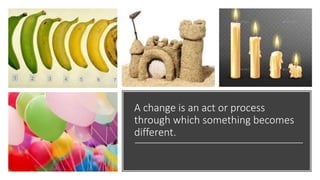
A change is an act or process
through which something becomes
different.
Learning objectives
To Know about
• The various changes
occurring in nature.
• Why changes occur
• To find the causes
behind different
changes
• Reversible and
irreversible changes
• Various conditions that
favor changes.
• Categorize different
changes occurring in
nature
Why do changes
occur ?
• Every change has a cause.
• These cause can bring out the
changes in shape, position,
color or state of anything.
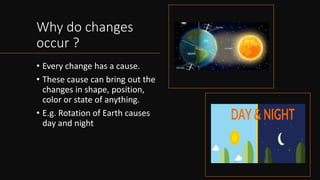
• E.g. Rotation of Earth causes
day and night
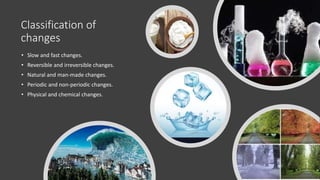
Classification of
changes
• Slow and fast changes.
• Reversible and irreversible changes.
• Natural and man-made changes.
• Periodic and non-periodic changes.
• Physical and chemical changes.
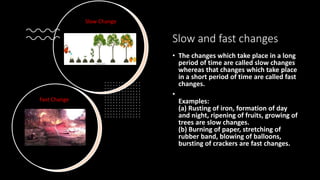
Slow and fast changes
• The changes which take place in a long
period of time are called slow changes
whereas that changes which take place
in a short period of time are called fast
changes.
•
Examples:
(a) Rusting of iron, formation of day
and night, ripening of fruits, growing of
trees are slow changes.
(b) Burning of paper, stretching of
rubber band, blowing of balloons,
bursting of crackers are fast changes.
Slow Change
Fast Change
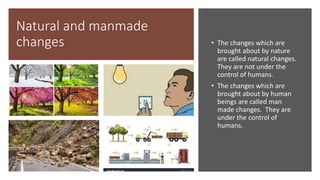
Natural and manmade
changes • The changes which are
brought about by nature
are called natural changes.
They are not under the
control of humans.
• The changes which are
brought about by human
beings are called man
made changes. They are
under the control of
humans.
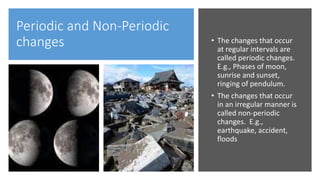
Periodic and Non-Periodic
changes • The changes that occur
at regular intervals are
called periodic changes.
E.g., Phases of moon,
sunrise and sunset,
ringing of pendulum.
• The changes that occur
in an irregular manner is
called non-periodic
changes. E.g.,
earthquake, accident,
floods
Physical and
chemical
changes
• A change in which a
substance undergoes a
change in its physical
properties is called a physical
change. E.g., melting of wax,
breaking of sandcastle.
• A chemical change is a type
of change where the chemical
properties of matter change.
E.g., rusting of iron, dissolving
of sugar in water
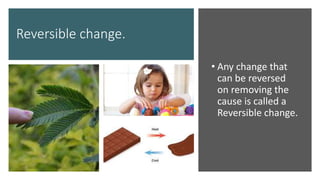
Reversible change.
• Any change that
can be reversed
on removing the
cause is called a
Reversible change.
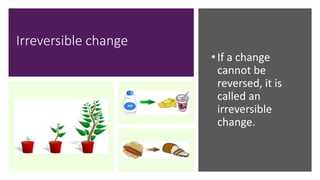
Irreversible change
•If a change
cannot be
reversed, it is
called an
irreversible
change.
Conditions favouring a
change •Interaction
between
substances.
•Mixing of
substances.
•Heating of
substances.
Interesting facts
• The Eiffel Tower can be 15 cm
taller during the summer
• Mount Everest, the highest peak
in the world rises by an inch
every year.
• Hawaii moves 7.5cm closer to
Alaska every year

changes around us class 6 ppt

  • 1.
  • 2.
    A change isan act or process through which something becomes different.
  • 3.
    Learning objectives To Knowabout • The various changes occurring in nature. • Why changes occur • To find the causes behind different changes • Reversible and irreversible changes • Various conditions that favor changes. • Categorize different changes occurring in nature
  • 4.
    Why do changes occur? • Every change has a cause. • These cause can bring out the changes in shape, position, color or state of anything. • E.g. Rotation of Earth causes day and night
  • 5.
    Classification of changes • Slowand fast changes. • Reversible and irreversible changes. • Natural and man-made changes. • Periodic and non-periodic changes. • Physical and chemical changes.
  • 6.
    Slow and fastchanges • The changes which take place in a long period of time are called slow changes whereas that changes which take place in a short period of time are called fast changes. • Examples: (a) Rusting of iron, formation of day and night, ripening of fruits, growing of trees are slow changes. (b) Burning of paper, stretching of rubber band, blowing of balloons, bursting of crackers are fast changes. Slow Change Fast Change
  • 7.
    Natural and manmade changes• The changes which are brought about by nature are called natural changes. They are not under the control of humans. • The changes which are brought about by human beings are called man made changes. They are under the control of humans.
  • 8.
    Periodic and Non-Periodic changes• The changes that occur at regular intervals are called periodic changes. E.g., Phases of moon, sunrise and sunset, ringing of pendulum. • The changes that occur in an irregular manner is called non-periodic changes. E.g., earthquake, accident, floods
  • 9.
    Physical and chemical changes • Achange in which a substance undergoes a change in its physical properties is called a physical change. E.g., melting of wax, breaking of sandcastle. • A chemical change is a type of change where the chemical properties of matter change. E.g., rusting of iron, dissolving of sugar in water
  • 10.
    Reversible change. • Anychange that can be reversed on removing the cause is called a Reversible change.
  • 11.
    Irreversible change •If achange cannot be reversed, it is called an irreversible change.
  • 12.
    Conditions favouring a change•Interaction between substances. •Mixing of substances. •Heating of substances.
  • 13.
    Interesting facts • TheEiffel Tower can be 15 cm taller during the summer • Mount Everest, the highest peak in the world rises by an inch every year. • Hawaii moves 7.5cm closer to Alaska every year