BODY LANGUAGE
PRESENTED BY –
Thakkar Umang Pravinbhai
Enrl no :- 151040109035
GUIDED BY –
Dr. Vikas Raval
GUJARAT POWER ENGINEERING & RESEARCH
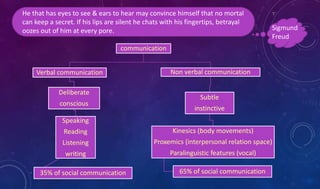
communication
Verbal communication
Deliberate
conscious
Speaking
Reading
Listening
writing
35% of social communication
Non verbal communication
Subtle
instinctive
Kinesics (body movements)
Proxemics (interpersonal relation space)
Paralinguistic features (vocal)
65% of social communication
He that has eyes to see & ears to hear may convince himself that no mortal
can keep a secret. If his lips are silent he chats with his fingertips, betrayal
oozes out of him at every pore. Sigmund
Freud
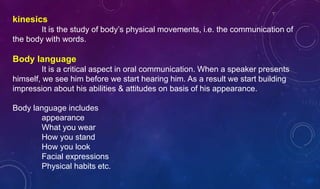
kinesics
It is the study of body’s physical movements, i.e. the communication of
the body with words.
Body language
It is a critical aspect in oral communication. When a speaker presents
himself, we see him before we start hearing him. As a result we start building
impression about his abilities & attitudes on basis of his appearance.
Body language includes
appearance
What you wear
How you stand
How you look
Facial expressions
Physical habits etc.
Personal appearance
o It includes clothes, hair, jewellery, cosmetics, footwear etc.
o The purpose of clothing has altered from fulfilling a basic need to
expressing yourself. Clothes accent the body movements.
o Your appearance should co ordinate with your clothing.
o Appearance may put the audience either in a resistant or a hostile attitude
or induce in them a receptive mood.
o Your appearance should go hand in hand with the message you want to
convey.
o Appearance communicates about the comfort you feel with yourself & the
energy that oozes to your surroundings.
Posture
It refers the way we hold ourselves when we stand, sit or walk. These aspects
reveal a lot of your personality traits.
Even if a person is nervous, it becomes quite obvious from his/her posture.
The mannerisms which depict nervousness include
pacing constantly
Bobbing the shoulders
Fidgeting with the notes
Jingling coins
Either moving or remaining static
The surrounding environment also says a lot about your posture.
When a person is surrounded by familiar people the movement of the person
becomes spontaneous & fluidic.
Standing sitting or walking in a relaxed way ensures that the person has a
positive approach. Being comfortably upright, squarely facing an audience, evenly
distributing your weight all communicate professionalism, confidence, and
attentiveness.
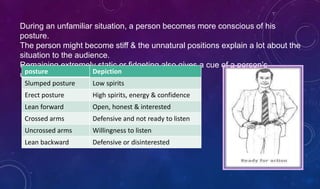
During an unfamiliar situation, a person becomes more conscious of his
posture.
The person might become stiff & the unnatural positions explain a lot about the
situation to the audience.
Remaining extremely static or fidgeting also gives a cue of a person’s
uncomfort.posture Depiction
Slumped posture Low spirits
Erect posture High spirits, energy & confidence
Lean forward Open, honest & interested
Crossed arms Defensive and not ready to listen
Uncrossed arms Willingness to listen
Lean backward Defensive or disinterested
Gesture
It is the movement made by hands, arms, shoulders, head & torso and impact
the speech.
Well timed gesture - has a greater impact on the point to be proven
Ungainly gesture – mars the effectiveness of the message .
Gestures - clarify the ideas, reinforce them if they are well suited to the
audience & occasion.
they outnumber any form of verbal communication, & the meanings attached
to them differ from culture to culture.
Care should be taken that the gesture is well timed, natural, spontaneous and
does not divert the attention of the listener or distract him.
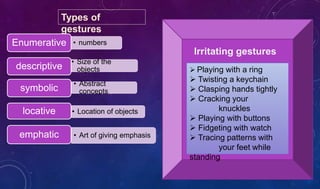
• numbersEnumerative
• Size of the
objectsdescriptive
• Abstract
conceptssymbolic
• Location of objectslocative
• Art of giving emphasisemphatic
Types of
gestures
Irritating gestures
 Playing with a ring
 Twisting a keychain
 Clasping hands tightly
 Cracking your
knuckles
 Playing with buttons
 Fidgeting with watch
 Tracing patterns with
your feet while
standing
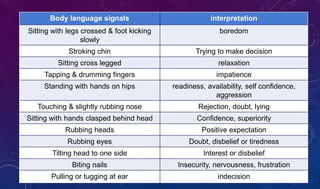
Body language signals interpretation
Sitting with legs crossed & foot kicking
slowly
boredom
Stroking chin Trying to make decision
Sitting cross legged relaxation
Tapping & drumming fingers impatience
Standing with hands on hips readiness, availability, self confidence,
aggression
Touching & slightly rubbing nose Rejection, doubt, lying
Sitting with hands clasped behind head Confidence, superiority
Rubbing heads Positive expectation
Rubbing eyes Doubt, disbelief or tiredness
Tilting head to one side Interest or disbelief
Biting nails Insecurity, nervousness, frustration
Pulling or tugging at ear indecision
PPT on "Body language''

PPT on "Body language''

  • 1.
    BODY LANGUAGE PRESENTED BY– Thakkar Umang Pravinbhai Enrl no :- 151040109035 GUIDED BY – Dr. Vikas Raval GUJARAT POWER ENGINEERING & RESEARCH
  • 2.
    communication Verbal communication Deliberate conscious Speaking Reading Listening writing 35% ofsocial communication Non verbal communication Subtle instinctive Kinesics (body movements) Proxemics (interpersonal relation space) Paralinguistic features (vocal) 65% of social communication He that has eyes to see & ears to hear may convince himself that no mortal can keep a secret. If his lips are silent he chats with his fingertips, betrayal oozes out of him at every pore. Sigmund Freud
  • 3.
    kinesics It is thestudy of body’s physical movements, i.e. the communication of the body with words. Body language It is a critical aspect in oral communication. When a speaker presents himself, we see him before we start hearing him. As a result we start building impression about his abilities & attitudes on basis of his appearance. Body language includes appearance What you wear How you stand How you look Facial expressions Physical habits etc.
  • 4.
    Personal appearance o Itincludes clothes, hair, jewellery, cosmetics, footwear etc. o The purpose of clothing has altered from fulfilling a basic need to expressing yourself. Clothes accent the body movements. o Your appearance should co ordinate with your clothing. o Appearance may put the audience either in a resistant or a hostile attitude or induce in them a receptive mood. o Your appearance should go hand in hand with the message you want to convey. o Appearance communicates about the comfort you feel with yourself & the energy that oozes to your surroundings.
  • 5.
    Posture It refers theway we hold ourselves when we stand, sit or walk. These aspects reveal a lot of your personality traits. Even if a person is nervous, it becomes quite obvious from his/her posture. The mannerisms which depict nervousness include pacing constantly Bobbing the shoulders Fidgeting with the notes Jingling coins Either moving or remaining static The surrounding environment also says a lot about your posture. When a person is surrounded by familiar people the movement of the person becomes spontaneous & fluidic. Standing sitting or walking in a relaxed way ensures that the person has a positive approach. Being comfortably upright, squarely facing an audience, evenly distributing your weight all communicate professionalism, confidence, and attentiveness.
  • 6.
    During an unfamiliarsituation, a person becomes more conscious of his posture. The person might become stiff & the unnatural positions explain a lot about the situation to the audience. Remaining extremely static or fidgeting also gives a cue of a person’s uncomfort.posture Depiction Slumped posture Low spirits Erect posture High spirits, energy & confidence Lean forward Open, honest & interested Crossed arms Defensive and not ready to listen Uncrossed arms Willingness to listen Lean backward Defensive or disinterested
  • 7.
    Gesture It is themovement made by hands, arms, shoulders, head & torso and impact the speech. Well timed gesture - has a greater impact on the point to be proven Ungainly gesture – mars the effectiveness of the message . Gestures - clarify the ideas, reinforce them if they are well suited to the audience & occasion. they outnumber any form of verbal communication, & the meanings attached to them differ from culture to culture. Care should be taken that the gesture is well timed, natural, spontaneous and does not divert the attention of the listener or distract him.
  • 8.
    • numbersEnumerative • Sizeof the objectsdescriptive • Abstract conceptssymbolic • Location of objectslocative • Art of giving emphasisemphatic Types of gestures Irritating gestures  Playing with a ring  Twisting a keychain  Clasping hands tightly  Cracking your knuckles  Playing with buttons  Fidgeting with watch  Tracing patterns with your feet while standing
  • 9.
    Body language signalsinterpretation Sitting with legs crossed & foot kicking slowly boredom Stroking chin Trying to make decision Sitting cross legged relaxation Tapping & drumming fingers impatience Standing with hands on hips readiness, availability, self confidence, aggression Touching & slightly rubbing nose Rejection, doubt, lying Sitting with hands clasped behind head Confidence, superiority Rubbing heads Positive expectation Rubbing eyes Doubt, disbelief or tiredness Tilting head to one side Interest or disbelief Biting nails Insecurity, nervousness, frustration Pulling or tugging at ear indecision