Effective Body Language for Self-improvement
Aditya Sinha
Assistant Professor-cum-Junior Scientist
Department of Extension Education
Bihar Agricultural College
Bihar Agricultural University, Sabour
Question
What are the key words that come to your mind while hearing
"BODY LANGUAGE"?
https://www.menti.com/y47oicyos7
Go to menti.com and use the code 8745797
2
Outline of the presentation
• Importance of Body language
• Phases of Body language
• Positioning
• Alignment
• Gesture
• Fidgeting
Body Language
• Body language is the best language.
• 58-60 % role in communication is of effective body language.
• We express almost everything through our body language.
• When your words and body language express in the same manner: CLARITY,
TRUST, REPUTATION
• When your words and body language DO NOT express in the same manner:
TENSION, MISTRUST, CONFUSION
• Learn others body language but TAKE CARE OF YOUR OWN.
What is Body Language
• Before you starting the talk, your body starts the talking.
• Body language refers to the nonverbal signals that we use to communicate.
• Increases confidence and we also get to learn the body language of others.
• If we learn the body language, we get to know the mind of the person.
• Whatever we talk can be manipulated but mind is constant.
Phases of Body Language
• Gesture
• Posture
• Expression
• Flow
Expansion of behaviour (confidence)
• When we are in stress or tension, our body tends to contract
• When we are happy or confident, even our body begins to expand and smile.
• Gentle expansion which moves our body upward.
• Sit across a wall with hands up. You will get to know whether you are
expanded or not?
Positioning
Role of legs
• See the legs.
• If the legs are in other direction, it means you are not interested in talking
and wish to move away.
• The body and feet position shows OUR INTENTION.
• The direction of the feet shows what is in the mind of their owners.
Positioning
Role of feet
Less space between feet is a sign
of
Feet distance should be like
shoulder
Less confidence Relax
Fear Confident behaviour
Defensive
Positioning
Role of hands
• Why police says to HANDS-UP or FOLD YOUR HANDS
backwards.
• When we see hands, we feel safe.
• It is in our sub-conscious mind. So whenever you meet
someone, raise your hand with hello at least.
• Whenever you start your talk, try that your palms are clearly
visible.
OPEN PALMS (Reflects friendly behaviour/ honesty)
Pointing fingers gives dominant and negative feelings
Positioning
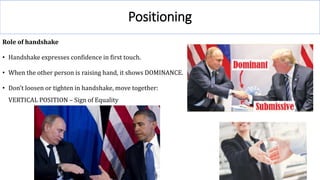
Role of handshake
• Handshake expresses confidence in first touch.
• When the other person is raising hand, it shows DOMINANCE.
• Don’t loosen or tighten in handshake, move together:
VERTICAL POSITION – Sign of Equality
Positioning
Role of TORSO (front trunk of the body)
• Never hide your torso (using hands, or bag, or some object/person)
• Sometimes people lower their shoulders to show politeness, but it creates
wrong impression in the sub-conscious mind.
• Whenever we are meeting for the first time, never hide the torso.
Positioning
Role of FACE
• Face expresses countless emotions without words (Happiness, Sadness,
Anger, Surprise, Fear).
• Gentle smile (shows that he/ she is feeling happy with you).
• Provides connectivity. Also pleasing to others.
Positioning
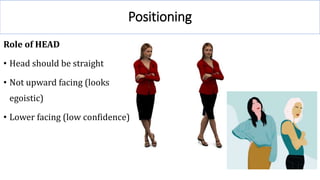
Role of HEAD
• Head should be straight
• Not upward facing (looks
egoistic)
• Lower facing (low confidence)
Positioning
How to move your body
• Less body movement (more confidence)
• More body movement (more nervousness)
MOVE NORMALLY
Alignment
• Like alignment of tyre in car, this is also necessary.
• Whenever we are talking, is it aligned with facial expressions.
Role of Eyes
• When we were kids and had committed some mistake, we used to stand near
parents with eyes facing downwards.
• Whenever we are telling a lie/ want to escape/ or want to move away: First of all we
reduce the eye contact. Again happens sub-consciously without us knowing it.
• Whenever we are looking upwards or downwards laterally, it means that we are
trying to manipulate things. We are thinking and answering so it might not be true.
Alignment
EYE
80 – 20 RULE: 80 % eye contact – 20 % eye expressions
(Talk without sunglasses for effective communication).
Alignment
Role of Eyes
• If there is something exciting, the body will automatically be expressive of
that.
• With introvert, it is not always possible. But to improve communication
skills/ impress upon others, it is necessary.
• 58-60 % role in communication is of effective body language.
• More important is HOW YOU ARE TELLING than what you are telling?
Gesture
The way we carry ourselves, the same way information goes to the world.
• Eye contact.
• Touch.
• Space (Everybody needs physical space: Depend upon relation).
• Voice and Intonation (pitch of sound).
MALE AND FEMALE
• Male caught easily on their mistakes (42 %): 4-6 areas
• Female can study more deeply (87 %): 14-16 areas: HR roles
Gesture
• Important to maintain physical space
(specially when meeting for the first
time)
• Avoid touching new people
• Depends on our relationship with
people.
Sitting posture
• Our sitting style shows
our basic character.
• Casual or egoistic
• Lean body posture
Stop Fidgeting
• Make small movements, especially of the hands and feet, through
nervousness or impatience (scratching head, hands, fingers, slowly moving
legs etc.): Sign of low-confidence.
• If there is something like pen holder or paper weight or mobile phone, do not
start playing with it or keeping it in your hand.
• If you are sitting in front of anyone and start scrolling your mobile phone, it is
again fidgeting.
How to correct the posture
• Change the configuration of your work station.
• Change your chair and the way you sit.
• Change the position in which you look at your cell phone.
• Buy a new mattress.
• Breathe more deeply.
• Practice walking properly.
Conclusion: To wind up
Aggressive
An overly firm handshake.
Invading personal space.
Hands on hips or legs too wide.
Eye contact to the point of staring.
Aggressive physical movements like finger-pointing.
Defensive
Crossed arms or legs.
A lack of eye contact.
Leaning away.
Hunched shoulders.
Eye rolls.
Nervous
Biting nails.
Fidgeting.
Coughing.
Weak handshake.
Putting hands on head.
Bored
No eye contact.
Excessive fidgeting.
Yawning.
Shifting weight and sitting uncomfortably.
Rubbing face.
Engaged
Good eye contact.
Confident stance.
Positive gestures.
Nodding in agreement.
Smiling.
Question
What will you improve in yourself after this session?
https://www.menti.com/psk3ghanjm
Go to menti.com and use the code 3783 0712
Thank You

BodyLanguageppt.pptx

  • 1.
    Effective Body Languagefor Self-improvement Aditya Sinha Assistant Professor-cum-Junior Scientist Department of Extension Education Bihar Agricultural College Bihar Agricultural University, Sabour
  • 2.
    Question What are thekey words that come to your mind while hearing "BODY LANGUAGE"? https://www.menti.com/y47oicyos7 Go to menti.com and use the code 8745797 2
  • 3.
    Outline of thepresentation • Importance of Body language • Phases of Body language • Positioning • Alignment • Gesture • Fidgeting
  • 4.
    Body Language • Bodylanguage is the best language. • 58-60 % role in communication is of effective body language. • We express almost everything through our body language. • When your words and body language express in the same manner: CLARITY, TRUST, REPUTATION • When your words and body language DO NOT express in the same manner: TENSION, MISTRUST, CONFUSION • Learn others body language but TAKE CARE OF YOUR OWN.
  • 5.
    What is BodyLanguage • Before you starting the talk, your body starts the talking. • Body language refers to the nonverbal signals that we use to communicate. • Increases confidence and we also get to learn the body language of others. • If we learn the body language, we get to know the mind of the person. • Whatever we talk can be manipulated but mind is constant.
  • 6.
    Phases of BodyLanguage • Gesture • Posture • Expression • Flow
  • 7.
    Expansion of behaviour(confidence) • When we are in stress or tension, our body tends to contract • When we are happy or confident, even our body begins to expand and smile. • Gentle expansion which moves our body upward. • Sit across a wall with hands up. You will get to know whether you are expanded or not?
  • 10.
    Positioning Role of legs •See the legs. • If the legs are in other direction, it means you are not interested in talking and wish to move away. • The body and feet position shows OUR INTENTION. • The direction of the feet shows what is in the mind of their owners.
  • 11.
    Positioning Role of feet Lessspace between feet is a sign of Feet distance should be like shoulder Less confidence Relax Fear Confident behaviour Defensive
  • 12.
    Positioning Role of hands •Why police says to HANDS-UP or FOLD YOUR HANDS backwards. • When we see hands, we feel safe. • It is in our sub-conscious mind. So whenever you meet someone, raise your hand with hello at least. • Whenever you start your talk, try that your palms are clearly visible. OPEN PALMS (Reflects friendly behaviour/ honesty) Pointing fingers gives dominant and negative feelings
  • 13.
    Positioning Role of handshake •Handshake expresses confidence in first touch. • When the other person is raising hand, it shows DOMINANCE. • Don’t loosen or tighten in handshake, move together: VERTICAL POSITION – Sign of Equality
  • 15.
    Positioning Role of TORSO(front trunk of the body) • Never hide your torso (using hands, or bag, or some object/person) • Sometimes people lower their shoulders to show politeness, but it creates wrong impression in the sub-conscious mind. • Whenever we are meeting for the first time, never hide the torso.
  • 16.
    Positioning Role of FACE •Face expresses countless emotions without words (Happiness, Sadness, Anger, Surprise, Fear). • Gentle smile (shows that he/ she is feeling happy with you). • Provides connectivity. Also pleasing to others.
  • 17.
    Positioning Role of HEAD •Head should be straight • Not upward facing (looks egoistic) • Lower facing (low confidence)
  • 18.
    Positioning How to moveyour body • Less body movement (more confidence) • More body movement (more nervousness) MOVE NORMALLY
  • 19.
    Alignment • Like alignmentof tyre in car, this is also necessary. • Whenever we are talking, is it aligned with facial expressions. Role of Eyes • When we were kids and had committed some mistake, we used to stand near parents with eyes facing downwards. • Whenever we are telling a lie/ want to escape/ or want to move away: First of all we reduce the eye contact. Again happens sub-consciously without us knowing it. • Whenever we are looking upwards or downwards laterally, it means that we are trying to manipulate things. We are thinking and answering so it might not be true.
  • 20.
    Alignment EYE 80 – 20RULE: 80 % eye contact – 20 % eye expressions (Talk without sunglasses for effective communication).
  • 22.
    Alignment Role of Eyes •If there is something exciting, the body will automatically be expressive of that. • With introvert, it is not always possible. But to improve communication skills/ impress upon others, it is necessary. • 58-60 % role in communication is of effective body language. • More important is HOW YOU ARE TELLING than what you are telling?
  • 23.
    Gesture The way wecarry ourselves, the same way information goes to the world. • Eye contact. • Touch. • Space (Everybody needs physical space: Depend upon relation). • Voice and Intonation (pitch of sound). MALE AND FEMALE • Male caught easily on their mistakes (42 %): 4-6 areas • Female can study more deeply (87 %): 14-16 areas: HR roles
  • 24.
    Gesture • Important tomaintain physical space (specially when meeting for the first time) • Avoid touching new people • Depends on our relationship with people.
  • 25.
    Sitting posture • Oursitting style shows our basic character. • Casual or egoistic • Lean body posture
  • 26.
    Stop Fidgeting • Makesmall movements, especially of the hands and feet, through nervousness or impatience (scratching head, hands, fingers, slowly moving legs etc.): Sign of low-confidence. • If there is something like pen holder or paper weight or mobile phone, do not start playing with it or keeping it in your hand. • If you are sitting in front of anyone and start scrolling your mobile phone, it is again fidgeting.
  • 27.
    How to correctthe posture • Change the configuration of your work station. • Change your chair and the way you sit. • Change the position in which you look at your cell phone. • Buy a new mattress. • Breathe more deeply. • Practice walking properly.
  • 28.
    Conclusion: To windup Aggressive An overly firm handshake. Invading personal space. Hands on hips or legs too wide. Eye contact to the point of staring. Aggressive physical movements like finger-pointing. Defensive Crossed arms or legs. A lack of eye contact. Leaning away. Hunched shoulders. Eye rolls. Nervous Biting nails. Fidgeting. Coughing. Weak handshake. Putting hands on head. Bored No eye contact. Excessive fidgeting. Yawning. Shifting weight and sitting uncomfortably. Rubbing face. Engaged Good eye contact. Confident stance. Positive gestures. Nodding in agreement. Smiling.
  • 29.
    Question What will youimprove in yourself after this session? https://www.menti.com/psk3ghanjm Go to menti.com and use the code 3783 0712
  • 30.