bPl0
/
Body language
• Body language is a kind of non verbal communication,
where thoughts, intentions, or feelings are expressed by
physical behaviors, such as facial expressions, body posture,
gestures, eye movement, touch and the use of space.
• The difference between the words people speak and our
understanding of what they are saying comes from non-
verbal communication, otherwise known as "body
language."
• By developing your awareness of the signs and signals of
body language, you can more easily understand other
people, and more effectively communicate with them.
It’s what you don’t say that matters the most.
Body language
• The way we talk, walk, sit and stand all say
something about us, and whatever is happening on
the inside can be reflected on the outside.
• There are times when we send mixed messages – we
say one thing yet our body language reveals
something different. This non-verbal language will
affect how we act and react to others, and how they
react to us.
• Body language is a display of our motives.
Body language
• Body Posture
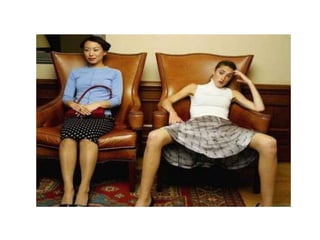
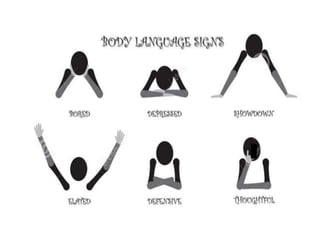
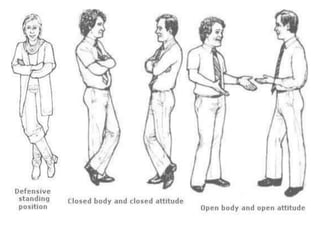
– You shouldn’t cross your arms as it might make you seem
defensive or guarded. This goes for your legs too. Keep
your arms and legs open.
– When sitting legs should not be wide open.
– Don’t keep your eyes on the ground, it might make you
seem insecure and a bit lost. Keep eye contact but don’t
stare.
– When you feel tense it’s easily winds up as tension in your
shoulders. They might move up and forward a bit. Try to
relax
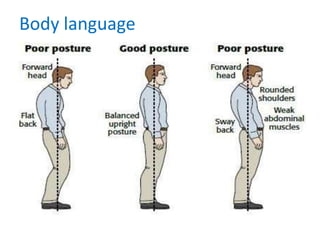
– Don’t slouch, sit up straight but in a relaxed way, not in a
tense manner. Keep your whole spine straight and aligned
for better posture.
Body language
Body language
• Shake hands firmly
– Touch is the most primitive and powerful nonverbal cue.
Touching someone on the arm, hand, or shoulder for as
little as 1/40 of a second creates a human bond.
– In the workplace, physical touch and warmth are
established through the handshaking tradition, and this
tactile contact makes a lasting and positive impression.
– People are two times more likely to remember you, if you
shake hands with them. The trade show researchers also
found that people react to those with whom they shake
hands by being more open and friendly.
– Make sure your handshake is neither too firm nor to shaky.
Body language
• Show Interest
– If you want to show that you are interested in what
someone is saying, lean toward the person talking. If you
want to show that you’re confident in yourself and relaxed
lean back a bit.
– Relax a bit, smile and laugh when someone says something
funny. People will be a lot more inclined to listen to you if
you seem to be a positive person.
– Don’t touch your face it might make you seem nervous and
can be distracting for the listeners or the people in the
conversation.
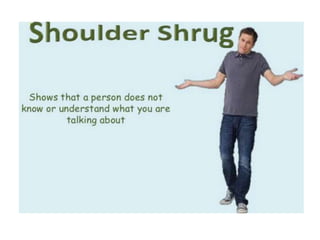
– Shoulder shrugs indicates you are not interested or not
understood.
Body language
• Space and Speech
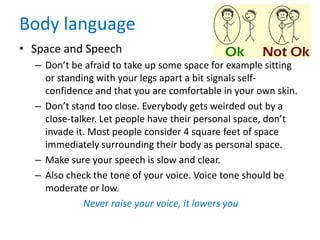
– Don’t be afraid to take up some space for example sitting
or standing with your legs apart a bit signals self-
confidence and that you are comfortable in your own skin.
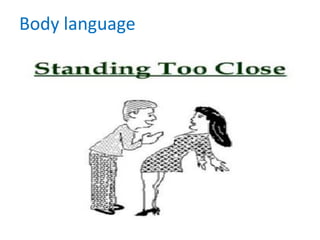
– Don’t stand too close. Everybody gets weirded out by a
close-talker. Let people have their personal space, don’t
invade it. Most people consider 4 square feet of space
immediately surrounding their body as personal space.
– Make sure your speech is slow and clear.
– Also check the tone of your voice. Voice tone should be
moderate or low.
Never raise your voice, it lowers you
Body language
Body language
• Use of Gestures
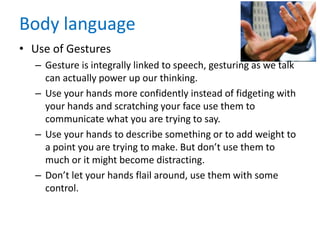
– Gesture is integrally linked to speech, gesturing as we talk
can actually power up our thinking.
– Use your hands more confidently instead of fidgeting with
your hands and scratching your face use them to
communicate what you are trying to say.
– Use your hands to describe something or to add weight to
a point you are trying to make. But don’t use them to
much or it might become distracting.
– Don’t let your hands flail around, use them with some
control.
Body language
• Linda was interviewing for an HR position in a multimedia
company. She was offered $70k + 20 paid vacation but she
was feeling a bit insecure because of her lack of
experience. Unlike the other two candidates who were
interviewing for the job, she knew how to control her
emotions. They were mumbling a lot, sweating and doing
all kinds of erratic gestures. When it was her time to speak,
she decided to stay calm. Quick answers, short sentences,
and a presentable attitude transformed Linda into a
favorite candidate for the job. Why? Because interviewers
wanted to hire someone who can deal with stressful
situations. Body language is vital in business negotiations,
and if you can’t control yourself, the job will go to the next
candidate who can best deal with a challenging work
environment.
Body language
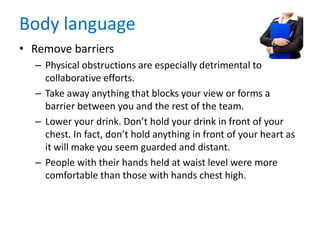
• Remove barriers
– Physical obstructions are especially detrimental to
collaborative efforts.
– Take away anything that blocks your view or forms a
barrier between you and the rest of the team.
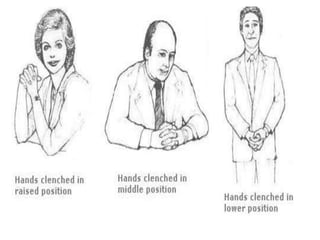
– Lower your drink. Don’t hold your drink in front of your
chest. In fact, don’t hold anything in front of your heart as
it will make you seem guarded and distant.
– People with their hands held at waist level were more
comfortable than those with hands chest high.
Body language
• Common body language mistakes
– Leaning back too much may come across as lazy or
arrogant.
– Leaning forward can seem aggressive.
– Breaking eye contact too soon can make you seem nervous
or untrustworthy.
– Staring can be interpreted as aggressive.
– Crossing you arms and pointing fingers.
– Keeping you hands in the pocket.
– Failing to smile.
– Stepping back when asked to take a decision.
Body language
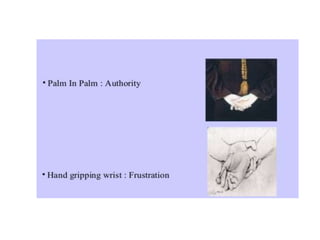
• Can you identify the different body language
How to meet a Potential Client
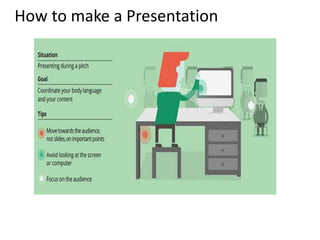
How to make a Presentation
How to encourage a colleague
How to take charge of your team
How to socialize with client
How to disagree
How to deal with angry colleague
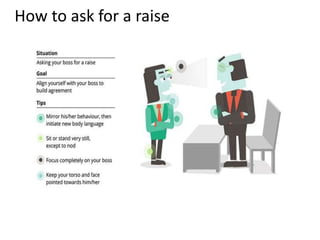
How to ask for a raise
Case study 1
• After a few months of hard work, you finally get
invited to a brainstorming meeting in the office in
the conference room table. You grab a seat, place
your hands in your lap and sit compactly to make
room for more people. As soon as your boss starts to
speak, you—eager to learn—hunch over your legal
pad and commence rapid-fire note-taking.
– What are good body language signs ?
– Are there any bad body language signs ?
Case study 2
• Recently promoted, you’ve been tasked with presenting
at the quarterly meeting of all the big wigs. You’ve
fleshed out your talking points, memorized your
presentation, and skillfully peppered your script with a
couple of well-timed (and seemingly unscripted) jokes.
You take your spot to the right of the board, and at the
end of the presentation, you face your colleagues and
cross your arms. “Any questions?” As there is no
response, you sit down.
– What right signs of body language does the manager
display?
– What body language signs needs improvement ?
Image Reading 1
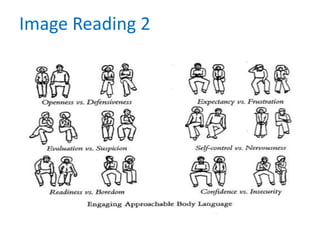
Image Reading 2
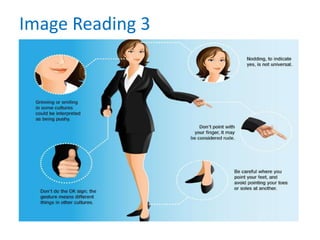
Image Reading 3

Body language

  • 1.
  • 3.
    Body language • Bodylanguage is a kind of non verbal communication, where thoughts, intentions, or feelings are expressed by physical behaviors, such as facial expressions, body posture, gestures, eye movement, touch and the use of space. • The difference between the words people speak and our understanding of what they are saying comes from non- verbal communication, otherwise known as "body language." • By developing your awareness of the signs and signals of body language, you can more easily understand other people, and more effectively communicate with them. It’s what you don’t say that matters the most.
  • 4.
    Body language • Theway we talk, walk, sit and stand all say something about us, and whatever is happening on the inside can be reflected on the outside. • There are times when we send mixed messages – we say one thing yet our body language reveals something different. This non-verbal language will affect how we act and react to others, and how they react to us. • Body language is a display of our motives.
  • 5.
    Body language • BodyPosture – You shouldn’t cross your arms as it might make you seem defensive or guarded. This goes for your legs too. Keep your arms and legs open. – When sitting legs should not be wide open. – Don’t keep your eyes on the ground, it might make you seem insecure and a bit lost. Keep eye contact but don’t stare. – When you feel tense it’s easily winds up as tension in your shoulders. They might move up and forward a bit. Try to relax – Don’t slouch, sit up straight but in a relaxed way, not in a tense manner. Keep your whole spine straight and aligned for better posture.
  • 7.
  • 8.
    Body language • Shakehands firmly – Touch is the most primitive and powerful nonverbal cue. Touching someone on the arm, hand, or shoulder for as little as 1/40 of a second creates a human bond. – In the workplace, physical touch and warmth are established through the handshaking tradition, and this tactile contact makes a lasting and positive impression. – People are two times more likely to remember you, if you shake hands with them. The trade show researchers also found that people react to those with whom they shake hands by being more open and friendly. – Make sure your handshake is neither too firm nor to shaky.
  • 11.
    Body language • ShowInterest – If you want to show that you are interested in what someone is saying, lean toward the person talking. If you want to show that you’re confident in yourself and relaxed lean back a bit. – Relax a bit, smile and laugh when someone says something funny. People will be a lot more inclined to listen to you if you seem to be a positive person. – Don’t touch your face it might make you seem nervous and can be distracting for the listeners or the people in the conversation. – Shoulder shrugs indicates you are not interested or not understood.
  • 14.
    Body language • Spaceand Speech – Don’t be afraid to take up some space for example sitting or standing with your legs apart a bit signals self- confidence and that you are comfortable in your own skin. – Don’t stand too close. Everybody gets weirded out by a close-talker. Let people have their personal space, don’t invade it. Most people consider 4 square feet of space immediately surrounding their body as personal space. – Make sure your speech is slow and clear. – Also check the tone of your voice. Voice tone should be moderate or low. Never raise your voice, it lowers you
  • 15.
  • 16.
    Body language • Useof Gestures – Gesture is integrally linked to speech, gesturing as we talk can actually power up our thinking. – Use your hands more confidently instead of fidgeting with your hands and scratching your face use them to communicate what you are trying to say. – Use your hands to describe something or to add weight to a point you are trying to make. But don’t use them to much or it might become distracting. – Don’t let your hands flail around, use them with some control.
  • 18.
    Body language • Lindawas interviewing for an HR position in a multimedia company. She was offered $70k + 20 paid vacation but she was feeling a bit insecure because of her lack of experience. Unlike the other two candidates who were interviewing for the job, she knew how to control her emotions. They were mumbling a lot, sweating and doing all kinds of erratic gestures. When it was her time to speak, she decided to stay calm. Quick answers, short sentences, and a presentable attitude transformed Linda into a favorite candidate for the job. Why? Because interviewers wanted to hire someone who can deal with stressful situations. Body language is vital in business negotiations, and if you can’t control yourself, the job will go to the next candidate who can best deal with a challenging work environment.
  • 21.
    Body language • Removebarriers – Physical obstructions are especially detrimental to collaborative efforts. – Take away anything that blocks your view or forms a barrier between you and the rest of the team. – Lower your drink. Don’t hold your drink in front of your chest. In fact, don’t hold anything in front of your heart as it will make you seem guarded and distant. – People with their hands held at waist level were more comfortable than those with hands chest high.
  • 22.
    Body language • Commonbody language mistakes – Leaning back too much may come across as lazy or arrogant. – Leaning forward can seem aggressive. – Breaking eye contact too soon can make you seem nervous or untrustworthy. – Staring can be interpreted as aggressive. – Crossing you arms and pointing fingers. – Keeping you hands in the pocket. – Failing to smile. – Stepping back when asked to take a decision.
  • 23.
    Body language • Canyou identify the different body language
  • 24.
    How to meeta Potential Client
  • 25.
    How to makea Presentation
  • 26.
    How to encouragea colleague
  • 27.
    How to takecharge of your team
  • 28.
    How to socializewith client
  • 29.
  • 30.
    How to dealwith angry colleague
  • 31.
    How to askfor a raise
  • 32.
    Case study 1 •After a few months of hard work, you finally get invited to a brainstorming meeting in the office in the conference room table. You grab a seat, place your hands in your lap and sit compactly to make room for more people. As soon as your boss starts to speak, you—eager to learn—hunch over your legal pad and commence rapid-fire note-taking. – What are good body language signs ? – Are there any bad body language signs ?
  • 33.
    Case study 2 •Recently promoted, you’ve been tasked with presenting at the quarterly meeting of all the big wigs. You’ve fleshed out your talking points, memorized your presentation, and skillfully peppered your script with a couple of well-timed (and seemingly unscripted) jokes. You take your spot to the right of the board, and at the end of the presentation, you face your colleagues and cross your arms. “Any questions?” As there is no response, you sit down. – What right signs of body language does the manager display? – What body language signs needs improvement ?
  • 34.
  • 35.
  • 36.