BODY LANGUAGE

“WHAT WE SAY” is less important
than “HOW WE SAY IT”……………….
WHAT IS BODY LANGUAGE?
It is communication of
o Personal feelings
o Emotions
o Attitudes
o Thoughts
Through BODY MOVEMENTS…..
MAIN ASPECTS OF BODY LANGUAGE

GESTURES:A gesture is the verbal or non
 verbal body movement used to express or
 emphasize an idea , an emotion and a state of
 mind.
BODY MOVEMENTS: This includes head, eyes,
 eyebrows, lips, neck, shoulder, fingers and so
 on.
Contd ………
o EMOTIONS: It refers to states such as
  happiness, depression and anxiety..and milder
  moods such as feeling of pleasure and
  displeasure , degrees of excitement or
  drowsiness etc.
o BEHAVIOUR : This refers quite simply to
  everything we do is observable to others.
BODY LANGUAGE
               INCLUDES:-
•   Unintentional Body Movements
•   Facial expressions
•   Body movements
•   Body postures
•   Eye contact
•   Touching gestures
UNINTENTIONAL BODY
          MOVEMENTS……
 BLINKING
 BLUSHING
 COWERING
 CRINGING
 SHUDDERING
 TREMBLING
 TWISTING HAIR
 WEEPING…
FACE


       7
FACIAL EXPRESSIONS…..….
The face is the most significant and the most
photographed part of our body . The flashes
of facial signals are spontaneous and therefore
are difficult to hide our true emotions .
Mouth
When ‘raised’ , the mouth communicates
positive feelings , happiness , optimism.IF kept
‘straight’ to conceal emotion. ‘ Turned down’
to express sadness, confusion , dissatisfaction.
The Lips: When one does not utter a word lips can
be eloquent because silent lips express a wide range of
emotions from smile to frown.
Throat: when the Adam’s applejump unconsciously
signals anxiety, embarrassment or stress.
Face is the most reliable indicator of wide range of
                         emotions:

•   JOY AND HAPPINESS
•   ANGER
•   ANXIETY
•   SADNESS
•   SURPRISE
•   ANNOYANCE
•   FEAR…
EXAMPLE:
• When we are shocked , we open our mouth..
• BLUSHING is another facial phenomenon that
  expresses emotions . A shy person becomes
  red in face when attention is focused on him.
• People frown in case they don’t understand a
  thing.
Contd …….…
SMILING : smiling and frowning are two major
 facial expressions.
  – A genuine smile means “I appreciate you” or “I
    accept your ideas” etc.
  – A frown means “I find you puzzling”.
LAUGHTER : laughter is composed of broad
 range of gestures and sounds.

   “Ha – Ha” is genuine laughter.
   “HE – HE” is mocking laughter.
    “HEE – HEE” suggests a secret giggle.
    “HO – HO” communicates surprise.
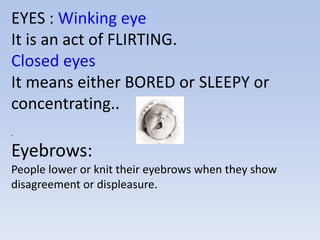
EYES : Winking eye
It is an act of FLIRTING.
Closed eyes
It means either BORED or SLEEPY or
concentrating..
.

Eyebrows:
People lower or knit their eyebrows when they show
disagreement or displeasure.
NOSE
* Holding the nose
  - “Something smells bad.”
* Nose tap
  - “It’s confidential.”
  - “Watch out!” or "Be careful.” (especially in
    Italy)


                                                   15
EARS
* Ear grasp
  - “I’m sorry.”
* Cupping the ear
  - “I can’t hear you.”
* Pulling ear
  - “You are in my heart”
Body Movement
• Balance movements with verbal cues
• Avoid random movements
• Step forward to indicate you are arriving at
  a point
• Step back when concluding a point and
  signals the audience they can relax
  momentarily
• Always lead with your foot nearest your
  destination
ARMS
 it is considered impolite to gesticulate with
 broad movements of the arms.
Folding arms are interpreted as a form of
 excluding self, “I am taking a defensive
 posture,” or “I disagree with what I am
 hearing.”


                                                  18
Contd…..

Arms behind back, hands grasped is a sign of
 ease and control.
Arms in front, hands grasped, common
 practice in most Asian countries, is a sign of
 mutual respect for others.


                                                  19
FINGERS
* The “O.K.” signal. (the thumb and forefinger
  form a circle) means
  *    “fine,” or “O.K.” in most cultures,
  *   “zero” or “worthless” in some parts of Europe
  *   “money” in Japan
  *   an insult in Greece, Brazil, Italy, Turkey, Russia and
      some other countries
FINGERS
* “Thumb-up” means:
  * “O.K.” “good job” or “fine”


                                  21
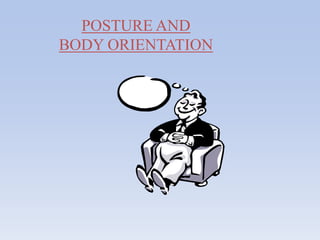
POSTURE AND
BODY ORIENTATION
POSTURE
• Body posture can be open or closed.

• Interested people pay attention and lean forward.

• Leaning backwards demonstrates aloofness or
  rejection.
• A head held straight up signals a neutral attitude.

• A head down is negative and judgmental.
POSTURE
• Some negative postures should be avoided:

• Rigid Body Posture-Anxious/ Uptight
• Hunched Shoulders –Lacks interest/ Feeling
  inferior
• Crossed Arms-Protecting the body/ Negative
  Thoughts
Eye Contact
• Most powerful feature after voice
• Establish a bond
• Look at your audience to convey your
  sincerity of the message
• You will increase their attention to
  you by sufficient eye contact
• Provides you feedback and helps you
  relax
GESTURES


• Gestures communicate as effectively as words, sometimes
  even better.

• Gestures support the verbal communication.

• They sometimes detract from what you say.
GESTURES

• There are some negative gestures which should be avoided:

• Pointing at people- It is perceived as accusatory.

• Fiddling with your items-It gives the impression that you are
  nervous.

• Dragging the feet-It implies lethargy.

• Head Down- It suggests timidity.
• Drooping shoulders- It implies weariness and
  lethargy.

• Weak handshake-It implies meek and ineffectual
  personality.
• Shifty eyes- It suggests nervousness.
• Arms crossed on the chest- It is a defensive
  gesture.
• Shaking feet or legs- It shows indifference and
  disinterest.
AVOID THESE HAND GESTURES
USE HAND GESTURES
Head Gestures
The Head Nod : A nod depicts a positive signal
& a ‘head- shake’ signifies ‘no’ or a negative
gesture.
Head nods show continuing attention , it also
depicts what is happening to us emotionally.
Heads tilt is a signal of interest.
THE HANDS
• The Human hand is a restless organ
• Limp hands show boredom.
• Nervous or jittery person shows restless hands.
• Clenched hands often shows frustration.
• Clapping of hands shows applause.
• When the arms are crossed they form a ‘barrier’ to
an impending threat.
• Arms folded with finger tucked in armpits & thumbs
sticking out: this is when subordinate faces his superior
whom he considers equal.
• Arms behind the back is resorted by those who is
experiencing an inner conflict.
• Neck stroking signals suspicion.
DIFFERENT TYPES OF
           HANDSHAKES…
o LIMP
o FIRM
o LOOSE
o VIGOROUS
o DOUBLE
o TAKING HOLD OF FINGERS INSTEAD OF THE
  HAND
o HOLDING HAND FOR A LONG TIME
THE LEGS

Crossed legs signify negativity.
The foot lock is especially among shy & timid women.
The ankle lock signifies ‘holding back’ of strong feelings ,
attitudes & emotions.
Sitting on edge of chair indicates compromise, accept or
agree or conclude.
Rocking or swinging in chair indicates a person is in full
control of situation.
Walking Gestures

Arms swinging.
Hands in pockets.
Hands on hips.
Meditative walk.
Confidence walk.
Leadership walk.
Pacing.
Swagger.
WHY TO IMPROVE BODY
          LANGUAGE????
 Words form a very less part of our
  communication.
 Emotions are well depicted through one’s
  body language.
 It helps in making our communication more
  effective.
 Good body language gives better first
  impression.
DO’S AND DON’TS OF
           BODY LANGUAGE….
Don’t cross your arms or legs.
Have eye contact , but don’t stare.
Don’t be afraid to keep up some space.
Relax your shoulders.
NOD when you agree.
Don’t slouch , sit up straight.
lean , but not too much
Don’t touch your face again and again.
Evaluation of Body
         Language……………
ENGAGED
LISTENING
BORED
LET ME SPEAK
EAGER
EVALUATING
LET ME GO!!
AGGRESSIVE
Contd…….
READY TO AGREE
ATTENTIVE
REJECTION
DEFIANT
NERVOUSNESS
LYING….
• Becoming sensitive to the clues of body language can help us
  communicate more effectively with everyone.

• We can understand what other person what to say even when
  they are not talking.

• We can sense when a person is silent and digesting
  information, or when he/she is silent and confused.

• We can share feelings too strong or too difficult to be
  expressed in words.


                                                                 40
• Or decode secret messages passing silently from
  person to person.

• And we may spot contradictions between what
  person say and what they really mean.

• Finally, we can learn to be more sensitive to our
  own bodies – to see how they express our
  feelings and to see ourselves as others see us.


                                                      41
TYPES OF BODY LANGUAGE……
CLOSED – AGGRESSIVE
body language
Hands on hips
Legs too wife – too macho
Invading personal space – too close
Aggressive gesturing – finger
pointing
Standing ‘over’ someone
Over firm handshake
‘Eye balling’ – out staring
CLOSED – DEFENSIVE body
language
Crossed arms or legs
Hunched shoulders
Poor eye contact
Leaning away
Tight voice
CLOSED – NERVOUS body
language
oNail biting
oDry throat – swallowing /
coughing
oBlushing – face/neck/chest
oWeak handshake
oAvoiding eye contact
CLOSED – BORED body
language
Looking around the room
Looking at watch
Drumming fingers
Yawning
Shifting weight
Rubbing face
OPEN – INTERESTED body
language
Firm handshake
Good eye contact
On the same level
Confident stance
Confident gestures – chosen
gestures
Showing interest – head nod /
slight lean in

Body language

  • 1.
    BODY LANGUAGE “WHAT WESAY” is less important than “HOW WE SAY IT”……………….
  • 2.
    WHAT IS BODYLANGUAGE? It is communication of o Personal feelings o Emotions o Attitudes o Thoughts Through BODY MOVEMENTS…..
  • 3.
    MAIN ASPECTS OFBODY LANGUAGE GESTURES:A gesture is the verbal or non verbal body movement used to express or emphasize an idea , an emotion and a state of mind. BODY MOVEMENTS: This includes head, eyes, eyebrows, lips, neck, shoulder, fingers and so on.
  • 4.
    Contd ……… o EMOTIONS:It refers to states such as happiness, depression and anxiety..and milder moods such as feeling of pleasure and displeasure , degrees of excitement or drowsiness etc. o BEHAVIOUR : This refers quite simply to everything we do is observable to others.
  • 5.
    BODY LANGUAGE INCLUDES:- • Unintentional Body Movements • Facial expressions • Body movements • Body postures • Eye contact • Touching gestures
  • 6.
    UNINTENTIONAL BODY MOVEMENTS……  BLINKING  BLUSHING  COWERING  CRINGING  SHUDDERING  TREMBLING  TWISTING HAIR  WEEPING…
  • 7.
  • 8.
    FACIAL EXPRESSIONS…..…. The faceis the most significant and the most photographed part of our body . The flashes of facial signals are spontaneous and therefore are difficult to hide our true emotions .
  • 9.
    Mouth When ‘raised’ ,the mouth communicates positive feelings , happiness , optimism.IF kept ‘straight’ to conceal emotion. ‘ Turned down’ to express sadness, confusion , dissatisfaction. The Lips: When one does not utter a word lips can be eloquent because silent lips express a wide range of emotions from smile to frown. Throat: when the Adam’s applejump unconsciously signals anxiety, embarrassment or stress.
  • 10.
    Face is themost reliable indicator of wide range of emotions: • JOY AND HAPPINESS • ANGER • ANXIETY • SADNESS • SURPRISE • ANNOYANCE • FEAR…
  • 11.
    EXAMPLE: • When weare shocked , we open our mouth.. • BLUSHING is another facial phenomenon that expresses emotions . A shy person becomes red in face when attention is focused on him. • People frown in case they don’t understand a thing.
  • 12.
    Contd …….… SMILING :smiling and frowning are two major facial expressions. – A genuine smile means “I appreciate you” or “I accept your ideas” etc. – A frown means “I find you puzzling”.
  • 13.
    LAUGHTER : laughteris composed of broad range of gestures and sounds.  “Ha – Ha” is genuine laughter.  “HE – HE” is mocking laughter.  “HEE – HEE” suggests a secret giggle.  “HO – HO” communicates surprise.
  • 14.
    EYES : Winkingeye It is an act of FLIRTING. Closed eyes It means either BORED or SLEEPY or concentrating.. . Eyebrows: People lower or knit their eyebrows when they show disagreement or displeasure.
  • 15.
    NOSE * Holding thenose - “Something smells bad.” * Nose tap - “It’s confidential.” - “Watch out!” or "Be careful.” (especially in Italy) 15
  • 16.
    EARS * Ear grasp - “I’m sorry.” * Cupping the ear - “I can’t hear you.” * Pulling ear - “You are in my heart”
  • 17.
    Body Movement • Balancemovements with verbal cues • Avoid random movements • Step forward to indicate you are arriving at a point • Step back when concluding a point and signals the audience they can relax momentarily • Always lead with your foot nearest your destination
  • 18.
    ARMS  it isconsidered impolite to gesticulate with broad movements of the arms. Folding arms are interpreted as a form of excluding self, “I am taking a defensive posture,” or “I disagree with what I am hearing.” 18
  • 19.
    Contd….. Arms behind back,hands grasped is a sign of ease and control. Arms in front, hands grasped, common practice in most Asian countries, is a sign of mutual respect for others. 19
  • 20.
    FINGERS * The “O.K.”signal. (the thumb and forefinger form a circle) means * “fine,” or “O.K.” in most cultures, * “zero” or “worthless” in some parts of Europe * “money” in Japan * an insult in Greece, Brazil, Italy, Turkey, Russia and some other countries
  • 21.
    FINGERS * “Thumb-up” means: * “O.K.” “good job” or “fine” 21
  • 22.
  • 23.
    POSTURE • Body posturecan be open or closed. • Interested people pay attention and lean forward. • Leaning backwards demonstrates aloofness or rejection. • A head held straight up signals a neutral attitude. • A head down is negative and judgmental.
  • 24.
    POSTURE • Some negativepostures should be avoided: • Rigid Body Posture-Anxious/ Uptight • Hunched Shoulders –Lacks interest/ Feeling inferior • Crossed Arms-Protecting the body/ Negative Thoughts
  • 25.
    Eye Contact • Mostpowerful feature after voice • Establish a bond • Look at your audience to convey your sincerity of the message • You will increase their attention to you by sufficient eye contact • Provides you feedback and helps you relax
  • 26.
    GESTURES • Gestures communicateas effectively as words, sometimes even better. • Gestures support the verbal communication. • They sometimes detract from what you say.
  • 27.
    GESTURES • There aresome negative gestures which should be avoided: • Pointing at people- It is perceived as accusatory. • Fiddling with your items-It gives the impression that you are nervous. • Dragging the feet-It implies lethargy. • Head Down- It suggests timidity.
  • 28.
    • Drooping shoulders-It implies weariness and lethargy. • Weak handshake-It implies meek and ineffectual personality. • Shifty eyes- It suggests nervousness. • Arms crossed on the chest- It is a defensive gesture. • Shaking feet or legs- It shows indifference and disinterest.
  • 29.
  • 30.
  • 31.
    Head Gestures The HeadNod : A nod depicts a positive signal & a ‘head- shake’ signifies ‘no’ or a negative gesture. Head nods show continuing attention , it also depicts what is happening to us emotionally. Heads tilt is a signal of interest.
  • 32.
    THE HANDS • TheHuman hand is a restless organ • Limp hands show boredom. • Nervous or jittery person shows restless hands. • Clenched hands often shows frustration. • Clapping of hands shows applause. • When the arms are crossed they form a ‘barrier’ to an impending threat. • Arms folded with finger tucked in armpits & thumbs sticking out: this is when subordinate faces his superior whom he considers equal. • Arms behind the back is resorted by those who is experiencing an inner conflict. • Neck stroking signals suspicion.
  • 33.
    DIFFERENT TYPES OF HANDSHAKES… o LIMP o FIRM o LOOSE o VIGOROUS o DOUBLE o TAKING HOLD OF FINGERS INSTEAD OF THE HAND o HOLDING HAND FOR A LONG TIME
  • 34.
    THE LEGS Crossed legssignify negativity. The foot lock is especially among shy & timid women. The ankle lock signifies ‘holding back’ of strong feelings , attitudes & emotions. Sitting on edge of chair indicates compromise, accept or agree or conclude. Rocking or swinging in chair indicates a person is in full control of situation.
  • 35.
    Walking Gestures Arms swinging. Handsin pockets. Hands on hips. Meditative walk. Confidence walk. Leadership walk. Pacing. Swagger.
  • 36.
    WHY TO IMPROVEBODY LANGUAGE????  Words form a very less part of our communication.  Emotions are well depicted through one’s body language.  It helps in making our communication more effective.  Good body language gives better first impression.
  • 37.
    DO’S AND DON’TSOF BODY LANGUAGE…. Don’t cross your arms or legs. Have eye contact , but don’t stare. Don’t be afraid to keep up some space. Relax your shoulders. NOD when you agree. Don’t slouch , sit up straight. lean , but not too much Don’t touch your face again and again.
  • 38.
    Evaluation of Body Language…………… ENGAGED LISTENING BORED LET ME SPEAK EAGER EVALUATING LET ME GO!! AGGRESSIVE
  • 39.
  • 40.
    • Becoming sensitiveto the clues of body language can help us communicate more effectively with everyone. • We can understand what other person what to say even when they are not talking. • We can sense when a person is silent and digesting information, or when he/she is silent and confused. • We can share feelings too strong or too difficult to be expressed in words. 40
  • 41.
    • Or decodesecret messages passing silently from person to person. • And we may spot contradictions between what person say and what they really mean. • Finally, we can learn to be more sensitive to our own bodies – to see how they express our feelings and to see ourselves as others see us. 41
  • 42.
    TYPES OF BODYLANGUAGE……
  • 43.
    CLOSED – AGGRESSIVE bodylanguage Hands on hips Legs too wife – too macho Invading personal space – too close Aggressive gesturing – finger pointing Standing ‘over’ someone Over firm handshake ‘Eye balling’ – out staring
  • 44.
    CLOSED – DEFENSIVEbody language Crossed arms or legs Hunched shoulders Poor eye contact Leaning away Tight voice
  • 45.
    CLOSED – NERVOUSbody language oNail biting oDry throat – swallowing / coughing oBlushing – face/neck/chest oWeak handshake oAvoiding eye contact
  • 46.
    CLOSED – BOREDbody language Looking around the room Looking at watch Drumming fingers Yawning Shifting weight Rubbing face
  • 47.
    OPEN – INTERESTEDbody language Firm handshake Good eye contact On the same level Confident stance Confident gestures – chosen gestures Showing interest – head nod / slight lean in