Body language session
Body language session-
- Pedagogy
Pedagogy
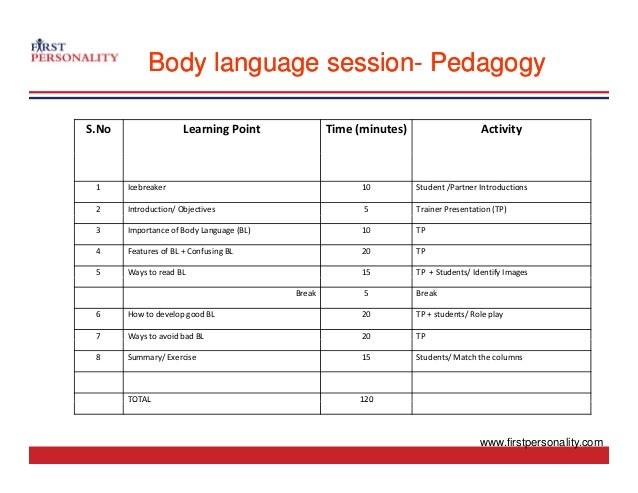
S.No Learning Point Time (minutes) Activity
1 Icebreaker 10 Student /Partner Introductions
2 Introduction/ Objectives 5 Trainer Presentation (TP) 
3 Importance of Body Language (BL)  10 TP
4 Features of BL + Confusing BL 20 TP
5 Ways to read BL 15 TP  + Students/ Identify Images
Break 5 Break
6 How to develop good BL 20 TP + students/ Role play
7 Ways to avoid bad BL 20 TP
y
8 Summary/ Exercise 15 Students/ Match the columns
TOTAL 120
www.firstpersonality.com
TOTAL 120
Body Language
Body Language
“
“ He who does not understand a
He who does not understand a
look will not understand a long
g
explanation either ”
”
Ancient
Ancient
proverb
www.firstpersonality.com
Understanding Body Language
“
“ H h d t d t d l k ill
“
“ He who does not understand a look will
not understand a long explanation either ”
”
Ancient proverb
Ancient proverb
Ancient proverb
Ancient proverb
www.firstpersonality.com
What is Body Language ?
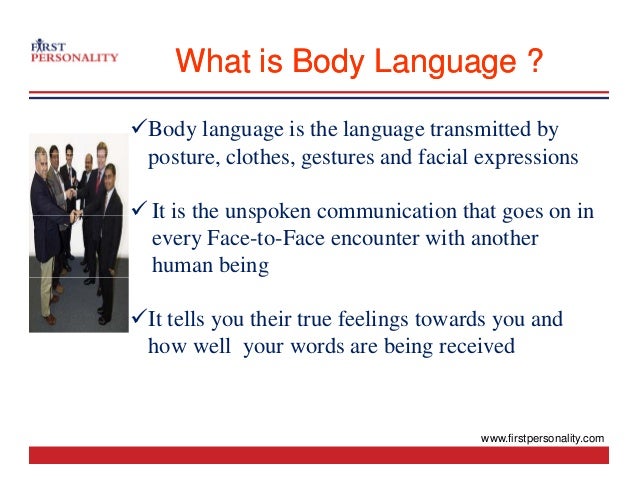
9Body language is the language transmitted by
post re clothes gest res and facial e pressions
posture, clothes, gestures and facial expressions
9 It is the unspoken communication that goes on in
It is the unspoken communication that goes on in
every Face-to-Face encounter with another
human being
9It tells you their true feelings towards you and
h ll d b i i d
how well your words are being received
www.firstpersonality.com
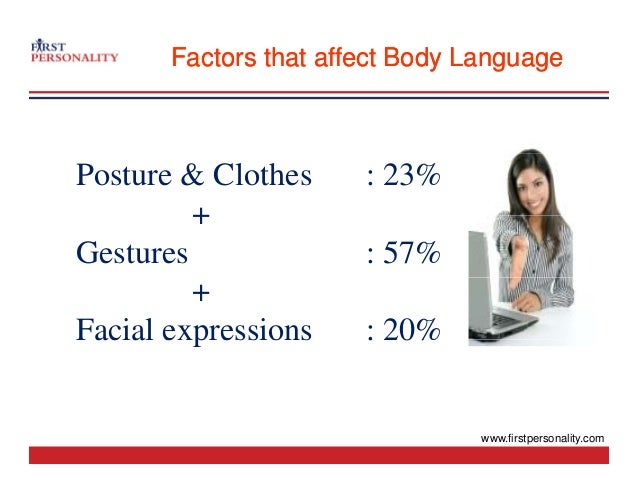
Factors that affect Body Language
Posture & Clothes : 23%
+
+
Gestures : 57%
+
Facial expressions : 20%
www.firstpersonality.com
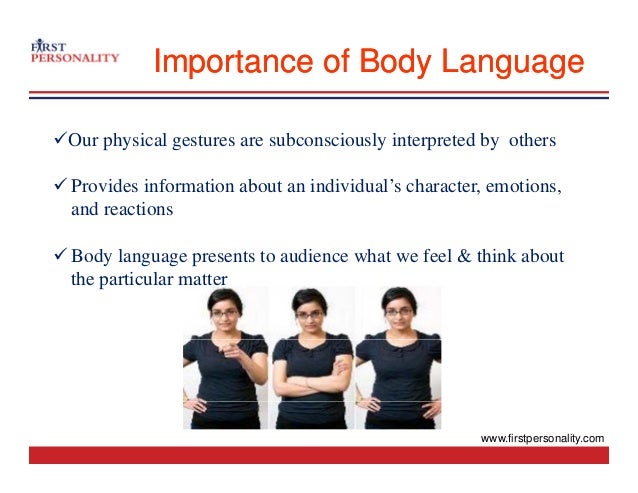
Importance of Body Language
9Our physical gestures are subconsciously interpreted by others
9 Provides information about an individual’s character, emotions,
and reactions
a d eact o s
9 Body language presents to audience what we feel & think about
the particular matter
www.firstpersonality.com
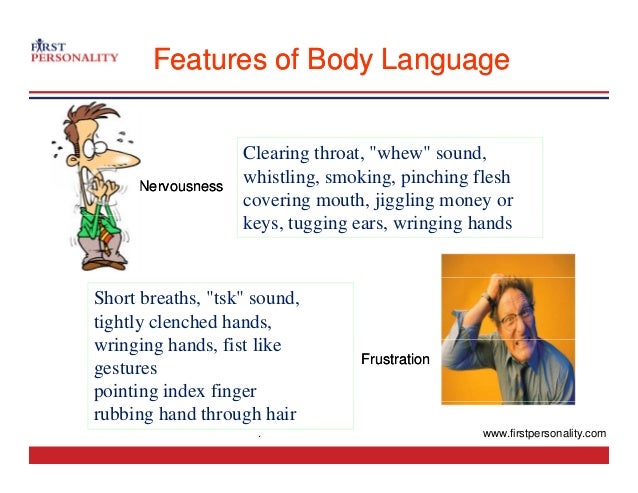
Features of Body Language
Clearing throat "whew" sound
Clearing throat, whew sound,
whistling, smoking, pinching flesh
covering mouth, jiggling money or
Nervousness
Nervousness
keys, tugging ears, wringing hands
Short breaths, "tsk" sound,
tightly clenched hands,
i i h d fi t lik
Frustration
Frustration
wringing hands, fist like
gestures
pointing index finger
rubbing hand through hair
. www.firstpersonality.com
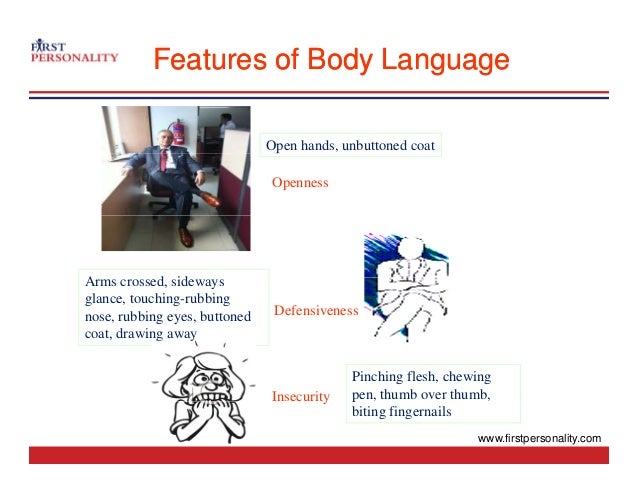
Features of Body Language
Open hands, unbuttoned coat
p
Openness
A d id
Defensiveness
Arms crossed, sideways
glance, touching-rubbing
nose, rubbing eyes, buttoned
coat, drawing away
, g y
Insecurity
Pinching flesh, chewing
pen, thumb over thumb,
y p
biting fingernails
www.firstpersonality.com
Features of Body Language
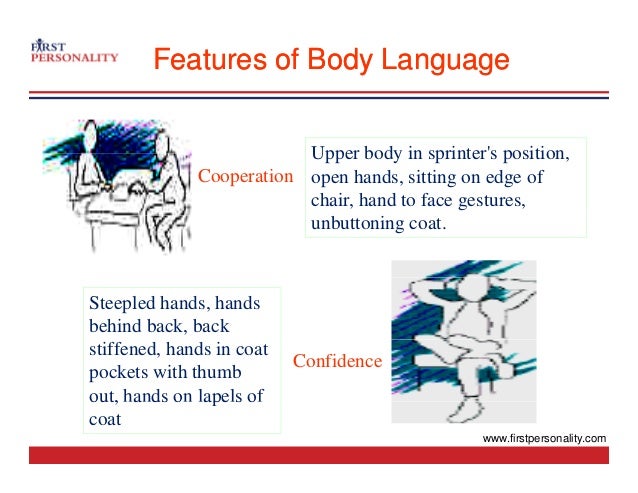
Upper body in sprinter's position
Cooperation
Upper body in sprinter s position,
open hands, sitting on edge of
chair, hand to face gestures,
unbuttoning coat.
Steepled hands, hands
behind back, back
Confidence
stiffened, hands in coat
pockets with thumb
out, hands on lapels of
out, a ds o ape s o
coat
www.firstpersonality.com
Features of Body Language
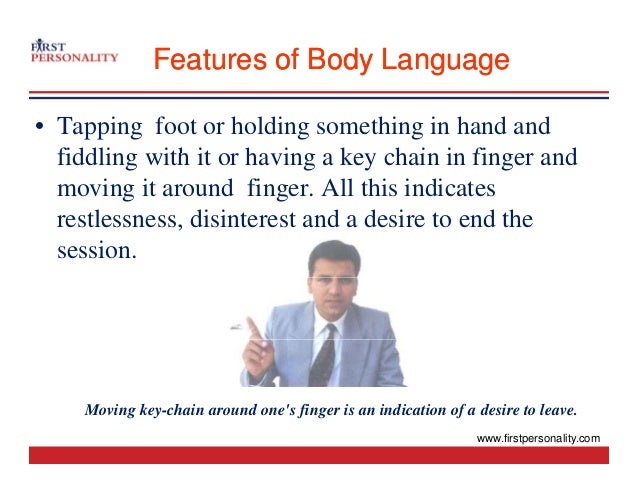
• Tapping foot or holding something in hand and
fiddling ith it or ha ing a ke chain in finger and
fiddling with it or having a key chain in finger and
moving it around finger. All this indicates
restlessness disinterest and a desire to end the
restlessness, disinterest and a desire to end the
session.
www.firstpersonality.com
Moving key-chain around one's finger is an indication of a desire to leave.
Remember …….
Remember …….
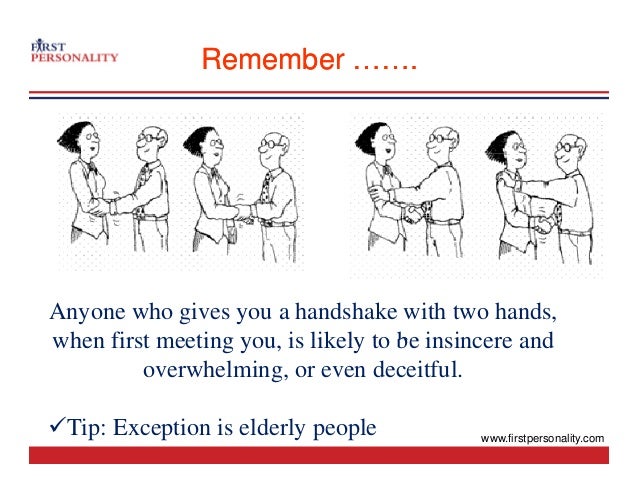
Anyone who gives you a handshake with two hands,
when first meeting you is likely to be insincere and
when first meeting you, is likely to be insincere and
overwhelming, or even deceitful.
9Tip: Exception is elderly people www.firstpersonality.com
Confusing Body Language
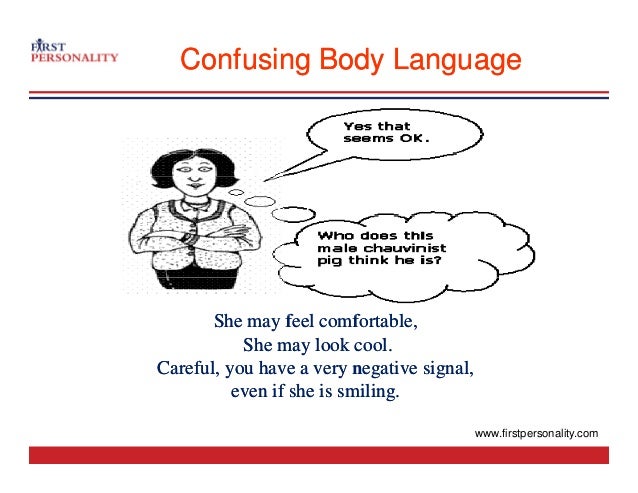
She may feel
She may feel comfortable,
comfortable,
Sh l k l
Sh l k l
She may look cool.
She may look cool.
Careful,
Careful, you
you have a very negative signal,
have a very negative signal,
even if she is smiling.
www.firstpersonality.com
Confusing Body Language
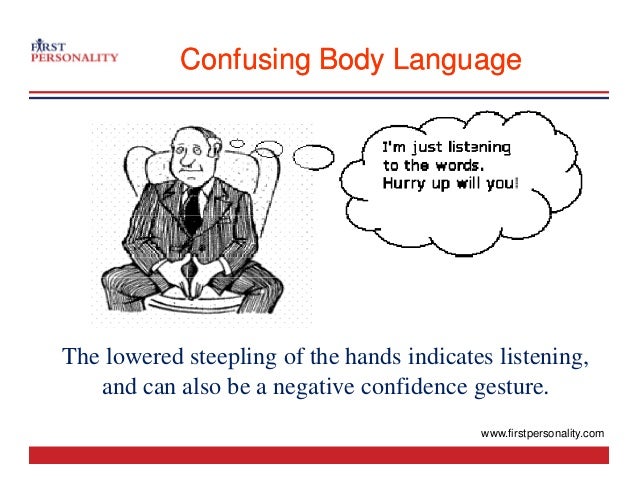
The lowered steepling of the hands indicates listening,
and can also be a negative confidence gesture.
www.firstpersonality.com
Confusing Body Language
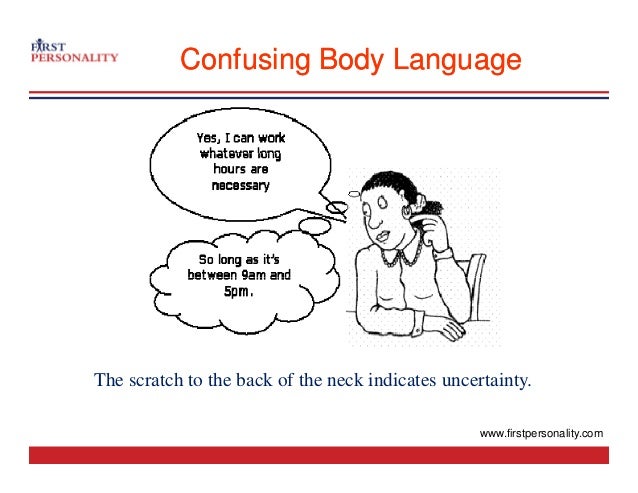
The scratch to the back of the neck indicates uncertainty.
www.firstpersonality.com
Confusing Body Language
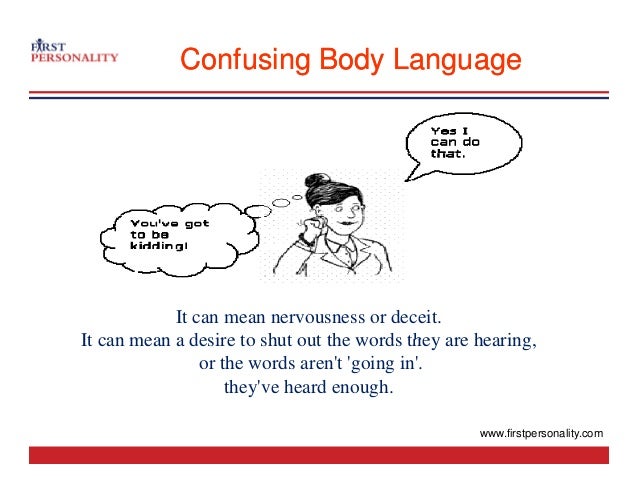
It can mean nervousness or deceit.
It can mean a desire to shut out the words they are hearing
It can mean a desire to shut out the words they are hearing,
or the words aren't 'going in'.
they've heard enough.
www.firstpersonality.com
Confusing Body Language
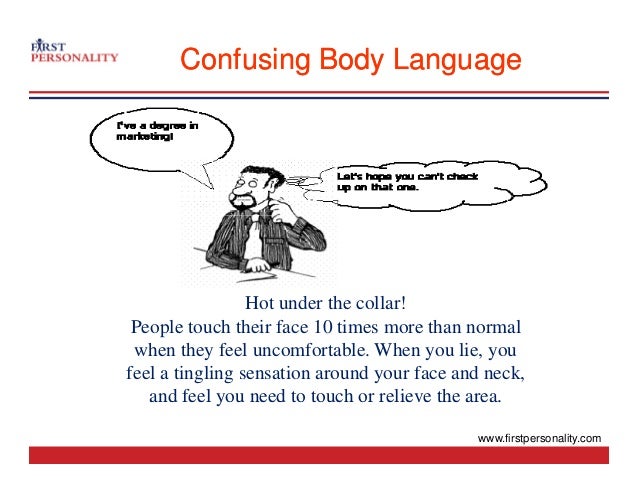
Hot under the collar!
People touch their face 10 times more than normal
when they feel uncomfortable. When you lie, you
feel a tingling sensation around your face and neck,
and feel you need to touch or relieve the area.
www.firstpersonality.com
Class Exercise
Class Exercise
Can you identify the body
language from each of the
following images displayed?
www.firstpersonality.com
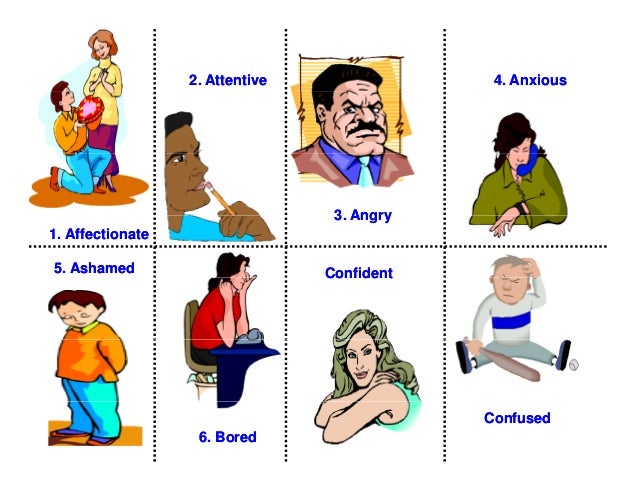
2. Attentive
2. Attentive 4. Anxious
4. Anxious
3 Angry
3 Angry
1. Affectionate
1. Affectionate
3. Angry
3. Angry
5. Ashamed
5. Ashamed Confident
Confident
Confident
Confident
6. Bored
6. Bored
Confused
Confused
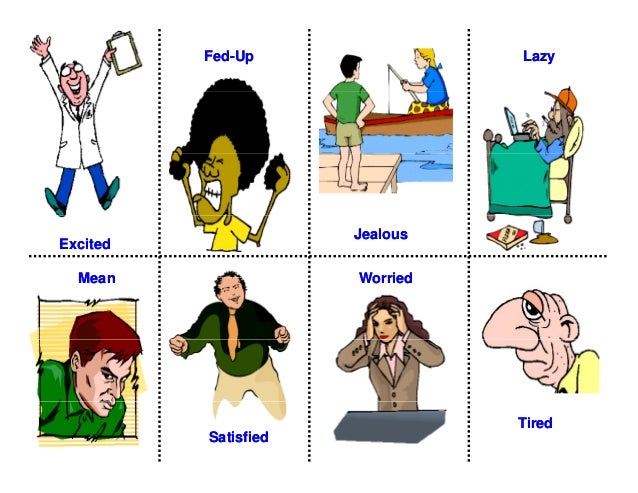
Fed
Fed-
-Up
Up Lazy
Lazy
Excited
Excited
Jealous
Jealous
Mean
Mean Worried
Worried
Mean
Mean Worried
Worried
Satisfied
Satisfied
Tired
Tired
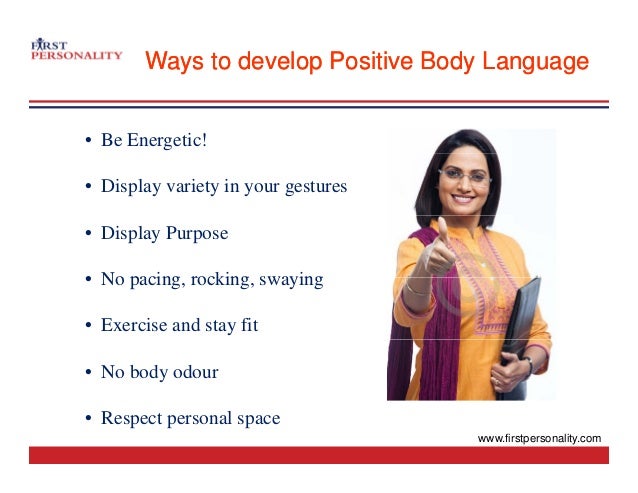
Ways to develop Positive Body Language
• Be Energetic!
• Display variety in your gestures
• Display Purpose
• No pacing rocking swaying
• No pacing, rocking, swaying
• Exercise and stay fit
• No body odour
• Respect personal space
www.firstpersonality.com
Proper Posture
Proper Posture
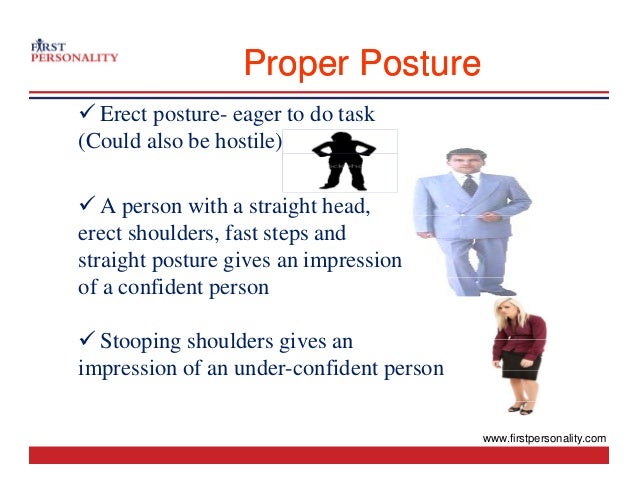
9 Erect posture- eager to do task
(Could also be hostile)
9 A person with a straight head,
p g ,
erect shoulders, fast steps and
straight posture gives an impression
of a confident person
9 Stooping shoulders gives an
impression of an under-confident person
www.firstpersonality.com
Eyes (as you see them)
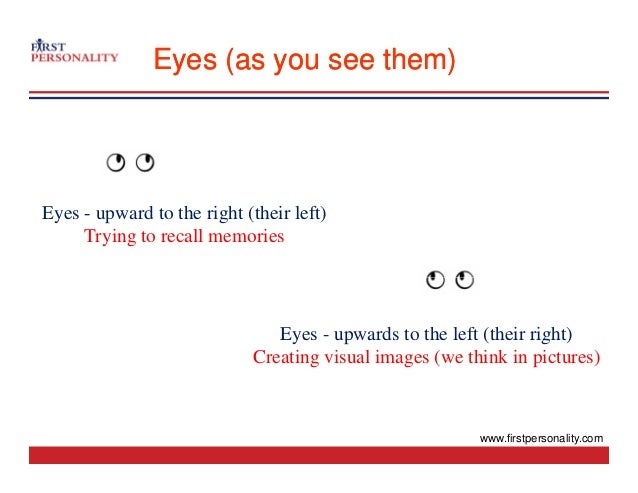
Eyes - upward to the right (their left)
Trying to recall memories
Eyes - upwards to the left (their right)
Eyes upwards to the left (their right)
Creating visual images (we think in pictures)
www.firstpersonality.com
What your eyes say about you?
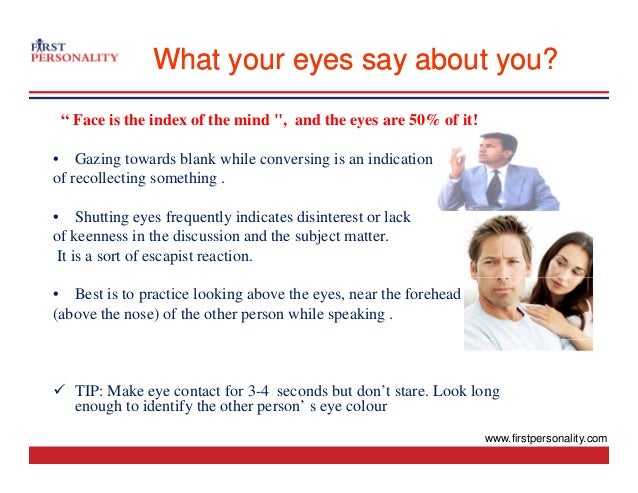
“ Face is the index of the mind ", and the eyes are 50% of it!
G i d bl k hil i i i di i
• Gazing towards blank while conversing is an indication
of recollecting something .
• Shutting eyes frequently indicates disinterest or lack
of keenness in the discussion and the subject matter.
It is a sort of escapist reaction.
• Best is to practice looking above the eyes, near the forehead
(above the nose) of the other person while speaking .
9 TIP: Make eye contact for 3-4 seconds but don’t stare. Look long
h id if h h ’ l
enough to identify the other person’ s eye colour
www.firstpersonality.com
Correct Handshake
Correct Handshake
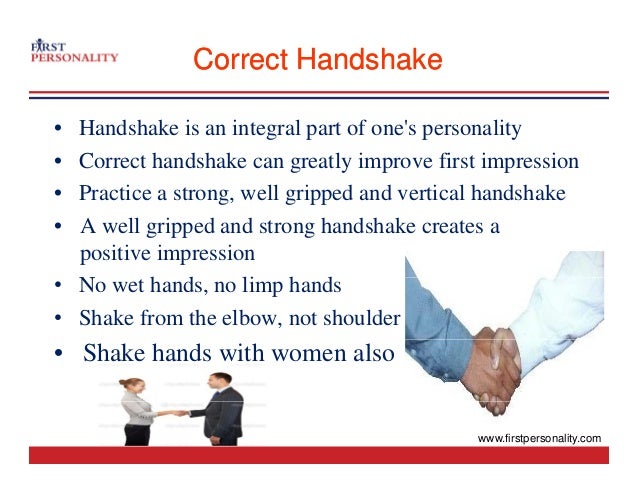
• Handshake is an integral part of one's personality
C h d h k l i fi i i
• Correct handshake can greatly improve first impression
• Practice a strong, well gripped and vertical handshake
• A well gripped and strong handshake creates a
positive impression
N h d li h d
• No wet hands, no limp hands
• Shake from the elbow, not shoulder
• Shake hands with women also
www.firstpersonality.com
Ways to develop positive body language
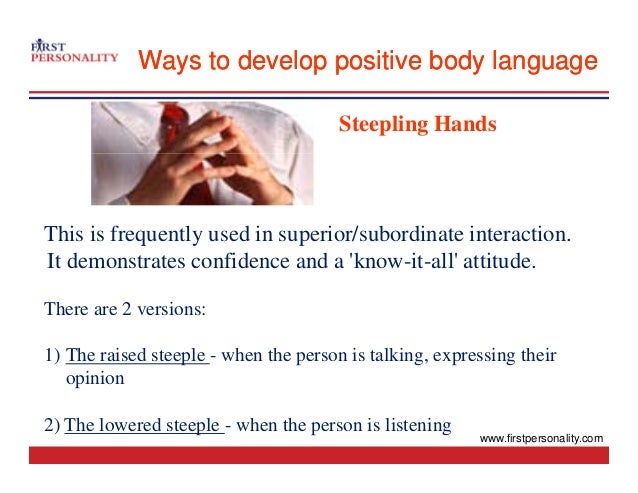
Steepling Hands
This is frequently used in superior/subordinate interaction.
It demonstrates confidence and a 'know-it-all' attitude.
There are 2 versions:
1) The raised steeple - when the person is talking, expressing their
opinion
2) The lowered steeple - when the person is listening
www.firstpersonality.com
Ways to develop positive body language
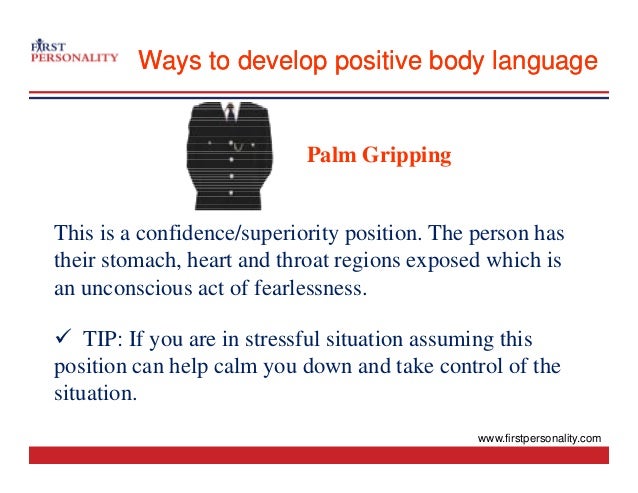
Palm Gripping
Palm Gripping
This is a confidence/superiority position. The person has
their stomach, heart and throat regions exposed which is
an unconscious act of fearlessness.
9 TIP: If you are in stressful situation assuming this
position can help calm you down and take control of the
situation.
www.firstpersonality.com
Ways to develop Positive Body Language
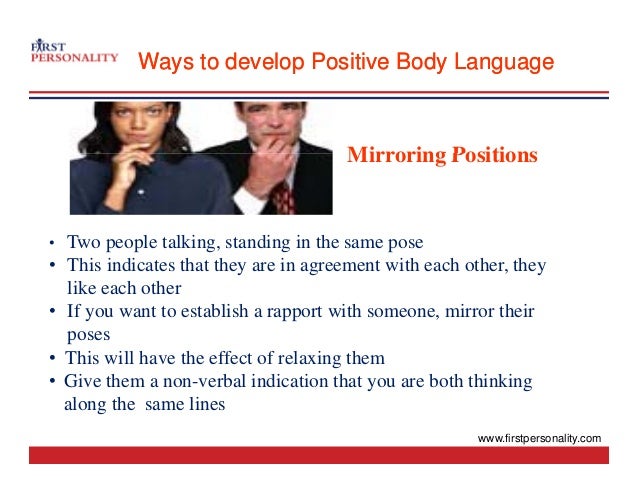
Mirroring Positions
Mirroring Positions
• Two people talking, standing in the same pose
• This indicates that they are in agreement with each other, they
like each other
• If you want to establish a rapport with someone, mirror their
poses
poses
• This will have the effect of relaxing them
• Give them a non-verbal indication that you are both thinking
along the same lines
www.firstpersonality.com
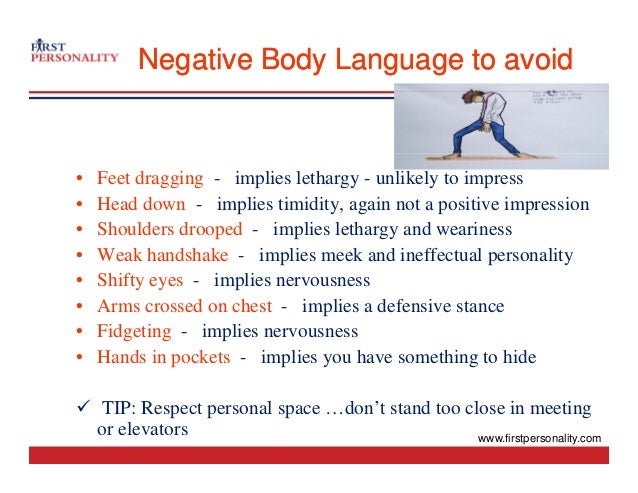
Negative Body Language to avoid
• Feet dragging - implies lethargy - unlikely to impress
• Head down - implies timidity, again not a positive impression
• Shoulders drooped - implies lethargy and weariness
• Weak handshake - implies meek and ineffectual personality
Shift e es implies ner o sness
• Shifty eyes - implies nervousness
• Arms crossed on chest - implies a defensive stance
• Fidgeting - implies nervousness
g g p
• Hands in pockets - implies you have something to hide
9 TIP R l d ’ d l i i
9 TIP: Respect personal space …don’t stand too close in meeting
or elevators www.firstpersonality.com
Poor Handshake
Poor Handshake
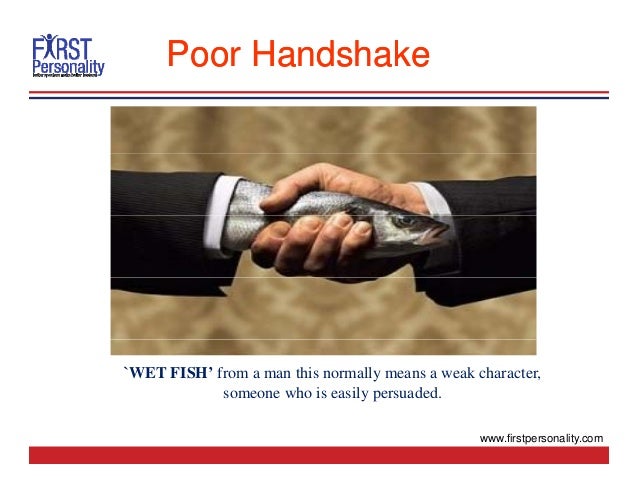
WEAK HANDSHAKE-THE FISH
`WET FISH’ from a man this normally means a weak character,
someone who is easily persuaded.
www.firstpersonality.com
How to identify Liars?
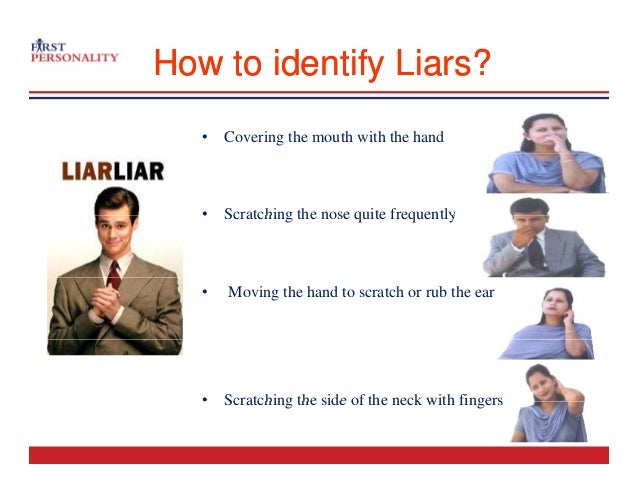
• Covering the mouth with the hand
• Scratching the nose quite frequently
• Moving the hand to scratch or rub the ear
• Scratching the side of the neck with fingers
Scratching the side of the neck with fingers
Conclusion
Conclusion
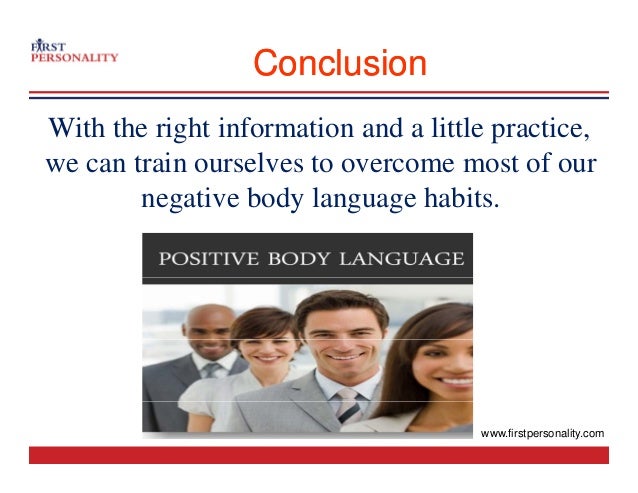
With the right information and a little practice,
i l f
we can train ourselves to overcome most of our
negative body language habits.
www.firstpersonality.com

Body-language_Trainer-PPT.pdf

  • 1.
    Body language session Bodylanguage session- - Pedagogy Pedagogy S.No Learning Point Time (minutes) Activity 1 Icebreaker 10 Student /Partner Introductions 2 Introduction/ Objectives 5 Trainer Presentation (TP)  3 Importance of Body Language (BL)  10 TP 4 Features of BL + Confusing BL 20 TP 5 Ways to read BL 15 TP  + Students/ Identify Images Break 5 Break 6 How to develop good BL 20 TP + students/ Role play 7 Ways to avoid bad BL 20 TP y 8 Summary/ Exercise 15 Students/ Match the columns TOTAL 120 www.firstpersonality.com TOTAL 120
  • 2.
    Body Language Body Language “ “He who does not understand a He who does not understand a look will not understand a long g explanation either ” ” Ancient Ancient proverb www.firstpersonality.com
  • 3.
    Understanding Body Language UnderstandingBody Language “ “ H h d t d t d l k ill “ “ He who does not understand a look will not understand a long explanation either ” ” Ancient proverb Ancient proverb Ancient proverb Ancient proverb www.firstpersonality.com
  • 4.
    What is BodyLanguage ? What is Body Language ? 9Body language is the language transmitted by post re clothes gest res and facial e pressions posture, clothes, gestures and facial expressions 9 It is the unspoken communication that goes on in It is the unspoken communication that goes on in every Face-to-Face encounter with another human being 9It tells you their true feelings towards you and h ll d b i i d how well your words are being received www.firstpersonality.com
  • 5.
    Factors that affectBody Language Factors that affect Body Language Posture & Clothes : 23% + + Gestures : 57% + Facial expressions : 20% Facial expressions : 20% www.firstpersonality.com
  • 6.
    Importance of BodyLanguage Importance of Body Language 9Our physical gestures are subconsciously interpreted by others 9 Provides information about an individual’s character, emotions, and reactions a d eact o s 9 Body language presents to audience what we feel & think about the particular matter the particular matter www.firstpersonality.com
  • 7.
    Features of BodyLanguage Features of Body Language Clearing throat "whew" sound Clearing throat, whew sound, whistling, smoking, pinching flesh covering mouth, jiggling money or Nervousness Nervousness keys, tugging ears, wringing hands Short breaths, "tsk" sound, tightly clenched hands, i i h d fi t lik Frustration Frustration wringing hands, fist like gestures pointing index finger rubbing hand through hair . www.firstpersonality.com
  • 8.
    Features of BodyLanguage Features of Body Language Open hands, unbuttoned coat p Openness A d id Defensiveness Arms crossed, sideways glance, touching-rubbing nose, rubbing eyes, buttoned coat, drawing away , g y Insecurity Pinching flesh, chewing pen, thumb over thumb, y p biting fingernails www.firstpersonality.com
  • 9.
    Features of BodyLanguage Features of Body Language Upper body in sprinter's position Cooperation Upper body in sprinter s position, open hands, sitting on edge of chair, hand to face gestures, unbuttoning coat. Steepled hands, hands behind back, back Confidence stiffened, hands in coat pockets with thumb out, hands on lapels of out, a ds o ape s o coat www.firstpersonality.com
  • 10.
    Features of BodyLanguage Features of Body Language • Tapping foot or holding something in hand and fiddling ith it or ha ing a ke chain in finger and fiddling with it or having a key chain in finger and moving it around finger. All this indicates restlessness disinterest and a desire to end the restlessness, disinterest and a desire to end the session. www.firstpersonality.com Moving key-chain around one's finger is an indication of a desire to leave.
  • 11.
    Remember ……. Remember ……. Anyonewho gives you a handshake with two hands, when first meeting you is likely to be insincere and when first meeting you, is likely to be insincere and overwhelming, or even deceitful. 9Tip: Exception is elderly people www.firstpersonality.com
  • 12.
    Confusing Body Language ConfusingBody Language She may feel She may feel comfortable, comfortable, Sh l k l Sh l k l She may look cool. She may look cool. Careful, Careful, you you have a very negative signal, have a very negative signal, even if she is smiling. even if she is smiling. www.firstpersonality.com
  • 13.
    Confusing Body Language ConfusingBody Language The lowered steepling of the hands indicates listening, and can also be a negative confidence gesture. www.firstpersonality.com
  • 14.
    Confusing Body Language ConfusingBody Language The scratch to the back of the neck indicates uncertainty. www.firstpersonality.com
  • 15.
    Confusing Body Language ConfusingBody Language It can mean nervousness or deceit. It can mean a desire to shut out the words they are hearing It can mean a desire to shut out the words they are hearing, or the words aren't 'going in'. they've heard enough. www.firstpersonality.com
  • 16.
    Confusing Body Language ConfusingBody Language Hot under the collar! People touch their face 10 times more than normal when they feel uncomfortable. When you lie, you feel a tingling sensation around your face and neck, and feel you need to touch or relieve the area. and feel you need to touch or relieve the area. www.firstpersonality.com
  • 17.
    Class Exercise Class Exercise Canyou identify the body language from each of the following images displayed? following images displayed? www.firstpersonality.com
  • 18.
    2. Attentive 2. Attentive4. Anxious 4. Anxious 3 Angry 3 Angry 1. Affectionate 1. Affectionate 3. Angry 3. Angry 5. Ashamed 5. Ashamed Confident Confident Confident Confident 6. Bored 6. Bored Confused Confused
  • 19.
  • 20.
    Ways to developPositive Body Language Ways to develop Positive Body Language • Be Energetic! • Display variety in your gestures • Display Purpose • No pacing rocking swaying • No pacing, rocking, swaying • Exercise and stay fit • No body odour • Respect personal space www.firstpersonality.com
  • 21.
    Proper Posture Proper Posture 9Erect posture- eager to do task (Could also be hostile) 9 A person with a straight head, p g , erect shoulders, fast steps and straight posture gives an impression of a confident person 9 Stooping shoulders gives an 9 Stooping shoulders gives an impression of an under-confident person www.firstpersonality.com
  • 22.
    Eyes (as yousee them) Eyes (as you see them) Eyes - upward to the right (their left) Eyes - upward to the right (their left) Trying to recall memories Eyes - upwards to the left (their right) Eyes upwards to the left (their right) Creating visual images (we think in pictures) www.firstpersonality.com
  • 23.
    What your eyessay about you? What your eyes say about you? “ Face is the index of the mind ", and the eyes are 50% of it! G i d bl k hil i i i di i • Gazing towards blank while conversing is an indication of recollecting something . • Shutting eyes frequently indicates disinterest or lack • Shutting eyes frequently indicates disinterest or lack of keenness in the discussion and the subject matter. It is a sort of escapist reaction. • Best is to practice looking above the eyes, near the forehead (above the nose) of the other person while speaking . 9 TIP: Make eye contact for 3-4 seconds but don’t stare. Look long h id if h h ’ l enough to identify the other person’ s eye colour www.firstpersonality.com
  • 24.
    Correct Handshake Correct Handshake •Handshake is an integral part of one's personality C h d h k l i fi i i • Correct handshake can greatly improve first impression • Practice a strong, well gripped and vertical handshake • A well gripped and strong handshake creates a positive impression N h d li h d • No wet hands, no limp hands • Shake from the elbow, not shoulder • Shake hands with women also www.firstpersonality.com
  • 25.
    Ways to developpositive body language Ways to develop positive body language Steepling Hands This is frequently used in superior/subordinate interaction. It demonstrates confidence and a 'know-it-all' attitude. There are 2 versions: 1) The raised steeple - when the person is talking, expressing their opinion 2) The lowered steeple - when the person is listening www.firstpersonality.com
  • 26.
    Ways to developpositive body language Ways to develop positive body language Palm Gripping Palm Gripping This is a confidence/superiority position. The person has their stomach, heart and throat regions exposed which is an unconscious act of fearlessness. 9 TIP: If you are in stressful situation assuming this 9 TIP: If you are in stressful situation assuming this position can help calm you down and take control of the situation. www.firstpersonality.com
  • 27.
    Ways to developPositive Body Language Ways to develop Positive Body Language Mirroring Positions Mirroring Positions • Two people talking, standing in the same pose • This indicates that they are in agreement with each other, they like each other • If you want to establish a rapport with someone, mirror their poses poses • This will have the effect of relaxing them • Give them a non-verbal indication that you are both thinking along the same lines along the same lines www.firstpersonality.com
  • 28.
    Negative Body Languageto avoid Negative Body Language to avoid • Feet dragging - implies lethargy - unlikely to impress • Head down - implies timidity, again not a positive impression • Shoulders drooped - implies lethargy and weariness • Weak handshake - implies meek and ineffectual personality Shift e es implies ner o sness • Shifty eyes - implies nervousness • Arms crossed on chest - implies a defensive stance • Fidgeting - implies nervousness g g p • Hands in pockets - implies you have something to hide 9 TIP R l d ’ d l i i 9 TIP: Respect personal space …don’t stand too close in meeting or elevators www.firstpersonality.com
  • 29.
    Poor Handshake Poor Handshake WEAKHANDSHAKE-THE FISH `WET FISH’ from a man this normally means a weak character, someone who is easily persuaded. www.firstpersonality.com
  • 30.
    How to identifyLiars? How to identify Liars? • Covering the mouth with the hand • Scratching the nose quite frequently • Scratching the nose quite frequently • Moving the hand to scratch or rub the ear • Scratching the side of the neck with fingers Scratching the side of the neck with fingers
  • 31.
    Conclusion Conclusion With the rightinformation and a little practice, i l f we can train ourselves to overcome most of our negative body language habits. www.firstpersonality.com