Introduction
History
Origin of the Bluetooth name
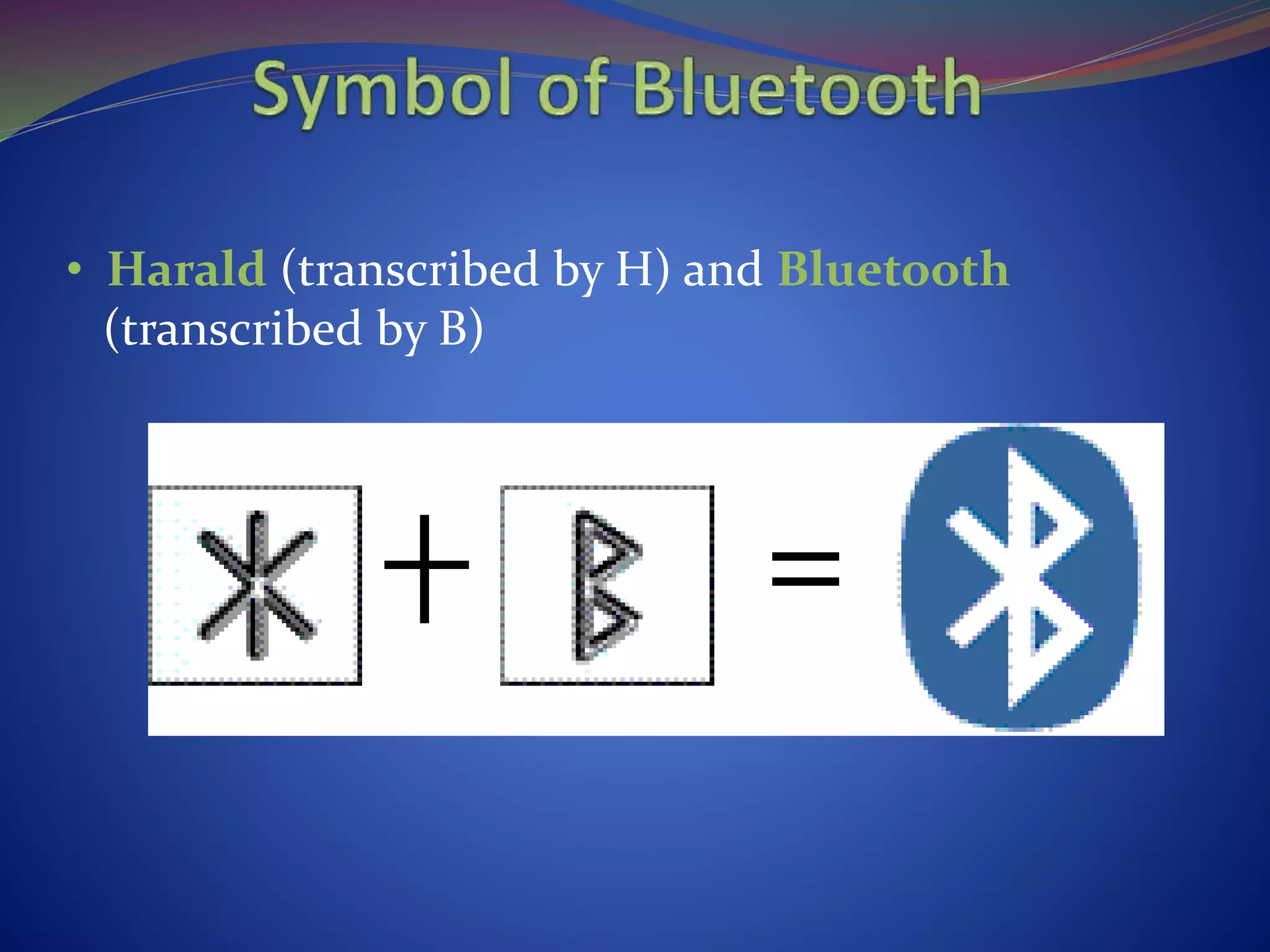
Symbol of Bluetooth
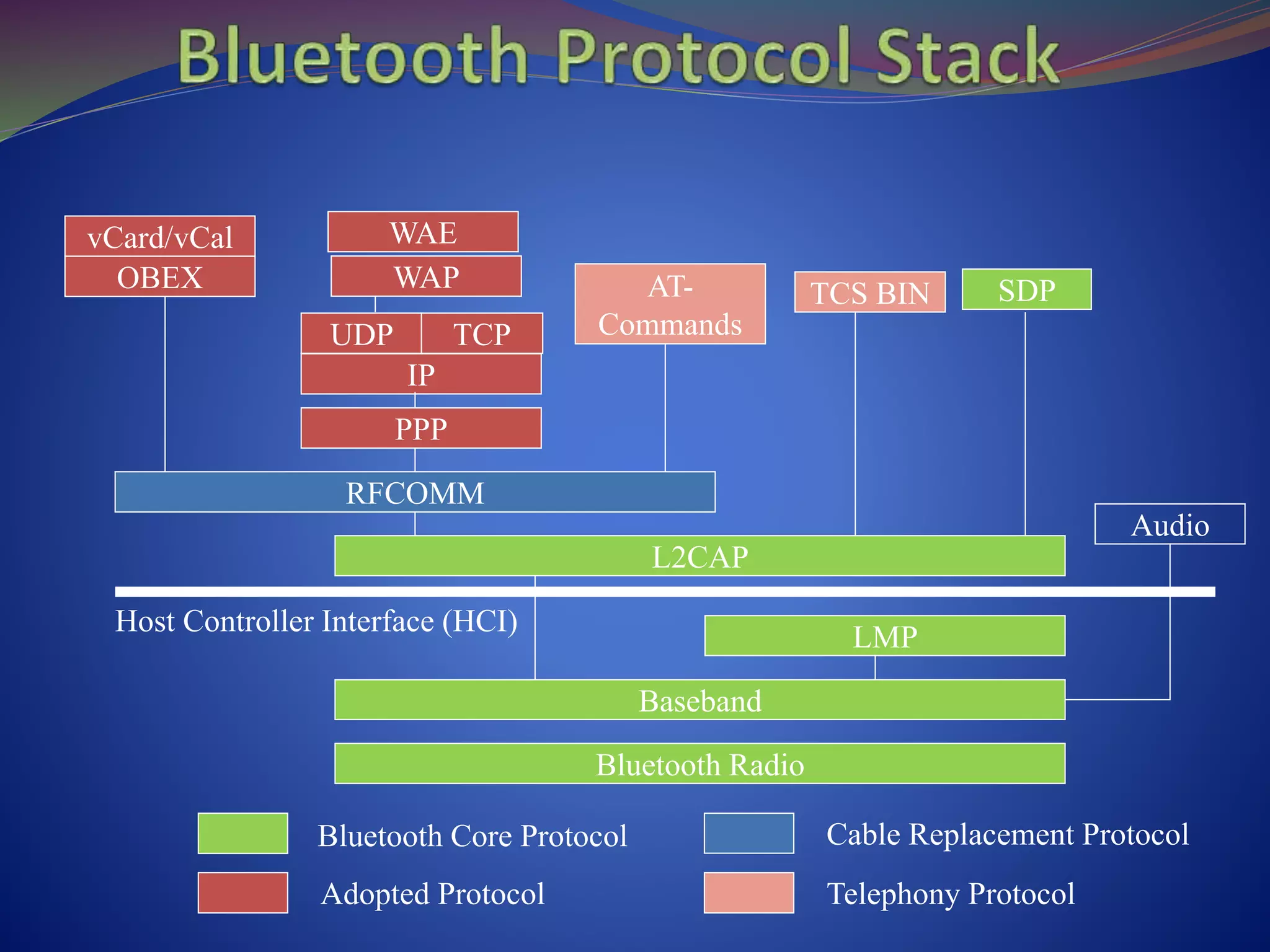
Bluetooth Protocol Stack
How Bluetooth works?
Bluetooth topology
Advantages and disadvantages of
Bluetooth.
Conclusion
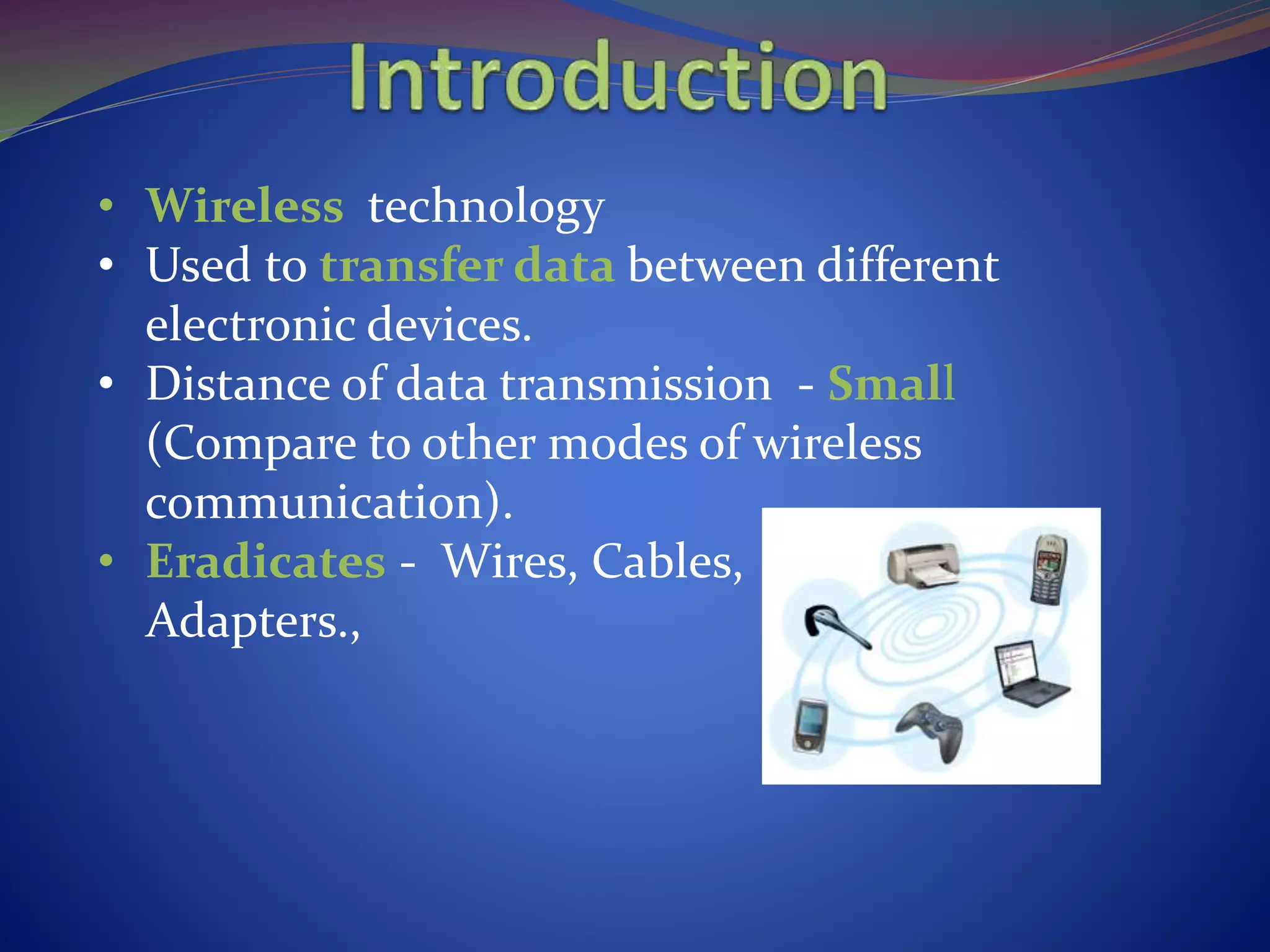
• Wireless technology
• Used to transfer data between different
electronic devices.
• Distance of data transmission - Small
(Compare to other modes of wireless
communication).
• Eradicates - Wires, Cables,
Adapters.,
• 1994 – Ericsson
Telecommunication (main idea).
• Objective – eliminate the
cables between the mobile
telephones and the desktop
devices, headset, etc..,
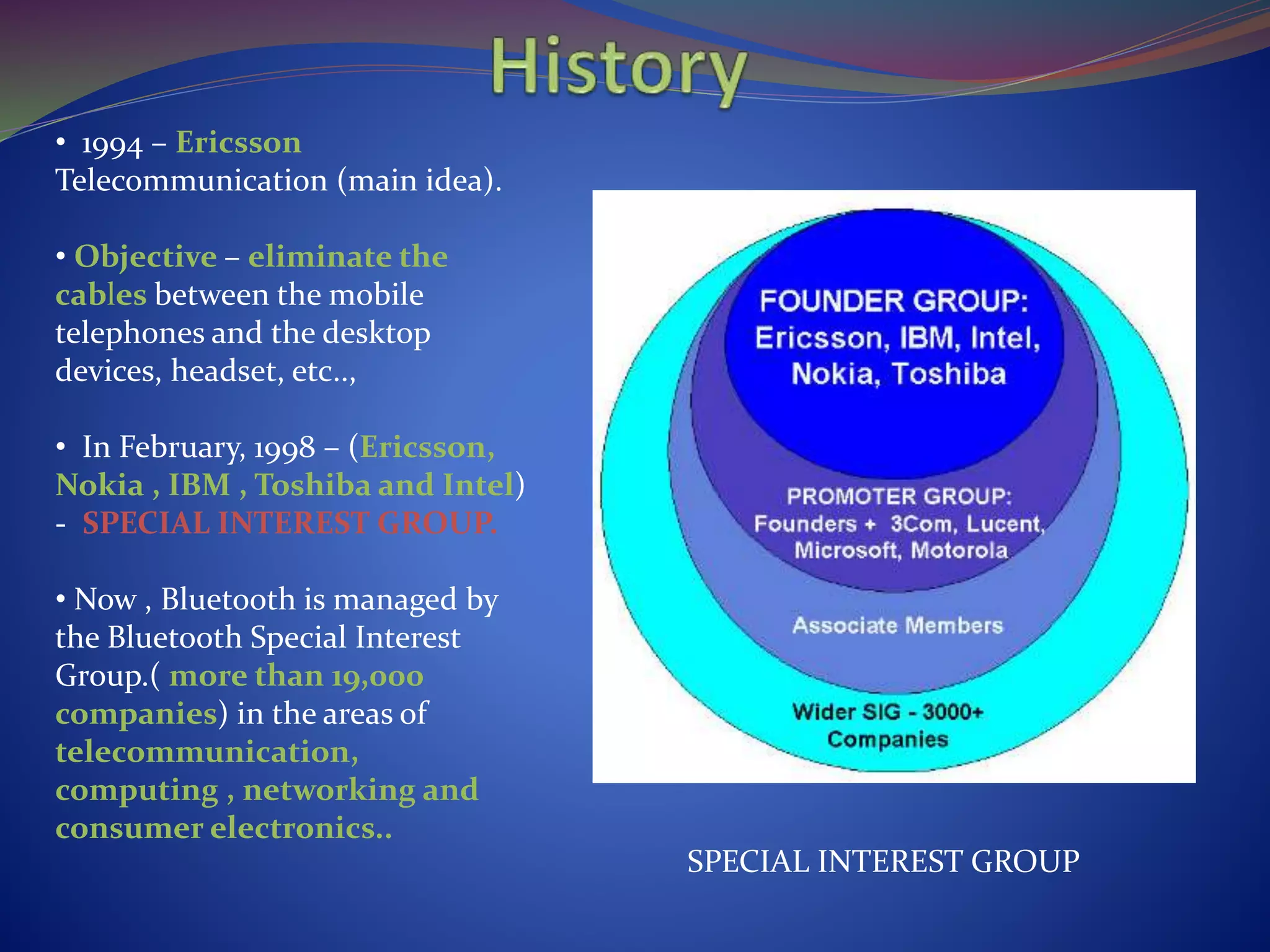
• In February, 1998 – (Ericsson,
Nokia , IBM , Toshiba and Intel)
- SPECIAL INTEREST GROUP.
• Now , Bluetooth is managed by
the Bluetooth Special Interest
Group.( more than 19,000
companies) in the areas of
telecommunication,
computing , networking and
consumer electronics..
SPECIAL INTEREST GROUP
• From an article EE Times: Jim Kardach , an Intel Engineer.
• The name was taken from the 10th century, Second king of
Denmark, “King Harald Bluetooth” who was famous for
uniting Scandinavia (just as them, to unite the PC and
cellular Industries with a short range of wireless link).
• By February 1997, SIG formed developing the official name.
• The top two names were “Radiowire” and “PAN”.
• In April, SIG board meeting voted for “PAN”.
• A search showed that the name was already in use.
• As launch date neared, running out of time , the SIG team had no
other alternative than to adopt “Bluetooth” as the official name.
• Harald (transcribed by H) and Bluetooth
(transcribed by B)
Bluetooth Radio
Baseband
LMP
L2CAP
Audio
RFCOMM
PPP
IP
UDP TCP
WAP
WAE
OBEX
vCard/vCal
AT-
Commands
TCS BIN
Host Controller Interface (HCI)
Bluetooth Core Protocol
Adopted Protocol
Cable Replacement Protocol
SDP
Telephony Protocol
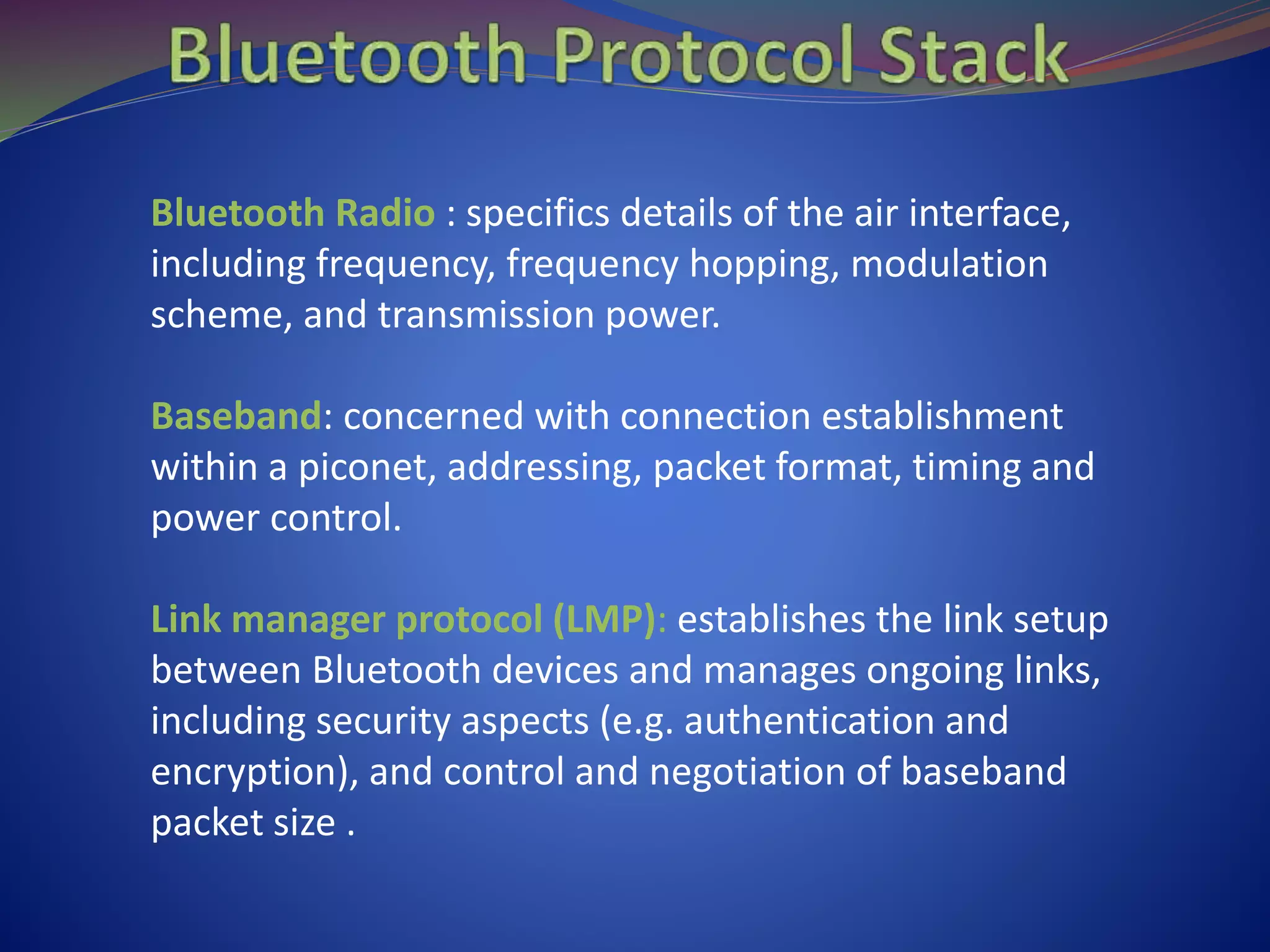
Bluetooth Radio : specifics details of the air interface,
including frequency, frequency hopping, modulation
scheme, and transmission power.
Baseband: concerned with connection establishment
within a piconet, addressing, packet format, timing and
power control.
Link manager protocol (LMP): establishes the link setup
between Bluetooth devices and manages ongoing links,
including security aspects (e.g. authentication and
encryption), and control and negotiation of baseband
packet size .
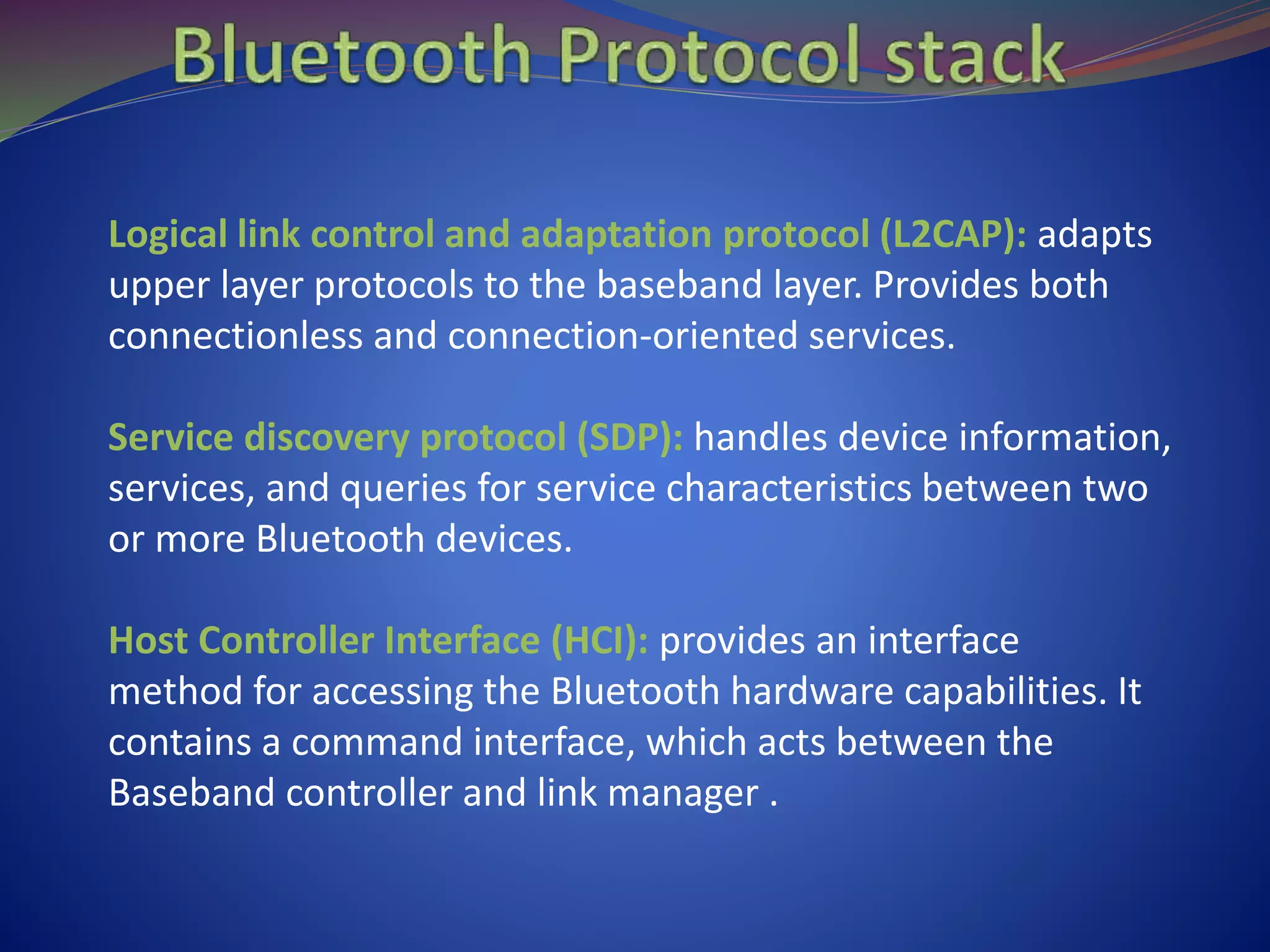
Logical link control and adaptation protocol (L2CAP): adapts
upper layer protocols to the baseband layer. Provides both
connectionless and connection-oriented services.
Service discovery protocol (SDP): handles device information,
services, and queries for service characteristics between two
or more Bluetooth devices.
Host Controller Interface (HCI): provides an interface
method for accessing the Bluetooth hardware capabilities. It
contains a command interface, which acts between the
Baseband controller and link manager .
TCS BIN (Telephony Control Service): bit-oriented protocol
that defines the call control signaling for the establishment
of voice and data calls between Bluetooth devices.
OBEX(OBject EXchange) : Session-layer protocol for the
exchange of objects, providing a model for object and
operation representation
RFCOMM: a reliable transport protocol, which provides
emulation of RS232 serial ports over the L2CAP protocol
WAE/WAP: Bluetooth incorporates the wireless application
environment and the wireless application protocol into its
architecture.
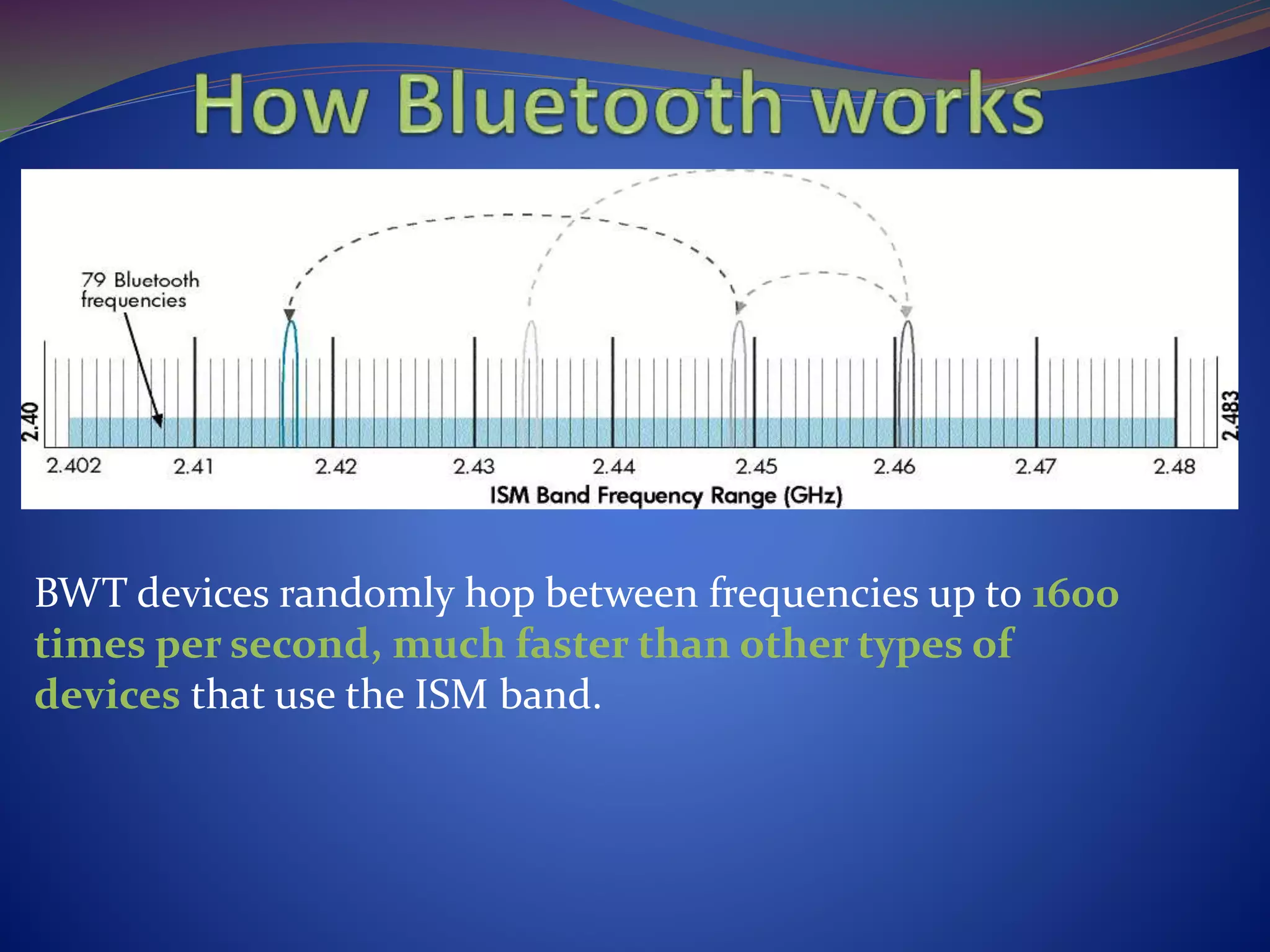
• ISM band ranges between 2.400 GHZ to 2.483
GHZ.
•BWT enabled devices uses a technique called
FREQUENCY HOPPING .
• Data is divided into small pieces called Packets.
•Transmitter and receiver exchange a data packet at one
frequency to exchange, and then they hop to another
frequency to exchange another packet.
•They repeat this process until all the data is transmitted.
BWT devices randomly hop between frequencies up to 1600
times per second, much faster than other types of
devices that use the ISM band.
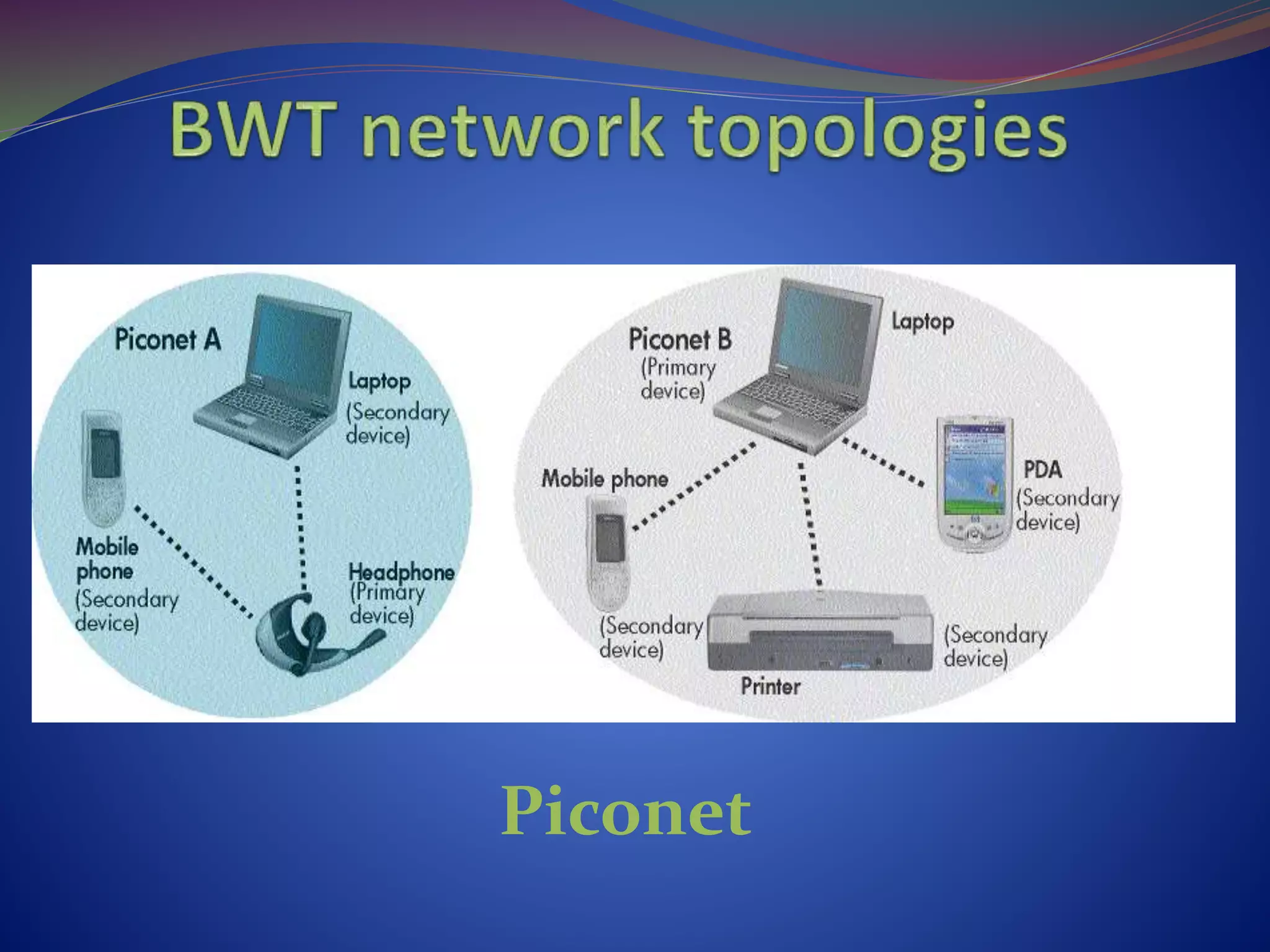
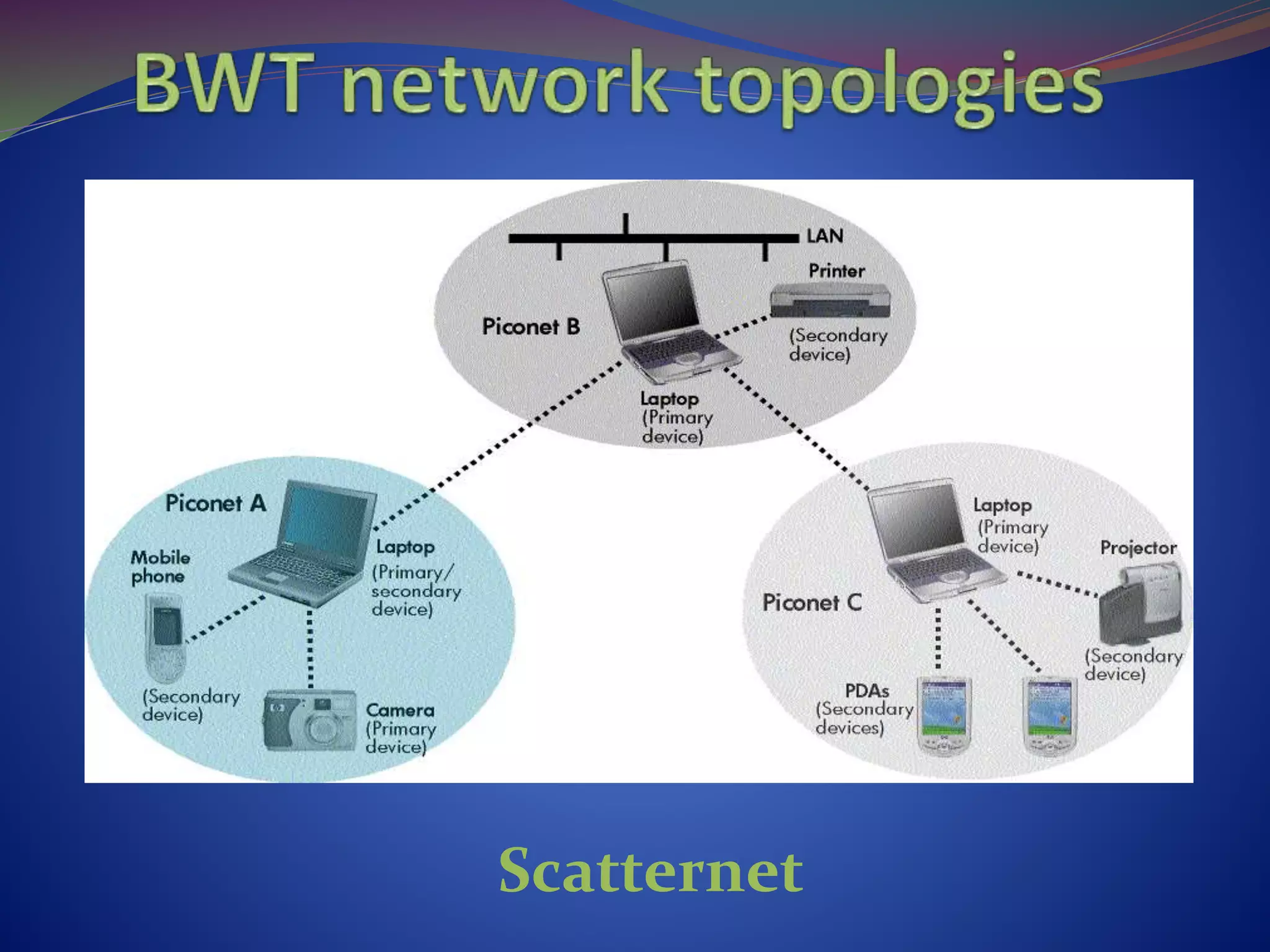
•BWT enabled devices form network topologies called
Piconets and Scatternets.
•Piconet:
- consists of up to eight BWT enabled devices.
- when a piconet is established, one device (primary
device/ master) sets the frequency – hopping
pattern and the other device (secondary device /
slave) synchronize their signals to the same
pattern.
•Scatter net:
- in which two or more piconets connected by a
common device.
Piconet
Scatternet
Bluetooth devices are wireless.
Bluetooth technology is inexpensive.
Bluetooth is Automatic.
Low energy consumption.
Share voice and data.
Bluetooth devices can not be
connected with more than one device
at a time, as it finds problem in
discovering the intended device.
Bluetooth has a low data rate
(i.e 1 MB ps) in comparison to infra-
red (i.e 4 MB ps).
Simple Choice for Convenient, wire-free,
short range communication between devices.
Bluetooth enabled products do not need to
install driver software.
Latest- This technology is now available in
Fourth version.
Fourth version – low power, low cost, built –
in-security, robustness , ease of use and
ad-hoc networking abilities.
Leading technology.
Shipping over 5 million units every week.
By,
SHOBANA. P
MCA,
Ethiraj College for women
March 23,2014.

Bluetooth - Overview

  • 2.
    Introduction History Origin of theBluetooth name Symbol of Bluetooth Bluetooth Protocol Stack How Bluetooth works? Bluetooth topology Advantages and disadvantages of Bluetooth. Conclusion
  • 3.
    • Wireless technology •Used to transfer data between different electronic devices. • Distance of data transmission - Small (Compare to other modes of wireless communication). • Eradicates - Wires, Cables, Adapters.,
  • 4.
    • 1994 –Ericsson Telecommunication (main idea). • Objective – eliminate the cables between the mobile telephones and the desktop devices, headset, etc.., • In February, 1998 – (Ericsson, Nokia , IBM , Toshiba and Intel) - SPECIAL INTEREST GROUP. • Now , Bluetooth is managed by the Bluetooth Special Interest Group.( more than 19,000 companies) in the areas of telecommunication, computing , networking and consumer electronics.. SPECIAL INTEREST GROUP
  • 6.
    • From anarticle EE Times: Jim Kardach , an Intel Engineer. • The name was taken from the 10th century, Second king of Denmark, “King Harald Bluetooth” who was famous for uniting Scandinavia (just as them, to unite the PC and cellular Industries with a short range of wireless link). • By February 1997, SIG formed developing the official name. • The top two names were “Radiowire” and “PAN”. • In April, SIG board meeting voted for “PAN”. • A search showed that the name was already in use. • As launch date neared, running out of time , the SIG team had no other alternative than to adopt “Bluetooth” as the official name.
  • 7.
    • Harald (transcribedby H) and Bluetooth (transcribed by B)
  • 8.
    Bluetooth Radio Baseband LMP L2CAP Audio RFCOMM PPP IP UDP TCP WAP WAE OBEX vCard/vCal AT- Commands TCSBIN Host Controller Interface (HCI) Bluetooth Core Protocol Adopted Protocol Cable Replacement Protocol SDP Telephony Protocol
  • 9.
    Bluetooth Radio :specifics details of the air interface, including frequency, frequency hopping, modulation scheme, and transmission power. Baseband: concerned with connection establishment within a piconet, addressing, packet format, timing and power control. Link manager protocol (LMP): establishes the link setup between Bluetooth devices and manages ongoing links, including security aspects (e.g. authentication and encryption), and control and negotiation of baseband packet size .
  • 10.
    Logical link controland adaptation protocol (L2CAP): adapts upper layer protocols to the baseband layer. Provides both connectionless and connection-oriented services. Service discovery protocol (SDP): handles device information, services, and queries for service characteristics between two or more Bluetooth devices. Host Controller Interface (HCI): provides an interface method for accessing the Bluetooth hardware capabilities. It contains a command interface, which acts between the Baseband controller and link manager .
  • 11.
    TCS BIN (TelephonyControl Service): bit-oriented protocol that defines the call control signaling for the establishment of voice and data calls between Bluetooth devices. OBEX(OBject EXchange) : Session-layer protocol for the exchange of objects, providing a model for object and operation representation RFCOMM: a reliable transport protocol, which provides emulation of RS232 serial ports over the L2CAP protocol WAE/WAP: Bluetooth incorporates the wireless application environment and the wireless application protocol into its architecture.
  • 12.
    • ISM bandranges between 2.400 GHZ to 2.483 GHZ. •BWT enabled devices uses a technique called FREQUENCY HOPPING . • Data is divided into small pieces called Packets. •Transmitter and receiver exchange a data packet at one frequency to exchange, and then they hop to another frequency to exchange another packet. •They repeat this process until all the data is transmitted.
  • 13.
    BWT devices randomlyhop between frequencies up to 1600 times per second, much faster than other types of devices that use the ISM band.
  • 14.
    •BWT enabled devicesform network topologies called Piconets and Scatternets. •Piconet: - consists of up to eight BWT enabled devices. - when a piconet is established, one device (primary device/ master) sets the frequency – hopping pattern and the other device (secondary device / slave) synchronize their signals to the same pattern. •Scatter net: - in which two or more piconets connected by a common device.
  • 15.
  • 16.
  • 17.
    Bluetooth devices arewireless. Bluetooth technology is inexpensive. Bluetooth is Automatic. Low energy consumption. Share voice and data.
  • 18.
    Bluetooth devices cannot be connected with more than one device at a time, as it finds problem in discovering the intended device. Bluetooth has a low data rate (i.e 1 MB ps) in comparison to infra- red (i.e 4 MB ps).
  • 19.
    Simple Choice forConvenient, wire-free, short range communication between devices. Bluetooth enabled products do not need to install driver software. Latest- This technology is now available in Fourth version. Fourth version – low power, low cost, built – in-security, robustness , ease of use and ad-hoc networking abilities. Leading technology. Shipping over 5 million units every week.
  • 20.
    By, SHOBANA. P MCA, Ethiraj Collegefor women March 23,2014.