Narrow Band Internet Of Things (NB IoT)
Copyright @ Nex-G | Skills, NESPL 1
Copyright @ Nex-G | Skills, NESPL 2
Table Of Content
Contents
IoT Introduction
NB IoT Introduction
RRC Layer
PDCP Layer
RLC Layer
Mac Layer
Physical Layer
Copyright @ Nex-G | Skills, NESPL 3
IOT INTRODUCTION
 It Is a network of devices embedded with sensors and network connectivity that
enables them to collect and exchange data.
 The IOT allows objects to be sensed and controlled remotely across existing network
infrastructure creating opportunities for direct integration between the physical and
digital world resulting in improved efficiency, accuracy and economic benefits.
 “Things” in IOT refers to the objects in physical world that could be connected to the
internet by sensors.
 These devices collect useful data with the help of various existing technologies and
then autonomously flow the data between other devices.
 IOT is an evolution of mobiles, homes and embedded applications connected to the
internet integrating greater capabilities and using data analytics to extract
meaningful information.
Copyright @ Nex-G | Skills, NESPL 44
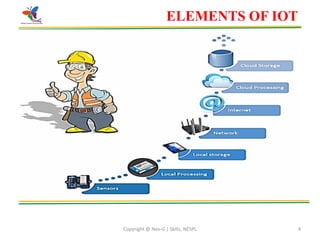
ELEMENTS OF IOT
Copyright @ Nex-G | Skills, NESPL 5
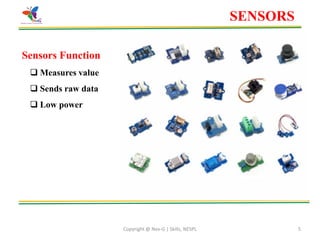
SENSORS
Sensors Function
 Measures value
 Sends raw data
 Low power
Copyright @ Nex-G | Skills, NESPL 6
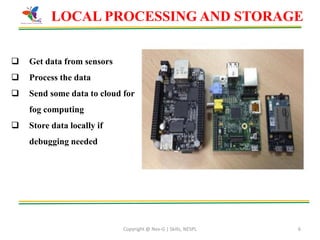
LOCAL PROCESSING AND STORAGE
 Get data from sensors
 Process the data
 Send some data to cloud for
fog computing
 Store data locally if
debugging needed
Copyright @ Nex-G | Skills, NESPL 7
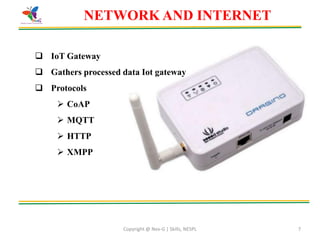
NETWORK AND INTERNET
 IoT Gateway
 Gathers processed data Iot gateway
 Protocols
 CoAP
 MQTT
 HTTP
 XMPP
Copyright @ Nex-G | Skills, NESPL 8
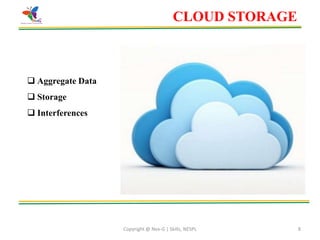
CLOUD STORAGE
 Aggregate Data
 Storage
 Interferences
Copyright @ Nex-G | Skills, NESPL 9
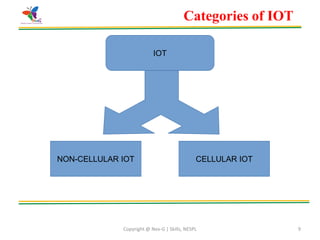
Categories of IOT
IOT
NON-CELLULAR IOT CELLULAR IOT
Copyright @ Nex-G | Skills, NESPL 10
 3GPP has been working on 3 different IoT standard solutions-
 LTE-M based on LTE evolutions, Cat0(rel 12) and cat-1(rel 13)
 EC-GSM – A narrowband solution based on GSM evolution,
 NB-LTE- A narrowband cellular IoT solution, also known as
clean state solutions, Cat200KHz.
 Later, EC-GSM and NB-LTE, were combined for standardization
as a single NB-IoT technology.
NB-IOT STANDARDS DEVELOPMENT
Copyright @ Nex-G | Skills, NESPL 11
NB-IoT Introduction
 Narrowband IoT (also known as NB-IoT or LTE-M2) is a proposed
LPWAN technology.
 NBIoT is a Low Power Wide Area Network (LPWAN) radio technology
standard that has been developed to enable a wide range of devices and
services to be connected using cellular telecommunications bands.
 NB-IoT technology can be deployed “in-Band, Guard-Band, Standalone.
 It is also suitable for the re-farming of GSM spectrum
 NB-IoT focuses specifically on indoor coverage, low cost, long battery life,
and enabling a large number of connected devices.
 Other 3GPP IoT technologies include eMTC (enhanced Machine-Type
Communication) and EC-GSM-IoT.
Copyright @ Nex-G | Skills, NESPL 12
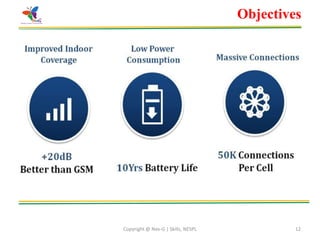
Objectives
Copyright @ Nex-G | Skills, NESPL 13
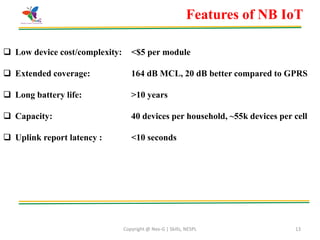
Features of NB IoT
 Low device cost/complexity: <$5 per module
 Extended coverage: 164 dB MCL, 20 dB better compared to GPRS
 Long battery life: >10 years
 Capacity: 40 devices per household, ~55k devices per cell
 Uplink report latency : <10 seconds
Copyright @ Nex-G | Skills, NESPL 14
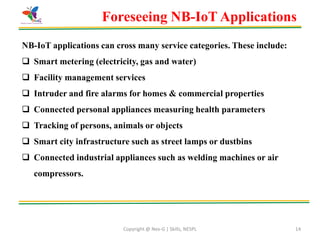
Foreseeing NB-IoT Applications
NB-IoT applications can cross many service categories. These include:
 Smart metering (electricity, gas and water)
 Facility management services
 Intruder and fire alarms for homes & commercial properties
 Connected personal appliances measuring health parameters
 Tracking of persons, animals or objects
 Smart city infrastructure such as street lamps or dustbins
 Connected industrial appliances such as welding machines or air
compressors.
Copyright @ Nex-G | Skills, NESPL 15
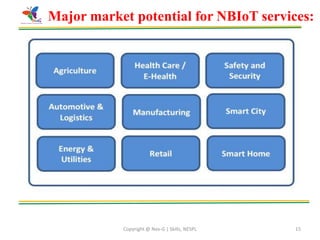
Major market potential for NBIoT services:
Copyright @ Nex-G | Skills, NESPL 16
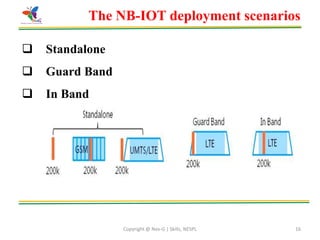
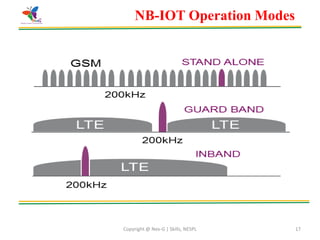
The NB-IOT deployment scenarios
 Standalone
 Guard Band
 In Band
Copyright @ Nex-G | Skills, NESPL 17
NB-IOT Operation Modes
Copyright @ Nex-G | Skills, NESPL 18
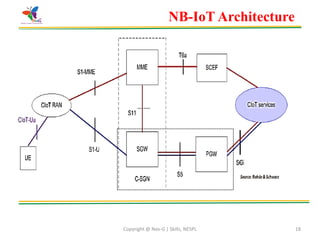
NB-IoT Architecture
Copyright @ Nex-G | Skills, NESPL 19
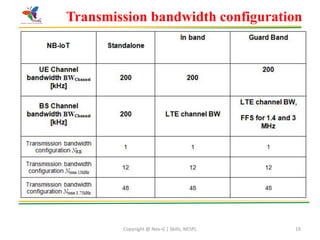
Transmission bandwidth configuration
Copyright @ Nex-G | Skills, NESPL 20
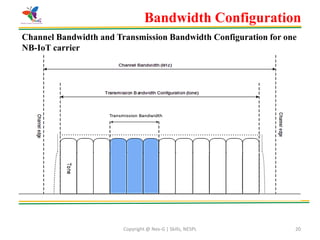
Channel Bandwidth and Transmission Bandwidth Configuration for one
NB-IoT carrier
Bandwidth Configuration
Copyright @ Nex-G | Skills, NESPL 21
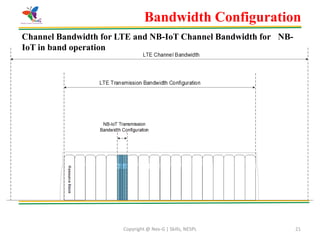
Channel Bandwidth for LTE and NB-IoT Channel Bandwidth for NB-
IoT in band operation
Bandwidth Configuration
Copyright @ Nex-G | Skills, NESPL 22
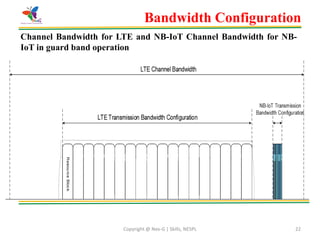
Channel Bandwidth for LTE and NB-IoT Channel Bandwidth for NB-
IoT in guard band operation
Bandwidth Configuration
Copyright @ Nex-G | Skills, NESPL 23
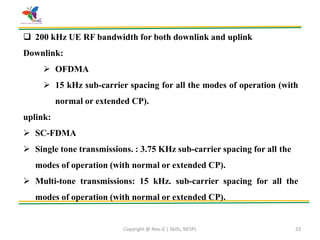
 200 kHz UE RF bandwidth for both downlink and uplink
Downlink:
 OFDMA
 15 kHz sub-carrier spacing for all the modes of operation (with
normal or extended CP).
uplink:
 SC-FDMA
 Single tone transmissions. : 3.75 KHz sub-carrier spacing for all the
modes of operation (with normal or extended CP).
 Multi-tone transmissions: 15 kHz. sub-carrier spacing for all the
modes of operation (with normal or extended CP).
Copyright @ Nex-G | Skills, NESPL 24
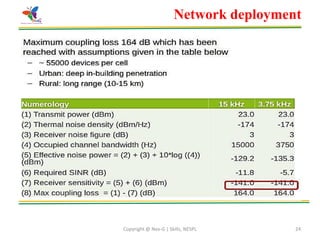
Network deployment
Copyright @ Nex-G | Skills, NESPL 25
NB IoT Characteristics
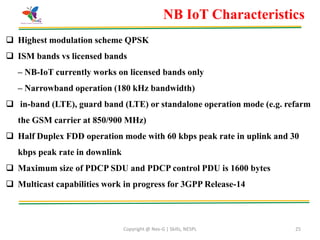
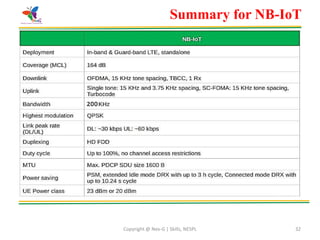
 Highest modulation scheme QPSK
 ISM bands vs licensed bands
– NB-IoT currently works on licensed bands only
– Narrowband operation (180 kHz bandwidth)
 in-band (LTE), guard band (LTE) or standalone operation mode (e.g. refarm
the GSM carrier at 850/900 MHz)
 Half Duplex FDD operation mode with 60 kbps peak rate in uplink and 30
kbps peak rate in downlink
 Maximum size of PDCP SDU and PDCP control PDU is 1600 bytes
 Multicast capabilities work in progress for 3GPP Release-14
Copyright @ Nex-G | Skills, NESPL 26
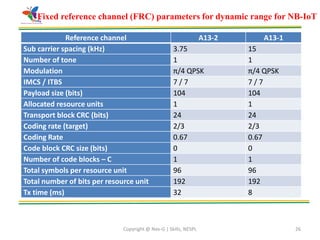
Fixed reference channel (FRC) parameters for dynamic range for NB-IoT
Reference channel A13-2 A13-1
Sub carrier spacing (kHz) 3.75 15
Number of tone 1 1
Modulation π/4 QPSK π/4 QPSK
IMCS / ITBS 7 / 7 7 / 7
Payload size (bits) 104 104
Allocated resource units 1 1
Transport block CRC (bits) 24 24
Coding rate (target) 2/3 2/3
Coding Rate 0.67 0.67
Code block CRC size (bits) 0 0
Number of code blocks – C 1 1
Total symbols per resource unit 96 96
Total number of bits per resource unit 192 192
Tx time (ms) 32 8
Copyright @ Nex-G | Skills, NESPL 27
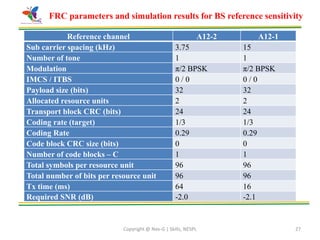
Reference channel A12-2 A12-1
Sub carrier spacing (kHz) 3.75 15
Number of tone 1 1
Modulation π/2 BPSK π/2 BPSK
IMCS / ITBS 0 / 0 0 / 0
Payload size (bits) 32 32
Allocated resource units 2 2
Transport block CRC (bits) 24 24
Coding rate (target) 1/3 1/3
Coding Rate 0.29 0.29
Code block CRC size (bits) 0 0
Number of code blocks – C 1 1
Total symbols per resource unit 96 96
Total number of bits per resource unit 96 96
Tx time (ms) 64 16
Required SNR (dB) -2.0 -2.1
FRC parameters and simulation results for BS reference sensitivity
Copyright @ Nex-G | Skills, NESPL 28
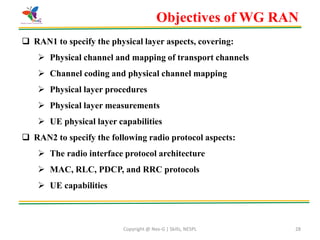
 RAN1 to specify the physical layer aspects, covering:
 Physical channel and mapping of transport channels
 Channel coding and physical channel mapping
 Physical layer procedures
 Physical layer measurements
 UE physical layer capabilities
 RAN2 to specify the following radio protocol aspects:
 The radio interface protocol architecture
 MAC, RLC, PDCP, and RRC protocols
 UE capabilities
Objectives of WG RAN
Copyright @ Nex-G | Skills, NESPL 29
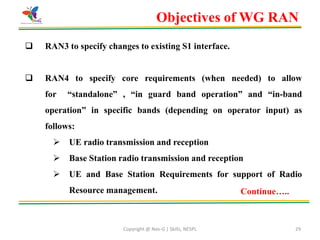
 RAN3 to specify changes to existing S1 interface.
 RAN4 to specify core requirements (when needed) to allow
for “standalone” , “in guard band operation” and “in-band
operation” in specific bands (depending on operator input) as
follows:
 UE radio transmission and reception
 Base Station radio transmission and reception
 UE and Base Station Requirements for support of Radio
Resource management.
Objectives of WG RAN
Continue…..
Copyright @ Nex-G | Skills, NESPL 30
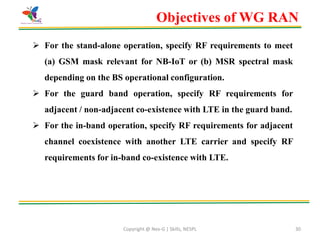
 For the stand-alone operation, specify RF requirements to meet
(a) GSM mask relevant for NB-IoT or (b) MSR spectral mask
depending on the BS operational configuration.
 For the guard band operation, specify RF requirements for
adjacent / non-adjacent co-existence with LTE in the guard band.
 For the in-band operation, specify RF requirements for adjacent
channel coexistence with another LTE carrier and specify RF
requirements for in-band co-existence with LTE.
Objectives of WG RAN
Copyright @ Nex-G | Skills, NESPL 31
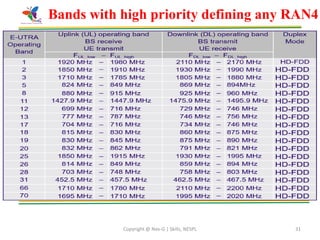
Bands with high priority defining any RAN4
Copyright @ Nex-G | Skills, NESPL 32
Summary for NB-IoT
Copyright @ Nex-G | Skills, NESPL 33
RRC:
Radio Resource Control
Copyright @ Nex-G | Skills, NESPL 34
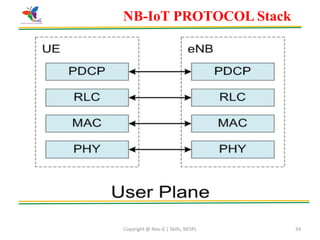
NB-IoT PROTOCOL Stack
Copyright @ Nex-G | Skills, NESPL 35
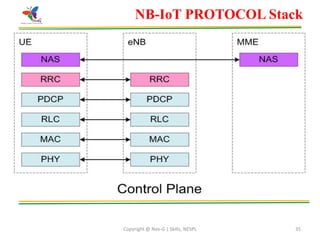
NB-IoT PROTOCOL Stack
Copyright @ Nex-G | Skills, NESPL 36
 RRC layer specification is defined in TS 36.331 , and for NB-IoT, the
RRC layer specifications are slightly different from that of LTE.
 UE must make the transition to RRC Connected mode before
transferring any application data, or completing any signaling
procedures.
 RRC connection establishment is a 3-way handshake between UE and
eNodeB, which is used to make the transition of UE from RRC Idle
mode to RRC Connected mode.
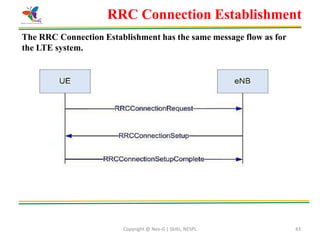
 RRC connection establishment procedure has mainly 3 steps. RRC
connection request message sent by UE, RRC connection setup sent by
eNodeB, RRC setup complete messages send by UE.
NB-IoT RRC
Copyright @ Nex-G | Skills, NESPL 37
 The RRC connection establishment procedure is always initiated by the
UE but can be triggered by either the UE or the network.
For example, the UE triggers RRC connection establishment if the
end-user starts an application to browse the internet, or to send an
email.
 The UE triggers RRC connection establishment if the UE moves into a
new Tracking Area and has to complete the Tracking Area Update
signaling procedure.
 The network triggers the RRC connection establishment procedure by
sending a Paging message. This could be used to allow the delivery of
an incoming SMS or notification of an incoming voice call.
NB-IoT RRC
Copyright @ Nex-G | Skills, NESPL 38
 The initial Non-Access Stratum (NAS) message is transferred as part
of the RRC connection establishment procedure to reduce connection
establishment delay
 RRC connection establishment configures Signaling Radio Bearer
(SRB) 1 and (SRB1 bis) allows subsequent signaling to use the
Dedicated Control Channel (DCCH) rather than the Common
Control Channel (CCCH) used by SRB 0
 some of the functions of normal LTE function are not supported in
LTE-NB.
NB-IoT RRC
Copyright @ Nex-G | Skills, NESPL 39
 Functionality that are supported in normal LTE but not in LTE-NB.
These are based on 36.331 4.4 Functions.
 ETWS Notification, CMAS Notification
 Inter RAT Mobility including e.g. security activation transfer of
RRC context information
 Measurement Configuration and Reporting
 Self-configuration and Self-optimization
 Measurement logging and reporting for network performance
optimization
NB-IoT RRC
Copyright @ Nex-G | Skills, NESPL 40
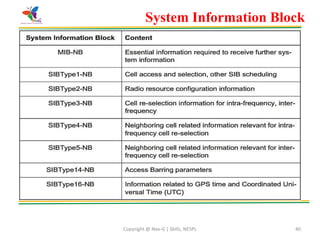
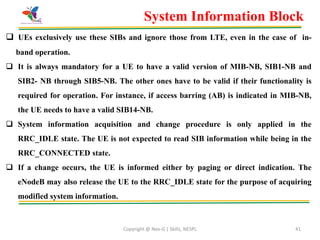
System Information Block
Copyright @ Nex-G | Skills, NESPL 41
 UEs exclusively use these SIBs and ignore those from LTE, even in the case of in-
band operation.
 It is always mandatory for a UE to have a valid version of MIB-NB, SIB1-NB and
SIB2- NB through SIB5-NB. The other ones have to be valid if their functionality is
required for operation. For instance, if access barring (AB) is indicated in MIB-NB,
the UE needs to have a valid SIB14-NB.
 System information acquisition and change procedure is only applied in the
RRC_IDLE state. The UE is not expected to read SIB information while being in the
RRC_CONNECTED state.
 If a change occurs, the UE is informed either by paging or direct indication. The
eNodeB may also release the UE to the RRC_IDLE state for the purpose of acquiring
modified system information.
System Information Block
Copyright @ Nex-G | Skills, NESPL 42
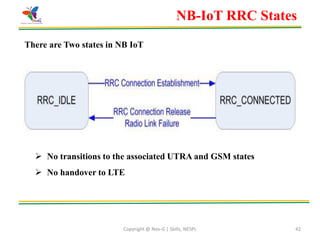
NB-IoT RRC States
There are Two states in NB IoT
 No transitions to the associated UTRA and GSM states
 No handover to LTE
Copyright @ Nex-G | Skills, NESPL 43
RRC Connection Establishment
The RRC Connection Establishment has the same message flow as for
the LTE system.
Copyright @ Nex-G | Skills, NESPL 44
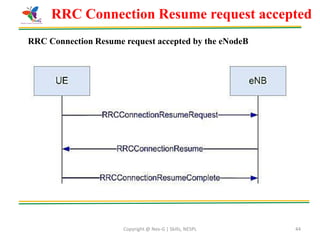
RRC Connection Resume request accepted by the eNodeB
RRC Connection Resume request accepted
Copyright @ Nex-G | Skills, NESPL 45
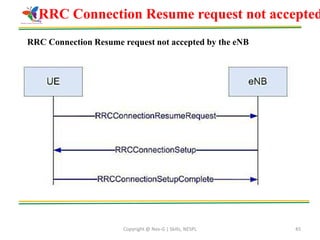
RRC Connection Resume request not accepted by the eNB
RRC Connection Resume request not accepted
Copyright @ Nex-G | Skills, NESPL 46
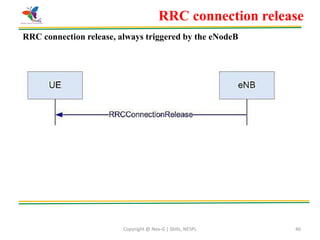
RRC connection release, always triggered by the eNodeB
RRC connection release
Copyright @ Nex-G | Skills, NESPL 47
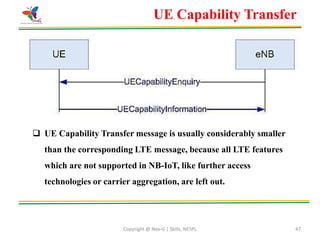
 UE Capability Transfer message is usually considerably smaller
than the corresponding LTE message, because all LTE features
which are not supported in NB-IoT, like further access
technologies or carrier aggregation, are left out.
UE Capability Transfer
Copyright @ Nex-G | Skills, NESPL 48
PDCP:
PACKET DATA CONVERGENCE
PROTOCOL
Copyright @ Nex-G | Skills, NESPL 49
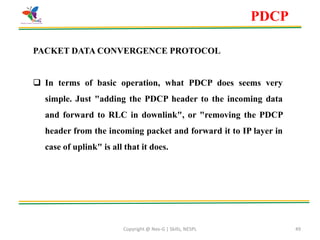
PDCP
PACKET DATA CONVERGENCE PROTOCOL
 In terms of basic operation, what PDCP does seems very
simple. Just "adding the PDCP header to the incoming data
and forward to RLC in downlink", or "removing the PDCP
header from the incoming packet and forward it to IP layer in
case of uplink" is all that it does.
Copyright @ Nex-G | Skills, NESPL 50
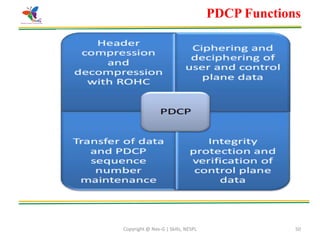
PDCP Functions
Copyright @ Nex-G | Skills, NESPL 51
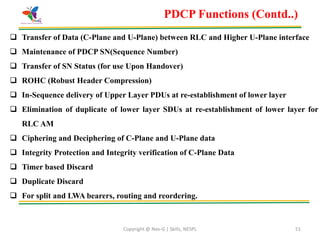
PDCP Functions (Contd..)
 Transfer of Data (C-Plane and U-Plane) between RLC and Higher U-Plane interface
 Maintenance of PDCP SN(Sequence Number)
 Transfer of SN Status (for use Upon Handover)
 ROHC (Robust Header Compression)
 In-Sequence delivery of Upper Layer PDUs at re-establishment of lower layer
 Elimination of duplicate of lower layer SDUs at re-establishment of lower layer for
RLC AM
 Ciphering and Deciphering of C-Plane and U-Plane data
 Integrity Protection and Integrity verification of C-Plane Data
 Timer based Discard
 Duplicate Discard
 For split and LWA bearers, routing and reordering.
Copyright @ Nex-G | Skills, NESPL 52
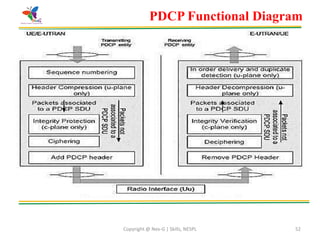
PDCP Functional Diagram
Copyright @ Nex-G | Skills, NESPL 53
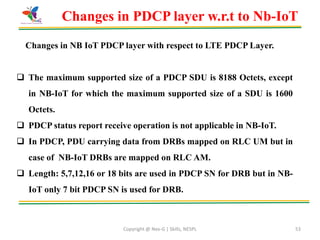
Changes in PDCP layer w.r.t to Nb-IoT
Changes in NB IoT PDCP layer with respect to LTE PDCP Layer.
 The maximum supported size of a PDCP SDU is 8188 Octets, except
in NB-IoT for which the maximum supported size of a SDU is 1600
Octets.
 PDCP status report receive operation is not applicable in NB-IoT.
 In PDCP, PDU carrying data from DRBs mapped on RLC UM but in
case of NB-IoT DRBs are mapped on RLC AM.
 Length: 5,7,12,16 or 18 bits are used in PDCP SN for DRB but in NB-
IoT only 7 bit PDCP SN is used for DRB.
Copyright @ Nex-G | Skills, NESPL 54
RLC
Radio Link Control
Copyright @ Nex-G | Skills, NESPL 55
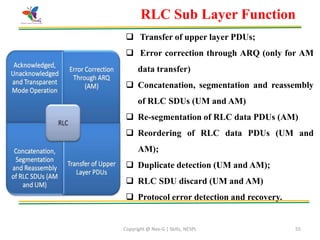
RLC Sub Layer Function
 Transfer of upper layer PDUs;
 Error correction through ARQ (only for AM
data transfer)
 Concatenation, segmentation and reassembly
of RLC SDUs (UM and AM)
 Re-segmentation of RLC data PDUs (AM)
 Reordering of RLC data PDUs (UM and
AM);
 Duplicate detection (UM and AM);
 RLC SDU discard (UM and AM)
 Protocol error detection and recovery.
Copyright @ Nex-G | Skills, NESPL 56
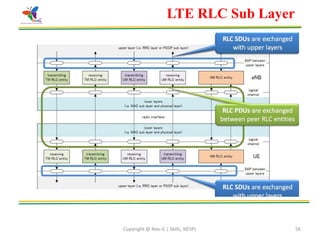
LTE RLC Sub Layer
Copyright @ Nex-G | Skills, NESPL 57
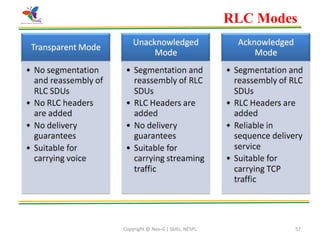
RLC Modes
Copyright @ Nex-G | Skills, NESPL 58
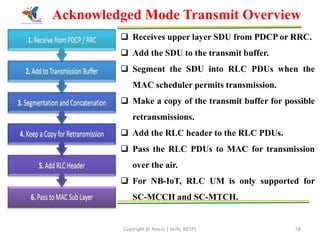
Acknowledged Mode Transmit Overview
 Receives upper layer SDU from PDCP or RRC.
 Add the SDU to the transmit buffer.
 Segment the SDU into RLC PDUs when the
MAC scheduler permits transmission.
 Make a copy of the transmit buffer for possible
retransmissions.
 Add the RLC header to the RLC PDUs.
 Pass the RLC PDUs to MAC for transmission
over the air.
 For NB-IoT, RLC UM is only supported for
SC-MCCH and SC-MTCH.
Copyright @ Nex-G | Skills, NESPL 59
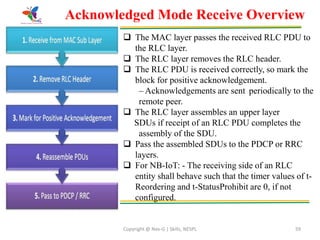
Acknowledged Mode Receive Overview
 The MAC layer passes the received RLC PDU to
the RLC layer.
 The RLC layer removes the RLC header.
 The RLC PDU is received correctly, so mark the
block for positive acknowledgement.
– Acknowledgements are sent periodically to the
remote peer.
 The RLC layer assembles an upper layer
SDUs if receipt of an RLC PDU completes the
assembly of the SDU.
 Pass the assembled SDUs to the PDCP or RRC
layers.
 For NB-IoT: - The receiving side of an RLC
entity shall behave such that the timer values of t-
Reordering and t-StatusProhibit are 0, if not
configured.
Copyright @ Nex-G | Skills, NESPL 60
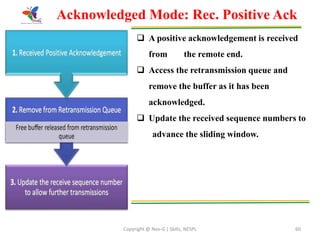
Acknowledged Mode: Rec. Positive Ack
 A positive acknowledgement is received
from the remote end.
 Access the retransmission queue and
remove the buffer as it has been
acknowledged.
 Update the received sequence numbers to
advance the sliding window.
Copyright @ Nex-G | Skills, NESPL 61
Ack Mode: Received -ve Acknowledgement
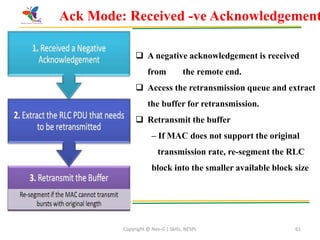
 A negative acknowledgement is received
from the remote end.
 Access the retransmission queue and extract
the buffer for retransmission.
 Retransmit the buffer
– If MAC does not support the original
transmission rate, re-segment the RLC
block into the smaller available block size
Copyright @ Nex-G | Skills, NESPL 62
Ack Mode: Received Retransmission
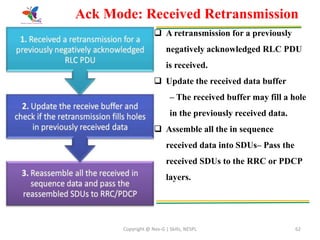
 A retransmission for a previously
negatively acknowledged RLC PDU
is received.
 Update the received data buffer
– The received buffer may fill a hole
in the previously received data.
 Assemble all the in sequence
received data into SDUs– Pass the
received SDUs to the RRC or PDCP
layers.
Copyright @ Nex-G | Skills, NESPL 63
 When a RLC data PDU is received from lower layer, where the RLC data
PDU contains byte segment numbers y to z of an AMD PDU with SN = x,
the receiving side of an AM RLC entity shall:
 if x falls outside of the receiving window; or
 if byte segment numbers y to z of the AMD PDU with SN = x have been
received before: discard the received RLC data PDU;
else:
 place the received RLC data PDU in the reception buffer;
 if some byte segments of the AMD PDU contained in the RLC data PDU
have been received before:
-
RLC data PDU is received from lower layer
Copyright @ Nex-G | Skills, NESPL 64
MAC:
Media Access Control
Copyright @ Nex-G | Skills, NESPL 65
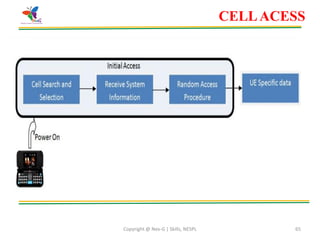
CELLACESS
Copyright @ Nex-G | Skills, NESPL 66
 It first searches a cell on an appropriate frequency,
 Reads the associated SIB information, and
 Starts the random access procedure to establish an RRC
connection.
 With this connection it registers with the core network via the NAS
layer, if not already done.
 After the UE has returned to the RRC_IDLE state, it may either
use again the random access procedure if it has mobile originated
data to send, or waits until it gets paged.
CELLACCESS
Copyright @ Nex-G | Skills, NESPL 67
 Mapping of logical channels onto transport channels.
 Multiplexing of MAC SDU’s from one or different logical channels
onto transport blocks to be delivered to physical layer on UE side.
 Error correction through HARQ retransmission.
 Priority handling between UE’s by means of dynamic scheduling.
 Logical channel prioritization.
 Transport format selection and TB size selection.
MAC LAYER FUNCTION
Copyright @ Nex-G | Skills, NESPL 68
 Initial access from RRC idle state.
 RRC connection re-establishment procedure.
 Achieving UL synchronization from UE to eNodeB.
 When UE’s UL synchronization is lost or “non-synchronized”.
 When UE has msg3 data to be send.
Why RACH procedure
Copyright @ Nex-G | Skills, NESPL 69
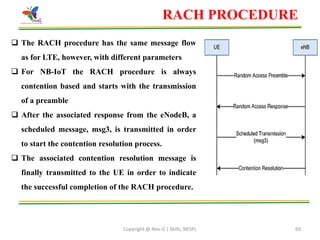
RACH PROCEDURE
 The RACH procedure has the same message flow
as for LTE, however, with different parameters
 For NB-IoT the RACH procedure is always
contention based and starts with the transmission
of a preamble
 After the associated response from the eNodeB, a
scheduled message, msg3, is transmitted in order
to start the contention resolution process.
 The associated contention resolution message is
finally transmitted to the UE in order to indicate
the successful completion of the RACH procedure.
Copyright @ Nex-G | Skills, NESPL 70
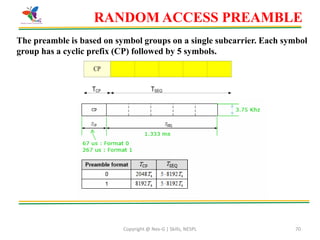
RANDOM ACCESS PREAMBLE
The preamble is based on symbol groups on a single subcarrier. Each symbol
group has a cyclic prefix (CP) followed by 5 symbols.
Copyright @ Nex-G | Skills, NESPL 71
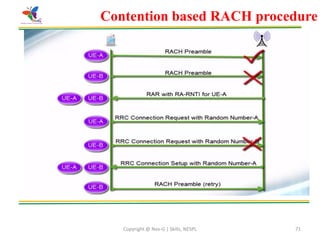
Contention based RACH procedure
Copyright @ Nex-G | Skills, NESPL 72
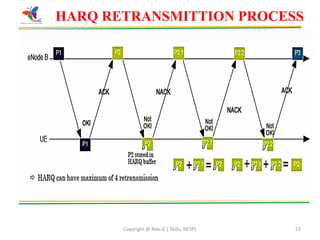
HARQ RETRANSMITTION PROCESS
Copyright @ Nex-G | Skills, NESPL 73
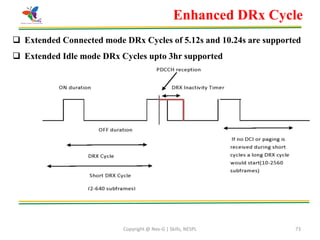
 Extended Connected mode DRx Cycles of 5.12s and 10.24s are supported
 Extended Idle mode DRx Cycles upto 3hr supported
Enhanced DRx Cycle
Copyright @ Nex-G | Skills, NESPL 74
PHY:
PHYSICAL LAYER
Copyright @ Nex-G | Skills, NESPL 75
Physical Layers Function
 Enables exchange of data & control info between eNodeB and UE and also
transport of data to and from higher layers
 Functions performed include error detection, FEC, antenna processing,
synchronization, etc.
It consists of Physical Signals and Physical Channels
 Physical Signals are used for system synchronization, cell identification and
channel estimation.
 Physical Channels for transporting control, scheduling and user payload
from the higher layers
 OFDMA in the DL, SC-FDMA in the UL
 NB-IoT supports FDD and TDD modes of operation
Copyright @ Nex-G | Skills, NESPL 76
Physical Channels
 Physical channels
 A downlink narrowband physical channel corresponds to a set of resource
elements carrying information originating from higher layers.
 The following downlink physical channels are defined:
 Narrowband Physical Downlink Shared Channel, NPDSCH
 Narrowband Physical Broadcast Channel, NPBCH
 Narrowband Physical Downlink Control Channel, NPDCCH
Copyright @ Nex-G | Skills, NESPL 77
Physical Channels
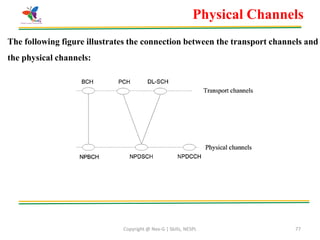
The following figure illustrates the connection between the transport channels and
the physical channels:
Copyright @ Nex-G | Skills, NESPL 78
Physical Channels
 Downlink
For the DL, three physical channels
 NPBCH, the narrowband physical broadcast channel
 NPDCCH, the narrowband physical downlink control channel
 NPDSCH, the narrowband physical downlink shared channel and two
physical signals
 NRS, Narrowband Reference Signal
 NPSS and NSSS, Primary and Secondary Synchronization Signals are
defined. These are less channels than for LTE.
 The physical multicast channel PMCH is not included, because there is
no MBMS service for NB-IoT.,
Copyright @ Nex-G | Skills, NESPL 79
Frame and Slot Structure
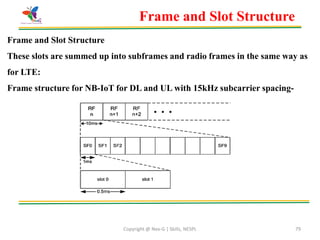
These slots are summed up into subframes and radio frames in the same way as
for LTE:
Frame structure for NB-IoT for DL and UL with 15kHz subcarrier spacing-
Copyright @ Nex-G | Skills, NESPL 80
Physical Resource Block
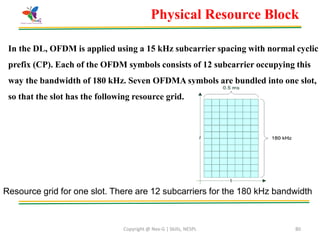
In the DL, OFDM is applied using a 15 kHz subcarrier spacing with normal cyclic
prefix (CP). Each of the OFDM symbols consists of 12 subcarrier occupying this
way the bandwidth of 180 kHz. Seven OFDMA symbols are bundled into one slot,
so that the slot has the following resource grid.
Resource grid for one slot. There are 12 subcarriers for the 180 kHz bandwidth
Copyright @ Nex-G | Skills, NESPL 81
Physical Channels
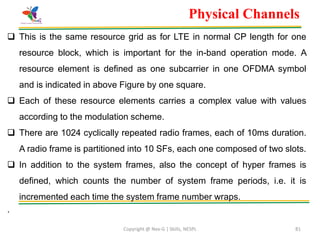
 This is the same resource grid as for LTE in normal CP length for one
resource block, which is important for the in-band operation mode. A
resource element is defined as one subcarrier in one OFDMA symbol
and is indicated in above Figure by one square.
 Each of these resource elements carries a complex value with values
according to the modulation scheme.
 There are 1024 cyclically repeated radio frames, each of 10ms duration.
A radio frame is partitioned into 10 SFs, each one composed of two slots.
 In addition to the system frames, also the concept of hyper frames is
defined, which counts the number of system frame periods, i.e. it is
incremented each time the system frame number wraps.
.
Copyright @ Nex-G | Skills, NESPL 82
Narrowband Reference Signal
 Narrowband Reference Signal
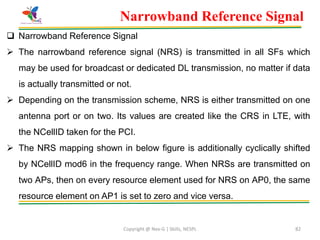
 The narrowband reference signal (NRS) is transmitted in all SFs which
may be used for broadcast or dedicated DL transmission, no matter if data
is actually transmitted or not.
 Depending on the transmission scheme, NRS is either transmitted on one
antenna port or on two. Its values are created like the CRS in LTE, with
the NCellID taken for the PCI.
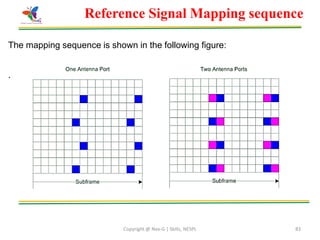
 The NRS mapping shown in below figure is additionally cyclically shifted
by NCellID mod6 in the frequency range. When NRSs are transmitted on
two APs, then on every resource element used for NRS on AP0, the same
resource element on AP1 is set to zero and vice versa.
Copyright @ Nex-G | Skills, NESPL 83
Reference Signal Mapping sequence
The mapping sequence is shown in the following figure:
.
Copyright @ Nex-G | Skills, NESPL 84
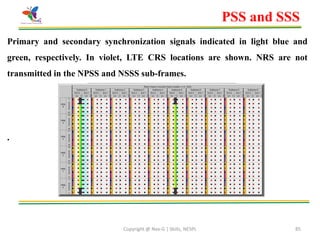
Synchronization Signals
 For a first synchronization in frame and subframe and in order to determine the
NCellID, the LTE concept of Primary Synchronization Signal (PSS) and Secondary
Synchronization Signal (SSS) is reused. With these signals, also timing and frequency
estimation may be refined in the UE receiver.
 In order to distinguish these signals from their LTE counterparts, they are denoted as
NPSS and NSSS, respectively.
 The first 3 OFDM symbols are left out, because they may carry the PDCCH in LTE
when NB-IoT is operated in the in-band mode. Note that during the time when the UE
synchronizes to the NPSS and NSSS, it may not know the operation mode,
consequently this guard time applies to all modes. In addition, both synchronization
signals are punctured by the LTE's CRS.
Copyright @ Nex-G | Skills, NESPL 85
PSS and SSS
Primary and secondary synchronization signals indicated in light blue and
green, respectively. In violet, LTE CRS locations are shown. NRS are not
transmitted in the NPSS and NSSS sub-frames.
.
Copyright @ Nex-G | Skills, NESPL 86
Narrowband Phy Broadcast Channel
Narrowband Physical Broadcast Channel.
 NPBCH is a special channel to carry MIB and has following characteristics:
It carries only the MIB.
It is using QPSK.
 Overall channel coding process is almost same as legacy LTE (the differences
are input/output bit length of each channel coding process) and of course
resource element mapping and transmission cycle/sub-frame will be
drastically different from legacy LTE.
Copyright @ Nex-G | Skills, NESPL 87
Dedicated Channels
 The principle of control and shared channel also applies for NB-IoT,
defining the Narrowband Physical Downlink Control Channel (NPDCCH)
and the Narrowband Physical Downlink Shared Channel (NPDSCH).
 Not all SFs may be used for transmission of the dedicated DL channels
For the case that a SF is not indicated as valid, dedicated DL channel
transmission is postponed until the next valid SF..
 The NPDCCH indicates for which UE there is data in the NPDSCH, where
to find them and how often they are repeated. Also, the UL grants are
provided therein, showing the resources the UE shall use for data
transmission in the UL. Finally, additional information like paging or system
information update is contained in the NPDCCH as well.
Copyright @ Nex-G | Skills, NESPL 88
 NB-IoT is the 3GPP radio-access technology designed to meet the connectivity
requirements for massive MTC applications.
 In contrast to other MTC standards, NB-IoT enjoys all the benefits of licensed
spectrum, the feature richness of EPC and the overall ecosystem spread of 3GPP .
 It is optimized to small and infrequent data packets this way UE can be kept in a cost
efficient way and needs only a small amount of battery power.
 In the ongoing discussions in 3GPP surrounding 5G , LTE will continue to be an
integral part of radio networks beyond 2020, and so, NB-IoT 's resemblance to LTE
safeguards the technology from diverging evolution paths.
 With Release 14, the development of NB-IoT will continue . According to the current
plans, NB-IoT will be extended to include positioning methods, multicast services
required.
CONCLUSION
Copyright @ Nex-G | Skills, NESPL 89
TS 36.331-Radio Resource Control (RRC); Protocol specification
TS 36.323- Packet Data Convergence Protocol (PDCP) specification
TS 36.322- Radio Link Control (RLC) protocol specification
TS 36.321-Medium Access Control (MAC) protocol specification
TS 36.211-Physical channels(PHY) and modulation
http://www.huawei.com/minisite/iot/img/nb_iot_whitepaper_en.pdf
https://en.wikipedia.org/wiki/NarrowBand_IOT
https://www.u-blox.com/en/narrowband-iot-nb-ioT
https://resources.nokia.com/asset/200178
https://www.link-labs.com/blog/overview-of-narrowband-iot
https://www.pages.arm.com/NB-IoT-White-Paper.htm
https://www.literature.cdn.keysight.com/litweb/pdf/5992-1734EN.pdf?id=2775285
https://www.3gpp.org/news-events/3gpp-news/1785-nb_iot_complete
References
Copyright @ Nex-G | Skills, NESPL 90

Nb iot presentation

  • 1.
    Narrow Band InternetOf Things (NB IoT) Copyright @ Nex-G | Skills, NESPL 1
  • 2.
    Copyright @ Nex-G| Skills, NESPL 2 Table Of Content Contents IoT Introduction NB IoT Introduction RRC Layer PDCP Layer RLC Layer Mac Layer Physical Layer
  • 3.
    Copyright @ Nex-G| Skills, NESPL 3 IOT INTRODUCTION  It Is a network of devices embedded with sensors and network connectivity that enables them to collect and exchange data.  The IOT allows objects to be sensed and controlled remotely across existing network infrastructure creating opportunities for direct integration between the physical and digital world resulting in improved efficiency, accuracy and economic benefits.  “Things” in IOT refers to the objects in physical world that could be connected to the internet by sensors.  These devices collect useful data with the help of various existing technologies and then autonomously flow the data between other devices.  IOT is an evolution of mobiles, homes and embedded applications connected to the internet integrating greater capabilities and using data analytics to extract meaningful information.
  • 4.
    Copyright @ Nex-G| Skills, NESPL 44 ELEMENTS OF IOT
  • 5.
    Copyright @ Nex-G| Skills, NESPL 5 SENSORS Sensors Function  Measures value  Sends raw data  Low power
  • 6.
    Copyright @ Nex-G| Skills, NESPL 6 LOCAL PROCESSING AND STORAGE  Get data from sensors  Process the data  Send some data to cloud for fog computing  Store data locally if debugging needed
  • 7.
    Copyright @ Nex-G| Skills, NESPL 7 NETWORK AND INTERNET  IoT Gateway  Gathers processed data Iot gateway  Protocols  CoAP  MQTT  HTTP  XMPP
  • 8.
    Copyright @ Nex-G| Skills, NESPL 8 CLOUD STORAGE  Aggregate Data  Storage  Interferences
  • 9.
    Copyright @ Nex-G| Skills, NESPL 9 Categories of IOT IOT NON-CELLULAR IOT CELLULAR IOT
  • 10.
    Copyright @ Nex-G| Skills, NESPL 10  3GPP has been working on 3 different IoT standard solutions-  LTE-M based on LTE evolutions, Cat0(rel 12) and cat-1(rel 13)  EC-GSM – A narrowband solution based on GSM evolution,  NB-LTE- A narrowband cellular IoT solution, also known as clean state solutions, Cat200KHz.  Later, EC-GSM and NB-LTE, were combined for standardization as a single NB-IoT technology. NB-IOT STANDARDS DEVELOPMENT
  • 11.
    Copyright @ Nex-G| Skills, NESPL 11 NB-IoT Introduction  Narrowband IoT (also known as NB-IoT or LTE-M2) is a proposed LPWAN technology.  NBIoT is a Low Power Wide Area Network (LPWAN) radio technology standard that has been developed to enable a wide range of devices and services to be connected using cellular telecommunications bands.  NB-IoT technology can be deployed “in-Band, Guard-Band, Standalone.  It is also suitable for the re-farming of GSM spectrum  NB-IoT focuses specifically on indoor coverage, low cost, long battery life, and enabling a large number of connected devices.  Other 3GPP IoT technologies include eMTC (enhanced Machine-Type Communication) and EC-GSM-IoT.
  • 12.
    Copyright @ Nex-G| Skills, NESPL 12 Objectives
  • 13.
    Copyright @ Nex-G| Skills, NESPL 13 Features of NB IoT  Low device cost/complexity: <$5 per module  Extended coverage: 164 dB MCL, 20 dB better compared to GPRS  Long battery life: >10 years  Capacity: 40 devices per household, ~55k devices per cell  Uplink report latency : <10 seconds
  • 14.
    Copyright @ Nex-G| Skills, NESPL 14 Foreseeing NB-IoT Applications NB-IoT applications can cross many service categories. These include:  Smart metering (electricity, gas and water)  Facility management services  Intruder and fire alarms for homes & commercial properties  Connected personal appliances measuring health parameters  Tracking of persons, animals or objects  Smart city infrastructure such as street lamps or dustbins  Connected industrial appliances such as welding machines or air compressors.
  • 15.
    Copyright @ Nex-G| Skills, NESPL 15 Major market potential for NBIoT services:
  • 16.
    Copyright @ Nex-G| Skills, NESPL 16 The NB-IOT deployment scenarios  Standalone  Guard Band  In Band
  • 17.
    Copyright @ Nex-G| Skills, NESPL 17 NB-IOT Operation Modes
  • 18.
    Copyright @ Nex-G| Skills, NESPL 18 NB-IoT Architecture
  • 19.
    Copyright @ Nex-G| Skills, NESPL 19 Transmission bandwidth configuration
  • 20.
    Copyright @ Nex-G| Skills, NESPL 20 Channel Bandwidth and Transmission Bandwidth Configuration for one NB-IoT carrier Bandwidth Configuration
  • 21.
    Copyright @ Nex-G| Skills, NESPL 21 Channel Bandwidth for LTE and NB-IoT Channel Bandwidth for NB- IoT in band operation Bandwidth Configuration
  • 22.
    Copyright @ Nex-G| Skills, NESPL 22 Channel Bandwidth for LTE and NB-IoT Channel Bandwidth for NB- IoT in guard band operation Bandwidth Configuration
  • 23.
    Copyright @ Nex-G| Skills, NESPL 23  200 kHz UE RF bandwidth for both downlink and uplink Downlink:  OFDMA  15 kHz sub-carrier spacing for all the modes of operation (with normal or extended CP). uplink:  SC-FDMA  Single tone transmissions. : 3.75 KHz sub-carrier spacing for all the modes of operation (with normal or extended CP).  Multi-tone transmissions: 15 kHz. sub-carrier spacing for all the modes of operation (with normal or extended CP).
  • 24.
    Copyright @ Nex-G| Skills, NESPL 24 Network deployment
  • 25.
    Copyright @ Nex-G| Skills, NESPL 25 NB IoT Characteristics  Highest modulation scheme QPSK  ISM bands vs licensed bands – NB-IoT currently works on licensed bands only – Narrowband operation (180 kHz bandwidth)  in-band (LTE), guard band (LTE) or standalone operation mode (e.g. refarm the GSM carrier at 850/900 MHz)  Half Duplex FDD operation mode with 60 kbps peak rate in uplink and 30 kbps peak rate in downlink  Maximum size of PDCP SDU and PDCP control PDU is 1600 bytes  Multicast capabilities work in progress for 3GPP Release-14
  • 26.
    Copyright @ Nex-G| Skills, NESPL 26 Fixed reference channel (FRC) parameters for dynamic range for NB-IoT Reference channel A13-2 A13-1 Sub carrier spacing (kHz) 3.75 15 Number of tone 1 1 Modulation π/4 QPSK π/4 QPSK IMCS / ITBS 7 / 7 7 / 7 Payload size (bits) 104 104 Allocated resource units 1 1 Transport block CRC (bits) 24 24 Coding rate (target) 2/3 2/3 Coding Rate 0.67 0.67 Code block CRC size (bits) 0 0 Number of code blocks – C 1 1 Total symbols per resource unit 96 96 Total number of bits per resource unit 192 192 Tx time (ms) 32 8
  • 27.
    Copyright @ Nex-G| Skills, NESPL 27 Reference channel A12-2 A12-1 Sub carrier spacing (kHz) 3.75 15 Number of tone 1 1 Modulation π/2 BPSK π/2 BPSK IMCS / ITBS 0 / 0 0 / 0 Payload size (bits) 32 32 Allocated resource units 2 2 Transport block CRC (bits) 24 24 Coding rate (target) 1/3 1/3 Coding Rate 0.29 0.29 Code block CRC size (bits) 0 0 Number of code blocks – C 1 1 Total symbols per resource unit 96 96 Total number of bits per resource unit 96 96 Tx time (ms) 64 16 Required SNR (dB) -2.0 -2.1 FRC parameters and simulation results for BS reference sensitivity
  • 28.
    Copyright @ Nex-G| Skills, NESPL 28  RAN1 to specify the physical layer aspects, covering:  Physical channel and mapping of transport channels  Channel coding and physical channel mapping  Physical layer procedures  Physical layer measurements  UE physical layer capabilities  RAN2 to specify the following radio protocol aspects:  The radio interface protocol architecture  MAC, RLC, PDCP, and RRC protocols  UE capabilities Objectives of WG RAN
  • 29.
    Copyright @ Nex-G| Skills, NESPL 29  RAN3 to specify changes to existing S1 interface.  RAN4 to specify core requirements (when needed) to allow for “standalone” , “in guard band operation” and “in-band operation” in specific bands (depending on operator input) as follows:  UE radio transmission and reception  Base Station radio transmission and reception  UE and Base Station Requirements for support of Radio Resource management. Objectives of WG RAN Continue…..
  • 30.
    Copyright @ Nex-G| Skills, NESPL 30  For the stand-alone operation, specify RF requirements to meet (a) GSM mask relevant for NB-IoT or (b) MSR spectral mask depending on the BS operational configuration.  For the guard band operation, specify RF requirements for adjacent / non-adjacent co-existence with LTE in the guard band.  For the in-band operation, specify RF requirements for adjacent channel coexistence with another LTE carrier and specify RF requirements for in-band co-existence with LTE. Objectives of WG RAN
  • 31.
    Copyright @ Nex-G| Skills, NESPL 31 Bands with high priority defining any RAN4
  • 32.
    Copyright @ Nex-G| Skills, NESPL 32 Summary for NB-IoT
  • 33.
    Copyright @ Nex-G| Skills, NESPL 33 RRC: Radio Resource Control
  • 34.
    Copyright @ Nex-G| Skills, NESPL 34 NB-IoT PROTOCOL Stack
  • 35.
    Copyright @ Nex-G| Skills, NESPL 35 NB-IoT PROTOCOL Stack
  • 36.
    Copyright @ Nex-G| Skills, NESPL 36  RRC layer specification is defined in TS 36.331 , and for NB-IoT, the RRC layer specifications are slightly different from that of LTE.  UE must make the transition to RRC Connected mode before transferring any application data, or completing any signaling procedures.  RRC connection establishment is a 3-way handshake between UE and eNodeB, which is used to make the transition of UE from RRC Idle mode to RRC Connected mode.  RRC connection establishment procedure has mainly 3 steps. RRC connection request message sent by UE, RRC connection setup sent by eNodeB, RRC setup complete messages send by UE. NB-IoT RRC
  • 37.
    Copyright @ Nex-G| Skills, NESPL 37  The RRC connection establishment procedure is always initiated by the UE but can be triggered by either the UE or the network. For example, the UE triggers RRC connection establishment if the end-user starts an application to browse the internet, or to send an email.  The UE triggers RRC connection establishment if the UE moves into a new Tracking Area and has to complete the Tracking Area Update signaling procedure.  The network triggers the RRC connection establishment procedure by sending a Paging message. This could be used to allow the delivery of an incoming SMS or notification of an incoming voice call. NB-IoT RRC
  • 38.
    Copyright @ Nex-G| Skills, NESPL 38  The initial Non-Access Stratum (NAS) message is transferred as part of the RRC connection establishment procedure to reduce connection establishment delay  RRC connection establishment configures Signaling Radio Bearer (SRB) 1 and (SRB1 bis) allows subsequent signaling to use the Dedicated Control Channel (DCCH) rather than the Common Control Channel (CCCH) used by SRB 0  some of the functions of normal LTE function are not supported in LTE-NB. NB-IoT RRC
  • 39.
    Copyright @ Nex-G| Skills, NESPL 39  Functionality that are supported in normal LTE but not in LTE-NB. These are based on 36.331 4.4 Functions.  ETWS Notification, CMAS Notification  Inter RAT Mobility including e.g. security activation transfer of RRC context information  Measurement Configuration and Reporting  Self-configuration and Self-optimization  Measurement logging and reporting for network performance optimization NB-IoT RRC
  • 40.
    Copyright @ Nex-G| Skills, NESPL 40 System Information Block
  • 41.
    Copyright @ Nex-G| Skills, NESPL 41  UEs exclusively use these SIBs and ignore those from LTE, even in the case of in- band operation.  It is always mandatory for a UE to have a valid version of MIB-NB, SIB1-NB and SIB2- NB through SIB5-NB. The other ones have to be valid if their functionality is required for operation. For instance, if access barring (AB) is indicated in MIB-NB, the UE needs to have a valid SIB14-NB.  System information acquisition and change procedure is only applied in the RRC_IDLE state. The UE is not expected to read SIB information while being in the RRC_CONNECTED state.  If a change occurs, the UE is informed either by paging or direct indication. The eNodeB may also release the UE to the RRC_IDLE state for the purpose of acquiring modified system information. System Information Block
  • 42.
    Copyright @ Nex-G| Skills, NESPL 42 NB-IoT RRC States There are Two states in NB IoT  No transitions to the associated UTRA and GSM states  No handover to LTE
  • 43.
    Copyright @ Nex-G| Skills, NESPL 43 RRC Connection Establishment The RRC Connection Establishment has the same message flow as for the LTE system.
  • 44.
    Copyright @ Nex-G| Skills, NESPL 44 RRC Connection Resume request accepted by the eNodeB RRC Connection Resume request accepted
  • 45.
    Copyright @ Nex-G| Skills, NESPL 45 RRC Connection Resume request not accepted by the eNB RRC Connection Resume request not accepted
  • 46.
    Copyright @ Nex-G| Skills, NESPL 46 RRC connection release, always triggered by the eNodeB RRC connection release
  • 47.
    Copyright @ Nex-G| Skills, NESPL 47  UE Capability Transfer message is usually considerably smaller than the corresponding LTE message, because all LTE features which are not supported in NB-IoT, like further access technologies or carrier aggregation, are left out. UE Capability Transfer
  • 48.
    Copyright @ Nex-G| Skills, NESPL 48 PDCP: PACKET DATA CONVERGENCE PROTOCOL
  • 49.
    Copyright @ Nex-G| Skills, NESPL 49 PDCP PACKET DATA CONVERGENCE PROTOCOL  In terms of basic operation, what PDCP does seems very simple. Just "adding the PDCP header to the incoming data and forward to RLC in downlink", or "removing the PDCP header from the incoming packet and forward it to IP layer in case of uplink" is all that it does.
  • 50.
    Copyright @ Nex-G| Skills, NESPL 50 PDCP Functions
  • 51.
    Copyright @ Nex-G| Skills, NESPL 51 PDCP Functions (Contd..)  Transfer of Data (C-Plane and U-Plane) between RLC and Higher U-Plane interface  Maintenance of PDCP SN(Sequence Number)  Transfer of SN Status (for use Upon Handover)  ROHC (Robust Header Compression)  In-Sequence delivery of Upper Layer PDUs at re-establishment of lower layer  Elimination of duplicate of lower layer SDUs at re-establishment of lower layer for RLC AM  Ciphering and Deciphering of C-Plane and U-Plane data  Integrity Protection and Integrity verification of C-Plane Data  Timer based Discard  Duplicate Discard  For split and LWA bearers, routing and reordering.
  • 52.
    Copyright @ Nex-G| Skills, NESPL 52 PDCP Functional Diagram
  • 53.
    Copyright @ Nex-G| Skills, NESPL 53 Changes in PDCP layer w.r.t to Nb-IoT Changes in NB IoT PDCP layer with respect to LTE PDCP Layer.  The maximum supported size of a PDCP SDU is 8188 Octets, except in NB-IoT for which the maximum supported size of a SDU is 1600 Octets.  PDCP status report receive operation is not applicable in NB-IoT.  In PDCP, PDU carrying data from DRBs mapped on RLC UM but in case of NB-IoT DRBs are mapped on RLC AM.  Length: 5,7,12,16 or 18 bits are used in PDCP SN for DRB but in NB- IoT only 7 bit PDCP SN is used for DRB.
  • 54.
    Copyright @ Nex-G| Skills, NESPL 54 RLC Radio Link Control
  • 55.
    Copyright @ Nex-G| Skills, NESPL 55 RLC Sub Layer Function  Transfer of upper layer PDUs;  Error correction through ARQ (only for AM data transfer)  Concatenation, segmentation and reassembly of RLC SDUs (UM and AM)  Re-segmentation of RLC data PDUs (AM)  Reordering of RLC data PDUs (UM and AM);  Duplicate detection (UM and AM);  RLC SDU discard (UM and AM)  Protocol error detection and recovery.
  • 56.
    Copyright @ Nex-G| Skills, NESPL 56 LTE RLC Sub Layer
  • 57.
    Copyright @ Nex-G| Skills, NESPL 57 RLC Modes
  • 58.
    Copyright @ Nex-G| Skills, NESPL 58 Acknowledged Mode Transmit Overview  Receives upper layer SDU from PDCP or RRC.  Add the SDU to the transmit buffer.  Segment the SDU into RLC PDUs when the MAC scheduler permits transmission.  Make a copy of the transmit buffer for possible retransmissions.  Add the RLC header to the RLC PDUs.  Pass the RLC PDUs to MAC for transmission over the air.  For NB-IoT, RLC UM is only supported for SC-MCCH and SC-MTCH.
  • 59.
    Copyright @ Nex-G| Skills, NESPL 59 Acknowledged Mode Receive Overview  The MAC layer passes the received RLC PDU to the RLC layer.  The RLC layer removes the RLC header.  The RLC PDU is received correctly, so mark the block for positive acknowledgement. – Acknowledgements are sent periodically to the remote peer.  The RLC layer assembles an upper layer SDUs if receipt of an RLC PDU completes the assembly of the SDU.  Pass the assembled SDUs to the PDCP or RRC layers.  For NB-IoT: - The receiving side of an RLC entity shall behave such that the timer values of t- Reordering and t-StatusProhibit are 0, if not configured.
  • 60.
    Copyright @ Nex-G| Skills, NESPL 60 Acknowledged Mode: Rec. Positive Ack  A positive acknowledgement is received from the remote end.  Access the retransmission queue and remove the buffer as it has been acknowledged.  Update the received sequence numbers to advance the sliding window.
  • 61.
    Copyright @ Nex-G| Skills, NESPL 61 Ack Mode: Received -ve Acknowledgement  A negative acknowledgement is received from the remote end.  Access the retransmission queue and extract the buffer for retransmission.  Retransmit the buffer – If MAC does not support the original transmission rate, re-segment the RLC block into the smaller available block size
  • 62.
    Copyright @ Nex-G| Skills, NESPL 62 Ack Mode: Received Retransmission  A retransmission for a previously negatively acknowledged RLC PDU is received.  Update the received data buffer – The received buffer may fill a hole in the previously received data.  Assemble all the in sequence received data into SDUs– Pass the received SDUs to the RRC or PDCP layers.
  • 63.
    Copyright @ Nex-G| Skills, NESPL 63  When a RLC data PDU is received from lower layer, where the RLC data PDU contains byte segment numbers y to z of an AMD PDU with SN = x, the receiving side of an AM RLC entity shall:  if x falls outside of the receiving window; or  if byte segment numbers y to z of the AMD PDU with SN = x have been received before: discard the received RLC data PDU; else:  place the received RLC data PDU in the reception buffer;  if some byte segments of the AMD PDU contained in the RLC data PDU have been received before: - RLC data PDU is received from lower layer
  • 64.
    Copyright @ Nex-G| Skills, NESPL 64 MAC: Media Access Control
  • 65.
    Copyright @ Nex-G| Skills, NESPL 65 CELLACESS
  • 66.
    Copyright @ Nex-G| Skills, NESPL 66  It first searches a cell on an appropriate frequency,  Reads the associated SIB information, and  Starts the random access procedure to establish an RRC connection.  With this connection it registers with the core network via the NAS layer, if not already done.  After the UE has returned to the RRC_IDLE state, it may either use again the random access procedure if it has mobile originated data to send, or waits until it gets paged. CELLACCESS
  • 67.
    Copyright @ Nex-G| Skills, NESPL 67  Mapping of logical channels onto transport channels.  Multiplexing of MAC SDU’s from one or different logical channels onto transport blocks to be delivered to physical layer on UE side.  Error correction through HARQ retransmission.  Priority handling between UE’s by means of dynamic scheduling.  Logical channel prioritization.  Transport format selection and TB size selection. MAC LAYER FUNCTION
  • 68.
    Copyright @ Nex-G| Skills, NESPL 68  Initial access from RRC idle state.  RRC connection re-establishment procedure.  Achieving UL synchronization from UE to eNodeB.  When UE’s UL synchronization is lost or “non-synchronized”.  When UE has msg3 data to be send. Why RACH procedure
  • 69.
    Copyright @ Nex-G| Skills, NESPL 69 RACH PROCEDURE  The RACH procedure has the same message flow as for LTE, however, with different parameters  For NB-IoT the RACH procedure is always contention based and starts with the transmission of a preamble  After the associated response from the eNodeB, a scheduled message, msg3, is transmitted in order to start the contention resolution process.  The associated contention resolution message is finally transmitted to the UE in order to indicate the successful completion of the RACH procedure.
  • 70.
    Copyright @ Nex-G| Skills, NESPL 70 RANDOM ACCESS PREAMBLE The preamble is based on symbol groups on a single subcarrier. Each symbol group has a cyclic prefix (CP) followed by 5 symbols.
  • 71.
    Copyright @ Nex-G| Skills, NESPL 71 Contention based RACH procedure
  • 72.
    Copyright @ Nex-G| Skills, NESPL 72 HARQ RETRANSMITTION PROCESS
  • 73.
    Copyright @ Nex-G| Skills, NESPL 73  Extended Connected mode DRx Cycles of 5.12s and 10.24s are supported  Extended Idle mode DRx Cycles upto 3hr supported Enhanced DRx Cycle
  • 74.
    Copyright @ Nex-G| Skills, NESPL 74 PHY: PHYSICAL LAYER
  • 75.
    Copyright @ Nex-G| Skills, NESPL 75 Physical Layers Function  Enables exchange of data & control info between eNodeB and UE and also transport of data to and from higher layers  Functions performed include error detection, FEC, antenna processing, synchronization, etc. It consists of Physical Signals and Physical Channels  Physical Signals are used for system synchronization, cell identification and channel estimation.  Physical Channels for transporting control, scheduling and user payload from the higher layers  OFDMA in the DL, SC-FDMA in the UL  NB-IoT supports FDD and TDD modes of operation
  • 76.
    Copyright @ Nex-G| Skills, NESPL 76 Physical Channels  Physical channels  A downlink narrowband physical channel corresponds to a set of resource elements carrying information originating from higher layers.  The following downlink physical channels are defined:  Narrowband Physical Downlink Shared Channel, NPDSCH  Narrowband Physical Broadcast Channel, NPBCH  Narrowband Physical Downlink Control Channel, NPDCCH
  • 77.
    Copyright @ Nex-G| Skills, NESPL 77 Physical Channels The following figure illustrates the connection between the transport channels and the physical channels:
  • 78.
    Copyright @ Nex-G| Skills, NESPL 78 Physical Channels  Downlink For the DL, three physical channels  NPBCH, the narrowband physical broadcast channel  NPDCCH, the narrowband physical downlink control channel  NPDSCH, the narrowband physical downlink shared channel and two physical signals  NRS, Narrowband Reference Signal  NPSS and NSSS, Primary and Secondary Synchronization Signals are defined. These are less channels than for LTE.  The physical multicast channel PMCH is not included, because there is no MBMS service for NB-IoT.,
  • 79.
    Copyright @ Nex-G| Skills, NESPL 79 Frame and Slot Structure Frame and Slot Structure These slots are summed up into subframes and radio frames in the same way as for LTE: Frame structure for NB-IoT for DL and UL with 15kHz subcarrier spacing-
  • 80.
    Copyright @ Nex-G| Skills, NESPL 80 Physical Resource Block In the DL, OFDM is applied using a 15 kHz subcarrier spacing with normal cyclic prefix (CP). Each of the OFDM symbols consists of 12 subcarrier occupying this way the bandwidth of 180 kHz. Seven OFDMA symbols are bundled into one slot, so that the slot has the following resource grid. Resource grid for one slot. There are 12 subcarriers for the 180 kHz bandwidth
  • 81.
    Copyright @ Nex-G| Skills, NESPL 81 Physical Channels  This is the same resource grid as for LTE in normal CP length for one resource block, which is important for the in-band operation mode. A resource element is defined as one subcarrier in one OFDMA symbol and is indicated in above Figure by one square.  Each of these resource elements carries a complex value with values according to the modulation scheme.  There are 1024 cyclically repeated radio frames, each of 10ms duration. A radio frame is partitioned into 10 SFs, each one composed of two slots.  In addition to the system frames, also the concept of hyper frames is defined, which counts the number of system frame periods, i.e. it is incremented each time the system frame number wraps. .
  • 82.
    Copyright @ Nex-G| Skills, NESPL 82 Narrowband Reference Signal  Narrowband Reference Signal  The narrowband reference signal (NRS) is transmitted in all SFs which may be used for broadcast or dedicated DL transmission, no matter if data is actually transmitted or not.  Depending on the transmission scheme, NRS is either transmitted on one antenna port or on two. Its values are created like the CRS in LTE, with the NCellID taken for the PCI.  The NRS mapping shown in below figure is additionally cyclically shifted by NCellID mod6 in the frequency range. When NRSs are transmitted on two APs, then on every resource element used for NRS on AP0, the same resource element on AP1 is set to zero and vice versa.
  • 83.
    Copyright @ Nex-G| Skills, NESPL 83 Reference Signal Mapping sequence The mapping sequence is shown in the following figure: .
  • 84.
    Copyright @ Nex-G| Skills, NESPL 84 Synchronization Signals Synchronization Signals  For a first synchronization in frame and subframe and in order to determine the NCellID, the LTE concept of Primary Synchronization Signal (PSS) and Secondary Synchronization Signal (SSS) is reused. With these signals, also timing and frequency estimation may be refined in the UE receiver.  In order to distinguish these signals from their LTE counterparts, they are denoted as NPSS and NSSS, respectively.  The first 3 OFDM symbols are left out, because they may carry the PDCCH in LTE when NB-IoT is operated in the in-band mode. Note that during the time when the UE synchronizes to the NPSS and NSSS, it may not know the operation mode, consequently this guard time applies to all modes. In addition, both synchronization signals are punctured by the LTE's CRS.
  • 85.
    Copyright @ Nex-G| Skills, NESPL 85 PSS and SSS Primary and secondary synchronization signals indicated in light blue and green, respectively. In violet, LTE CRS locations are shown. NRS are not transmitted in the NPSS and NSSS sub-frames. .
  • 86.
    Copyright @ Nex-G| Skills, NESPL 86 Narrowband Phy Broadcast Channel Narrowband Physical Broadcast Channel.  NPBCH is a special channel to carry MIB and has following characteristics: It carries only the MIB. It is using QPSK.  Overall channel coding process is almost same as legacy LTE (the differences are input/output bit length of each channel coding process) and of course resource element mapping and transmission cycle/sub-frame will be drastically different from legacy LTE.
  • 87.
    Copyright @ Nex-G| Skills, NESPL 87 Dedicated Channels  The principle of control and shared channel also applies for NB-IoT, defining the Narrowband Physical Downlink Control Channel (NPDCCH) and the Narrowband Physical Downlink Shared Channel (NPDSCH).  Not all SFs may be used for transmission of the dedicated DL channels For the case that a SF is not indicated as valid, dedicated DL channel transmission is postponed until the next valid SF..  The NPDCCH indicates for which UE there is data in the NPDSCH, where to find them and how often they are repeated. Also, the UL grants are provided therein, showing the resources the UE shall use for data transmission in the UL. Finally, additional information like paging or system information update is contained in the NPDCCH as well.
  • 88.
    Copyright @ Nex-G| Skills, NESPL 88  NB-IoT is the 3GPP radio-access technology designed to meet the connectivity requirements for massive MTC applications.  In contrast to other MTC standards, NB-IoT enjoys all the benefits of licensed spectrum, the feature richness of EPC and the overall ecosystem spread of 3GPP .  It is optimized to small and infrequent data packets this way UE can be kept in a cost efficient way and needs only a small amount of battery power.  In the ongoing discussions in 3GPP surrounding 5G , LTE will continue to be an integral part of radio networks beyond 2020, and so, NB-IoT 's resemblance to LTE safeguards the technology from diverging evolution paths.  With Release 14, the development of NB-IoT will continue . According to the current plans, NB-IoT will be extended to include positioning methods, multicast services required. CONCLUSION
  • 89.
    Copyright @ Nex-G| Skills, NESPL 89 TS 36.331-Radio Resource Control (RRC); Protocol specification TS 36.323- Packet Data Convergence Protocol (PDCP) specification TS 36.322- Radio Link Control (RLC) protocol specification TS 36.321-Medium Access Control (MAC) protocol specification TS 36.211-Physical channels(PHY) and modulation http://www.huawei.com/minisite/iot/img/nb_iot_whitepaper_en.pdf https://en.wikipedia.org/wiki/NarrowBand_IOT https://www.u-blox.com/en/narrowband-iot-nb-ioT https://resources.nokia.com/asset/200178 https://www.link-labs.com/blog/overview-of-narrowband-iot https://www.pages.arm.com/NB-IoT-White-Paper.htm https://www.literature.cdn.keysight.com/litweb/pdf/5992-1734EN.pdf?id=2775285 https://www.3gpp.org/news-events/3gpp-news/1785-nb_iot_complete References
  • 90.
    Copyright @ Nex-G| Skills, NESPL 90