An Introduction to BLUETOOTH
TECHNOLOGY
28 January, 2020 2
28 January, 2020 3
What is Bluetooth?
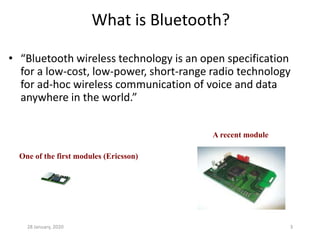
• “Bluetooth wireless technology is an open specification
for a low-cost, low-power, short-range radio technology
for ad-hoc wireless communication of voice and data
anywhere in the world.”
One of the first modules (Ericsson)
A recent module
28 January, 2020 4
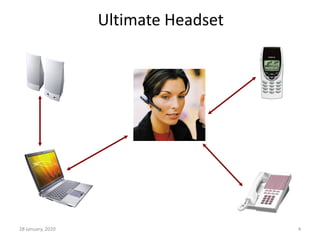
Ultimate Headset
28 January, 2020 5
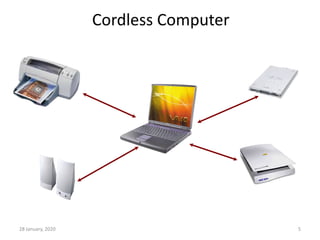
Cordless Computer
28 January, 2020 6
Bluetooth Goals & Vision
• Originally conceived as a cable replacement
technology
• Short-Range Wireless Solutions
• Open Specification
• Voice and Data Capability
• Worldwide Usability
• Other usage models began to develop:
– Personal Area Network (PAN)
– Ad-hoc networks
– Data/voice access points
– Wireless telematics
28 January, 2020 7
Overview of Bluetooth History
• What is Bluetooth?
– Bluetooth is a short-range wireless communications
technology.
• When does it appear?
– 1994 – Ericsson study on a wireless technology to link mobile
phones & accessories.
– 5 companies joined to form the Bluetooth Special Interest
Group (SIG) in 1998.
– First specification released in July 1999.
28 January, 2020 8
Timeline
• 1994 : Ericsson study complete / vision
• 1995 : Engineering work begins
• 1997 : Intel agrees to collaborate
• 1998 : Bluetooth SIG formed: Ericsson, Intel, IBM, Nokia & Toshiba
• 1999 : Bluetooth Specification 1.0ASIG promoter group expanded: 3Com,
Lucent, Microsoft & Motorola
• 2000 : Bluetooth Specification 1.0B, 2000+ adopters
• 2001 : First retail products released, Specification 1.1
• 2003 : Bluetooth Specification 1.2
• 2005 : Bluetooth Specification 2.0 (?)
28 January, 2020 9
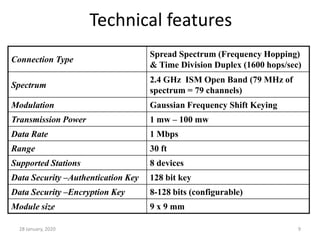
Technical features
Connection Type
Spread Spectrum (Frequency Hopping)
& Time Division Duplex (1600 hops/sec)
Spectrum
2.4 GHz ISM Open Band (79 MHz of
spectrum = 79 channels)
Modulation Gaussian Frequency Shift Keying
Transmission Power 1 mw – 100 mw
Data Rate 1 Mbps
Range 30 ft
Supported Stations 8 devices
Data Security –Authentication Key 128 bit key
Data Security –Encryption Key 8-128 bits (configurable)
Module size 9 x 9 mm
28 January, 2020 10
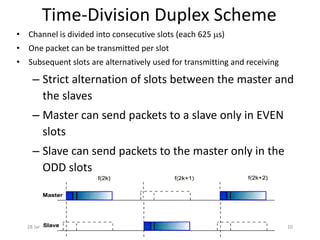
Time-Division Duplex Scheme
• Channel is divided into consecutive slots (each 625 s)
• One packet can be transmitted per slot
• Subsequent slots are alternatively used for transmitting and receiving
– Strict alternation of slots between the master and
the slaves
– Master can send packets to a slave only in EVEN
slots
– Slave can send packets to the master only in the
ODD slots
28 January, 2020 11
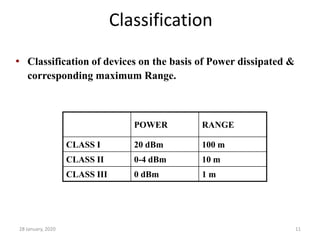
Classification
POWER RANGE
CLASS I 20 dBm 100 m
CLASS II 0-4 dBm 10 m
CLASS III 0 dBm 1 m
• Classification of devices on the basis of Power dissipated &
corresponding maximum Range.
28 January, 2020 12
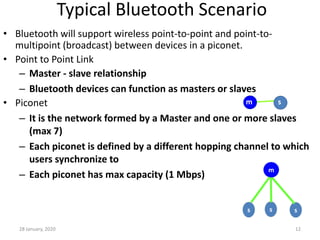
Typical Bluetooth Scenario
• Bluetooth will support wireless point-to-point and point-to-
multipoint (broadcast) between devices in a piconet.
• Point to Point Link
– Master - slave relationship
– Bluetooth devices can function as masters or slaves
• Piconet
– It is the network formed by a Master and one or more slaves
(max 7)
– Each piconet is defined by a different hopping channel to which
users synchronize to
– Each piconet has max capacity (1 Mbps)
m s
s s s
m
28 January, 2020 13
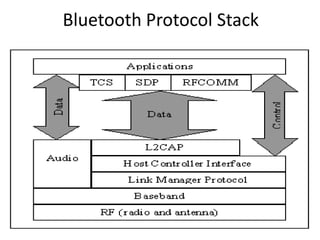
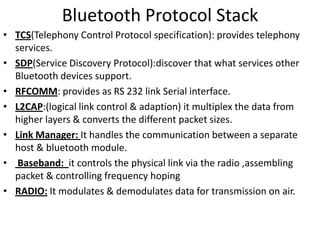
Bluetooth Protocol Stack
• TCS(Telephony Control Protocol specification): provides telephony
services.
• SDP(Service Discovery Protocol):discover that what services other
Bluetooth devices support.
• RFCOMM: provides as RS 232 link Serial interface.
• L2CAP:(logical link control & adaption) it multiplex the data from
higher layers & converts the different packet sizes.
• Link Manager: It handles the communication between a separate
host & bluetooth module.
• Baseband: it controls the physical link via the radio ,assembling
packet & controlling frequency hoping
• RADIO: It modulates & demodulates data for transmission on air.
28 January, 2020 15
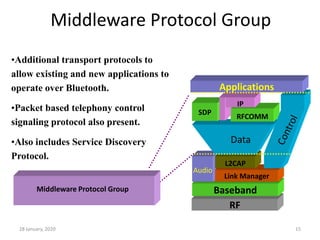
Middleware Protocol Group
RF
Baseband
Audio
Link Manager
L2CAP
Data
SDP
RFCOMM
IP
Applications
Middleware Protocol Group
•Additional transport protocols to
allow existing and new applications to
operate over Bluetooth.
•Packet based telephony control
signaling protocol also present.
•Also includes Service Discovery
Protocol.
28 January, 2020 16
Middleware Protocol Group (contd.)
• Service Discovery Protocol (SDP)
– Means for applications to discover device info, services
and its characteristics.
• TCP/IP
– Network Protocols for packet data communication,
routing.
• RFCOMM
– Cable replacement protocol, emulation of serial ports
over wireless network.
28 January, 2020 17
Link Manager Protocol
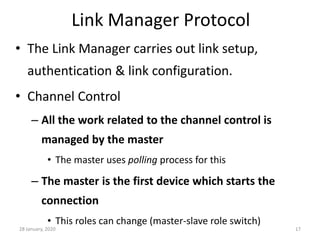
• The Link Manager carries out link setup,
authentication & link configuration.
• Channel Control
– All the work related to the channel control is
managed by the master
• The master uses polling process for this
– The master is the first device which starts the
connection
• This roles can change (master-slave role switch)
28 January, 2020 18
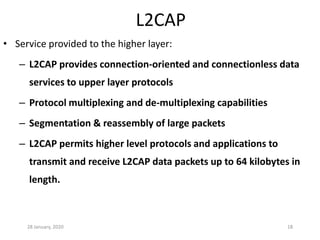
• Service provided to the higher layer:
– L2CAP provides connection-oriented and connectionless data
services to upper layer protocols
– Protocol multiplexing and de-multiplexing capabilities
– Segmentation & reassembly of large packets
– L2CAP permits higher level protocols and applications to
transmit and receive L2CAP data packets up to 64 kilobytes in
length.
L2CAP
Assignment
• Write a short note on Bluetooth technology.

Fair Bluetooth.pdf

  • 1.
    An Introduction toBLUETOOTH TECHNOLOGY
  • 2.
  • 3.
    28 January, 20203 What is Bluetooth? • “Bluetooth wireless technology is an open specification for a low-cost, low-power, short-range radio technology for ad-hoc wireless communication of voice and data anywhere in the world.” One of the first modules (Ericsson) A recent module
  • 4.
    28 January, 20204 Ultimate Headset
  • 5.
    28 January, 20205 Cordless Computer
  • 6.
    28 January, 20206 Bluetooth Goals & Vision • Originally conceived as a cable replacement technology • Short-Range Wireless Solutions • Open Specification • Voice and Data Capability • Worldwide Usability • Other usage models began to develop: – Personal Area Network (PAN) – Ad-hoc networks – Data/voice access points – Wireless telematics
  • 7.
    28 January, 20207 Overview of Bluetooth History • What is Bluetooth? – Bluetooth is a short-range wireless communications technology. • When does it appear? – 1994 – Ericsson study on a wireless technology to link mobile phones & accessories. – 5 companies joined to form the Bluetooth Special Interest Group (SIG) in 1998. – First specification released in July 1999.
  • 8.
    28 January, 20208 Timeline • 1994 : Ericsson study complete / vision • 1995 : Engineering work begins • 1997 : Intel agrees to collaborate • 1998 : Bluetooth SIG formed: Ericsson, Intel, IBM, Nokia & Toshiba • 1999 : Bluetooth Specification 1.0ASIG promoter group expanded: 3Com, Lucent, Microsoft & Motorola • 2000 : Bluetooth Specification 1.0B, 2000+ adopters • 2001 : First retail products released, Specification 1.1 • 2003 : Bluetooth Specification 1.2 • 2005 : Bluetooth Specification 2.0 (?)
  • 9.
    28 January, 20209 Technical features Connection Type Spread Spectrum (Frequency Hopping) & Time Division Duplex (1600 hops/sec) Spectrum 2.4 GHz ISM Open Band (79 MHz of spectrum = 79 channels) Modulation Gaussian Frequency Shift Keying Transmission Power 1 mw – 100 mw Data Rate 1 Mbps Range 30 ft Supported Stations 8 devices Data Security –Authentication Key 128 bit key Data Security –Encryption Key 8-128 bits (configurable) Module size 9 x 9 mm
  • 10.
    28 January, 202010 Time-Division Duplex Scheme • Channel is divided into consecutive slots (each 625 s) • One packet can be transmitted per slot • Subsequent slots are alternatively used for transmitting and receiving – Strict alternation of slots between the master and the slaves – Master can send packets to a slave only in EVEN slots – Slave can send packets to the master only in the ODD slots
  • 11.
    28 January, 202011 Classification POWER RANGE CLASS I 20 dBm 100 m CLASS II 0-4 dBm 10 m CLASS III 0 dBm 1 m • Classification of devices on the basis of Power dissipated & corresponding maximum Range.
  • 12.
    28 January, 202012 Typical Bluetooth Scenario • Bluetooth will support wireless point-to-point and point-to- multipoint (broadcast) between devices in a piconet. • Point to Point Link – Master - slave relationship – Bluetooth devices can function as masters or slaves • Piconet – It is the network formed by a Master and one or more slaves (max 7) – Each piconet is defined by a different hopping channel to which users synchronize to – Each piconet has max capacity (1 Mbps) m s s s s m
  • 13.
    28 January, 202013 Bluetooth Protocol Stack
  • 14.
    Bluetooth Protocol Stack •TCS(Telephony Control Protocol specification): provides telephony services. • SDP(Service Discovery Protocol):discover that what services other Bluetooth devices support. • RFCOMM: provides as RS 232 link Serial interface. • L2CAP:(logical link control & adaption) it multiplex the data from higher layers & converts the different packet sizes. • Link Manager: It handles the communication between a separate host & bluetooth module. • Baseband: it controls the physical link via the radio ,assembling packet & controlling frequency hoping • RADIO: It modulates & demodulates data for transmission on air.
  • 15.
    28 January, 202015 Middleware Protocol Group RF Baseband Audio Link Manager L2CAP Data SDP RFCOMM IP Applications Middleware Protocol Group •Additional transport protocols to allow existing and new applications to operate over Bluetooth. •Packet based telephony control signaling protocol also present. •Also includes Service Discovery Protocol.
  • 16.
    28 January, 202016 Middleware Protocol Group (contd.) • Service Discovery Protocol (SDP) – Means for applications to discover device info, services and its characteristics. • TCP/IP – Network Protocols for packet data communication, routing. • RFCOMM – Cable replacement protocol, emulation of serial ports over wireless network.
  • 17.
    28 January, 202017 Link Manager Protocol • The Link Manager carries out link setup, authentication & link configuration. • Channel Control – All the work related to the channel control is managed by the master • The master uses polling process for this – The master is the first device which starts the connection • This roles can change (master-slave role switch)
  • 18.
    28 January, 202018 • Service provided to the higher layer: – L2CAP provides connection-oriented and connectionless data services to upper layer protocols – Protocol multiplexing and de-multiplexing capabilities – Segmentation & reassembly of large packets – L2CAP permits higher level protocols and applications to transmit and receive L2CAP data packets up to 64 kilobytes in length. L2CAP
  • 19.
    Assignment • Write ashort note on Bluetooth technology.