NFC
Applications and Security
WHAT IS
NFC ?
NFC stands for Near Field Communication.
NFC is a short-range wireless connectivity technology that provides
intuitive, simple, and safe communication between electronic devices.
It is a wireless communication interface with a working distance limited
to about 10 cm.
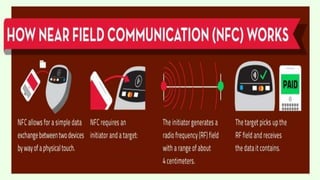
 It works on the simple principle of inductive coupling.
 When current flows through the NFC chip, a magnetic field is
generated.
 This field induces electricity within the second device or an NFC
tag.
 The second device generates a magnetic field of its own which
is then detected by the first device.
 It registers this RF field and decodes it.
NFC STANDARDS
 Operates at 13.56 MHz
 Can send data at a rate of 106, 212 or 424 kb per
second.
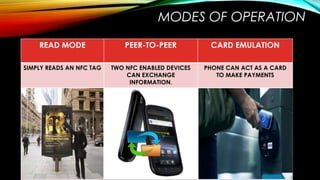
MODES OF OPERATION
READ MODE PEER-TO-PEER CARD EMULATION
SIMPLY READS AN NFC TAG TWO NFC ENABLED DEVICES
CAN EXCHANGE
INFORMATION.
PHONE CAN ACT AS A CARD
TO MAKE PAYMENTS
PRESENT AND PROTOTYPED
• Make payments with a wave or a touch anywhere contactless card readers have
been deployed.
• Read information and “pick up” special offers and discounts from smart posters or
smart billboards.
• Store tickets to access transportation gates, parking garages or get into events.
• Store personal information that will allow secure building access.
• Take a picture and transfer it to an NFC-enabled printer or monitor.
• Share business cards with other NFC-enabled phones.
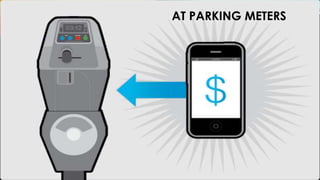
AT PARKING METERS
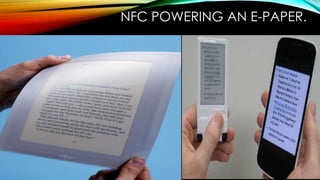
NFC POWERING AN E-PAPER.
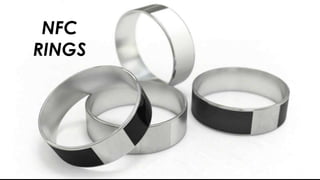
NFC
RINGS
SECURITY
• Whenever radio frequencies are involved, there's a potential security risk.
• Even though NFC transmissions must take place over very short ranges, it's possible
to pick up transmissions from much further away.
• It's harder to detect transmissions from passive components. Even so, an
eavesdropper could detect signals from about a meter away with the right
equipment.
• Data can be stolen or corrupted by an attacker easily
By creating an RF field of the same frequency as that of the sender.
By changing bits 1 to 0 or vice versa in a signal.
By modulating carrier signal with a pause in the original signal.
SOLUTIONS
• NFC specific key agreement
Set of keys unique for NFC transactions
This one does not require any asymmetric cryptography.
Therefore reduces the computational requirements significantly
• Secure Channel for NFC
 Establishing a secure channel between two NFC devices is clearly the best approach to
protect against eavesdropping and any kind of data modification attack.
 A standard key agreement protocol like Diffie-Hellmann Elliptic Curves could be applied
to establish a shared secret between two devices
• Chip Modification
The NFC chip can be modified to constantly check its RF field while it is transmitting data.
 The power required to attack is much larger than the power of the NFC signal.
Hence the chip will be able to identify an attacking signal instantly
CONCLUSION
• NFC is not more insecure than other related technologies. It offers options for
encrypting data on the application layer the same way as Wi-Fi or Bluetooth,
but additionally provides safety through the requirement of very close physical
proximity.
• At present, the NFC technology has reached a level where
commercial launch preparation can begin and should be established.
• Reliability and usability of NFC applications are probably
the most striking advantages of the NFC technology and therefore important
keys to its success.
• When compared to alternative technologies, NFC offers great advantages.
• It is very likely that the NFC technology will play a big role in our future
everyday life.

Nfc

  • 1.
  • 2.
    WHAT IS NFC ? NFCstands for Near Field Communication. NFC is a short-range wireless connectivity technology that provides intuitive, simple, and safe communication between electronic devices. It is a wireless communication interface with a working distance limited to about 10 cm.
  • 3.
     It workson the simple principle of inductive coupling.  When current flows through the NFC chip, a magnetic field is generated.  This field induces electricity within the second device or an NFC tag.  The second device generates a magnetic field of its own which is then detected by the first device.  It registers this RF field and decodes it.
  • 5.
    NFC STANDARDS  Operatesat 13.56 MHz  Can send data at a rate of 106, 212 or 424 kb per second.
  • 6.
    MODES OF OPERATION READMODE PEER-TO-PEER CARD EMULATION SIMPLY READS AN NFC TAG TWO NFC ENABLED DEVICES CAN EXCHANGE INFORMATION. PHONE CAN ACT AS A CARD TO MAKE PAYMENTS
  • 7.
  • 8.
    • Make paymentswith a wave or a touch anywhere contactless card readers have been deployed. • Read information and “pick up” special offers and discounts from smart posters or smart billboards. • Store tickets to access transportation gates, parking garages or get into events. • Store personal information that will allow secure building access. • Take a picture and transfer it to an NFC-enabled printer or monitor. • Share business cards with other NFC-enabled phones.
  • 9.
  • 10.
  • 11.
  • 12.
    SECURITY • Whenever radiofrequencies are involved, there's a potential security risk. • Even though NFC transmissions must take place over very short ranges, it's possible to pick up transmissions from much further away. • It's harder to detect transmissions from passive components. Even so, an eavesdropper could detect signals from about a meter away with the right equipment. • Data can be stolen or corrupted by an attacker easily By creating an RF field of the same frequency as that of the sender. By changing bits 1 to 0 or vice versa in a signal. By modulating carrier signal with a pause in the original signal.
  • 13.
    SOLUTIONS • NFC specifickey agreement Set of keys unique for NFC transactions This one does not require any asymmetric cryptography. Therefore reduces the computational requirements significantly • Secure Channel for NFC  Establishing a secure channel between two NFC devices is clearly the best approach to protect against eavesdropping and any kind of data modification attack.  A standard key agreement protocol like Diffie-Hellmann Elliptic Curves could be applied to establish a shared secret between two devices • Chip Modification The NFC chip can be modified to constantly check its RF field while it is transmitting data.  The power required to attack is much larger than the power of the NFC signal. Hence the chip will be able to identify an attacking signal instantly
  • 14.
    CONCLUSION • NFC isnot more insecure than other related technologies. It offers options for encrypting data on the application layer the same way as Wi-Fi or Bluetooth, but additionally provides safety through the requirement of very close physical proximity. • At present, the NFC technology has reached a level where commercial launch preparation can begin and should be established. • Reliability and usability of NFC applications are probably the most striking advantages of the NFC technology and therefore important keys to its success.
  • 15.
    • When comparedto alternative technologies, NFC offers great advantages. • It is very likely that the NFC technology will play a big role in our future everyday life.