BLUETOOTH TECHNOLOGY PRESENTED BY G. Sowmya
CONTENTS WHAT IS BLUETOOTH OVERVIEW OF BLUETOOTH PICONET STRUCTURE SCATTERNET STRUCTURE APPLICATIONS ADVANTAGES DISADVANTAGES FUTURE OF BLUETOOTH
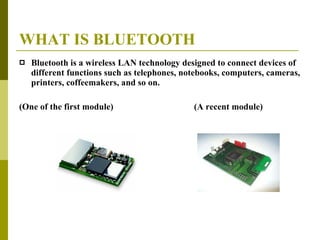
WHAT IS BLUETOOTH Bluetooth is a wireless LAN technology designed to connect devices of different functions such as telephones, notebooks, computers, cameras, printers, coffeemakers, and so on. (One of the first module)  (A recent module)
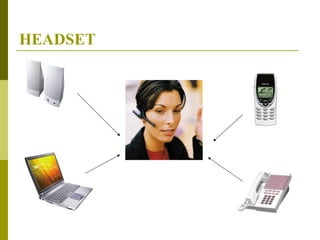
HEADSET
OVERVIEW OF BLUETOOTH What is Bluetooth? Bluetooth is a short-range wireless communications technology. Why this name? It was taken from the 10th century Danish King Harald Blaatand who unified Denmark and Norway. When does it appear? 1994 – Ericsson study on a wireless technology to link mobile phones & accessories. 5 companies joined to form the Bluetooth Special Interest Group (SIG) in 1998. First specification released in July 1999.
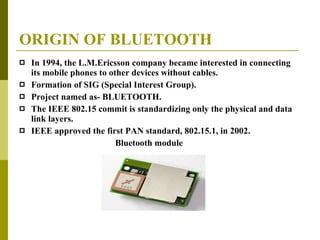
ORIGIN OF BLUETOOTH In 1994, the L.M.Ericsson company became interested in connecting its mobile phones to other devices without cables. Formation of SIG (Special Interest Group). Project named as- BLUETOOTH. The IEEE 802.15 commit is standardizing only the physical and data link layers. IEEE approved the first PAN standard, 802.15.1, in 2002. Bluetooth module
AT THAT TIMES 1994 :  Ericsson study complete / vision 1995 :  Engineering work begins 1997 :  Intel agrees to collaborate 1998 :  Bluetooth SIG formed: Ericsson, Intel, IBM, Nokia & Toshiba 1999 :  Bluetooth Specification 1.0A SIG promoter group expanded: 3Com, Lucent, Microsoft &    Motorola 2000 :  Bluetooth Specification 1.0B 2001 :  First retail products released, Specification 1.1 2003 :  Bluetooth Specification 1.2 2005 :  Bluetooth Specification 2.0 (?)
ONE IN IEEE STANDARDS IEEE stands for Institute of Electrical and Electronic Engineers. In 2005, IEEE had close to 900 active standards, with 500 standards under development. Some of the IEEE standards: 802 LAN/MAN 802.3 Ethernet 802.11 wireless Networking 802.15.1 BLUETOOTH .
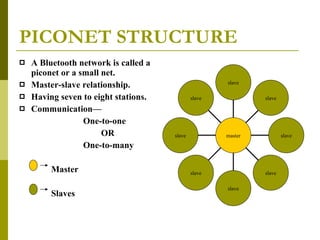
PICONET STRUCTURE A Bluetooth network is called a piconet or a small net. Master-slave relationship. Having seven to eight stations. Communication— One-to-one   OR One-to-many Master Slaves slave slave slave slave slave slave slave slave master
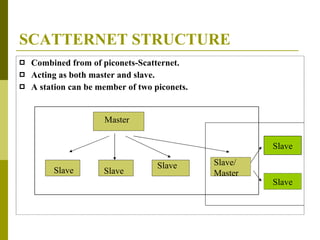
SCATTERNET STRUCTURE Combined from of piconets-Scatternet. Acting as both master and slave. A station can be member of two piconets. Slave Slave Master Slave Slave Slave Slave/ Master
BLUETOOTH APPLICATIONS By installing a Bluetooth network in office you can do away with the complex task of networking between the computing devices. Each Bluetooth device could be connected to 200 other devices. It supports both point to point and point to multipoint connections. The Bluetooth technology connects all your peripherals wirelessly. Connect your pc or to printers, scanners and other devices without the trouble of cable attachments. You can increase your connections by connecting your keyboard wirelessly to your computer. If your digital camera is Bluetooth enabled, you can send videos, images from any location to any location without the problem of connection your cameras to the mobile phone. Connect your wireless headset to your pc to your mobile phone or mobile computer to keep your hands free for more important tasks when you are at the office or in your car.
ADVANTAGES OF BLUETOOTH Bluetooth Devices are Wireless Bluetooth Technology is Inexpensive Bluetooth is Automatic Low Energy Consumption Share Voice and Data Accessible From Anywhere
DISADVANTAGES OF BLUETOOTH Bluetooth devices can not connected with more than one devices at a time, as it finds problem  in discovering the intended recipient device. Bluetooth has a low data rate(i.e.1MBps).
FUTURE OF BLUETOOTH KEY FACTORS FOR SUCCESS: Consumers are more interested in applications than the technology  Must provide benefits for consumer  Must not destroy current product benefits  Interoperability Low Cost Ease of Use End User Experience
THANKYOU

Blue1

  • 1.
  • 2.
    CONTENTS WHAT ISBLUETOOTH OVERVIEW OF BLUETOOTH PICONET STRUCTURE SCATTERNET STRUCTURE APPLICATIONS ADVANTAGES DISADVANTAGES FUTURE OF BLUETOOTH
  • 3.
    WHAT IS BLUETOOTHBluetooth is a wireless LAN technology designed to connect devices of different functions such as telephones, notebooks, computers, cameras, printers, coffeemakers, and so on. (One of the first module) (A recent module)
  • 4.
  • 5.
    OVERVIEW OF BLUETOOTHWhat is Bluetooth? Bluetooth is a short-range wireless communications technology. Why this name? It was taken from the 10th century Danish King Harald Blaatand who unified Denmark and Norway. When does it appear? 1994 – Ericsson study on a wireless technology to link mobile phones & accessories. 5 companies joined to form the Bluetooth Special Interest Group (SIG) in 1998. First specification released in July 1999.
  • 6.
    ORIGIN OF BLUETOOTHIn 1994, the L.M.Ericsson company became interested in connecting its mobile phones to other devices without cables. Formation of SIG (Special Interest Group). Project named as- BLUETOOTH. The IEEE 802.15 commit is standardizing only the physical and data link layers. IEEE approved the first PAN standard, 802.15.1, in 2002. Bluetooth module
  • 7.
    AT THAT TIMES1994 : Ericsson study complete / vision 1995 : Engineering work begins 1997 : Intel agrees to collaborate 1998 : Bluetooth SIG formed: Ericsson, Intel, IBM, Nokia & Toshiba 1999 : Bluetooth Specification 1.0A SIG promoter group expanded: 3Com, Lucent, Microsoft & Motorola 2000 : Bluetooth Specification 1.0B 2001 : First retail products released, Specification 1.1 2003 : Bluetooth Specification 1.2 2005 : Bluetooth Specification 2.0 (?)
  • 8.
    ONE IN IEEESTANDARDS IEEE stands for Institute of Electrical and Electronic Engineers. In 2005, IEEE had close to 900 active standards, with 500 standards under development. Some of the IEEE standards: 802 LAN/MAN 802.3 Ethernet 802.11 wireless Networking 802.15.1 BLUETOOTH .
  • 9.
    PICONET STRUCTURE ABluetooth network is called a piconet or a small net. Master-slave relationship. Having seven to eight stations. Communication— One-to-one OR One-to-many Master Slaves slave slave slave slave slave slave slave slave master
  • 10.
    SCATTERNET STRUCTURE Combinedfrom of piconets-Scatternet. Acting as both master and slave. A station can be member of two piconets. Slave Slave Master Slave Slave Slave Slave/ Master
  • 11.
    BLUETOOTH APPLICATIONS Byinstalling a Bluetooth network in office you can do away with the complex task of networking between the computing devices. Each Bluetooth device could be connected to 200 other devices. It supports both point to point and point to multipoint connections. The Bluetooth technology connects all your peripherals wirelessly. Connect your pc or to printers, scanners and other devices without the trouble of cable attachments. You can increase your connections by connecting your keyboard wirelessly to your computer. If your digital camera is Bluetooth enabled, you can send videos, images from any location to any location without the problem of connection your cameras to the mobile phone. Connect your wireless headset to your pc to your mobile phone or mobile computer to keep your hands free for more important tasks when you are at the office or in your car.
  • 12.
    ADVANTAGES OF BLUETOOTHBluetooth Devices are Wireless Bluetooth Technology is Inexpensive Bluetooth is Automatic Low Energy Consumption Share Voice and Data Accessible From Anywhere
  • 13.
    DISADVANTAGES OF BLUETOOTHBluetooth devices can not connected with more than one devices at a time, as it finds problem in discovering the intended recipient device. Bluetooth has a low data rate(i.e.1MBps).
  • 14.
    FUTURE OF BLUETOOTHKEY FACTORS FOR SUCCESS: Consumers are more interested in applications than the technology Must provide benefits for consumer Must not destroy current product benefits Interoperability Low Cost Ease of Use End User Experience
  • 15.