Bluetooth
Technology
Presented By:
Ujjwal Chaudhari.
Contents
 Definition of Bluetooth.
 History of Bluetooth.
 Characteristics of Bluetooth.
 Working of Bluetooth.
 Security Features of Bluetooth.
 Advantages of Bluetooth.
 Disadvantages of Bluetooth.
 Application of Bluetooth.
 Future of Bluetooth.
 Conclusion
Definition of Bluetooth.
Bluetooth is a short range and low power
wireless technology originally developed for
exchanging data over short distances from
fixed and mobile devices, creating personal
area network.
History of Bluetooth
 The word “Bluetooth” is taken from the 10th century Danish King
Harlard, who unified Scandinavian people tribes into a single
kingdom.
 Bluetooth was named because –
 Bluetooth technology was developed in Scandinavian.
 Bluetooth technology was able to unite different industries such as
cell phone, computing and automotive markets.
 The Bluetooth specification was first developed in 1994 by Ericsson
Mobile Communication Ltd.
 5 Companies (Ericsson, Nokia, Intel, Toshiba, & IMB) joined to form
Bluetooth Special Interest Group (SIG) in 1998.
 In 1999, first specification of Bluetooth i.e. Bluetooth 1.0 is released.
Characteristics of Bluetooth
 Bluetooth stands for Short-range transmission of digital
voice and data.
 Frequency Range: ISM (Industrial, Scientific and Medical
Radio Bands) 2200MHz – 2400 MHz
 Bluetooth used a Radio Technology called Frequency
Hopping Spread Spectrum.
 Vanishes the need of chord and wire.
 Range of Connection : 10 m – 100 m.
 Supports data rate of : 1Mb/s.
Characteristics of Bluetooth
There are three classes of Bluetooth devices.
Class 3 Radio: have range up to 1 meters or 3 feet.
Class 2 Radio: most commonly found in mobile
devices – have range of 10 metes or 30 feet.
Class 1 Radio: used primarily in Industrial use
cases – have range of 100 meters or 300 feet.
Working of Bluetooth
Uses short range of RF spectrum at 2.45 GHz.
Uses quick frequency hoping packet switch Protocol.
Transceiver has a unique 48 bit address.
Uses IEEE 802 Standards.
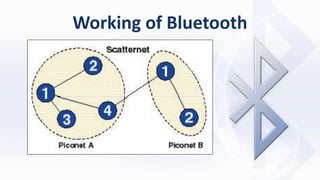
Several Bluetooth devices can form an AD-HOC
Network called a “PICONET”.
In PICONET, one device is act like a master (sets
frequency hoping behavior) and the others as slaves.
Working of Bluetooth
More than one PICONET is called SCATTERNET.
Up to Eight devices are allowed in PICONET.
Each PICONET is identified by a different
frequency hopping structure.
Connections can be made up to 10 meters or can
be extended to 100 meters.
Power consumption is 0.3 mA.
Security Features of Bluetooth
 Bluejacking
 Funny type message sent to people’s Bluetooth enabled device without owner
permission.
 Bluesnarfing
 Hacker’s gaining access to people Bluetooth enabled device mainly to made some
harm.
 Allows hackers to send message, make phone calls etc.
 The hacker to be within 30 ft rage
 To avoid set your phone to non-discoverable mode
 Bluebugging
 Advanced level of hacking with technology use
 Hacker’s gaining access to people Bluetooth enabled device mainly to made some
harm.
 Allows hackers to send message, make phone calls etc.
 Also 30 ft range
Advantages of Bluetooth
Bluetooth devices are wireless
Bluetooth technology is inexpensive
Bluetooth is automatic
Share voice and data
Low energy consumption
Accessible from anywhere
Disadvantage of Bluetooth
Low data rate.
Short range.
Low security.
Interference with other devices.
Applications of Bluetooth
Laptops
Cellular phones
Personal digital assistants
Headsets
Printers
Car
GPS etc…
Future of Bluetooth
Radio2 Working Group
• Working to overcome bandwidth, interference, and
connection setup issues while remaining
compatible with current radio
Other Working Groups
• Audio/Video, Car, Co-existence, ISDN, Local
Positioning, Personal Area Networking, Printing
Study Groups
• Industrial Automation
Conclusion
A new global standard for data and voice
 Eliminates Cables .
 Low Power, Low range, Low Cost network devices.
 Bluetooth seems to have a bright future after reviewing its benefits and wide
use.
 Further improvements are planned to be made in
– Data Rates
– Power Reduction
– Range
References
i. www.bluetooth.com
ii. en.wikipedia.org/wiki/Bluetooth
iii. www.google.com/images
THANK YOU

Bluetooth

  • 1.
  • 2.
    Contents  Definition ofBluetooth.  History of Bluetooth.  Characteristics of Bluetooth.  Working of Bluetooth.  Security Features of Bluetooth.  Advantages of Bluetooth.  Disadvantages of Bluetooth.  Application of Bluetooth.  Future of Bluetooth.  Conclusion
  • 3.
    Definition of Bluetooth. Bluetoothis a short range and low power wireless technology originally developed for exchanging data over short distances from fixed and mobile devices, creating personal area network.
  • 4.
    History of Bluetooth The word “Bluetooth” is taken from the 10th century Danish King Harlard, who unified Scandinavian people tribes into a single kingdom.  Bluetooth was named because –  Bluetooth technology was developed in Scandinavian.  Bluetooth technology was able to unite different industries such as cell phone, computing and automotive markets.  The Bluetooth specification was first developed in 1994 by Ericsson Mobile Communication Ltd.  5 Companies (Ericsson, Nokia, Intel, Toshiba, & IMB) joined to form Bluetooth Special Interest Group (SIG) in 1998.  In 1999, first specification of Bluetooth i.e. Bluetooth 1.0 is released.
  • 5.
    Characteristics of Bluetooth Bluetooth stands for Short-range transmission of digital voice and data.  Frequency Range: ISM (Industrial, Scientific and Medical Radio Bands) 2200MHz – 2400 MHz  Bluetooth used a Radio Technology called Frequency Hopping Spread Spectrum.  Vanishes the need of chord and wire.  Range of Connection : 10 m – 100 m.  Supports data rate of : 1Mb/s.
  • 6.
    Characteristics of Bluetooth Thereare three classes of Bluetooth devices. Class 3 Radio: have range up to 1 meters or 3 feet. Class 2 Radio: most commonly found in mobile devices – have range of 10 metes or 30 feet. Class 1 Radio: used primarily in Industrial use cases – have range of 100 meters or 300 feet.
  • 7.
    Working of Bluetooth Usesshort range of RF spectrum at 2.45 GHz. Uses quick frequency hoping packet switch Protocol. Transceiver has a unique 48 bit address. Uses IEEE 802 Standards. Several Bluetooth devices can form an AD-HOC Network called a “PICONET”. In PICONET, one device is act like a master (sets frequency hoping behavior) and the others as slaves.
  • 8.
  • 9.
    Working of Bluetooth Morethan one PICONET is called SCATTERNET. Up to Eight devices are allowed in PICONET. Each PICONET is identified by a different frequency hopping structure. Connections can be made up to 10 meters or can be extended to 100 meters. Power consumption is 0.3 mA.
  • 10.
    Security Features ofBluetooth  Bluejacking  Funny type message sent to people’s Bluetooth enabled device without owner permission.  Bluesnarfing  Hacker’s gaining access to people Bluetooth enabled device mainly to made some harm.  Allows hackers to send message, make phone calls etc.  The hacker to be within 30 ft rage  To avoid set your phone to non-discoverable mode  Bluebugging  Advanced level of hacking with technology use  Hacker’s gaining access to people Bluetooth enabled device mainly to made some harm.  Allows hackers to send message, make phone calls etc.  Also 30 ft range
  • 11.
    Advantages of Bluetooth Bluetoothdevices are wireless Bluetooth technology is inexpensive Bluetooth is automatic Share voice and data Low energy consumption Accessible from anywhere
  • 12.
    Disadvantage of Bluetooth Lowdata rate. Short range. Low security. Interference with other devices.
  • 13.
    Applications of Bluetooth Laptops Cellularphones Personal digital assistants Headsets Printers Car GPS etc…
  • 14.
    Future of Bluetooth Radio2Working Group • Working to overcome bandwidth, interference, and connection setup issues while remaining compatible with current radio Other Working Groups • Audio/Video, Car, Co-existence, ISDN, Local Positioning, Personal Area Networking, Printing Study Groups • Industrial Automation
  • 15.
    Conclusion A new globalstandard for data and voice  Eliminates Cables .  Low Power, Low range, Low Cost network devices.  Bluetooth seems to have a bright future after reviewing its benefits and wide use.  Further improvements are planned to be made in – Data Rates – Power Reduction – Range
  • 16.
  • 17.