Blood vessels
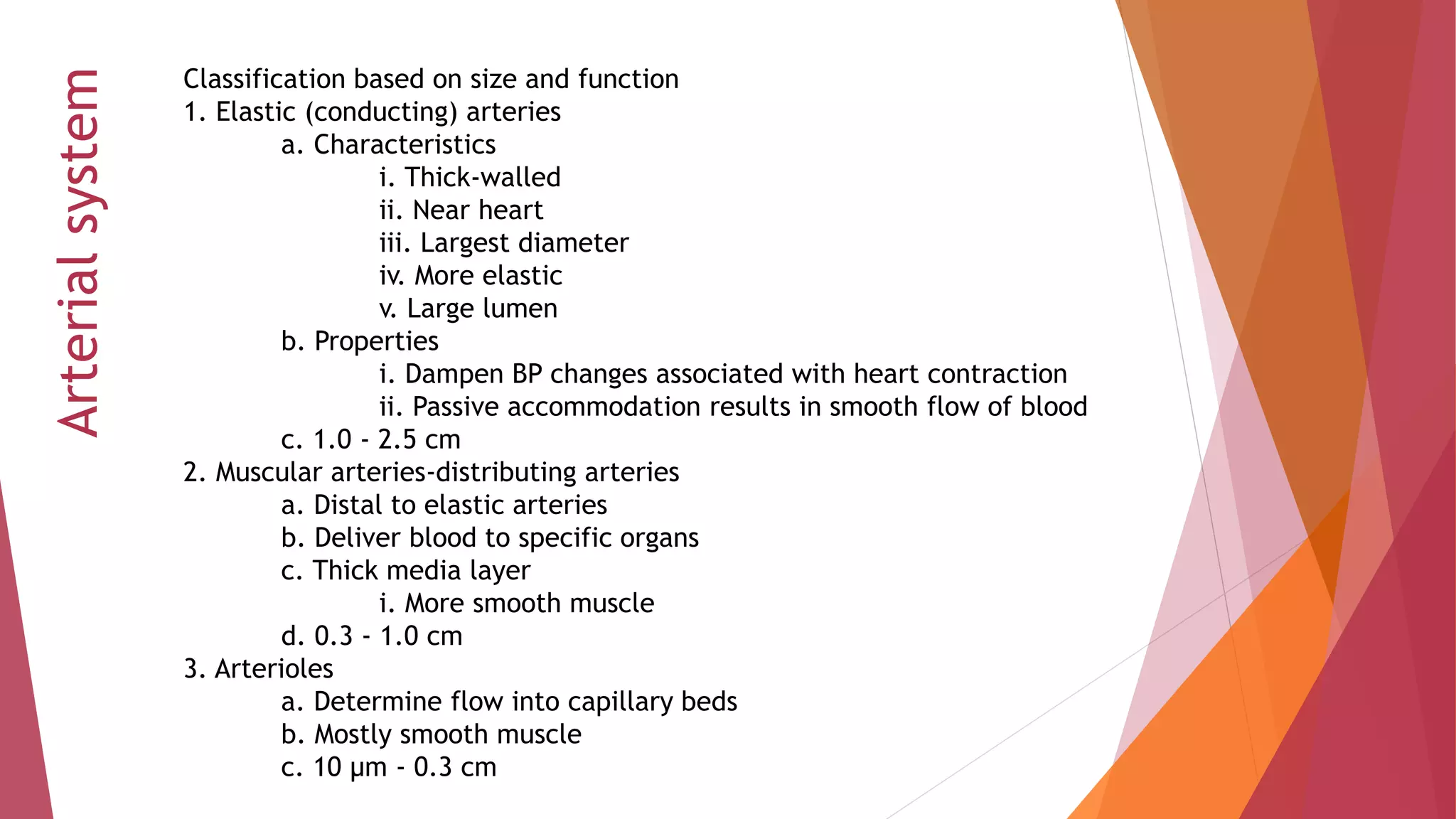
Arterialsystem Classification based on size and function
1. Elastic (conducting) arteries
a. Characteristics
i. Thick-walled
ii. Near heart
iii. Largest diameter
iv. More elastic
v. Large lumen
b. Properties
i. Dampen BP changes associated with heart contraction
ii. Passive accommodation results in smooth flow of blood
c. 1.0 - 2.5 cm
2. Muscular arteries-distributing arteries
a. Distal to elastic arteries
b. Deliver blood to specific organs
c. Thick media layer
i. More smooth muscle
d. 0.3 - 1.0 cm
3. Arterioles
a. Determine flow into capillary beds
b. Mostly smooth muscle
c. 10 µm - 0.3 cm
Venoussystem A. Types of vessels
1. Venules
a. 8 - 100 µm
b. Characteristics vary with size
i. Little muscle
ii. Thin externa
2. Veins
a. Formed from venules
b. Thinner walls and less muscle than arteries
c. Little muscle in media
i. Mostly elastin
d. Externa is thickest wall layer
B. Capacitance vessels
1. Veins act as reservoirs
a. Large lumens
b. Low blood pressure allows walls to thin
2. Venous valves
a. Prevent backflow
b. Folds of interna
Capillaries
 Smallest blood vessels 8 - 10 µm one cell thick
 Exchange of materials
 Very low blood pressure
 Where gas exchange takes place.
 They can carry oxygenated and deoxygenated blood
Types of capillaryContinuous
• Uninterrupted
endothelial
cells
• Incomplete
tight junctions
• Intercellular
clefts
Fenestrated
• Endothelial
cells have oval
pores
(Fenestrations)
• Pores permit
greater
permeability
Sinusoidal
• Modified,
leaky
capillaries
• Large
molecules can
pass through
(a) continuous, (b) frenestrated, (c) sinusoid
Blood vessels
Blood vessels
Blood vessels

Blood vessels

  • 1.
  • 5.
    Arterialsystem Classification basedon size and function 1. Elastic (conducting) arteries a. Characteristics i. Thick-walled ii. Near heart iii. Largest diameter iv. More elastic v. Large lumen b. Properties i. Dampen BP changes associated with heart contraction ii. Passive accommodation results in smooth flow of blood c. 1.0 - 2.5 cm 2. Muscular arteries-distributing arteries a. Distal to elastic arteries b. Deliver blood to specific organs c. Thick media layer i. More smooth muscle d. 0.3 - 1.0 cm 3. Arterioles a. Determine flow into capillary beds b. Mostly smooth muscle c. 10 µm - 0.3 cm
  • 7.
    Venoussystem A. Typesof vessels 1. Venules a. 8 - 100 µm b. Characteristics vary with size i. Little muscle ii. Thin externa 2. Veins a. Formed from venules b. Thinner walls and less muscle than arteries c. Little muscle in media i. Mostly elastin d. Externa is thickest wall layer B. Capacitance vessels 1. Veins act as reservoirs a. Large lumens b. Low blood pressure allows walls to thin 2. Venous valves a. Prevent backflow b. Folds of interna
  • 10.
    Capillaries  Smallest bloodvessels 8 - 10 µm one cell thick  Exchange of materials  Very low blood pressure  Where gas exchange takes place.  They can carry oxygenated and deoxygenated blood
  • 11.
    Types of capillaryContinuous •Uninterrupted endothelial cells • Incomplete tight junctions • Intercellular clefts Fenestrated • Endothelial cells have oval pores (Fenestrations) • Pores permit greater permeability Sinusoidal • Modified, leaky capillaries • Large molecules can pass through
  • 12.
    (a) continuous, (b)frenestrated, (c) sinusoid

Editor's Notes

  • #4 There are three types of arteries in the body: elastic arteries, muscular arteries, and arterioles. Arteries that leave the heart to distribute the oxygenated blood exhibit progressive branching. With each branching, the luminal diameters of the arteries gradually decrease, until the smallest vessel, the capillary, is formed. Elastic arteries are the largest blood vessels in the body and include the pulmonary trunk and aorta with their major branches. The walls of these vessels are primarily composed of elastic connective tissue fibers. These fibers provide great resilience and flexibility during blood flow. The large elastic arteries branch and become medium-sized muscular arteries, the most numerous vessels in the body. In contrast to the walls of elastic arteries, those of muscular arteries contain greater amounts of smooth muscle fibers. Arterioles are the smallest branches of the arterial system. Their walls consist of one to five layers of smooth muscle fibers. Arterioles deliver blood to the smallest blood vessels, the capillaries. Capillaries unite to form larger blood vessels called venules; venules usually accompany arterioles. The venous blood initially flows into smaller postcapillary venules and then into veins of increasing size. The veins are arbitrarily classified as small, medium, and large. Compared with arteries, veins typically are more numerous and have thinner walls, larger diameters, and greater structural variation. Small-sized and medium-sized veins, particularly in the extremities, have valves. Because of the low blood pressure in the veins, blood flow to the heart in the veins is slow and can even back up. The presence of valves in veins assists venous blood flow by preventing backflow.When blood flows toward the heart, pressure in the veins forces the valves to open. As the blood begins to flow backward, the valve flaps close the lumen and prevent backflow of blood. Venous blood between the valves in the extremities flows toward the heart as a result of contraction of muscles that surround the veins.Valves are absent in veins of the central nervous system, the inferior and superior venae cavae, and viscera. The walls of the veins, like the arteries, also exhibit three layers or tunics. However, the muscular layer is much less prominent. The tunica intima in large veins exhibits a prominent endothelium and subendothelial connective tissue. In large veins, the muscular tunica media is thin, and the smooth muscles intermix with connective tissue fibers. In large veins, the tunica adventitia is the thickest and best-developed layer of the three tunics. Longitudinal bundles of smooth muscle fibers are common in the connective tissue of this layer
  • #5 The wall of a typical artery contains three concentric layers or tunics. The innermost layer is the tunica intima. This layer consists of a simple squamous epithelium, called endothelium in the vascular system, and the underlying subendothelial connective tissue. The middle layer is the tunica media, composed primarily of smooth muscle fibers. The outermost layer is the tunica adventitia, composed primarily of collagen and elastic connective tissue fibers. The walls of some muscular arteries also exhibit two thin, wavy bands of elastic fibers. The internal elastic lamina is located between the tunica intima and the tunica media; this layer is not seen in smaller arteries. The external elastic lamina is located on the periphery of the muscular tunica media and is primarily seen in large muscular arteries.
  • #13 Capillaries are the smallest blood vessels. Their average diameter is about 8 μm, which is about the size of an erythrocyte (red blood cell). There are three types of capillaries: continuous capillaries, fenestrated capillaries, and sinusoids. These structural variations in capillaries allow for different types of metabolic exchange between blood and the surrounding tissues. Continuous capillaries are the most common. They are found in muscle, connective tissue, nervous tissue, skin, respiratory organs, and exocrine glands. In these capillaries, the endothelial cells are joined and form an uninterrupted, solid endothelial lining. Fenestrated capillaries are characterized by large openings or fenestrations (pores) in the cytoplasm of endothelial cells designed for a rapid exchange of molecules between blood and tissues. Fenestrated capillaries are found in endocrine tissues and glands, small intestine, and kidney glomeruli. Sinusoidal (discontinuous) capillaries are blood vessels that exhibit irregular, tortuous paths. Their much wider diameters slow down the flow of blood. Endothelial cell junctions are rare in sinusoidal capillaries, and wide gaps exist between individual endothelial cells. Also, because a basement membrane underlying the endothelium is either incomplete or absent, a direct exchange of molecules occurs between blood contents and cells. Sinusoidal capillaries are found in the liver, spleen, and bone marrow.
  • #14 Capillaries do not function as individual units but as part of an interconnected network called a capillary bed , or capillary plexus