Author(s): Michael Hortsch, Ph.D., 2009

License: Unless otherwise noted, this material is made available under the terms of the
Creative Commons Attribution–Non-commercial–Share Alike 3.0 License:
http://creativecommons.org/licenses/by-nc-sa/3.0/

We have reviewed this material in accordance with U.S. Copyright Law and have tried to maximize your ability to use,
share, and adapt it. The citation key on the following slide provides information about how you may share and adapt this
material.

Copyright holders of content included in this material should contact open.michigan@umich.edu with any questions,
corrections, or clarification regarding the use of content.

For more information about how to cite these materials visit http://open.umich.edu/education/about/terms-of-use.

Any medical information in this material is intended to inform and educate and is not a tool for self-diagnosis or a
replacement for medical evaluation, advice, diagnosis or treatment by a healthcare professional. Please speak to your
physician if you have questions about your medical condition.

Viewer discretion is advised: Some medical content is graphic and may not be suitable for all viewers.
Citation Key
                          for more information see: http://open.umich.edu/wiki/CitationPolicy


Use + Share + Adapt
  { Content the copyright holder, author, or law permits you to use, share and adapt. }
               Public Domain – Government: Works that are produced by the U.S. Government. (17 USC § 105)
               Public Domain – Expired: Works that are no longer protected due to an expired copyright term.
               Public Domain – Self Dedicated: Works that a copyright holder has dedicated to the public domain.

               Creative Commons – Zero Waiver

               Creative Commons – Attribution License
               Creative Commons – Attribution Share Alike License
               Creative Commons – Attribution Noncommercial License
               Creative Commons – Attribution Noncommercial Share Alike License
               GNU – Free Documentation License

Make Your Own Assessment
  { Content Open.Michigan believes can be used, shared, and adapted because it is ineligible for copyright. }
               Public Domain – Ineligible: Works that are ineligible for copyright protection in the U.S. (17 USC § 102(b)) *laws in
               your jurisdiction may differ
   { Content Open.Michigan has used under a Fair Use determination. }
               Fair Use: Use of works that is determined to be Fair consistent with the U.S. Copyright Act. (17 USC § 107) *laws in
               your jurisdiction may differ
               Our determination DOES NOT mean that all uses of this 3rd-party content are Fair Uses and we DO NOT guarantee
               that your use of the content is Fair.
               To use this content you should do your own independent analysis to determine whether or not your use will be Fair.
Histology of the Respiratory
                       Tract

              M1 – Cardiovascular/Respiratory
                        Sequence
                  Michael Hortsch, Ph.D.


Fall 2008
Objectives Respiratory Tract Histology:
•  Know the general functions of the respiratory system and the overall organization of the respiratory tree

•  Identify the histological features of the nasal cavity, the vocal cords and the trachea

•  Know the cellular components of the respiratory epithelium and their functional importance

•  Be able to recognize olfactory epithelium and know how it differs from regular respiratory epithelium

•  Identify bronchi, bronchiole, terminal bronchiole, respiratory bronchiole, alveolar ducts and sacs and know their

  
 distinct histological features

•  Be able to recognize Clara cells and know their functional significance

•  Understand the structural organization of alveoli, including the air-blood barrier and alveolar pores

•  Know the cellular components of the alveolar tissue and their individual functions and be able to recognize them

•  Understand the organization of the intrapulmonary blood circulation and recognize its different parts
Major Functions of the Respiratory System:
1.  Air conditioning (air warming, humidifying and filtering)
2.  Oxygen/carbon dioxide exchange


Minor Functions of the Respiratory System:
1.
 Perception of smell
2.
 Phonation
3.
 Endocrine functions, conversion of Angiotensin I into II
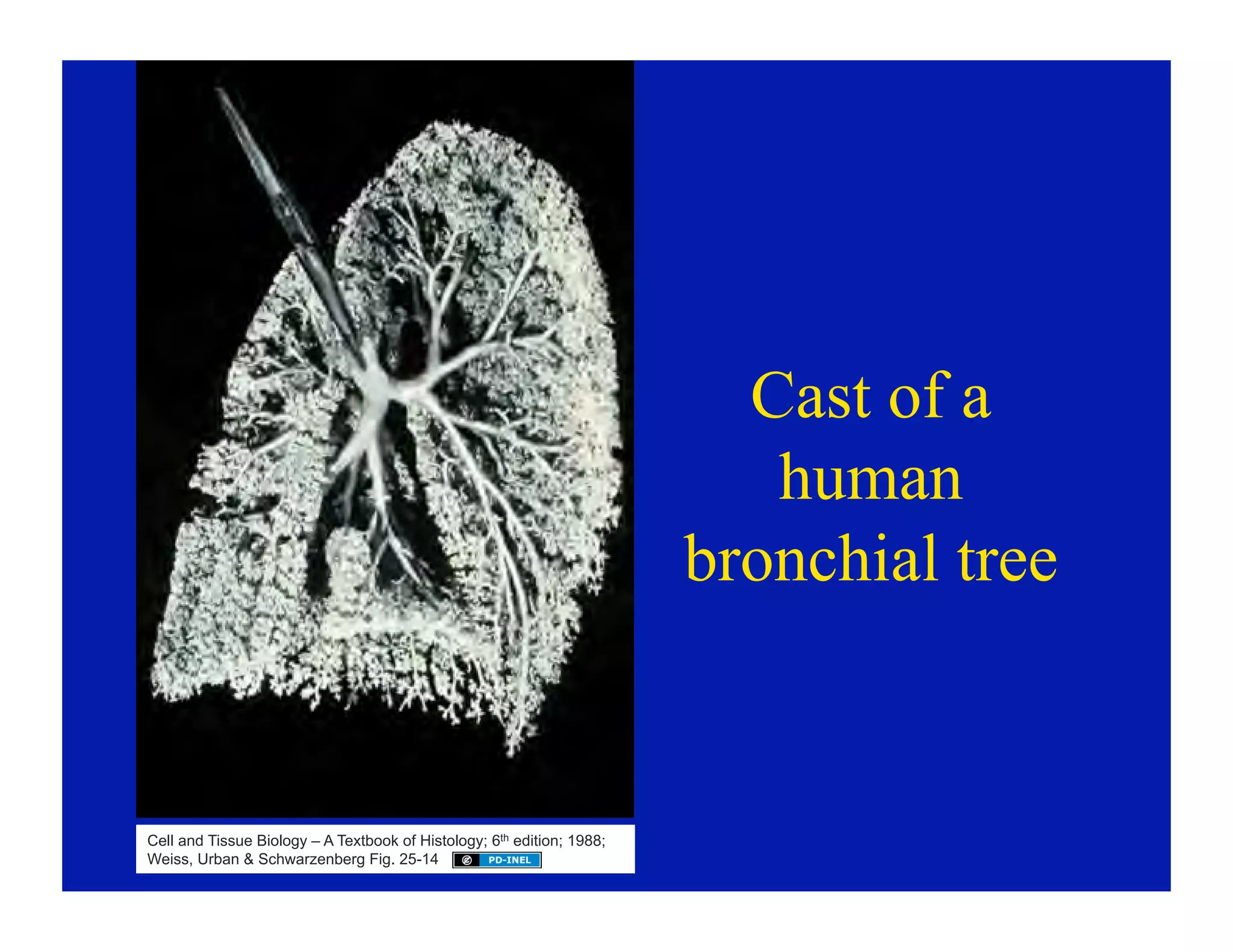
Cast of a
                                                                           human
                                                                        bronchial tree


Cell and Tissue Biology – A Textbook of Histology; 6th edition; 1988;
Weiss, Urban & Schwarzenberg Fig. 25-14
Image of
                           respiratory tree
                             arborization
Arborization of               removed


respiratory tree
                    Original Image: Wheater’s Functional
                    Histology; 5th edition, 2006, Young, Lowe,
                    Stevens and Heath; Churchill Livingstone
                    Elsevier Fig. 12.1
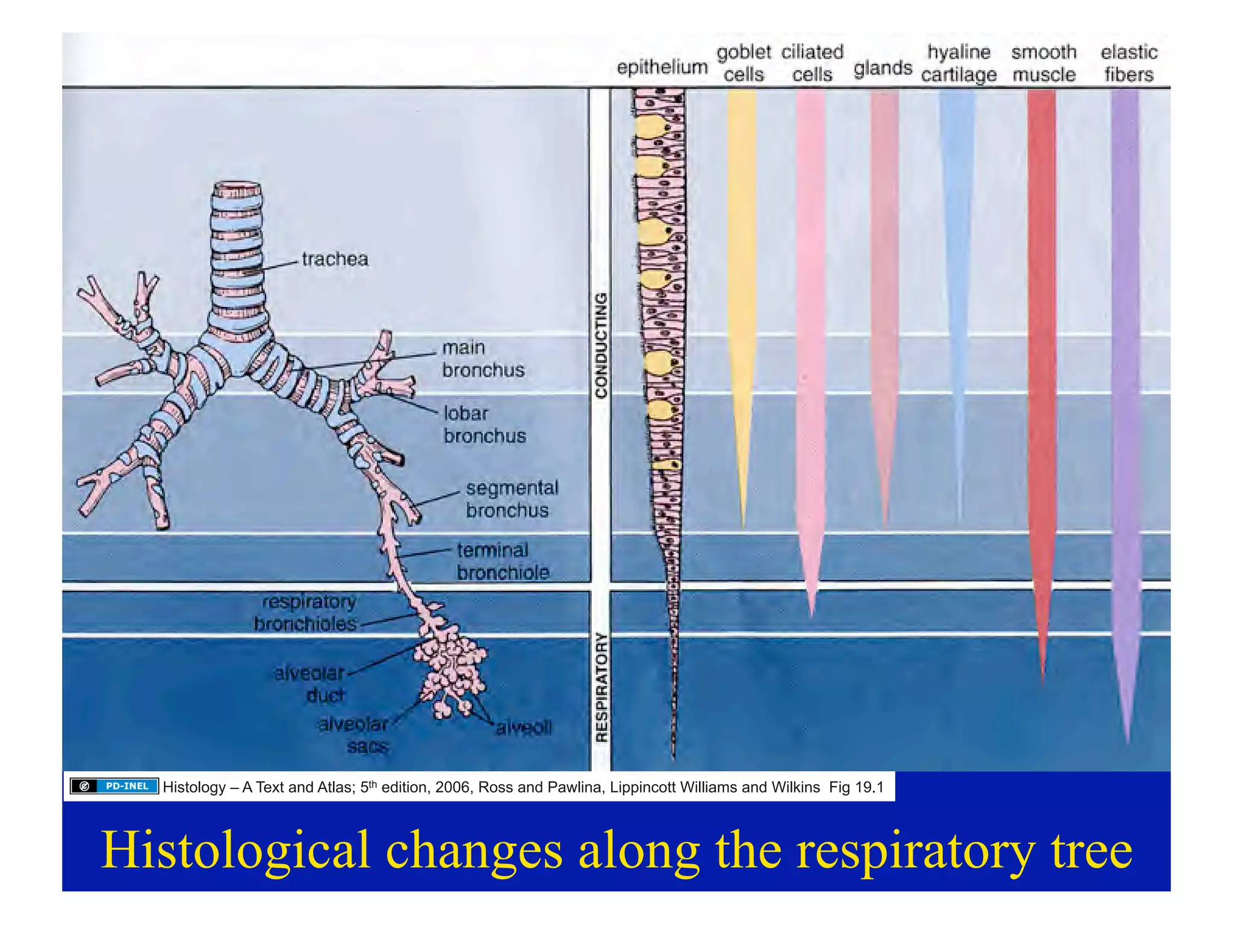
Histology – A Text and Atlas; 5th edition, 2006, Ross and Pawlina, Lippincott Williams and Wilkins Fig 19.1


Histological changes along the respiratory tree
Histological
                                                                       features of
                                                                        the nasal
                                                                          cavity


Human Histology, 2nd edition, 1997, Stevens and Lowe, Mosby Fig 10.4
Nasal venous
                                                                 sinuses warm
                                                               the incoming air


Wheater’s Functional Histology; 4th edition, 2000, Young and
Heath; Churchill Livingstone Elsevier; Fig 12.3
Transition from
                                                     stratified
                                                    squamous
                                                epithelium to the
                                                   respiratory
                                                epithelium at the
                                                    laryngeal
                                                     ventricle
Color Atlas of Basic Histology; 1993; Berman;
Appelton and Lange, Fig 14-3
Resident cells of the respiratory epithelium
Color Atlas of Basic Histology; 1993; Berman; Appelton and Lange; Fig 14-8


Light micrograph of the respiratory
       epithelium/mucosa
Basic Histology – Text & Atlas; 10th edition, 2003; Junqueira and Carneiro, Lange McGraw-Hill; Fig. 17-4 top


Scanning EM of the respiratory epithelium
                                                                        G = goblet cell
Transmission
                                                                           EM of a
                                                                          respiratory
                                                                          epithelium


Cell and Tissue Ultrastructure – A Functional Perspective; 1993; Cross
and Mercer, Freeman and Co.; page 305
Diagram of
the olfactory
 epithelium


                                           Dr. Thomas Caceci,


                 Original Image: Human Histology, 1st
                 edition, 1992, Stevens and Lowe,
     Wikipedia   Grower Medical Publishing , Fig. 9.5
Light micrograph
                                                                        of olfactory
                                                                        epithelium
                                                                     (note the absence
                                                                      of goblet cells)


Color Textbook of Histology; 2nd edition, 1994; Gartner and Hiatt;
Williams and Wilkins; Plate 12.1, Fig. 1
Light micrograph
                                                                        of olfactory
                                                                        epithelium
                                                                     (note the absence
                                                                      of goblet cells)


Color Textbook of Histology; 2nd edition, 1994; Gartner and Hiatt;
Williams and Wilkins; Plate 12.1, Fig. 2
True vocal cords
                                                                     are not lines by a
                                                                         respiratory
                                                                      epithelium, but
                                                                         rather by a
                                                                       stratified non-
                                                                         keratinized
                                                                         squamous
                                                                        epithelium.
Histology – A Text and Atlas; 5th edition, 2006, Ross and Pawlina,
Lippincott Williams and Wilkins; Fig 19.4
Source Undetermined
Color Atlas of Basic Histology; 1993; Berman; Appelton and Lange, Fig 14-2


  Two types of glands are found in the lamina
propria of the laryngeal and tracheal respiratory
epithelium: Serous and mucus producing glands
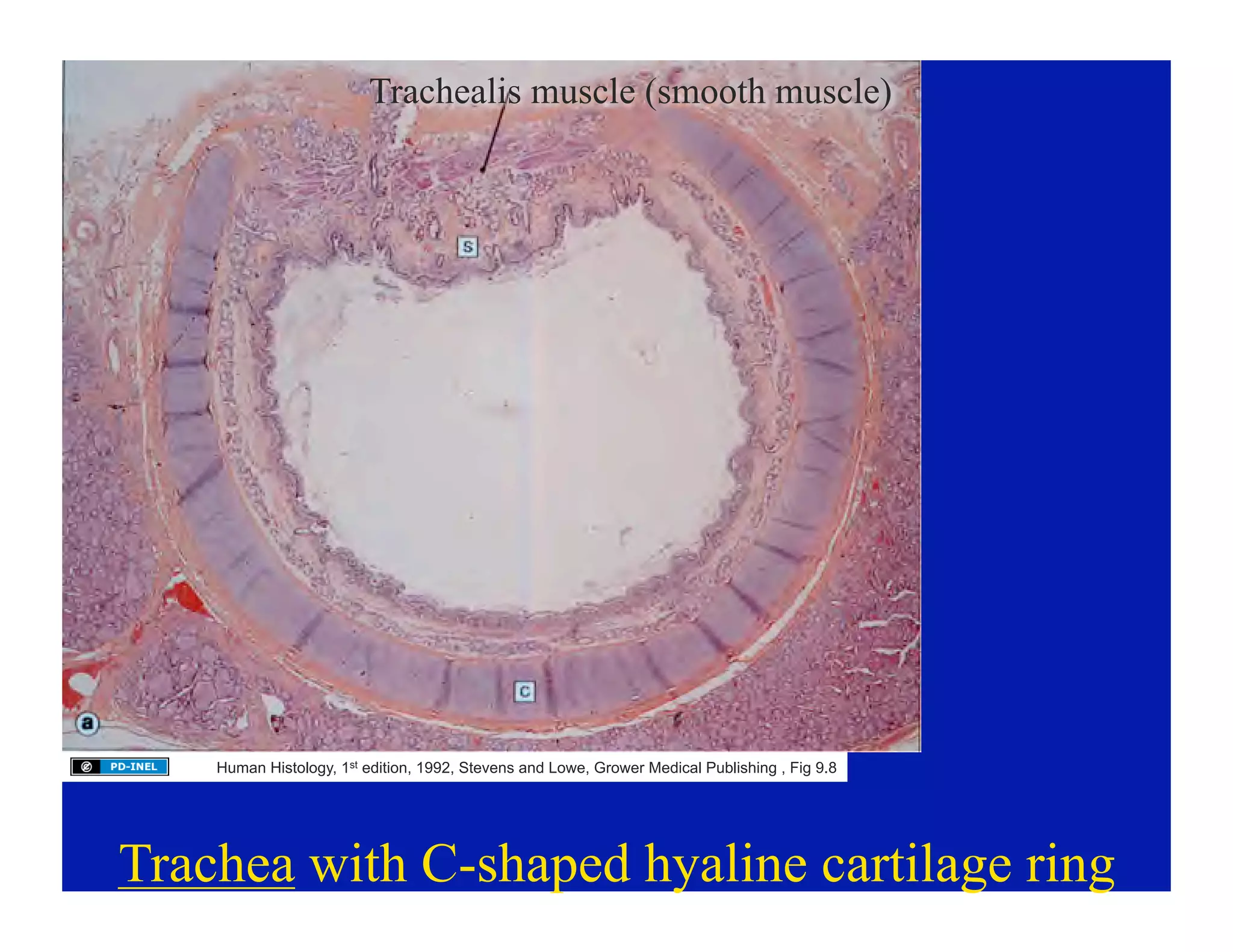
Trachealis muscle (smooth muscle)


    Human Histology, 1st edition, 1992, Stevens and Lowe, Grower Medical Publishing , Fig 9.8


Trachea with C-shaped hyaline cartilage ring
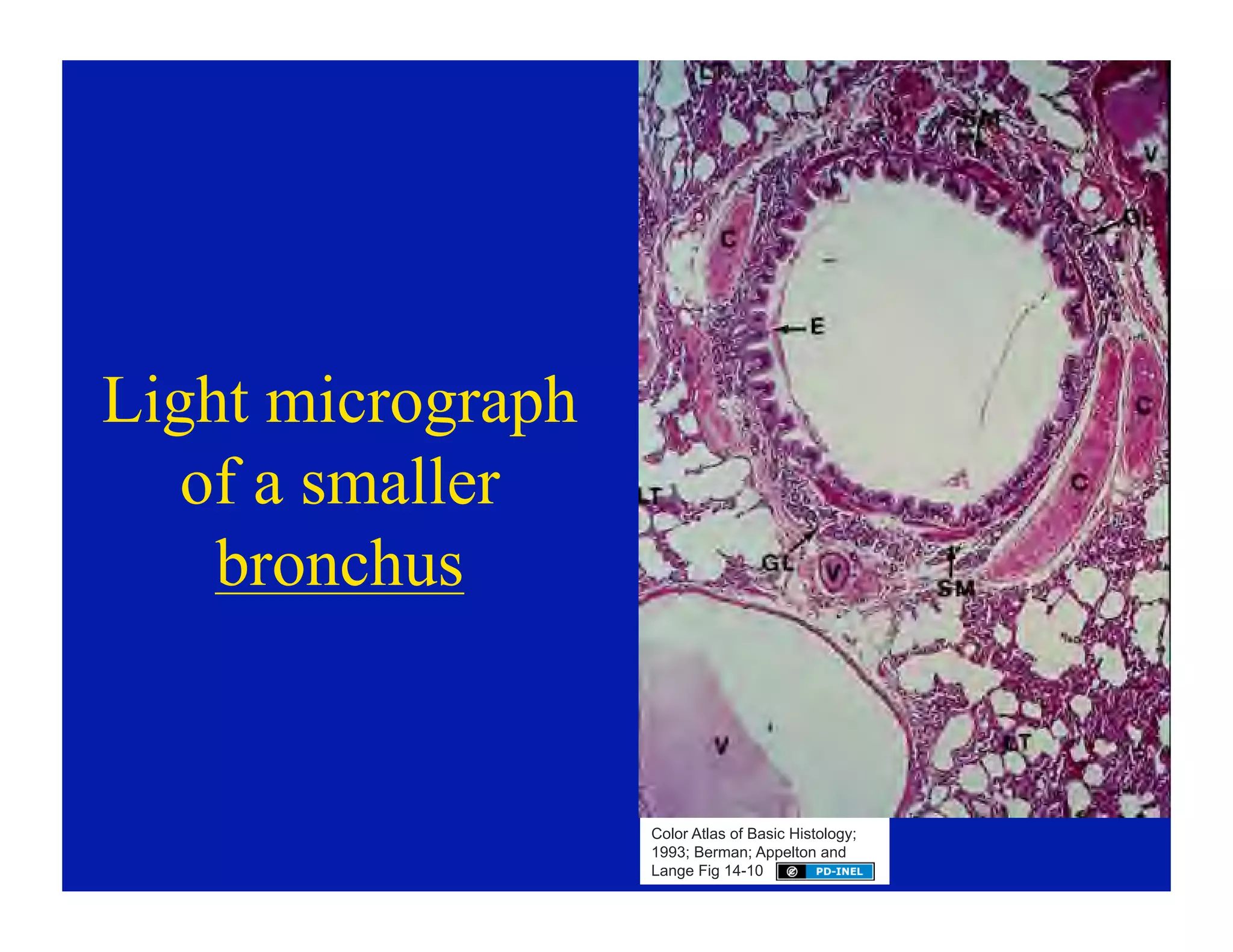
Light micrograph
   of a smaller
    bronchus


                   Color Atlas of Basic Histology;
                   1993; Berman; Appelton and
                   Lange Fig 14-10
Higher
                                                magnification of
                                                a bronchial wall


Color Atlas of Basic Histology; 1993; Berman;
Appelton and Lange; Fig 14-11
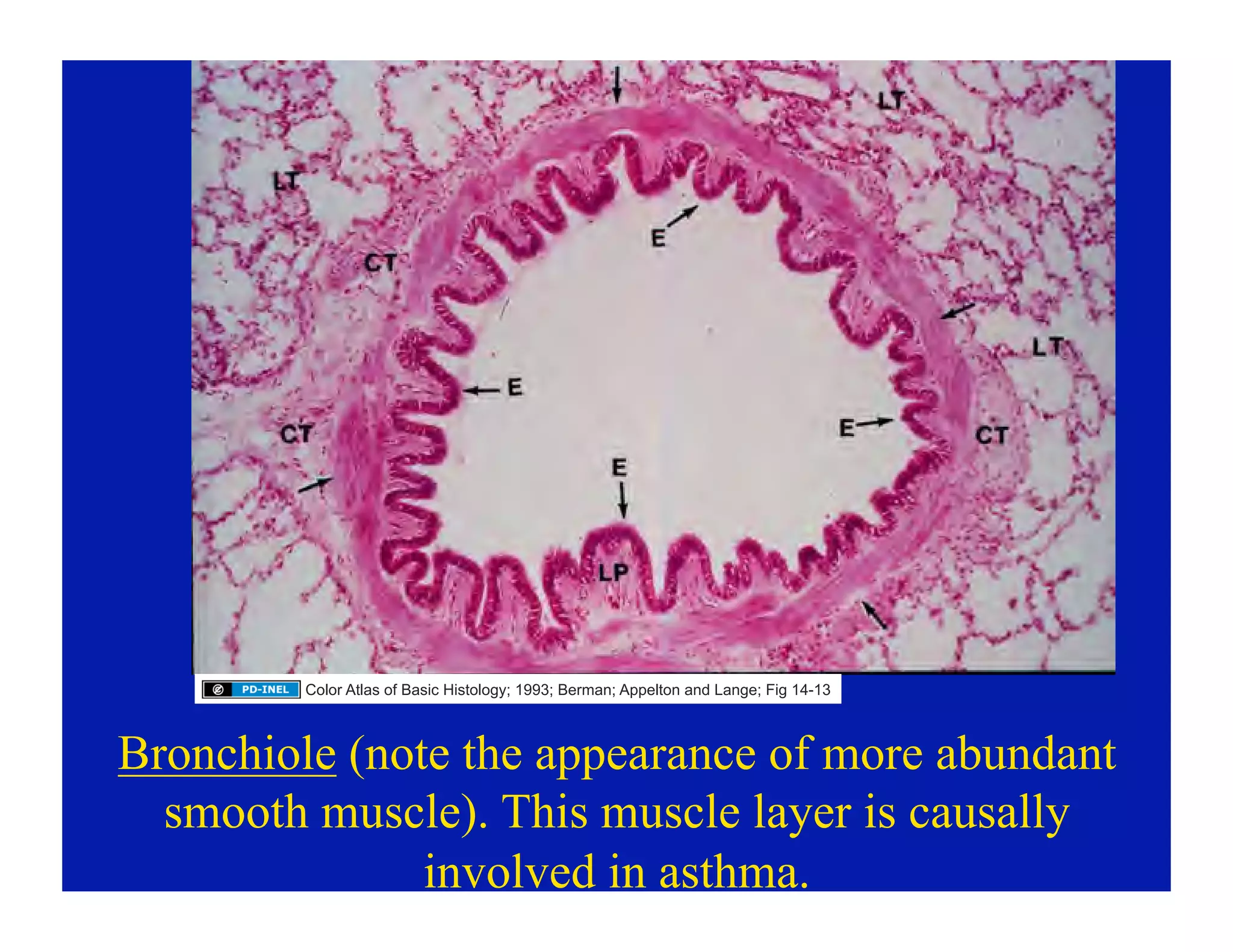
Color Atlas of Basic Histology; 1993; Berman; Appelton and Lange; Fig 14-13


Bronchiole (note the appearance of more abundant
  smooth muscle). This muscle layer is causally
               involved in asthma.
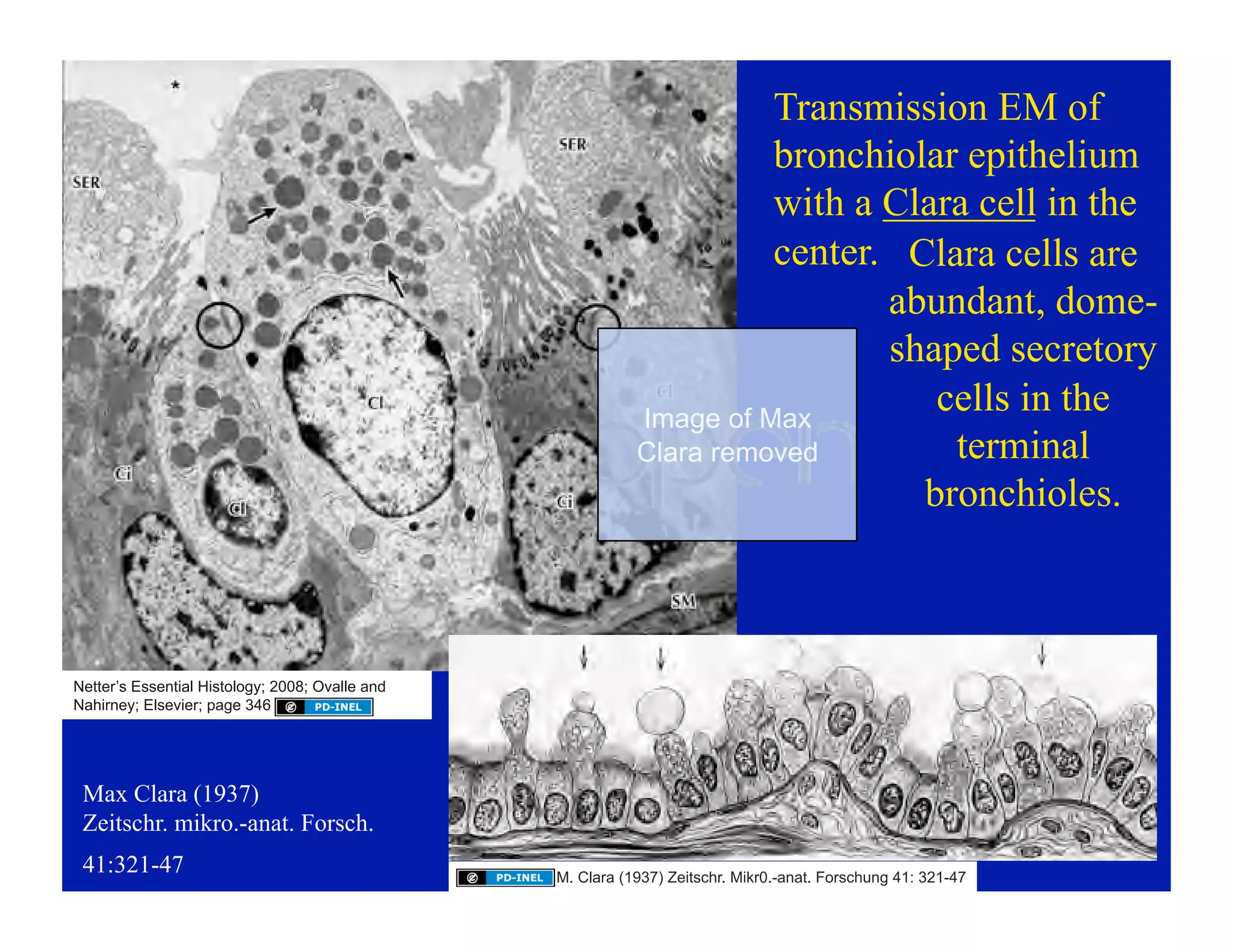
Transmission EM of
                                                                      bronchiolar epithelium
                                                                      with a Clara cell in the
                                                                      center.
 Clara cells are
                                                                              abundant, dome-
                                                                              shaped secretory
                                                            Image of Max
                                                                                 cells in the
                                                            Clara removed         terminal
                                                                                bronchioles. 


Netter’s Essential Histology; 2008; Ovalle and
Nahirney; Elsevier; page 346


 Max Clara (1937) 
 Zeitschr. mikro.-anat. Forsch.
 41:321-47       
                               M. Clara (1937) Zeitschr. Mikr0.-anat. Forschung 41: 321-47
Histology – A Text and Atlas; 5th edition, 2006, Ross and Pawlina, Lippincott Williams and Wilkins; Fig 19.12


Clara cells are not ciliated and secrete “protective” proteins. They have
an extensive smooth ER that is involved in the detoxification of inhaled
 substances. Furthermore, they act as progenitor/stem cells for ciliated
              and non-ciliated bronchiolar epithelial cells.
      Clara cell image: Basic Histology – Text  Atlas; 10th edition, 2003; Junqueira and Carneiro, Lange McGraw-Hill; Fig 17-12
Clara cells in a terminal bronchiole


                   Clara cells
                                           Terminal bronchiole
                                                                                     Clara cells
 Respiratory bronchiole


      Basic Histology – Text  Atlas by Junqueira and Carneiro; 10th edition, 2003; Lange McGraw-Hill Modified from Fig 17-18
Terminal

   Transition                                                      bronchiole


    from the
 conducting to    Alveolus


the respiratory                                                             Respiratory
                                                                            bronchiole

 portion of the
  respiratory                 Patrick J. Lynch (wikimedia)


      tract
                                       Original Image: Human Histology, 1st edition, 1992,
                                       Stevens and Lowe, Grower Medical Publishing ; Fig 9.12a
Color Atlas of Basic Histology, 1993, Berman, Appelton and Lange, Fig 14-15


                   Transition from the terminal (TB)

   
             to the respiratory bronchiole (RB)
Structure of a
                                                                                 respiratory
                                                                              bronchiole and an
                                                                                alveolar duct


Color Atlas of Basic Histology, 1993, Berman, Appelton and Lange, Fig 14-16
Color Atlas of Basic Histology, 1993, Berman, Appelton and Lange, Fig 14-19


Alveolar ducts branch further into
 alveolar sacs and single alveoli
Scanning EM
                                                                               of alveolar
                                                                                  space


Color Atlas of Histology, 1992, Erlandsen and Magney, Mosby Book, Fig 17-20
Color Atlas of Basic Histology, 1993, Berman, Appelton and Lange, Fig 14-20


Light micrograph of alveolar wall
Cell and Tissue Ultrastructure – A Functional Perspective, 1993, Cross and Mercer, Freeman and Co., Fig 25-38


Scanning EM of an alveolus demonstrates
      “holes” in the alveolar wall.
Image of Hans
                                                             Kohn removed
                 Image of Pores of
                   Kohn removed


     Original Images: Human Histology, 1st edition, 1992,
     Stevens and Lowe, Grower Medical Publishing, Fig 9.14


Structure of the interalveolar septum with
 Pores of Kohn (allow collateral ventilation)
Human Histology, 2nd edition, 1997, Stevens and Lowe, Mosby, Fig 10.15


                      Destruction 
of alveolar organization in emphysema patient
Image of air-blood
                           barrier removed


              Original Image: Human Histology, 1st edition, 1992,
              Stevens and Lowe, Grower Medical Publishing, Fig 9.14


Air-blood barrier in the interalveolar septum
The air-blood
                                                                                             barrier consists of
                                                                                               three different
                                                                                             components, two 
                                                                                              cellular and one
Fused basal
                                                                                      acellular.
lamina

                                                                               The endothelial, as well as
                                                                               the type I pneumocyte
                                                                               layer are sealed by tight
   Type I pneumocyte layer 
                                 Endothelial layer junctions.
                                                                             
    Basic Histology – Text  Atlas, 10th edition, 2003, Junqueira and Carneiro, Lange McGraw-Hill, Fig 17-20
Capillary system in the alveolar septa. 


    Mammalian Histology-B408; Department of Biological Sciences; University of Delaware. Produced by Roger C. Wagner and Fred E. Hossler
Transmission
                                                                     EM of air-blood
                                                                         barrier
                                                                     Gas exchange occurs by
                                                                     diffusion across the alveolar
                                                                     wall, which on average is
                                                                     only 0.1 to 1.5 µm thick. 

                                                                     The red arrows mark tight
                                                                     junctions
Histology – A Text and Atlas, 5th edition, 2006, Ross and Pawlina,
Lippincott Williams and Wilkins, Fig 19.19
Basic Histology – Text  Atlas, 10th edition, 2003, Junqueira and Carneiro, Lange McGraw-Hill, Fig 17-25

                                                                                             Composition of surfactant:
 Type II pneumocytes are secretory                                                           Lipids (90%)

cells, which produce a protein-lipid  Phosphatidylglycerol, Cholesterol…
                                       Dipalmitoylphosphatidylcholine (DPPC),


secretion product, called surfactant.
 Plasma proteins, 
 A, B, C and D
                                      Proteins (10%)
                                       Surfactant proteins
Lamellar bodies
   constitute the
     secretory
 vesicles of type
 II pneumocytes.
Infants born before 30
weeks of gestation often
are unable to produce
sufficient quantities of
surfactant, a situation
known as Infant
respiratory distress
syndrome (RDS).
                           Basic Histology – Text  Atlas, 10th edition, 2003, Junqueira
                                          and Carneiro, Lange McGraw-Hill, Fig 17-26
Pulmonary
                                                                   macrophages 
                                                                        or
                                                                     dust cells


Cell and Tissue Ultrastructure – A Functional Perspective, 1993,
Cross and Mercer, Freeman and Co., Page 317
Color Atlas of Basic Histology, 1993, Berman, Appelton and Lange, Fig 14-21


Light micrograph of pulmonary macrophages
Pulmonary
                                                        macrophage from a
                                                           non-smoker


                                                           Pulmonary
                                                        macrophage from a
                                                             smoker
Color Atlas of Histology, 1992, Erlandsen and Magney,
Mosby Book, Figs 17-15 and 17-16
Intrapulmonary Blood
                                                   Circulation

                                                Bronchial arteries and
                                                Pulmonary arteries travel
              Image of                          together along the
          pulmonary blood
           flow removed
                                                bronchiolar system,
                                                Pulmonary veins are
                                                usually not associated
                                                with the lower branches
      Original Image: Netter’s Essential
      Histology, 2008, Ovalle and Nahirney,
      Elsevier, page 347
                                                of the bronchiolar system


Pulmonary arteries supply deoxygenated blood.
Bronchial arteries supply oxygenated blood.
After oxygenation in the capillary plexuses, blood is drained by
Pulmonary veins.
Pulmonary
                                                arteries are
                                                 large and
                                              relatively thin-
                                                  walled.
                                                  They are
                                                 associated
                                                  with the
                                                bronchiolar
                                                    tree.


Michigan Medical Histology Slide Collection
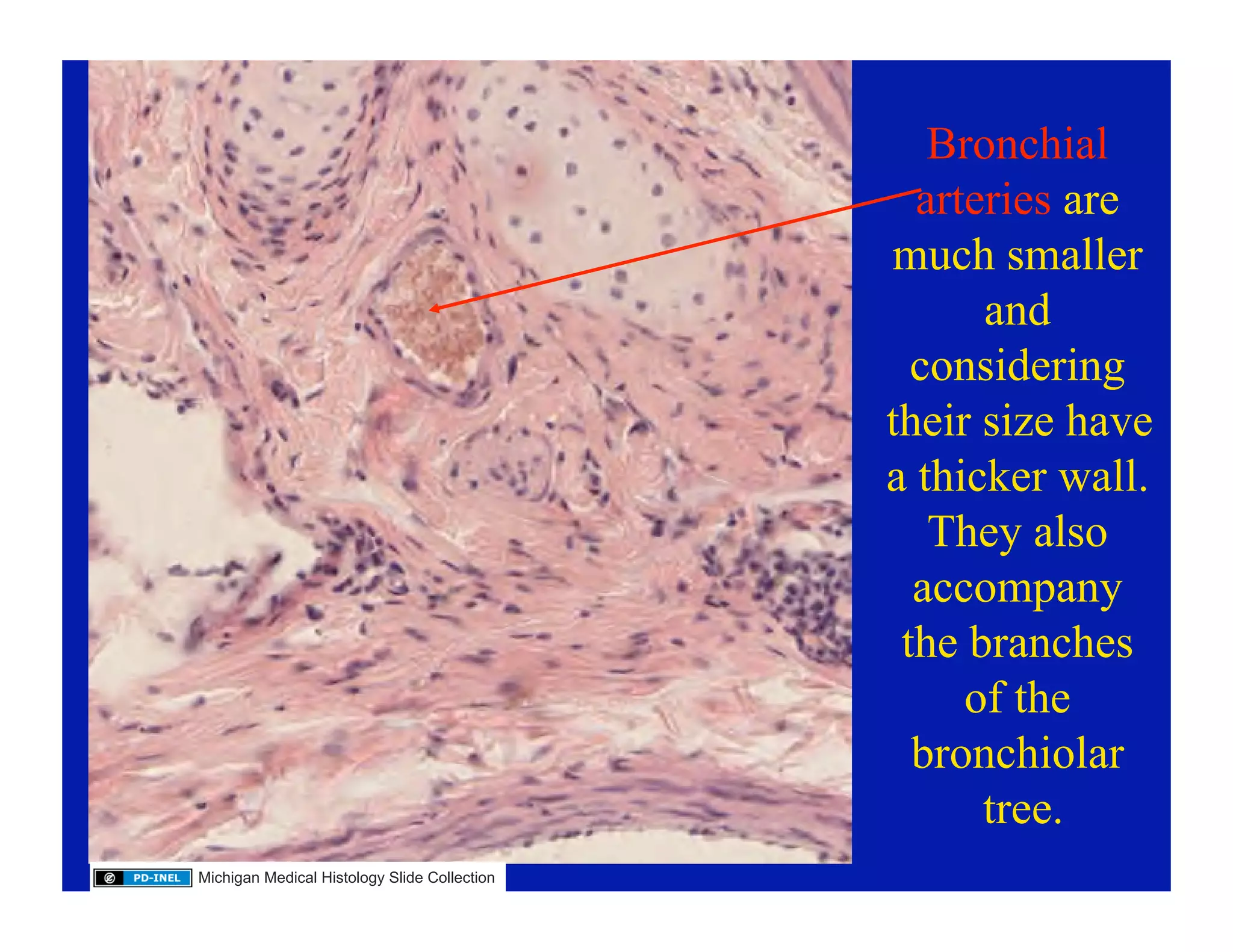
Bronchial
                                                arteries are
                                              much smaller
                                                    and
                                                considering
                                              their size have
                                              a thicker wall.
                                                 They also
                                                accompany
                                               the branches
                                                   of the
                                                bronchiolar
                                                    tree.
                                                        
Michigan Medical Histology Slide Collection


Pulmonary veins collect blood from both Pulmonary
          arteries and Bronchial arteries. 
 They are usually not associated with bronchioles.
Histology – A Text and Atlas; 5th edition, 2006, Ross and Pawlina, Lippincott Williams and Wilkins Fig 19.1


Histological changes along the respiratory tree
Additional Source Information
                              for more information see: http://open.umich.edu/wiki/CitationPolicy

Slide 6: Cell and Tissue Biology – A Textbook of Histology, 6th edition, 1988, Weiss, Urban  Schwarzenberg Fig. 25-14
Slide 8: Histology – A Text and Atlas; 5th edition, 2006, Ross and Pawlina, Lippincott Williams and Wilkins Fig 19.1
Slide 9: Human Histology, 2nd edition, 1997, Stevens and Lowe, Mosby Fig 10.4
Slide 10: Wheater’s Functional Histology, 4th edition, 2000, Young and Heath, Churchill Livingstone Elsevier, Fig 12.3
Slide 11: Color Atlas of Basic Histology, 1993, Berman, Appelton and Lange, Fig 14-3
Slide 12: Cell and Tissue Biology – A Textbook of Histology, 6th edition, 1988, Weiss, Urban  Schwarzenberg, Fog 25-11
Slide 13: Color Atlas of Basic Histology, 1993, Berman, Appelton and Lange, Fig 14-8
Slide 14: Basic Histology – Text  Atlas, 10th edition, 2003, Junqueira and Carneiro, Lange McGraw-Hill, Fig. 17-4 top
Slide 15: Cell and Tissue Ultrastructure – A Functional Perspective, 1993, Cross and Mercer, Freeman and Co., page 305
Slide 16: “Bowman” Wikipedia, http://en.wikipedia.org/wiki/Sir_William_Bowman,_1st_Baronet; Dr. Thomas Caceci,
    http://education.vetmed.vt.edu/curriculum/vm8054/labs/Lab25/lab25.htm
Slide 17: Color Textbook of Histology, 2nd edition, 1994, Gartner and Hiatt, Williams and Wilkins, Plate 12.1, Fig. 1
Slide 18: Color Textbook of Histology, 2nd edition, 1994, Gartner and Hiatt, Williams and Wilkins, Plate 12.1, Fig. 2
Slide 19: Histology – A Text and Atlas, 5th edition, 2006, Ross and Pawlina, Lippincott Williams and Wilkins, Fig 19.4
Slide 20: Source Undetermined
Slide 21: Color Atlas of Basic Histology, 1993, Berman, Appelton and Lange, Fig 14-2
Slide 22: Human Histology, 1st edition, 1992, Stevens and Lowe, Grower Medical Publishing , Fig 9.8
Slide 23: Color Atlas of Basic Histology, 1993, Berman, Appelton and Lange, Fig 14-10
Slide 24: Color Atlas of Basic Histology, 1993, Berman, Appelton and Lange, Fig 14-11
Slide 25: Color Atlas of Basic Histology, 1993, Berman, Appelton and Lange, Fig 14-13
Slide 26: Netter’s Essential Histology, 2008, Ovalle and Nahirney, Elsevier, page 346; M. Clara (1937) Zeitschr. Mikr0.-anat. Forschung
    41: 321-47
Slide 27: Histology – A Text and Atlas, 5th edition, 2006, Ross and Pawlina, Lippincott Williams and Wilkins, Fig 19.12; Clara cell
    image: Basic Histology – Text  Atlas; 10th edition, 2003; Junqueira and Carneiro, Lange McGraw-Hill; Fig 17-12
Slide 28: Basic Histology – Text  Atlas by Junqueira and Carneiro, 10th edition, 2003, Lange McGraw-Hill Modified from Fig 17-18
Slide 29: Patrick J. Lynch, Wikimedia, http://commons.wikimedia.org/wiki/File:Bronchial_anatomy_with_description.png, CC: BY 2.5
http://creativecommons.org/licenses/by/2.5/
Slide 30: Color Atlas of Basic Histology, 1993, Berman, Appelton and Lange, Fig 14-15
Slide 31: Color Atlas of Basic Histology, 1993, Berman, Appelton and Lange, Fig 14-16
Slide 32: Color Atlas of Basic Histology, 1993, Berman, Appelton and Lange, Fig 14-19
Slide 33: Color Atlas of Histology, 1992, Erlandsen and Magney, Mosby Book, Fig 17-20
Slide 34: Color Atlas of Basic Histology, 1993, Berman, Appelton and Lange, Fig 14-20
Slide 35: Cell and Tissue Ultrastructure – A Functional Perspective, 1993, Cross and Mercer, Freeman and Co., Fig 25-38
Slide 36: Human Histology, 1st edition, 1992, Stevens and Lowe, Grower Medical Publishing, Fig 9.14; The photo of Hans Kohn is used
with permission from Kohn’s granddaughter Dr. Ruth Anna Putnam, not relicensed for distribution
Slide 37: Human Histology, 2nd edition, 1997, Stevens and Lowe, Mosby, Fig 10.15
Slide 38: Human Histology, 1st edition, 1992, Stevens and Lowe, Grower Medical Publishing, Fig 9.14
Slide 39: Basic Histology – Text  Atlas, 10th edition, 2003, Junqueira and Carneiro, Lange McGraw-Hill, Fig 17-20
Slide 40: Mammalian Histology-B408, http://www.udel.edu/biology/Wags/histopage/colorpage/cre/cre.htm ; Department of Biological
Sciences, University of Delaware. Produced by Roger C. Wagner and Fred E. Hossler
Slide 41: Histology – A Text and Atlas, 5th edition, 2006, Ross and Pawlina, Lippincott Williams and Wilkins, Fig 19.19
Slide 42: Basic Histology – Text  Atlas, 10th edition, 2003, Junqueira and Carneiro, Lange McGraw-Hill, Fig 17-25
Slide 43: Basic Histology – Text  Atlas, 10th edition, 2003, Junqueira and Carneiro, Lange McGraw-Hill, Fig 17-26
Slide 44: Cell and Tissue Ultrastructure – A Functional Perspective, 1993, Cross and Mercer, Freeman and Co., Page 317
Slide 45: Color Atlas of Basic Histology, 1993, Berman, Appelton and Lange, Fig 14-21
Slide 46: Color Atlas of Histology, 1992, Erlandsen and Magney, Mosby Book, Figs 17-15 and 17-16
Slide 47: Netter’s Essential Histology, 2008, Ovalle and Nahirney, Elsevier, page 347
Slide 48: Michigan Medical Histology Slide Collection
Slide 49: Michigan Medical Histology Slide Collection
Slide 50: Michigan Medical Histology Slide Collection
Slide 51: Histology – A Text and Atlas, 5th edition, 2006, Ross and Pawlina, Lippincott Williams and Wilkins Fig 19.1

11.10.08(d): Histology of the Respiratory Tract

  • 1.
    Author(s): Michael Hortsch,Ph.D., 2009 License: Unless otherwise noted, this material is made available under the terms of the Creative Commons Attribution–Non-commercial–Share Alike 3.0 License: http://creativecommons.org/licenses/by-nc-sa/3.0/ We have reviewed this material in accordance with U.S. Copyright Law and have tried to maximize your ability to use, share, and adapt it. The citation key on the following slide provides information about how you may share and adapt this material. Copyright holders of content included in this material should contact open.michigan@umich.edu with any questions, corrections, or clarification regarding the use of content. For more information about how to cite these materials visit http://open.umich.edu/education/about/terms-of-use. Any medical information in this material is intended to inform and educate and is not a tool for self-diagnosis or a replacement for medical evaluation, advice, diagnosis or treatment by a healthcare professional. Please speak to your physician if you have questions about your medical condition. Viewer discretion is advised: Some medical content is graphic and may not be suitable for all viewers.
  • 2.
    Citation Key for more information see: http://open.umich.edu/wiki/CitationPolicy Use + Share + Adapt { Content the copyright holder, author, or law permits you to use, share and adapt. } Public Domain – Government: Works that are produced by the U.S. Government. (17 USC § 105) Public Domain – Expired: Works that are no longer protected due to an expired copyright term. Public Domain – Self Dedicated: Works that a copyright holder has dedicated to the public domain. Creative Commons – Zero Waiver Creative Commons – Attribution License Creative Commons – Attribution Share Alike License Creative Commons – Attribution Noncommercial License Creative Commons – Attribution Noncommercial Share Alike License GNU – Free Documentation License Make Your Own Assessment { Content Open.Michigan believes can be used, shared, and adapted because it is ineligible for copyright. } Public Domain – Ineligible: Works that are ineligible for copyright protection in the U.S. (17 USC § 102(b)) *laws in your jurisdiction may differ { Content Open.Michigan has used under a Fair Use determination. } Fair Use: Use of works that is determined to be Fair consistent with the U.S. Copyright Act. (17 USC § 107) *laws in your jurisdiction may differ Our determination DOES NOT mean that all uses of this 3rd-party content are Fair Uses and we DO NOT guarantee that your use of the content is Fair. To use this content you should do your own independent analysis to determine whether or not your use will be Fair.
  • 3.
    Histology of theRespiratory Tract
 M1 – Cardiovascular/Respiratory Sequence Michael Hortsch, Ph.D.
 Fall 2008
  • 4.
    Objectives Respiratory TractHistology: •  Know the general functions of the respiratory system and the overall organization of the respiratory tree •  Identify the histological features of the nasal cavity, the vocal cords and the trachea •  Know the cellular components of the respiratory epithelium and their functional importance •  Be able to recognize olfactory epithelium and know how it differs from regular respiratory epithelium •  Identify bronchi, bronchiole, terminal bronchiole, respiratory bronchiole, alveolar ducts and sacs and know their distinct histological features •  Be able to recognize Clara cells and know their functional significance •  Understand the structural organization of alveoli, including the air-blood barrier and alveolar pores •  Know the cellular components of the alveolar tissue and their individual functions and be able to recognize them •  Understand the organization of the intrapulmonary blood circulation and recognize its different parts
  • 5.
    Major Functions ofthe Respiratory System: 1.  Air conditioning (air warming, humidifying and filtering) 2.  Oxygen/carbon dioxide exchange Minor Functions of the Respiratory System: 1. Perception of smell 2. Phonation 3. Endocrine functions, conversion of Angiotensin I into II
  • 6.
    Cast of a human bronchial tree Cell and Tissue Biology – A Textbook of Histology; 6th edition; 1988; Weiss, Urban & Schwarzenberg Fig. 25-14
  • 7.
    Image of respiratory tree arborization Arborization of removed respiratory tree Original Image: Wheater’s Functional Histology; 5th edition, 2006, Young, Lowe, Stevens and Heath; Churchill Livingstone Elsevier Fig. 12.1
  • 8.
    Histology – AText and Atlas; 5th edition, 2006, Ross and Pawlina, Lippincott Williams and Wilkins Fig 19.1 Histological changes along the respiratory tree
  • 9.
    Histological features of the nasal cavity Human Histology, 2nd edition, 1997, Stevens and Lowe, Mosby Fig 10.4
  • 10.
    Nasal venous sinuses warm the incoming air Wheater’s Functional Histology; 4th edition, 2000, Young and Heath; Churchill Livingstone Elsevier; Fig 12.3
  • 11.
    Transition from stratified squamous epithelium to the respiratory epithelium at the laryngeal ventricle Color Atlas of Basic Histology; 1993; Berman; Appelton and Lange, Fig 14-3
  • 12.
    Resident cells ofthe respiratory epithelium
  • 13.
    Color Atlas ofBasic Histology; 1993; Berman; Appelton and Lange; Fig 14-8 Light micrograph of the respiratory epithelium/mucosa
  • 14.
    Basic Histology –Text & Atlas; 10th edition, 2003; Junqueira and Carneiro, Lange McGraw-Hill; Fig. 17-4 top Scanning EM of the respiratory epithelium G = goblet cell
  • 15.
    Transmission EM of a respiratory epithelium Cell and Tissue Ultrastructure – A Functional Perspective; 1993; Cross and Mercer, Freeman and Co.; page 305
  • 16.
    Diagram of the olfactory epithelium Dr. Thomas Caceci, Original Image: Human Histology, 1st edition, 1992, Stevens and Lowe, Wikipedia Grower Medical Publishing , Fig. 9.5
  • 17.
    Light micrograph of olfactory epithelium (note the absence of goblet cells) Color Textbook of Histology; 2nd edition, 1994; Gartner and Hiatt; Williams and Wilkins; Plate 12.1, Fig. 1
  • 18.
    Light micrograph of olfactory epithelium (note the absence of goblet cells) Color Textbook of Histology; 2nd edition, 1994; Gartner and Hiatt; Williams and Wilkins; Plate 12.1, Fig. 2
  • 19.
    True vocal cords are not lines by a respiratory epithelium, but rather by a stratified non- keratinized squamous epithelium. Histology – A Text and Atlas; 5th edition, 2006, Ross and Pawlina, Lippincott Williams and Wilkins; Fig 19.4
  • 20.
  • 21.
    Color Atlas ofBasic Histology; 1993; Berman; Appelton and Lange, Fig 14-2 Two types of glands are found in the lamina propria of the laryngeal and tracheal respiratory epithelium: Serous and mucus producing glands
  • 22.
    Trachealis muscle (smoothmuscle) Human Histology, 1st edition, 1992, Stevens and Lowe, Grower Medical Publishing , Fig 9.8 Trachea with C-shaped hyaline cartilage ring
  • 23.
    Light micrograph of a smaller bronchus Color Atlas of Basic Histology; 1993; Berman; Appelton and Lange Fig 14-10
  • 24.
    Higher magnification of a bronchial wall Color Atlas of Basic Histology; 1993; Berman; Appelton and Lange; Fig 14-11
  • 25.
    Color Atlas ofBasic Histology; 1993; Berman; Appelton and Lange; Fig 14-13 Bronchiole (note the appearance of more abundant smooth muscle). This muscle layer is causally involved in asthma.
  • 26.
    Transmission EM of bronchiolar epithelium with a Clara cell in the center. Clara cells are abundant, dome- shaped secretory Image of Max cells in the Clara removed terminal bronchioles. Netter’s Essential Histology; 2008; Ovalle and Nahirney; Elsevier; page 346 Max Clara (1937) Zeitschr. mikro.-anat. Forsch. 41:321-47 M. Clara (1937) Zeitschr. Mikr0.-anat. Forschung 41: 321-47
  • 27.
    Histology – AText and Atlas; 5th edition, 2006, Ross and Pawlina, Lippincott Williams and Wilkins; Fig 19.12 Clara cells are not ciliated and secrete “protective” proteins. They have an extensive smooth ER that is involved in the detoxification of inhaled substances. Furthermore, they act as progenitor/stem cells for ciliated and non-ciliated bronchiolar epithelial cells. Clara cell image: Basic Histology – Text Atlas; 10th edition, 2003; Junqueira and Carneiro, Lange McGraw-Hill; Fig 17-12
  • 28.
    Clara cells ina terminal bronchiole Clara cells Terminal bronchiole Clara cells Respiratory bronchiole Basic Histology – Text Atlas by Junqueira and Carneiro; 10th edition, 2003; Lange McGraw-Hill Modified from Fig 17-18
  • 29.
    Terminal Transition bronchiole from the conducting to Alveolus the respiratory Respiratory bronchiole portion of the respiratory Patrick J. Lynch (wikimedia) tract Original Image: Human Histology, 1st edition, 1992, Stevens and Lowe, Grower Medical Publishing ; Fig 9.12a
  • 30.
    Color Atlas ofBasic Histology, 1993, Berman, Appelton and Lange, Fig 14-15 Transition from the terminal (TB) to the respiratory bronchiole (RB)
  • 31.
    Structure of a respiratory bronchiole and an alveolar duct Color Atlas of Basic Histology, 1993, Berman, Appelton and Lange, Fig 14-16
  • 32.
    Color Atlas ofBasic Histology, 1993, Berman, Appelton and Lange, Fig 14-19 Alveolar ducts branch further into alveolar sacs and single alveoli
  • 33.
    Scanning EM of alveolar space Color Atlas of Histology, 1992, Erlandsen and Magney, Mosby Book, Fig 17-20
  • 34.
    Color Atlas ofBasic Histology, 1993, Berman, Appelton and Lange, Fig 14-20 Light micrograph of alveolar wall
  • 35.
    Cell and TissueUltrastructure – A Functional Perspective, 1993, Cross and Mercer, Freeman and Co., Fig 25-38 Scanning EM of an alveolus demonstrates “holes” in the alveolar wall.
  • 36.
    Image of Hans Kohn removed Image of Pores of Kohn removed Original Images: Human Histology, 1st edition, 1992, Stevens and Lowe, Grower Medical Publishing, Fig 9.14 Structure of the interalveolar septum with Pores of Kohn (allow collateral ventilation)
  • 37.
    Human Histology, 2ndedition, 1997, Stevens and Lowe, Mosby, Fig 10.15 Destruction of alveolar organization in emphysema patient
  • 38.
    Image of air-blood barrier removed Original Image: Human Histology, 1st edition, 1992, Stevens and Lowe, Grower Medical Publishing, Fig 9.14 Air-blood barrier in the interalveolar septum
  • 39.
    The air-blood barrier consists of three different components, two cellular and one Fused basal acellular. lamina The endothelial, as well as the type I pneumocyte layer are sealed by tight Type I pneumocyte layer Endothelial layer junctions. Basic Histology – Text Atlas, 10th edition, 2003, Junqueira and Carneiro, Lange McGraw-Hill, Fig 17-20
  • 40.
    Capillary system inthe alveolar septa. Mammalian Histology-B408; Department of Biological Sciences; University of Delaware. Produced by Roger C. Wagner and Fred E. Hossler
  • 41.
    Transmission EM of air-blood barrier Gas exchange occurs by diffusion across the alveolar wall, which on average is only 0.1 to 1.5 µm thick. The red arrows mark tight junctions Histology – A Text and Atlas, 5th edition, 2006, Ross and Pawlina, Lippincott Williams and Wilkins, Fig 19.19
  • 42.
    Basic Histology –Text Atlas, 10th edition, 2003, Junqueira and Carneiro, Lange McGraw-Hill, Fig 17-25 Composition of surfactant: Type II pneumocytes are secretory Lipids (90%) cells, which produce a protein-lipid Phosphatidylglycerol, Cholesterol… Dipalmitoylphosphatidylcholine (DPPC), secretion product, called surfactant. Plasma proteins, A, B, C and D Proteins (10%) Surfactant proteins
  • 43.
    Lamellar bodies constitute the secretory vesicles of type II pneumocytes. Infants born before 30 weeks of gestation often are unable to produce sufficient quantities of surfactant, a situation known as Infant respiratory distress syndrome (RDS). Basic Histology – Text Atlas, 10th edition, 2003, Junqueira and Carneiro, Lange McGraw-Hill, Fig 17-26
  • 44.
    Pulmonary macrophages or dust cells Cell and Tissue Ultrastructure – A Functional Perspective, 1993, Cross and Mercer, Freeman and Co., Page 317
  • 45.
    Color Atlas ofBasic Histology, 1993, Berman, Appelton and Lange, Fig 14-21 Light micrograph of pulmonary macrophages
  • 46.
    Pulmonary macrophage from a non-smoker Pulmonary macrophage from a smoker Color Atlas of Histology, 1992, Erlandsen and Magney, Mosby Book, Figs 17-15 and 17-16
  • 47.
    Intrapulmonary Blood Circulation Bronchial arteries and Pulmonary arteries travel Image of together along the pulmonary blood flow removed bronchiolar system, Pulmonary veins are usually not associated with the lower branches Original Image: Netter’s Essential Histology, 2008, Ovalle and Nahirney, Elsevier, page 347 of the bronchiolar system Pulmonary arteries supply deoxygenated blood. Bronchial arteries supply oxygenated blood. After oxygenation in the capillary plexuses, blood is drained by Pulmonary veins.
  • 48.
    Pulmonary arteries are large and relatively thin- walled. They are associated with the bronchiolar tree. Michigan Medical Histology Slide Collection
  • 49.
    Bronchial arteries are much smaller and considering their size have a thicker wall. They also accompany the branches of the bronchiolar tree. Michigan Medical Histology Slide Collection
  • 50.
    Michigan Medical HistologySlide Collection Pulmonary veins collect blood from both Pulmonary arteries and Bronchial arteries. They are usually not associated with bronchioles.
  • 51.
    Histology – AText and Atlas; 5th edition, 2006, Ross and Pawlina, Lippincott Williams and Wilkins Fig 19.1 Histological changes along the respiratory tree
  • 52.
    Additional Source Information for more information see: http://open.umich.edu/wiki/CitationPolicy Slide 6: Cell and Tissue Biology – A Textbook of Histology, 6th edition, 1988, Weiss, Urban Schwarzenberg Fig. 25-14 Slide 8: Histology – A Text and Atlas; 5th edition, 2006, Ross and Pawlina, Lippincott Williams and Wilkins Fig 19.1 Slide 9: Human Histology, 2nd edition, 1997, Stevens and Lowe, Mosby Fig 10.4 Slide 10: Wheater’s Functional Histology, 4th edition, 2000, Young and Heath, Churchill Livingstone Elsevier, Fig 12.3 Slide 11: Color Atlas of Basic Histology, 1993, Berman, Appelton and Lange, Fig 14-3 Slide 12: Cell and Tissue Biology – A Textbook of Histology, 6th edition, 1988, Weiss, Urban Schwarzenberg, Fog 25-11 Slide 13: Color Atlas of Basic Histology, 1993, Berman, Appelton and Lange, Fig 14-8 Slide 14: Basic Histology – Text Atlas, 10th edition, 2003, Junqueira and Carneiro, Lange McGraw-Hill, Fig. 17-4 top Slide 15: Cell and Tissue Ultrastructure – A Functional Perspective, 1993, Cross and Mercer, Freeman and Co., page 305 Slide 16: “Bowman” Wikipedia, http://en.wikipedia.org/wiki/Sir_William_Bowman,_1st_Baronet; Dr. Thomas Caceci, http://education.vetmed.vt.edu/curriculum/vm8054/labs/Lab25/lab25.htm Slide 17: Color Textbook of Histology, 2nd edition, 1994, Gartner and Hiatt, Williams and Wilkins, Plate 12.1, Fig. 1 Slide 18: Color Textbook of Histology, 2nd edition, 1994, Gartner and Hiatt, Williams and Wilkins, Plate 12.1, Fig. 2 Slide 19: Histology – A Text and Atlas, 5th edition, 2006, Ross and Pawlina, Lippincott Williams and Wilkins, Fig 19.4 Slide 20: Source Undetermined Slide 21: Color Atlas of Basic Histology, 1993, Berman, Appelton and Lange, Fig 14-2 Slide 22: Human Histology, 1st edition, 1992, Stevens and Lowe, Grower Medical Publishing , Fig 9.8 Slide 23: Color Atlas of Basic Histology, 1993, Berman, Appelton and Lange, Fig 14-10 Slide 24: Color Atlas of Basic Histology, 1993, Berman, Appelton and Lange, Fig 14-11 Slide 25: Color Atlas of Basic Histology, 1993, Berman, Appelton and Lange, Fig 14-13 Slide 26: Netter’s Essential Histology, 2008, Ovalle and Nahirney, Elsevier, page 346; M. Clara (1937) Zeitschr. Mikr0.-anat. Forschung 41: 321-47 Slide 27: Histology – A Text and Atlas, 5th edition, 2006, Ross and Pawlina, Lippincott Williams and Wilkins, Fig 19.12; Clara cell image: Basic Histology – Text Atlas; 10th edition, 2003; Junqueira and Carneiro, Lange McGraw-Hill; Fig 17-12 Slide 28: Basic Histology – Text Atlas by Junqueira and Carneiro, 10th edition, 2003, Lange McGraw-Hill Modified from Fig 17-18 Slide 29: Patrick J. Lynch, Wikimedia, http://commons.wikimedia.org/wiki/File:Bronchial_anatomy_with_description.png, CC: BY 2.5 http://creativecommons.org/licenses/by/2.5/ Slide 30: Color Atlas of Basic Histology, 1993, Berman, Appelton and Lange, Fig 14-15 Slide 31: Color Atlas of Basic Histology, 1993, Berman, Appelton and Lange, Fig 14-16 Slide 32: Color Atlas of Basic Histology, 1993, Berman, Appelton and Lange, Fig 14-19 Slide 33: Color Atlas of Histology, 1992, Erlandsen and Magney, Mosby Book, Fig 17-20
  • 53.
    Slide 34: ColorAtlas of Basic Histology, 1993, Berman, Appelton and Lange, Fig 14-20 Slide 35: Cell and Tissue Ultrastructure – A Functional Perspective, 1993, Cross and Mercer, Freeman and Co., Fig 25-38 Slide 36: Human Histology, 1st edition, 1992, Stevens and Lowe, Grower Medical Publishing, Fig 9.14; The photo of Hans Kohn is used with permission from Kohn’s granddaughter Dr. Ruth Anna Putnam, not relicensed for distribution Slide 37: Human Histology, 2nd edition, 1997, Stevens and Lowe, Mosby, Fig 10.15 Slide 38: Human Histology, 1st edition, 1992, Stevens and Lowe, Grower Medical Publishing, Fig 9.14 Slide 39: Basic Histology – Text Atlas, 10th edition, 2003, Junqueira and Carneiro, Lange McGraw-Hill, Fig 17-20 Slide 40: Mammalian Histology-B408, http://www.udel.edu/biology/Wags/histopage/colorpage/cre/cre.htm ; Department of Biological Sciences, University of Delaware. Produced by Roger C. Wagner and Fred E. Hossler Slide 41: Histology – A Text and Atlas, 5th edition, 2006, Ross and Pawlina, Lippincott Williams and Wilkins, Fig 19.19 Slide 42: Basic Histology – Text Atlas, 10th edition, 2003, Junqueira and Carneiro, Lange McGraw-Hill, Fig 17-25 Slide 43: Basic Histology – Text Atlas, 10th edition, 2003, Junqueira and Carneiro, Lange McGraw-Hill, Fig 17-26 Slide 44: Cell and Tissue Ultrastructure – A Functional Perspective, 1993, Cross and Mercer, Freeman and Co., Page 317 Slide 45: Color Atlas of Basic Histology, 1993, Berman, Appelton and Lange, Fig 14-21 Slide 46: Color Atlas of Histology, 1992, Erlandsen and Magney, Mosby Book, Figs 17-15 and 17-16 Slide 47: Netter’s Essential Histology, 2008, Ovalle and Nahirney, Elsevier, page 347 Slide 48: Michigan Medical Histology Slide Collection Slide 49: Michigan Medical Histology Slide Collection Slide 50: Michigan Medical Histology Slide Collection Slide 51: Histology – A Text and Atlas, 5th edition, 2006, Ross and Pawlina, Lippincott Williams and Wilkins Fig 19.1