Overview
Structure:
Arteries
Veins
Capillaries

Copyright © 2011 Pearson Education, Inc.
Blood Vessels
• Transport blood
• Arteries: carry blood away from the heart
• Usually ↑ O2
• Pulmonary circulation exception

• Veins: carry blood toward the heart
• Usually ↓ O2
• Capillaries: contact tissue directly

Copyright © 2011 Pearson Education, Inc.
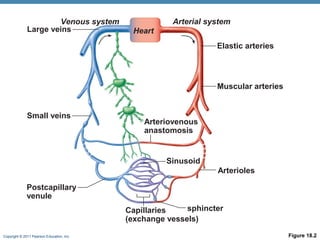
Venous system
Large veins

Arterial system
Heart
Elastic arteries

Muscular arteries

Small veins

Arteriovenous
anastomosis

Sinusoid
Arterioles
Postcapillary
venule
sphincter
Capillaries
(exchange vessels)
Copyright © 2011 Pearson Education, Inc.

Figure 18.2
BLOOD VESSEL STRUCTURE

Tunics (extera, media, intima)

Copyright © 2011 Pearson Education, Inc.
Structure of Blood Vessel Walls
• Arteries and veins
1. Tunica intima
2. Tunica media
3. Tunica externa
•

Lumen
• Central space, contains blood

• Capillaries
•

Endothelium with basal layer

Copyright © 2011 Pearson Education, Inc.
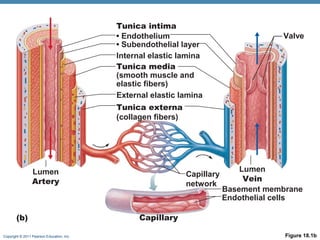
Tunica intima
• Endothelium
• Subendothelial layer
Internal elastic lamina
Tunica media
(smooth muscle and
elastic fibers)
External elastic lamina

Valve

Tunica externa
(collagen fibers)

Lumen
Artery

(b)
Copyright © 2011 Pearson Education, Inc.

Capillary
network

Lumen
Vein
Basement membrane
Endothelial cells

Capillary
Figure 18.1b
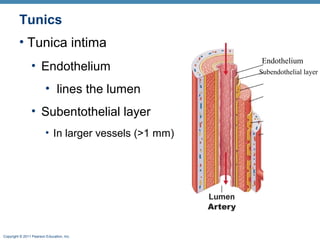
Tunics
• Tunica intima
• Endothelium
• lines the lumen
• Subentothelial layer
• In larger vessels (>1 mm)

Copyright © 2011 Pearson Education, Inc.

Endothelium
Subendothelial layer
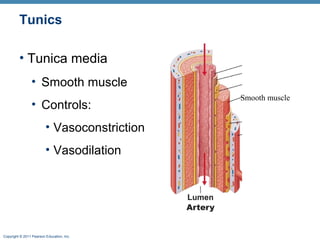
Tunics
• Tunica media
• Smooth muscle
• Controls:
• Vasoconstriction
• Vasodilation

Copyright © 2011 Pearson Education, Inc.

Smooth muscle
Tunics
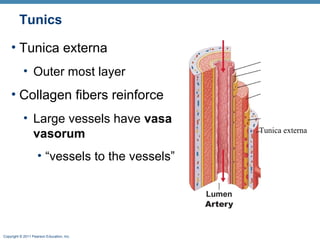
• Tunica externa
• Outer most layer

• Collagen fibers reinforce
• Large vessels have vasa
vasorum
• “vessels to the vessels”

Copyright © 2011 Pearson Education, Inc.

Tunica externa
TYPES OF ARTERIES

Elastic, Muscular and Arterioles

Copyright © 2011 Pearson Education, Inc.
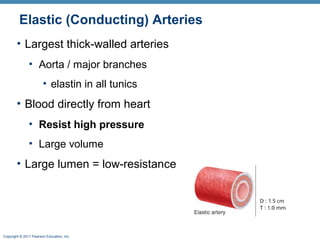
Elastic (Conducting) Arteries
• Largest thick-walled arteries
• Aorta / major branches
• elastin in all tunics

• Blood directly from heart
• Resist high pressure
• Large volume

• Large lumen = low-resistance

Copyright © 2011 Pearson Education, Inc.
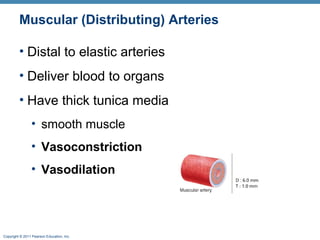
Muscular (Distributing) Arteries
• Distal to elastic arteries
• Deliver blood to organs
• Have thick tunica media
• smooth muscle
• Vasoconstriction
• Vasodilation

Copyright © 2011 Pearson Education, Inc.
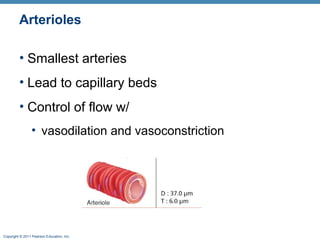
Arterioles
• Smallest arteries
• Lead to capillary beds
• Control of flow w/
• vasodilation and vasoconstriction

Copyright © 2011 Pearson Education, Inc.

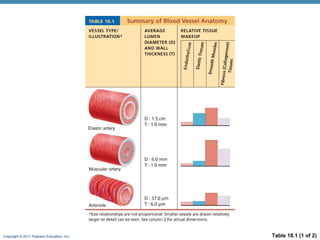
Table 18.1 (1 of 2)
Capillaries
• Smallest blood vessels
• thin tunica intima
• one cell thick

• Only one RBC wide
• Pericytes support and control permeability

Copyright © 2011 Pearson Education, Inc.
CAPILLARIES

Copyright © 2011 Pearson Education, Inc.
Capillaries
• Location• all tissues except for:
• cartilage, epithelia, cornea and lens of eye

• Functions• Exchange:
• gases, nutrients, wastes, hormones, etc.

Copyright © 2011 Pearson Education, Inc.
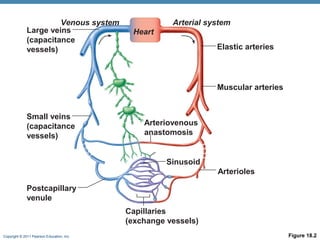
Venous system
Large veins
(capacitance
vessels)

Arterial system
Heart
Elastic arteries

Muscular arteries

Small veins
(capacitance
vessels)

Arteriovenous
anastomosis

Sinusoid
Arterioles
Postcapillary
venule
Capillaries
(exchange vessels)
Copyright © 2011 Pearson Education, Inc.

Figure 18.2
Capillaries
•

Three structural types
1. Continuous capillaries
2. Fenestrated capillaries
3. Sinusoidal capillaries

Copyright © 2011 Pearson Education, Inc.
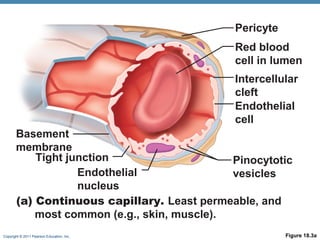
Continuous Capillaries
• Location:
• skin & muscles

• Cells connected with tight junctions
• Clefts allow passage
• Blood-brain barrier
• ↑ Tight junctions
• Limits passage
Copyright © 2011 Pearson Education, Inc.
Pericyte
Red blood
cell in lumen
Intercellular
cleft
Endothelial
cell
Basement
membrane
Tight junction
Pinocytotic
Endothelial
vesicles
nucleus
(a) Continuous capillary. Least permeable, and
most common (e.g., skin, muscle).
Copyright © 2011 Pearson Education, Inc.

Figure 18.3a
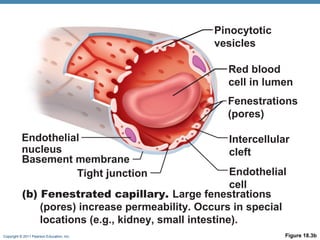
Fenestrated Capillaries
• Endothelial cells contain pores “fenestrations”
• Function:
• Absorption / Filtration

• Location:
• small intestines, endocrine glands, and kidneys

Copyright © 2011 Pearson Education, Inc.
Pinocytotic
vesicles
Red blood
cell in lumen
Fenestrations
(pores)
Endothelial
nucleus
Basement membrane
Tight junction

Intercellular
cleft

Endothelial
cell
(b) Fenestrated capillary. Large fenestrations
(pores) increase permeability. Occurs in special
locations (e.g., kidney, small intestine).

Copyright © 2011 Pearson Education, Inc.

Figure 18.3b
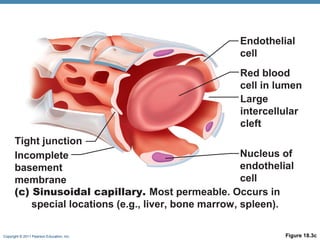
Sinusoidal Capillaries
• Larger intercellular clefts
• Function:
• Passage of large molecules and blood cells

• Location:
• liver, bone marrow, spleen

Copyright © 2011 Pearson Education, Inc.
Endothelial
cell
Red blood
cell in lumen
Large
intercellular
cleft
Tight junction
Nucleus of
Incomplete
endothelial
basement
cell
membrane
(c) Sinusoidal capillary. Most permeable. Occurs in
special locations (e.g., liver, bone marrow, spleen).
Copyright © 2011 Pearson Education, Inc.

Figure 18.3c
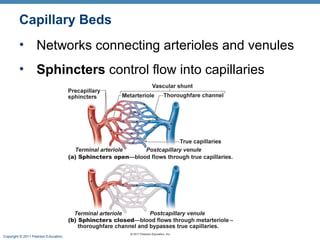
Capillary Beds
• Networks connecting arterioles and venules
• Sphincters control flow into capillaries

Copyright © 2011 Pearson Education, Inc.
Venules & Anastomosis
• Venules (smallest vein)
• Form from capillary beds
• “Postcapillary venules”

• Anastomosis
• Alternative connections between arteries and
veins

Copyright © 2011 Pearson Education, Inc.
Veins
• Return blood flow to heart
• Converging venules

• larger lumens w/ thin walls
• ↓ blood pressure
• Blood reservoirs
• contain ~65% of blood supply

Copyright © 2011 Pearson Education, Inc.
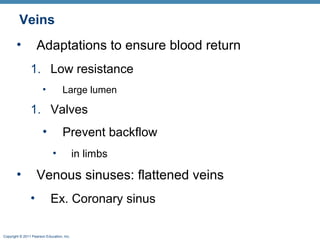
Veins
Adaptations to ensure blood return

•

1. Low resistance
Large lumen

•

1. Valves
Prevent backflow

•
•

in limbs

Venous sinuses: flattened veins

•
•

Ex. Coronary sinus

Copyright © 2011 Pearson Education, Inc.
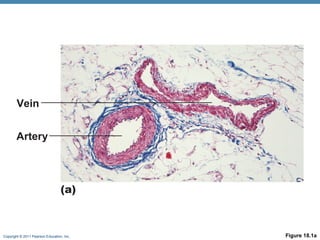
Vein
Artery

(a)

Copyright © 2011 Pearson Education, Inc.

Figure 18.1a
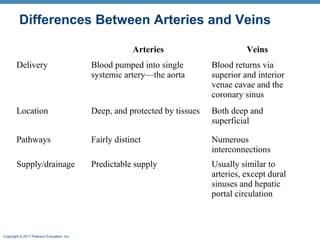
Differences Between Arteries and Veins
Arteries

Veins

Delivery

Blood pumped into single
systemic artery—the aorta

Blood returns via
superior and interior
venae cavae and the
coronary sinus

Location

Deep, and protected by tissues

Both deep and
superficial

Pathways

Fairly distinct

Numerous
interconnections

Supply/drainage

Predictable supply

Usually similar to
arteries, except dural
sinuses and hepatic
portal circulation

Copyright © 2011 Pearson Education, Inc.

Veins arteries online

  • 1.
  • 2.
    Blood Vessels • Transportblood • Arteries: carry blood away from the heart • Usually ↑ O2 • Pulmonary circulation exception • Veins: carry blood toward the heart • Usually ↓ O2 • Capillaries: contact tissue directly Copyright © 2011 Pearson Education, Inc.
  • 3.
    Venous system Large veins Arterialsystem Heart Elastic arteries Muscular arteries Small veins Arteriovenous anastomosis Sinusoid Arterioles Postcapillary venule sphincter Capillaries (exchange vessels) Copyright © 2011 Pearson Education, Inc. Figure 18.2
  • 4.
    BLOOD VESSEL STRUCTURE Tunics(extera, media, intima) Copyright © 2011 Pearson Education, Inc.
  • 5.
    Structure of BloodVessel Walls • Arteries and veins 1. Tunica intima 2. Tunica media 3. Tunica externa • Lumen • Central space, contains blood • Capillaries • Endothelium with basal layer Copyright © 2011 Pearson Education, Inc.
  • 6.
    Tunica intima • Endothelium •Subendothelial layer Internal elastic lamina Tunica media (smooth muscle and elastic fibers) External elastic lamina Valve Tunica externa (collagen fibers) Lumen Artery (b) Copyright © 2011 Pearson Education, Inc. Capillary network Lumen Vein Basement membrane Endothelial cells Capillary Figure 18.1b
  • 7.
    Tunics • Tunica intima •Endothelium • lines the lumen • Subentothelial layer • In larger vessels (>1 mm) Copyright © 2011 Pearson Education, Inc. Endothelium Subendothelial layer
  • 8.
    Tunics • Tunica media •Smooth muscle • Controls: • Vasoconstriction • Vasodilation Copyright © 2011 Pearson Education, Inc. Smooth muscle
  • 9.
    Tunics • Tunica externa •Outer most layer • Collagen fibers reinforce • Large vessels have vasa vasorum • “vessels to the vessels” Copyright © 2011 Pearson Education, Inc. Tunica externa
  • 10.
    TYPES OF ARTERIES Elastic,Muscular and Arterioles Copyright © 2011 Pearson Education, Inc.
  • 11.
    Elastic (Conducting) Arteries •Largest thick-walled arteries • Aorta / major branches • elastin in all tunics • Blood directly from heart • Resist high pressure • Large volume • Large lumen = low-resistance Copyright © 2011 Pearson Education, Inc.
  • 12.
    Muscular (Distributing) Arteries •Distal to elastic arteries • Deliver blood to organs • Have thick tunica media • smooth muscle • Vasoconstriction • Vasodilation Copyright © 2011 Pearson Education, Inc.
  • 13.
    Arterioles • Smallest arteries •Lead to capillary beds • Control of flow w/ • vasodilation and vasoconstriction Copyright © 2011 Pearson Education, Inc.
  • 14.
    Copyright © 2011Pearson Education, Inc. Table 18.1 (1 of 2)
  • 15.
    Capillaries • Smallest bloodvessels • thin tunica intima • one cell thick • Only one RBC wide • Pericytes support and control permeability Copyright © 2011 Pearson Education, Inc.
  • 16.
    CAPILLARIES Copyright © 2011Pearson Education, Inc.
  • 17.
    Capillaries • Location• alltissues except for: • cartilage, epithelia, cornea and lens of eye • Functions• Exchange: • gases, nutrients, wastes, hormones, etc. Copyright © 2011 Pearson Education, Inc.
  • 18.
    Venous system Large veins (capacitance vessels) Arterialsystem Heart Elastic arteries Muscular arteries Small veins (capacitance vessels) Arteriovenous anastomosis Sinusoid Arterioles Postcapillary venule Capillaries (exchange vessels) Copyright © 2011 Pearson Education, Inc. Figure 18.2
  • 19.
    Capillaries • Three structural types 1.Continuous capillaries 2. Fenestrated capillaries 3. Sinusoidal capillaries Copyright © 2011 Pearson Education, Inc.
  • 20.
    Continuous Capillaries • Location: •skin & muscles • Cells connected with tight junctions • Clefts allow passage • Blood-brain barrier • ↑ Tight junctions • Limits passage Copyright © 2011 Pearson Education, Inc.
  • 21.
    Pericyte Red blood cell inlumen Intercellular cleft Endothelial cell Basement membrane Tight junction Pinocytotic Endothelial vesicles nucleus (a) Continuous capillary. Least permeable, and most common (e.g., skin, muscle). Copyright © 2011 Pearson Education, Inc. Figure 18.3a
  • 22.
    Fenestrated Capillaries • Endothelialcells contain pores “fenestrations” • Function: • Absorption / Filtration • Location: • small intestines, endocrine glands, and kidneys Copyright © 2011 Pearson Education, Inc.
  • 23.
    Pinocytotic vesicles Red blood cell inlumen Fenestrations (pores) Endothelial nucleus Basement membrane Tight junction Intercellular cleft Endothelial cell (b) Fenestrated capillary. Large fenestrations (pores) increase permeability. Occurs in special locations (e.g., kidney, small intestine). Copyright © 2011 Pearson Education, Inc. Figure 18.3b
  • 24.
    Sinusoidal Capillaries • Largerintercellular clefts • Function: • Passage of large molecules and blood cells • Location: • liver, bone marrow, spleen Copyright © 2011 Pearson Education, Inc.
  • 25.
    Endothelial cell Red blood cell inlumen Large intercellular cleft Tight junction Nucleus of Incomplete endothelial basement cell membrane (c) Sinusoidal capillary. Most permeable. Occurs in special locations (e.g., liver, bone marrow, spleen). Copyright © 2011 Pearson Education, Inc. Figure 18.3c
  • 26.
    Capillary Beds • Networksconnecting arterioles and venules • Sphincters control flow into capillaries Copyright © 2011 Pearson Education, Inc.
  • 27.
    Venules & Anastomosis •Venules (smallest vein) • Form from capillary beds • “Postcapillary venules” • Anastomosis • Alternative connections between arteries and veins Copyright © 2011 Pearson Education, Inc.
  • 28.
    Veins • Return bloodflow to heart • Converging venules • larger lumens w/ thin walls • ↓ blood pressure • Blood reservoirs • contain ~65% of blood supply Copyright © 2011 Pearson Education, Inc.
  • 29.
    Veins Adaptations to ensureblood return • 1. Low resistance Large lumen • 1. Valves Prevent backflow • • in limbs Venous sinuses: flattened veins • • Ex. Coronary sinus Copyright © 2011 Pearson Education, Inc.
  • 30.
    Vein Artery (a) Copyright © 2011Pearson Education, Inc. Figure 18.1a
  • 31.
    Differences Between Arteriesand Veins Arteries Veins Delivery Blood pumped into single systemic artery—the aorta Blood returns via superior and interior venae cavae and the coronary sinus Location Deep, and protected by tissues Both deep and superficial Pathways Fairly distinct Numerous interconnections Supply/drainage Predictable supply Usually similar to arteries, except dural sinuses and hepatic portal circulation Copyright © 2011 Pearson Education, Inc.