1
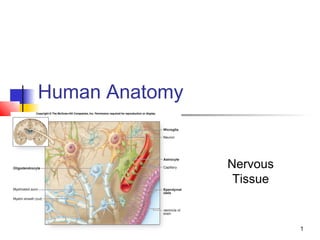
Human Anatomy
Nervous
Tissue
14-2
The Nervous System
 The body’s primary communication and
control system.
 Can be divided according to:
 Structural categories
 Functional categories.
14-3
Nervous System: Structural
Organization
Structural subdivisions of the nervous system:
 Central nervous system (CNS)
 brain and spinal cord
 Peripheral nervous system (PNS)
 cranial nerves (nerves that extend from the brain)
 spinal nerves (nerves that extend from the spinal cord)
 ganglia (clusters of neuron cell bodies (somas) located
outside the CNS)
4
14-5
Nervous System: Functional Organization
Functional divisions of the nervous system:
 Sensory afferent division:
 receives sensory information (input) from receptors
 transmits this information to the CNS.
 Motor efferent division:
 transmits motor impulses (output) from the CNS
 to muscles or glands (effector organs).
6
14-7
Sensory Division: two components
 Somatic sensory components:
 General somatic senses:

touch

pain

pressure

vibration,

temperature

proprioception.
 Special senses:

Taste

Vision

Hearing

Balance

smell
14-8
Sensory Division: two components
 Visceral sensory components
 transmit nerve impulses from blood vessels and
viscera to the CNS
 visceral senses primarily include:

temperature

stretch (of the organ wall).
14-9
Motor Division: two components
 The somatic motor component (somatic nervous system;
SNS):
 conducts nerve impulses from the CNS to skeletal muscles
 also known as the voluntary nervous system
 The autonomic motor component (autonomic nervous
system; ANS): internal organs, regulates smooth muscle,
cardiac muscle, and glands.
 Innervates

Internal organs

Regulates smooth muscle

Regulates cardiac muscle

Regulates glands
 also known as the visceral motor system or involuntary nervous
system
14-10
Nerve Cells
 Nervous Tissue
 Two distinct cell types

Neurons
 excitable cells
 initiate and transmit nerve impulses

Glial cells
 nonexcitable cells

support and protect the neurons
14-11
Characteristics of Neurons
 Neurons have a high metabolic rate.
 Neurons have extreme longevity.
 Neurons typically are non-mitotic.
14-12
Neuron Structure
 Neurons come in all shapes and sizes
 All neurons share certain basic structural features.
 typical neuron:
 Cell body (soma, perikaryon)
 Dendrites
 Axon

Collaterals: branches

axon terminals or telodendria

Synaptic knobs
14-13
Neuron Structure – Cell Body
 The cell body (perikaryon, soma)
 the neuron’s control center

responsible for:
 receiving
 integrating
 sending nerve impulses.
 Consists of:

Plasma membrane

Cytoplasm

Nucleus with prominent nucleolus

Chromatophobic substance (Nissil bodies): RER

Free ribosomes
14-14
Neuron Structure – Dendrites
 Shorter, smaller processes
 Branch off the cell body.
 Some neurons have only one dendrite, while others
have many.
 Dendrites conduct nerve impulses toward the cell
body
 they receive input
 transfer input to the cell body for processing.
 The more dendrites a neuron has, the more nerve
impulses that neuron can receive from other cells.
14-15
Neuron Structure – Axon
 larger, typically longer nerve cell process
 Extend from the cell body
 Axon hillock
 also called a nerve fiber
 Most neurons have only one axon.
 Anaxonic
14-16
Neuron Structure – Axon
 Structures
 Collaterals
 Telodendria (axon terminals)
 Synaptic knobs (terminal boutons)
 The axon transmits a nerve impulse away
from the cell body toward another cell.
14-17
Neuron Structure
 Cytoskeleton
 Neurotubules

microtubules
 Neurofilaments

Intermediate fibers
 Neurofibrils

Bundles of neurofibrils

In both dendrites and axons

Provide strength
18
19
14-20
Classifications of Neurons
 Neurons vary widely in morphology and
location.
 classified based on

structure

function.
 Structural classification: number of processes
extending from the cell body.
 unipolar neuron has a single process
 bipolar neurons have two processes
 multipolar neurons have three or more processes
21
14-22
Functional Classification
 Sensory afferent neurons: receptor to CNS
 Motor efferent neurons: CNS to effector
 Interneurons (association neurons): facilitate
communication between sensory and motor neurons.
14-23
Interneurons
 Interneurons, or association neurons
 lie entirely within the CNS
 multipolar.
 They receive nerve impulses from many other
neurons
 They carry out the integrative function of the nervous
system.
 Interneurons facilitate communication between
sensory and motor neurons.
24
14-25
Glial Cells
 Also called neuroglia
 Occur within both the CNS and the PNS.
 are smaller than neurons
 are capable of mitosis.
 do not transmit nerve impulses.
 Glial cells
 physically protect neurons
 help nourish neurons
 provide a supporting framework for all the nervous tissue.
 Glial cells far outnumber neurons.
 Glial cells account for about half the volume of the
nervous system.
26
27
14-28
Glial Cells of the CNS: astrocytes
 Exhibit a starlike shape due to projections from their
surface.
 The most abundant glial cells in the CNS
 constitute over 90% of the tissue in some areas of the brain.
 Help form the blood-brain barrier (BBB):
 strictly controls substances entering the nervous tissue in
the brain from the bloodstream.
 Regulate tissue fluid composition.
 Provide structural support
 Replace damaged neurons
 Assist neuronal development
14-29
Glial Cells of the CNS: ependymal
cells
 Cuboid ET
 Cilia on apical surface

Circulates CSF.
 Line internal cavities
 Processes make contact with other glial
cells
 Help form the choroid plexus
 CSF: cerebral spinal fluid
30
14-31
Glial Cells of the CNS: microglia
 Smallest % of CNS glial cells.
 Phagocytic
 Move through the tissue in response to
infection

Remove debris.
 Like macrophages
14-32
Glial Cells of the CNS: oligodendrocytes
 Large, with big body and processes.
 Processes form myelin sheaths
 Speeds up transmission
33
14-34
Glial Cells of the PNS
 Satellite cells:
 Flattened cells
 Cover somas in ganglia
 Separate soma from surrounding tissue
fluid

Regulate exchange.
 Neurolemmocytes (Schwann cells)
 Myelination in the PNS
14-35
Myelination
 Process by which part of an axon is
wrapped with a myelin sheath
 Forms a protective fatty coating
 Has a glossy-white appearance.
 The myelin sheath:
 supports the axon
 protects the axon
 insulates an axon
14-36
Myelination
 No change in voltage can occur across the
membrane in the insulated portion of an axon.
 Voltage change occurs at the nodes
 Neurolemmocytes: form myelin sheaths in PNS
 Oligodendrocytes: form myelin sheaths in the CNS
37
38
39
14-40
Mylenated vs. Unmylenated
Axons
 myelinated axon
 nerve impulse “jumps” from neurofibril node to neurofibril
node
 known as saltatory conduction
 requires less energy (ATP) than does an unmyelinated axon
 unmyelinated axon
 nerve impulse must travel the entire length of the axon
 known as continuous conduction
 nerve impulse takes longer to reach the end of the axon
 Using continuous conduction, unmyelinated axons conduct
nerve impulses from pain stimuli
 A myelinated axon produces a faster nerve impulse.
41
14-42
Regeneration of PNS Axons
 PNS axons are vulnerable to cuts and
trauma.
 A damaged axon can regenerate
 if some neurilemma remains.
 PNS axon regeneration depends upon three
factors.
 amount of damage
 neurolemmocyte secretion of nerve growth factors

stimulates outgrowth of severed axons
 distance between the site of the damaged axon
and the effector organ
14-43
Regeneration of PNS Axons
 Wallerian degeneration.
 Axon damaged
 Proximal end seals, and swells.
 Distal end degenerates, macrophages
clean up
 Distal neurolemmocytes survive
 Neurolemmocytes form regeneration tube
(with endoneurinum)
 Axon regenerates, remyelinates
 Axon reestablishes contact with effector
44
45
14-46
Structure of a Nerve
 A nerve is a cable-like bundle of parallel axons.
 three connective tissue wrappings.
 Endoneurium

delicate layer of loose connective tissue
 Perineurium

a cellular and fibrous connective tissue layer

wraps groups of axons into fascicles
 Epineurium - a superficial connective tissue covering

This thick layer of dense irregular fibrous connective tissue

encloses entire nerve

provides support and protection
47
48
14-49
Nerves
 Nerves are organs of the PNS.
 Sensory (afferent) nerves convey sensory information
to the CNS.
 Motor (efferent) nerves convey motor impulses from
the CNS to the muscles and glands.
 Mixed nerves: both sensory and motor
 Axons terminate as they contact other neurons,
muscle cells, or gland cells.
 An axon transmits a nerve impulse at a specialized
junction with another neuron called synapse.
14-50
Synapses
 Presynaptic neurons
 transmit nerve impulses toward a synapse.
 Postsynaptic neurons
 conduct nerve impulses away from the synapse.
 Axons may establish synaptic contacts with
any portion of the surface of another neuron
 except those regions that are myelinated.
51
14-52
Types of synapses: based on contacts
 axodendritic
 axosomatic
 axoaxonic
53
14-54
Main types of synapses
 Electrical synapses
 Gap junctions
 Chemical synapses
 Use neurotransmitters
14-55
Electrical Synapses
 Electrical synapses are not very common in
mammals.
 In humans, these synapses occur primarily between
smooth muscle cells where quick, uniform innervation
is essential.
 Electrical synapses are also located in cardiac
muscle.
56
14-57
Chemical Synapses
 Most numerous type of synapse
 Facilitates interactions
 between neurons
 between neurons and effectors.
 These are cell junctions
 Presynaptic membrane:
 releases a signaling molecule called a neurotransmitter,
such as acetylcholine (ACh).
 Other types of neurons use other neurotransmitters.
 Postsynaptic membrane:
 Contains receptors for neurotransmitters
58
14-59
Neurotransmitters
 Released from the plasma membrane of the
presynaptic cell.
 Then binds to receptor proteins on the
plasma membrane of the postsynaptic cell.
 A unidirectional flow of information and
communication
 Two factors influence the rate of conduction
of the impulse:
 axon’s diameter
 presence (or absence) of a myelin sheath.
14-60
Neuronal Pools (or Neuronal
Circuits or Pathways)
 Billions of interneurons within the CNS are grouped in
complex patterns called neuronal pools (or neuronal
circuits or pathways).
 Neuronal pools are defined based upon function, not
anatomy, into four types of circuits:
 converging
 diverging
 reverberating
 parallel-after-discharge
 A pool may be localized, or its neurons may be distributed in
several different regions of the CNS.
61

Ch14 nervous tissue

  • 1.
  • 2.
    14-2 The Nervous System The body’s primary communication and control system.  Can be divided according to:  Structural categories  Functional categories.
  • 3.
    14-3 Nervous System: Structural Organization Structuralsubdivisions of the nervous system:  Central nervous system (CNS)  brain and spinal cord  Peripheral nervous system (PNS)  cranial nerves (nerves that extend from the brain)  spinal nerves (nerves that extend from the spinal cord)  ganglia (clusters of neuron cell bodies (somas) located outside the CNS)
  • 4.
  • 5.
    14-5 Nervous System: FunctionalOrganization Functional divisions of the nervous system:  Sensory afferent division:  receives sensory information (input) from receptors  transmits this information to the CNS.  Motor efferent division:  transmits motor impulses (output) from the CNS  to muscles or glands (effector organs).
  • 6.
  • 7.
    14-7 Sensory Division: twocomponents  Somatic sensory components:  General somatic senses:  touch  pain  pressure  vibration,  temperature  proprioception.  Special senses:  Taste  Vision  Hearing  Balance  smell
  • 8.
    14-8 Sensory Division: twocomponents  Visceral sensory components  transmit nerve impulses from blood vessels and viscera to the CNS  visceral senses primarily include:  temperature  stretch (of the organ wall).
  • 9.
    14-9 Motor Division: twocomponents  The somatic motor component (somatic nervous system; SNS):  conducts nerve impulses from the CNS to skeletal muscles  also known as the voluntary nervous system  The autonomic motor component (autonomic nervous system; ANS): internal organs, regulates smooth muscle, cardiac muscle, and glands.  Innervates  Internal organs  Regulates smooth muscle  Regulates cardiac muscle  Regulates glands  also known as the visceral motor system or involuntary nervous system
  • 10.
    14-10 Nerve Cells  NervousTissue  Two distinct cell types  Neurons  excitable cells  initiate and transmit nerve impulses  Glial cells  nonexcitable cells  support and protect the neurons
  • 11.
    14-11 Characteristics of Neurons Neurons have a high metabolic rate.  Neurons have extreme longevity.  Neurons typically are non-mitotic.
  • 12.
    14-12 Neuron Structure  Neuronscome in all shapes and sizes  All neurons share certain basic structural features.  typical neuron:  Cell body (soma, perikaryon)  Dendrites  Axon  Collaterals: branches  axon terminals or telodendria  Synaptic knobs
  • 13.
    14-13 Neuron Structure –Cell Body  The cell body (perikaryon, soma)  the neuron’s control center  responsible for:  receiving  integrating  sending nerve impulses.  Consists of:  Plasma membrane  Cytoplasm  Nucleus with prominent nucleolus  Chromatophobic substance (Nissil bodies): RER  Free ribosomes
  • 14.
    14-14 Neuron Structure –Dendrites  Shorter, smaller processes  Branch off the cell body.  Some neurons have only one dendrite, while others have many.  Dendrites conduct nerve impulses toward the cell body  they receive input  transfer input to the cell body for processing.  The more dendrites a neuron has, the more nerve impulses that neuron can receive from other cells.
  • 15.
    14-15 Neuron Structure –Axon  larger, typically longer nerve cell process  Extend from the cell body  Axon hillock  also called a nerve fiber  Most neurons have only one axon.  Anaxonic
  • 16.
    14-16 Neuron Structure –Axon  Structures  Collaterals  Telodendria (axon terminals)  Synaptic knobs (terminal boutons)  The axon transmits a nerve impulse away from the cell body toward another cell.
  • 17.
    14-17 Neuron Structure  Cytoskeleton Neurotubules  microtubules  Neurofilaments  Intermediate fibers  Neurofibrils  Bundles of neurofibrils  In both dendrites and axons  Provide strength
  • 18.
  • 19.
  • 20.
    14-20 Classifications of Neurons Neurons vary widely in morphology and location.  classified based on  structure  function.  Structural classification: number of processes extending from the cell body.  unipolar neuron has a single process  bipolar neurons have two processes  multipolar neurons have three or more processes
  • 21.
  • 22.
    14-22 Functional Classification  Sensoryafferent neurons: receptor to CNS  Motor efferent neurons: CNS to effector  Interneurons (association neurons): facilitate communication between sensory and motor neurons.
  • 23.
    14-23 Interneurons  Interneurons, orassociation neurons  lie entirely within the CNS  multipolar.  They receive nerve impulses from many other neurons  They carry out the integrative function of the nervous system.  Interneurons facilitate communication between sensory and motor neurons.
  • 24.
  • 25.
    14-25 Glial Cells  Alsocalled neuroglia  Occur within both the CNS and the PNS.  are smaller than neurons  are capable of mitosis.  do not transmit nerve impulses.  Glial cells  physically protect neurons  help nourish neurons  provide a supporting framework for all the nervous tissue.  Glial cells far outnumber neurons.  Glial cells account for about half the volume of the nervous system.
  • 26.
  • 27.
  • 28.
    14-28 Glial Cells ofthe CNS: astrocytes  Exhibit a starlike shape due to projections from their surface.  The most abundant glial cells in the CNS  constitute over 90% of the tissue in some areas of the brain.  Help form the blood-brain barrier (BBB):  strictly controls substances entering the nervous tissue in the brain from the bloodstream.  Regulate tissue fluid composition.  Provide structural support  Replace damaged neurons  Assist neuronal development
  • 29.
    14-29 Glial Cells ofthe CNS: ependymal cells  Cuboid ET  Cilia on apical surface  Circulates CSF.  Line internal cavities  Processes make contact with other glial cells  Help form the choroid plexus  CSF: cerebral spinal fluid
  • 30.
  • 31.
    14-31 Glial Cells ofthe CNS: microglia  Smallest % of CNS glial cells.  Phagocytic  Move through the tissue in response to infection  Remove debris.  Like macrophages
  • 32.
    14-32 Glial Cells ofthe CNS: oligodendrocytes  Large, with big body and processes.  Processes form myelin sheaths  Speeds up transmission
  • 33.
  • 34.
    14-34 Glial Cells ofthe PNS  Satellite cells:  Flattened cells  Cover somas in ganglia  Separate soma from surrounding tissue fluid  Regulate exchange.  Neurolemmocytes (Schwann cells)  Myelination in the PNS
  • 35.
    14-35 Myelination  Process bywhich part of an axon is wrapped with a myelin sheath  Forms a protective fatty coating  Has a glossy-white appearance.  The myelin sheath:  supports the axon  protects the axon  insulates an axon
  • 36.
    14-36 Myelination  No changein voltage can occur across the membrane in the insulated portion of an axon.  Voltage change occurs at the nodes  Neurolemmocytes: form myelin sheaths in PNS  Oligodendrocytes: form myelin sheaths in the CNS
  • 37.
  • 38.
  • 39.
  • 40.
    14-40 Mylenated vs. Unmylenated Axons myelinated axon  nerve impulse “jumps” from neurofibril node to neurofibril node  known as saltatory conduction  requires less energy (ATP) than does an unmyelinated axon  unmyelinated axon  nerve impulse must travel the entire length of the axon  known as continuous conduction  nerve impulse takes longer to reach the end of the axon  Using continuous conduction, unmyelinated axons conduct nerve impulses from pain stimuli  A myelinated axon produces a faster nerve impulse.
  • 41.
  • 42.
    14-42 Regeneration of PNSAxons  PNS axons are vulnerable to cuts and trauma.  A damaged axon can regenerate  if some neurilemma remains.  PNS axon regeneration depends upon three factors.  amount of damage  neurolemmocyte secretion of nerve growth factors  stimulates outgrowth of severed axons  distance between the site of the damaged axon and the effector organ
  • 43.
    14-43 Regeneration of PNSAxons  Wallerian degeneration.  Axon damaged  Proximal end seals, and swells.  Distal end degenerates, macrophages clean up  Distal neurolemmocytes survive  Neurolemmocytes form regeneration tube (with endoneurinum)  Axon regenerates, remyelinates  Axon reestablishes contact with effector
  • 44.
  • 45.
  • 46.
    14-46 Structure of aNerve  A nerve is a cable-like bundle of parallel axons.  three connective tissue wrappings.  Endoneurium  delicate layer of loose connective tissue  Perineurium  a cellular and fibrous connective tissue layer  wraps groups of axons into fascicles  Epineurium - a superficial connective tissue covering  This thick layer of dense irregular fibrous connective tissue  encloses entire nerve  provides support and protection
  • 47.
  • 48.
  • 49.
    14-49 Nerves  Nerves areorgans of the PNS.  Sensory (afferent) nerves convey sensory information to the CNS.  Motor (efferent) nerves convey motor impulses from the CNS to the muscles and glands.  Mixed nerves: both sensory and motor  Axons terminate as they contact other neurons, muscle cells, or gland cells.  An axon transmits a nerve impulse at a specialized junction with another neuron called synapse.
  • 50.
    14-50 Synapses  Presynaptic neurons transmit nerve impulses toward a synapse.  Postsynaptic neurons  conduct nerve impulses away from the synapse.  Axons may establish synaptic contacts with any portion of the surface of another neuron  except those regions that are myelinated.
  • 51.
  • 52.
    14-52 Types of synapses:based on contacts  axodendritic  axosomatic  axoaxonic
  • 53.
  • 54.
    14-54 Main types ofsynapses  Electrical synapses  Gap junctions  Chemical synapses  Use neurotransmitters
  • 55.
    14-55 Electrical Synapses  Electricalsynapses are not very common in mammals.  In humans, these synapses occur primarily between smooth muscle cells where quick, uniform innervation is essential.  Electrical synapses are also located in cardiac muscle.
  • 56.
  • 57.
    14-57 Chemical Synapses  Mostnumerous type of synapse  Facilitates interactions  between neurons  between neurons and effectors.  These are cell junctions  Presynaptic membrane:  releases a signaling molecule called a neurotransmitter, such as acetylcholine (ACh).  Other types of neurons use other neurotransmitters.  Postsynaptic membrane:  Contains receptors for neurotransmitters
  • 58.
  • 59.
    14-59 Neurotransmitters  Released fromthe plasma membrane of the presynaptic cell.  Then binds to receptor proteins on the plasma membrane of the postsynaptic cell.  A unidirectional flow of information and communication  Two factors influence the rate of conduction of the impulse:  axon’s diameter  presence (or absence) of a myelin sheath.
  • 60.
    14-60 Neuronal Pools (orNeuronal Circuits or Pathways)  Billions of interneurons within the CNS are grouped in complex patterns called neuronal pools (or neuronal circuits or pathways).  Neuronal pools are defined based upon function, not anatomy, into four types of circuits:  converging  diverging  reverberating  parallel-after-discharge  A pool may be localized, or its neurons may be distributed in several different regions of the CNS.
  • 61.