Massive Transfusion And
Coagulopathy
Coagulopathy
Christine Mai, MD
Christine Mai, MD
Faculty Advisor: Mauricio Gonzalez, MD
Department of Anesthesiology
Boston University Medical Center
Guidelines to Blood Product
Transfusions
Transfusions
 In 1994, the ASA established the Task Force on
In 1994, the ASA established the Task Force on
Blood Component Therapy to develop evidence-
based guidelines for transfusing blood products in
perioperative and peripartum settings
 22 million blood components transfused yearly
22 million blood components transfused yearly
 Benefits: improved tissue oxygenation and decreased
Benefits: improved tissue oxygenation and decreased
bleeding
bleeding
 Risks: Transmission of infectious diseases,
Risks: Transmission of infectious diseases,
hemolytic and nonhemolytic transfusion reactions,
immunosuppression, alloimmunization, coagulopathy
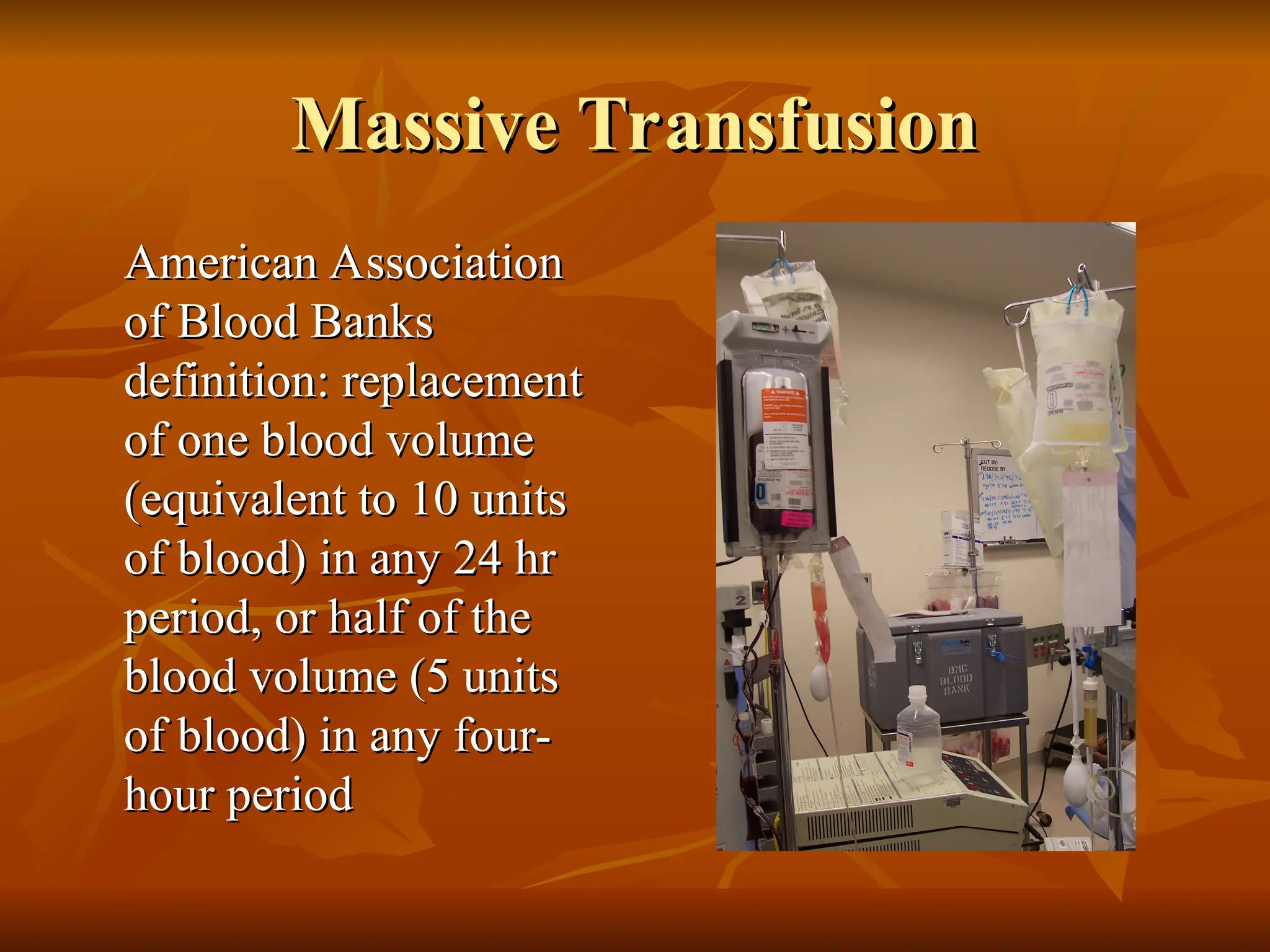
Massive Transfusion
Massive Transfusion
American Association
of Blood Banks
of Blood Banks
definition: replacement
of one blood volume
of one blood volume
(equivalent to 10 units
of blood) in any 24 hr
period, or half of the
blood volume (5 units
of blood) in any four-
hour period
hour period
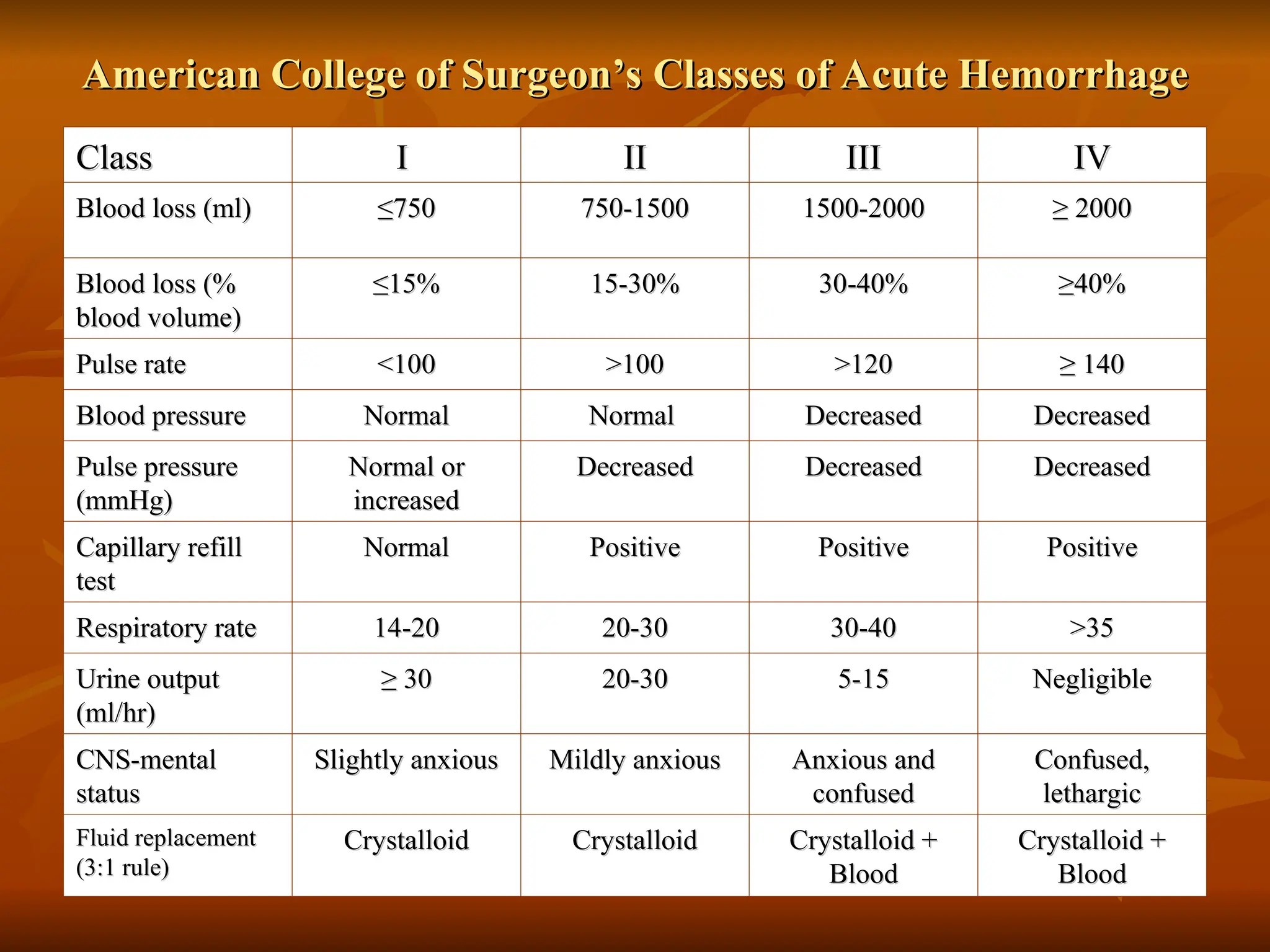
American College of Surgeon’s Classes of Acute Hemorrhage
Class
Class I
I II
II III
III IV
IV
Blood loss (ml)
Blood loss (ml) ≤
≤750
750 750-1500
750-1500 1500-2000
1500-2000 ≥
≥ 2000
2000
Blood loss (%
Blood loss (%
blood volume)
blood volume)
≤
≤15%
15% 15-30%
15-30% 30-40%
30-40% ≥
≥40%
40%
Pulse rate
Pulse rate <100
<100 >100
>100 >120
>120 ≥
≥ 140
140
Blood pressure
Blood pressure Normal
Normal Normal
Normal Decreased
Decreased Decreased
Decreased
Pulse pressure
Pulse pressure
(mmHg)
(mmHg)
Normal or
Normal or
increased
increased
Decreased
Decreased Decreased
Decreased Decreased
Decreased
Capillary refill
Capillary refill
test
test
Normal
Normal Positive
Positive Positive
Positive Positive
Positive
Respiratory rate
Respiratory rate 14-20
14-20 20-30
20-30 30-40
30-40 >35
>35
Urine output
Urine output
(ml/hr)
(ml/hr)
≥
≥ 30
30 20-30
20-30 5-15
5-15 Negligible
Negligible
CNS-mental
CNS-mental
status
status
Slightly anxious
Slightly anxious Mildly anxious
Mildly anxious Anxious and
Anxious and
confused
confused
Confused,
Confused,
lethargic
lethargic
Fluid replacement
Fluid replacement
(3:1 rule)
(3:1 rule)
Crystalloid
Crystalloid Crystalloid
Crystalloid Crystalloid +
Crystalloid +
Blood
Blood
Crystalloid +
Crystalloid +
Blood
Blood
Parameters For Fluid Replacement
 Maintenance
Maintenance
 Deficits
Deficits

Insensible loss
Insensible loss
 Estimated blood loss
Estimated blood loss
Maintenance
Maintenance

4:2:1 Rule or Calculate Wt +40 cc

Calculated weight: (IBW + ABW)/2

IBW male: 110 lbs + 7 lbs * in > 5’
female: 100 lbs + 6 lbs * in > 5’
Deficits
Deficits

NPO status
NPO status
Calculated Wt x hrs NPO x 0.7

Bowel prep ~ 1200cc
Bowel prep ~ 1200cc

Diuretics/ Urine output

NGT drainage
NGT drainage

CT drainage
CT drainage
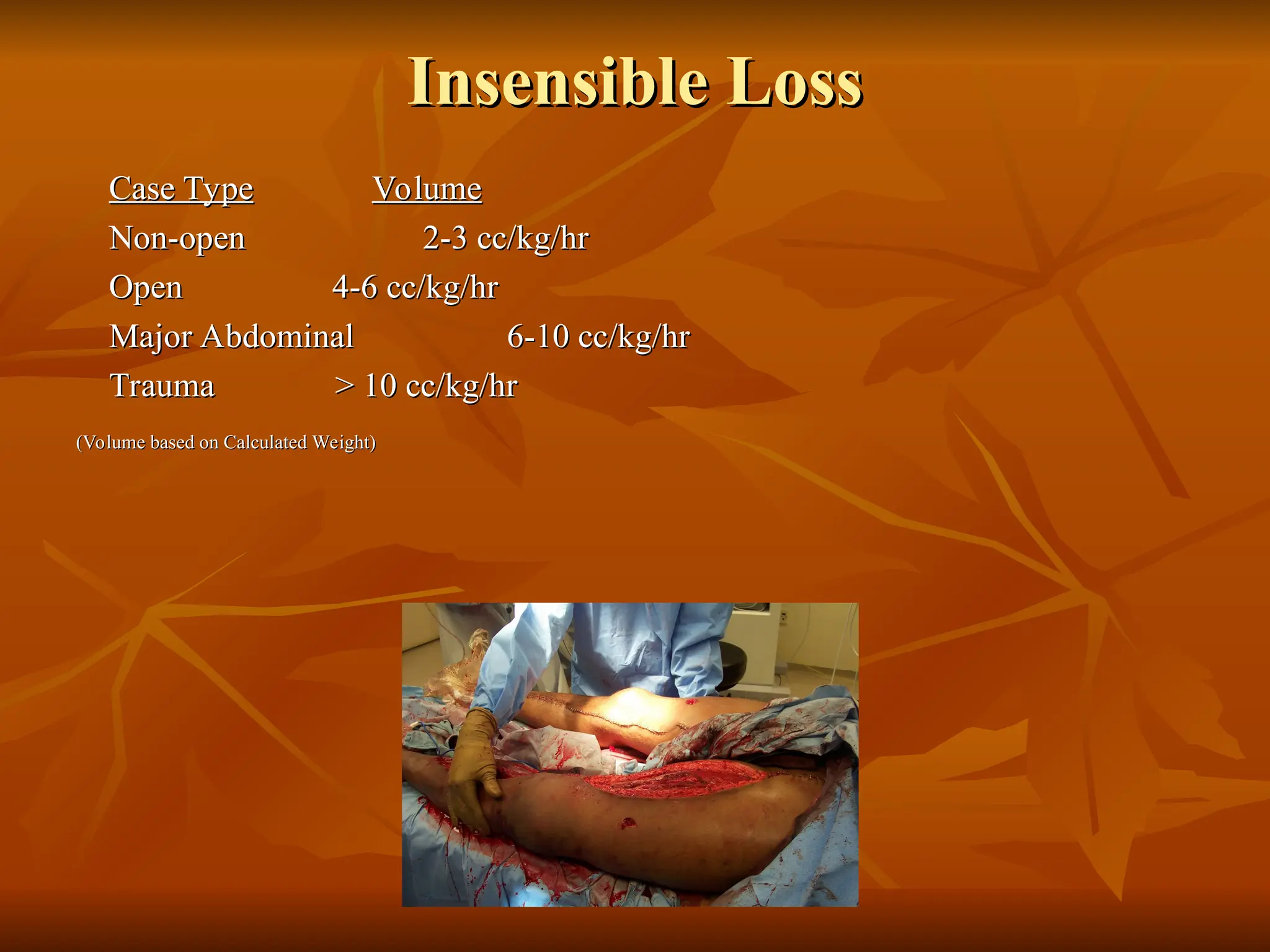
Insensible Loss
Insensible Loss
Case Type
Case Type Volume
Volume
Non-open
Non-open 2-3 cc/kg/hr
2-3 cc/kg/hr
Open
Open 4-6 cc/kg/hr
4-6 cc/kg/hr
Major Abdominal 6-10 cc/kg/hr
Trauma
Trauma > 10 cc/kg/hr
> 10 cc/kg/hr
(Volume based on Calculated Weight)
Estimated Blood Loss

The 3: 1 Rule, replace 3 cc crystalloid : 1
cc blood loss
cc blood loss

The 1:1 Rule, replace 1 cc colloid : 1 cc
blood loss
blood loss
Allowable Blood Loss
(
(Hct present - Hct allowable
Hct present - Hct allowable) + EBV
) + EBV
Hct present
Hct present
Estimated Blood
Estimated Blood
Volume
Volume
Adults: 75 cc/kg
Adults: 75 cc/kg
Infants: 80 cc/kg
Infants: 80 cc/kg
Neonates: 85cc/kg
Neonates: 85cc/kg
Fluid Resuscitation Crystalloids
Na
Na
(mEq)
(mEq)
Cl
Cl
(mEq)
(mEq)
K
K
(mEq)
(mEq)
Ca
Ca
(mEq)
(mEq)
Mg
Mg
(mEq)
(mEq)
Lactate
Lactate Acetate
Acetate Gluconate
Gluconate pH
pH mOsm
mOsm Other
Other
NS
NS
(0.9%)
(0.9%)
154
154 154
154 5.0
5.0 308
308 Indicated in
Indicated in
neurosugery
neurosugery
cases
cases
LR
LR 130
130 109
109 4
4 2.7
2.7 28
28 6.5
6.5 273
273 Contraindicated
Contraindicated
in liver and
in liver and
kidney failure
kidney failure
PL
PL 140
140 98
98 5
5 3
3 27
27 23
23 7.4
7.4 294
294 Physiologic
Physiologic pH
pH
Type and Screen
Type and Screen
 Screen for ABO-Rh type and most common antibodies
Screen for ABO-Rh type and most common antibodies
 ABO incompatibility is a tragic and severe reaction, resulting
ABO incompatibility is a tragic and severe reaction, resulting
in rapid intravenous hemolysis
 Ordered during elective cases when the probability of blood
Ordered during elective cases when the probability of blood
loss and transfusion are high
 If blood is needed for emergent transfusion, a crossmatch can
If blood is needed for emergent transfusion, a crossmatch can
be performed to reconfirm ABO-Rh typing
 Reactions against lower-incident antigens may still occur
Reactions against lower-incident antigens may still occur
 Emergency trauma cases: Type O Rh-Negative (Universal
Emergency trauma cases: Type O Rh-Negative (Universal
Donor) Uncrossmatched Blood transfused until a Type and
Cross clot is tested
Type and Crossmatching

Crossmatching
Crossmatching
-Trial transfusion within a test tube between donor RBCs and recipient serum to
detect a potential for serious transfusion reaction
- 3 Phases:
- 3 Phases:
-Reconfirm ABO-Rh typing
- Detect antibodies that are incomplete or do not agglutinate
easily
easily
- Detect antibodies in other blood group systems (ie. Rh, Kell,
- Detect antibodies in other blood group systems (ie. Rh, Kell, Kidd, Duffy)
Kidd, Duffy)

Antibody screening
Antibody screening
- Trial transfusion between the recipient’s serum and commercially supplied RBCs
Trial transfusion between the recipient’s serum and commercially supplied RBCs
with antigens that will react with antibodies commonly implicated in non-ABO
hemolytic transfusion reactions
- Donor’s serum also screened for unexpected antibodies to prevent their
Donor’s serum also screened for unexpected antibodies to prevent their
introduction to the recipient’s serum
- Otherwise known as the Coomb’s test.
Otherwise known as the Coomb’s test.
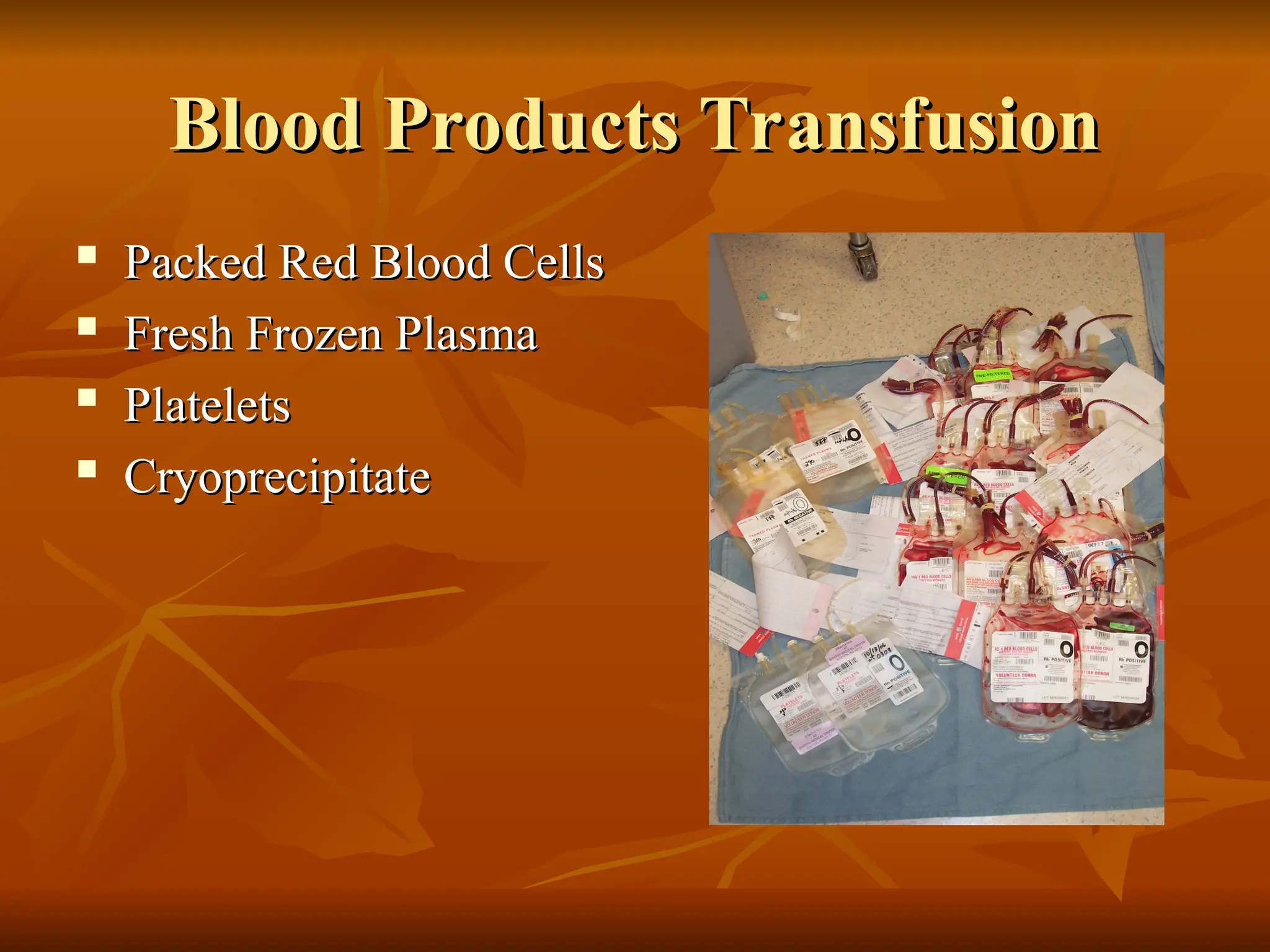
Blood Products Transfusion
 Packed Red Blood Cells
Packed Red Blood Cells
 Fresh Frozen Plasma
Fresh Frozen Plasma

Platelets
Platelets
 Cryoprecipitate
Cryoprecipitate
Packed Red Blood Cells

Approx. 12 000 000 units of RBC are transfused yearly in the US

Indicated for patients needing red cells for oxygen carrying
capacity rather than for volume replacement (ie. CHF patients)

70% Hct in pRBC compared to 40% Hct in whole blood

Each unit contains 250-350 cc of red cells, increases Hct 3-4% or
increases Hgb 1g/dL
increases Hgb 1g/dL

Large amount of transfusions should be warmed to 37
Large amount of transfusions should be warmed to 370
0
C
C

Dilute pRBCs with either normal saline or plasmalyte when
giving massive transfusions

Avoid Lactated Ringers because calcium can chealate with citrate
Citrate Toxicity
Citrate Toxicity
 Calcium binding to citrate preservative in
Calcium binding to citrate preservative in
transfused blood
transfused blood →
→ Hypocalcemia
Hypocalcemia
 Signs of citrate intoxication: hypocalcemia,
Signs of citrate intoxication: hypocalcemia,
hypotension, narrowed pulse pressure,
increased end-diastolic pressure
 Cardiovascular depression can occur if
Cardiovascular depression can occur if
transfusion rate > 1 unit of blood per 5 mins
 Risk factors: hypothermia, liver disease, liver
Risk factors: hypothermia, liver disease, liver
transplantation
transplantation
Fresh Frozen Plasma
Fresh Frozen Plasma

Portion of whole blood
that remains after cellular
elements and platelets are
removed
removed

Each unit contains 250cc
plasma
plasma

Contains coagulating
factors and fibrinogen

Increases level of each
clotting factor by 2-3%

Needs to be ABO-
Needs to be ABO-
compatible but does not
require crossmatching Rh
typing
typing
Fresh Frozen Plasma
Fresh Frozen Plasma
Indications:
Indications:
1) urgent reversal of Warfarin therapy
2) correction of isolated coagulation factor deficiencies
3) correction of microvascular bleeding when INR and
pTT >1.5 x normal
pTT >1.5 x normal
4) correction of microvascular bleeding due to
coagulation factor deficiency in patients transfused with
> one blood volume and when PT and pTT can not be
obtained
obtained
5) Antithrombin III deficiency
6) Treatment of immunodeficiencies
7) Treatment of thrombotic thrombocytopenia purpura
Platelets
Platelets

Indicated for thrombocytopenia platelet count < 50 x 10
Indicated for thrombocytopenia platelet count < 50 x 109
9
/L
/L

Pooled from donated blood (ie. 5 donors=5000 plt/microL)

Each 10-12 units of pRBC decrease plt count by 50%, for
replacement therapy, 5-10 units of plt (ie. 5000 – 10 000
plt/microL) should be given when 10-20 units of pRBC has
been transfused
been transfused

Transfuse SLOWLY to avoid hypotension
Cryoprecipitate
Cryoprecipitate
 Collected by thawing FFP at 4
Collected by thawing FFP at 40
0
C, contains von Willebrand
factor, factor VIII, XIII, fibrinogen, and fibronectin
 One unit of cryoprecipitate will increase fibrinogen
One unit of cryoprecipitate will increase fibrinogen
concentration by 50mg/dL
 Indicatation:
Indicatation:
 Patients with von Willebrand’s Dz unresponsive to Desmopressin
Patients with von Willebrand’s Dz unresponsive to Desmopressin
 Bleeding patients with vWD
Bleeding patients with vWD
 Bleeding patients with fibrinogen levels < 80-100mg/dL
Bleeding patients with fibrinogen levels < 80-100mg/dL
 Hemophilia A
Hemophilia A
 Administer rapidly through a filter (ie. 200 cc/hr, infusion
Administer rapidly through a filter (ie. 200 cc/hr, infusion
should be completed within 6 hrs of thawing)
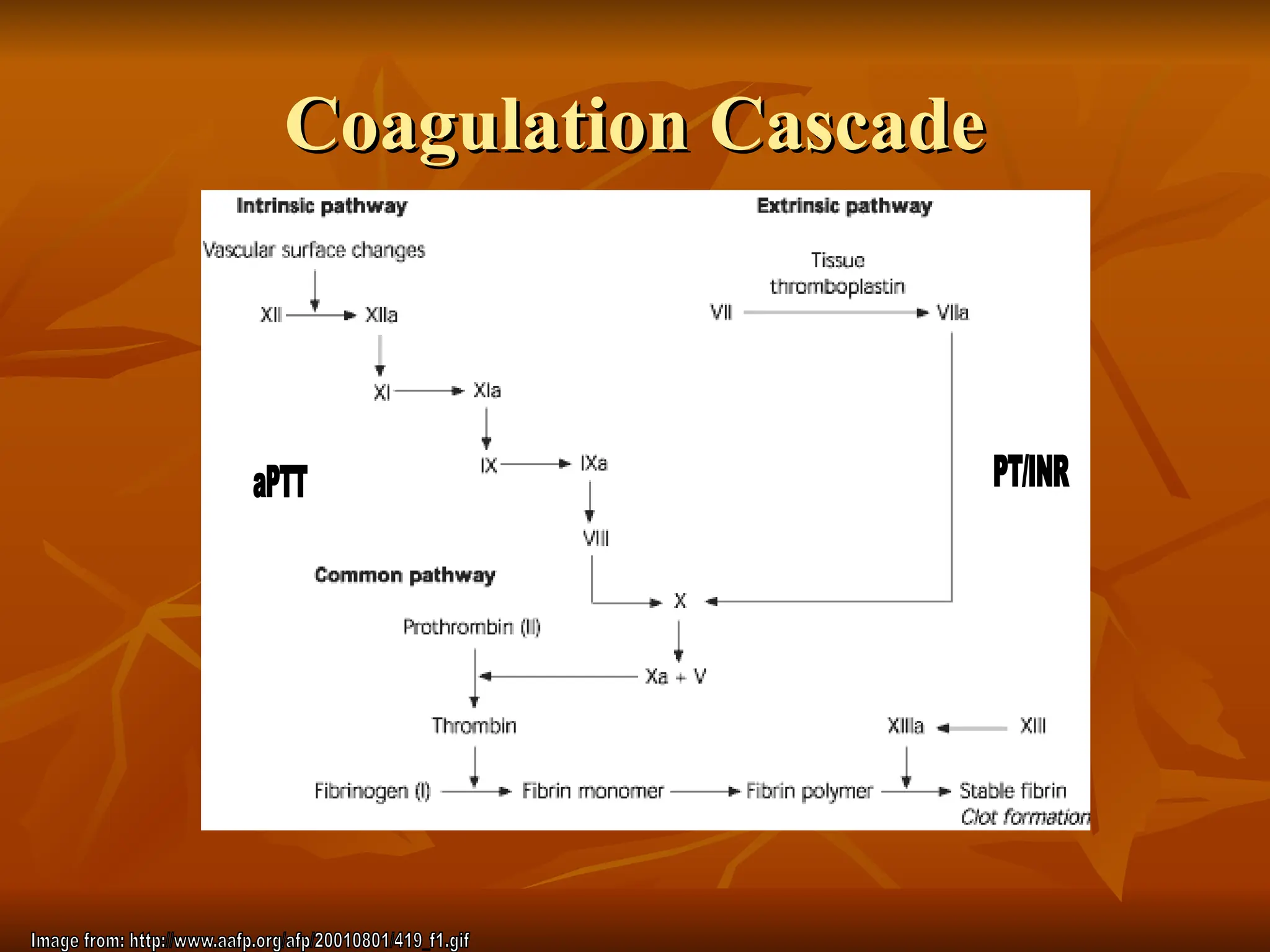
Coagulation Cascade
Coagulation Cascade
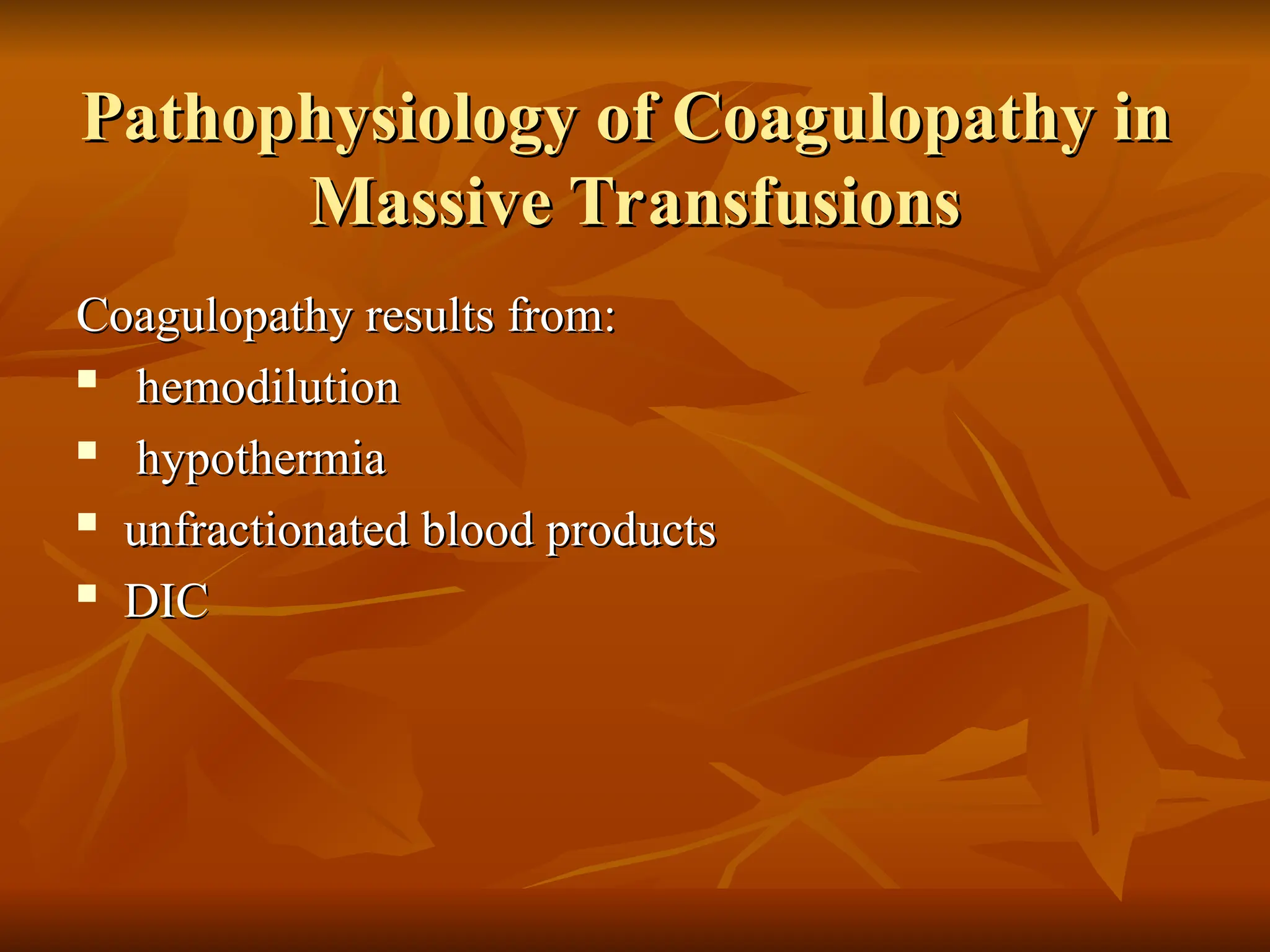
Pathophysiology of Coagulopathy in
Massive Transfusions
Coagulopathy results from:

hemodilution
hemodilution
 hypothermia
hypothermia
 unfractionated blood products
unfractionated blood products

DIC
DIC
Hemodilution
Hemodilution
 Crystalloids
Crystalloids
-1/4 stays intravascularly, 3/4
goes into interstium
-Dilute platelet and coagulating
factors
factors

Colloids
Colloids
-Hespan and Dextran impair
platelet adhesion by decreasing
von Willebrand factor activity
-Impair thrombin and clot
formation
formation
Hypothermia
Hypothermia
Hypothermia (<35 degrees):

slows activity of coagulation cascade

reduces synthesis of coagulation factors

increase fibrinolysis

decrease platelets and affects platelet
function
function

Hypothermia and acidosis cause
significant bleeding despite adequate
blood, plasma and plt replacement
Blood Components
Blood Components
 Red Blood Cells-contribute to thrombosis and hemostasis
Red Blood Cells-contribute to thrombosis and hemostasis
-Contain ADP that activates platelets, activate platelet
cyclooxygenase, increase generation of thromboxane A2,
increase thrombin
increase thrombin
-Abnormalities of Prothrombin time (PT) and activated
partial thromboplastin time (aPTT) occur after transfusion
of 12 units of pRBC
of 12 units of pRBC
 Coagulation Factors-Blood loss greater than EBVx2
Coagulation Factors-Blood loss greater than EBVx2
resulted in deficiency of prothrombin, factor V, factor VII,
and platelets
and platelets
 Platelet- Thrombocytopenia occur after transfusion of 20
Platelet- Thrombocytopenia occur after transfusion of 20
units of pRBC
units of pRBC
Disseminated Intravascular
Coagulation
Coagulation

An acquired syndrome secondary to systemic and excessive
activation of coagulation.

Tissue trauma, brain injury, shock, tissue anoxia,
hypothermia contribute to DIC

Diagnosis: D-dimer>500mcg/L, increased INR,
thrombocytopenia, microvascular bleeding +/- thrombosis

Risk factors: acidosis, hypothermia, hypotension, increase in
injury severity
injury severity
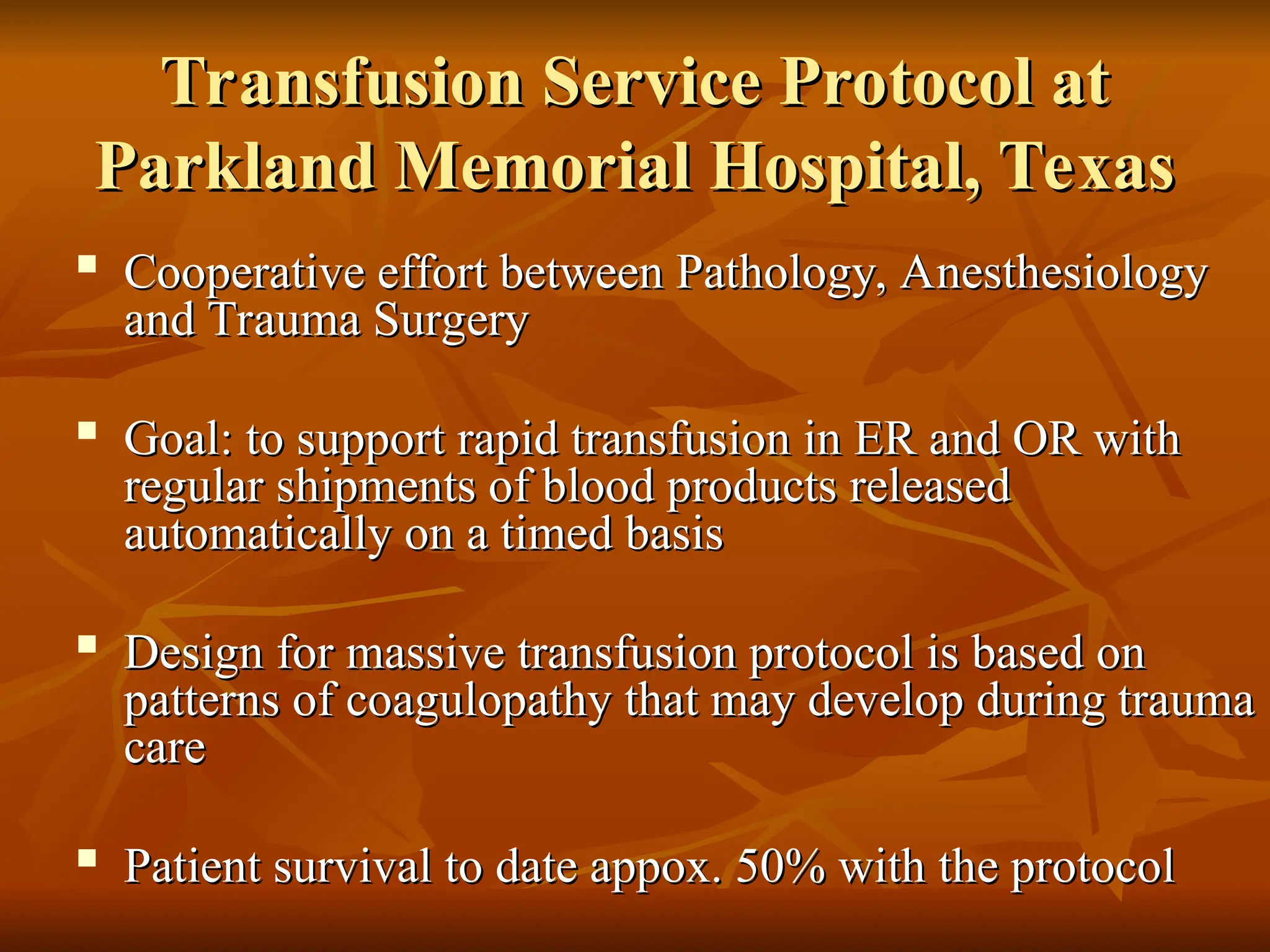
Transfusion Service Protocol at
Parkland Memorial Hospital, Texas

Cooperative effort between Pathology, Anesthesiology
and Trauma Surgery
and Trauma Surgery

Goal: to support rapid transfusion in ER and OR with
regular shipments of blood products released
automatically on a timed basis

Design for massive transfusion protocol is based on
patterns of coagulopathy that may develop during trauma
care
care

Patient survival to date appox. 50% with the protocol
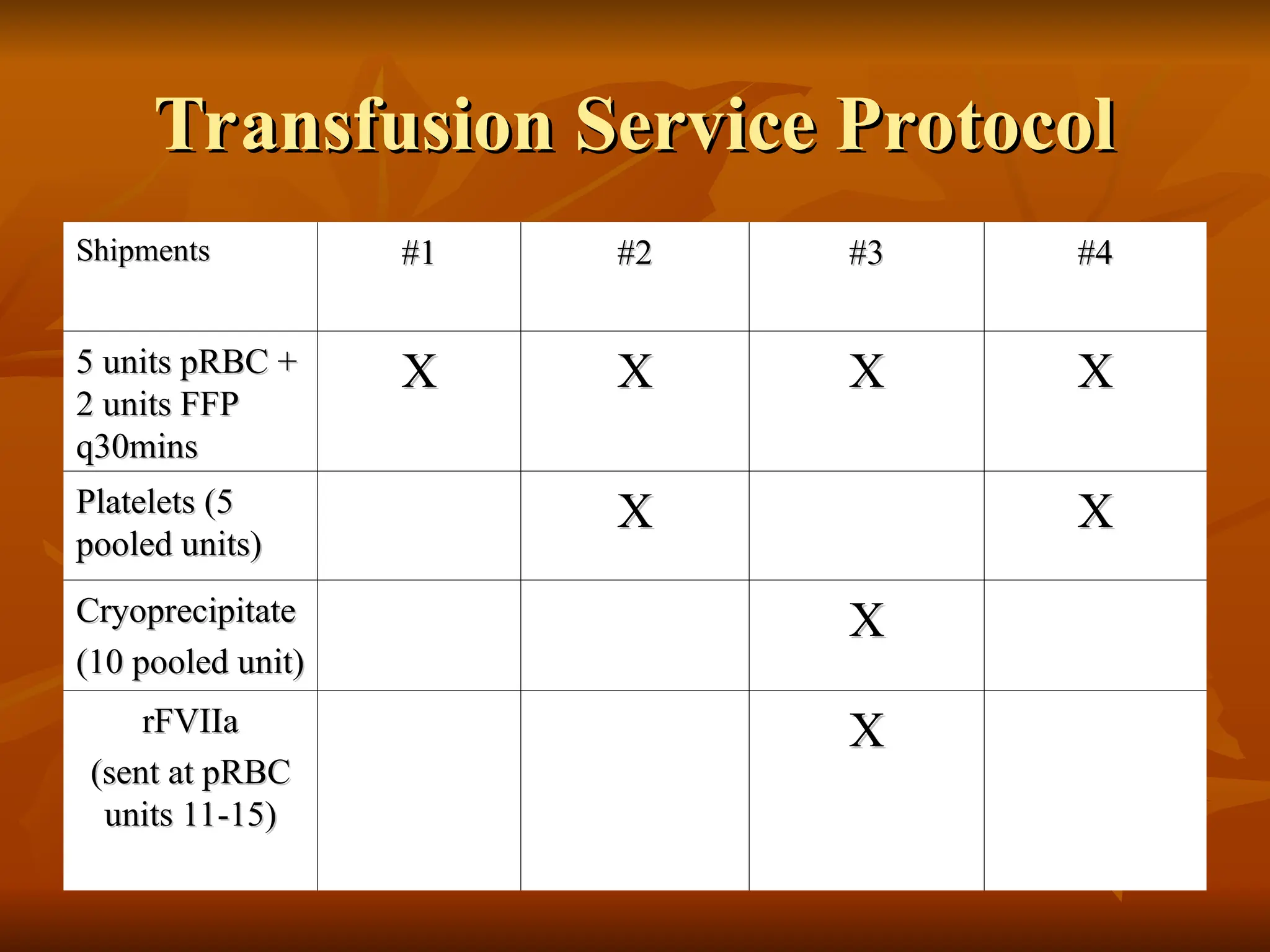
Transfusion Service Protocol
Shipments
Shipments #1
#1 #2
#2 #3
#3 #4
#4
5 units pRBC +
5 units pRBC +
2 units FFP
2 units FFP
q30mins
q30mins
X
X X
X X
X X
X
Platelets (5
Platelets (5
pooled units)
pooled units)
X
X X
X
Cryoprecipitate
Cryoprecipitate
(10 pooled unit)
(10 pooled unit)
X
X
rFVIIa
rFVIIa
(sent at pRBC
(sent at pRBC
units 11-15)
units 11-15)
X
X
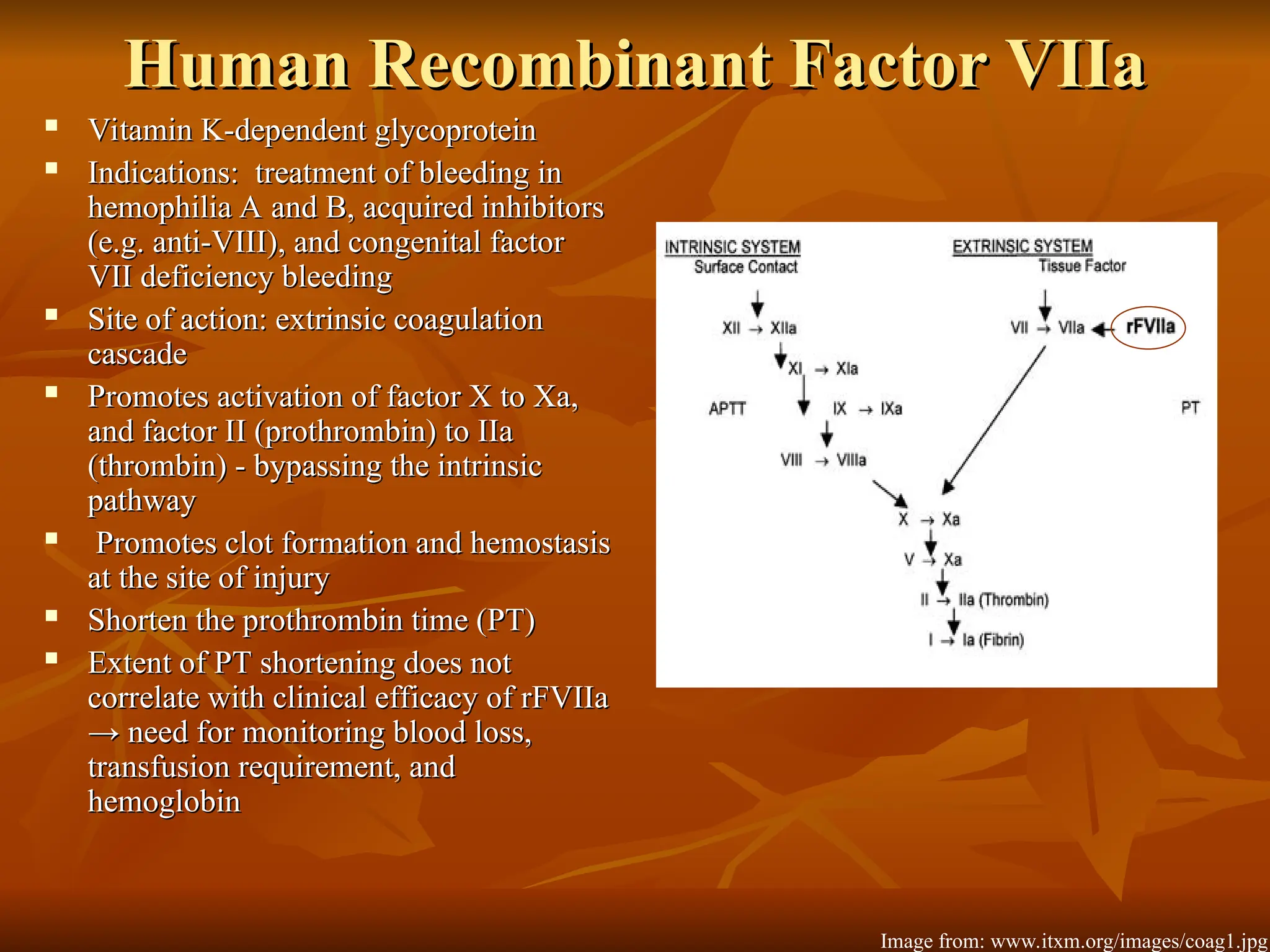
Human Recombinant Factor VIIa
 Vitamin K-dependent glycoprotein
Vitamin K-dependent glycoprotein
 Indications: treatment of bleeding in
Indications: treatment of bleeding in
hemophilia A and B, acquired inhibitors
(e.g. anti-VIII), and congenital factor
VII deficiency bleeding
 Site of action: extrinsic coagulation
Site of action: extrinsic coagulation
cascade
cascade
 Promotes activation of factor X to Xa,
Promotes activation of factor X to Xa,
and factor II (prothrombin) to IIa
(thrombin) - bypassing the intrinsic
pathway
pathway
 Promotes clot formation and hemostasis
Promotes clot formation and hemostasis
at the site of injury
 Shorten the prothrombin time (PT)
Shorten the prothrombin time (PT)
 Extent of PT shortening does not
Extent of PT shortening does not
correlate with clinical efficacy of rFVIIa
→ need for
→ need for monitoring blood loss,
monitoring blood loss,
transfusion requirement, and
hemoglobin
hemoglobin
Image from: www.itxm.org/images/coag1.jpg
Human Recombinant Factor VIIa
 Efficacious adjuvant therapy in managing hemorrhage due to
Efficacious adjuvant therapy in managing hemorrhage due to
trauma
trauma
 Reduce the need for massive blood transfusions in blunt trauma
Reduce the need for massive blood transfusions in blunt trauma
 No increased risk for thromboembolic event, DIC, allergic rxn
No increased risk for thromboembolic event, DIC, allergic rxn
or thrombocytopenia
or thrombocytopenia
 Reduced risk assoc. with plasma transmission of virus
Reduced risk assoc. with plasma transmission of virus
 Less frequent complications associated with microthrombus
Less frequent complications associated with microthrombus
generations such as multi-organ failure and ARDS
 Frequent dosing needed due to short half-life (2-3hrs)
Frequent dosing needed due to short half-life (2-3hrs)
 Recommended dose: 90 mg/kg, continued every 2-3 hours.
Recommended dose: 90 mg/kg, continued every 2-3 hours.
Once bleeding and hemoglobin have stabilized, taper to every
6-8 hours, then every 12-24 hours, and then stop
Management of Coagulopathy in
Massive Transfusions
 Maintain core body temp > 35
Maintain core body temp > 35o
o
C
C
 Correct Acidosis by re-establishing adequate tissue perfusion
Correct Acidosis by re-establishing adequate tissue perfusion
and oxygenation
and oxygenation
 Check labs (ie. ABGs, lytes, coags, plt, fibrinogen, lactate)
Check labs (ie. ABGs, lytes, coags, plt, fibrinogen, lactate)
 Replete electrolytes (ie. Calcium)
Replete electrolytes (ie. Calcium)
 Early administration of FFP and platelets during massive
Early administration of FFP and platelets during massive
transfusion with pRBC
Stay ahead of the game to prevent coagulopathy
in the first instance

Massive Transfusion and Coagulopathy.ppt

  • 1.
    Massive Transfusion And MassiveTransfusion And Coagulopathy Coagulopathy Christine Mai, MD Christine Mai, MD Faculty Advisor: Mauricio Gonzalez, MD Faculty Advisor: Mauricio Gonzalez, MD Department of Anesthesiology Department of Anesthesiology Boston University Medical Center Boston University Medical Center
  • 2.
    Guidelines to BloodProduct Guidelines to Blood Product Transfusions Transfusions  In 1994, the ASA established the Task Force on In 1994, the ASA established the Task Force on Blood Component Therapy to develop evidence- Blood Component Therapy to develop evidence- based guidelines for transfusing blood products in based guidelines for transfusing blood products in perioperative and peripartum settings perioperative and peripartum settings  22 million blood components transfused yearly 22 million blood components transfused yearly  Benefits: improved tissue oxygenation and decreased Benefits: improved tissue oxygenation and decreased bleeding bleeding  Risks: Transmission of infectious diseases, Risks: Transmission of infectious diseases, hemolytic and nonhemolytic transfusion reactions, hemolytic and nonhemolytic transfusion reactions, immunosuppression, alloimmunization, coagulopathy immunosuppression, alloimmunization, coagulopathy
  • 3.
    Massive Transfusion Massive Transfusion AmericanAssociation American Association of Blood Banks of Blood Banks definition: replacement definition: replacement of one blood volume of one blood volume (equivalent to 10 units (equivalent to 10 units of blood) in any 24 hr of blood) in any 24 hr period, or half of the period, or half of the blood volume (5 units blood volume (5 units of blood) in any four- of blood) in any four- hour period hour period
  • 4.
    American College ofSurgeon’s Classes of Acute Hemorrhage American College of Surgeon’s Classes of Acute Hemorrhage Class Class I I II II III III IV IV Blood loss (ml) Blood loss (ml) ≤ ≤750 750 750-1500 750-1500 1500-2000 1500-2000 ≥ ≥ 2000 2000 Blood loss (% Blood loss (% blood volume) blood volume) ≤ ≤15% 15% 15-30% 15-30% 30-40% 30-40% ≥ ≥40% 40% Pulse rate Pulse rate <100 <100 >100 >100 >120 >120 ≥ ≥ 140 140 Blood pressure Blood pressure Normal Normal Normal Normal Decreased Decreased Decreased Decreased Pulse pressure Pulse pressure (mmHg) (mmHg) Normal or Normal or increased increased Decreased Decreased Decreased Decreased Decreased Decreased Capillary refill Capillary refill test test Normal Normal Positive Positive Positive Positive Positive Positive Respiratory rate Respiratory rate 14-20 14-20 20-30 20-30 30-40 30-40 >35 >35 Urine output Urine output (ml/hr) (ml/hr) ≥ ≥ 30 30 20-30 20-30 5-15 5-15 Negligible Negligible CNS-mental CNS-mental status status Slightly anxious Slightly anxious Mildly anxious Mildly anxious Anxious and Anxious and confused confused Confused, Confused, lethargic lethargic Fluid replacement Fluid replacement (3:1 rule) (3:1 rule) Crystalloid Crystalloid Crystalloid Crystalloid Crystalloid + Crystalloid + Blood Blood Crystalloid + Crystalloid + Blood Blood
  • 5.
    Parameters For FluidReplacement Parameters For Fluid Replacement  Maintenance Maintenance  Deficits Deficits  Insensible loss Insensible loss  Estimated blood loss Estimated blood loss
  • 6.
    Maintenance Maintenance  4:2:1 Rule orCalculate Wt +40 cc 4:2:1 Rule or Calculate Wt +40 cc  Calculated weight: (IBW + ABW)/2 Calculated weight: (IBW + ABW)/2  IBW male: 110 lbs + 7 lbs * in > 5’ IBW male: 110 lbs + 7 lbs * in > 5’ female: 100 lbs + 6 lbs * in > 5’ female: 100 lbs + 6 lbs * in > 5’ Deficits Deficits  NPO status NPO status Calculated Wt x hrs NPO x 0.7 Calculated Wt x hrs NPO x 0.7  Bowel prep ~ 1200cc Bowel prep ~ 1200cc  Diuretics/ Urine output Diuretics/ Urine output  NGT drainage NGT drainage  CT drainage CT drainage
  • 7.
    Insensible Loss Insensible Loss CaseType Case Type Volume Volume Non-open Non-open 2-3 cc/kg/hr 2-3 cc/kg/hr Open Open 4-6 cc/kg/hr 4-6 cc/kg/hr Major Abdominal 6-10 cc/kg/hr Major Abdominal 6-10 cc/kg/hr Trauma Trauma > 10 cc/kg/hr > 10 cc/kg/hr (Volume based on Calculated Weight) (Volume based on Calculated Weight)
  • 8.
    Estimated Blood Loss EstimatedBlood Loss  The 3: 1 Rule, replace 3 cc crystalloid : 1 The 3: 1 Rule, replace 3 cc crystalloid : 1 cc blood loss cc blood loss  The 1:1 Rule, replace 1 cc colloid : 1 cc The 1:1 Rule, replace 1 cc colloid : 1 cc blood loss blood loss Allowable Blood Loss Allowable Blood Loss ( (Hct present - Hct allowable Hct present - Hct allowable) + EBV ) + EBV Hct present Hct present Estimated Blood Estimated Blood Volume Volume Adults: 75 cc/kg Adults: 75 cc/kg Infants: 80 cc/kg Infants: 80 cc/kg Neonates: 85cc/kg Neonates: 85cc/kg
  • 9.
    Fluid Resuscitation Crystalloids FluidResuscitation Crystalloids Na Na (mEq) (mEq) Cl Cl (mEq) (mEq) K K (mEq) (mEq) Ca Ca (mEq) (mEq) Mg Mg (mEq) (mEq) Lactate Lactate Acetate Acetate Gluconate Gluconate pH pH mOsm mOsm Other Other NS NS (0.9%) (0.9%) 154 154 154 154 5.0 5.0 308 308 Indicated in Indicated in neurosugery neurosugery cases cases LR LR 130 130 109 109 4 4 2.7 2.7 28 28 6.5 6.5 273 273 Contraindicated Contraindicated in liver and in liver and kidney failure kidney failure PL PL 140 140 98 98 5 5 3 3 27 27 23 23 7.4 7.4 294 294 Physiologic Physiologic pH pH
  • 10.
    Type and Screen Typeand Screen  Screen for ABO-Rh type and most common antibodies Screen for ABO-Rh type and most common antibodies  ABO incompatibility is a tragic and severe reaction, resulting ABO incompatibility is a tragic and severe reaction, resulting in rapid intravenous hemolysis in rapid intravenous hemolysis  Ordered during elective cases when the probability of blood Ordered during elective cases when the probability of blood loss and transfusion are high loss and transfusion are high  If blood is needed for emergent transfusion, a crossmatch can If blood is needed for emergent transfusion, a crossmatch can be performed to reconfirm ABO-Rh typing be performed to reconfirm ABO-Rh typing  Reactions against lower-incident antigens may still occur Reactions against lower-incident antigens may still occur  Emergency trauma cases: Type O Rh-Negative (Universal Emergency trauma cases: Type O Rh-Negative (Universal Donor) Uncrossmatched Blood transfused until a Type and Donor) Uncrossmatched Blood transfused until a Type and Cross clot is tested Cross clot is tested
  • 11.
    Type and Crossmatching Typeand Crossmatching  Crossmatching Crossmatching -Trial transfusion within a test tube between donor RBCs and recipient serum to -Trial transfusion within a test tube between donor RBCs and recipient serum to detect a potential for serious transfusion reaction detect a potential for serious transfusion reaction - 3 Phases: - 3 Phases: -Reconfirm ABO-Rh typing -Reconfirm ABO-Rh typing - Detect antibodies that are incomplete or do not agglutinate - Detect antibodies that are incomplete or do not agglutinate easily easily - Detect antibodies in other blood group systems (ie. Rh, Kell, - Detect antibodies in other blood group systems (ie. Rh, Kell, Kidd, Duffy) Kidd, Duffy)  Antibody screening Antibody screening - Trial transfusion between the recipient’s serum and commercially supplied RBCs Trial transfusion between the recipient’s serum and commercially supplied RBCs with antigens that will react with antibodies commonly implicated in non-ABO with antigens that will react with antibodies commonly implicated in non-ABO hemolytic transfusion reactions hemolytic transfusion reactions - Donor’s serum also screened for unexpected antibodies to prevent their Donor’s serum also screened for unexpected antibodies to prevent their introduction to the recipient’s serum introduction to the recipient’s serum - Otherwise known as the Coomb’s test. Otherwise known as the Coomb’s test.
  • 12.
    Blood Products Transfusion BloodProducts Transfusion  Packed Red Blood Cells Packed Red Blood Cells  Fresh Frozen Plasma Fresh Frozen Plasma  Platelets Platelets  Cryoprecipitate Cryoprecipitate
  • 13.
    Packed Red BloodCells Packed Red Blood Cells  Approx. 12 000 000 units of RBC are transfused yearly in the US Approx. 12 000 000 units of RBC are transfused yearly in the US  Indicated for patients needing red cells for oxygen carrying Indicated for patients needing red cells for oxygen carrying capacity rather than for volume replacement (ie. CHF patients) capacity rather than for volume replacement (ie. CHF patients)  70% Hct in pRBC compared to 40% Hct in whole blood 70% Hct in pRBC compared to 40% Hct in whole blood  Each unit contains 250-350 cc of red cells, increases Hct 3-4% or Each unit contains 250-350 cc of red cells, increases Hct 3-4% or increases Hgb 1g/dL increases Hgb 1g/dL  Large amount of transfusions should be warmed to 37 Large amount of transfusions should be warmed to 370 0 C C  Dilute pRBCs with either normal saline or plasmalyte when Dilute pRBCs with either normal saline or plasmalyte when giving massive transfusions giving massive transfusions  Avoid Lactated Ringers because calcium can chealate with citrate Avoid Lactated Ringers because calcium can chealate with citrate
  • 14.
    Citrate Toxicity Citrate Toxicity Calcium binding to citrate preservative in Calcium binding to citrate preservative in transfused blood transfused blood → → Hypocalcemia Hypocalcemia  Signs of citrate intoxication: hypocalcemia, Signs of citrate intoxication: hypocalcemia, hypotension, narrowed pulse pressure, hypotension, narrowed pulse pressure, increased end-diastolic pressure increased end-diastolic pressure  Cardiovascular depression can occur if Cardiovascular depression can occur if transfusion rate > 1 unit of blood per 5 mins transfusion rate > 1 unit of blood per 5 mins  Risk factors: hypothermia, liver disease, liver Risk factors: hypothermia, liver disease, liver transplantation transplantation
  • 15.
    Fresh Frozen Plasma FreshFrozen Plasma  Portion of whole blood Portion of whole blood that remains after cellular that remains after cellular elements and platelets are elements and platelets are removed removed  Each unit contains 250cc Each unit contains 250cc plasma plasma  Contains coagulating Contains coagulating factors and fibrinogen factors and fibrinogen  Increases level of each Increases level of each clotting factor by 2-3% clotting factor by 2-3%  Needs to be ABO- Needs to be ABO- compatible but does not compatible but does not require crossmatching Rh require crossmatching Rh typing typing
  • 16.
    Fresh Frozen Plasma FreshFrozen Plasma Indications: Indications: 1) urgent reversal of Warfarin therapy 1) urgent reversal of Warfarin therapy 2) correction of isolated coagulation factor deficiencies 2) correction of isolated coagulation factor deficiencies 3) correction of microvascular bleeding when INR and 3) correction of microvascular bleeding when INR and pTT >1.5 x normal pTT >1.5 x normal 4) correction of microvascular bleeding due to 4) correction of microvascular bleeding due to coagulation factor deficiency in patients transfused with coagulation factor deficiency in patients transfused with > one blood volume and when PT and pTT can not be > one blood volume and when PT and pTT can not be obtained obtained 5) Antithrombin III deficiency 5) Antithrombin III deficiency 6) Treatment of immunodeficiencies 6) Treatment of immunodeficiencies 7) Treatment of thrombotic thrombocytopenia purpura 7) Treatment of thrombotic thrombocytopenia purpura
  • 17.
    Platelets Platelets  Indicated for thrombocytopeniaplatelet count < 50 x 10 Indicated for thrombocytopenia platelet count < 50 x 109 9 /L /L  Pooled from donated blood (ie. 5 donors=5000 plt/microL) Pooled from donated blood (ie. 5 donors=5000 plt/microL)  Each 10-12 units of pRBC decrease plt count by 50%, for Each 10-12 units of pRBC decrease plt count by 50%, for replacement therapy, 5-10 units of plt (ie. 5000 – 10 000 replacement therapy, 5-10 units of plt (ie. 5000 – 10 000 plt/microL) should be given when 10-20 units of pRBC has plt/microL) should be given when 10-20 units of pRBC has been transfused been transfused  Transfuse SLOWLY to avoid hypotension Transfuse SLOWLY to avoid hypotension
  • 18.
    Cryoprecipitate Cryoprecipitate  Collected bythawing FFP at 4 Collected by thawing FFP at 40 0 C, contains von Willebrand C, contains von Willebrand factor, factor VIII, XIII, fibrinogen, and fibronectin factor, factor VIII, XIII, fibrinogen, and fibronectin  One unit of cryoprecipitate will increase fibrinogen One unit of cryoprecipitate will increase fibrinogen concentration by 50mg/dL concentration by 50mg/dL  Indicatation: Indicatation:  Patients with von Willebrand’s Dz unresponsive to Desmopressin Patients with von Willebrand’s Dz unresponsive to Desmopressin  Bleeding patients with vWD Bleeding patients with vWD  Bleeding patients with fibrinogen levels < 80-100mg/dL Bleeding patients with fibrinogen levels < 80-100mg/dL  Hemophilia A Hemophilia A  Administer rapidly through a filter (ie. 200 cc/hr, infusion Administer rapidly through a filter (ie. 200 cc/hr, infusion should be completed within 6 hrs of thawing) should be completed within 6 hrs of thawing)
  • 19.
  • 20.
    Pathophysiology of Coagulopathyin Pathophysiology of Coagulopathy in Massive Transfusions Massive Transfusions Coagulopathy results from: Coagulopathy results from:  hemodilution hemodilution  hypothermia hypothermia  unfractionated blood products unfractionated blood products  DIC DIC
  • 21.
    Hemodilution Hemodilution  Crystalloids Crystalloids -1/4 staysintravascularly, 3/4 -1/4 stays intravascularly, 3/4 goes into interstium goes into interstium -Dilute platelet and coagulating -Dilute platelet and coagulating factors factors  Colloids Colloids -Hespan and Dextran impair -Hespan and Dextran impair platelet adhesion by decreasing platelet adhesion by decreasing von Willebrand factor activity von Willebrand factor activity -Impair thrombin and clot -Impair thrombin and clot formation formation
  • 22.
    Hypothermia Hypothermia Hypothermia (<35 degrees): Hypothermia(<35 degrees):  slows activity of coagulation cascade slows activity of coagulation cascade  reduces synthesis of coagulation factors reduces synthesis of coagulation factors  increase fibrinolysis increase fibrinolysis  decrease platelets and affects platelet decrease platelets and affects platelet function function  Hypothermia and acidosis cause Hypothermia and acidosis cause significant bleeding despite adequate significant bleeding despite adequate blood, plasma and plt replacement blood, plasma and plt replacement
  • 23.
    Blood Components Blood Components Red Blood Cells-contribute to thrombosis and hemostasis Red Blood Cells-contribute to thrombosis and hemostasis -Contain ADP that activates platelets, activate platelet -Contain ADP that activates platelets, activate platelet cyclooxygenase, increase generation of thromboxane A2, cyclooxygenase, increase generation of thromboxane A2, increase thrombin increase thrombin -Abnormalities of Prothrombin time (PT) and activated -Abnormalities of Prothrombin time (PT) and activated partial thromboplastin time (aPTT) occur after transfusion partial thromboplastin time (aPTT) occur after transfusion of 12 units of pRBC of 12 units of pRBC  Coagulation Factors-Blood loss greater than EBVx2 Coagulation Factors-Blood loss greater than EBVx2 resulted in deficiency of prothrombin, factor V, factor VII, resulted in deficiency of prothrombin, factor V, factor VII, and platelets and platelets  Platelet- Thrombocytopenia occur after transfusion of 20 Platelet- Thrombocytopenia occur after transfusion of 20 units of pRBC units of pRBC
  • 24.
    Disseminated Intravascular Disseminated Intravascular Coagulation Coagulation  Anacquired syndrome secondary to systemic and excessive An acquired syndrome secondary to systemic and excessive activation of coagulation. activation of coagulation.  Tissue trauma, brain injury, shock, tissue anoxia, Tissue trauma, brain injury, shock, tissue anoxia, hypothermia contribute to DIC hypothermia contribute to DIC  Diagnosis: D-dimer>500mcg/L, increased INR, Diagnosis: D-dimer>500mcg/L, increased INR, thrombocytopenia, microvascular bleeding +/- thrombosis thrombocytopenia, microvascular bleeding +/- thrombosis  Risk factors: acidosis, hypothermia, hypotension, increase in Risk factors: acidosis, hypothermia, hypotension, increase in injury severity injury severity
  • 25.
    Transfusion Service Protocolat Transfusion Service Protocol at Parkland Memorial Hospital, Texas Parkland Memorial Hospital, Texas  Cooperative effort between Pathology, Anesthesiology Cooperative effort between Pathology, Anesthesiology and Trauma Surgery and Trauma Surgery  Goal: to support rapid transfusion in ER and OR with Goal: to support rapid transfusion in ER and OR with regular shipments of blood products released regular shipments of blood products released automatically on a timed basis automatically on a timed basis  Design for massive transfusion protocol is based on Design for massive transfusion protocol is based on patterns of coagulopathy that may develop during trauma patterns of coagulopathy that may develop during trauma care care  Patient survival to date appox. 50% with the protocol Patient survival to date appox. 50% with the protocol
  • 26.
    Transfusion Service Protocol TransfusionService Protocol Shipments Shipments #1 #1 #2 #2 #3 #3 #4 #4 5 units pRBC + 5 units pRBC + 2 units FFP 2 units FFP q30mins q30mins X X X X X X X X Platelets (5 Platelets (5 pooled units) pooled units) X X X X Cryoprecipitate Cryoprecipitate (10 pooled unit) (10 pooled unit) X X rFVIIa rFVIIa (sent at pRBC (sent at pRBC units 11-15) units 11-15) X X
  • 27.
    Human Recombinant FactorVIIa Human Recombinant Factor VIIa  Vitamin K-dependent glycoprotein Vitamin K-dependent glycoprotein  Indications: treatment of bleeding in Indications: treatment of bleeding in hemophilia A and B, acquired inhibitors hemophilia A and B, acquired inhibitors (e.g. anti-VIII), and congenital factor (e.g. anti-VIII), and congenital factor VII deficiency bleeding VII deficiency bleeding  Site of action: extrinsic coagulation Site of action: extrinsic coagulation cascade cascade  Promotes activation of factor X to Xa, Promotes activation of factor X to Xa, and factor II (prothrombin) to IIa and factor II (prothrombin) to IIa (thrombin) - bypassing the intrinsic (thrombin) - bypassing the intrinsic pathway pathway  Promotes clot formation and hemostasis Promotes clot formation and hemostasis at the site of injury at the site of injury  Shorten the prothrombin time (PT) Shorten the prothrombin time (PT)  Extent of PT shortening does not Extent of PT shortening does not correlate with clinical efficacy of rFVIIa correlate with clinical efficacy of rFVIIa → need for → need for monitoring blood loss, monitoring blood loss, transfusion requirement, and transfusion requirement, and hemoglobin hemoglobin Image from: www.itxm.org/images/coag1.jpg
  • 28.
    Human Recombinant FactorVIIa Human Recombinant Factor VIIa  Efficacious adjuvant therapy in managing hemorrhage due to Efficacious adjuvant therapy in managing hemorrhage due to trauma trauma  Reduce the need for massive blood transfusions in blunt trauma Reduce the need for massive blood transfusions in blunt trauma  No increased risk for thromboembolic event, DIC, allergic rxn No increased risk for thromboembolic event, DIC, allergic rxn or thrombocytopenia or thrombocytopenia  Reduced risk assoc. with plasma transmission of virus Reduced risk assoc. with plasma transmission of virus  Less frequent complications associated with microthrombus Less frequent complications associated with microthrombus generations such as multi-organ failure and ARDS generations such as multi-organ failure and ARDS  Frequent dosing needed due to short half-life (2-3hrs) Frequent dosing needed due to short half-life (2-3hrs)  Recommended dose: 90 mg/kg, continued every 2-3 hours. Recommended dose: 90 mg/kg, continued every 2-3 hours. Once bleeding and hemoglobin have stabilized, taper to every Once bleeding and hemoglobin have stabilized, taper to every 6-8 hours, then every 12-24 hours, and then stop 6-8 hours, then every 12-24 hours, and then stop
  • 29.
    Management of Coagulopathyin Management of Coagulopathy in Massive Transfusions Massive Transfusions  Maintain core body temp > 35 Maintain core body temp > 35o o C C  Correct Acidosis by re-establishing adequate tissue perfusion Correct Acidosis by re-establishing adequate tissue perfusion and oxygenation and oxygenation  Check labs (ie. ABGs, lytes, coags, plt, fibrinogen, lactate) Check labs (ie. ABGs, lytes, coags, plt, fibrinogen, lactate)  Replete electrolytes (ie. Calcium) Replete electrolytes (ie. Calcium)  Early administration of FFP and platelets during massive Early administration of FFP and platelets during massive transfusion with pRBC transfusion with pRBC Stay ahead of the game to prevent coagulopathy Stay ahead of the game to prevent coagulopathy in the first instance in the first instance