What will we discuss in this chapter?
(Outline)
I.

Blood composing

II. Physical and chemical characteristics of blood
III. Blood Cells
1. Hemopoietic process and hemopoietic stem cells
2. Hemopoietic microenvironment
3. Erythrocyte Physiology
4. Leukocyte Physiology
5. Platelet or Thrombocyte Physiology
IV. Physiological Hemostasis
1. Physiological Characteristics of Platelet
2. Blood Coagulation
3. Fibrinolysis
What will we discuss in this chapter?
(Outline)
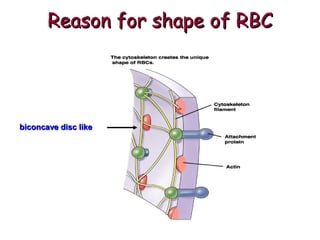
V. Blood Group
1. RBC Agglutination
2. ABO blood group system
3. Rh blood group system
4. Relation between blood volume and clinic
5. Principle of Transfusion and Cross-match test
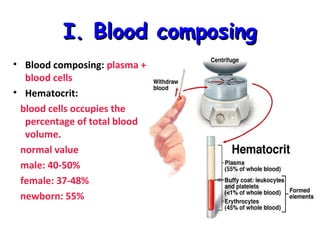
I. Blood composing
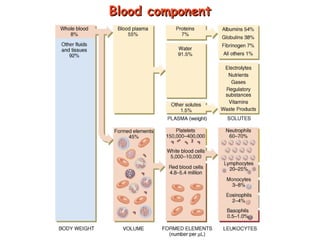
• Blood composing: plasma +
blood cells
• Hematocrit:
blood cells occupies the
percentage of total blood
volume.
normal value
male: 40-50%
female: 37-48%
newborn: 55%
Blood component
Chemical component of plasma
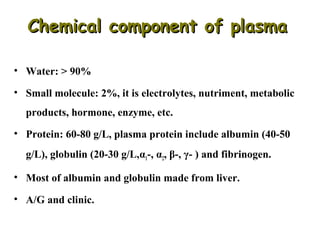
• Water: > 90%
• Small molecule: 2%, it is electrolytes, nutriment, metabolic
products, hormone, enzyme, etc.
• Protein: 60-80 g/L, plasma protein include albumin (40-50
g/L), globulin (20-30 g/L,α1-, α2, β-, γ- ) and fibrinogen.
• Most of albumin and globulin made from liver.
• A/G and clinic.
Chemical component of plasma
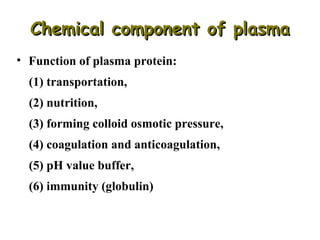
• Function of plasma protein:
(1) transportation,
(2) nutrition,
(3) forming colloid osmotic pressure,
(4) coagulation and anticoagulation,
(5) pH value buffer,
(6) immunity (globulin)
Chemical component of plasma
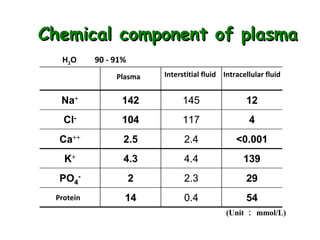
H2 O

90 - 91%
Plasma
血浆

Interstitial fluid Intracellular fluid
组织液
细胞内液

Na+

142

145

12

Cl-

104

117

4

Ca++

2.5

2.4

<0.001

K+

4.3

4.4

139

PO4-

2

2.3

29

Protein
蛋白质

14

0.4

54
(Unit : mmol/L)
II. Physical and chemical
characteristics of blood
• Specific gravity:
– total blood (1.050-1.060) more influenced by red blood
cells;
– plasma (1.025-1.030) more influenced by plasma protein;
– RBC (1.090-1.092) more influenced by Hb.
II. Physical and chemical
characteristics of blood
• Viscosity:
– Blood relative viscosity (4~5) mainly depends on the
numbers of red blood cells.
– Plasma relative viscosity (1.6~2.4) is mainly involved in
plasma protein
II. Physical and chemical
characteristics of blood
• Plasma osmotic pressure is 300 mmol/L or 770kPa
(1) Crystal osmotic pressure results from NaCl and modulates
water distribution between inside and outside of cells.
(2) Colloid osmotic pressure results from albumin and regulates
water distribution between inside and outside of capillary.
II. Physical and chemical
characteristics of blood
• Plasma pH value is about 7.35~7.45, and
• usually buffer systems are:
– NaHCO3/H2CO3 (20:1), protein salt/protein,
– Na2HPO4/ NaH2PO4,
– Hb salt/Hb, HbO salt/ HbO2,
– K2HPO4/ KH2PO4, etc
– [lungs and kidney mainly regulate Plasma pH value ].
Osmosis and Osmotic Pressure
• Osmosis is the movement of water down its
concentration gradient.
• Osmosis is determined by the number of
impermeable molecules.
• Osmotic pressure is the force drawing water
down its concentration gradient.
Osmosis and Osmotic Pressure
A

B
∗

∗ ∗
∗

Water
∗ ∗ ∗
∗

∗ ∗
∗ ∗

∗

∗

∗

∗
∗
∗
∗ ∗ ∗
∗∗ ∗
∗
∗
∗

[Water] > [Water]
[Salt] < [Salt]
Osmotic Pressure < Osmotic Pressure
Osmosis is the movement of water from a high concentration to a low concentration. In
this illustration, two compartments (A and B) are separated by a semipermeable
membrane (broken vertical line). The water concentration in compartment A is greater
than the concentration in compartment B because of the presence of salt (X) in B.
Therefore, water will move down its concentration gradient from A to B. The force
needed to prevent this water movement is called osmotic pressure.
Tonicity
• The tonicity of a solution refers to the effect of the solution
on cell volume.
• A hypertonic extracellular solution is one in which the
water concentration is less outside the cell than inside;
water leaves the cell; cell volume decreases.

• An isotonic extracellular solution is one in which the water
concentration is the same inside and outside the cell;
no water movement; cell volume does not change.
Tonicity
• A hypotonic solution is one in which the water
concentration is greater outside than inside the cell;
water enters the cell; cell volume increases.

• An isosmotic solution may not be an isotonic solution if
the particles are permeable to the cell membrane.
III.Blood Cells
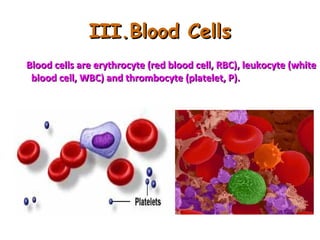
Blood cells are erythrocyte (red blood cell, RBC), leukocyte (white
blood cell, WBC) and thrombocyte (platelet, P).
3.Erythrocyte Physiology
Shape and number of red blood cells (RBC)
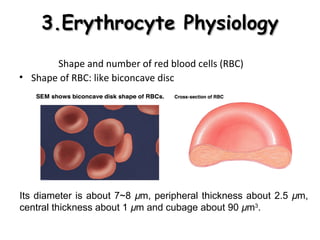
• Shape of RBC: like biconcave disc

Its diameter is about 7~8 µm, peripheral thickness about 2.5 µm,
central thickness about 1 µm and cubage about 90 µm3.
Reason for shape of RBC

biconcave disc like
Erythrocyte Physiology
Number of RBC: It is most numbers in the blood.
Normal value about RBC
Male adult, 4.5~5.5×10¹²/L; average, 5.0×10¹²/L
Female adult, 3.8~4.6× 10¹²/L; average, 4.2×10¹²/L
Newborn, ≥ 6.0×10¹²/L
Protein within RBC is hemoglobin (Hb).
Hb in male adult, 120~160 g/L;
Hb in female adult, 110~150 g/L;
Hb in newborn (within 5 days), ≥ 200 g/L
Pregnant female, numbers of RBC and Hb are relatively less (because of more
plasma).
Dweller lived in plateau, numbers of RBC and Hb are relatively more (because of
compensation for anoxia).
Physiological Characteristics and
Functions of RBC
a.

b.

Characteristics of RBC
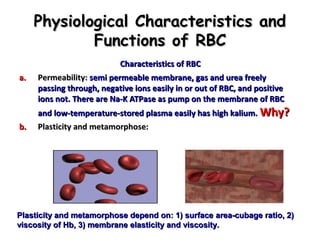
Permeability: semi permeable membrane, gas and urea freely
passing through, negative ions easily in or out of RBC, and positive
ions not. There are Na-K ATPase as pump on the membrane of RBC

and low-temperature-stored plasma easily has high kalium. Why?
Plasticity and metamorphose:

Plasticity and metamorphose depend on: 1) surface area-cubage ratio, 2)
viscosity of Hb, 3) membrane elasticity and viscosity.
Physiological Characteristics and
Functions of RBC
Characteristics of RBC
c. Suspension stability: it cab be described by erythrocyte
sedimentation rate (ESR) which is RBC descending distance
per hour and suspension stability is inverse proportion to
ESR.
Normal value of ESR: male, 0~15 mm/h; female, 0~20 mm/h.
ESR and clinic: some diseases bring about rouleaux formation
(mainly involved in plasma component, e.g. globulin,
fibrinogen, cholesterol) and speed up ESR.
Physiological Characteristics and
Functions of RBC
Characteristics of RBC
d.

Osmotic fragility: Changes in RBC put into lower osmotic salty
solution.
Osmotic fragility of aged RBC is large and easily results in rupture
(hemolysis and ghost cell).
Isosmotic solution, e.g. 0.85% NaCl, 1.4%NaHCO 3, 5% glucose, etc.
Isotonic solution, e.g. 0.85% NaCl
Isosmotic solution does not equal to isotonic solution.
Isosmotic solution, isotonic solution and clinic
Physiological Characteristics and
Functions of RBC
Functions of RBC

•

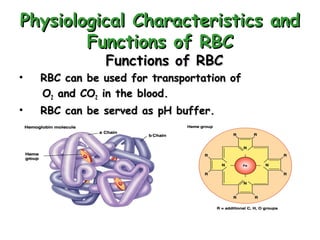
RBC can be used for transportation of
O2 and CO2 in the blood.

•

RBC can be served as pH buffer.
Erythropoiesis
• Hemopoietic material for erythropoiesis:
iron (Fe++) and protein, [reason for anemia]
• Influencing factors of RBC maturity:
Vitamin B12 and folic acid (DNA metabolism),
[clinic relation]
• Process of erythropoiesis:
Hemopoietic stem cells→multi systemic hemopoietic progenitor cells→RBCcommitted progenitor cells (BFU-E→CFU-E)→original RBC→ earlier infantile
RBC→medium-term infantile RBC→terminal infantile RBC→reticular RBC→mature
RBC→blood for circulation.

This process requires 6~7 days.
[mitosis several times] [apoptosis]
Place for Erythropoiesis
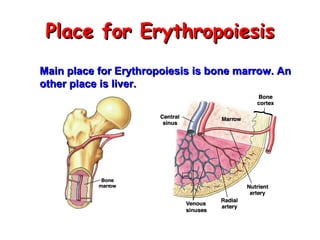
Main place for Erythropoiesis is bone marrow. An
other place is liver.
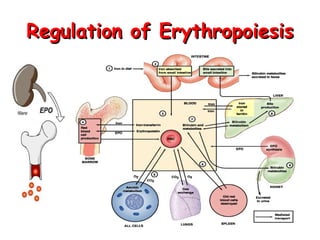
Regulation of Erythropoiesis
• 0.8% of total RBCs has self renewal, that is to say, 160×106 RBC
production every minute.
• Burst forming unit-erythroid, BUF-E, important to earlier
erythropoiesis, depends on stimulation of burst promoting
activity, BPA outside body. BPA made by leucocyte is a
glycoprotein whose molecular weight is about 25000~40000
• Colony forming unit-erythroid, CFU-E, important to terminal
erythropoiesis, depends on erythropoietin, EPO which is also a
glycoprotein, molecular weight, 34000, plasma concentration 10
pmol/L, half life 5 hours, increasing release when anoxia.
Regulation of Erythropoiesis
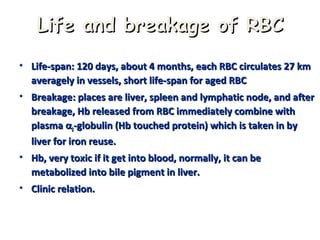
Life and breakage of RBC
• Life-span: 120 days, about 4 months, each RBC circulates 27 km
averagely in vessels, short life-span for aged RBC
• Breakage: places are liver, spleen and lymphatic node, and after
breakage, Hb released from RBC immediately combine with
plasma α2-globulin (Hb touched protein) which is taken in by
liver for iron reuse.
• Hb, very toxic if it get into blood, normally, it can be
metabolized into bile pigment in liver.
• Clinic relation.
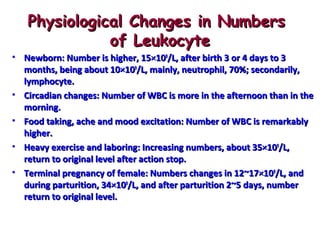
Physiological Changes in Numbers
of Leukocyte
• Newborn: Number is higher, 15×109/L, after birth 3 or 4 days to 3
months, being about 10×109/L, mainly, neutrophil, 70%; secondarily,
lymphocyte.
• Circadian changes: Number of WBC is more in the afternoon than in the
morning.
• Food taking, ache and mood excitation: Number of WBC is remarkably
higher.
• Heavy exercise and laboring: Increasing numbers, about 35×109/L,
return to original level after action stop.
• Terminal pregnancy of female: Numbers changes in 12~17×109/L, and
during parturition, 34×109/L, and after parturition 2~5 days, number
return to original level.
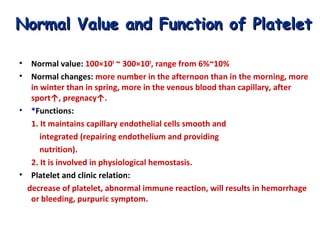
Normal Value and Function of Platelet
•
•

Normal value: 100×109 ~ 300×109, range from 6%~10%
Normal changes: more number in the afternoon than in the morning, more
in winter than in spring, more in the venous blood than capillary, after
sport↑, pregnacy↑.
• *Functions:
1. It maintains capillary endothelial cells smooth and
integrated (repairing endothelium and providing
nutrition).
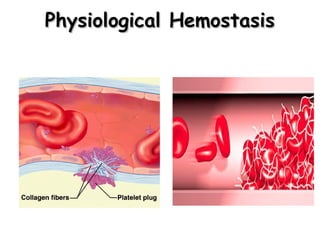
2. It is involved in physiological hemostasis.
• Platelet and clinic relation:
decrease of platelet, abnormal immune reaction, will results in hemorrhage
or bleeding, purpuric symptom.
Life- Span and Breakage of Platelet

• Life-span: Averagely, 7~14 days in the blood.
It can be consumed when it displays
physiological functions.
• Breakage: Aged platelet can be processed by
phagocytosis in liver, spleen and lymphatic
node.
Physiological Hemostasis
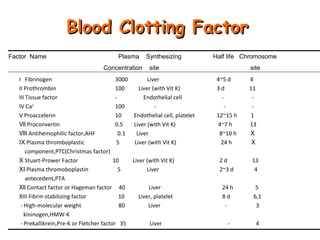
Blood Clotting Factor
Factor Name

Plasma
Concentration

Synthesizing

Half life Chromosome

site

I Fibrinogen
3000
Liver
II Prothrombin
100
Liver (with Vit K)
III Tissue factor
Endothelial cell
IV Ca2+
100
V Proaccelerin
10
Endothelial cell, platelet
Ⅶ Proconvertin
0.5
Liver (with Vit K)
Ⅷ Antihemophilic factor,AHF
0.1
Liver
Ⅸ Plasma thromboplastic
5
Liver (with Vit K)
component,PTC(Christmas factor)
Ⅹ Stuart-Prower Factor
10
Liver (with Vit K)
Ⅺ Plasma thromoboplastin
5
Liver
antecedent,PTA
Ⅻ Contact factor or Hageman factor 40
Liver
XIII Fibrin-stabilizing factor
10
Liver, platelet
- High-molecular weight
80
Liver
kininogen,HMW-K
- Prekallikrein,Pre-K or Fletcher factor 35
Liver

site
4~5 d
3d
12~15 h
4~7 h
8~10 h
24 h
2d
2~3 d

4
11
1
13
Ⅹ
Ⅹ
13
4

24 h
8d
-

5
6,1
3

-

4
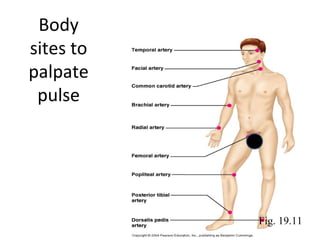
Body
sites to
palpate
pulse

Fig. 19.11
Principles of Animal Physiology
Circulatory Systems

Circulatory Fluids
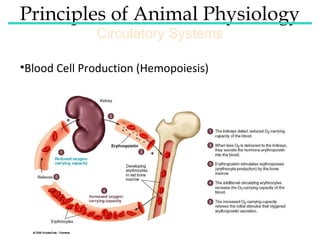
•Blood Cell Production (Hemopoiesis)
1) Erythrocytes (continued): Disorders
•

•

Anemia – blood has abnormally low oxygen-carrying capacity
– It is a symptom rather than a disease itself
– Blood oxygen levels cannot support normal metabolism
– Signs/symptoms include:
• fatigue, paleness, shortness of breath, and chills
Types
– Hemorrhagic anemia – result of loss of blood
– Hemolytic anemia – prematurely ruptured RBCs
– Aplastic anemia – destruction/inhibition of red bone marrow
– Iron-deficiency anemia results from lack of iron
– Pernicious anemia results from either deficiency of vitamin B 12 or lack of
intrinsic factor needed for absorption of B12 Treatment is intramuscular injection
of B12
– Thalassemias – absent or faulty globin chain in Hb
– Sickle-cell anemia – results from a defective gene & causes RBCs to become
sickle-shaped in low oxygen situations
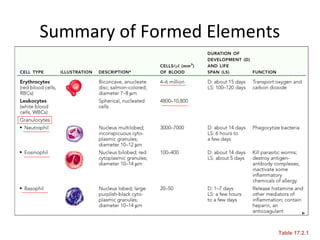
2) Leukocytes (continued): Granulocytes
• Granulocytes – neutrophils, eosinophils, and basophils
– Are larger and usually shorter-lived than RBCs
– Have lobed nuclei
– ALL are phagocytic cells
• Three types
A. Neutrophils
B. Eosinophils
C. Basophils

Neutrophils

Eosinophils

Basophil
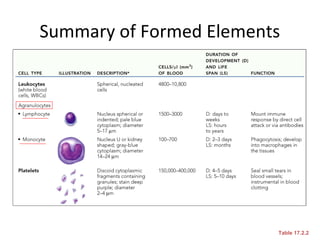
2. Leukocytes (continued):
Agranulocytes

• Agranulocytes
– Lack visible cytoplasmic granules
– Are similar structurally, but are functionally distinct and
unrelated cell types
• Two types:
– A. Lymphocytes
– B. Monocytes:

Lymphocyte

Monocyte
Summary of Formed Elements

Table 17.2.1
Summary of Formed Elements

Table 17.2.2
Physiological Factors Affecting Red
Cell Count
* Age: it is high in newly born infants and low in old
individuals
* Sex: it s higher in males than in females for two
reasons:
a. androgens stimulate the production of RBC
b. women lose blood via menstration
* High altitude
41

blood physiology

  • 1.
    What will wediscuss in this chapter? (Outline) I. Blood composing II. Physical and chemical characteristics of blood III. Blood Cells 1. Hemopoietic process and hemopoietic stem cells 2. Hemopoietic microenvironment 3. Erythrocyte Physiology 4. Leukocyte Physiology 5. Platelet or Thrombocyte Physiology IV. Physiological Hemostasis 1. Physiological Characteristics of Platelet 2. Blood Coagulation 3. Fibrinolysis
  • 2.
    What will wediscuss in this chapter? (Outline) V. Blood Group 1. RBC Agglutination 2. ABO blood group system 3. Rh blood group system 4. Relation between blood volume and clinic 5. Principle of Transfusion and Cross-match test
  • 3.
    I. Blood composing •Blood composing: plasma + blood cells • Hematocrit: blood cells occupies the percentage of total blood volume. normal value male: 40-50% female: 37-48% newborn: 55%
  • 4.
  • 5.
    Chemical component ofplasma • Water: > 90% • Small molecule: 2%, it is electrolytes, nutriment, metabolic products, hormone, enzyme, etc. • Protein: 60-80 g/L, plasma protein include albumin (40-50 g/L), globulin (20-30 g/L,α1-, α2, β-, γ- ) and fibrinogen. • Most of albumin and globulin made from liver. • A/G and clinic.
  • 6.
    Chemical component ofplasma • Function of plasma protein: (1) transportation, (2) nutrition, (3) forming colloid osmotic pressure, (4) coagulation and anticoagulation, (5) pH value buffer, (6) immunity (globulin)
  • 7.
    Chemical component ofplasma H2 O 90 - 91% Plasma 血浆 Interstitial fluid Intracellular fluid 组织液 细胞内液 Na+ 142 145 12 Cl- 104 117 4 Ca++ 2.5 2.4 <0.001 K+ 4.3 4.4 139 PO4- 2 2.3 29 Protein 蛋白质 14 0.4 54 (Unit : mmol/L)
  • 8.
    II. Physical andchemical characteristics of blood • Specific gravity: – total blood (1.050-1.060) more influenced by red blood cells; – plasma (1.025-1.030) more influenced by plasma protein; – RBC (1.090-1.092) more influenced by Hb.
  • 9.
    II. Physical andchemical characteristics of blood • Viscosity: – Blood relative viscosity (4~5) mainly depends on the numbers of red blood cells. – Plasma relative viscosity (1.6~2.4) is mainly involved in plasma protein
  • 10.
    II. Physical andchemical characteristics of blood • Plasma osmotic pressure is 300 mmol/L or 770kPa (1) Crystal osmotic pressure results from NaCl and modulates water distribution between inside and outside of cells. (2) Colloid osmotic pressure results from albumin and regulates water distribution between inside and outside of capillary.
  • 11.
    II. Physical andchemical characteristics of blood • Plasma pH value is about 7.35~7.45, and • usually buffer systems are: – NaHCO3/H2CO3 (20:1), protein salt/protein, – Na2HPO4/ NaH2PO4, – Hb salt/Hb, HbO salt/ HbO2, – K2HPO4/ KH2PO4, etc – [lungs and kidney mainly regulate Plasma pH value ].
  • 12.
    Osmosis and OsmoticPressure • Osmosis is the movement of water down its concentration gradient. • Osmosis is determined by the number of impermeable molecules. • Osmotic pressure is the force drawing water down its concentration gradient.
  • 13.
    Osmosis and OsmoticPressure A B ∗ ∗ ∗ ∗ Water ∗ ∗ ∗ ∗ ∗ ∗ ∗ ∗ ∗ ∗ ∗ ∗ ∗ ∗ ∗ ∗ ∗ ∗∗ ∗ ∗ ∗ ∗ [Water] > [Water] [Salt] < [Salt] Osmotic Pressure < Osmotic Pressure Osmosis is the movement of water from a high concentration to a low concentration. In this illustration, two compartments (A and B) are separated by a semipermeable membrane (broken vertical line). The water concentration in compartment A is greater than the concentration in compartment B because of the presence of salt (X) in B. Therefore, water will move down its concentration gradient from A to B. The force needed to prevent this water movement is called osmotic pressure.
  • 14.
    Tonicity • The tonicityof a solution refers to the effect of the solution on cell volume. • A hypertonic extracellular solution is one in which the water concentration is less outside the cell than inside; water leaves the cell; cell volume decreases. • An isotonic extracellular solution is one in which the water concentration is the same inside and outside the cell; no water movement; cell volume does not change.
  • 15.
    Tonicity • A hypotonicsolution is one in which the water concentration is greater outside than inside the cell; water enters the cell; cell volume increases. • An isosmotic solution may not be an isotonic solution if the particles are permeable to the cell membrane.
  • 16.
    III.Blood Cells Blood cellsare erythrocyte (red blood cell, RBC), leukocyte (white blood cell, WBC) and thrombocyte (platelet, P).
  • 17.
    3.Erythrocyte Physiology Shape andnumber of red blood cells (RBC) • Shape of RBC: like biconcave disc Its diameter is about 7~8 µm, peripheral thickness about 2.5 µm, central thickness about 1 µm and cubage about 90 µm3.
  • 18.
    Reason for shapeof RBC biconcave disc like
  • 19.
    Erythrocyte Physiology Number ofRBC: It is most numbers in the blood. Normal value about RBC Male adult, 4.5~5.5×10¹²/L; average, 5.0×10¹²/L Female adult, 3.8~4.6× 10¹²/L; average, 4.2×10¹²/L Newborn, ≥ 6.0×10¹²/L Protein within RBC is hemoglobin (Hb). Hb in male adult, 120~160 g/L; Hb in female adult, 110~150 g/L; Hb in newborn (within 5 days), ≥ 200 g/L Pregnant female, numbers of RBC and Hb are relatively less (because of more plasma). Dweller lived in plateau, numbers of RBC and Hb are relatively more (because of compensation for anoxia).
  • 20.
    Physiological Characteristics and Functionsof RBC a. b. Characteristics of RBC Permeability: semi permeable membrane, gas and urea freely passing through, negative ions easily in or out of RBC, and positive ions not. There are Na-K ATPase as pump on the membrane of RBC and low-temperature-stored plasma easily has high kalium. Why? Plasticity and metamorphose: Plasticity and metamorphose depend on: 1) surface area-cubage ratio, 2) viscosity of Hb, 3) membrane elasticity and viscosity.
  • 21.
    Physiological Characteristics and Functionsof RBC Characteristics of RBC c. Suspension stability: it cab be described by erythrocyte sedimentation rate (ESR) which is RBC descending distance per hour and suspension stability is inverse proportion to ESR. Normal value of ESR: male, 0~15 mm/h; female, 0~20 mm/h. ESR and clinic: some diseases bring about rouleaux formation (mainly involved in plasma component, e.g. globulin, fibrinogen, cholesterol) and speed up ESR.
  • 22.
    Physiological Characteristics and Functionsof RBC Characteristics of RBC d. Osmotic fragility: Changes in RBC put into lower osmotic salty solution. Osmotic fragility of aged RBC is large and easily results in rupture (hemolysis and ghost cell). Isosmotic solution, e.g. 0.85% NaCl, 1.4%NaHCO 3, 5% glucose, etc. Isotonic solution, e.g. 0.85% NaCl Isosmotic solution does not equal to isotonic solution. Isosmotic solution, isotonic solution and clinic
  • 23.
    Physiological Characteristics and Functionsof RBC Functions of RBC • RBC can be used for transportation of O2 and CO2 in the blood. • RBC can be served as pH buffer.
  • 24.
    Erythropoiesis • Hemopoietic materialfor erythropoiesis: iron (Fe++) and protein, [reason for anemia] • Influencing factors of RBC maturity: Vitamin B12 and folic acid (DNA metabolism), [clinic relation] • Process of erythropoiesis: Hemopoietic stem cells→multi systemic hemopoietic progenitor cells→RBCcommitted progenitor cells (BFU-E→CFU-E)→original RBC→ earlier infantile RBC→medium-term infantile RBC→terminal infantile RBC→reticular RBC→mature RBC→blood for circulation. This process requires 6~7 days. [mitosis several times] [apoptosis]
  • 25.
    Place for Erythropoiesis Mainplace for Erythropoiesis is bone marrow. An other place is liver.
  • 26.
    Regulation of Erythropoiesis •0.8% of total RBCs has self renewal, that is to say, 160×106 RBC production every minute. • Burst forming unit-erythroid, BUF-E, important to earlier erythropoiesis, depends on stimulation of burst promoting activity, BPA outside body. BPA made by leucocyte is a glycoprotein whose molecular weight is about 25000~40000 • Colony forming unit-erythroid, CFU-E, important to terminal erythropoiesis, depends on erythropoietin, EPO which is also a glycoprotein, molecular weight, 34000, plasma concentration 10 pmol/L, half life 5 hours, increasing release when anoxia.
  • 27.
  • 28.
    Life and breakageof RBC • Life-span: 120 days, about 4 months, each RBC circulates 27 km averagely in vessels, short life-span for aged RBC • Breakage: places are liver, spleen and lymphatic node, and after breakage, Hb released from RBC immediately combine with plasma α2-globulin (Hb touched protein) which is taken in by liver for iron reuse. • Hb, very toxic if it get into blood, normally, it can be metabolized into bile pigment in liver. • Clinic relation.
  • 29.
    Physiological Changes inNumbers of Leukocyte • Newborn: Number is higher, 15×109/L, after birth 3 or 4 days to 3 months, being about 10×109/L, mainly, neutrophil, 70%; secondarily, lymphocyte. • Circadian changes: Number of WBC is more in the afternoon than in the morning. • Food taking, ache and mood excitation: Number of WBC is remarkably higher. • Heavy exercise and laboring: Increasing numbers, about 35×109/L, return to original level after action stop. • Terminal pregnancy of female: Numbers changes in 12~17×109/L, and during parturition, 34×109/L, and after parturition 2~5 days, number return to original level.
  • 30.
    Normal Value andFunction of Platelet • • Normal value: 100×109 ~ 300×109, range from 6%~10% Normal changes: more number in the afternoon than in the morning, more in winter than in spring, more in the venous blood than capillary, after sport↑, pregnacy↑. • *Functions: 1. It maintains capillary endothelial cells smooth and integrated (repairing endothelium and providing nutrition). 2. It is involved in physiological hemostasis. • Platelet and clinic relation: decrease of platelet, abnormal immune reaction, will results in hemorrhage or bleeding, purpuric symptom.
  • 31.
    Life- Span andBreakage of Platelet • Life-span: Averagely, 7~14 days in the blood. It can be consumed when it displays physiological functions. • Breakage: Aged platelet can be processed by phagocytosis in liver, spleen and lymphatic node.
  • 32.
  • 33.
    Blood Clotting Factor FactorName Plasma Concentration Synthesizing Half life Chromosome site I Fibrinogen 3000 Liver II Prothrombin 100 Liver (with Vit K) III Tissue factor Endothelial cell IV Ca2+ 100 V Proaccelerin 10 Endothelial cell, platelet Ⅶ Proconvertin 0.5 Liver (with Vit K) Ⅷ Antihemophilic factor,AHF 0.1 Liver Ⅸ Plasma thromboplastic 5 Liver (with Vit K) component,PTC(Christmas factor) Ⅹ Stuart-Prower Factor 10 Liver (with Vit K) Ⅺ Plasma thromoboplastin 5 Liver antecedent,PTA Ⅻ Contact factor or Hageman factor 40 Liver XIII Fibrin-stabilizing factor 10 Liver, platelet - High-molecular weight 80 Liver kininogen,HMW-K - Prekallikrein,Pre-K or Fletcher factor 35 Liver site 4~5 d 3d 12~15 h 4~7 h 8~10 h 24 h 2d 2~3 d 4 11 1 13 Ⅹ Ⅹ 13 4 24 h 8d - 5 6,1 3 - 4
  • 34.
  • 35.
    Principles of AnimalPhysiology Circulatory Systems Circulatory Fluids •Blood Cell Production (Hemopoiesis)
  • 36.
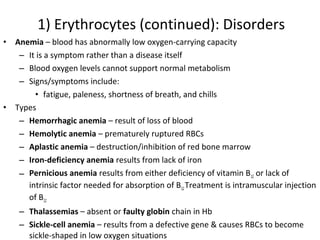
    1) Erythrocytes (continued):Disorders • • Anemia – blood has abnormally low oxygen-carrying capacity – It is a symptom rather than a disease itself – Blood oxygen levels cannot support normal metabolism – Signs/symptoms include: • fatigue, paleness, shortness of breath, and chills Types – Hemorrhagic anemia – result of loss of blood – Hemolytic anemia – prematurely ruptured RBCs – Aplastic anemia – destruction/inhibition of red bone marrow – Iron-deficiency anemia results from lack of iron – Pernicious anemia results from either deficiency of vitamin B 12 or lack of intrinsic factor needed for absorption of B12 Treatment is intramuscular injection of B12 – Thalassemias – absent or faulty globin chain in Hb – Sickle-cell anemia – results from a defective gene & causes RBCs to become sickle-shaped in low oxygen situations
  • 37.
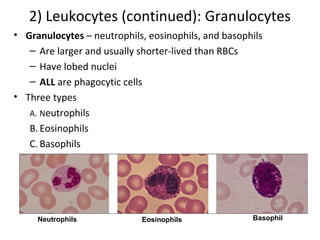
    2) Leukocytes (continued):Granulocytes • Granulocytes – neutrophils, eosinophils, and basophils – Are larger and usually shorter-lived than RBCs – Have lobed nuclei – ALL are phagocytic cells • Three types A. Neutrophils B. Eosinophils C. Basophils Neutrophils Eosinophils Basophil
  • 38.
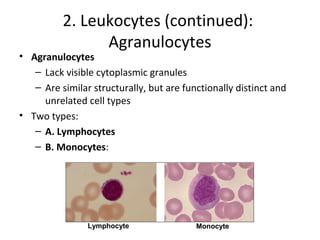
    2. Leukocytes (continued): Agranulocytes •Agranulocytes – Lack visible cytoplasmic granules – Are similar structurally, but are functionally distinct and unrelated cell types • Two types: – A. Lymphocytes – B. Monocytes: Lymphocyte Monocyte
  • 39.
    Summary of FormedElements Table 17.2.1
  • 40.
    Summary of FormedElements Table 17.2.2
  • 41.
    Physiological Factors AffectingRed Cell Count * Age: it is high in newly born infants and low in old individuals * Sex: it s higher in males than in females for two reasons: a. androgens stimulate the production of RBC b. women lose blood via menstration * High altitude 41