ERYTHROPOIESIS
ERYTHROPOIESIS
CONTENTS
1. Definition
2. Sites of erythropoiesis
3. Stages of erythropoiesis
4. Factors affecting Erythropoiesis
5. Erythropoietin
6. HYPOXIA
7. FOLIC ACID
8. Vitamin B12
9. CLINICAL ASPECTS
10. SUMMARY
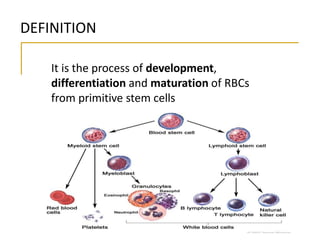
It is the process of development,
differentiation and maturation of RBCs
from primitive stem cells
DEFINITION
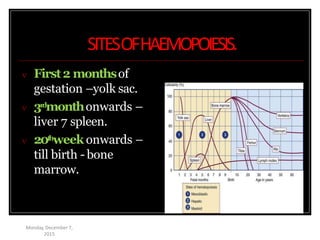
SITESOFHAEMOPOIESIS.
 First2 monthsof
gestation –yolk sac.
 3rdmonthonwards –
liver 7 spleen.
 20thweek onwards –
till birth - bone
marrow.
Monday, December 7,
2015
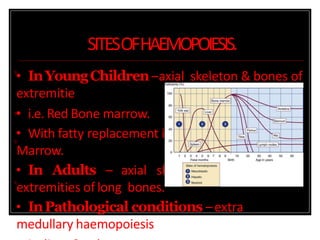
SITESOFHAEMOPOIESIS.

s



• InYoungChildren–axial skeleton & bones of
extremitie
• i.e. Red Bone marrow.
• With fatty replacement it becomes Yellow Bone
Marrow.
• In Adults – axial skeleton & proximal
extremities of long bones.
• InPathological conditions –extra
medullary haemopoiesis
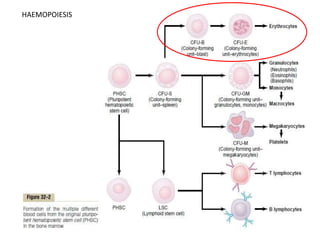
HAEMOPOIESIS
1. STEM CELLS
 These cells have extensive proliferative capacity
and also the:
 Ability to give rise to new stem cells(Self
Renewal)
 Ability to differentiate into any blood cells lines
(Pluripotency)
 Hematopoietic stem cells (HSCs) are bone
marrow cells that are capable of producing all
types of blood cells.
 They differentiate into one or another type of
committed stem cells (progenitor cells).
2. Progenitor cells BFU-E & CFU-E
 BFU-E Give rise each to
thousands of nucleated
erythroid precursor cells.
 Undergo some changes to
become the Colony
Forming Units-Erythrocyte
(CFU-E)
 Regulator: Burst
Promoting Activity (BPA)
 Committed stem cells
lose their capacity for
self- renewal.
 They become
irreversibly
committed.
Burst forming unit BFU(E)
 Unipotent progenitor cell
 Less sensitive to erythropoietin
 Responds to other
stimulus forms
Colony forming unit CFU (e)
 Highly sensitive and dependent on
erythropoietin
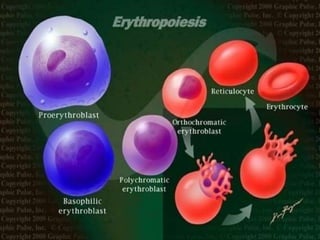
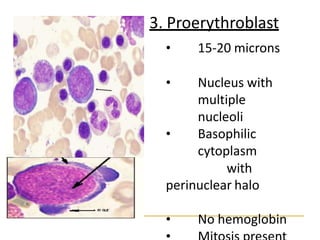
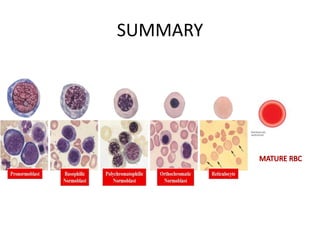
3. Proerythroblast
• 15-20 microns
• Nucleus with
multiple
nucleoli
• Basophilic
cytoplasm
with
perinuclear halo
• No hemoglobin
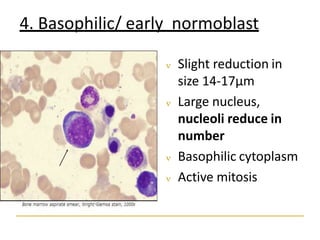
4. Basophilic/ early normoblast
 Slight reduction in
size 14-17µm
 Large nucleus,
nucleoli reduce in
number
 Basophilic cytoplasm
 Active mitosis
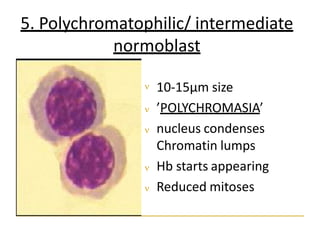
5. Polychromatophilic/ intermediate
normoblast
 10-15µm size
 ’POLYCHROMASIA’
 nucleus condenses
Chromatin lumps
 Hb starts appearing
 Reduced mitoses
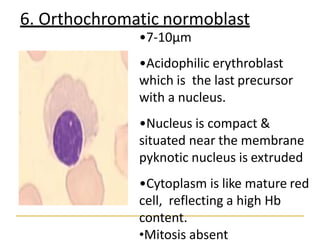
6. Orthochromatic normoblast
•7-10µm
•Acidophilic erythroblast
which is the last precursor
with a nucleus.
•Nucleus is compact &
situated near the membrane
pyknotic nucleus is extruded
•Cytoplasm is like mature red
cell, reflecting a high Hb
content.
•Mitosis absent
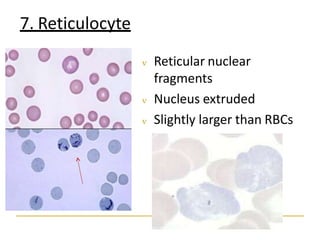
7. Reticulocyte
 Reticular nuclear
fragments
 Nucleus extruded
 Slightly larger than RBCs
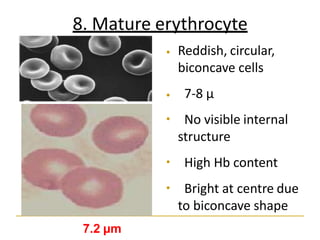
8. Mature erythrocyte
• Reddish, circular,
biconcave cells
•
•
•
• 7-8 µ
No visible internal
structure
High Hb content
Bright at centre due
to biconcave shape
7.2 µm
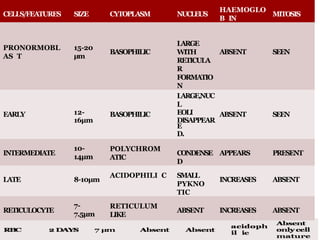
CELLS/FEATURES SIZE CYTOPLASM NUCLEUS
HAEMOGLO
B IN
MITOSIS
PRONORMOBL
AS T
15-20
μm
BASOPHILIC
LARGE
WITH
RETICULA
R
FORMATIO
N
ABSENT SEEN
LARGE,NUC
L
EARLY 12- BASOPHILIC EOLI ABSENT SEEN
16μm DISAPPEAR
E
D.
INTERMEDIATE
10-
14μm
POLYCHROM
ATIC
CONDENSE
D
APPEARS PRESENT
LATE 8-10μm
ACIDOPHILI C SMALL
PYKNO
TIC
INCREASES ABSENT
RETICULOCYTE
7-
7.5μm
RETICULUM
LIKE
ABSENT INCREASES ABSENT
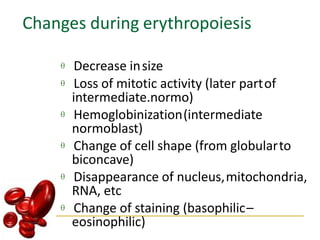
Changes during erythropoiesis
 Decrease insize
 Loss of mitotic activity (later partof
intermediate.normo)
 Hemoglobinization(intermediate
normoblast)
 Change of cell shape (from globularto
biconcave)
 Disappearance of nucleus,mitochondria,
RNA, etc
 Change of staining (basophilic–
eosinophilic)
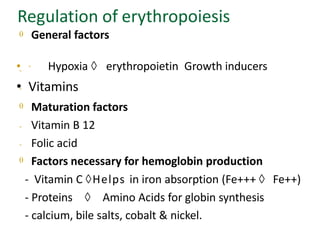
Regulation of erythropoiesis
 General factors
-
-
• - Hypoxia  erythropoietin Growth inducers
• Vitamins
 Maturation factors
- Vitamin B 12
- Folic acid
 Factors necessary for hemoglobin production
- Vitamin C Helps in iron absorption (Fe+++  Fe++)
- Proteins  Amino Acids for globin synthesis
- calcium, bile salts, cobalt & nickel.
ERYTHROPOIETIN
 Glycoprotein MW-34000 (165 AA residues)
Formation
 85% formed in endothelial cells of the
peritubular capillaries of the renal tubules.
 15% formed in liver, hepatic cells & Kupffer
cells.
Breakdown
 In liver. Half life is 5hours
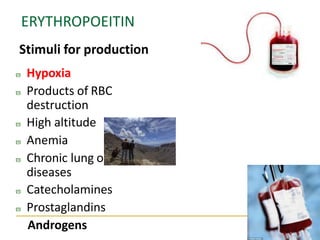
ERYTHROPOEITIN
r heart
Stimuli for production
 Hypoxia
 Products of RBC
destruction
 High altitude
 Anemia
 Chronic lung o
diseases
 Catecholamines
 Prostaglandins
Androgens
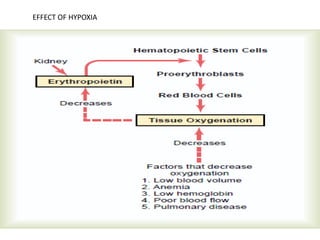
EFFECT OF HYPOXIA
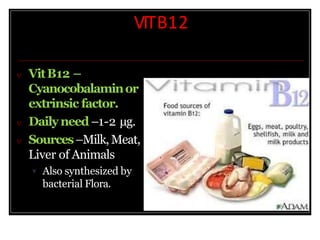
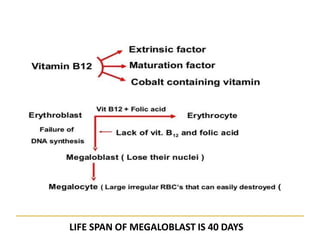
VITB12
 VitB12 –
Cyanocobalaminor
extrinsic factor.
 Dailyneed–1-2 μg.
 Sources–Milk, Meat,
Liver of Animals
 Also synthesized by
bacterial Flora.
LIFE SPAN OF MEGALOBLAST IS 40 DAYS
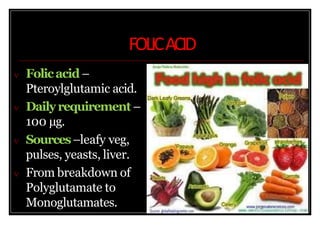
FOLICACID
 Folicacid–
Pteroylglutamic acid.
 Dailyrequirement–
100 μg.
 Sources–leafy veg,
pulses, yeasts, liver.
 From breakdown of
Polyglutamate to
Monoglutamates.
Clinical Aspects
Anemias: ReducedRBCcount /reduced Hb
concentration
Polycythemia: Increased RBCcount
 Polycythemia vera
 Secondary polycythemia- due tohypoxia
SUMMARY
BIBLIOGRAPHY
1. Guyton and Hall Textbook of Medical Physiology E-Book
(Guyton Physiology)
2. Essentials of Medical Physiology by k.sembulingum
3. Google
4. TEXTBOOK OF PHYSIOLOGY BY AK JAIN
5. Ganongs Review Of Medical Physiology 25th Edition
THANK YOU

Erythropoiesis

  • 1.
  • 2.
  • 3.
    CONTENTS 1. Definition 2. Sitesof erythropoiesis 3. Stages of erythropoiesis 4. Factors affecting Erythropoiesis 5. Erythropoietin 6. HYPOXIA 7. FOLIC ACID 8. Vitamin B12 9. CLINICAL ASPECTS 10. SUMMARY
  • 4.
    It is theprocess of development, differentiation and maturation of RBCs from primitive stem cells DEFINITION
  • 5.
    SITESOFHAEMOPOIESIS.  First2 monthsof gestation–yolk sac.  3rdmonthonwards – liver 7 spleen.  20thweek onwards – till birth - bone marrow. Monday, December 7, 2015
  • 6.
    SITESOFHAEMOPOIESIS.  s    • InYoungChildren–axial skeleton& bones of extremitie • i.e. Red Bone marrow. • With fatty replacement it becomes Yellow Bone Marrow. • In Adults – axial skeleton & proximal extremities of long bones. • InPathological conditions –extra medullary haemopoiesis
  • 7.
  • 9.
    1. STEM CELLS These cells have extensive proliferative capacity and also the:  Ability to give rise to new stem cells(Self Renewal)  Ability to differentiate into any blood cells lines (Pluripotency)  Hematopoietic stem cells (HSCs) are bone marrow cells that are capable of producing all types of blood cells.  They differentiate into one or another type of committed stem cells (progenitor cells).
  • 10.
    2. Progenitor cellsBFU-E & CFU-E  BFU-E Give rise each to thousands of nucleated erythroid precursor cells.  Undergo some changes to become the Colony Forming Units-Erythrocyte (CFU-E)  Regulator: Burst Promoting Activity (BPA)  Committed stem cells lose their capacity for self- renewal.  They become irreversibly committed.
  • 11.
    Burst forming unitBFU(E)  Unipotent progenitor cell  Less sensitive to erythropoietin  Responds to other stimulus forms Colony forming unit CFU (e)  Highly sensitive and dependent on erythropoietin
  • 12.
    3. Proerythroblast • 15-20microns • Nucleus with multiple nucleoli • Basophilic cytoplasm with perinuclear halo • No hemoglobin
  • 13.
    4. Basophilic/ earlynormoblast  Slight reduction in size 14-17µm  Large nucleus, nucleoli reduce in number  Basophilic cytoplasm  Active mitosis
  • 14.
    5. Polychromatophilic/ intermediate normoblast 10-15µm size  ’POLYCHROMASIA’  nucleus condenses Chromatin lumps  Hb starts appearing  Reduced mitoses
  • 15.
    6. Orthochromatic normoblast •7-10µm •Acidophilicerythroblast which is the last precursor with a nucleus. •Nucleus is compact & situated near the membrane pyknotic nucleus is extruded •Cytoplasm is like mature red cell, reflecting a high Hb content. •Mitosis absent
  • 16.
    7. Reticulocyte  Reticularnuclear fragments  Nucleus extruded  Slightly larger than RBCs
  • 17.
    8. Mature erythrocyte •Reddish, circular, biconcave cells • • • • 7-8 µ No visible internal structure High Hb content Bright at centre due to biconcave shape 7.2 µm
  • 18.
    CELLS/FEATURES SIZE CYTOPLASMNUCLEUS HAEMOGLO B IN MITOSIS PRONORMOBL AS T 15-20 μm BASOPHILIC LARGE WITH RETICULA R FORMATIO N ABSENT SEEN LARGE,NUC L EARLY 12- BASOPHILIC EOLI ABSENT SEEN 16μm DISAPPEAR E D. INTERMEDIATE 10- 14μm POLYCHROM ATIC CONDENSE D APPEARS PRESENT LATE 8-10μm ACIDOPHILI C SMALL PYKNO TIC INCREASES ABSENT RETICULOCYTE 7- 7.5μm RETICULUM LIKE ABSENT INCREASES ABSENT
  • 19.
    Changes during erythropoiesis Decrease insize  Loss of mitotic activity (later partof intermediate.normo)  Hemoglobinization(intermediate normoblast)  Change of cell shape (from globularto biconcave)  Disappearance of nucleus,mitochondria, RNA, etc  Change of staining (basophilic– eosinophilic)
  • 20.
    Regulation of erythropoiesis General factors - - • - Hypoxia  erythropoietin Growth inducers • Vitamins  Maturation factors - Vitamin B 12 - Folic acid  Factors necessary for hemoglobin production - Vitamin C Helps in iron absorption (Fe+++  Fe++) - Proteins  Amino Acids for globin synthesis - calcium, bile salts, cobalt & nickel.
  • 21.
    ERYTHROPOIETIN  Glycoprotein MW-34000(165 AA residues) Formation  85% formed in endothelial cells of the peritubular capillaries of the renal tubules.  15% formed in liver, hepatic cells & Kupffer cells. Breakdown  In liver. Half life is 5hours
  • 22.
    ERYTHROPOEITIN r heart Stimuli forproduction  Hypoxia  Products of RBC destruction  High altitude  Anemia  Chronic lung o diseases  Catecholamines  Prostaglandins Androgens
  • 23.
  • 24.
    VITB12  VitB12 – Cyanocobalaminor extrinsicfactor.  Dailyneed–1-2 μg.  Sources–Milk, Meat, Liver of Animals  Also synthesized by bacterial Flora.
  • 25.
    LIFE SPAN OFMEGALOBLAST IS 40 DAYS
  • 26.
    FOLICACID  Folicacid– Pteroylglutamic acid. Dailyrequirement– 100 μg.  Sources–leafy veg, pulses, yeasts, liver.  From breakdown of Polyglutamate to Monoglutamates.
  • 27.
    Clinical Aspects Anemias: ReducedRBCcount/reduced Hb concentration Polycythemia: Increased RBCcount  Polycythemia vera  Secondary polycythemia- due tohypoxia
  • 28.
  • 29.
    BIBLIOGRAPHY 1. Guyton andHall Textbook of Medical Physiology E-Book (Guyton Physiology) 2. Essentials of Medical Physiology by k.sembulingum 3. Google 4. TEXTBOOK OF PHYSIOLOGY BY AK JAIN 5. Ganongs Review Of Medical Physiology 25th Edition
  • 30.