D R A K S H A Y A T O M A R
D E P A R T M E N T O F I M M U N O H E M A T O L O G Y A N D
B L O O D T R A N S F U S I O N
A F M C , P U N E
RBC STRUCTURE AND
METABOLISM
INTRODUCTION
 RBCs are complex ,metabolically active cells using
glucose to make ATP and reducing equivalents to ensure
flexibility and O2 delivery
 Life span – 120 days
 Neither use O2 for extraction of energy nor synthesizes
protein
 Proteomics has identified 2200 separate proteins in RBC
that are the product of 5% of all human genes
RBC MEMBRANE
Erythrocyte membrane that is normal in structure and
function is essential for survival of red cell
 Accounts for the cell's antigenic characteristics
 Maintains stability and normal discoid shape of cell
 Preserve cell deformability
 Retain selective permeability
RBC MEMBRANE
 Semipermeable lipid bilayer supported by a meshlike
protein cytoskeleton
 Proteins and phospholipids are organized
asymmeterically.
 Biochemical composition includes 52% proteins,40%
lipids and 8% carbohydrate.
MEMBRANE LIPIDS
 Choline containing, uncharged phospholipids, outer
layer:
–Phosphatidylcholine(PC) (30%)
–Sphingomyelin(SM) (25%)
 Charged phospholipids, inner layer:
–Phosphatidylethanolamine (PE) (28%)
–Phosphatidylserine (PS) (14%)- Apoptotic marker of
RBC
 Asymmetric phospholipids distribution is maintained by:
–Differential rate of diffusion through membrane bilayer
of choline containing phospholipids (PC and SM diffuse
slowly)
–Charged phospholipids interaction with membrane
skeletal protein.
–Active transport of amino phospholipids (PC and PE)
from outer to inner layer.
 This asymmetric phospholipid distribution among
the bilayer is the result of the function of several
energy-dependent and energy-
independent phospholipid transport proteins.
MAINTAINENCE OF ASSYMETRY
MEMBRANE PROTEINS
 Integral proteins
–Embedded in membrane via hydrophobic
interactions with lipids.
 Peripheral proteins
–Located on cytoplasmic surface of lipid bilayer,
constitute membrane skeleton.
–Anchored via integral proteins
–Responsible for membrane elasticity and stability.
INTEGRAL PROTEINS
 Band 3
 Glycophorin
 Aquaporin
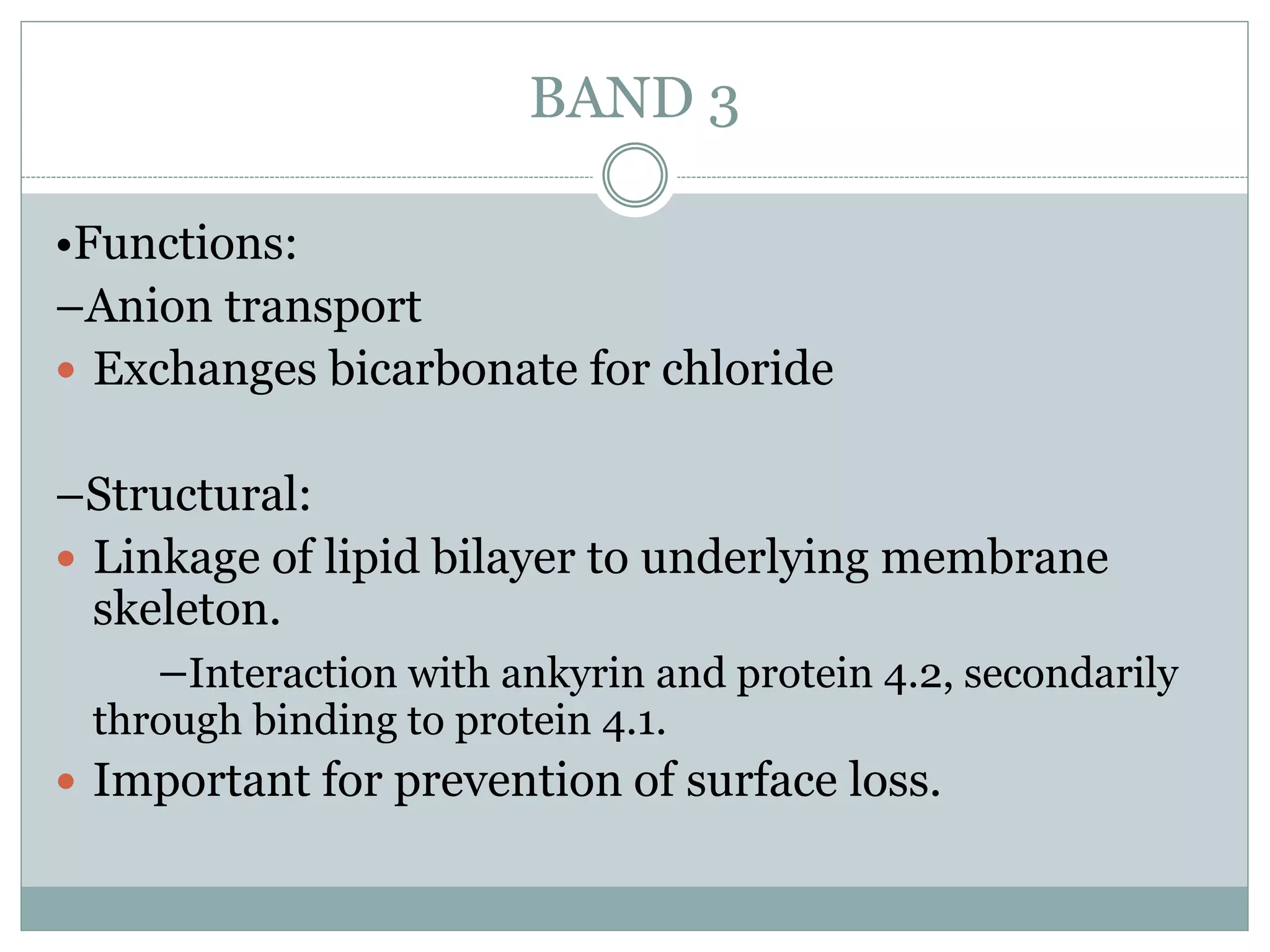
BAND 3
•Functions:
–Anion transport
 Exchanges bicarbonate for chloride
–Structural:
 Linkage of lipid bilayer to underlying membrane
skeleton.
–Interaction with ankyrin and protein 4.2, secondarily
through binding to protein 4.1.
 Important for prevention of surface loss.
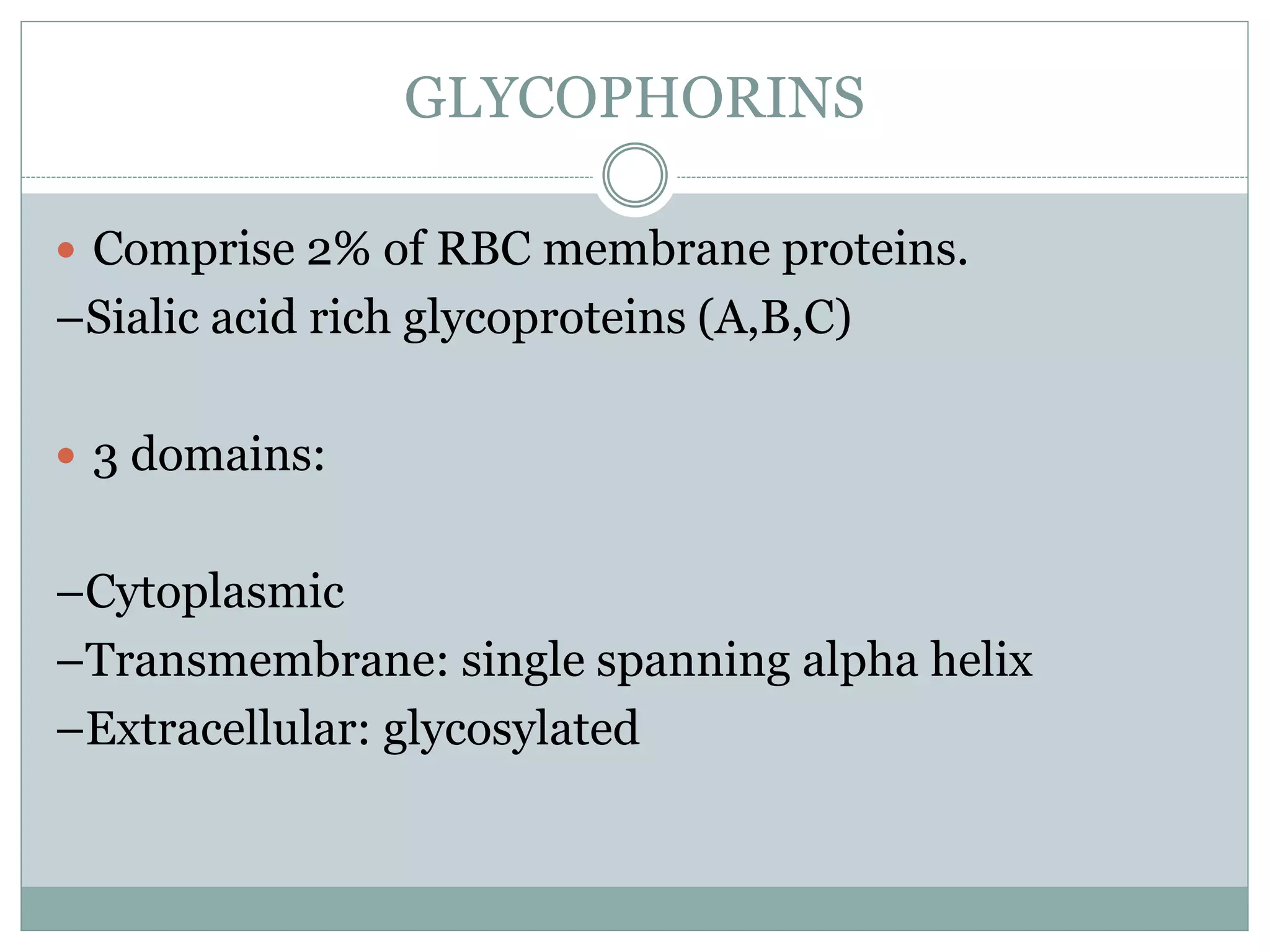
GLYCOPHORINS
 Comprise 2% of RBC membrane proteins.
–Sialic acid rich glycoproteins (A,B,C)
 3 domains:
–Cytoplasmic
–Transmembrane: single spanning alpha helix
–Extracellular: glycosylated
GLYCOPHORINS
 Human RBCs glycophorins are integral membrane
proteins rich in sialic acids that carry blood group
antigenic determinants and serve as ligands for
viruses and parasites
AQUAPORINS
 Aquaporins selectively conduct water molecules in
and out of the cell, while preventing the passage
of ions and other solutes
 Allow RBC to remain in osmotic equilibrium with
extracellular fluid.
Sphingomyelin(SM)
Phosphatidylethanolamine (PE)
PERIPHERAL MEMBRANE PROTEINS
 Spectrin
 Actin
 Protein 4.1
 Pallidin(band 4.2)
 Ankyrin
 Adducin
 Tropomycin
 Tropomodulin
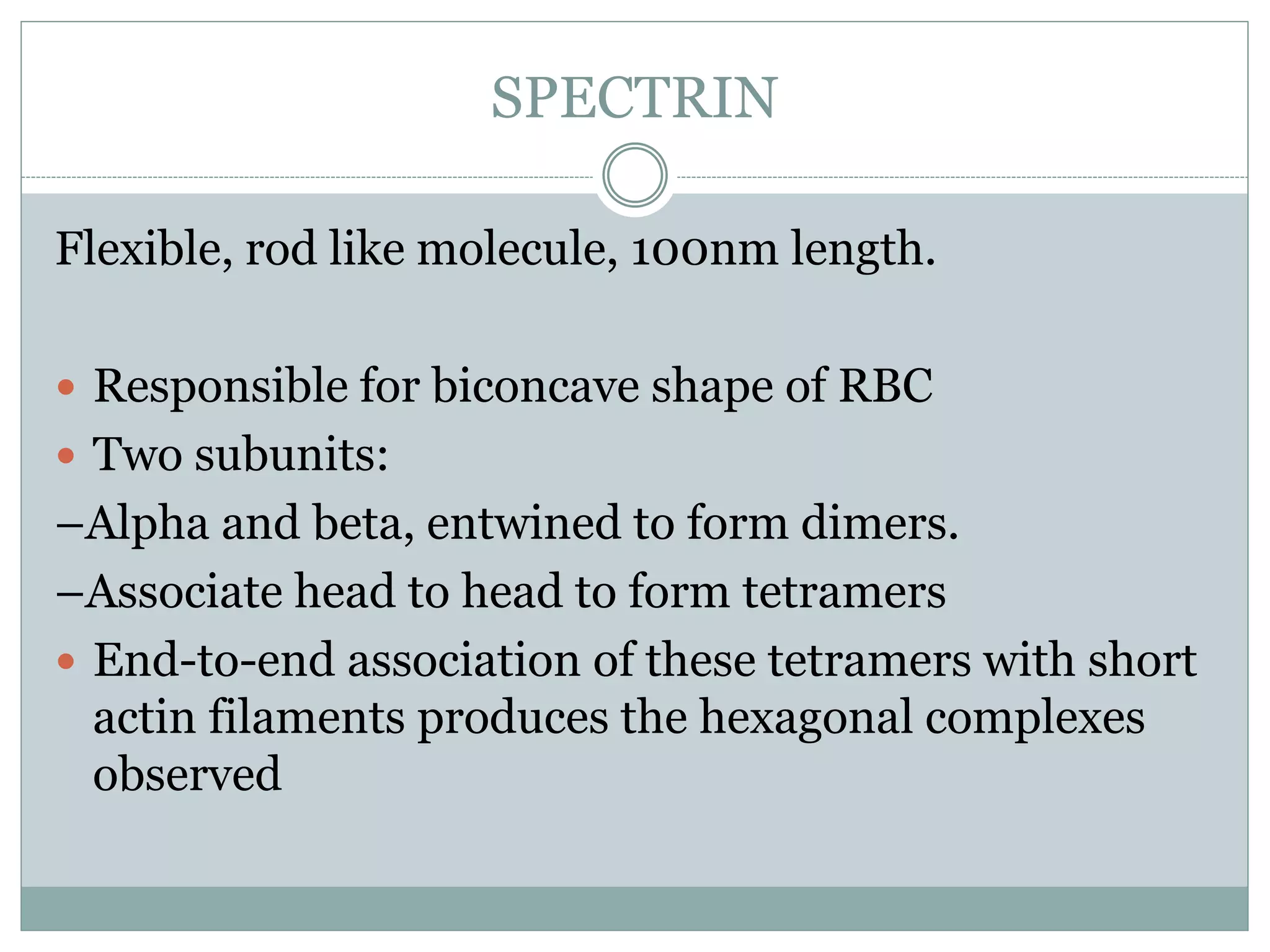
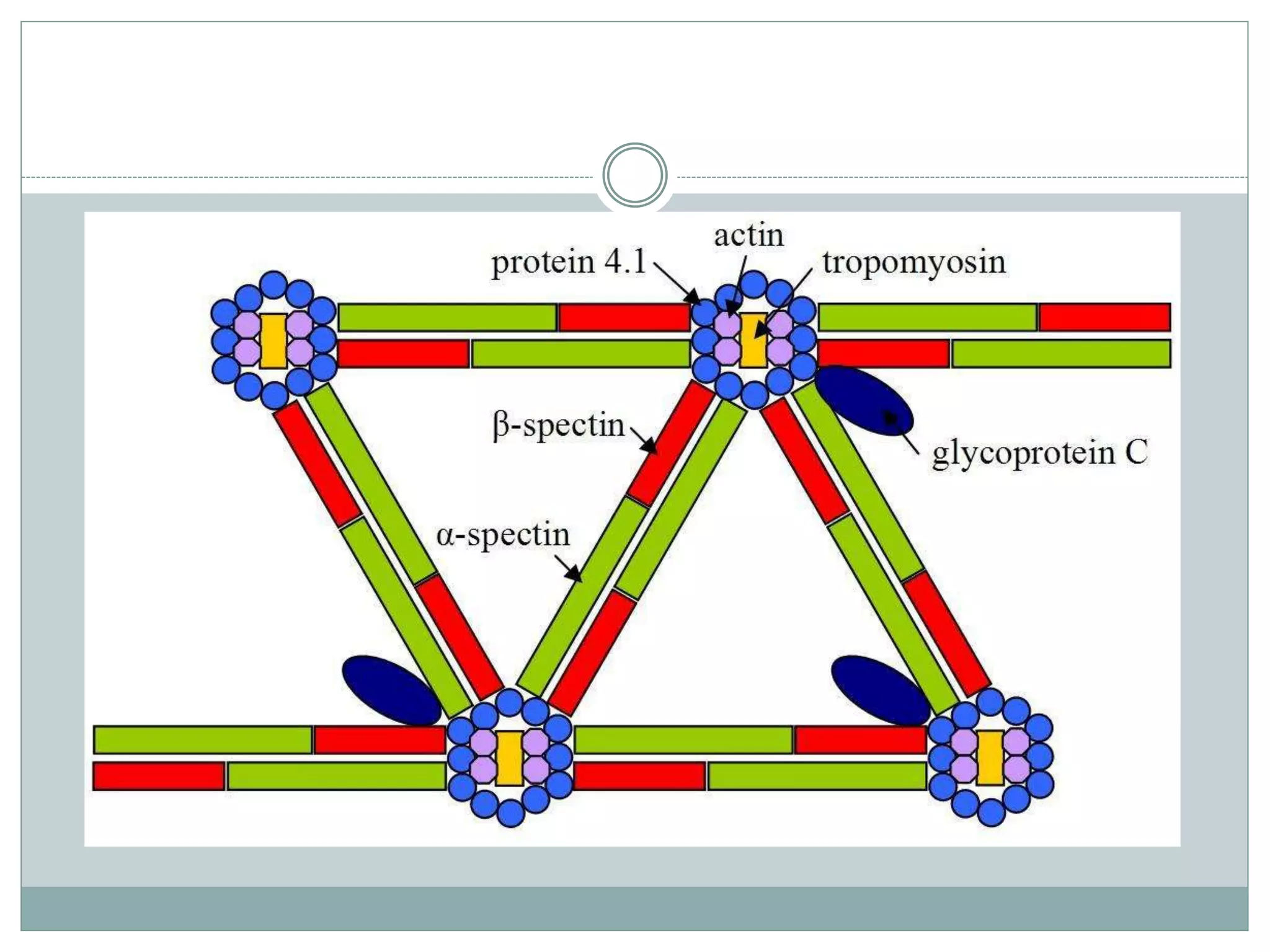
SPECTRIN
Flexible, rod like molecule, 100nm length.
 Responsible for biconcave shape of RBC
 Two subunits:
–Alpha and beta, entwined to form dimers.
–Associate head to head to form tetramers
 End-to-end association of these tetramers with short
actin filaments produces the hexagonal complexes
observed
ACTIN
 Short, uniform filaments 35nm in length
 Length modulated by tropomyosin/tropomodulin
 Spectrintail associated with actin filaments
 Approx 6 spectrin ends interface with one actin
filament, stabilized by protein 4.1
ANKYRIN
 Interacts with band 3 and spectrin to achieve linkage
between bilayer and skeleton.
 Augmented by protein 4.2.
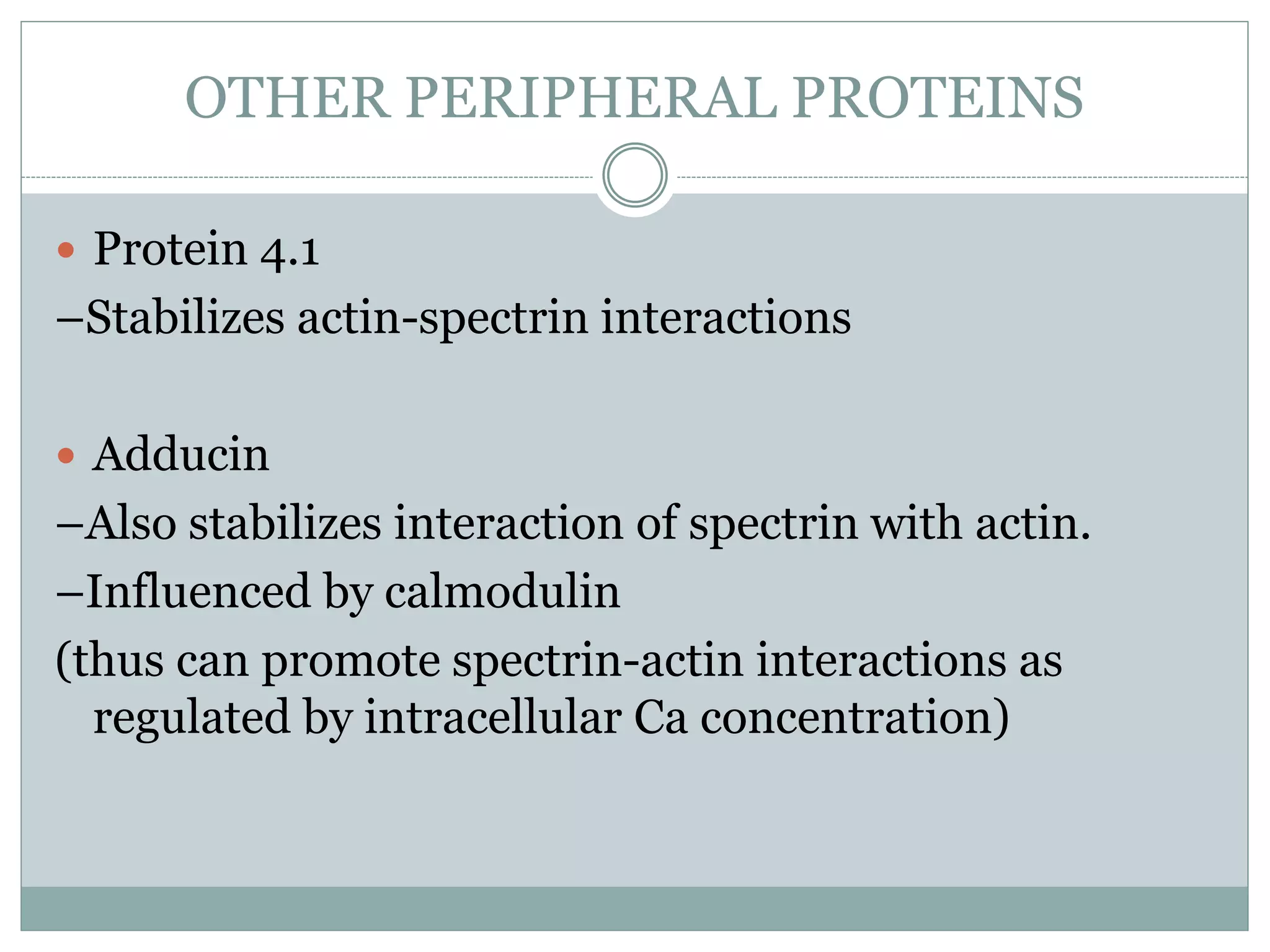
OTHER PERIPHERAL PROTEINS
 Protein 4.1
–Stabilizes actin-spectrin interactions
 Adducin
–Also stabilizes interaction of spectrin with actin.
–Influenced by calmodulin
(thus can promote spectrin-actin interactions as
regulated by intracellular Ca concentration)
CHARACTERISTICS OF RBCs
DEFORMABILITY :
 It is controlled by ATP driven membrane
cytoskeleton.
 Loss of ATP leads to decrease in phosphorylation of
spectrin.
 Increase in deposition of membrane calcium.
 Rigid cells are removed from the circulation.
PERMEABILITY :
 Permeability properties of the RBC membrane and
the active RBC cation transport prevent colloid
hemolysis and control the volume of RBC.
 Freely permeable to water and anions; relatively
impermeable to cations.
 When RBC are ATP depleted Ca and Na are allowed
to accumulate intracellularly and K and water are
lost.
METABOLIC PATHWAYS
 Mainly anaerobic, RBC have to deliver not consume
O2.
 No nucleus/No mitochondria.
 RBC metabolism may be divided into anaerobic
glycolysis and 3 ancillary pathways
 RBCs contain no mitochondria, so there is no
respiratory chain, no citric acid cycle, and no oxidation
of fatty acids or ketone bodies.
 The RBC is highly dependent upon glucose as its
energy source.
 Energy in the form of ATP is obtained ONLY from the
glycolytic breakdown of glucose with the production of
lactate (anaerobic glycolysis).

RBC METABOLISM
 Glucose transport through RBC membrane:
Glucose is transported through RBC membrane
by facilitated diffusion through glucose transporters
(GLUT-1).
GLYCOLYSIS
Importance of glycolysis in red cells:
 Energy production: It is the only
pathway that supplies the red cells
with ATP.
 Reduction of methemoglobin:
Glycolysis provides NADH for
reduction of metHb by NADH-
cytob5 reductase
 In red cells 2,3
bisphosphoglycerate binds to Hb,
decreasing its affinity for O2, and
helps its availability to tissues.
UTILIZATION OF ATP
 Phosphorylation of sugars and proteins
 ATPase driven ion pumps
 Maintenance of membrane asymmetry
 Maintenance of red cell shape and deformability
using ATP dependent cytoskeleton
METH Hb REDUCTASE PATHWAY
 Maintains Iron in reduced state for effective
transport of O2
 Protect SH group of Hb and membrane proteins
from oxidation
LEUBERING RAPOPORT SHUNT
 The hydrogen ion concentration is the most
important physiological modulator
LEUBERING RAPOPORT SHUNT
 Binding of 2,3 DPG to DeoxyHb stabilise the tense
state of Hb and favours release of O2
LEUBERING RAPOPORT SHUNT
 Free 2,3 DPG also binds with Band 3 and causes
partial detachment of membrane from cytoskeleton
allowing lateral movement of membrane structure.
PENTOSE PHOSPHATE PATHWAY
 Production of NADPH – ‘reducing power’
Glutathione is needed in reduced form for:
 Elimination of peroxide
 Protection of proteins SH groups
This shunt also provide ribose 5 phosphate needed for
PRPP ( substrate for adenine nucleotides reqd for
continuing ATP synthesis)
PENTOSE PHOSPHATE PATHWAY
PATHWAYS
HEMOGLOBIN OXYGEN DISSOCIATION
 Dissociation and binding of oxygen by hemoglobin
are not directly proportional to pO2.
Sigmoid-curve.
 It permits a considerable amount of O2 to be
delivered to the tissues with a small drop in O2
tension.
THANK
YOU

Rbc structure and metabolism

  • 1.
    D R AK S H A Y A T O M A R D E P A R T M E N T O F I M M U N O H E M A T O L O G Y A N D B L O O D T R A N S F U S I O N A F M C , P U N E RBC STRUCTURE AND METABOLISM
  • 2.
    INTRODUCTION  RBCs arecomplex ,metabolically active cells using glucose to make ATP and reducing equivalents to ensure flexibility and O2 delivery  Life span – 120 days  Neither use O2 for extraction of energy nor synthesizes protein  Proteomics has identified 2200 separate proteins in RBC that are the product of 5% of all human genes
  • 3.
    RBC MEMBRANE Erythrocyte membranethat is normal in structure and function is essential for survival of red cell  Accounts for the cell's antigenic characteristics  Maintains stability and normal discoid shape of cell  Preserve cell deformability  Retain selective permeability
  • 4.
    RBC MEMBRANE  Semipermeablelipid bilayer supported by a meshlike protein cytoskeleton  Proteins and phospholipids are organized asymmeterically.  Biochemical composition includes 52% proteins,40% lipids and 8% carbohydrate.
  • 5.
    MEMBRANE LIPIDS  Cholinecontaining, uncharged phospholipids, outer layer: –Phosphatidylcholine(PC) (30%) –Sphingomyelin(SM) (25%)  Charged phospholipids, inner layer: –Phosphatidylethanolamine (PE) (28%) –Phosphatidylserine (PS) (14%)- Apoptotic marker of RBC
  • 7.
     Asymmetric phospholipidsdistribution is maintained by: –Differential rate of diffusion through membrane bilayer of choline containing phospholipids (PC and SM diffuse slowly) –Charged phospholipids interaction with membrane skeletal protein. –Active transport of amino phospholipids (PC and PE) from outer to inner layer.
  • 8.
     This asymmetricphospholipid distribution among the bilayer is the result of the function of several energy-dependent and energy- independent phospholipid transport proteins.
  • 9.
  • 10.
    MEMBRANE PROTEINS  Integralproteins –Embedded in membrane via hydrophobic interactions with lipids.  Peripheral proteins –Located on cytoplasmic surface of lipid bilayer, constitute membrane skeleton. –Anchored via integral proteins –Responsible for membrane elasticity and stability.
  • 11.
    INTEGRAL PROTEINS  Band3  Glycophorin  Aquaporin
  • 12.
    BAND 3 •Functions: –Anion transport Exchanges bicarbonate for chloride –Structural:  Linkage of lipid bilayer to underlying membrane skeleton. –Interaction with ankyrin and protein 4.2, secondarily through binding to protein 4.1.  Important for prevention of surface loss.
  • 13.
    GLYCOPHORINS  Comprise 2%of RBC membrane proteins. –Sialic acid rich glycoproteins (A,B,C)  3 domains: –Cytoplasmic –Transmembrane: single spanning alpha helix –Extracellular: glycosylated
  • 15.
    GLYCOPHORINS  Human RBCsglycophorins are integral membrane proteins rich in sialic acids that carry blood group antigenic determinants and serve as ligands for viruses and parasites
  • 16.
    AQUAPORINS  Aquaporins selectivelyconduct water molecules in and out of the cell, while preventing the passage of ions and other solutes  Allow RBC to remain in osmotic equilibrium with extracellular fluid.
  • 17.
  • 19.
    PERIPHERAL MEMBRANE PROTEINS Spectrin  Actin  Protein 4.1  Pallidin(band 4.2)  Ankyrin  Adducin  Tropomycin  Tropomodulin
  • 20.
    SPECTRIN Flexible, rod likemolecule, 100nm length.  Responsible for biconcave shape of RBC  Two subunits: –Alpha and beta, entwined to form dimers. –Associate head to head to form tetramers  End-to-end association of these tetramers with short actin filaments produces the hexagonal complexes observed
  • 22.
    ACTIN  Short, uniformfilaments 35nm in length  Length modulated by tropomyosin/tropomodulin  Spectrintail associated with actin filaments  Approx 6 spectrin ends interface with one actin filament, stabilized by protein 4.1
  • 23.
    ANKYRIN  Interacts withband 3 and spectrin to achieve linkage between bilayer and skeleton.  Augmented by protein 4.2.
  • 24.
    OTHER PERIPHERAL PROTEINS Protein 4.1 –Stabilizes actin-spectrin interactions  Adducin –Also stabilizes interaction of spectrin with actin. –Influenced by calmodulin (thus can promote spectrin-actin interactions as regulated by intracellular Ca concentration)
  • 25.
    CHARACTERISTICS OF RBCs DEFORMABILITY:  It is controlled by ATP driven membrane cytoskeleton.  Loss of ATP leads to decrease in phosphorylation of spectrin.  Increase in deposition of membrane calcium.  Rigid cells are removed from the circulation.
  • 27.
    PERMEABILITY :  Permeabilityproperties of the RBC membrane and the active RBC cation transport prevent colloid hemolysis and control the volume of RBC.  Freely permeable to water and anions; relatively impermeable to cations.  When RBC are ATP depleted Ca and Na are allowed to accumulate intracellularly and K and water are lost.
  • 28.
    METABOLIC PATHWAYS  Mainlyanaerobic, RBC have to deliver not consume O2.  No nucleus/No mitochondria.  RBC metabolism may be divided into anaerobic glycolysis and 3 ancillary pathways
  • 29.
     RBCs containno mitochondria, so there is no respiratory chain, no citric acid cycle, and no oxidation of fatty acids or ketone bodies.  The RBC is highly dependent upon glucose as its energy source.  Energy in the form of ATP is obtained ONLY from the glycolytic breakdown of glucose with the production of lactate (anaerobic glycolysis). 
  • 30.
    RBC METABOLISM  Glucosetransport through RBC membrane: Glucose is transported through RBC membrane by facilitated diffusion through glucose transporters (GLUT-1).
  • 31.
    GLYCOLYSIS Importance of glycolysisin red cells:  Energy production: It is the only pathway that supplies the red cells with ATP.  Reduction of methemoglobin: Glycolysis provides NADH for reduction of metHb by NADH- cytob5 reductase  In red cells 2,3 bisphosphoglycerate binds to Hb, decreasing its affinity for O2, and helps its availability to tissues.
  • 32.
    UTILIZATION OF ATP Phosphorylation of sugars and proteins  ATPase driven ion pumps  Maintenance of membrane asymmetry  Maintenance of red cell shape and deformability using ATP dependent cytoskeleton
  • 33.
    METH Hb REDUCTASEPATHWAY  Maintains Iron in reduced state for effective transport of O2  Protect SH group of Hb and membrane proteins from oxidation
  • 34.
    LEUBERING RAPOPORT SHUNT The hydrogen ion concentration is the most important physiological modulator
  • 35.
    LEUBERING RAPOPORT SHUNT Binding of 2,3 DPG to DeoxyHb stabilise the tense state of Hb and favours release of O2
  • 36.
    LEUBERING RAPOPORT SHUNT Free 2,3 DPG also binds with Band 3 and causes partial detachment of membrane from cytoskeleton allowing lateral movement of membrane structure.
  • 37.
    PENTOSE PHOSPHATE PATHWAY Production of NADPH – ‘reducing power’ Glutathione is needed in reduced form for:  Elimination of peroxide  Protection of proteins SH groups This shunt also provide ribose 5 phosphate needed for PRPP ( substrate for adenine nucleotides reqd for continuing ATP synthesis)
  • 38.
  • 39.
  • 40.
    HEMOGLOBIN OXYGEN DISSOCIATION Dissociation and binding of oxygen by hemoglobin are not directly proportional to pO2. Sigmoid-curve.  It permits a considerable amount of O2 to be delivered to the tissues with a small drop in O2 tension.
  • 42.