CHAPTER 12: BLOOD
Blood & Blood Cells - Red Blood Cells (RBC) - White Blood Cells (WBC) - Platelets - Plasma Volume & Composition of Blood - 5 liters - 45% cells - 55% plasma } the percentages is called the hematocrit (HCT)
Red Blood Cells Characteristics    erythrocytes - contains hemoglobin - 1 Hb contains 4 iron atoms to carry O 2 - 200 - 300 million Hb per RBC - lack a nucleus
RBC Counts men = 4.6 - 6.2 million cells/mm 3 women = 4.2 - 5.4 million cells/mm 3 * the more RBC’s - the more O 2  carried RBC Production  – hematopoeisis - a typical RBC lasts about 120 days so  new RBC’s made all the time
- when O 2  levels decrease, the hormone erythropoeiten (EPO) is released from the kidney - EPO goes to the red bone marrow - increases in RBC production - more RBC’s = increased O 2  levels - O 2  levels increase, EPO secretions decreases the rate of blood cell productions
Destruction of RBC’s - become fragile as they get older - destroyed by macrophages in liver and spleen
hemoglobin     iron (Fe) & biliverden amino acids  biliruben  excreted in bile or urine RBC Destruction
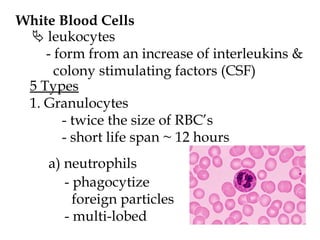
White Blood Cells    leukocytes - form from an increase of interleukins & colony stimulating factors (CSF) 5 Types 1. Granulocytes - twice the size of RBC’s - short life span ~ 12 hours a) neutrophils - phagocytize  foreign particles - multi-lobed
b) eosinophils - help control against inflammation and allergic reactions - kill certain parasites
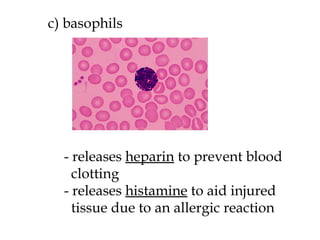
c) basophils - releases  heparin  to prevent blood clotting - releases  histamine  to aid injured  tissue due to an allergic reaction
2. Agranulocytes a) monocytes - phagocytize foreign substances
b) lymphocytes - produce  antibodies  that act against foreign substances
WBC Counts 5,000 - 10,000 cells/mm 3 Leukocytosis - 10,000 + cells/mm 3 - more WBC found due to disease Leukopenia - less than 5,000 cells/mm 3
Platelets    thrombocytes - produced from a  megakaryocyte  that  breaks up into fragments (platelets) - helps in blood clotting - affected by the hormone  thrombopoieten
 
Blood Plasma - yellowish color - 92% water Functions - transporting nutrients, gases, & vitamins - regulates fluid & electrolyte balance - maintains pH
1.  Plasma Proteins a) Albumins - maintains osmotic pressure of  the blood - helps to regulate water movement, in doing so, controls blood volume  which in turn controls blood pressure Plasma Contents
b) Globulins - transports lipids & fat-soluble   vitamins - make up the antibodies of immune   system c) Fibrinogen - blood clotting 2. Nutrients and Gases - amino acids - CO 2 - glucose - N 2 - fatty acids - O 2
3. Nonprotein nitrogenous substances - urea - uric acid 4. Plasma Electrolytes - Na + - Cl - - K + - HCO 3 - - Mg + - PO 4 - * These help maintain osmotic pressure and pH
 
Hemostasis    the stoppage of bleeding 3 Things May Occur 1. Blood Vessel Spasm – Vasospasm - walls of blood vessel contracts - decreases blood flow 2. Platelet Plug Formation - platelets stick to collagen fibers in blood vessels - forms a plug over the blood vessel
Copyright © The McGraw-Hill Companies, Inc. Permission required for reproduction or display. Endothelial lining Collagen fiber Erythrocyte Break in vessel wall 1 Platelet
Copyright © The McGraw-Hill Companies, Inc. Permission required for reproduction or display. Endothelial lining Collagen fiber Erythrocyte Break in vessel wall 1 Blood escaping through break 2 Platelet
Copyright © The McGraw-Hill Companies, Inc. Permission required for reproduction or display. Endothelial lining Collagen fiber Erythrocyte Break in vessel wall 1 Blood escaping through break 2 Platelets adhere to each other, to end of broken vessel, and to exposed collagen 3 Platelet
Copyright © The McGraw-Hill Companies, Inc. Permission required for reproduction or display. Endothelial lining Collagen fiber Erythrocyte Break in vessel wall 1 Blood escaping through break 2 Platelets adhere to each other, to end of broken vessel, and to exposed collagen 3 Platelet plug helps control blood loss 4 Platelet
3. Blood Coagulation - most effective - forms a blood clot - depends on many clotting factors
 
Thrombus  - an abnormally formed blood   clot Embolus  - when a thrombus dislodges and   begins to move - can get stuck, cause a blockage   which leads to death
Blood Groups and Transfusions - RBC’s membrane contains  agglutinogens    antigens - plasma contains  aglutinins    antibodies - these two types of proteins gives a person their blood type
ABO Blood Groups - based on the presence or absence of    antigen A & B Blood Type Antigen Antibody A A anti-B B B anti-A AB A & B None O None anti-A & anti-B
- type AB is the universal recipient - type O is the universal donor - it is important to get the proper blood  otherwise  agglutination  or clumping of the blood will occur
Rh Blood Groups    named after the rhesus monkey - (Rh+) means antigen D is present - (Rh–) means antigen D is absent - this condition needs to be checked when a female is pregnant
- if mother is Rh (-), & father is Rh (+), then baby will be Rh (+) - mother will make antibodies for the  Rh or D antigen.  This is OK for the first child but for the second, the mothers  antibodies (anti-D) will combine with  the child’s D antigens and blood will clump
- condition is called  erythroblastosis fetalis - easily prevented with a shot of RhoGAM

Physiology ch 12 lecture notes

  • 1.
  • 2.
    Blood & BloodCells - Red Blood Cells (RBC) - White Blood Cells (WBC) - Platelets - Plasma Volume & Composition of Blood - 5 liters - 45% cells - 55% plasma } the percentages is called the hematocrit (HCT)
  • 3.
    Red Blood CellsCharacteristics  erythrocytes - contains hemoglobin - 1 Hb contains 4 iron atoms to carry O 2 - 200 - 300 million Hb per RBC - lack a nucleus
  • 4.
    RBC Counts men= 4.6 - 6.2 million cells/mm 3 women = 4.2 - 5.4 million cells/mm 3 * the more RBC’s - the more O 2 carried RBC Production – hematopoeisis - a typical RBC lasts about 120 days so new RBC’s made all the time
  • 5.
    - when O2 levels decrease, the hormone erythropoeiten (EPO) is released from the kidney - EPO goes to the red bone marrow - increases in RBC production - more RBC’s = increased O 2 levels - O 2 levels increase, EPO secretions decreases the rate of blood cell productions
  • 6.
    Destruction of RBC’s- become fragile as they get older - destroyed by macrophages in liver and spleen
  • 7.
    hemoglobin   iron (Fe) & biliverden amino acids  biliruben  excreted in bile or urine RBC Destruction
  • 8.
    White Blood Cells leukocytes - form from an increase of interleukins & colony stimulating factors (CSF) 5 Types 1. Granulocytes - twice the size of RBC’s - short life span ~ 12 hours a) neutrophils - phagocytize foreign particles - multi-lobed
  • 9.
    b) eosinophils -help control against inflammation and allergic reactions - kill certain parasites
  • 10.
    c) basophils -releases heparin to prevent blood clotting - releases histamine to aid injured tissue due to an allergic reaction
  • 11.
    2. Agranulocytes a)monocytes - phagocytize foreign substances
  • 12.
    b) lymphocytes -produce antibodies that act against foreign substances
  • 13.
    WBC Counts 5,000- 10,000 cells/mm 3 Leukocytosis - 10,000 + cells/mm 3 - more WBC found due to disease Leukopenia - less than 5,000 cells/mm 3
  • 14.
    Platelets  thrombocytes - produced from a megakaryocyte that breaks up into fragments (platelets) - helps in blood clotting - affected by the hormone thrombopoieten
  • 15.
  • 16.
    Blood Plasma -yellowish color - 92% water Functions - transporting nutrients, gases, & vitamins - regulates fluid & electrolyte balance - maintains pH
  • 17.
    1. PlasmaProteins a) Albumins - maintains osmotic pressure of the blood - helps to regulate water movement, in doing so, controls blood volume which in turn controls blood pressure Plasma Contents
  • 18.
    b) Globulins -transports lipids & fat-soluble vitamins - make up the antibodies of immune system c) Fibrinogen - blood clotting 2. Nutrients and Gases - amino acids - CO 2 - glucose - N 2 - fatty acids - O 2
  • 19.
    3. Nonprotein nitrogenoussubstances - urea - uric acid 4. Plasma Electrolytes - Na + - Cl - - K + - HCO 3 - - Mg + - PO 4 - * These help maintain osmotic pressure and pH
  • 20.
  • 21.
    Hemostasis  the stoppage of bleeding 3 Things May Occur 1. Blood Vessel Spasm – Vasospasm - walls of blood vessel contracts - decreases blood flow 2. Platelet Plug Formation - platelets stick to collagen fibers in blood vessels - forms a plug over the blood vessel
  • 22.
    Copyright © TheMcGraw-Hill Companies, Inc. Permission required for reproduction or display. Endothelial lining Collagen fiber Erythrocyte Break in vessel wall 1 Platelet
  • 23.
    Copyright © TheMcGraw-Hill Companies, Inc. Permission required for reproduction or display. Endothelial lining Collagen fiber Erythrocyte Break in vessel wall 1 Blood escaping through break 2 Platelet
  • 24.
    Copyright © TheMcGraw-Hill Companies, Inc. Permission required for reproduction or display. Endothelial lining Collagen fiber Erythrocyte Break in vessel wall 1 Blood escaping through break 2 Platelets adhere to each other, to end of broken vessel, and to exposed collagen 3 Platelet
  • 25.
    Copyright © TheMcGraw-Hill Companies, Inc. Permission required for reproduction or display. Endothelial lining Collagen fiber Erythrocyte Break in vessel wall 1 Blood escaping through break 2 Platelets adhere to each other, to end of broken vessel, and to exposed collagen 3 Platelet plug helps control blood loss 4 Platelet
  • 26.
    3. Blood Coagulation- most effective - forms a blood clot - depends on many clotting factors
  • 27.
  • 28.
    Thrombus -an abnormally formed blood clot Embolus - when a thrombus dislodges and begins to move - can get stuck, cause a blockage which leads to death
  • 29.
    Blood Groups andTransfusions - RBC’s membrane contains agglutinogens  antigens - plasma contains aglutinins  antibodies - these two types of proteins gives a person their blood type
  • 30.
    ABO Blood Groups- based on the presence or absence of antigen A & B Blood Type Antigen Antibody A A anti-B B B anti-A AB A & B None O None anti-A & anti-B
  • 31.
    - type ABis the universal recipient - type O is the universal donor - it is important to get the proper blood otherwise agglutination or clumping of the blood will occur
  • 32.
    Rh Blood Groups named after the rhesus monkey - (Rh+) means antigen D is present - (Rh–) means antigen D is absent - this condition needs to be checked when a female is pregnant
  • 33.
    - if motheris Rh (-), & father is Rh (+), then baby will be Rh (+) - mother will make antibodies for the Rh or D antigen. This is OK for the first child but for the second, the mothers antibodies (anti-D) will combine with the child’s D antigens and blood will clump
  • 34.
    - condition iscalled erythroblastosis fetalis - easily prevented with a shot of RhoGAM