WELCOME
SREE NARAYANA TRAINING 
COLLEGE 
SREEKANDESWARAM, 
POOCHAKKAL 
B.Ed 2013-2014 
KERALA UNIVERSITY
SUBMITTED BY, 
ANUSREE.C 
NATURAL SCIENCE 
REG.NO:(181)13383002
SUBMITTED TO, 
Smt.SOYA.P 
LECTURER Dept.of Natural Science 
SNTC, Poochakkal
POWER POINT PRESENTATION ON 
BLOOD CELLS
INTRODUCTION 
The average human adult has more than 5 liters of 
blood in his/her body.Blood carries O2 and nutrients 
to living cells and takes away their waste 
products.Through the circulatory system , blood 
adapts to the body’s need. 
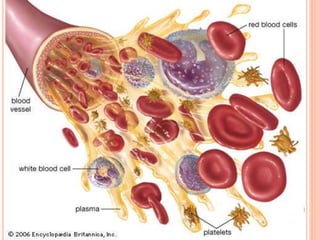
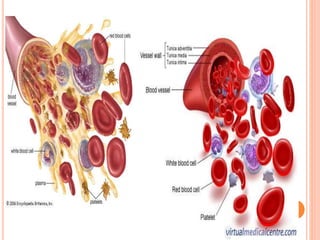
Blood contains liquid plasma and blood cells.Blood 
cells are formed in the bone marrow.All blood cells 
arise from the same bone marrow stem cells. 
The immortal,undifferentiated,pluripotent stem 
cellsgive rise to 
Erythrocytes(RBCs),Leukocytes(WBCs), and 
Platelets.
ERYTHROCYTES(RBC) 
 Also known as red blood cells. 
 The most numerous type in the blood. 
 Function to transport of O2 in the blood. 
 The shape of RBC is ideal for this function 
 Seen from the top ,RBC appear to be circular,but a side 
view shows that they are actually biconcaved discs.
 This shape increase surface area –to-volume ratio 
of the cell,thus increasing the efficiency of diffusion 
of O2 & CO2 in and out of the cell. 
 RBCs also have a flexible plasma membrane 
 RBCs contain tremendous amount of 
haemoglobin,the protein that binds O2. 
 They have a limited limited life span of about 120 
days. 
 RBCs are produced through a process under 
erythropoesis.
RBC
LEUCOCYTES(WBC) 
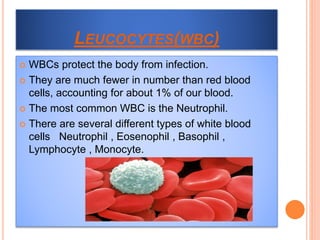
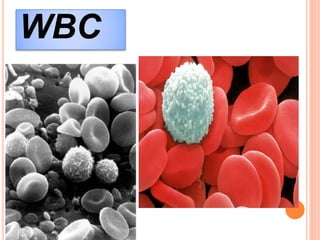
 WBCs protect the body from infection. 
 They are much fewer in number than red blood 
cells, accounting for about 1% of our blood. 
 The most common WBC is the Neutrophil. 
 There are several different types of white blood 
cells Neutrophil , Eosenophil , Basophil , 
Lymphocyte , Monocyte.
WBC
PLATELETS 
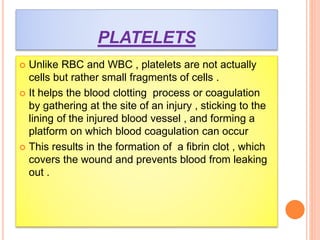
 Unlike RBC and WBC , platelets are not actually 
cells but rather small fragments of cells . 
 It helps the blood clotting process or coagulation 
by gathering at the site of an injury , sticking to the 
lining of the injured blood vessel , and forming a 
platform on which blood coagulation can occur 
 This results in the formation of a fibrin clot , which 
covers the wound and prevents blood from leaking 
out .
THANK YOU

blood cells Powerpoint presentation

  • 1.
  • 2.
    SREE NARAYANA TRAINING COLLEGE SREEKANDESWARAM, POOCHAKKAL B.Ed 2013-2014 KERALA UNIVERSITY
  • 3.
    SUBMITTED BY, ANUSREE.C NATURAL SCIENCE REG.NO:(181)13383002
  • 4.
    SUBMITTED TO, Smt.SOYA.P LECTURER Dept.of Natural Science SNTC, Poochakkal
  • 5.
  • 7.
    INTRODUCTION The averagehuman adult has more than 5 liters of blood in his/her body.Blood carries O2 and nutrients to living cells and takes away their waste products.Through the circulatory system , blood adapts to the body’s need. Blood contains liquid plasma and blood cells.Blood cells are formed in the bone marrow.All blood cells arise from the same bone marrow stem cells. The immortal,undifferentiated,pluripotent stem cellsgive rise to Erythrocytes(RBCs),Leukocytes(WBCs), and Platelets.
  • 8.
    ERYTHROCYTES(RBC)  Alsoknown as red blood cells.  The most numerous type in the blood.  Function to transport of O2 in the blood.  The shape of RBC is ideal for this function  Seen from the top ,RBC appear to be circular,but a side view shows that they are actually biconcaved discs.
  • 9.
     This shapeincrease surface area –to-volume ratio of the cell,thus increasing the efficiency of diffusion of O2 & CO2 in and out of the cell.  RBCs also have a flexible plasma membrane  RBCs contain tremendous amount of haemoglobin,the protein that binds O2.  They have a limited limited life span of about 120 days.  RBCs are produced through a process under erythropoesis.
  • 10.
  • 11.
    LEUCOCYTES(WBC)  WBCsprotect the body from infection.  They are much fewer in number than red blood cells, accounting for about 1% of our blood.  The most common WBC is the Neutrophil.  There are several different types of white blood cells Neutrophil , Eosenophil , Basophil , Lymphocyte , Monocyte.
  • 12.
  • 14.
    PLATELETS  UnlikeRBC and WBC , platelets are not actually cells but rather small fragments of cells .  It helps the blood clotting process or coagulation by gathering at the site of an injury , sticking to the lining of the injured blood vessel , and forming a platform on which blood coagulation can occur  This results in the formation of a fibrin clot , which covers the wound and prevents blood from leaking out .
  • 16.