Red blood cells (RBCs) are the
non-nucleated formed elements in the blood.
Red blood cells are also known as erythrocytes
(erythros = red). Red color of the red blood cell
is due to the presence of the coloring pigment
called hemoglobin. RBCs play a vital role in
transport of respiratory gases.
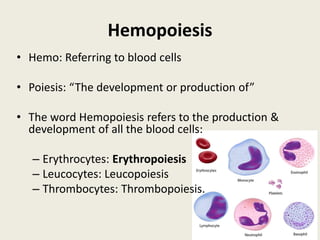
Hemopoiesis
• Hemo: Referring to blood cells
• Poiesis: “The development or production of”
• The word Hemopoiesis refers to the production &
development of all the blood cells:
– Erythrocytes: Erythropoiesis
– Leucocytes: Leucopoiesis
– Thrombocytes: Thrombopoiesis.
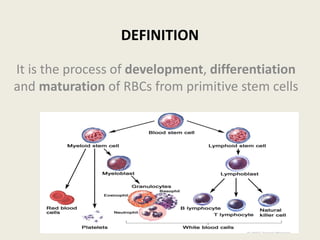
It is the process of development, differentiation
and maturation of RBCs from primitive stem cells
DEFINITION
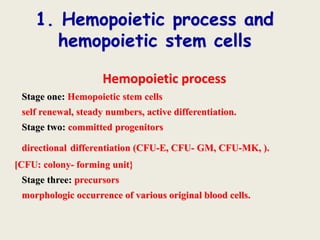
1. Hemopoietic process and
hemopoietic stem cells
Hemopoietic process
Stage one: Hemopoietic stem cells
self renewal, steady numbers, active differentiation.
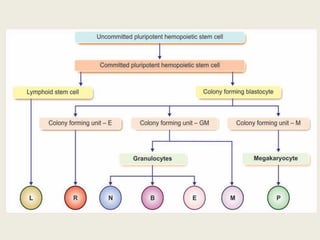
Stage two: committed progenitors
directional differentiation (CFU-E, CFU- GM, CFU-MK, ).
[CFU: colony- forming unit}
Stage three: precursors
morphologic occurrence of various original blood cells.
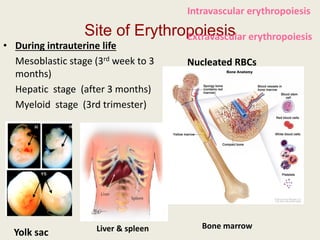
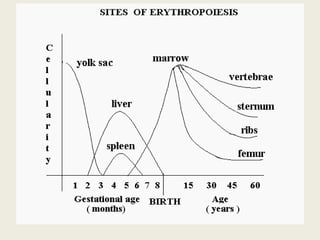
Site of Erythropoiesis
• During intrauterine life
Mesoblastic stage (3rd week to 3
months)
Hepatic stage (after 3 months)
Myeloid stage (3rd trimester)
Intravascular erythropoiesis
Extravascular erythropoiesis
Nucleated RBCs
Yolk sac Liver & spleen Bone marrow
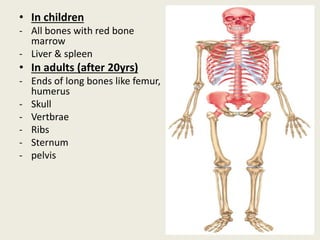
• In children
- All bones with red bone
marrow
- Liver & spleen
• In adults (after 20yrs)
- Ends of long bones like femur,
humerus
- Skull
- Vertbrae
- Ribs
- Sternum
- pelvis
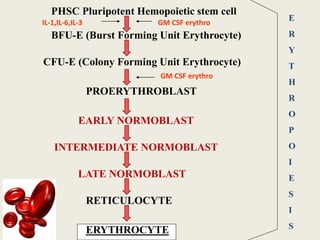
PHSC Pluripotent Hemopoietic stem cell
BFU-E (Burst Forming Unit Erythrocyte)
CFU-E (Colony Forming Unit Erythrocyte)
PROERYTHROBLAST
EARLY NORMOBLAST
INTERMEDIATE NORMOBLAST
LATE NORMOBLAST
RETICULOCYTE
ERYTHROCYTE
ERYTHROCYTE
E
R
Y
T
H
R
O
P
O
I
E
S
I
S
GM CSF erythro
IL-1,IL-6,IL-3
GM CSF erythro
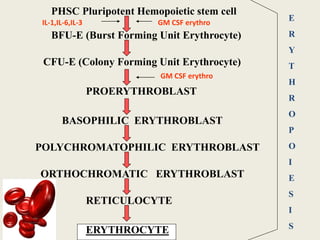
PHSC Pluripotent Hemopoietic stem cell
BFU-E (Burst Forming Unit Erythrocyte)
CFU-E (Colony Forming Unit Erythrocyte)
PROERYTHROBLAST
BASOPHILIC ERYTHROBLAST
POLYCHROMATOPHILIC ERYTHROBLAST
ORTHOCHROMATIC ERYTHROBLAST
RETICULOCYTE
ERYTHROCYTE
ERYTHROCYTE
E
R
Y
T
H
R
O
P
O
I
E
S
I
S
GM CSF erythro
IL-1,IL-6,IL-3
GM CSF erythro
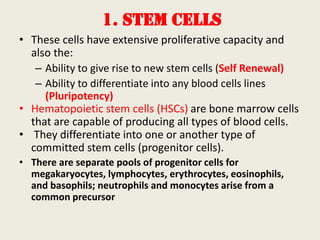
1. STEM CELLS
• These cells have extensive proliferative capacity and
also the:
– Ability to give rise to new stem cells (Self Renewal)
– Ability to differentiate into any blood cells lines
(Pluripotency)
• Hematopoietic stem cells (HSCs) are bone marrow cells
that are capable of producing all types of blood cells.
• They differentiate into one or another type of
committed stem cells (progenitor cells).
• There are separate pools of progenitor cells for
megakaryocytes, lymphocytes, erythrocytes, eosinophils,
and basophils; neutrophils and monocytes arise from a
common precursor
PROGENITOR CELLS
• Committed stem cells lose their capacity for
self-renewal.
• They become irreversibly committed.
• These cells are termed as “Progenitor cells”
• They are regulated by certain hormones or
substances so that they can:
– Proliferate
– Undergo Maturation.
ERYTHROID PROGENITOR CELLS
• BFU-E: Burst Forming Unit – Erythrocyte:
– Give rise each to thousands of nucleated
erythroid precursor cells, in vitro.
– Undergo some changes to become the Colony
Forming Units-Erythrocyte (CFU-E)
– Regulator: Burst Promoting Activity (BPA)
Burst forming unit BFU(E)
• Unipotent progenitor cell
• Less sensitive to erythropoietin
• Responds to other stimulus
forms
Colony forming unit CFU (e)
• Highly sensitive and dependent on
erythropoietin
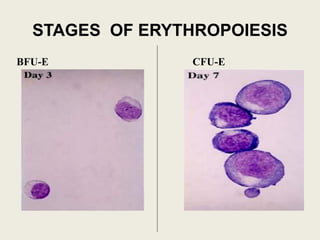
BFU-E CFU-E
STAGES OF ERYTHROPOIESIS
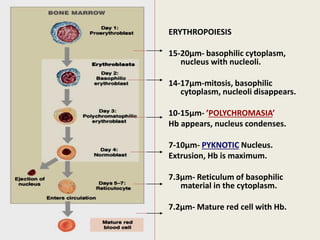
ERYTHROPOIESIS
15-20µm- basophilic cytoplasm,
nucleus with nucleoli.
14-17µm-mitosis, basophilic
cytoplasm, nucleoli disappears.
10-15µm- ’POLYCHROMASIA’
Hb appears, nucleus condenses.
7-10µm- PYKNOTIC Nucleus.
Extrusion, Hb is maximum.
7.3µm- Reticulum of basophilic
material in the cytoplasm.
7.2µm- Mature red cell with Hb.
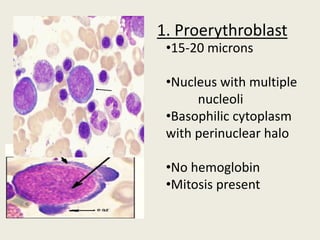
1. Proerythroblast
•15-20 microns
•Nucleus with multiple
nucleoli
•Basophilic cytoplasm
with perinuclear halo
•No hemoglobin
•Mitosis present
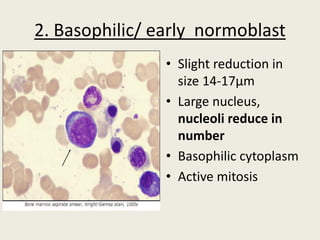
2. Basophilic/ early normoblast
• Slight reduction in
size 14-17µm
• Large nucleus,
nucleoli reduce in
number
• Basophilic cytoplasm
• Active mitosis
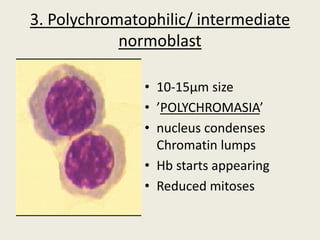
3. Polychromatophilic/ intermediate
normoblast
• 10-15µm size
• ’POLYCHROMASIA’
• nucleus condenses
Chromatin lumps
• Hb starts appearing
• Reduced mitoses
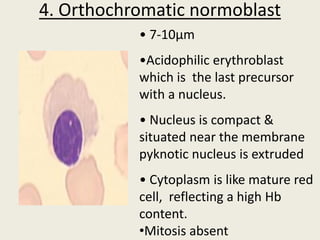
4. Orthochromatic normoblast
• 7-10µm
•Acidophilic erythroblast
which is the last precursor
with a nucleus.
• Nucleus is compact &
situated near the membrane
pyknotic nucleus is extruded
• Cytoplasm is like mature red
cell, reflecting a high Hb
content.
•Mitosis absent
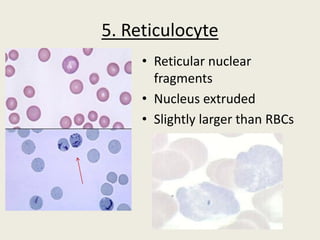
5. Reticulocyte
• Reticular nuclear
fragments
• Nucleus extruded
• Slightly larger than RBCs
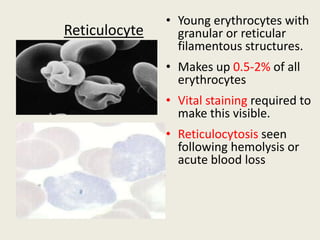
Reticulocyte
• Young erythrocytes with
granular or reticular
filamentous structures.
• Makes up 0.5-2% of all
erythrocytes
• Vital staining required to
make this visible.
• Reticulocytosis seen
following hemolysis or
acute blood loss
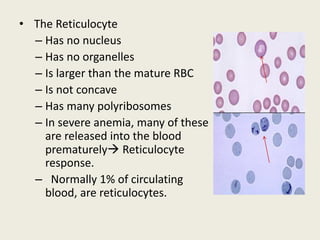
• The Reticulocyte
– Has no nucleus
– Has no organelles
– Is larger than the mature RBC
– Is not concave
– Has many polyribosomes
– In severe anemia, many of these
are released into the blood
prematurely→ Reticulocyte
response.
– Normally 1% of circulating
blood, are reticulocytes.
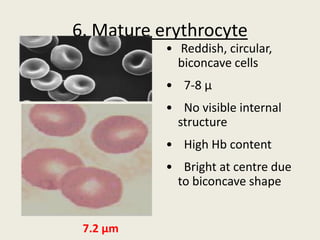
6. Mature erythrocyte
• Reddish, circular,
biconcave cells
• 7-8 µ
• No visible internal
structure
• High Hb content
• Bright at centre due
to biconcave shape
7.2 µm
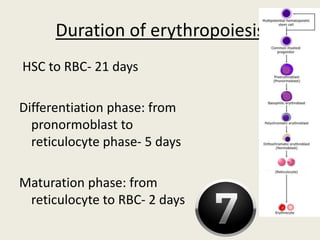
Duration of erythropoiesis
HSC to RBC- 21 days
Differentiation phase: from
pronormoblast to
reticulocyte phase- 5 days
Maturation phase: from
reticulocyte to RBC- 2 days
Changes during erythropoiesis
–Decrease in size
–Loss of mitotic activity (later part of
intermediate.normo)
–Hemoglobinization (intermediate
normoblast)
–Change of cell shape (from globular to
biconcave)
–Disappearance of nucleus, mitochondria,
RNA, etc
–Change of staining (basophilic –
eosinophilic)
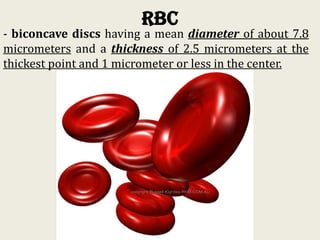
RBC
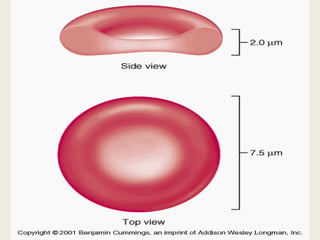
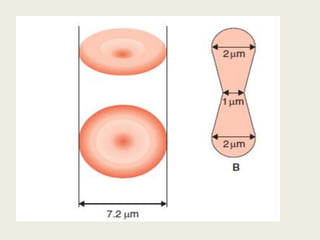
- biconcave discs having a mean diameter of about 7.8
micrometers and a thickness of 2.5 micrometers at the
thickest point and 1 micrometer or less in the center.
absence of nucleus in human RBC, the DNA is also
absent. Other organelles such as mitochondria and Golgi
apparatus also are absent in RBC. Because of absence
of mitochondria, the energy is produced from glycolytic
process. Red cell does not have insulin receptor and
so the glucose uptake by this cell is not controlled by
insulin. RBC has a special type of cytoskeleton, which is made
up of actin and spectrin. Both the proteins are anchored
to transmembrane proteins by means of another protein
called ankyrin. Absence of spectrin results in hereditary
spherocytosis. In this condition, the cell is deformed,
losses its biconcave shape and becomes globular
(spherocytic). The spherocyte is very fragile and easily
ruptured (hemolyzed) in hypotonic solutions.
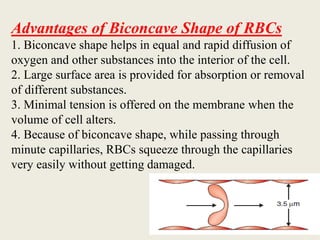
Advantages of Biconcave Shape of RBCs
1. Biconcave shape helps in equal and rapid diffusion of
oxygen and other substances into the interior of the cell.
2. Large surface area is provided for absorption or removal
of different substances.
3. Minimal tension is offered on the membrane when the
volume of cell alters.
4. Because of biconcave shape, while passing through
minute capillaries, RBCs squeeze through the capillaries
very easily without getting damaged.
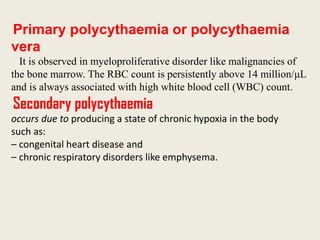
Primary polycythaemia or polycythaemia
vera
It is observed in myeloproliferative disorder like malignancies of
the bone marrow. The RBC count is persistently above 14 million/μL
and is always associated with high white blood cell (WBC) count.
Secondary polycythaemia
occurs due to producing a state of chronic hypoxia in the body
such as:
– congenital heart disease and
– chronic respiratory disorders like emphysema.
„LIFESPAN OF RED BLOOD CELLS
Average lifespan of RBC is about 120 days. After the lifetime the
senile (old) RBCs are destroyed in reticuloendothelial system.
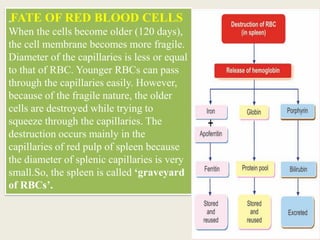
„FATE OF RED BLOOD CELLS
When the cells become older (120 days),
the cell membrane becomes more fragile.
Diameter of the capillaries is less or equal
to that of RBC. Younger RBCs can pass
through the capillaries easily. However,
because of the fragile nature, the older
cells are destroyed while trying to
squeeze through the capillaries. The
destruction occurs mainly in the
capillaries of red pulp of spleen because
the diameter of splenic capillaries is very
small.So, the spleen is called ‘graveyard
of RBCs’.
„VARIATIONS IN SIZE OF RED BLOOD CELLS
Under physiological conditions, the size of RBCs in
venous blood is slightly larger than those in arterial
blood. In pathological conditions, the variations in size
of RBCs are:
1. Microcytes (smaller cells)
2. Macrocytes (larger cells)
3. Anisocytes (cells with different sizes).
„MICROCYTES
Microcytes are present in:
i. Iron-deficiency anemia
ii. Prolonged forced breathing
iii. Increased osmotic pressure in blood.
„MACROCYTES
Macrocytes are present in:
i. Megaloblastic anemia
ii. Decreased osmotic pressure in blood.
„ANISOCYTES
Anisocytes occurs in pernicious anemia
„VARIATIONS IN SHAPE OF RED
BLOOD CELLS
Shape of RBCs is altered in many conditions including
different types of anemia.
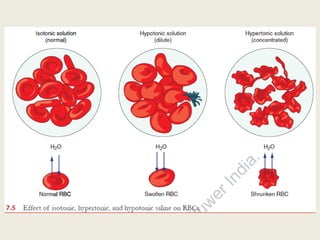
1. Crenation: Shrinkage as in hypertonic conditions.
2. Spherocytosis: Globular form as in hypotonic conditions.
3. Elliptocytosis: Elliptical shape as in certain types of anemia.
4. Sickle cell: Crescentic shape as in sickle cell anemia.
5. Poikilocytosis: Unusual shapes due to deformed cell membrane.
The shape will be of flask, hammer or any other unusual shape.
Regulation of erythropoiesis
❑ General factors
- Hypoxia → erythropoietin
- Growth inducers
- Vitamins
❑ Maturation factors
- Vitamin B 12
- Folic acid
❑ Factors necessary for hemoglobin production
- Vitamin C →Helps in iron absorption (Fe+++ → Fe++)
- Proteins → Amino Acids for globin synthesis
- Iron & copper → Heme synthesis
- calcium, bile salts, cobalt & nickel.
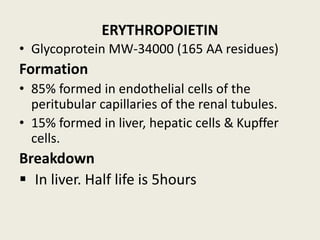
ERYTHROPOIETIN
• Glycoprotein MW-34000 (165 AA residues)
Formation
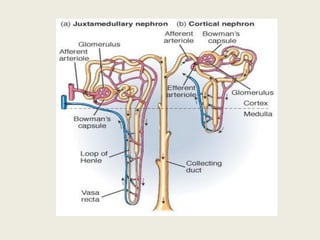
• 85% formed in endothelial cells of the
peritubular capillaries of the renal tubules.
• 15% formed in liver, hepatic cells & Kupffer
cells.
Breakdown
▪ In liver. Half life is 5hours
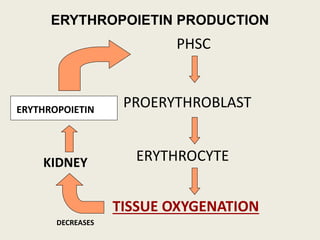
PHSC
PROERYTHROBLAST
ERYTHROCYTE
TISSUE OXYGENATION
ERYTHROPOIETIN
ERYTHROPOIETIN
DECREASES
KIDNEY
ERYTHROPOIETIN PRODUCTION
ERYTHROPOEITIN
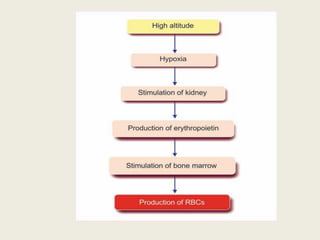
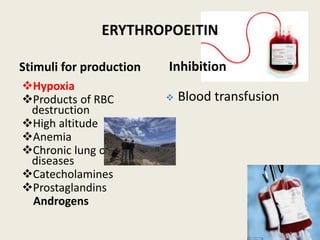
Stimuli for production
❖Hypoxia
❖Products of RBC
destruction
❖High altitude
❖Anemia
❖Chronic lung or heart
diseases
❖Catecholamines
❖Prostaglandins
Androgens
Inhibition
❖ Blood transfusion
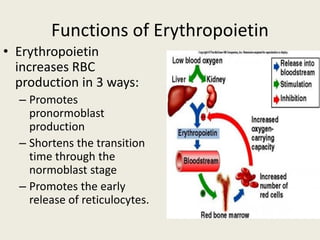
Functions of Erythropoietin
• Erythropoietin
increases RBC
production in 3 ways:
– Promotes
pronormoblast
production
– Shortens the transition
time through the
normoblast stage
– Promotes the early
release of reticulocytes.
Growth inducers/ Differentiation inducers
• Interleukin 1, 3, 6 (IL-3 is a growth inducer for
all cell lines )
• CSF- E (colony stimulating factor – erythro)
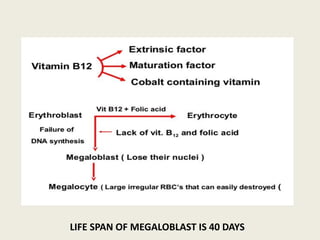
Vit B-12
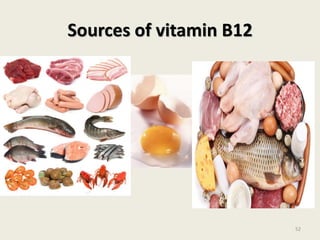
• Source : only animal tissues
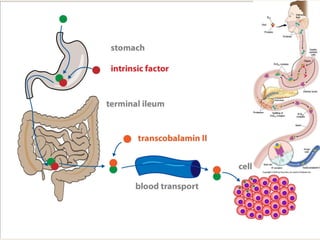
• Absorption from ileum
• Functions
• Promotes maturation of RBCs (plays an
important role in folic acid synthesis of nucleic
acid-DNA)
Sources of vitamin B12
52
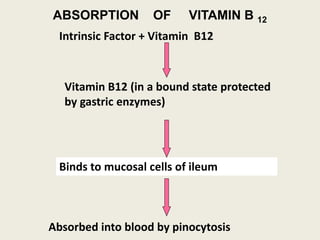
Intrinsic Factor + Vitamin B12
Vitamin B12 (in a bound state protected
by gastric enzymes)
Binds to mucosal cells of ileum
Absorbed into blood by pinocytosis
ABSORPTION OF VITAMIN B 12
Folic acid
• Green leafy vegetables , yeast, liver
• Function : maturation of RBC
LIFE SPAN OF MEGALOBLAST IS 40 DAYS
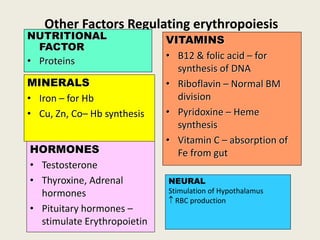
Other Factors Regulating erythropoiesis
NUTRITIONAL
FACTOR
• Proteins
VITAMINS
• B12 & folic acid – for
synthesis of DNA
• Riboflavin – Normal BM
division
• Pyridoxine – Heme
synthesis
• Vitamin C – absorption of
Fe from gut
MINERALS
• Iron – for Hb
• Cu, Zn, Co– Hb synthesis
HORMONES
• Testosterone
• Thyroxine, Adrenal
hormones
• Pituitary hormones –
stimulate Erythropoietin
NEURAL
Stimulation of Hypothalamus
 RBC production

erythropoieses

  • 1.
    Red blood cells(RBCs) are the non-nucleated formed elements in the blood. Red blood cells are also known as erythrocytes (erythros = red). Red color of the red blood cell is due to the presence of the coloring pigment called hemoglobin. RBCs play a vital role in transport of respiratory gases.
  • 2.
    Hemopoiesis • Hemo: Referringto blood cells • Poiesis: “The development or production of” • The word Hemopoiesis refers to the production & development of all the blood cells: – Erythrocytes: Erythropoiesis – Leucocytes: Leucopoiesis – Thrombocytes: Thrombopoiesis.
  • 3.
    It is theprocess of development, differentiation and maturation of RBCs from primitive stem cells DEFINITION
  • 4.
    1. Hemopoietic processand hemopoietic stem cells Hemopoietic process Stage one: Hemopoietic stem cells self renewal, steady numbers, active differentiation. Stage two: committed progenitors directional differentiation (CFU-E, CFU- GM, CFU-MK, ). [CFU: colony- forming unit} Stage three: precursors morphologic occurrence of various original blood cells.
  • 6.
    Site of Erythropoiesis •During intrauterine life Mesoblastic stage (3rd week to 3 months) Hepatic stage (after 3 months) Myeloid stage (3rd trimester) Intravascular erythropoiesis Extravascular erythropoiesis Nucleated RBCs Yolk sac Liver & spleen Bone marrow
  • 7.
    • In children -All bones with red bone marrow - Liver & spleen • In adults (after 20yrs) - Ends of long bones like femur, humerus - Skull - Vertbrae - Ribs - Sternum - pelvis
  • 9.
    PHSC Pluripotent Hemopoieticstem cell BFU-E (Burst Forming Unit Erythrocyte) CFU-E (Colony Forming Unit Erythrocyte) PROERYTHROBLAST EARLY NORMOBLAST INTERMEDIATE NORMOBLAST LATE NORMOBLAST RETICULOCYTE ERYTHROCYTE ERYTHROCYTE E R Y T H R O P O I E S I S GM CSF erythro IL-1,IL-6,IL-3 GM CSF erythro
  • 10.
    PHSC Pluripotent Hemopoieticstem cell BFU-E (Burst Forming Unit Erythrocyte) CFU-E (Colony Forming Unit Erythrocyte) PROERYTHROBLAST BASOPHILIC ERYTHROBLAST POLYCHROMATOPHILIC ERYTHROBLAST ORTHOCHROMATIC ERYTHROBLAST RETICULOCYTE ERYTHROCYTE ERYTHROCYTE E R Y T H R O P O I E S I S GM CSF erythro IL-1,IL-6,IL-3 GM CSF erythro
  • 11.
    1. STEM CELLS •These cells have extensive proliferative capacity and also the: – Ability to give rise to new stem cells (Self Renewal) – Ability to differentiate into any blood cells lines (Pluripotency) • Hematopoietic stem cells (HSCs) are bone marrow cells that are capable of producing all types of blood cells. • They differentiate into one or another type of committed stem cells (progenitor cells). • There are separate pools of progenitor cells for megakaryocytes, lymphocytes, erythrocytes, eosinophils, and basophils; neutrophils and monocytes arise from a common precursor
  • 12.
    PROGENITOR CELLS • Committedstem cells lose their capacity for self-renewal. • They become irreversibly committed. • These cells are termed as “Progenitor cells” • They are regulated by certain hormones or substances so that they can: – Proliferate – Undergo Maturation.
  • 13.
    ERYTHROID PROGENITOR CELLS •BFU-E: Burst Forming Unit – Erythrocyte: – Give rise each to thousands of nucleated erythroid precursor cells, in vitro. – Undergo some changes to become the Colony Forming Units-Erythrocyte (CFU-E) – Regulator: Burst Promoting Activity (BPA)
  • 14.
    Burst forming unitBFU(E) • Unipotent progenitor cell • Less sensitive to erythropoietin • Responds to other stimulus forms Colony forming unit CFU (e) • Highly sensitive and dependent on erythropoietin
  • 16.
    BFU-E CFU-E STAGES OFERYTHROPOIESIS
  • 17.
    ERYTHROPOIESIS 15-20µm- basophilic cytoplasm, nucleuswith nucleoli. 14-17µm-mitosis, basophilic cytoplasm, nucleoli disappears. 10-15µm- ’POLYCHROMASIA’ Hb appears, nucleus condenses. 7-10µm- PYKNOTIC Nucleus. Extrusion, Hb is maximum. 7.3µm- Reticulum of basophilic material in the cytoplasm. 7.2µm- Mature red cell with Hb.
  • 18.
    1. Proerythroblast •15-20 microns •Nucleuswith multiple nucleoli •Basophilic cytoplasm with perinuclear halo •No hemoglobin •Mitosis present
  • 19.
    2. Basophilic/ earlynormoblast • Slight reduction in size 14-17µm • Large nucleus, nucleoli reduce in number • Basophilic cytoplasm • Active mitosis
  • 20.
    3. Polychromatophilic/ intermediate normoblast •10-15µm size • ’POLYCHROMASIA’ • nucleus condenses Chromatin lumps • Hb starts appearing • Reduced mitoses
  • 21.
    4. Orthochromatic normoblast •7-10µm •Acidophilic erythroblast which is the last precursor with a nucleus. • Nucleus is compact & situated near the membrane pyknotic nucleus is extruded • Cytoplasm is like mature red cell, reflecting a high Hb content. •Mitosis absent
  • 22.
    5. Reticulocyte • Reticularnuclear fragments • Nucleus extruded • Slightly larger than RBCs
  • 23.
    Reticulocyte • Young erythrocyteswith granular or reticular filamentous structures. • Makes up 0.5-2% of all erythrocytes • Vital staining required to make this visible. • Reticulocytosis seen following hemolysis or acute blood loss
  • 24.
    • The Reticulocyte –Has no nucleus – Has no organelles – Is larger than the mature RBC – Is not concave – Has many polyribosomes – In severe anemia, many of these are released into the blood prematurely→ Reticulocyte response. – Normally 1% of circulating blood, are reticulocytes.
  • 25.
    6. Mature erythrocyte •Reddish, circular, biconcave cells • 7-8 µ • No visible internal structure • High Hb content • Bright at centre due to biconcave shape 7.2 µm
  • 27.
    Duration of erythropoiesis HSCto RBC- 21 days Differentiation phase: from pronormoblast to reticulocyte phase- 5 days Maturation phase: from reticulocyte to RBC- 2 days
  • 28.
    Changes during erythropoiesis –Decreasein size –Loss of mitotic activity (later part of intermediate.normo) –Hemoglobinization (intermediate normoblast) –Change of cell shape (from globular to biconcave) –Disappearance of nucleus, mitochondria, RNA, etc –Change of staining (basophilic – eosinophilic)
  • 29.
    RBC - biconcave discshaving a mean diameter of about 7.8 micrometers and a thickness of 2.5 micrometers at the thickest point and 1 micrometer or less in the center.
  • 31.
    absence of nucleusin human RBC, the DNA is also absent. Other organelles such as mitochondria and Golgi apparatus also are absent in RBC. Because of absence of mitochondria, the energy is produced from glycolytic process. Red cell does not have insulin receptor and so the glucose uptake by this cell is not controlled by insulin. RBC has a special type of cytoskeleton, which is made up of actin and spectrin. Both the proteins are anchored to transmembrane proteins by means of another protein called ankyrin. Absence of spectrin results in hereditary spherocytosis. In this condition, the cell is deformed, losses its biconcave shape and becomes globular (spherocytic). The spherocyte is very fragile and easily ruptured (hemolyzed) in hypotonic solutions.
  • 32.
    Advantages of BiconcaveShape of RBCs 1. Biconcave shape helps in equal and rapid diffusion of oxygen and other substances into the interior of the cell. 2. Large surface area is provided for absorption or removal of different substances. 3. Minimal tension is offered on the membrane when the volume of cell alters. 4. Because of biconcave shape, while passing through minute capillaries, RBCs squeeze through the capillaries very easily without getting damaged.
  • 35.
    Primary polycythaemia orpolycythaemia vera It is observed in myeloproliferative disorder like malignancies of the bone marrow. The RBC count is persistently above 14 million/μL and is always associated with high white blood cell (WBC) count. Secondary polycythaemia occurs due to producing a state of chronic hypoxia in the body such as: – congenital heart disease and – chronic respiratory disorders like emphysema.
  • 36.
    „LIFESPAN OF REDBLOOD CELLS Average lifespan of RBC is about 120 days. After the lifetime the senile (old) RBCs are destroyed in reticuloendothelial system.
  • 37.
    „FATE OF REDBLOOD CELLS When the cells become older (120 days), the cell membrane becomes more fragile. Diameter of the capillaries is less or equal to that of RBC. Younger RBCs can pass through the capillaries easily. However, because of the fragile nature, the older cells are destroyed while trying to squeeze through the capillaries. The destruction occurs mainly in the capillaries of red pulp of spleen because the diameter of splenic capillaries is very small.So, the spleen is called ‘graveyard of RBCs’.
  • 40.
    „VARIATIONS IN SIZEOF RED BLOOD CELLS Under physiological conditions, the size of RBCs in venous blood is slightly larger than those in arterial blood. In pathological conditions, the variations in size of RBCs are: 1. Microcytes (smaller cells) 2. Macrocytes (larger cells) 3. Anisocytes (cells with different sizes).
  • 41.
    „MICROCYTES Microcytes are presentin: i. Iron-deficiency anemia ii. Prolonged forced breathing iii. Increased osmotic pressure in blood. „MACROCYTES Macrocytes are present in: i. Megaloblastic anemia ii. Decreased osmotic pressure in blood. „ANISOCYTES Anisocytes occurs in pernicious anemia
  • 42.
    „VARIATIONS IN SHAPEOF RED BLOOD CELLS Shape of RBCs is altered in many conditions including different types of anemia. 1. Crenation: Shrinkage as in hypertonic conditions. 2. Spherocytosis: Globular form as in hypotonic conditions. 3. Elliptocytosis: Elliptical shape as in certain types of anemia. 4. Sickle cell: Crescentic shape as in sickle cell anemia. 5. Poikilocytosis: Unusual shapes due to deformed cell membrane. The shape will be of flask, hammer or any other unusual shape.
  • 44.
    Regulation of erythropoiesis ❑General factors - Hypoxia → erythropoietin - Growth inducers - Vitamins ❑ Maturation factors - Vitamin B 12 - Folic acid ❑ Factors necessary for hemoglobin production - Vitamin C →Helps in iron absorption (Fe+++ → Fe++) - Proteins → Amino Acids for globin synthesis - Iron & copper → Heme synthesis - calcium, bile salts, cobalt & nickel.
  • 45.
    ERYTHROPOIETIN • Glycoprotein MW-34000(165 AA residues) Formation • 85% formed in endothelial cells of the peritubular capillaries of the renal tubules. • 15% formed in liver, hepatic cells & Kupffer cells. Breakdown ▪ In liver. Half life is 5hours
  • 46.
  • 48.
    ERYTHROPOEITIN Stimuli for production ❖Hypoxia ❖Productsof RBC destruction ❖High altitude ❖Anemia ❖Chronic lung or heart diseases ❖Catecholamines ❖Prostaglandins Androgens Inhibition ❖ Blood transfusion
  • 49.
    Functions of Erythropoietin •Erythropoietin increases RBC production in 3 ways: – Promotes pronormoblast production – Shortens the transition time through the normoblast stage – Promotes the early release of reticulocytes.
  • 50.
    Growth inducers/ Differentiationinducers • Interleukin 1, 3, 6 (IL-3 is a growth inducer for all cell lines ) • CSF- E (colony stimulating factor – erythro)
  • 51.
    Vit B-12 • Source: only animal tissues • Absorption from ileum • Functions • Promotes maturation of RBCs (plays an important role in folic acid synthesis of nucleic acid-DNA)
  • 52.
  • 53.
    Intrinsic Factor +Vitamin B12 Vitamin B12 (in a bound state protected by gastric enzymes) Binds to mucosal cells of ileum Absorbed into blood by pinocytosis ABSORPTION OF VITAMIN B 12
  • 55.
    Folic acid • Greenleafy vegetables , yeast, liver • Function : maturation of RBC
  • 56.
    LIFE SPAN OFMEGALOBLAST IS 40 DAYS
  • 57.
    Other Factors Regulatingerythropoiesis NUTRITIONAL FACTOR • Proteins VITAMINS • B12 & folic acid – for synthesis of DNA • Riboflavin – Normal BM division • Pyridoxine – Heme synthesis • Vitamin C – absorption of Fe from gut MINERALS • Iron – for Hb • Cu, Zn, Co– Hb synthesis HORMONES • Testosterone • Thyroxine, Adrenal hormones • Pituitary hormones – stimulate Erythropoietin NEURAL Stimulation of Hypothalamus  RBC production