In Nursing
INTRODUCTIONINTRODUCTION
Distance education is an alternative
Mode for receiving the highest,
Professional and technical education which
distinguishes from conventional campus based
mode of Learning.
Distance education is a formal educational
process in which the majority of the
instruction occurs when student and
instructor are not in the same place.
Distance EducationDistance Education, , 
Distance LearningDistance Learning or or 
D-LearningD-Learning
Is a mode of delivering education
and instruction, often on an individual
basis, to students who are not
physically present in a traditional setting
such as a classroom. Distance learning
provides "access to learning when the
source of information and the learners
are separated by time and distance, or
both.
ContdContd……
Distance learning aims to provide
effective learning for specific and
desired knowledge in a flexible
manner.
The learner, whether an individual or a group, is
separated, by place and/or time, from the
originator of the teaching material. Interaction
between individuals and with the teaching
material is by the use of various media and
communication technologies.
Nursing Distance EducationNursing Distance Education
• Distance Education (DE), also known as distributed
learning, uses a wide range of computing and
communications technologies to provide learning
opportunities beyond the time and place constraints of
traditional classroom. (The CSU Center for Distributed Learning, 2004).
• DE, by its nature, draws in students who wouldn’t otherwise
be able to pursue course work because of lack of access to a
campus or because work, family, or economic considerations
preclude full time, on-site education. (AACN, 2000).
• Online DE also meets the needs of students who prefer more
independence in their learning. (Leasure, Davis, & Thievon, 2000)
ISSAC PITMANISSAC PITMAN
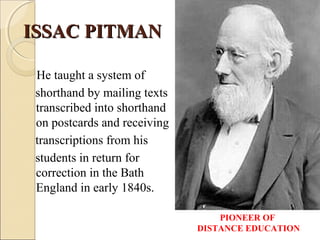
He taught a system of
shorthand by mailing texts
transcribed into shorthand
on postcards and receiving
transcriptions from his
students in return for
correction in the Bath
England in early 1840s.
PIONEER OF
DISTANCE EDUCATION
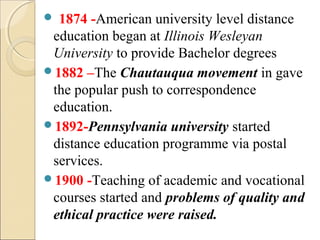
 1874 -American university level distance
education began at Illinois Wesleyan
University to provide Bachelor degrees
1882 –The Chautauqua movement in gave
the popular push to correspondence
education.
1892-Pennsylvania university started
distance education programme via postal
services.
1900 -Teaching of academic and vocational
courses started and problems of quality and
ethical practice were raised.
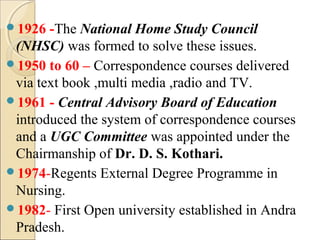
1926 -The National Home Study Council
(NHSC) was formed to solve these issues.
1950 to 60 – Correspondence courses delivered
via text book ,multi media ,radio and TV.
1961 - Central Advisory Board of Education
introduced the system of correspondence courses
and a UGC Committee was appointed under the
Chairmanship of Dr. D. S. Kothari.
1974-Regents External Degree Programme in
Nursing.
1982- First Open university established in Andra
Pradesh.
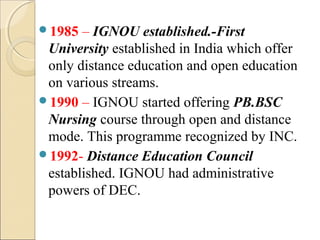
1985 – IGNOU established.-First
University established in India which offer
only distance education and open education
on various streams.
1990 – IGNOU started offering PB.BSC
Nursing course through open and distance
mode. This programme recognized by INC.
1992- Distance Education Council
established. IGNOU had administrative
powers of DEC.
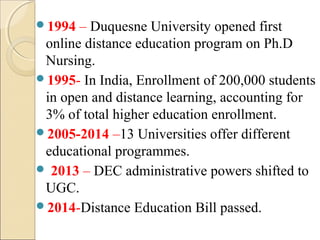
1994 – Duquesne University opened first
online distance education program on Ph.D
Nursing.
1995- In India, Enrollment of 200,000 students
in open and distance learning, accounting for
3% of total higher education enrollment.
2005-2014 –13 Universities offer different
educational programmes.
 2013 – DEC administrative powers shifted to
UGC.
2014-Distance Education Bill passed.
PRINCIPLESPRINCIPLES
VIDEO
Interaction andInteraction and
Technology inTechnology in
Distance EducationDistance Education
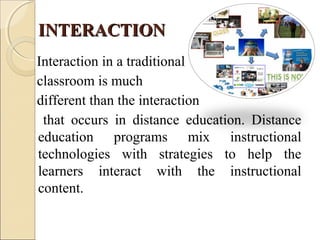
INTERACTIONINTERACTION
Interaction in a traditional
classroom is much
different than the interaction
that occurs in distance education. Distance
education programs mix instructional
technologies with strategies to help the
learners interact with the instructional
content.
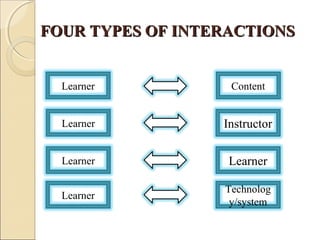
FOUR TYPES OF INTERACTIONSFOUR TYPES OF INTERACTIONS
Learner Content
Learner
Learner
Learner
Instructor
Learner
Technolog
y/system
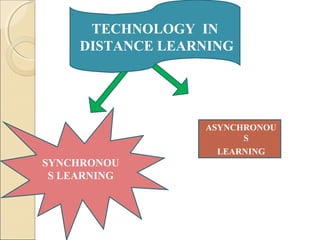
SYNCHRONOU
S LEARNING
ASYNCHRONOU
S
LEARNING
TECHNOLOGY IN
DISTANCE LEARNING
SYNCHRONOUSSYNCHRONOUS
LEARNINGLEARNING
In synchronous learning, all participants are "present" at the same
time. In this regard, it resembles traditional classroom teaching
methods despite the participants being located remotely. It requires
a timetable to be organized.
Web conferencing, videoconferencing, educational television,
instructional television are examples of synchronous technology, as
are direct-broadcast satellite (DBS), internet radio, live
streaming, telephone, and VoIP. Online meeting software such as
Adobe Connect has helped to facilitate meetings in distance learning
courses.
I
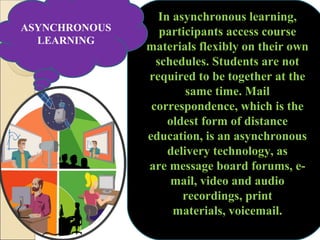
In asynchronous learning,
participants access course
materials flexibly on their own
schedules. Students are not
required to be together at the
same time. Mail
correspondence, which is the
oldest form of distance
education, is an asynchronous
delivery technology, as
are message board forums, e-
mail, video and audio
recordings, print
materials, voicemail.
ASYNCHRONOUS
LEARNING
CHARACTERISTICSCHARACTERISTICS
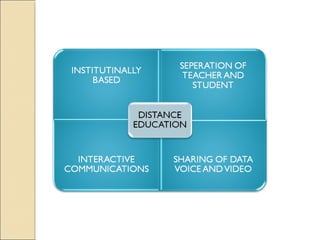
• The quasi-permanent separation of teacher and
learner throughout the length of the learning
process : this distinguishes it from conventional
face-to-face education.
• The influence of an educational organisation both
in planning and preparation of learning materials
and in the provision of student support services;
this distinguishes it from private study and teach
yourself programmes.
The use of technical media; print, audio, video or
computer, to unite teachers and learners and carry
the content of the course.
The provision of two-way communication so that
the student may benefit from or even initiate a
dialogue; this distinguishes it from other uses of
technology in education.
 The quasi-permanent absence of a learning group
throughout the length of the learning process so
that people are usually taught as individuals and
not in groups, with the possibility of occasional
meetings for both didactic and socialisation
purposes.
Each student is separated from his/her peer group
in the sense that although the learners form a fairly
sizable population they do not have face-to-face
interaction among themselves. Thus distance
education becomes a highly individualised
learning system. In this sense, it remains one of the
most individualised of all educational systems.
Education in real life setting
 Student centered
Indirect education
Flexible approach
Independence to adult learner/Learners autonomy.
Higher
Learning
Provision
For
Research
FlexibilityOppor
tunity
Advance
ment
And
Dissemin
ation
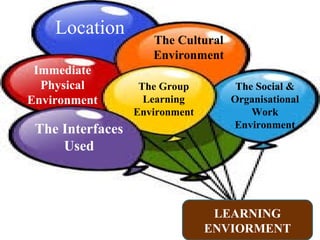
Location
Immediate
Physical
Environment
The Interfaces
Used
The Social &
Organisational
Work
Environment
The Group
Learning
Environment
The Cultural
Environment
LEARNING
ENVIORMENT
TYPES OF METHODS USED INTYPES OF METHODS USED IN
DISTANCE LEARNINGDISTANCE LEARNING
FLIP BOOK
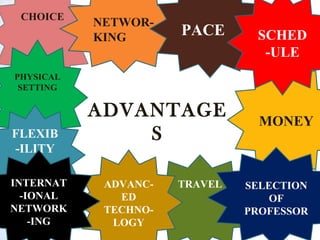
CHOICE
NETWOR-
KING PACE
PHYSICAL
SETTING
MONEY
FLEXIB
-ILITY
TRAVELADVANC-
ED
TECHNO-
LOGY
SELECTION
OF
PROFESSOR
INTERNAT
-IONAL
NETWORK
-ING
SCHED
-ULE
ADVANTAGE
S
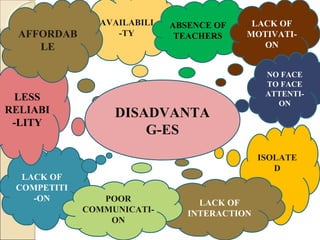
LACK OF
COMPETITI
-ON
LESS
RELIABI
-LITY
ISOLATE
D
LACK OF
INTERACTION
AVAILABILI
-TY
POOR
COMMUNICATI-
ON
AFFORDAB
LE
ABSENCE OF
TEACHERS
LACK OF
MOTIVATI-
ON
NO FACE
TO FACE
ATTENTI-
ON
DISADVANTA
G-ES
ReferencesReferences
 Chitty K. & Black B. (2007). Professional Nursing: Concepts &
challenges, 5th edition, Saunders, USA.
 Cherry, B. & Jacob, S. (2008). Contemporary nursing. (4th ed.).
St Louis: Mosby Elsevier.
 O'Neil, C. Fisher, C. & Newbold, S. (2009). Developing Online
Learning Environments in Nursing Education. (2nd ed.). Springer
Publishing Company, LLC. New York.
 Reiners, G. ( 2005 ). Nursing Distance Education. A Paper
Presented in Partial Fulfillment Of the Requirements of
Administration and Leadership of Distance Education Programs.
Capella University.
THANK
YOU

Distance education

  • 2.
  • 3.
    INTRODUCTIONINTRODUCTION Distance education isan alternative Mode for receiving the highest, Professional and technical education which distinguishes from conventional campus based mode of Learning. Distance education is a formal educational process in which the majority of the instruction occurs when student and instructor are not in the same place.
  • 4.
    Distance EducationDistance Education, ,  DistanceLearningDistance Learning or or  D-LearningD-Learning Is a mode of delivering education and instruction, often on an individual basis, to students who are not physically present in a traditional setting such as a classroom. Distance learning provides "access to learning when the source of information and the learners are separated by time and distance, or both.
  • 5.
    ContdContd…… Distance learning aimsto provide effective learning for specific and desired knowledge in a flexible manner. The learner, whether an individual or a group, is separated, by place and/or time, from the originator of the teaching material. Interaction between individuals and with the teaching material is by the use of various media and communication technologies.
  • 7.
    Nursing Distance EducationNursingDistance Education • Distance Education (DE), also known as distributed learning, uses a wide range of computing and communications technologies to provide learning opportunities beyond the time and place constraints of traditional classroom. (The CSU Center for Distributed Learning, 2004). • DE, by its nature, draws in students who wouldn’t otherwise be able to pursue course work because of lack of access to a campus or because work, family, or economic considerations preclude full time, on-site education. (AACN, 2000). • Online DE also meets the needs of students who prefer more independence in their learning. (Leasure, Davis, & Thievon, 2000)
  • 9.
    ISSAC PITMANISSAC PITMAN Hetaught a system of shorthand by mailing texts transcribed into shorthand on postcards and receiving transcriptions from his students in return for correction in the Bath England in early 1840s. PIONEER OF DISTANCE EDUCATION
  • 10.
     1874 -Americanuniversity level distance education began at Illinois Wesleyan University to provide Bachelor degrees 1882 –The Chautauqua movement in gave the popular push to correspondence education. 1892-Pennsylvania university started distance education programme via postal services. 1900 -Teaching of academic and vocational courses started and problems of quality and ethical practice were raised.
  • 11.
    1926 -The NationalHome Study Council (NHSC) was formed to solve these issues. 1950 to 60 – Correspondence courses delivered via text book ,multi media ,radio and TV. 1961 - Central Advisory Board of Education introduced the system of correspondence courses and a UGC Committee was appointed under the Chairmanship of Dr. D. S. Kothari. 1974-Regents External Degree Programme in Nursing. 1982- First Open university established in Andra Pradesh.
  • 12.
    1985 – IGNOUestablished.-First University established in India which offer only distance education and open education on various streams. 1990 – IGNOU started offering PB.BSC Nursing course through open and distance mode. This programme recognized by INC. 1992- Distance Education Council established. IGNOU had administrative powers of DEC.
  • 13.
    1994 – DuquesneUniversity opened first online distance education program on Ph.D Nursing. 1995- In India, Enrollment of 200,000 students in open and distance learning, accounting for 3% of total higher education enrollment. 2005-2014 –13 Universities offer different educational programmes.  2013 – DEC administrative powers shifted to UGC. 2014-Distance Education Bill passed.
  • 14.
  • 15.
    Interaction andInteraction and TechnologyinTechnology in Distance EducationDistance Education
  • 16.
    INTERACTIONINTERACTION Interaction in atraditional classroom is much different than the interaction that occurs in distance education. Distance education programs mix instructional technologies with strategies to help the learners interact with the instructional content.
  • 17.
    FOUR TYPES OFINTERACTIONSFOUR TYPES OF INTERACTIONS Learner Content Learner Learner Learner Instructor Learner Technolog y/system
  • 19.
  • 20.
    SYNCHRONOUSSYNCHRONOUS LEARNINGLEARNING In synchronous learning,all participants are "present" at the same time. In this regard, it resembles traditional classroom teaching methods despite the participants being located remotely. It requires a timetable to be organized. Web conferencing, videoconferencing, educational television, instructional television are examples of synchronous technology, as are direct-broadcast satellite (DBS), internet radio, live streaming, telephone, and VoIP. Online meeting software such as Adobe Connect has helped to facilitate meetings in distance learning courses. I
  • 21.
    In asynchronous learning, participantsaccess course materials flexibly on their own schedules. Students are not required to be together at the same time. Mail correspondence, which is the oldest form of distance education, is an asynchronous delivery technology, as are message board forums, e- mail, video and audio recordings, print materials, voicemail. ASYNCHRONOUS LEARNING
  • 22.
    CHARACTERISTICSCHARACTERISTICS • The quasi-permanentseparation of teacher and learner throughout the length of the learning process : this distinguishes it from conventional face-to-face education. • The influence of an educational organisation both in planning and preparation of learning materials and in the provision of student support services; this distinguishes it from private study and teach yourself programmes.
  • 23.
    The use oftechnical media; print, audio, video or computer, to unite teachers and learners and carry the content of the course. The provision of two-way communication so that the student may benefit from or even initiate a dialogue; this distinguishes it from other uses of technology in education.  The quasi-permanent absence of a learning group throughout the length of the learning process so that people are usually taught as individuals and not in groups, with the possibility of occasional meetings for both didactic and socialisation purposes.
  • 24.
    Each student isseparated from his/her peer group in the sense that although the learners form a fairly sizable population they do not have face-to-face interaction among themselves. Thus distance education becomes a highly individualised learning system. In this sense, it remains one of the most individualised of all educational systems. Education in real life setting  Student centered Indirect education Flexible approach Independence to adult learner/Learners autonomy.
  • 25.
  • 26.
    Location Immediate Physical Environment The Interfaces Used The Social& Organisational Work Environment The Group Learning Environment The Cultural Environment LEARNING ENVIORMENT
  • 27.
    TYPES OF METHODSUSED INTYPES OF METHODS USED IN DISTANCE LEARNINGDISTANCE LEARNING FLIP BOOK
  • 28.
  • 29.
  • 30.
    ReferencesReferences  Chitty K.& Black B. (2007). Professional Nursing: Concepts & challenges, 5th edition, Saunders, USA.  Cherry, B. & Jacob, S. (2008). Contemporary nursing. (4th ed.). St Louis: Mosby Elsevier.  O'Neil, C. Fisher, C. & Newbold, S. (2009). Developing Online Learning Environments in Nursing Education. (2nd ed.). Springer Publishing Company, LLC. New York.  Reiners, G. ( 2005 ). Nursing Distance Education. A Paper Presented in Partial Fulfillment Of the Requirements of Administration and Leadership of Distance Education Programs. Capella University.
  • 31.