Contact Process
Manufacture of Sulphuric
Acid
Sulphuric acid is made by the Contact
process. The anhydride of sulphuric
acid is sulphur(VI) oxide, SO3. It is
made by the oxidation of sulphur(IV)
oxide (sulphur dioxide), which is
obtained from the following sources.
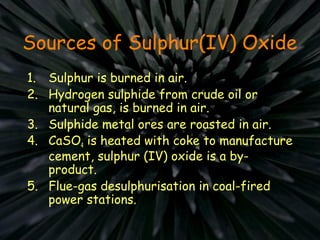
Sources of Sulphur(IV) Oxide
1. Sulphur is burned in air.
2. Hydrogen sulphide from crude oil or
natural gas, is burned in air.
3. Sulphide metal ores are roasted in air.
4. CaSO4 is heated with coke to manufacture
cement, sulphur (IV) oxide is a by-
product.
5. Flue-gas desulphurisation in coal-fired
power stations.
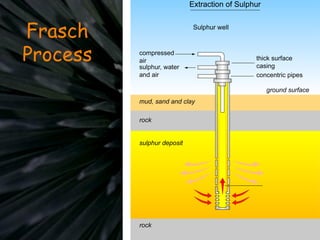
Frasch
Process
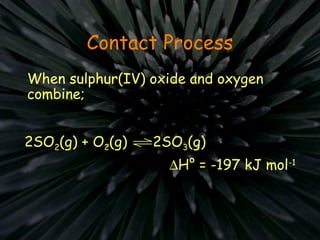
Contact Process
When sulphur(IV) oxide and oxygen
combine;
2SO2(g) + O2(g) 2SO3(g)
∆H° = -197 kJ mol-1
Reaction Conditions
Le Chatelier’s Principle would favour a
low temperature and a high pressure.
However, at high pressures the
sulphur(IV) oxide liquifies and at low
temperatures the rate of reaction is
too slow.
Addition of Catalyst
The vanadium(V) oxide is so effective
that a 95 % conversion is achieved at
450 °C and 2 atm.
Addition of Catalyst
The catalyst is easily ‘poisoned’ by
absorbing impurities. These block the
active sites on the surface of the
catalyst and impair its efficiency.
A constant temperature of 450 °C is
maintained by using heat exchangers to
heat the incoming gases.
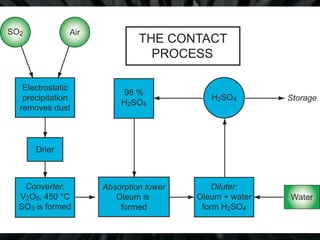
Conversion to Sulphuric Acid
The sulphur(VI) oxide is not absorbed in
water because the reaction is so intensely
exothermic as to vaporise the sulphuric acid
formed.
It can be safely absorbed in 98 % sulphuric
acid to form fuming sulphuric acid, oleum,
H2S2O7, which is then reacted with water to
form the sulphuric acid.
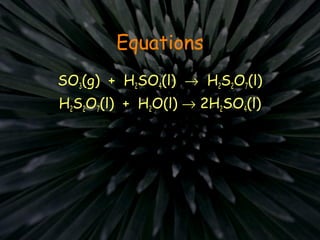
Equations
SO3(g) + H2SO4(l) → H2S2O7(l)
H2S2O7(l) + H2O(l) → 2H2SO4(l)
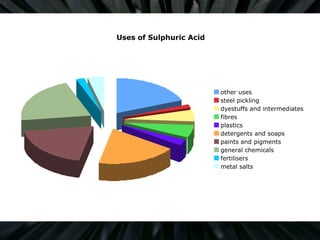
Uses of Sulphuric Acid
other uses
steel pickling
dyestuffs and intermediates
fibres
plastics
detergents and soaps
paints and pigments
general chemicals
fertilisers
metal salts
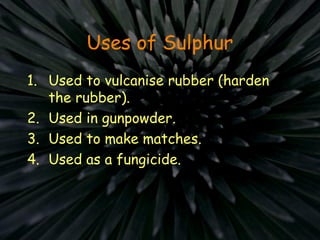
Uses of Sulphur
1. Used to vulcanise rubber (harden
the rubber).
2. Used in gunpowder.
3. Used to make matches.
4. Used as a fungicide.
Uses of Sulphur(IV) oxide
(Sulphur dioxide)
1. The manufacture of sulphuric acid.
2. Used to makes sulphites SO3
2-
, which
are used to break down wood pulp
and to bleach the wood pulp.
3. Used as a food preservative.
4. Used to bleach straw, silk and wool.
5. Used as a fungicide.

Contact Process

  • 1.
  • 2.
    Manufacture of Sulphuric Acid Sulphuricacid is made by the Contact process. The anhydride of sulphuric acid is sulphur(VI) oxide, SO3. It is made by the oxidation of sulphur(IV) oxide (sulphur dioxide), which is obtained from the following sources.
  • 3.
    Sources of Sulphur(IV)Oxide 1. Sulphur is burned in air. 2. Hydrogen sulphide from crude oil or natural gas, is burned in air. 3. Sulphide metal ores are roasted in air. 4. CaSO4 is heated with coke to manufacture cement, sulphur (IV) oxide is a by- product. 5. Flue-gas desulphurisation in coal-fired power stations.
  • 4.
  • 5.
    Contact Process When sulphur(IV)oxide and oxygen combine; 2SO2(g) + O2(g) 2SO3(g) ∆H° = -197 kJ mol-1
  • 6.
    Reaction Conditions Le Chatelier’sPrinciple would favour a low temperature and a high pressure. However, at high pressures the sulphur(IV) oxide liquifies and at low temperatures the rate of reaction is too slow.
  • 7.
    Addition of Catalyst Thevanadium(V) oxide is so effective that a 95 % conversion is achieved at 450 °C and 2 atm.
  • 8.
    Addition of Catalyst Thecatalyst is easily ‘poisoned’ by absorbing impurities. These block the active sites on the surface of the catalyst and impair its efficiency. A constant temperature of 450 °C is maintained by using heat exchangers to heat the incoming gases.
  • 9.
    Conversion to SulphuricAcid The sulphur(VI) oxide is not absorbed in water because the reaction is so intensely exothermic as to vaporise the sulphuric acid formed. It can be safely absorbed in 98 % sulphuric acid to form fuming sulphuric acid, oleum, H2S2O7, which is then reacted with water to form the sulphuric acid.
  • 10.
    Equations SO3(g) + H2SO4(l)→ H2S2O7(l) H2S2O7(l) + H2O(l) → 2H2SO4(l)
  • 12.
    Uses of SulphuricAcid other uses steel pickling dyestuffs and intermediates fibres plastics detergents and soaps paints and pigments general chemicals fertilisers metal salts
  • 13.
    Uses of Sulphur 1.Used to vulcanise rubber (harden the rubber). 2. Used in gunpowder. 3. Used to make matches. 4. Used as a fungicide.
  • 14.
    Uses of Sulphur(IV)oxide (Sulphur dioxide) 1. The manufacture of sulphuric acid. 2. Used to makes sulphites SO3 2- , which are used to break down wood pulp and to bleach the wood pulp. 3. Used as a food preservative. 4. Used to bleach straw, silk and wool. 5. Used as a fungicide.